An aching lower back after a 30-minute commute isn’t a sign of age — it’s a sign your car seat is working against your spine. Factory seats are sculpted for a generic torso, not your specific curve, and that mismatch drives the tailbone, hips, and lumbar region into a pressure trap that worsens over every mile.
I’m Amir — the founder and writer behind Four Wheel Ask. I’ve spent years analyzing how ergonomic contours, foam density, adjustable tension systems, and anti-slip bases translate into measurable relief for daily drivers, long-haul truckers, and rideshare operators.
This guide breaks down seven distinct solutions designed to fit your seat, your build, and your driving habits so you can pick the back support for car that actually keeps your spine neutral mile after mile.
How To Choose The Best Back Support For Car
Not every cushion or lumbar pillow will fix your pain. You need to match the support type to your body dimensions, your seat shape, and the duration of your drives. Here are the three factors that separate a useful support from an expensive dust collector.
Support Type: Lumbar Pillow vs. Full Seat Cushion
A lumbar-only pillow works best if your primary complaint is a hollow gap between your lower back and the seatback. It pushes the spine into a neutral curve. A full seat cushion addresses tailbone and sit-bone pressure by adding height, redistributing weight, and often including a coccyx cutout. Drivers with both lower back ache and numb legs should look for a two-piece set that combines a seat pad with a lumbar wedge.
Foam Density and Break-In Period
High-density memory foam holds its shape for thousands of hours but feels stiff for the first week or two. That firmness is actually a quality marker — it means the foam won’t bottom out after six months. Low-density foam feels soft immediately but flattens quickly, leaving you with no support and the same pain. If your car sits in cold weather, denser foam can harden; plan to bring the cushion indoors on freezing nights.
Adjustability and Fit Retention
Straps keep a lumbar pillow locked to the seatback at the correct height, while rubber-studded bottoms prevent a seat cushion from sliding forward during braking. Adjustable tension straps let you dial in how much the pillow pushes into your lower back. A support that shifts during hard turns is worse than no support, because it creates an unpredictable pressure point.
Quick Comparison
On smaller screens, swipe sideways to see the full table.
| Model | Category | Best For | Key Spec | Amazon |
|---|---|---|---|---|
| Elmara Car Seat Cushion Set | 2-Piece Set | Full lower body relief | Doctor-led NeuroFoam + gel infusion | Amazon |
| ObusForme Highback Backrest Support | High-Back Design | Tall torso & upper back support | 31″ tall with polycarbonate frame | Amazon |
| Lifted Lumbar Adjustable Support | Adjustable Tension | 14-hour seated endurance | Adjustable height & strap tension | Amazon |
| SitCushion X-Large Seat Cushion | Coccyx Cutout | Tailbone & sciatica relief | 20″ x 18″ with 3″ thickness | Amazon |
| ComfiLife Gel & Memory Foam Cushion | U-Shaped Gel Top | Versatile chair use | Cooling gel layer + non-slip base | Amazon |
| ComfiLife Lumbar Support Pillow | Lumbar Pillow | Targeted lower back curve | 3-strap adjustable design | Amazon |
| Lofty Aim Car Seat Cushion | Booster Seat | Short driver visibility | Adds 2.5″ of seated height | Amazon |
In‑Depth Reviews
1. Elmara Car Seat Cushion Set
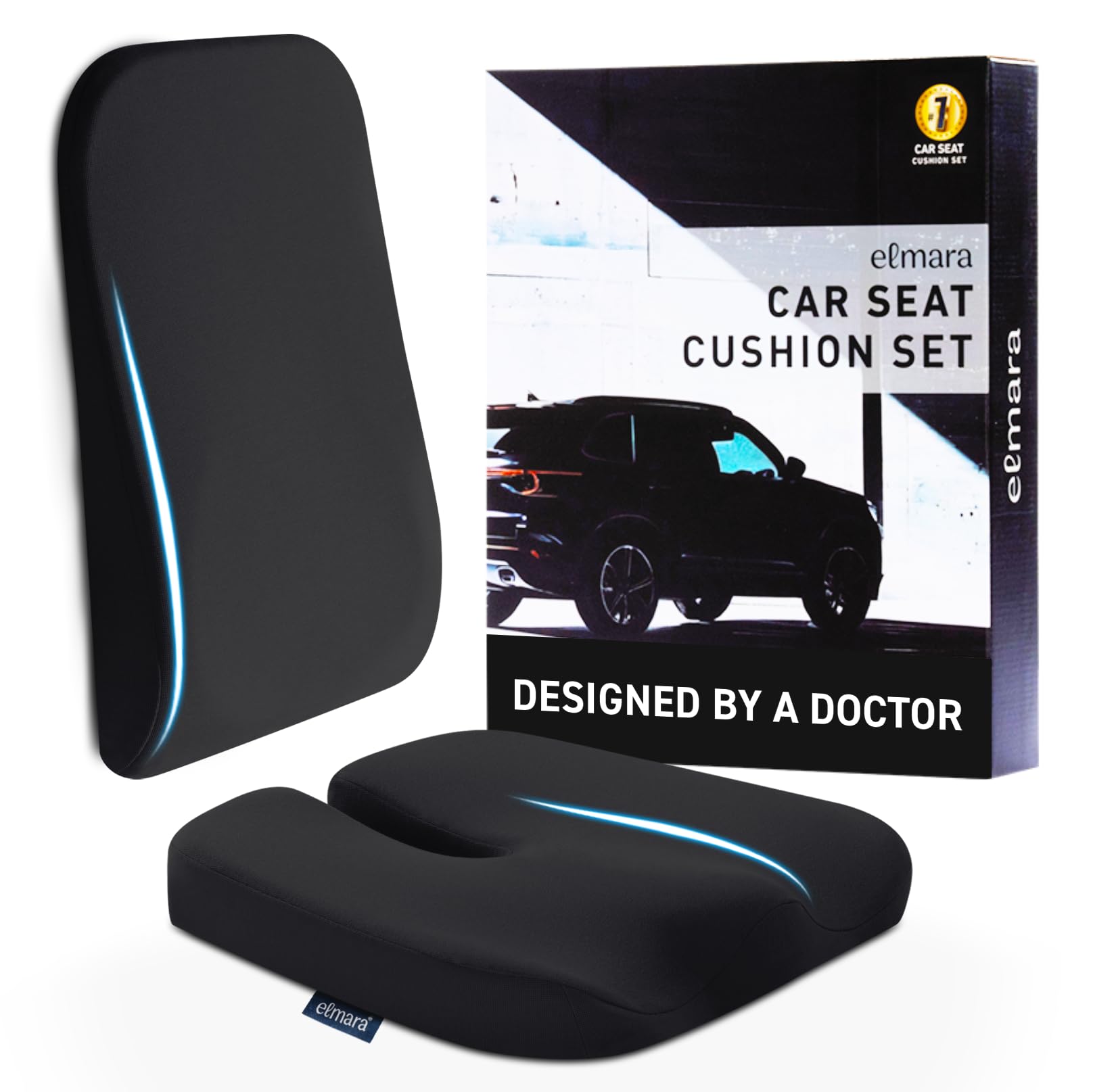
The Elmara set stands apart because it delivers a seat cushion and a lumbar pillow engineered together under the guidance of Dr. Michael Anderson. The seat pad uses NeuroFoam, a gel-infused memory foam that contours to the sit bones without the sticky heat buildup of standard foam. The lumbar wedge attaches with adjustable straps and stays fixed at the precise height you set, so both cushions work together to support the tailbone, hips, and lower back simultaneously.
Each cushion is 2.11 kilograms of dense foam, which means you won’t feel the seat’s hard pan even on a five-hour highway stretch. The rubber-studded bottom on the seat pad prevents slipping, and the lumbar pillow’s straps are long enough to fit around thick SUV seatbacks. Owners report that the set eliminates the need to shift positions constantly during long drives.
For drivers suffering from both tailbone pain and a hollow lower back, this is the most complete solution in the lineup. The two-year warranty provides peace of mind that the foam won’t degrade rapidly. The only real consideration is that the extra thickness may reduce foot reach for very short drivers.
What works
- Full coverage from tailbone to mid-back in one purchase
- Gel-infused foam stays cool and contours precisely
- Doctor-developed design with a two-year guarantee
What doesn’t
- Set price is higher than single-unit competitors
- May elevate shorter drivers too much for optimal pedal reach
2. ObusForme Highback Backrest Support

The ObusForme is the only product here that extends support all the way up to the mid-back and shoulder blades. Its 31-inch tall shell is wrapped in polyurethane foam over a polycarbonate core, and it uses a removable adjustable lumbar insert to fill the gap at the base of the spine. The manufacturer claims a 35 percent reduction in back pressure, which aligns with the firmness provided by the dense foam and rigid frame.
A built-in carry handle makes it easy to move between a desk chair and a car seat, and the strap system is thick enough to stay anchored on seats with bulky side bolsters. Drivers over six feet appreciate that the backrest reaches high enough to support the thoracic spine, not just the lumbar curve. The foam holds its shape well and shows little compression after months of daily use.
The downside is that the rigid shell adds bulk, making the unit feel less like a slim pillow and more like a dedicated bucket seat insert. It also does not include a seat cushion, so you will still need a separate pad for tailbone pressure relief. For drivers whose pain radiates up the entire back, this high-back design is unmatched.
What works
- Tall profile supports upper back and shoulders
- Rigid frame provides consistent firm pressure
- Adjustable lumbar insert fine-tunes lower curve
What doesn’t
- Bulky design may feel restrictive in narrow seats
- No integrated seat cushion for tailbone relief
3. Lifted Lumbar Adjustable Support
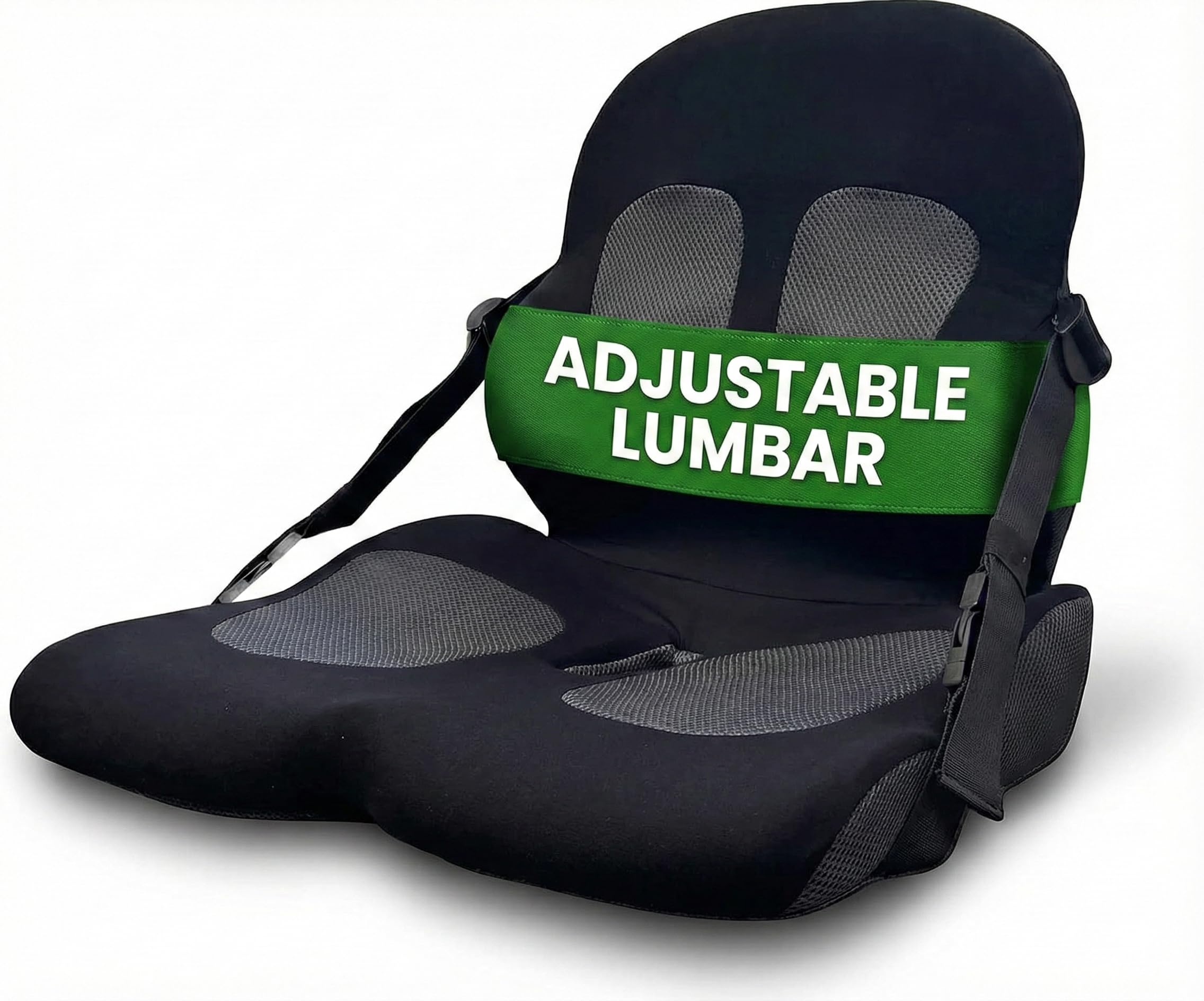
The Lifted Lumbar unit is unique because the same strap that secures the pillow to the seat also lets you pull the pillow tighter or looser against your lower back. This tension adjustability, combined with the ability to shift the pillow up or down, means you can dial in exactly how much forward push the foam exerts on your lumbar curve. Spine specialists contributed to the 18.5-inch tall profile, which fills the gap from the sacrum to the mid-back.
Testers found the support comfortable for full work-plus-commute days approaching 14 hours. The memory foam is on the firmer side, which provides stable resistance rather than a sinking feeling. The pillow also doubles as a seat cushion because its base is thick enough to raise the hips slightly, but its main mission is lumbar alignment.
Because the unit is primarily a vertical pillow, it does not contain a coccyx cutout or a wide seat pan for sit-bone relief. Drivers whose primary complaint is tailbone pain should look at a wider seat cushion instead. For lower back discomfort specifically, this is the most tunable option available.
What works
- Strap tension adjusts the push depth in real time
- Firm memory foam maintains support through long days
- Compact enough to transfer between vehicles and office chairs
What doesn’t
- Narrow focus on lumbar only, no seat pan for tailbone
- Foam feels stiff before the break-in period
4. SitCushion X-Large Seat Cushion
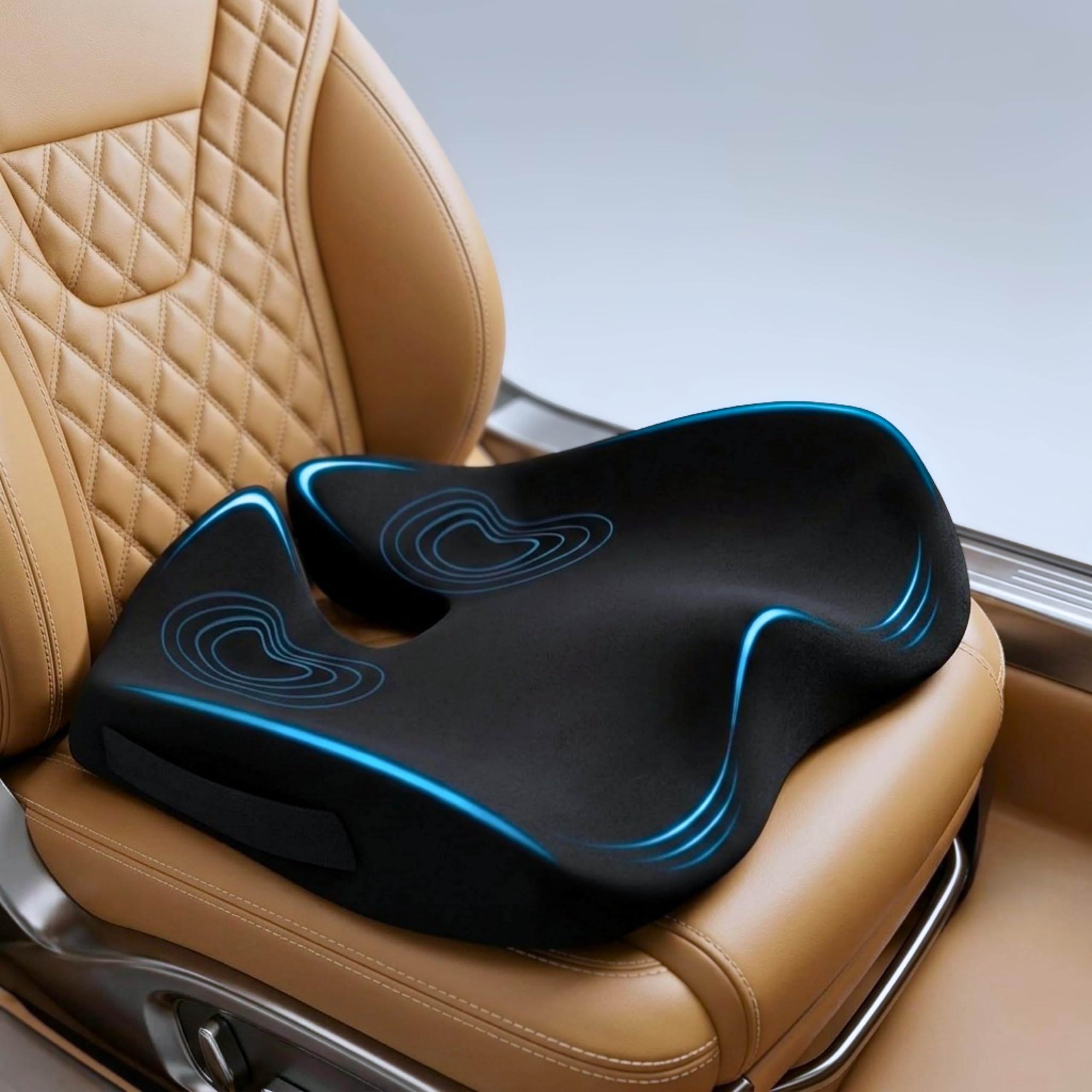
The SitCushion’s defining feature is its U-shaped coccyx cutout, which completely lifts the tailbone off the seat surface. At 20 inches wide and 18 inches deep, the cushion is noticeably larger than standard pads, distributing weight across the entire thigh and hip area. The charcoal-infused foam resists odors and maintains its firmness even after extended exposure to heat inside a parked car.
The 3-inch thickness adds noticeable height, which helps shorter drivers see over the steering wheel and improves mirror visibility. The non-slip rubber base grips the seat fabric tightly without straps. The cotton cover is fully removable and machine-washable, a valuable feature for drivers who eat in their vehicle or run rideshare shifts. The manufacturer notes a normal 57-day break-in period, so the cushion starts firm and softens to its ideal compliance over a few weeks.
Tall drivers with long torsos may find that the 3-inch lift pushes their head too close to the roof, especially in compact cars. The lack of straps means the cushion can shift slightly on deeply contoured bucket seats. For drivers under six feet who need tailbone relief and a height boost, this is the most effective single cushion available.
What works
- Large surface area distributes weight evenly across hips
- Coccyx cutout completely suspends the tailbone
- Washable cotton cover and charcoal odor control
What doesn’t
- 3-inch height lift may be too tall for full-size truck drivers
- No straps; relies entirely on rubber grip
5. ComfiLife Premium Gel & Memory Foam Seat Cushion

The ComfiLife gel cushion bridges the gap between an entry-level pad and a premium orthopedic device. The gel layer sits on top of a medical-grade memory foam core, providing immediate cooling and pressure redistribution. The U-shape cutout relieves the coccyx and sacrum, while the non-slip rubber bottom keeps the cushion in place on leather and cloth seats alike.
The velour cover zips off and goes into the washing machine, and the built-in carrying handle makes it easy to take between a car seat and an office chair. The dimensions are slightly narrower than the SitCushion, fitting standard sedan seats without overhang. Users recovering from herniated discs or sciatica report noticeable relief within the first week.
At 2.8 inches thick, the cushion provides moderate height lift but does not double as a booster for short drivers the way thicker pads do. The gel layer is effective initially but can feel less cooling after several hours of continuous pressure. For a versatile cushion that handles office, car, and travel use at a mid-range investment, this is the smartest choice.
What works
- Gel layer reduces heat buildup compared to solid foam
- Machine-washable cover simplifies maintenance
- Non-slip base works reliably on multiple seat materials
What doesn’t
- Cooling effect diminishes during extended use
- Narrower width may not cover wide hips fully
6. ComfiLife Lumbar Support Pillow

The ComfiLife lumbar pillow is the most focused product on this list — it does one thing and does it well. The 18-by-16-inch memory foam core is shaped to match the natural curve of the lumbar spine, and the three-strap system secures it to virtually any seatback without slipping. The leatherette front panel resists moisture and wipes clean easily, while the mesh back panel allows airflow to keep your shirt dry.
At just 5 inches thick at its deepest point, the pillow does not push too far into the back, making it suitable for drivers who feel cramped by larger cushions. The straps loop around the headrest posts or the seatback itself, so the pillow stays at the exact height you set. The foam is rated as soft firmness, meaning it compresses noticeably under pressure but never flattens completely.
The pillow lacks a seat cushion component, so it will not help with tailbone or sciatic pain originating under the thighs. It also tends to slide down on seats with heavily reclined backrest angles. For straight lower back gap filling, this is a lightweight, low-bulk fix that fits in a glovebox.
What works
- Three straps hold position securely on any seat type
- Soft foam curve matches the spine without excessive push
- Thin profile saves legroom in compact cars
What doesn’t
- No seat cushion for tailbone or thigh support
- Mesh back panel only, leatherette front may trap heat
7. Lofty Aim Car Seat Cushion

The Lofty Aim cushion addresses a specific pain point: drivers who sit too low in their vehicle and strain their neck and shoulders trying to see over the dash. At 2.5 inches thick, the high-density memory foam pad adds enough height for a shorter driver to gain a clearer view of the road and mirrors without feeling perched. The PU leather top layer with 4D mesh fabric provides a balance of durability and ventilation.
The cushion distributes weight across the buttocks and thighs, reducing pressure on the sciatic nerve and tailbone. The anti-slip rubber bottom keeps the pad in place on most seat materials, and the foam core resists permanent flattening under repeated use. Drivers who spend their day in delivery vans or trucks will appreciate the extra circulation support.
The Lofty Aim does not include a backrest component, so it works best as a standalone seat pad for drivers whose issue is height and thigh numbness rather than lumbar curvature. The 2.5-inch lift is moderate, so very tall drivers in lifted trucks will not benefit. For a budget-friendly entry point into car seat support, this pad delivers reliable baseline comfort.
What works
- Modest height boost improves visibility for shorter drivers
- 4D mesh cover stays breathable during warm drives
- Firm foam evenly distributes body weight across hips
What doesn’t
- No lumbar pillow for lower back curve support
- Foam density may feel too firm for lightweight users
Hardware & Specs Guide
Foam Density and Memory Retention
High-density memory foam, typically rated above 5 pounds per cubic foot, resists permanent compression and retains its shape after thousands of sitting cycles. Lower-density foam compresses faster and feels softer initially but develops a permanent flat spot within months. The break-in period — often lasting one to two months — is a normal process where the foam gradually adapts to your specific sit-bone and lumbar contour without losing its structural support.
Coccyx Cutout Geometry
A U-shaped or V-shaped cutout at the rear of a seat cushion suspends the tailbone (coccyx) above the seat surface, eliminating direct pressure that causes sharp pain during long drives. The cutout should be deep enough to clear the bone even when you lean back, but not so wide that the hips lose lateral support. Products with a cutout also tend to tilt the pelvis slightly forward, promoting a more neutral spinal curve.
Strap vs. Rubber Grip Retention
Lumbar pillows rely on adjustable straps looped around the seatback or headrest posts to stay at the correct height. Seat cushions typically use a rubberized or silicone bottom that grips the seat fabric. Straps provide more height precision but can loosen over time, while rubber bases offer instant placement but may slide on deeply contoured bucket seats or heated leather surfaces.
Cover Material and Breathability
Cotton, mesh, and velour covers allow air to circulate and wick moisture away, reducing sweat buildup during summer drives. Leatherette or PU leather covers wipe clean easily but trap heat against the body. Removable and machine-washable covers extend the useful life of the cushion and prevent odor accumulation in rideshare or daily-commute environments.
FAQ
Will a lumbar pillow alone fix my tailbone pain?
How thick should a seat cushion be to help a short driver?
Does memory foam harden in cold weather?
Final Thoughts: The Verdict
For most buyers, the back support for car winner is the Elmara Car Seat Cushion Set because it combines doctor-designed NeuroFoam technology with a seat cushion and lumbar pillow that work together to relieve tailbone, hip, and lower back pressure simultaneously. If you need adjustable tension that lets you dial in the exact lumbar push depth, grab the Lifted Lumbar Adjustable Support. And for tall drivers whose upper back and shoulders also ache after long drives, nothing beats the ObusForme Highback Backrest Support.

Certification: BSc in Mechanical Engineering
Education: Mechanical engineer
Lives In: 539 W Commerce St, Dallas, TX 75208, USA
Md Amir is an auto mechanic student and writer with over half a decade of experience in the automotive field. He has worked with top automotive brands such as Lexus, Quantum, and also owns two automotive blogs autocarneed.com and taxiwiz.com.