Every driver dreads the moment steam rises from under the hood or a warning light flickers without context. A reliable temperature monitor strips away that guesswork, giving you hard numbers before minor heat spikes turn into major repairs. Whether you are tracking coolant loops, transmission fluid, or just the air outside the cabin, the right gauge delivers data you can actually trust.
I’m Amir — the founder and writer behind Four Wheel Ask. I spend my time studying market specs, analyzing build quality reports, and comparing real owner feedback to find the truth about automotive accessories.
After digging through countless listings and separating marketing fluff from genuine engineering, this guide to the best automotive temperature gauge outside car ensures you catch heat issues before they cost you.
How To Choose The Best Automotive Temperature Gauge Outside Car
Not every gauge is built for the same job. A sensor meant for engine coolant won’t read ambient air accurately, and a cheap household thermometer won’t survive underhood heat. Understanding the hardware behind the number is the only way to buy once and buy right.
Sensor Type: Thermocouple, Thermistor, or Mechanical
The sensor is the heart of every gauge. K-type thermocouples handle extreme ranges (from arctic cold to exhaust heat) with solid accuracy, but require careful insulation. Thermistors are common in automotive coolant applications and respond quickly to temperature shifts. Mechanical capillary gauges run directly from a copper bulb to the dial — no power needed, but the tube is vulnerable to kinks. Choose your sensor based on where you plan to measure.
Display Readability Under Driving Conditions
An LED display offers instant readability in direct sunlight and at night without straining your eyes. Analog dials suffer from parallax error but provide a satisfying mechanical feel. LCD screens often get washed out in bright daylight but demand very little power. Consider where you are mounting the gauge — a 52mm pod in the dash or a cigarette lighter unit on the center console — and pick the backlight that matches your vehicle’s interior.
Power and Wiring Simplicity
Hardwiring into a 12V DC source gives you the most stable power and cleanest installation, but it requires tapping into a fuse box or radio circuit. Plug-and-play cigarette lighter adapters eliminate wiring complexity, though they limit placement and may introduce slight voltage noise. Always verify the gauge has built-in fuse protection to avoid shorting your vehicle’s electrical system during installation or operation.
Quick Comparison
On smaller screens, swipe sideways to see the full table.
| Model | Category | Best For | Key Spec | Amazon |
|---|---|---|---|---|
| ESUPPORT 52mm Digital Water Temp Gauge | Digital / Coolant | Real‑time blue LED monitoring with warning light | 104–300°F, NPT 1/8 sensor, 12V DC | Amazon |
| AcuRite 00888A3 Indoor/Outdoor | General Purpose | Remote ambient & cabin temperature logging | 10‑ft probe cable, min/max memory, °F/°C | Amazon |
| Dyno Racing 52mm Mechanical Water Temp | Mechanical / Coolant | Analog reliability and classic dash aesthetics | 110–265°F, NPT 1/2‑14, 1.8m cable, 12V | Amazon |
| DROK Digital Voltage & Temp (2pk) | Muti‑Function | Instant plug‑and‑play with voltage monitoring | 10–170°F, 12V/24V, cigarette lighter plug | Amazon |
| PEMENOL 12V Digital K‑Type Meter | Industrial / High‑Temp | Widest temperature range for extreme applications | –76°F to 999°F, 0.5m K‑type probe, 4–28V DC | Amazon |
In‑Depth Reviews
1. ESUPPORT 2″ 52mm Digital Water Temp Gauge Blue LED

The ESUPPORT digital gauge delivers exactly what an enthusiast needs: a crisp blue LED readout that steps through 104 to 300 degrees Fahrenheit with a dedicated warning light that trips above 212 degrees. This isn’t a vague needle sweep — it gives you a precise number every second, so you know the instant coolant temps start climbing toward dangerous territory.
Build quality centers on a standard 52mm housing that slides into almost any aftermarket pod or factory dash opening. The included NPT 1/8 thread sender integrates cleanly into an existing coolant port or an adapter, and the 12V DC power draw is light enough to tap into a radio circuit without worries. The nylon and rubber construction holds up well underhood without rattling loose over rough pavement.
For daily drivers and weekend project cars alike, this gauge earns its keep through pure readability and a useful visual buffer. The blue backlight stays legible even with direct sun hitting the dash, and the warning light provides a safety net when you are focused on the road rather than the digits. It is the most balanced pick on the market right now for anyone serious about cooling system transparency.
What works
- Bright blue LED display stays readable in direct sunlight
- Built‑in warning light at 212°F adds a safety layer
- Compact 52mm size fits most universal gauge pods
What doesn’t
- Limited to water/coolant temperature only
- Requires stable 12V source and proper grounding
2. AcuRite 00888A3 Indoor/Outdoor Digital Thermometer

AcuRite is a household name for precision weather tools, and this wired thermometer brings that same reliability into the automotive space for ambient temp monitoring. The main unit sits inside your cabin or garage while the weather-resistant sensor at the end of the 10‑foot cable reads true outside conditions — free from radiant heat soak off the asphalt or engine bay.
The push-button backlight makes the large digital display readable at night, and the ability to record minimum and maximum temperatures in both Fahrenheit and Celsius is a genuinely helpful tool for tracking overnight lows or interior heat buildup. The design is tabletop or wall-mountable, giving you flexibility to place it wherever it is most convenient without cluttering your dashboard.
For the driver who wants to know exactly how cold the morning is before stepping outside, or how hot the cabin gets while parked in summer sun, the AcuRite delivers that data without any wiring complications. It is not a coolant gauge, but it fills the “outside car” part of the equation with effortless accuracy.
What works
- Min and max temperature recording is incredibly useful
- Easy to read display with simple push‑button backlight
- Versatile mounting options for cabin or garage use
What doesn’t
- Not designed for direct engine coolant or exhaust contact
- Wired sensor length may limit placement for some vehicles
3. Dyno Racing 2″ 52mm Mechanical Water Temperature Gauge
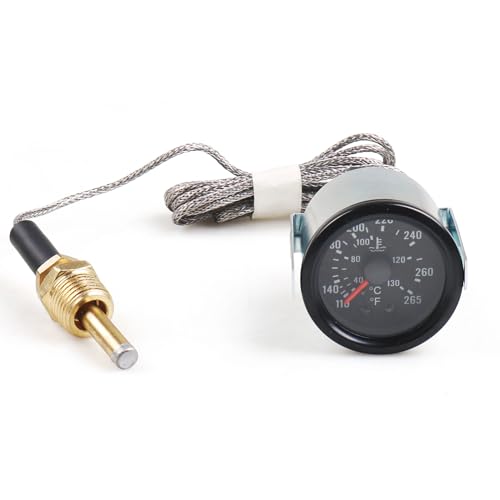
The Dyno Racing gauge goes old-school with a mechanical pointer that reacts directly to coolant temperature without relying on solid-state electronics. The dial displays both Celsius (40–130°C) and Fahrenheit (110–265°F) scales, giving you immediate context at a glance, while the yellow LED backlight keeps the needle visible after dark without washing out the analog face.
Installation requires the NPT 1/2‑14 thread sensor to be fitted into the engine’s cooling system, and the 1.8‑meter wire bundle routes easily to a 12V power source for the backlight. The glass, metal, and plastic construction feels substantial in hand, and the mechanical nature means there is zero parasitic draw on the battery when the ignition is off.
This gauge is the right choice for restoration projects, classic cars, or any build where a vintage aesthetic is prioritized. It trades the exact digital number for a reliable mechanical sweep that many long-time mechanics still trust implicitly for judging quick temperature changes while pushing a car hard through corners.
What works
- No battery drain when the vehicle is parked
- Classic analog look suits vintage and retro builds
- Dual scale in Celsius and Fahrenheit
What doesn’t
- Mechanical senders can fail over time
- Less precise reading than a digital numerical display
4. DROK Digital Voltage & Temperature Monitor (2‑Pack)
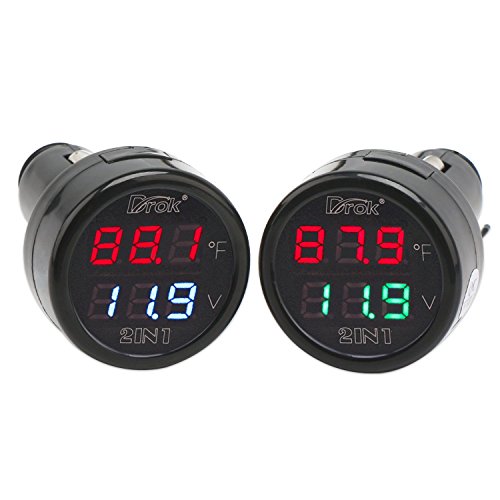
The DROK twin pack takes the friction out of installation by plugging directly into your 12V or 24V cigarette lighter socket. The LED screen cycles between your battery voltage and the current temperature readout from 10 to 170 degrees Fahrenheit, making it a two‑for‑one diagnostic tool that works in any vehicle without cutting a single wire.
The external temperature sensor on a thin lead lets you route the probe outside the window or away from the heat of the center console, giving a truer reading of the ambient air. A built‑in fuse protects both the gauge and your vehicle’s electrical system, and the LCD-based screen sips power so it can run continuously without draining the battery during longer drives.
For less than the cost of a single hardwired gauge, you get two units you can split between vehicles or monitor a trailer and a tow rig simultaneously. The voltage readout is a handy bonus for catching alternator or battery issues early, making this pack an incredibly practical entry point for drivers who want more data with zero hassle.
What works
- Truly plug‑and‑play installation in seconds
- Two‑pack offers excellent value for multiple vehicles
- Integrated voltage monitoring is a useful extra
What doesn’t
- Limited temperature range (10–170°F) not for exhaust
- Display brightness may be distracting in dark cabins
5. PEMENOL 12V Digital K‑Type Thermocouple Meter
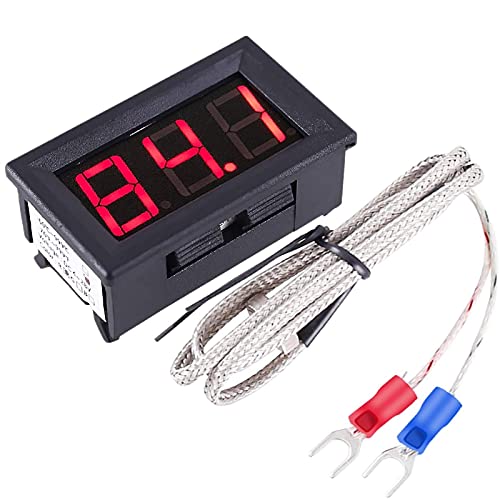
When your temperature monitoring needs stretch beyond coolant into exhaust gas, turbo inlet, or industrial equipment territory, the PEMENOL digital meter covers a staggering range from 76 degrees below zero Fahrenheit all the way up to 999 degrees. The included K‑type thermocouple with cold junction compensation delivers accuracy that budget sensors simply cannot match at the top of the scale.
The red LED display is designed for maximum visibility in harsh environments — dim machine shops, bright sunlight, or complete darkness — and the meter accepts a wide power input from 4V to 28V DC, making it compatible with everything from motorcycles to heavy equipment. The 0.5‑meter M6 probe is replaceable, so you can swap in different probe lengths for different monitoring points.
Owners should note that the manufacturer recommends wrapping the probe tip in insulating tape to prevent static interference, especially when measuring quick temperature changes. This is not a casual plug‑and‑play accessory — it is a technical tool for people who understand thermocouples and want a bare‑bones, highly capable digital readout without paying for a brand name.
What works
- Extreme temperature range unmatched by automotive gauges
- Industrial‑grade accuracy with cold junction compensation
- Works on a broad 4–28V DC power supply
What doesn’t
- Wiring and sensor insulation requires some technical effort
- ±10°F error margin at the extreme ends of the range
Hardware & Specs Guide
Sensor Types Explained
K‑Type Thermocouples use two dissimilar metals to generate a voltage proportional to temperature. They handle the widest range (–200°C to +1250°C) but need cold‑junction compensation and careful shielding. Thermistors change resistance with temperature and are the standard in automotive coolant applications — they respond fast but max out around 300°C. Mechanical capillary gauges rely on fluid expansion in a copper bulb and require no electricity, but the tube is fragile and difficult to route through modern firewall grommets.
Display & Readability
LED displays offer the best contrast in bright daylight and at night, with viewing angles that work in a driver’s peripheral vision. LCD screens consume less power but wash out in direct sun unless they have a dedicated backlight. Analog dials suffer from parallax error — your eye position changes the reading — but they give a quick visual trend (needle rising) that some drivers prefer over numerical digits.
Power & Wiring
Hardwiring to a switched 12V DC source keeps the gauge off when the car is parked, eliminating battery drain. Use a fuse tap or piggyback fuse holder to protect the circuit. Cigarette lighter adapters simplify installation but often place the gauge low on the center console, which can be a distraction. Always confirm the gauge has an internal fuse — without it, a shorted sensor wire can damage the instrument cluster or ECU.
Temperature Range & Accuracy
Ambient air monitoring typically requires –40°F to 120°F. Coolant temperature should be measured from 180°F to 240°F. Exhaust gas or turbo monitoring demands a K‑type probe rated for 1,000°F or more. Accuracy matters: a ±2°F error is fine for ambient, but coolant monitoring should stay within ±1°F to catch overheating before the head gasket fails.
FAQ
Can I use an indoor/outdoor thermometer in my car’s engine bay?
Do I need a mechanical or an electric temperature gauge?
What does the temperature gauge warning light mean?
Final Thoughts: The Verdict
For most buyers, the best automotive temperature gauge outside car winner is the ESUPPORT Digital Water Temp Gauge because it combines a bright, legible display with a practical warning threshold and a compact size that fits almost any build. If you want remote ambient monitoring without wiring into the engine bay, grab the AcuRite Indoor/Outdoor Thermometer. And for extreme industrial ranges, nothing beats the PEMENOL K‑Type Meter.

Certification: BSc in Mechanical Engineering
Education: Mechanical engineer
Lives In: 539 W Commerce St, Dallas, TX 75208, USA
Md Amir is an auto mechanic student and writer with over half a decade of experience in the automotive field. He has worked with top automotive brands such as Lexus, Quantum, and also owns two automotive blogs autocarneed.com and taxiwiz.com.