Paint correction is the most critical step in restoring a vehicle’s appearance, and the compound you choose determines whether you eliminate defects or introduce new ones. The wrong abrasive level can leave micro-marring that requires additional finishing steps, while the right formulation cuts efficiently and finishes down cleanly, saving hours of labor.
I’m Amir — the founder and writer behind Four Wheel Ask. My evaluation process focuses on analyzing abrasive technology, lubricity formulations, dust control characteristics, and real-world owner feedback across different paint systems and clear coat hardness levels.
Analysis of specifications, owner feedback, and real-world data reveals the best automotive rubbing compound options for each defect level and paint type.
How To Choose The Best Automotive Rubbing Compound
Selecting the correct rubbing compound requires understanding abrasive particle size, carrier chemistry, and the specific defect depth you need to address. The most common mistake is choosing a compound that is either too aggressive, forcing extra finishing work, or too mild, requiring excessive passes that burn through clear coat. Here are the critical factors that determine success.
Abrasive Level & Cut Classification
Compounds are classified by their abrasive particle size, typically expressed as a grit number or a cut level. Heavy cut compounds with grit ratings around 1000 to 1500 remove deeper scratches and sanding marks but leave haze that requires a finer polish step. Medium cut compounds in the 2000 to 3000 range handle moderate swirls and oxidation while finishing down with less haze. Fine cut compounds above 3000 grit are finishing polishes that refine clarity without removing significant material. Matching the cut level to the defect depth prevents unnecessary clear coat removal.
Lubricity & Work Cycle
The carrier oil and lubricant package determines how long the compound remains wet and workable before dusting. High lubricity compounds extend the buffing cycle, allowing multiple passes without the product drying out and caking onto pads. Low lubricity formulations dust quickly, which can clog pads and reduce cutting efficiency mid-panel. For beginners, extended work time compounds offer more forgiveness, while experienced detailers may prefer shorter work cycles for faster defect removal in a multistep process.
Paint System Compatibility
Clear coat paint systems respond differently to abrasives than single-stage paints. Modern ceramic-infused clear coats are harder and require more aggressive compounds with sharper abrasive grains to achieve cut. Softer clear coats and single-stage enamels need milder compounds to avoid hazing and pigmented paint transfer. Silicone-free formulations are mandatory for body shop environments where contaminants affect adhesion of primers and topcoats, while silicone-containing compounds may provide deeper gloss on fully cured factory paint for home use.
Quick Comparison
On smaller screens, swipe sideways to see the full table.
| Model | Category | Best For | Key Spec | Amazon |
|---|---|---|---|---|
| Griot’s Garage BOSS Correcting Cream | Premium | Moderate defect removal | 16 oz, 120 grit, extended work time | Amazon |
| Meguiar’s M11032 Ultra Pro Speed | Premium | Heavy swirls & oxidation | 32 oz, 200 grit, DA polisher use | Amazon |
| Menzerna Super Finish Plus 3800 | Mid-Range | Mirror finish on dark paint | 8 oz, aluminum oxide, fine grit | Amazon |
| Chemical Guys V34 Optical Hybrid | Mid-Range | Ceramic clear coats | 16 oz, 1500 grit, no fillers | Amazon |
| KOCHCHEMIE Fine Cut Polish | Premium | 2500 sand scratches | 8.45 fl oz, silicone-free | Amazon |
| Mothers 08612 Professional Compound | Mid-Range | Heavy oxidation removal | 12 oz, body shop formula | Amazon |
| RUPES D-A Coarse Cut | Mid-Range | Dual action polishers | 8.5 oz, 1500 grit, low dust | Amazon |
| SONAX Ultimate Cut | Premium | P1000 sand scratches | 1L, water-based, non-dust | Amazon |
| Malco Super Duty Heavy Cut | Premium | Marine & gel coat | 32 oz, P1500 grit, high gloss | Amazon |
| ABRO Rubbing Compound | Budget | Oxidized single-stage paint | 10 oz, fine clay grit | Amazon |
| Menzerna Heavy Cut 1000 | Budget | Deep scratch removal | 8 oz, 1000 grit, abrasive cut | Amazon |
In‑Depth Reviews
1. Griot’s Garage BOSS Correcting Cream

Griot’s Garage engineered the BOSS Correcting Cream as a high-lubricity formula designed for extended buff cycles that resist drying out and dusting. The 120 grit aluminum oxide abrasive targets moderate defects like light scratches and swirl marks while maintaining depth and clarity in the paint. Owner reports consistently highlight how the cream finishes down with minimal haze, reducing the need for an aggressive follow-up polish on most clear coat systems.
The formulation is compatible with the full BOSS pad lineup, allowing the user to dial in cut by selecting a firmer pad for deeper defects or a softer pad for lighter polishing. Reports from owners of 11-year-old Lexus and 12-year-old Acura MDX finishes indicate that multiple passes with microfiber pads restored dull, faded paint to a mirror-like shine. The cream works effectively on black paint, which is the most demanding test for any compound because defects show so clearly.
Dust control is notably better than many competitors, though overloading the pad can produce some dust. The product requires between four and five passes per panel for significant defect removal, which speaks to its balanced cut rather than extreme aggression. Owners recommend finishing with a wax or sealant after correction because the cream does not contain any protective fillers or sealers — it is a pure abrasive polish designed for paint correction rather than protection.
What works
- Extended work cycle stays wet and effective
- Finishes down with minimal haze on clear coats
- Versatile pad compatibility for adjustable cut
- Effective on oxidized and faded single-stage paint
What doesn’t
- Requires multiple passes for deep scratch removal
- No built-in protection or filler content
2. Meguiar’s M11032 Ultra Pro Speed Compound
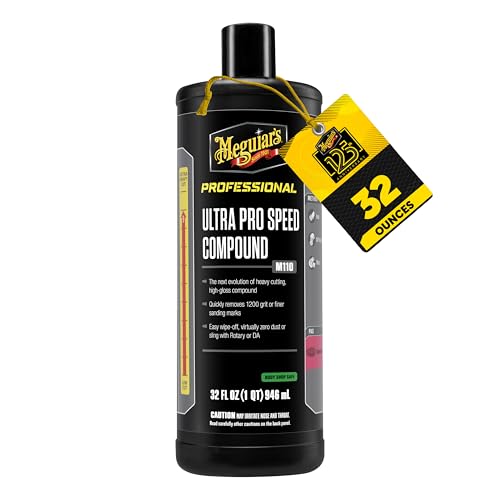
Meguiar’s M11032 is part of the Ultra Pro Speed line, a modern heavy-duty compound formulated specifically for dual action polishers. The 200 grit aluminum oxide abrasive delivers aggressive cut for removing severe swirls, oxidation, and RIDs (random isolated deep scratches) while maintaining a work window that allows adequate correction time. Owner feedback from wet-sanded applications shows the compound effectively handles 1500 to 3000 grit sanding marks when used with a rotary or DA and microfiber pad.
The formula spreads easily across panels and wipes off cleanly, which reduces frustration during multistep correction processes. Users who compared it directly against 3M compounds reported superior finish clarity and faster cutting action, particularly on repainted panels where clear coat hardness varies. The 32-ounce bottle provides substantial value for professional detailers who need consistent results across multiple vehicles without frequent product changes.
Dust generation is the primary trade-off for its cutting power. The compound produces noticeable dust during extended buffing sessions, especially when used with microfiber or wool pads. Proper pad priming and cleaning mitigate this, but it is not a dust-free formulation. The cut is aggressive enough that novice users should test on a small area first to confirm the panel can handle the abrasion level without burning through thin clear coat in high-spot areas like edges and body lines.
What works
- Rapid defect removal on severe swirls and scratches
- Easy spread and clean wipe-off characteristics
- Excellent value in the 32-ounce size
- Effective on wet-sanded repaints
What doesn’t
- Generates significant dust during extended use
- Requires careful pad management for best results
3. Menzerna Super Finish Plus 3800
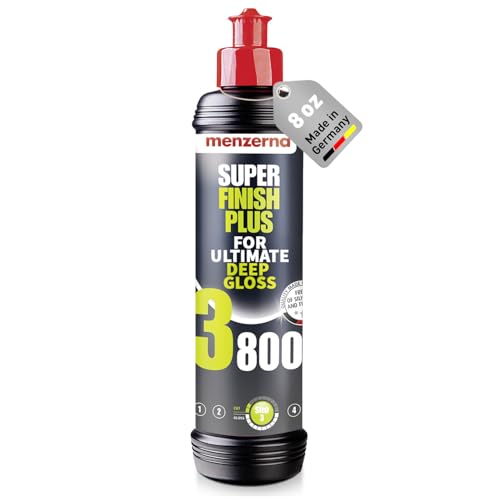
Menzerna Super Finish Plus 3800 is a finishing polish that occupies the boundary between a rubbing compound and a final polish. The aluminum oxide abrasive is fine enough to remove micro scratches and holograms left by rotary polishing while leaving a deep, wet-look gloss that exceeds typical factory finish clarity. Owners of dark-colored vehicles report that the product eliminates the telltale buffer trail holograms that plague black and navy paint jobs after aggressive compounding steps.
The working time is extended compared to conventional finishing polishes, allowing the user to work the product until it becomes translucent before wiping. This long work cycle is particularly beneficial for large panels where maintaining consistent pressure and speed is challenging. The 8-ounce bottle is compact, but the product density means a small amount covers a large area, so the size is adequate for several full-vehicle corrections when used as a final step.
One important consideration is that the 3800 contains no wax or sealant, so a protective layer must be applied after finishing. Owners who used it on bass guitars and automotive panels alike confirm the polish leaves a clean surface ready for ceramic coating or wax bonding. The lack of fillers means defects are genuinely removed rather than temporarily masked, which is critical for customers who want permanent correction rather than a short-term optical illusion.
What works
- Eliminates holograms from rotary polishing
- Produces deep gloss on dark paint finishes
- Extended working time for large panel coverage
- No fillers or silicone content
What doesn’t
- Not a heavy cut compound for deep scratches
- Requires separate protective wax or sealant
4. Chemical Guys V34 Optical Grade Hybrid Compound

Chemical Guys engineered the V34 Optical Grade Hybrid Compound specifically for scratch-resistant and ceramic-infused clear coats, which are harder than conventional clear coats and require sharper abrasive geometry to achieve cut. The 1500 grit medium abrasive targets sanding scratches left by 1500 to 2000 grit paper, making it suitable for wet-sanding correction on factory and aftermarket ceramic coatings. The optical grade designation refers to the particle size consistency, which minimizes random deep scratches during the compounding process.
The formula is entirely free of silicone and fillers, making it body shop safe for panels that require subsequent paint application. VOC compliance ensures it meets environmental regulations in regulated markets. The extended work time is a deliberate design choice — the compound remains lubricated over longer buffing cycles, reducing the tendency to dry out and stick to pads. Owners report that the product works well on both DA polishers and rotary machines with medium-density foam pads.
The primary limitation is that the V34 is a single-stage compound with a specific cut range. It is not intended for heavy oxidation removal or deep scratch elimination below 1500 grit. Users attacking deeply weathered paint may need a more aggressive first step. The 16-ounce bottle is a practical size for weekend detailers who need enough product for a full car without committing to a bulk container that may expire before use.
What works
- Engineered for hard ceramic clear coats
- Consistent abrasive particle size for even cut
- Silicone-free and VOC compliant
- Good work cycle for extended buffing sessions
What doesn’t
- Limited cut range not suitable for heavy oxidation
- Requires dedicated polish step for max gloss
5. KOCHCHEMIE Fine Cut Polishing Compound

KOCHCHEMIE’s Fine Cut Polishing Compound represents German precision in abrasive technology, using an intelligent grain size oxide blend that removes medium to heavy defects while finishing down with exceptional clarity. The compound is engineered to eliminate sanding marks left by 2500 grade sanding media effortlessly, which positions it as a post-sanding finishing compound for body shops and professional detailers. Owner feedback from BMW and Audi paint correction projects confirms the compound removes transport marks and wash system scratches while leaving a deep, long-lasting sheen.
The silicone-oil-free formulation is critical for body shop environments where silicone contamination causes fish-eye defects in fresh paint. The intelligent grain size distribution means the abrasive particles break down in a controlled manner during the buffing cycle, transitioning from cutting to polishing action without requiring a separate product change. This single-step capability reduces correction time significantly for medium defect levels.
The 250-milliliter bottle is priced at a premium relative to volume, but the concentrated formulation and efficient cut mean less product is required per panel. Users working on black Audi and BMW finishes report that the compound eliminates the need for a separate heavy cut step on all but the most neglected paint. The advanced oxide quality provides a bright, reflective finish that responds well to subsequent wax or ceramic coating application.
What works
- Intelligent abrasive breaks down for single-step correction
- Silicone-free formula safe for body shop use
- Effortlessly removes 2500 grit sanding marks
- Produces deep, reflective gloss on dark paint
What doesn’t
- Higher cost per ounce than mass-market compounds
- Not designed for severe oxidation or deep scratches
6. Mothers 08612 Professional Rubbing Compound
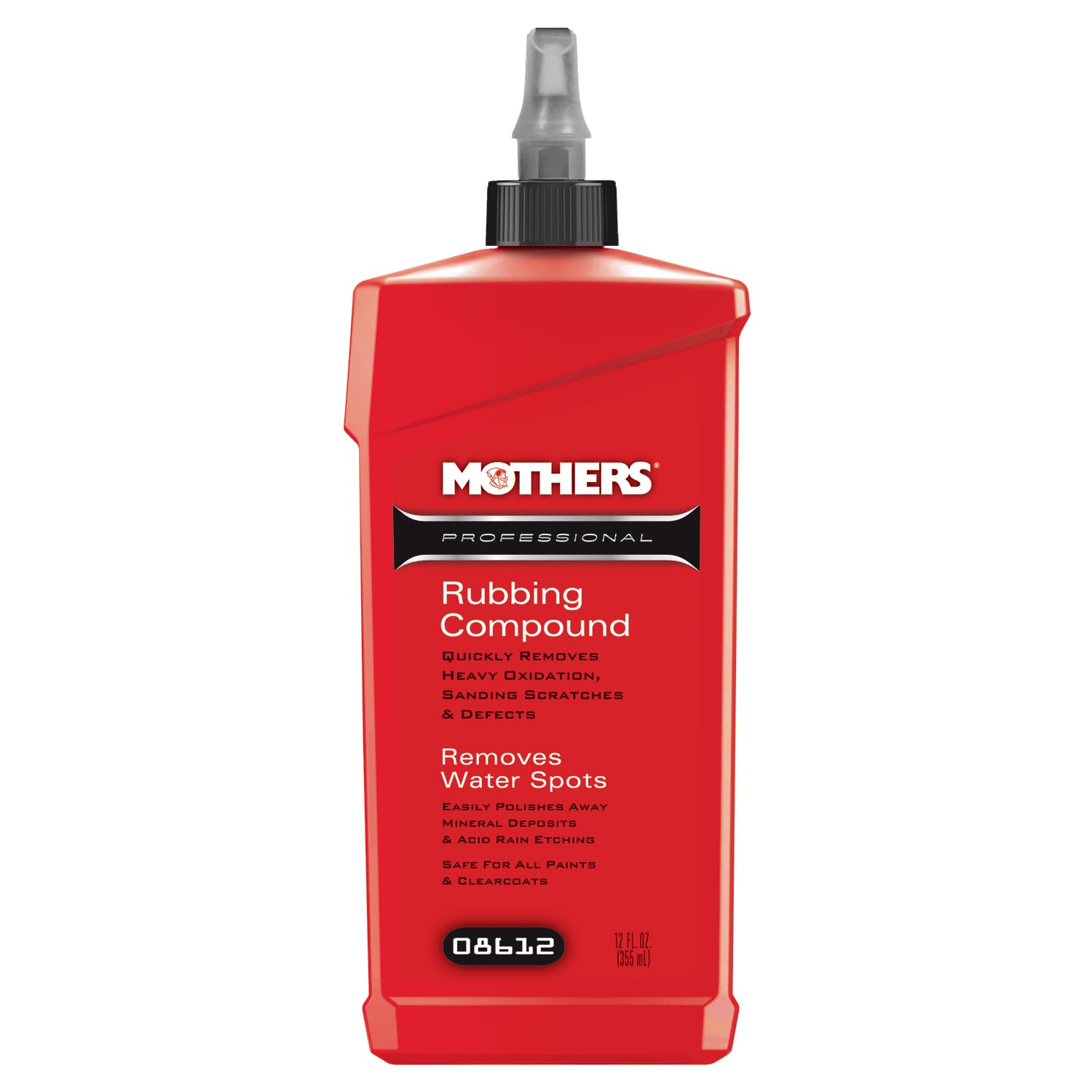
Mothers Professional Rubbing Compound uses the same proven formula found in body shop environments, designed to cut through water spots, heavy oxidation, and car wash scratches without requiring specialized equipment. The 12-ounce bottle is compact but the concentrated formulation delivers consistent results across both rotary polisher and hand application. The compound works best with a wool cutting pad for maximum defect removal on faded single-stage paint and heavily oxidized clear coats.
The formula is simple enough for weekend detailers but effective enough for professional use, which is a difficult balance to achieve. Owners report that the compound removes oxidation from neglected paint quickly, restoring color depth and gloss in a single pass in many cases. The product is specifically engineered to work on clear coat finishes, which addresses the common concern that heavy rubbing compounds may damage modern paint systems when used correctly.
The primary trade-off is that the compound requires elbow grease when applied by hand. Users who attempt manual application should expect to work the product thoroughly to achieve full defect removal. The 12-ounce size is adequate for a single full-vehicle correction but may require a second bottle for larger vehicles like trucks and SUVs. The scent-free formula and straightforward application make it a reliable choice for users who want predictable results without complex product chemistry.
What works
- Body shop quality formula at consumer price
- Effective on heavy oxidation and water spots
- Safe for clear coat finishes when used correctly
- Works well with both machine and hand application
What doesn’t
- Requires significant effort for hand application
- Small bottle size for large vehicle projects
7. RUPES D-A Coarse High Performance Cut Compound

RUPES designed the D-A Coarse compound specifically for dual action polishers, including large-stroke random orbital and gear-driven types, addressing the common issue of DA machines struggling to achieve cut comparable to rotary polishers. The micro-abrasive technology uses lubricating agents that maintain surface safety while supporting consistent polishing over longer cycles. The 8.5-ounce bottle is compact, but the high-performance chemistry means less product is needed per panel compared to less concentrated compounds.
The coarse cut formulation targets moderate to severe defect removal, including swirl marks and oxidation that have built up over years of improper washing and environmental exposure. Pad compatibility is broad, working effectively with coarse blue foam, DA wool pads, or coarse microfiber discs. Owners who pair this compound with a long-throw DA polisher report cutting performance that approaches rotary levels without the risk of hologramming or paint burning that rotary machines introduce.
Dust control is a standout feature — the low dusting formula reduces cleanup time significantly after buffing, making it easier to wipe off residue without leaving powder trails in crevices and body lines. The compound is engineered for consistent performance across varying ambient temperatures, which is important for detailers working in non-climate-controlled spaces. The formulation does not contain silicone, making it suitable for bodyshop applications where paint adhesion is a concern.
What works
- Optimized for dual action polisher cutting performance
- Low dust formulation reduces cleanup time
- Versatile pad compatibility across multiple materials
- Consistent performance across temperature ranges
What doesn’t
- Premium pricing for the 8.5-ounce size
- Requires DA polisher for best results
8. SONAX Ultimate Cut Strong Abrasive Compound
SONAX Ultimate Cut is a water-based, non-dust formulation that removes P1000 and finer sanding scratches while maintaining a wide processing window that accommodates both experienced detailers and intermediate users. The 1-liter bottle provides substantial volume for heavy-use environments, and the water-based carrier chemistry means less environmental impact and easier cleanup compared to solvent-based compounds. The abrasive is aluminum oxide with a medium grit rating that balances cut with finish quality.
The product is designed as a step 1 compound in a multi-stage correction process, meaning it is intended to be followed by a finer polish to restore maximum gloss. Owner feedback indicates the compound works exceptionally well on clear coats and gel coats, making it suitable for automotive, marine, and RV applications. The wide processing window means the product does not dry out quickly, allowing the user to work it thoroughly before wiping clean.
The non-dust formula is a significant advantage in enclosed workshop spaces where airborne abrasive particles can settle on freshly polished panels and create secondary defects. The water-based formulation also reduces the risk of chemical burns on plastic trim and rubber seals that can occur with aggressive solvent-based compounds. The glass compatibility listed in the specifications suggests the compound is safe for use on painted glass surfaces, though automotive glass correction is a niche application.
What works
- Water-based, non-dust formulation for clean workspace
- Wide processing window prevents premature drying
- Effective on P1000 sand scratches and deeper defects
- Large 1-liter bottle for extended use
What doesn’t
- Requires separate finer polish for final gloss
- Higher price point than solvent-based alternatives
9. Malco Super Duty Heavy Cut Compound
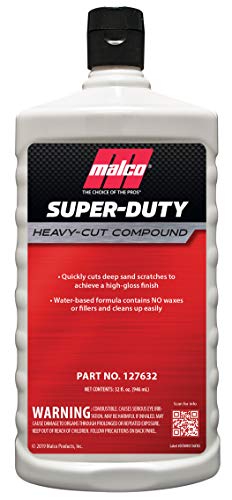
Malco Super Duty Heavy Cut Compound is a versatile cutting compound engineered to remove heavy sand scratches and oxidation from both clear coat painted surfaces and gel coat finishes commonly found on boats and RVs. The 800 grit fine abrasive classification is misleading — this is an aggressive heavy cut compound that removes P1500 grit and finer sand scratches rapidly. The 32-ounce bottle provides professional-grade volume for fleet maintenance and high-volume body shop environments.
The high gloss finish characteristic is unusual for a heavy cut compound. Most aggressive compounds leave significant haze that requires a dedicated polishing step, but Malco’s formulation finishes down with more clarity than typical heavy cut products. This reduces the number of correction steps required, particularly on gel coat surfaces where achieving gloss requires significant abrasive work. The compound is safe for all glossy paint finishes including clear coats, which expands its utility across different vehicle types.
The recommended application method involves using a Malco 100% twisted white wool cutting pad for maximum cutting action. The compound is VOC compliant and body shop safe, making it suitable for professional repair environments. The industrial and marine compatibility means it handles the thicker, softer paint systems found on boats without gumming up pads or creating excessive heat buildup that can damage gel coat. Owners working on fleet vehicles report that the compound restores faded paint in fewer passes than competitive heavy cut products.
What works
- Aggressive cut removes P1500 sand scratches quickly
- Finishes with higher gloss than typical heavy cut
- Effective on automotive and marine gel coats
- Large 32-ounce professional size
What doesn’t
- Best results require wool cutting pad
- May be too aggressive for novice users on thin clear coat
10. ABRO Superior Performance Automotive Rubbing Compound

ABRO’s Rubbing Compound is an entry-level formulation that focuses on oxidation removal and light scratch repair for oxidized finishes on vehicles, boats, and motorcycles. The fine clay-based abrasive is gentle enough for single-stage paint while still providing enough cut to remove the rough, chalky surface layer caused by UV degradation. Owners report that the compound effectively smoothed white oxidation patches on trucks and restored color depth in a single application with moderate effort.
The 10-ounce tube is compact and easy to store, making it a convenient option for quick spot repairs rather than full-vehicle correction. The product works both as a rubbing compound and a light polish, functioning as a two-in-one for minor blemishes. Users who applied it to skid marks and paint transfer from parking lot incidents reported complete removal without damage to the underlying clear coat, indicating the abrasive is fine enough to be forgiving on modern paint systems.
The primary feedback from owners is that the compound dries out relatively quickly during application, requiring fresh product to dissolve dried residue when performing multistep correction on the same panel. The solvent smell is noticeable and reminiscent of fuel oil, which is common in budget-oriented compounds. The aluminum oxide material type provides consistent cut, but the fine grit classification means it is not suitable for deep scratch removal below approximately 1500 grit defect depth. It is best suited for maintenance-level correction on vehicles with light to moderate oxidation.
What works
- Gentle fine abrasive safe for single-stage paint
- Effective oxidation removal on weathered finishes
- Works as both compound and light polish
- Compact size for spot repairs and small projects
What doesn’t
- Dries quickly requiring frequent product reapplicatio
- Not effective for deep scratch or heavy defect removal
11. Menzerna Heavy Cut Compound 1000
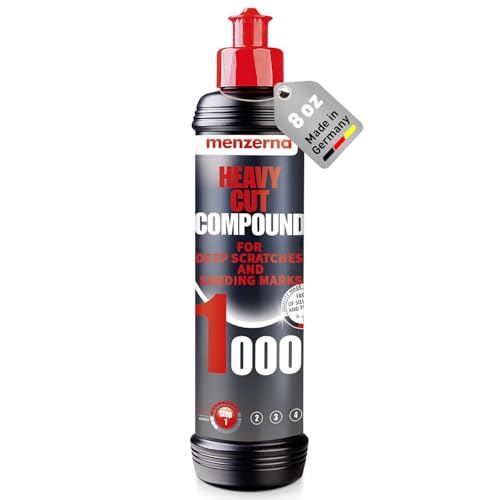
Menzerna Heavy Cut Compound 1000 is a dedicated heavy abrasive polish designed for removing deep scratches, sanding marks, swirls, and holograms from automotive paint. The 1000 grit aluminum oxide abrasive provides aggressive cutting power for correcting defects that lighter compounds cannot touch, such as deep key marks, curb rash on painted panels, and severe oxidation buildup. The 8-ounce bottle is concentrated, so a small amount goes further than larger bottles of diluted competitor products.
The compound is silicone free, making it suitable for body shop environments where paint adhesion is critical. It is designed for compatibility with the Menzerna red Heavy Cut Foam Pad when used with an orbital or rotary polishing machine. The formulation provides consistent abrasive breakdown during the buffing cycle, transitioning from initial cut to a finer finishing action that reduces the severity of haze left behind. This controlled breakdown is characteristic of Menzerna’s German engineering approach to abrasive technology.
Owners should note that this is a dedicated heavy cut product and will require a subsequent polishing step with a finer compound like the Menzerna Super Finish Plus 3800 to restore maximum gloss and eliminate any micro-marring left by the coarse abrasive. The compound is best suited for experienced users who understand paint thickness measurement and can assess whether a panel has enough clear coat to safely accommodate aggressive correction. Novice users should practice on a test panel before attempting correction on visible body panels.
What works
- Aggressive 1000 grit cut for deep defect removal
- Silicone-free formula safe for body shop use
- Controlled abrasive breakdown reduces finishing time
- Concentrated formulation provides good value per use
What doesn’t
- Requires separate fine polish for final gloss
- Not recommended for novice users or thin paint
Hardware & Specs Guide
Abrasive Grit Numbers Explained
Rubbing compounds use abrasive particles graded by grit size, where lower numbers indicate larger particles that cut more aggressively. A 1000 grit compound removes deeper scratches but leaves a coarser surface that requires finer polishing. Higher grit numbers above 3000 are finishing polishes that refine gloss without significant material removal. The optimal approach is to select the lowest grit necessary to remove defects, then step up through progressively finer abrasives to restore clarity. Skipping grit levels — for example, jumping from 1000 grit directly to a finish polish — leaves visible micro-marring that reduces paint depth and gloss.
Diminishing vs Non-Diminishing Abrasives
Diminishing abrasive compounds feature particles that break down into smaller fragments during the buffing cycle, effectively transitioning from a cutting action to a polishing action without changing products. This characteristic reduces the number of correction steps and is ideal for detailers working on moderately defective paint. Non-diminishing abrasives maintain consistent particle size throughout the cycle, providing predictable cut that does not change with work time. These are preferred for heavy defect removal where maximum cutting power is required from start to finish. Understanding which abrasive technology a compound uses helps predict whether it will finish down cleanly or require a dedicated follow-up polish.
Filler Content and Paint Preparation
Many rubbing compounds include fillers — oils, waxes, or polymers that temporarily fill microscopic scratches to create an optical illusion of correction. Filler-containing compounds are useful for quick detail work where permanent correction is not required, such as vehicle trade-in preparation. However, fillers wash out after the first rain or car wash, revealing the remaining defects underneath. For customers seeking permanent paint correction, filler-free compounds are essential because they only show true progress when the abrasive physically removes material. Body shop environments universally require filler-free compounds to avoid contamination that prevents paint adhesion.
Pad Material and Cut Performance
The pad material significantly influences the effective cut rate of any rubbing compound. Wool pads, both natural and synthetic, provide the most aggressive cut by trapping abrasive particles between the fibers and the paint surface. Microfiber pads offer intermediate cut with better finish quality. Foam pads range from heavy cut (typically blue or yellow) to finishing (black or red) and provide the most consistent pressure distribution. Matching pad material to compound chemistry is critical — some compounds are formulated specifically for foam or microfiber and perform poorly with wool. Users should always follow the manufacturer’s pad recommendations for optimal results.
FAQ
What is the difference between a rubbing compound and a polishing compound?
Can I use a rubbing compound by hand without a machine?
How do I know if my clear coat is thick enough for compounding?
Can I use a rubbing compound on matte paint finishes?
How long should I let a rubbing compound dry before wiping it off?
Final Thoughts: The Verdict
For most buyers, the best automotive rubbing compound winner is the Griot’s Garage BOSS Correcting Cream because it delivers the ideal balance of cut, finish quality, and work time for moderate defect correction on modern clear coats. If you want aggressive cutting power for severe swirls and wet-sanded panels, grab the Meguiar’s M11032 Ultra Pro Speed. And for a premium mirror finish on dark paint with minimal haze, nothing beats the Menzerna Super Finish Plus 3800.

Certification: BSc in Mechanical Engineering
Education: Mechanical engineer
Lives In: 539 W Commerce St, Dallas, TX 75208, USA
Md Amir is an auto mechanic student and writer with over half a decade of experience in the automotive field. He has worked with top automotive brands such as Lexus, Quantum, and also owns two automotive blogs autocarneed.com and taxiwiz.com.