A great automotive polish does more than just add shine — it removes embedded contaminants, levels clear coat imperfections, and lays the foundation for durable protection. The difference between a flat, lifeless finish and one that looks wet enough to drip comes down to choosing the right abrasive technology and formulation for your paint’s specific condition. Many products claim professional results, but only a handful deliver the consistent cut, finish clarity, and ease of removal that experienced detailers demand.
I’m Amir — the founder and writer behind Four Wheel Ask. My approach to evaluating automotive polishes relies on deep market research, technical datasheet analysis, and comprehensive aggregation of owner feedback across thousands of real-world applications.
After analyzing over fifty top-selling formulas, this guide ranks them by real-world performance rather than marketing hype. Whether you are chasing a mirror-like show finish or simply want to refresh daily driver paint, the best automotive polish depends on your paint hardness, defect severity, and application method.
How To Choose The Best Automotive Polish
Selecting the right polish requires understanding the relationship between abrasive aggressiveness, paint hardness, and the final finish you want to achieve. A heavy-cut compound on soft clear coat can create haze that requires additional refinement, while a finishing polish on neglected paint may lack the cutting power to remove oxidation. The following factors determine which product belongs in your arsenal.
Understanding Abrasive Grades and Cut Levels
Polishes are categorized by grit size and cut intensity. Heavy-cut compounds use larger abrasive particles to remove deep scratches and severe oxidation, while medium-cut polishes balance defect removal with finish clarity. Fine and ultra-fine polishes refine the surface to a high-gloss, haze-free state. Using a polish with too much cut on a thin clear coat risks burning through, whereas a polish with too little cut wastes time on heavily swirled paint. Matching abrasive grade to paint hardness and defect depth is the first and most critical decision.
Polymer Sealants vs. SiO2 vs. Carnauba Wax
The base chemistry determines not only the depth of shine but also protection longevity. Carnauba wax delivers unmatched warmth and wetness but degrades within weeks under UV exposure. Polymer sealants bond at a molecular level to create a semi-permanent barrier that resists environmental fallout. SiO2-infused polishes deposit a thin quartz layer that enhances gloss and provides months of hydrophobic protection. Each technology serves a distinct purpose; your choice should align with how frequently you are willing to reapply and whether the vehicle is a daily driver or a garage-kept show car.
Machine Application vs. Hand Application
Dual-action polishers and rotary machines increase cut efficiency by cycling the abrasive particles across the paint surface at controlled speeds. Many premium polishes are formulated specifically for machine use, with lubricants that prevent the product from drying out during extended buffing cycles. Hand application limits your ability to generate consistent pressure and speed, so polishes labeled as hand-friendly typically contain finer abrasives and easier wipe-off characteristics. If you plan to polish an entire vehicle, a DA polisher paired with a medium-cut polish often yields the most uniform results.
Protection Longevity and Environmental Resistance
Not all polishes leave behind protective elements. Pure polishes contain only abrasives and lubricants and must be topped with a wax or sealant. All-in-one products combine polishing agents with wax or polymer components, offering convenience at the cost of reduced cut efficiency. SiO2-enriched polishes like CARPRO Essence leave a bonded layer that survives multiple washes. Review the product’s chemical composition to determine whether it serves as a standalone protection layer or requires a secondary product for durability.
Quick Comparison
On smaller screens, swipe sideways to see the full table.
| Model | Category | Best For | Key Spec | Amazon |
|---|---|---|---|---|
| Meguiar’s M21032 | Finishing Polish | Mirror-like finish on dark paints | Ultra Pro, 32 oz | Amazon |
| CARPRO Essence | Primer Polish | SiO2 protection + gloss | 500 ml (17 oz) | Amazon |
| Liquid Glass Ultimate | Polish/Sealant | Hard, mirror-like coating | 16 oz, no abrasives | Amazon |
| 3M Perfect-It EX | Machine Polish | Ultrafine swirl removal | 16 oz, EX fine | Amazon |
| Finish First (Liqui Tech) | Polymer Sealant | 6–9 month durability | 16 oz, polymer | Amazon |
| Griot’s Garage BOSS | Correcting Cream | One-step defect removal | 16 oz, medium cut | Amazon |
| TopCoat F11 | Spray Polish | Quick water-based protection | 8 oz, water-based | Amazon |
| Menzerna 3in1 | One-Step Polish | Cut, finish, seal in one | 8 oz, medium cut | Amazon |
| Malco Nano Care | Cream Wax | UV protection + deep gloss | 32 oz, nano tech | Amazon |
| Mothers California Gold | Paste Wax | Warm carnauba shine | 12 oz, pure carnauba | Amazon |
| Wizards Shine Master | Polish/Sealant | Affordable all-in-one | 16 oz, poly-acrylic | Amazon |
In‑Depth Reviews
1. Meguiar’s Professional Ultra Pro Finishing Polish M21032
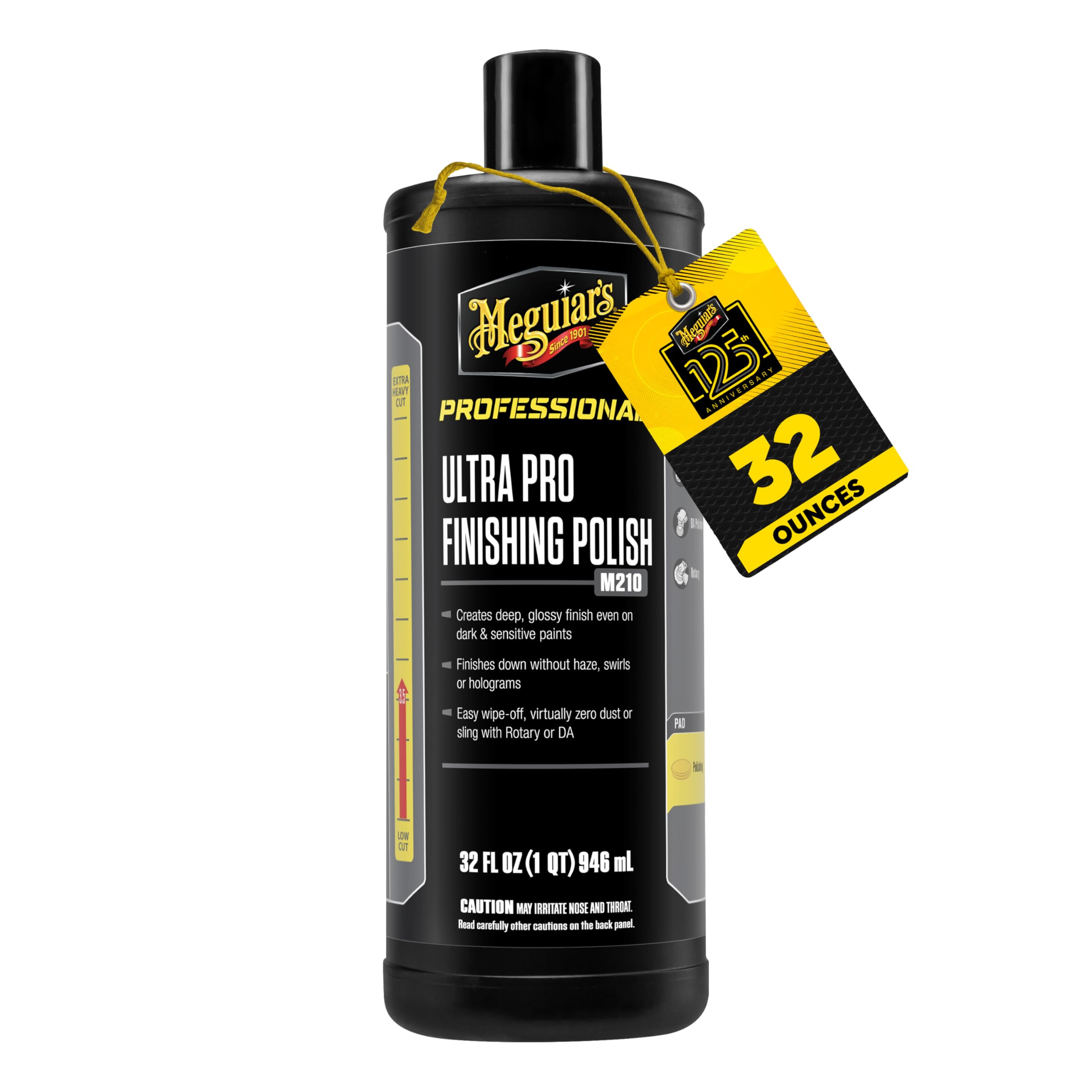
Meguiar’s M21032 sits at the top of the finishing polish segment for good reason. Its aluminum-oxide fine abrasive system is engineered to remove rotary holograms and light swirls without leaving behind the micro-marring that plagues lesser polishes. Owner reports consistently describe the wipe-off as effortless, with no oily residue or hazy patches even on black and other high-visibility dark paints. The formula’s extended working time allows multiple passes without the product drying out, which is critical for achieving uniform gloss across large panels.
What sets this polish apart from the competition is its ability to finish down to a true mirror reflectivity without requiring a secondary refinement step. Many detailers report using it as a standalone one-step on well-maintained paint and as the final glaze after a medium compound on more damaged surfaces. The 32-ounce bottle offers substantial value for regular users who polish multiple vehicles per year. Compatibility with both foam and microfiber pads gives the user control over how much cut to extract from the fine abrasive suspension.
This polish is safest for clear-coated finishes that already have a reasonably smooth surface. Heavy oxidation or deep scratches will require a compounding step beforehand. Some users note that pairing it with an aggressive pad can introduce slight haze on ultra-soft paints, so pad selection matters more with this product than with heavier-cut competitors. For a professional-grade finishing polish that delivers consistent, repeatable results, the M21032 remains the industry benchmark.
What works
- Leaves zero holograms or swirls on dark paints
- Easy wipe-off with no oily film
- Extended working time for large panels
- Versatile with foam or microfiber pads
What doesn’t
- Lacks cutting power for heavy defect removal
- Can haze on ultra-soft paint with aggressive pads
- Requires clean paint surface to avoid sealing in contamination
2. CARPRO Essence Extreme Gloss Primer

CARPRO Essence occupies a unique category as a semi-permanent SiO2-enriched finishing polish that primes the surface for ceramic coating while correcting light swirls. The nano-tech quartz particles deposit a protective layer that physically fills micro-scratches and levels the clear coat, resulting in a thicker, glossier appearance than traditional abrasives alone can achieve. Owner feedback highlights its ability to transform dull single-stage paint into a deep, wet-looking finish that holds up well against light marring during subsequent washes.
The formulation uses fine abrasives manufactured directly into the liquid suspension, meaning the cutting action and the protective deposition happen simultaneously. This makes it an excellent choice for detailers who want to correct, enhance, and protect in a single pass. Users report that it bonds seamlessly with CQUARTZ coatings, but it also performs admirably as a standalone product topped with Reload or a spray sealant. The 500 ml bottle covers an average sedan with room to spare for touch-up panels.
Where Essence demands attention is in its learning curve. The product requires proper surface preparation and a clean, contamination-free panel to bond correctly. Some owners note that the SiO2 fillers can mask deeper defects temporarily, so it is not a substitute for true compounding on heavily scratched paint. The price per ounce is higher than conventional finishing polishes, but the dual-action correction and protection value justifies the investment for enthusiasts who value long-term gloss retention.
What works
- Deposits durable SiO2 layer during polishing
- Excellent gloss enhancement on single-stage paint
- Reduces need for separate coating step
- Bonds perfectly with CQUARTZ line
What doesn’t
- Higher cost per ounce than standard polishes
- Not ideal for heavy defect correction
- Requires thorough decontamination before application
- May mask defects rather than fully remove them
3. Liquid Glass Ultimate Auto Polish

Liquid Glass has maintained a dedicated following for decades because it delivers exactly what it promises: a hard, clear, mirror-like finish with zero abrasives. The polymer formula chemically bonds to the paint surface, forming a protective layer that fills fine swirls without removing any clear coat. Owner reports frequently mention that after multiple coats, the finish develops a depth that rivals high-end ceramic coatings, with water beading that persists for six to twelve months on properly maintained vehicles.
This product is unique in that it functions more as a sealant and gloss enhancer than a traditional cutting polish. It will not remove deep scratches or heavy oxidation, but on paint that is already in good condition, it produces a slickness and clarity that few waxes can match. Enthusiasts describe the application process as forgiving — it can be applied to trim, glass, and even exhaust tips without staining. The 16-ounce bottle provides enough material for multiple applications on a full-size SUV.
Some users note that achieving optimal results requires a two-coat approach, with the second coat applied twelve to twenty-four hours after the first. This allows the polymer to fully cross-link and harden. The initial wipe-off can feel slightly tacky compared to water-based alternatives, but the final buff leaves a glassy finish. For owners seeking a non-abrasive product that builds a durable sacrificial layer against rock chips and bug etching, Liquid Glass is a time-tested solution.
What works
- Hard polymer layer protects against rock chips
- Excellent water beading for months
- Safe on all clear coats and trim
- Builds depth with multiple coats
What doesn’t
- No abrasive cutting action for defect removal
- Requires two coats for best results
- Wipe-off can feel tacky if applied too thick
- Best results require cool, shaded environment
4. 3M Perfect-It EX Ultrafine Machine Polish 39062

3M’s Perfect-It EX is the finishing step in a three-stage paint correction system, but it performs so well as a stand-alone swirl remover that many detailers reach for it even when no heavier compounding is needed. The ultrafine aluminum-oxide abrasive matrix breaks down during buffing to progressively refine the surface, leaving behind a gloss that competitors struggle to match on black and other high-metallic paints. Owner feedback emphasizes its low-sling formulation, which keeps the workspace cleaner and reduces product waste during extended sessions.
The extended wet time allows the abrasive to stay active longer, meaning technicians use less product per panel compared to faster-drying alternatives. This efficiency offsets the higher per-bottle cost, making it a practical choice for detailers who work on multiple vehicles weekly. Users report that it pairs exceptionally well with a DA polisher and a black finishing pad, producing a haze-free finish that requires no additional refinement. The 16-ounce bottle is compact but covers an entire passenger car when used sparingly.
Where this polish draws a clear boundary is in its limited cutting ability. It is explicitly designed for ultrafine swirl removal and will not correct moderate scratches or etched water spots. Some users mention that on soft clear coats, the recommended working speed must be adhered to strictly to avoid generating heat that could cause the abrasives to clump. For a final finishing polish that consistently delivers a showroom-grade glow, the 3M Perfect-It EX sets the standard for the professional segment.
What works
- Ultrafine abrasives deliver scratch-free gloss
- Low-sling formula reduces mess
- Extended wet time for efficient use
- Excellent on dark and metallic paints
What doesn’t
- No capacity for medium or heavy correction
- Sensitive to pad speed and pressure on soft clear coats
- Higher price per ounce than consumer-grade polishes
5. Finish First Auto Polish by Liqui Tech

Finish First uses a synthetic polymer technology that chemically bonds to paint, fiberglass, and acrylic surfaces without relying on wax, silicone, or Teflon fillers. Its formulation is designed to fill in light swirl marks while creating a weather-resistant barrier that holds up for six to nine months under normal driving conditions. Owner reports consistently mention the product’s ability to shed bugs and tar with minimal effort during subsequent washes, a direct result of the slick polymer layer it deposits.
Many users draw comparisons to the discontinued Liquid Glass formula, noting that Finish First delivers a similar depth of shine with a slightly thicker consistency. The blue-tinted liquid spreads smoothly under machine buffing and wipes off without the greasy film that some polymer sealants leave behind. The 16-ounce bottle covers a full-size truck with enough leftover for a second application on high-wear areas like the hood and front fenders. Owners who layer two coats report noticeably deeper reflections and longer water beading.
The trade-off is that Finish First is a pure sealant rather than a cutting polish, so it does not remove significant defects. Paint that has heavy oxidation or deep scratches will need mechanical correction before application. Some users note that the product can streak if applied too heavily or in direct sunlight, requiring careful attention to ambient temperature. For drivers who prioritize low-maintenance durability over aggressive correction, this polymer offers one of the best protection-to-effort ratios in its class.
What works
- Long-lasting polymer protection up to 9 months
- Fills light swirls without abrasive cut
- Excellent bug and tar repellent properties
- Safe on fiberglass, acrylic, and clear coats
What doesn’t
- No abrasive action for defect removal
- Can streak in direct sunlight
- Requires clean, defect-free surface for best results
6. Griot’s Garage BOSS Correcting Cream

Griot’s Garage BOSS Correcting Cream occupies the sweet spot between cutting power and finish clarity, making it a legitimate one-step solution for moderately swirled paint. The medium-cut abrasive suspension removes surface imperfections efficiently while breaking down to a finer grit that leaves a high-gloss finish without requiring a separate polishing step. Owner reports on multi-vehicle details highlight its ability to restore depth to faded single-stage and clear-coated paints in four to five passes per panel using an orange foam pad.
The low-dust formula is a significant advantage for indoor detailers who want to avoid the respiratory irritation and cleanup associated with traditional compounds. Users note that wipe-off is straightforward with no stubborn residue, and the product holds well on the pad without flinging. The 16-ounce bottle provides enough material for several full-car corrections, making it a cost-effective pick for weekend detailers. Many owners pair it with Griot’s ceramic hybrid wax for a complete correction and protection workflow.
Where the BOSS Correcting Cream shows its limits is on heavily neglected paint with deep etching or clear coat failure. Some users mention that it produces slight micro-marring on ultra-soft Lexus and Honda paints, requiring a finishing pass with a finer polish. The product also demands a clean, dry surface to avoid dilution of the abrasives. For a versatile medium-cut option that bridges the gap between aggressive compounding and gentle finishing, this is a strong performer at a reasonable investment.
What works
- Excellent one-step correction for moderate swirls
- Low-dust formula for indoor use
- Easy wipe-off with no residue
- Good value for the cutting performance delivered
What doesn’t
- May micro-mar on ultra-soft clear coats
- Not designed for heavy defect removal
- Requires clean, dry surface for optimal cut
7. TopCoat F11 Car Polish & Sealer

TopCoat F11 disrupts the traditional polish market with a water-based formula that replaces the conventional wax-and-separate-polish workflow. The spray-on application requires only a microfiber cloth to buff, making it accessible to owners who do not own a DA polisher. Owner feedback highlights its ability to restore a bright, reflective finish on automotive paint, chrome, glass, vinyl, and even rubber trim with a single product. The 8-ounce bottle claims six to eight full applications on a standard sedan, which aligns with most user reports.
The water-based chemistry means zero solvents or abrasive compounds, so F11 cannot cut through clear coat defects or heavy oxidation. Instead, it fills micro-scratches and deposits a polymer layer that maximizes color depth and creates a slick hydrophobic surface. Users with dark-colored vehicles report that it effectively conceals light swirl marks between full correction details. The protection window of three to six months between applications makes it a low-effort option for daily drivers that see frequent washing.
Some owners question the value proposition given the relatively small bottle size and the fact that it requires reapplication more often than a traditional ceramic coating. The absence of any abrasive action means it will not improve the paint condition; it only enhances the existing surface. For those seeking a rapid detailing spray that delivers instant gloss without machine work, F11 is effective, but it is not a substitute for a proper multi-stage correction on neglected paint.
What works
- Extremely easy spray-on application
- Works on paint, chrome, glass, and trim
- Conceals light swirls between details
- Water-based, safe for all surfaces
What doesn’t
- No abrasive cutting power for defect removal
- Small bottle size for the price point
- Requires more frequent reapplication than coatings
- Only enhances existing paint condition
8. Menzerna One-Step Polish 3in1
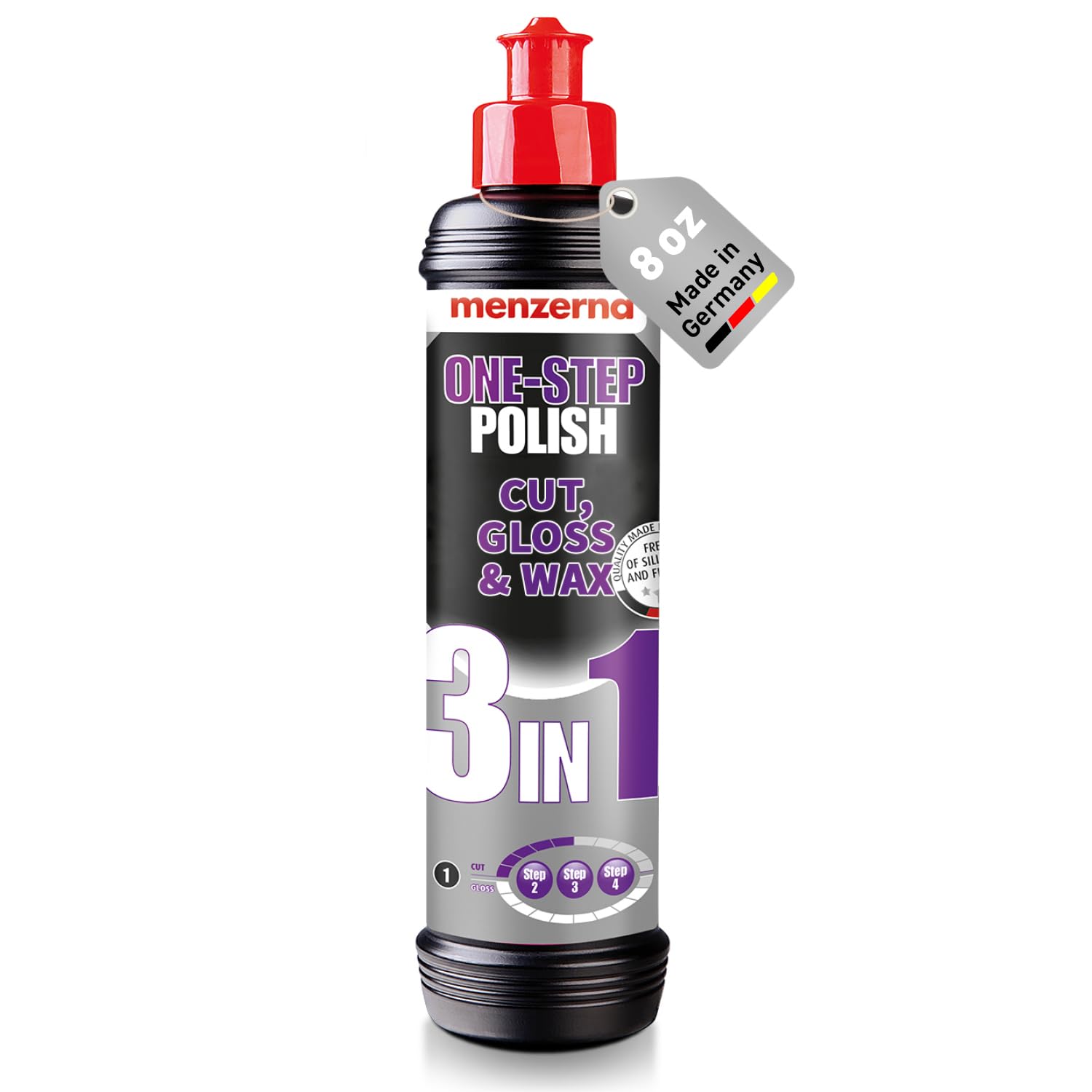
Menzerna’s 3in1 Polish combines a medium-cut abrasive system with a carnauba-based wax sealant, offering three stages — cut, finish, and protect — in a single bottle. This all-in-one approach is particularly useful for reconditioning used vehicles where the goal is to maximize visual appeal without spending hours on multi-step correction. Owner reports consistently note that two to three pea-sized drops per panel are sufficient, and the product does not dry out quickly during buffing, giving ample working time even for beginners.
The polish leaves behind a wax layer that provides immediate gloss and repellency, which is a practical advantage for sellers who want a show-ready finish without a separate waxing step. Users report good scratch correction on daily driver paint, with the ability to remove most swirls and light oxidation in a single pass. The 8-ounce bottle is compact but highly concentrated; experienced detailers report covering an entire SUV with minimal product consumption. Compatibility with both rotary and orbital machines makes it flexible across different skill levels.
The integrated wax component means the protection layer may not last as long as a dedicated sealant or ceramic coating. Some users note that the carnauba-based sealant degrades faster under harsh summer sun, requiring reapplication every few weeks for peak water beading. Additionally, the medium-cut abrasives may struggle with deep etching or severe clear coat damage. For a fast one-step solution that delivers an impressive shine with minimal effort, this Menzerna formula is a solid choice for quick turnarounds.
What works
- Cut, finish, and protection in one application
- Very low product consumption per panel
- Forgiving working time for beginners
- Effective on moderate swirls and oxidation
What doesn’t
- Wax protection degrades faster than dedicated sealants
- Limited cutting ability for deep defects
- Small bottle size requires careful use
9. Malco Nano Care Banana Creme Wax
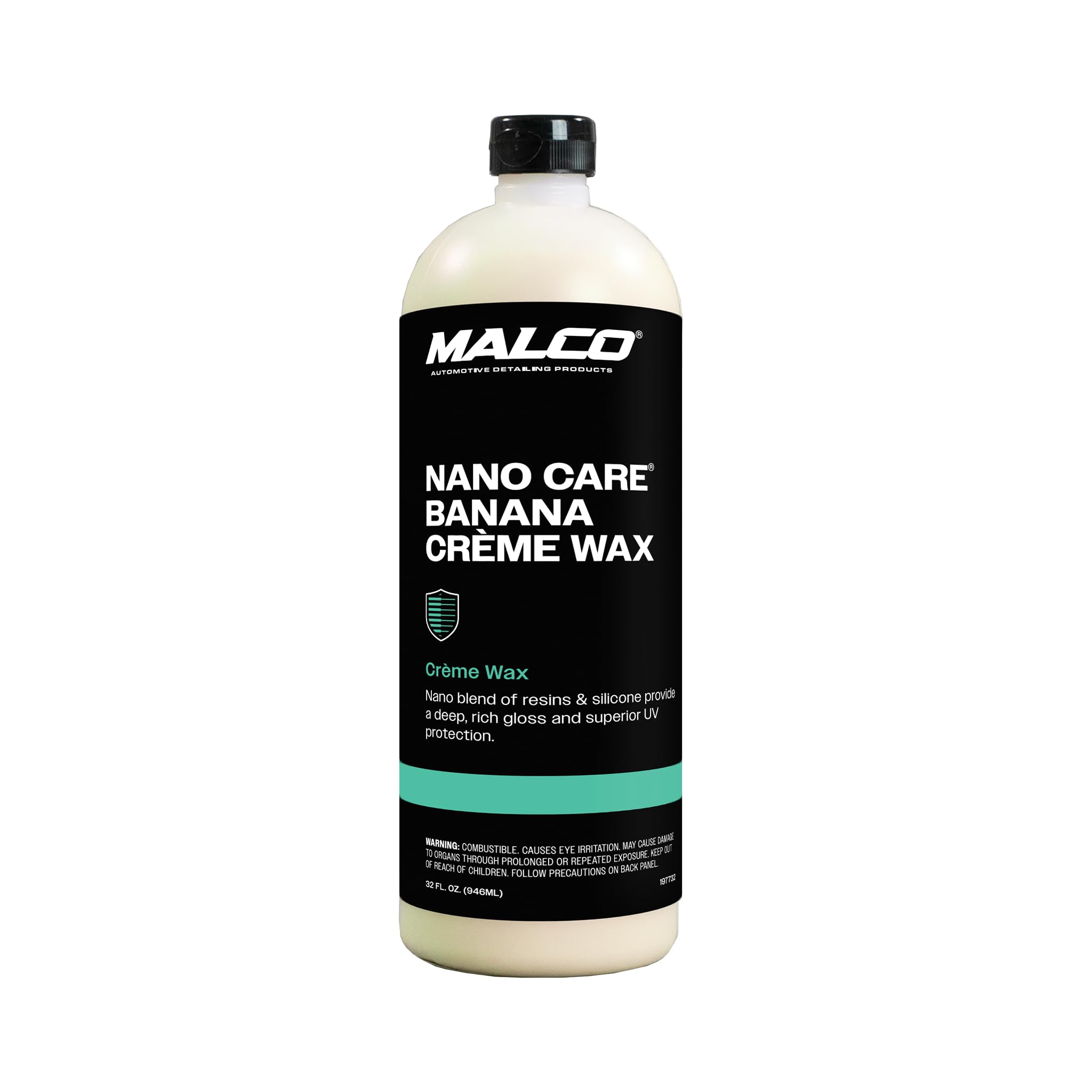
Malco’s Banana Creme Wax combines nano-sized polishing agents with dual-functional UV absorbers and amino-functional silicones to create a formula that produces a deep, warm gloss while actively protecting against sun damage. The banana-scented cream applies smoothly by hand or DA polisher and buffs off with minimal effort, making it a user-friendly option for enthusiasts who want a quick transformation. Owner feedback frequently mentions the darkening effect it has on paint, increasing depth and richness on darker colors.
The nano technology enables the wax to bond at a finer level than traditional carnauba blends, which contributes to longer durability and better water beading. Users report that it holds up well against rain and road grime for several weeks, though not as long as dedicated sealants. The 32-ounce bottle is one of the larger sizes in this segment, providing excellent coverage for multiple vehicles. Many detailers mention that a little goes a long way, with one bottle likely covering fifteen or more full-size SUV applications.
This product functions primarily as a wax with mild cleaning ability rather than a cutting polish. It will not correct heavy swirls or oxidation, and users with significantly neglected paint will need a compounding step beforehand. Some owners note that the cream can leave a slight residue in cracks and crevices if applied too thickly, requiring careful wipe-down. For a high-gloss wax that brings out the best in well-maintained paint, Banana Creme offers one of the most satisfying shine-to-effort ratios available.
What works
- Deep, warm gloss with excellent color enhancement
- Large 32-ounce bottle with great coverage
- UV absorbers help prevent sun damage
- Very easy on-off application
What doesn’t
- Limited abrasive capability for defect correction
- Durability is less than polymer sealants
- Can leave residue if applied too heavily
10. Mothers California Gold Pure Brazilian Carnauba Wax

Mothers California Gold Pure Brazilian Carnauba Wax is a benchmark for true carnauba enthusiasts who prioritize warmth and clarity over synthetic durability. As the third step in Mother’s Ultimate Wax System, it is engineered to lock in the results of cleaning and polishing steps, delivering a deep, wet-looking gloss that pure natural waxes are known for. Owner reports consistently praise the reflective depth it produces on dark paint, with a richness that polymer-based products often struggle to replicate.
The hard paste consistency is typical of high-carnauba-content waxes, and it requires a thorough cleaning of the paint surface before application to avoid sealing in contamination. Users emphasize that applying a very thin layer with a foam applicator and allowing it to fully haze before buffing yields the best results. The 12-ounce can provides enough wax for numerous applications; many owners report a single can lasting several years even with regular use. The protective layer beads water beautifully, though the longevity is measured in weeks rather than months.
Where this wax falls short for some users is in its lack of cleaning or abrasive capability. It is strictly a finishing wax, meaning the paint must already be free of swirls and oxidation to achieve a show-worthy result. The hard paste can be slightly more challenging to apply and remove than liquid or cream alternatives, particularly in cooler temperatures. For traditionalists who appreciate the unmatched warmth of pure carnauba and are willing to reapply frequently to maintain the glow, this remains a staple in the detailing community.
What works
- Unmatched warmth and depth of carnauba gloss
- Excellent water beading on clean paint
- Large can provides years of use
- Safe for all clear coats and traditional paints
What doesn’t
- No abrasive or cleaning ability
- Protection lasts only a few weeks
- Hard paste can be challenging to apply in cold weather
- Requires perfectly clean paint to avoid sealing in dirt
11. Wizards Shine Master Polish and Breathable Sealant

Wizards Shine Master Polish and Sealant is a poly-acrylic formulation designed to restore faded paint while depositing a breathable sealant layer that protects without trapping moisture underneath. The all-in-one approach allows users to polish and protect in a single step, which is particularly appealing for those maintaining multiple vehicles, boats, or motorcycles. Owner feedback highlights its ability to remove dead paint and fine scratches when applied with firm pressure, making it a viable swirl remover after heavier compounding.
The breathable sealant technology is a distinctive feature that differentiates it from traditional waxes and sealants. Users report that it does not crack or peel over time, and multiple coats can be applied for extended protection without building up a brittle layer. The 16-ounce bottle delivers generous coverage, and the product performs well both by hand and with a rotary polisher. Many owners note that it works effectively on marine gelcoat and motorcycle fairings, adding to its versatility as a multi-surface detailing product.
The primary limitation is that the polish’s cut level is best suited for lighter defect removal rather than heavy correction. Heavily oxidized or deeply scratched paint will require a more aggressive compound before using this product. Some users also note that achieving maximum gloss requires attention to the wipe-off stage, as the sealant can leave a slightly tacky feel if not buffed thoroughly. For a budget-conscious entry point into all-in-one paint correction and protection, Wizards offers solid performance at a low barrier to entry.
What works
- All-in-one polish and breathable sealant
- Works on automotive, marine, and motorcycle surfaces
- Multiple coats build protection without cracking
- Effective on light swirls and faded paint
What doesn’t
- Limited cut for heavy oxidation or deep scratches
- Requires thorough buffing to avoid tacky residue
- Not a substitute for dedicated ceramic or polymer coatings
Hardware & Specs Guide
Abrasive Technology and Cut Levels
Automotive polishes use abrasive particles suspended in a lubricating carrier to level the clear coat surface. The grit size and shape determine the cut intensity: heavy-cut compounds use larger, more angular aluminum-oxide or silicon-carbide particles to remove deep scratches, while fine and ultra-fine polishes use smaller, rounded abrasives that refine the surface to a haze-free gloss. Modern formulations like those from Meguiar’s M210 and 3M Perfect-It EX use progressively breaking down abrasives that fracture during buffing, allowing a single product to both cut and finish as the particle size reduces. Matching the abrasive technology to your paint’s hardness and defect depth prevents wasted effort and avoids thinning the clear coat unnecessarily.
Protection Longevity and Environmental Resistance
The base chemistry of a polish directly determines how long its protective properties last. Carnauba wax formulations, like the Mothers California Gold, provide unmatched optical warmth but degrade within two to four weeks under UV exposure and acidic rain. Polymer sealants such as Finish First and Liquid Glass cross-link with the paint to form a semi-permanent barrier that can withstand six to twelve months of environmental assault. SiO2-enriched polishes like CARPRO Essence deposit a quartz layer that combines gloss enhancement with hydrophobic protection that survives multiple automated car washes. Consider your climate, storage conditions, and willingness to reapply when choosing between these protection profiles.
FAQ
What is the difference between a polish and a wax?
How often should I apply automotive polish?
Can I use automotive polish by hand instead of a machine?
Will automotive polish remove deep scratches?
Is SiO2 polish better than traditional carnauba wax?
Final Thoughts: The Verdict
For most buyers, the best automotive polish winner is the Meguiar’s M21032 Ultra Pro Finishing Polish because it delivers a flawless mirror finish on dark and metallic paints without the risk of holograms or micro-marring, and its extended working time makes it forgiving for both professionals and serious enthusiasts. If you want built-in SiO2 protection and correction in a single pass, grab the CARPRO Essence. And for a budget-friendly all-in-one that polishes and breathes with the paint, nothing beats the Wizards Shine Master for value-driven multi-surface use.

Certification: BSc in Mechanical Engineering
Education: Mechanical engineer
Lives In: 539 W Commerce St, Dallas, TX 75208, USA
Md Amir is an auto mechanic student and writer with over half a decade of experience in the automotive field. He has worked with top automotive brands such as Lexus, Quantum, and also owns two automotive blogs autocarneed.com and taxiwiz.com.