Painting automotive plastic is plagued by one universal failure: adhesion loss. Whether it’s a meticulously prepped bumper cover, a faded trim piece, or a custom motorcycle fairing, the line between a factory-quality finish and a peeling disaster is drawn entirely by the foundation underneath. Generic hardware store primers lack the chemical flexibility and mechanical grip required for modern polyolefins, leaving topcoats vulnerable to chipping and delamination. Understanding the specialized chemistry of adhesion promoters, etch primers, and 2K epoxy systems is the only way to guarantee a result that withstands weather, wash cycles, and road debris.
I’m Amir — the founder and writer behind Four Wheel Ask. My approach combines rigorous analysis of technical data sheets, cross-referencing manufacturer claims, and aggregating long-term owner feedback to separate marketing hype from genuine formulation differences.
This guide evaluates eleven products across the adhesion spectrum, from budget-friendly bonding primers to professional-grade catalyzed systems. To guarantee a factory-quality bond that resists peeling and chipping, choosing the right best automotive plastic primer is the single most critical step in any refinishing project.
How to Choose the Best Automotive Plastic Primer
Selecting the correct primer requires matching chemistry to the specific plastic type and the performance demands of the project. The wrong choice guarantees failure, while the right one delivers a finish indistinguishable from OEM coating systems.
Adhesion Technology
The mechanism of adhesion varies widely. Mechanical adhesion relies on sanding to create a tooth, while chemical adhesion uses solvents that partially dissolve the plastic surface (etching or melt-in) to create a fused bond. Wash primers use phosphoric acid for metal, while adhesion promoters for plastic use aggressive solvent blends that require careful flash timing.
Substrate Specificity
Low-energy plastics like Polyethylene (PE) and Polypropylene (PP) demand specialized high-solvent promoters to raise surface energy enough for paint to wet out and grip. ABS, Polycarbonate (PC), and Polyurethane (PU) are more forgiving, but still benefit from a flexible primer system rather than a rigid, high-solids automotive primer designed for steel.
Application Method & Cure System
1K aerosol products offer unmatched convenience for small jobs but cure solely by solvent evaporation, leaving a thermoplastic film. 2K catalyzed systems (urethane or epoxy) chemically cross-link, creating a thermoset film with superior solvent resistance, hardness, and adhesion. The trade-off is pot life, mixing complexity, and the need for proper respiratory protection.
Quick Comparison
On smaller screens, swipe sideways to see the full table.
| Model | Category | Best For | Key Spec | Amazon |
|---|---|---|---|---|
| SEM 39863 | Adhesion Promoter | Polypropylene & ABS plastics | 14.8 oz, Low Viscosity | Amazon |
| SprayMax 2K Epoxy | 2K Epoxy Primer | Maximum durability & corrosion resistance | 12.5 oz, 2K Aerosol | Amazon |
| 3M 4298UV | Tape Primer | Adhesive bonding for emblems & trim | 4 fl oz, UV Detectable | Amazon |
| Custom Shop Promoter | Adhesion Promoter | Fiberglass & truck bed liners | 12 oz, High Atomization | Amazon |
| Klean-Strip Bulldog | Adhesion Promoter | Polyolefin plastic (bumpers) | 15 oz, Fills 320 Grit | Amazon |
| Custom Shop Epoxy Kit | 2K Epoxy Primer | DTM on metal & rigid plastics | 1 Quart, 1:1 Mix | Amazon |
| U-POL High Build | Urethane Primer | Filling imperfections & blocking | 1 Gallon, 4:1 Mix | Amazon |
| Speedokote Fast Dry | Epoxy Primer | Production shop efficiency | Gallon Kit, 4:1 Mix | Amazon |
| Raptor Acid Etch | Etch Primer | Bare metal substrate prep | 13.2 oz, 1K Aerosol | Amazon |
| Dupli-Color DAP1689 | Sandable Primer | General purpose & metal surfaces | 12 oz, 360° Nozzle | Amazon |
| Rust-Oleum 286793 | Bonding Primer | Multi-surface adhesion | 12 oz, Flat White | Amazon |
In‑Depth Reviews
1. SEM 39863 Plastic Adhesion Promoter

SEM has long been a staple in professional automotive repair facilities, and the 39863 formulation is their dedicated solution for low-surface-energy plastics. Spec analysis confirms a low-viscosity solvent blend designed to penetrate porous plastic substrates and create a chemical melt-in layer. Owner feedback consistently highlights its ability to prevent paint delamination on flexible bumpers and trim pieces, even under extreme temperature swings.
Real-world applications documented in owner reviews include repairing a 2020 Traverse bumper and refinishing motorcycle panels. The consensus is that SEM 39863 significantly reduces the flash-off time needed before topcoating and provides a visibly stronger bite than generic spray primers. The aerosol spray pattern is well-regarded for applying thin, controlled coats without runs, which is critical for maintaining the texture of underlying plastic.
While the cost per ounce positions this as a premium option relative to hardware store primers, the reduced failure rate and labor savings from rework make it a cost-effective choice for serious restorations. It performs best when used as part of SEM’s complete refinishing system, but compatibility with aftermarket basecoats and clears is broadly reported as excellent.
What works
- Exceptional chemical bond to polyolefins
- Thin viscosity prevents texture buildup
- Professional-grade, consistent results
What doesn’t
- Premium price per can
- Limited availability in local stores
2. SprayMax 2K Epoxy Primer Black
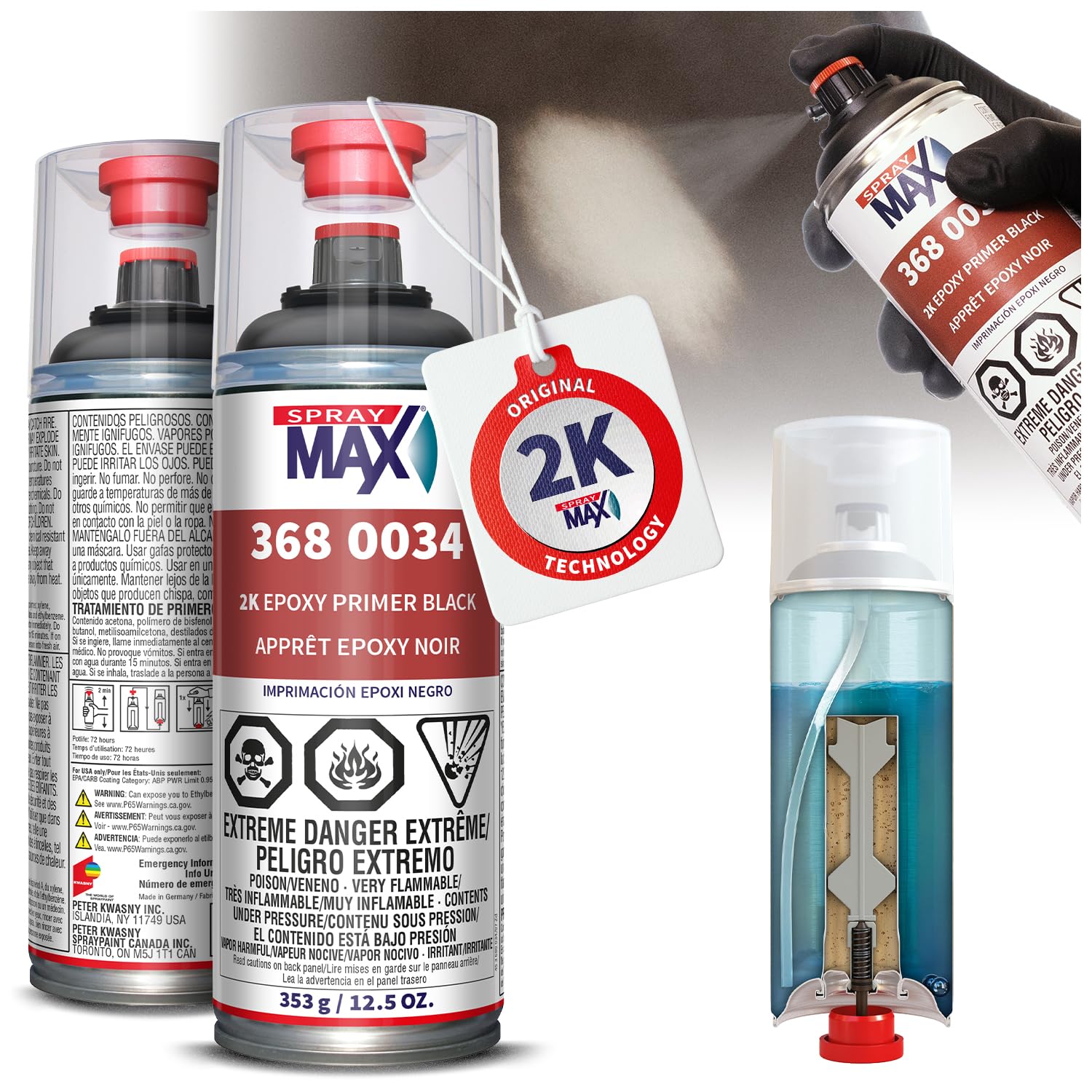
SprayMax bridges the gap between rattle-can convenience and spray-gun performance by offering a true 2K epoxy system in an aerosol can. The internal catalyst activation system delivers a thermoset film that provides superior solvent resistance and mechanical hardness compared to any 1K primer. Technical documentation shows a 15-minute dust-dry time with full sandability achievable within hours, a workflow advantage for high-efficiency projects.
Owner feedback from motorcycle restorations reveals that three cans can adequately coat a set of fairings and a tank with multiple coats, producing a surface that sands like a professionally sprayed epoxy primer. The adjustable fan tip allows the user to tailor the spray pattern for coverage on large panels or precision on small parts. One reviewer noted that despite the 2K hardness, the primer sands smoothly with 600 grit without clogging paper.
The primary consideration is the single-use nature of the 2K activator mechanism—once activated, the entire can must be used within the pot life window, or it will harden in the can. Storage conditions also matter, as temperature fluctuations can prematurely activate the internal bladder. For users who need genuine 2K performance without investing in spray equipment, this is the definitive option.
What works
- True 2K cross-linking chemistry
- Excellent sandability and adhesion
- Adjustable fan pattern
What doesn’t
- Nozzle sputtered on some units
- Must use entire can after activation
3. 3M 4298UV Adhesion Promoter

Unlike paint primers, 3M 4298UV is specifically formulated to prepare plastic surfaces for acrylic foam tapes used in emblem, molding, and trim attachment. Chemical analysis shows it contains a solvent mixture that temporarily dissolves the plastic surface, allowing the tape adhesive to mechanically interlock at a molecular level. This is the same chemistry used by OEMs for factory trim installation.
Owner reports confirm its extreme effectiveness: one review documented aftermarket louvers staying firmly attached to a Mustang at 145 mph, while another used it for structural attachment on a golf cart roof. The UV tracer additive allows technicians to inspect coverage with a black light, ensuring no bare spots are missed. The bottle format is significantly more economical than the single-use packets, providing enough material for dozens of applications.
The primary risk factor is over-application. If the promoter seeps beyond the intended bond line, it can stain or damage the surrounding paint finish. Ventilation and gloves are mandatory. For non-tape applications like direct paint adhesion, other products in this guide are more appropriate, but for its intended role, 4298UV is the industry benchmark.
What works
- Extreme bond strength for tape
- UV trace for application verification
- Excellent value per ounce
What doesn’t
- Can stain surrounding paint
- Strong solvents require ventilation
4. Custom Shop Adhesion Promoter
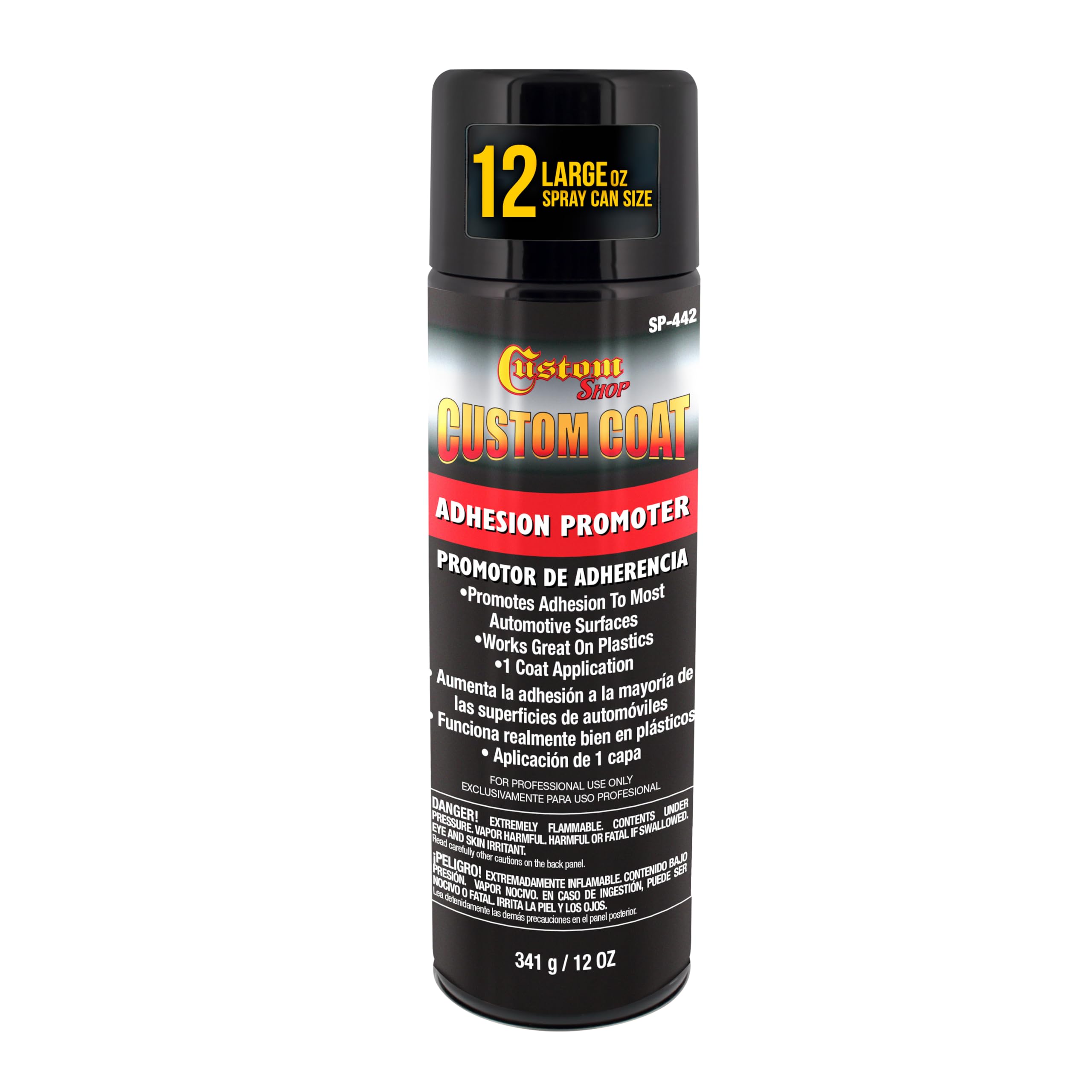
Custom Shop’s SP-442 adhesion promoter is designed as a universal bridge between difficult substrates and topcoats. Market research positions it as a direct alternative to name-brand promoters, with a formula optimized for hard-to-sand areas like intricate bumper contours and engine bay components. Its clear finish allows it to be used under any color without affecting the final hue.
Owner feedback highlights its success on diverse substrates, including fiberglass golf cart bodies, melting dashboards in Nissan Altimas, and truck bed liners. The high-atomization nozzle is noted for producing a fine mist that lays down evenly, though reports of nozzle clogging during intermittent use suggest the need for regular cleaning mid-project or using consistent short bursts.
Performance data gathered from user reports indicates that a single coat, followed by a 30-minute flash time, provides adequate adhesion for basecoat application. It does not create the same structural bond as a 2K epoxy, but for flexible plastic parts and non-structural panels, it offers a reliable and convenient solution at a competitive mid-range price point.
What works
- Excellent adhesion on multiple plastics
- Clear coating won’t affect topcoat color
- Suitable for fiberglass and painted surfaces
What doesn’t
- Nozzle prone to clogging mid-use
- Clear finish makes coverage hard to judge
5. Klean-Strip Bulldog Adhesion Promoter

Klean-Strip Bulldog is one of the few aerosol products specifically engineered for polyolefin plastics, which constitute the majority of modern automotive bumper covers. Its formulation includes higher solvent strength to swell the plastic surface, combined with a binder that fills 320-grit sanding scratches, creating a unified layer for paint to adhere to. The 5-minute tack-free dry time is exceptionally fast, streamlining the prep process.
Owner reviews consistently recommend this for professionals painting new or bare replacement bumpers. The feedback notes that it sprays very thin and can cause runs if applied too heavily, requiring a misted approach from a distance. Despite the application learning curve, the results—paint staying intact on polyolefin surfaces—are highly praised.
The primary drawbacks are its high price per can and the thin consistency that can mislead users expecting a thick primer. It remains active on the surface for up to 24 hours, allowing for batch prep of multiple parts. For shops dealing with difficult polypropylene bumpers that other primers fail on, Bulldog is a proven specialist tool.
What works
- Specifically designed for polyolefin plastic
- Ultra-fast 5-minute dry time
- Remains active for 24 hours
What doesn’t
- Very expensive per can
- Thin consistency requires careful technique
6. Custom Shop Black Epoxy Primer/Sealer Kit

The KEP (Kustom Shop Epoxy Primer) series is a 2.1 VOC compliant, direct-to-metal epoxy that offers substantial build and anti-corrosive properties. The 1:1 mix ratio by volume is simple to measure, and technical data confirms a 4-hour pot life and the ability to be topcoated within 30 minutes when used as a sealer. This flexibility makes it suitable for both bare metal panels and properly prepared rigid plastics.
Owner feedback from professional and advanced DIY users indicates that when properly mixed, it lays down exceptionally smooth through a spray gun, providing excellent mileage per gallon. The hard, sandable finish resists shrinking over body filler, a common issue with lower-quality primers. Users paired it with various topcoat brands successfully, confirming its role as a neutral, high-performance foundation.
Some quality control issues have been reported regarding settled solids that are difficult to remix, which can result in a glossy, unsandable surface if the binder is applied without proper agitation. Using a drill-powered mixer at the bottom of the can is essential. For projects requiring maximum chemical resistance and a thick, blockable film, this kit represents strong value.
What works
- Excellent corrosion resistance
- High build for blocking panels
- Versatile DTM or sealer application
What doesn’t
- Solids can be stubborn to remix
- Requires spray gun equipment
7. U-POL 1 Gallon High Build Urethane Primer Kit

U-POL’s European-formulated high-build urethane primer functions as a primer-filler-sealer, designed to minimize labor by combining multiple steps. The 4:1 mix ratio and high solids content mean it can be applied thick to fill pitting, sand scratches, and minor surface imperfections in a single stage. Technical data supports its use direct-to-metal and over properly prepared primers.
Owner feedback heavily emphasizes the sandability of this material, with multiple users describing it as “sanding like butter” and excellent for blocking. It dries fast enough to be sanded within a couple of hours, accelerating the refinishing workflow. The opacity is noted as excellent, covering dark substrates thoroughly in two coats.
The main drawbacks are logistical: a full gallon kit is excessive for small touch-ups and has a limited shelf life once mixed. It is also a 4.2 VOC formula, which may not be legal in all regions without proper permitting. For shops or heavy-duty hobbyists tackling full panel restorations, the U-POL system is a time-saving, high-fill powerhouse.
What works
- Exceptional filling capability
- Easily sandable to a smooth finish
- Can be topcoated quickly
What doesn’t
- Large quantity may waste for small jobs
- VOC content restricted in some areas
8. Speedokote Epoxy Fast Dry Primer & Sealer

Speedokote’s SMR-260 series is a 2.1 VOC epoxy primer designed for fast dry cycles without sacrificing adhesion or corrosion resistance. The 4:1 mix with optional 5-10% reduction allows it to lay down smoothly through conventional or HVLP spray guns. Technical application notes confirm adhesion to steel, aluminum, fiberglass, and OEM finishes.
Owner experiences present a nuanced picture. Initial feedback from one user reported a total adhesion failure on bare metal, requiring blasting off at 28 PSI. However, the manufacturer’s subsequent customer service and the user’s eventual success with proper prep and degreaser suggest the formulation itself is sound but extremely sensitive to surface cleanliness. Other users report it sprays wonderfully, dries fast, and sands easily, describing it as “the Wagyu beef of primers.”
The gallon cans are reported to be slightly underfilled, leaving a surplus of hardener when mixing the standard 4:1 ratio from a full can. Users should verify this upon receipt. When applied with meticulous prep, the final results are described as excellent, with a smooth surface that wet sands beautifully to 600 grit. It is a high-performance product that demands high-performance prep work.
What works
- Sprays and sands beautifully
- Fast dry time for efficient workflow
- Professional-grade finish
What doesn’t
- Adhesion failure reported with poor prep
- Cans may be slightly underfilled
9. Raptor Acid Etch Primer 1K Aerosol

Raptor Acid Etch Primer fills a specific niche: preparing bare metal panels, especially galvanized steel and aluminum, for topcoating. The phosphoric acid ester formula creates a microscopic etch on smooth metal surfaces, providing mechanical anchorage while also passivating the metal to prevent flash rusting. This is a critical step for any restoration involving stripped metal.
Owner feedback confirms its effectiveness when used as a prep for spray-on bed liners and running boards. The flat fan nozzle is designed for high atomization, delivering even coverage on large panels. One user reported that nearly a year after application, the primer and subsequent liner showed no signs of delamination or corrosion creep.
This product is specifically not designed for plastic substrates; applying it to flexible parts will likely result in cracking. The fumes are potent, containing reactive acids, so full ventilation and a respirator are mandatory. For its intended purpose of sealing and etching bare metal in a single, convenient aerosol step, it outperforms general-purpose primers by a wide margin.
What works
- Creates excellent mechanical etch on metal
- Provides rust and corrosion protection
- No sanding required before topcoat
What doesn’t
- Not suitable for plastic surfaces
- Strong chemical odor requires respiratory protection
10. Dupli-Color DAP1689 Sandable Primer

Dupli-Color’s DAP1689 is a classic general-purpose sandable primer that has been a staple in the automotive aftermarket for decades. It is formulated primarily for metal, fiberglass, and wood, but owner feedback indicates it works tolerably on plastic when the surface is thoroughly scuffed and cleaned. The EZ Touch 360° Fan Spray Nozzle provides good control and coverage for a standard aerosol can.
Market feedback from budget-conscious restorers rates this highly for its cost-to-coverage ratio. It dries quickly to a semi-gloss finish that sands smoothly, filling light scratches effectively. Multiple owners noted that on rigid plastics like ABS, it provides an acceptable base for topcoats, though its lack of flexibility makes it unsuitable for flexible bumper covers.
The primary limitation is adhesion strength on olefin plastics; it relies heavily on mechanical abrasion rather than chemical bonding. For metal parts, interior trim, and non-flexible applications, it represents strong value. For flexible exterior plastics, a dedicated adhesion promoter is a significantly safer investment to prevent long-term peeling.
What works
- Excellent value for general priming
- Sands easily to a smooth finish
- User-friendly spray nozzle
What doesn’t
- Limited chemical adhesion on plastics
- Not flexible enough for bumper covers
11. Rust-Oleum 286793 Universal Bonding Primer

Rust-Oleum’s Universal Bonding Primer is marketed as a solution for difficult surfaces including plastic, fiberglass, and galvanized metal. It is the most budget-friendly option in this guide, widely available in retail stores. The flat white color provides an excellent base for light-colored topcoats and allows easy visual confirmation of coverage during application.
Owner reviews on automotive projects are mixed but generally positive for non-critical applications. It performed well on a white car for minor body repairs and reduced sanding time by filling small defects effectively. However, some users reported a textured finish that required extra sanding to achieve smoothness, which somewhat negates the labor savings. The 30-minute dry-to-touch time is competitive with other 1K aerosols.
The formula prioritizes versatility over specialized performance. It does not contain the aggressive solvents needed to chemically bond to polypropylene or polyethylene, so longevity on flexible exterior parts is questionable. For interior trim, solid panels, and projects where convenience and price are the primary drivers, Rust-Oleum provides an adequate foundation. For critical exterior adhesion, investing in a higher-tier promoter is recommended.
What works
- Exceptional coverage per can
- Quick dry time for rapid work
- Easy to find at retail stores
What doesn’t
- Textured finish may require sanding
- Weak chemical adhesion on plastics
Hardware & Specs Guide
Adhesion Mechanisms
The science of plastic painting hinges on surface energy. Low-energy plastics like PP/PE require chemically aggressive promoters (containing solvents like xylene or toluene) to temporarily swell the plastic matrix, allowing the primer to penetrate and form a mechanical lock as the solvent flashes off. High-energy plastics like ABS or PU can be successfully primed with urethane or epoxy systems that provide a strong mechanical tooth following abrasion. Standard lacquer-based primers lack this internal bonding capability and rely purely on surface profile, making them the leading cause of topcoat delamination on flexible plastic parts in field conditions.
1K vs. 2K Cure Systems
Single-component (1K) primers cure through solvent evaporation and remain thermoplastic. They can be re-dissolved by aggressive solvents in topcoats, leading to lifting. Two-component (2K) systems (epoxy or urethane) initiate an irreversible chemical cross-linking reaction when the hardener is added. This creates a thermoset polymer that is resistant to solvents, heat, and physical impact. While 2K systems require mixing and have a limited pot life, the resulting film hardness and long-term adhesion are significantly superior for exterior-grade automotive refinishing.
VOC Compliance and Practical Impact
Regulations limit Volatile Organic Compounds (VOCs) in paints and primers. Products labeled 2.1 VOC or 4.2 VOC indicate the solvent load per liter. Lower VOC formulations (2.1) may contain slower-evaporating solvents, which can improve flow and leveling but may extend drying times or require specific hardeners. High-VOC (4.2) products like the U-POL offer faster flash and better build but are restricted in many professional shop environments. Choosing a compliant product ensures legality without necessarily sacrificing performance, provided the application technique is adjusted.
Surface Preparation Protocol
No primer can overcome poor preparation. The standard industry protocol for plastic refinishing involves: (1) Cleaning with a waterborne degreaser to remove mold release agents and oils. (2) Abrading with 400-600 grit sandpaper (dry) to create a uniform mechanical profile. (3) Re-cleaning with a dedicated wax and grease remover. (4) Applying the adhesion promoter or epoxy primer within the specified flash window (typically 5-30 minutes). Skipping any step in this chain is the single most documented cause of adhesion failure in owner feedback data.
FAQ
What is the difference between an adhesion promoter and a standard primer?
Do I need to sand plastic before using an adhesion promoter?
Can I apply an adhesion promoter over existing paint?
How long should I wait before topcoating after applying primer?
Final Thoughts: The Verdict
For most buyers, the best automotive plastic primer winner is the SEM 39863 because it offers the most reliable chemical bond for the widest range of automotive plastics in a convenient aerosol format. If you want maximum film hardness and corrosion resistance for a bare-metal restoration or a high-stress panel, grab the SprayMax 2K Epoxy Primer. And for securely bonding emblems and trim that must never fail, nothing beats the 3M 4298UV Adhesion Promoter.

Certification: BSc in Mechanical Engineering
Education: Mechanical engineer
Lives In: 539 W Commerce St, Dallas, TX 75208, USA
Md Amir is an auto mechanic student and writer with over half a decade of experience in the automotive field. He has worked with top automotive brands such as Lexus, Quantum, and also owns two automotive blogs autocarneed.com and taxiwiz.com.