Plastic repairs on a vehicle are rarely simple — interior trim cracks, bumper tabs snap, and mirror housings separate under vibration. A general-purpose glue simply won’t hold under hood heat, road shock, or exposure to fluids. The difference between a repair that fails in a week and one that lasts years comes down to the adhesive chemistry and the specific demands of automotive plastics.
I’m Amir — the founder and writer behind Four Wheel Ask. My work focuses on dissecting product specifications, analyzing material compatibility data, and synthesizing owner feedback across thousands of real-world repair scenarios to determine what actually holds up under vehicle conditions.
The best automotive plastic adhesive requires balancing bond strength, heat tolerance, and flexibility for lasting trim, bumper, and panel repairs.
How To Choose The Best Automotive Plastic Adhesive
Selecting the right adhesive for automotive plastic repairs requires understanding the specific stresses the bond will face. Temperature cycling, vibration, fluid exposure, and the plastic substrate itself all dictate which chemistry and format will deliver a permanent repair.
Bond Strength
Measured in PSI (pounds per square inch), bond strength indicates how much force the adhesive joint can withstand before failing. For interior trim and light exterior work, tensile strength above 2000 PSI is sufficient. For structural repairs like bumper brackets or mirror mounts, adhesives with 3000+ PSI provide the necessary margin against road loads and impact forces.
Temperature & Chemical Resistance
Underhood components, engine bay plastics, and exterior trim near exhaust paths can see temperatures exceeding 200°F. Adhesives rated for continuous heat exposure up to 230°F or higher maintain their bond when thermal cycling causes expansion and contraction. Resistance to oil, coolant, and washer fluid is equally critical for long-term reliability in automotive environments.
Flexibility vs. Rigidity
Flexible adhesives — typically urethane-based — absorb vibration and impact without cracking, making them ideal for bumpers, trim clips, and body panels. Rigid adhesives like cyanoacrylate gels offer high shear strength for non-moving parts such as dashboard panels, bracket repairs, and emblem attachment. Matching flexibility to the substrate prevents bond-line failure under stress.
Application Format & Cure Time
Syringes, cartridges, and gel bottles each suit different repair scenarios. Two-part urethane or epoxy systems require mixing but offer superior gap-filling and structural strength. Instant-bond cyanoacrylate gels cure in seconds and work well for small, precise repairs. Double-sided tapes provide clean, mess-free attachment for trim and emblems without liquid adhesive runoff.
Quick Comparison
On smaller screens, swipe sideways to see the full table.
| Model | Category | Best For | Key Spec | Amazon |
|---|---|---|---|---|
| J-B Weld Plastic Bonder | Urethane Epoxy | High-strength bumper and panel repairs | 3770 PSI tensile strength | Amazon |
| 3M Super-Fast Repair Adhesive | Urethane | Gap-filling structural plastic repairs | 47.3 mL cartridge, wide-gap filler | Amazon |
| 3M Super-Strength Molding Tape | Double-Sided Tape | Trim, emblems, and molding attachment | 180 in x 0.5 in, aircraft-grade VHB | Amazon |
| KRAFTPROTZ Automotive Super Glue Gel | Cyanoacrylate Gel | Trim, brackets, and mirror housing repairs | 1.76 oz, heat-resistant to 230°F | Amazon |
| Rhino Glue Heavy Duty | Cyanoacrylate | Multi-material bonding and quick fixes | 1.41 oz, impact and moisture resistant | Amazon |
In-Depth Reviews
1. J-B Weld Plastic Bonder Black 25ml Syringe (2 Pack)
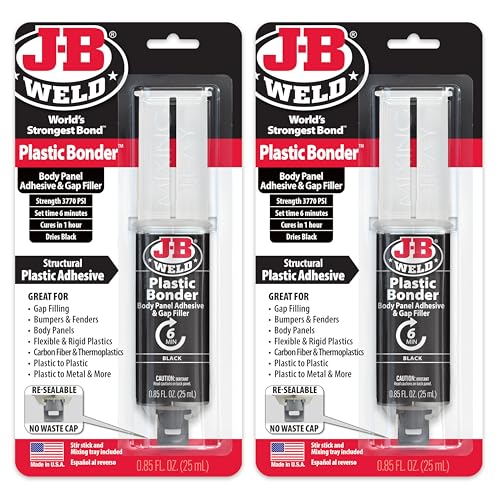
J-B Weld Plastic Bonder delivers a 3770 PSI tensile strength that places it among the strongest automotive plastic adhesives available without moving to industrial-grade systems. The two-part urethane formulation cures to a black finish that blends into bumper repairs, trim pieces, and interior panels where aesthetics matter. The 1:1 syringe design eliminates guesswork during mixing, and the resealable cap prevents the remaining adhesive from hardening between uses.
The 15-minute set time with full cure at 30 hours provides a practical working window for positioning parts before the bond locks in place. Owner reports consistently highlight the adhesive’s ability to fill gaps on cracked bumper covers and repair broken plastic brackets that other glues fail to hold. The compatibility with thermoplastics, thermoset composites, fiberglass, and coated metals makes it a versatile choice for mixed-material repairs common in modern vehicles.
For DIY mechanics who need a reliable plastic repair solution that matches professional-grade results, the J-B Weld Plastic Bonder offers the best balance of strength, workability, and value across the adhesive categories tested.
What works
- Exceptional 3770 PSI tensile strength for structural repairs
- Resealable syringe allows multiple uses without waste
- Black color blends seamlessly with dark trim and bumpers
- Works on thermoplastics, composites, fiberglass, and coated metals
What doesn’t
- Requires mixing and has a 30-hour full cure time
- Syringe can be difficult to dispense in very cold temperatures
2. 3M Super-Fast Repair Adhesive 04747

3M Super-Fast Repair Adhesive is a two-component semi-rigid urethane system engineered for professional-grade plastic repairs where gap-filling capability is paramount. The 47.3 mL cartridge format with static mixing nozzles delivers a consistent 1:1 ratio every time, eliminating the variability of hand-mixed epoxies. The translucent finish allows for use on visible interior and exterior surfaces where color match matters less than bond integrity.
Owner feedback emphasizes the adhesive’s resistance to running and sagging on vertical surfaces, which makes it suitable for repairing door panels, fairings, and exterior trim pieces where gravity would pull thinner adhesives out of position. The wide temperature tolerance suits engine bay and underbody applications where thermal cycling is a constant stressor. Full cure at 24 hours is standard for a urethane system, and the semi-rigid nature provides enough flexibility to absorb vibration without cracking.
For restorers, fleet maintenance teams, and serious DIY enthusiasts who need a dedicated urethane plastic repair solution with consistent mixing and industrial reliability, the 3M Super-Fast Repair Adhesive justifies its position as a top-tier choice.
What works
- Excellent wide-gap filling without running or sagging
- Static mixing nozzles ensure consistent 1:1 ratio every use
- Semi-rigid formulation absorbs vibration without cracking
- Resilient across a broad temperature range for underhood use
What doesn’t
- Intended for industrial/occupational use, not general consumer retail
- Cartridge system requires a compatible dispensing gun
3. 3M Super-Strength Molding Tape 03614

3M Super-Strength Molding Tape represents a completely different approach to plastic adhesion — no liquids, no mixing, no curing. This VHB (Very High Bond) double-sided tape uses aircraft-grade acrylic foam to create a permanent bond between trim pieces, emblems, side moldings, and vehicle body panels. The 0.5-inch by 15-foot roll provides ample material for multiple attachment jobs without the mess of liquid adhesives.
The temperature range of -40°F to 250°F ensures the tape maintains its hold through extreme winter cold and summer heat soak. The conformable foam core presses into textured and irregular surfaces, creating intimate contact that maximizes adhesion across the entire bond line. Owner reports consistently rate this tape as the go-to solution for reattaching loose trim and moldings that original adhesive foam has failed over time.
For those who need a clean, immediate, and vibration-resistant attachment method for non-structural plastic parts, the 3M Super-Strength Molding Tape eliminates the complexity and mess of liquid adhesives while delivering professional-grade holding power.
What works
- Instant bond with no curing time or liquid mess
- Extreme temperature range from -40°F to 250°F
- Conformable foam adheres to textured and irregular surfaces
- Aircraft-grade VHB technology for permanent exterior attachment
What doesn’t
- Not suitable for gap-filling or structural load-bearing repairs
- Surface preparation must be meticulous for long-term hold
4. KRAFTPROTZ Automotive Super Glue Gel 1.76 oz
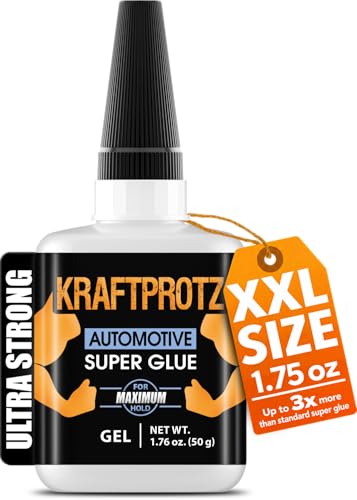
KRAFTPROTZ Automotive Super Glue Gel addresses a specific pain point for mechanics and DIYers: vertical plastic repairs where liquid cyanoacrylate runs and drips before it cures. The no-drip gel formulation stays exactly where applied, making it suited for dashboard panels, fender clips, mirror housings, and body trim that sit at odd angles. The 1.76-ounce XXL bottle holds roughly three times the adhesive of standard automotive glue tubes.
The oil-resistant and heat-resistant formulation withstands underhood temperatures up to 230°F (110°C), which covers the thermal demands of engine bay components, exterior trim, and interior parts near HVAC vents. Vibration resistance is built into the cyanoacrylate chemistry, addressing the constant mechanical stress that causes brittle adhesives to fail on vehicles. The anti-clog tip maintains consistent gel flow even after weeks of storage between repairs.
For owners who need a precision gel that stays put on vertical surfaces and handles the heat and vibration of daily driving, the KRAFTPROTZ Automotive Super Glue Gel delivers a high-value, large-format solution.
What works
- No-drip gel formula stays in place on vertical parts
- Heat-resistant to 230°F for underhood and exterior use
- Large 1.76 oz bottle offers exceptional per-application value
- Anti-clog tip prevents drying between uses
What doesn’t
- Cyanoacrylate is brittle under high-impact loads
- Not ideal for large gap-filling or structural bumper repairs
5. Rhino Glue Heavy Duty 40 Gram Clear
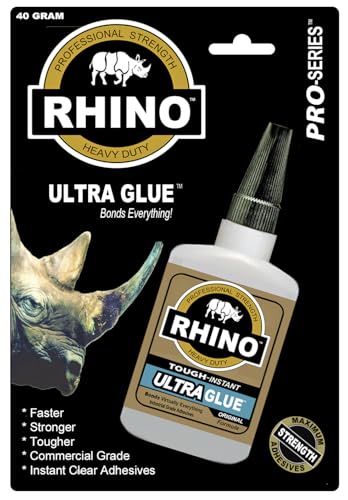
Rhino Glue Heavy Duty positions itself as a faster-curing general-purpose cyanoacrylate with a toughened formula that improves impact, shock, and moisture resistance over standard super glues. The triple-distilled manufacturing process reduces impurities that can cause cloudy bonds or inconsistent curing. The clear finish makes it suitable for visible repairs on interior trim and exterior plastic parts where appearance matters.
The adhesive bonds in seconds across a broad range of materials including plastics, vinyl, rubber, metals, ceramics, and glass, which makes it a practical addition to a shop drawer for quick fixes on multiple substrate types. The 1.41-ounce bottle provides enough volume for numerous small repairs, though the liquid consistency means it works best on horizontal or low-angle applications where gravity won’t pull the adhesive out of the joint.
For budget-conscious owners who want one adhesive that handles a wide variety of quick fixes around the vehicle and home, Rhino Glue offers a fast-curing, impact-resistant option that outperforms generic super glues without the specialized price tag.
What works
- Bonds in seconds with impact and moisture resistance
- Clear finish works for visible interior and exterior repairs
- Triple-distilled for consistent, pure adhesive quality
- Works across plastics, rubber, metal, glass, and ceramics
What doesn’t
- Liquid formula can run on vertical or overhead surfaces
- Not designed for high-heat underhood applications
Hardware & Specs Guide
Cyanoacrylate vs. Urethane vs. Epoxy
Cyanoacrylate gels cure in seconds via moisture activation and excel at small, precise repairs where clamping is difficult. They are rigid and brittle under impact, making them best for non-structural interior trim and emblem attachment. Urethane adhesives remain semi-rigid after curing, absorbing vibration and thermal expansion — ideal for bumpers, fairings, and body panels that experience flex. Epoxy systems offer the highest tensile strength (3000+ PSI) but require mixing and longer cure times, suitable for structural repairs on brackets and mounts where load-bearing capacity is critical.
Gap Filling & Surface Preparation
Gap-filling ability varies significantly by adhesive format. Two-part urethanes and epoxies bridge gaps up to several millimeters, making them the only choice for cracked or broken plastic parts where the mating surfaces no longer fit flush. Cyanoacrylate gels require tight-fitting joints for optimum bond strength. Surface preparation is non-negotiable for all adhesives — roughing the plastic with sandpaper and cleaning with isopropyl alcohol removes mold release agents, oils, and dirt that prevent chemical bonding. Flexible plastics like polypropylene and polyethylene require a compatible plastic primer or an adhesive specifically formulated for low-surface-energy substrates.
FAQ
What type of adhesive works best for automotive plastic bumpers?
Can cyanoacrylate glue handle engine bay heat?
How do I prepare a plastic surface for adhesive bonding?
Is double-sided tape strong enough to hold exterior trim permanently?
What does PSI mean in adhesive specifications?
Final Thoughts: The Verdict
For most buyers, the best automotive plastic adhesive winner is the J-B Weld Plastic Bonder because it delivers a 3770 PSI bond, versatile compatibility with multiple plastic types, and a resealable syringe format that reduces waste. If you want instant attachment without liquid adhesive, grab the 3M Super-Strength Molding Tape. And for precise gel repairs on vertical surfaces under high heat, nothing beats the KRAFTPROTZ Automotive Super Glue Gel.

Certification: BSc in Mechanical Engineering
Education: Mechanical engineer
Lives In: 539 W Commerce St, Dallas, TX 75208, USA
Md Amir is an auto mechanic student and writer with over half a decade of experience in the automotive field. He has worked with top automotive brands such as Lexus, Quantum, and also owns two automotive blogs autocarneed.com and taxiwiz.com.