Electrical gremlins can turn a simple repair into an endless loop of guesswork and wasted time. Choosing the wrong diagnostic tool only compounds the frustration, leaving you chasing symptoms instead of root causes. A precise automotive electrical circuit tester eliminates that uncertainty by delivering clear, actionable data on voltage, continuity, and circuit integrity — every time you touch a wire.
I’m Amir — the founder and writer behind Four Wheel Ask. My workflow centers on deep market research, analyzing product specifications and build quality, and aggregating real owner feedback to separate marketing fluff from genuine performance.
After thorough research comparing specs, build quality, and owner feedback, we identify the definitive best automotive electrical circuit tester.
How To Choose The Best Automotive Electrical Circuit Tester
Not all circuit testers are built the same. Some are glorified test lights, while others pack multimeter-level capability into a handheld probe. Understanding the specs that actually matter will save you from buying a tool that can’t handle your daily diagnostic needs.
Voltage Range and Input Impedance
A tester that only covers 6–12V is obsolete the moment you work on a 24V truck, RV, or heavy equipment. Look for a minimum of 6–30V support to cover passenger cars, light trucks, and commercial vehicles. High input impedance — 10 MegOhms or more — is critical on modern vehicles because it prevents the tool from loading down sensitive ECU circuits and triggering false readings.
Testing Modes and Functional Depth
Basic test lights only confirm power and ground presence. A capable circuit tester should offer continuity testing, component activation (switching loads on and off), polarity detection, and short-circuit tracing. The ability to read resistance and duty cycle adds significant diagnostic power without requiring a separate multimeter.
Cable Length and Probe Design
A short ground lead forces you to hunt for a nearby grounding point, wasting time on every test. A 20-foot extension cable lets you reach the rear of a full-size SUV or a trailer hitch without repositioning the vehicle. A sharp, stainless steel probe tip with a threaded adapter for an alligator clip adds piercing capability for back-probing weatherpack connectors without damaging seals.
Overload Protection and Build Quality
Accidentally touching power to ground can instantly destroy a cheap tester. Look for a built-in circuit breaker or fuse that trips under overload and resets without needing a replacement part. The handle should feel solid in the hand, and the button action should be crisp. A tester that feels hollow or rattles inside is a reliability risk in a professional bay.
Quick Comparison
On smaller screens, swipe sideways to see the full table.
| Model | Category | Best For | Key Spec | Amazon |
|---|---|---|---|---|
| Autel PowerScan | Power Probe | All-in-one pro diagnostics | 6–30V, 20+20ft cable, 4 modes | Amazon |
| Topdiag P100 | Power Probe | Extended reach with safety breaker | 12–24V, 20ft cable, circuit breaker | Amazon |
| KAIWEETS KT301P | Breaker Finder | Circuit tracing and GFCI testing | 30–150V, LCD, NCV, GFCI test | Amazon |
| Innova 3340 | Multimeter | Precision measurement with RPM | 10MΩ impedance, 15A, RPM clamp | Amazon |
| OTC 3633 | Test Light | Simple, reliable, compact test light | 6–12V, 12ft coil cord, needle probe | Amazon |
| ES 309A Fuse Buddy | Fuse Tester | Measuring amp draw via fuses | Micro/Mini/ATO, 30A, 0.1A res. | Amazon |
| Topdiag P60 | Power Probe | Budget-friendly all-in-one probe | 0.3–70V, LCD, short-circuit locate | Amazon |
In‑Depth Reviews
1. Autel PowerScan Automotive Circuit Tester
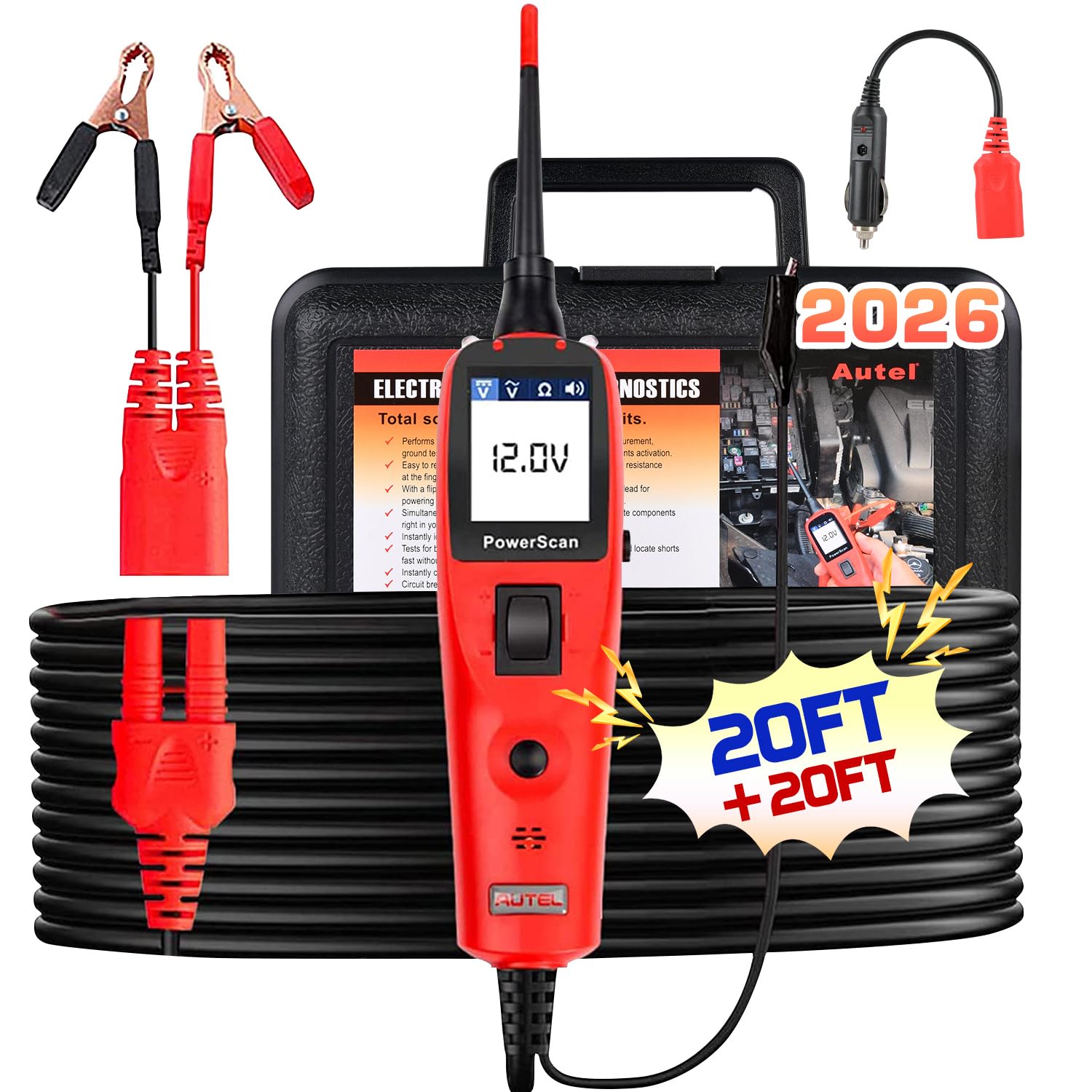
The Autel PowerScan delivers the most complete feature set in this roundup, combining voltage and polarity testing, continuity checks, component activation, and short-circuit location in a single ergonomic probe. Its four working modes — DC voltage, AC voltage, resistance, and tone on/off — allow the tool to replace both a dedicated power probe and a multimeter in most everyday diagnostic scenarios. Owner feedback consistently praises its solid build quality and intuitive interface, with multiple diesel technicians noting it performs on par with Snap-on units at roughly half the investment.
The inclusion of a 20-foot cable plus an additional 20-foot extension gives you full vehicle coverage without hunting for ground points. The built-in circuit breaker trips cleanly under overload and resets without blowing a fuse, a safety detail that matters when you are probing unknown circuits. The tip design is sturdy enough for repeated back-probing, and the bright indicator LEDs eliminate ambiguity when checking polarity in dimly lit engine bays.
Where the Autel PowerScan truly shines is in component activation. Being able to directly fire a fuel pump, cooling fan, or injector from the probe tells you instantly whether the component itself is faulty or the wiring upstream is the problem. This real-time feedback cuts diagnostic time dramatically, especially on intermittent failures that only appear under load. If you work on anything from 12V passenger cars to 24V commercial trucks, this is the one tool that genuinely does it all.
What works
- Four testing modes eliminate the need for a separate multimeter
- 40 feet total cable reach with extension included
- Built-in circuit breaker resets without replacement parts
- Component activation confirms part health in seconds
What doesn’t
- No carrying case included for storage
- Ground lead could be longer for full vehicle span
2. Topdiag P100 Power Circuit Probe Tester
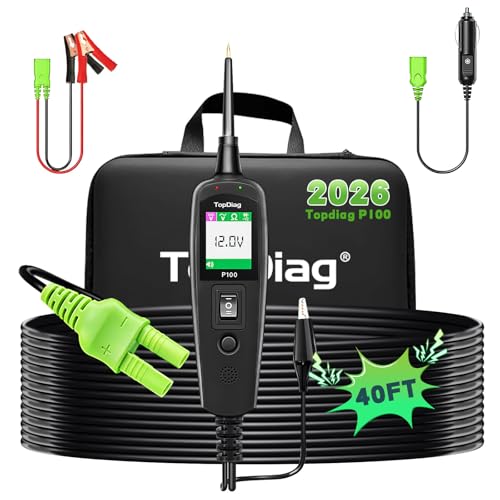
The Topdiag P100 positions itself as a versatile power probe with an emphasis on safety and extended reach. Its built-in circuit breaker is the standout feature — if you accidentally short the probe to ground, the breaker trips instantly and resets with a simple button press, protecting both the tool and the vehicle electronics. The 20-foot extension cable provides ample freedom to move around the vehicle, and the wide 9V to 30V input range covers everything from compact cars to heavy-duty trucks and excavators.
Owners consistently report that the P100 accurately diagnoses continuity, ground connections, short circuits, and polarity without the learning curve of a full multimeter. The component activation function lets you pulse test fuel pumps, solenoids, and cooling fans directly, which is invaluable for isolating a dead component from a broken wire. The package includes a storage case, and the 60-day no-questions-asked return policy adds confidence for first-time power probe buyers.
Where the P100 differentiates itself is in the clarity of its display and the ergonomics of the probe handle. The LCD readout shows voltage values in real time, and the LED indicators for polarity are bright enough to see in direct sunlight. The main trade-off is that the ground cable is on the shorter side relative to the extension, so you may need to reposition the clamp occasionally. Still, for a mid-range investment, this tool delivers professional-grade capability without the professional price tag.
What works
- Resetable circuit breaker eliminates fuse replacement
- 20-foot extension cable covers full vehicle length
- Component activation pins down faulty parts quickly
- Clear LCD and LED indicators work in bright conditions
What doesn’t
- Ground lead is shorter than ideal for large vehicles
- Plastic housing does not feel as rugged as premium competitors
3. KAIWEETS KT301P Circuit Breaker Finder
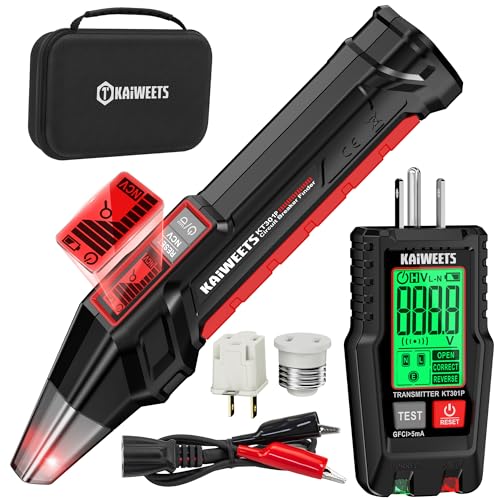
The KAIWEETS KT301P takes a different approach from traditional power probes by combining a circuit breaker finder, GFCI outlet tester, and non-contact voltage detector into one compact kit. While it is primarily designed for residential and commercial electrical work, its ability to trace circuits and identify breakers makes it a valuable addition to an automotive tool set — particularly for diagnosing trailer wiring, RV electrical systems, and shop power distribution. The large LCD screen with backlight displays real-time voltage from 30V to 150V and identifies seven common wiring faults.
Owner feedback highlights the clarity of the display and the accuracy of the signal tracing. The two-pass identification method — first learning the circuit, then identifying the breaker — eliminates false positives that plague cheaper tracers. The included accessories, such as the 3-prong to 2-prong adapter, light socket adapter, and alligator clip adapter, extend its versatility beyond simple outlet testing. The compact carrying case keeps everything organized, making it easy to grab when you need to map an unknown circuit.
Where the KT301P earns its place in an automotive context is the GFCI test and non-contact voltage function. Quickly verifying that a shop outlet is properly wired and protected before plugging in shop equipment is a genuine time-saver. The auto-hold function retains the last reading after unplugging, so you do not need to crane your neck to see the display. If your diagnostic work involves both vehicle circuits and facility wiring, this tool bridges the gap without requiring two separate devices.
What works
- Combines breaker tracing, GFCI test, and NCV in one unit
- Large backlit LCD shows voltage and fault status clearly
- Two-pass identification eliminates false positives
- Includes multiple adapters and padded carrying case
What doesn’t
- Limited to 30–150V, not designed for low-voltage automotive circuits
- Requires two passes for accurate breaker identification
4. Innova 3340 Professional Automotive Digital Multimeter

The Innova 3340 is not a power probe in the traditional sense — it is a full-featured automotive digital multimeter that brings lab-grade measurement to the DIY garage. Its 10 MegOhm input impedance ensures it will not load down sensitive ECU circuits, making it safe for modern engine control modules. The inductive RPM clamp allows you to measure engine speed without piercing spark plug wires, and the temperature probe expands diagnostic capability to cooling system and HVAC troubleshooting. For the price, this multimeter packs more automotive-specific functionality than any general-purpose meter in its bracket.
Users consistently praise the auto-ranging function, which eliminates the need to manually select voltage or resistance ranges during quick checks. The large backlit display is easy to read in low-light conditions, and the auto-shutoff feature prevents accidental battery drain. The overload protection on all ranges adds a layer of safety when probing unknown circuits. The included carrying case keeps the meter, leads, temperature probe, and RPM clamp organized, which is a detail many competitors overlook.
Where the Innova 3340 truly delivers value is in its ability to measure duty cycle and pulse width — critical for diagnosing fuel injectors, idle air control valves, and variable-speed fans. Combined with the Min/Max recording function, you can capture intermittent voltage drops or spikes that would be missed by a standard power probe. The included test leads are serviceable but not premium; upgrading to silicone-jacketed leads with finer tips improves back-probing performance. For home mechanics who want multimeter accuracy with automotive-specific features, this is the best investment.
What works
- 10MΩ impedance protects ECU circuits from loading
- Inductive RPM clamp measures engine speed without piercing wires
- Auto-ranging and auto-shutoff simplify daily use
- Measures duty cycle and pulse width for injector diagnostics
What doesn’t
- Included test leads feel thin for heavy professional use
- No low-current measurement below 15 amps
5. OTC 3633 Mini-Coil Cord Circuit Tester

The OTC 3633 is a throwback to the classic test light, but with modern execution that makes it a reliable everyday companion. Its needlepoint stainless steel probe pierces wire insulation cleanly without leaving a large hole, and the threaded tip accepts a screw-on alligator clip for hands-free testing. The 12-foot heavy-duty coiled cord retracts neatly for storage and extends far enough to reach the rear of most vehicles. The replaceable incandescent bulb is bright enough to be visible in direct sunlight, and the slim handle fits comfortably in tight fuse box areas.
Owner reviews consistently describe the OTC 3633 as a tool that just works — no menus, no batteries, no learning curve. Connecting the clip to a known ground and touching the probe to a circuit instantly shows power presence with a clear, bright glow. The compact size is a major advantage in modern engine bays where space is at a premium. Many users specifically mention using it to test injector power, fuse box terminals, and trailer connectors with better access than bulkier power probes allow.
The main limitation is that a test light can only confirm the presence or absence of voltage and ground — it cannot measure voltage level, resistance, or continuity with the precision of a multimeter or power probe. The incandescent bulb also draws enough current to trigger false positives on low-power circuits. Still, for quick go-or-no-go checks, this tool is faster than uncoiling a multimeter and fiddling with leads. If you already own a power probe or multimeter, the OTC 3633 is the perfect backup for rapid circuit verification.
What works
- Compact handle fits into tight engine bay spaces
- Needlepoint probe pierces insulation cleanly
- Threaded tip accepts screw-on alligator clip
- 12-foot coil cord retracts for easy storage
What doesn’t
- Only confirms power/ground, no voltage reading
- Bulb draws enough current to load low-power circuits
6. Electronic Specialties 309A Fuse Buddy Mini Kit

The Electronic Specialties 309A Fuse Buddy takes a specialized approach to circuit testing by letting you measure current draw directly at the fuse box. It comes with three adapters that cover Micro, Mini, and ATO fuse sizes, allowing you to plug the tool into an empty fuse slot and read the circuit’s amp draw on the built-in display. This is an incredibly efficient way to identify parasitic drains, verify that a circuit is operating within its expected range, or confirm that a component is drawing the correct current after a repair.
Owner feedback highlights how much time the Fuse Buddy saves compared to breaking into a wire to clamp an amp meter. The improved adapters on the Mini Kit version offer better clearance in tightly packed fuse boxes, a common pain point with earlier generations. The display shows current draw with 0.1 amp resolution up to 30 amps, though some users note that sustained readings above 20 amps should be limited to under 60 seconds. The included storage pouch is basic but functional, and the instruction manual is clear enough for first-time users.
The Fuse Buddy is not a replacement for a full power probe or multimeter — it only measures current, not voltage, resistance, or continuity. But for the specific use case of finding battery drains and verifying circuit loads, it is faster and more intuitive than any alternative method. If parasitic drain diagnosis is a regular part of your workflow, this tool pays for itself in the first few jobs by eliminating the need to pull fuses and set up a multimeter in series every time.
What works
- Reads amp draw directly at the fuse box without breaking wires
- Includes Micro, Mini, and ATO adapters for wide coverage
- 0.1A resolution provides accurate parasitic drain measurements
- Fast workflow for repetitive current checks
What doesn’t
- Sustained readings above 20A require cooldown periods
- No voltage, resistance, or continuity functions
7. Topdiag P60 Automotive Power Circuit Probe Tester
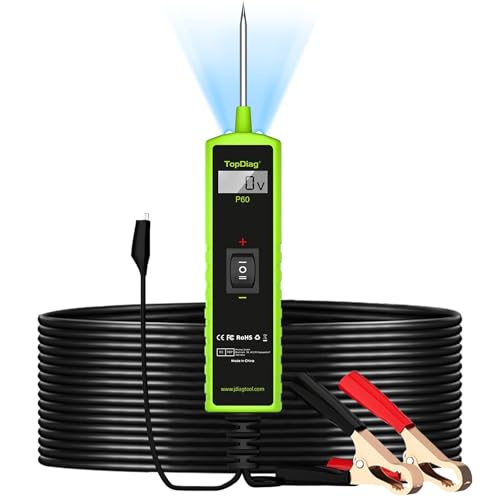
The Topdiag P60 proves that you do not need to spend a fortune to get a functional power circuit probe. It packs more than nine practical functions — including voltage testing, polarity detection, component activation, continuity testing, short-circuit locating, and diode checking — into a compact green housing with a built-in LCD screen. The voltage measurement range of 0.3V to 70V covers everything from low-signal sensor circuits to 24V commercial systems, and the LED work light on the probe tip is genuinely useful in dark engine bays.
Owner reviews consistently note that the P60 solved diagnostic problems that had been chased for days, particularly intermittent fuel pump and starter issues. The ability to activate components directly from the probe — pulsing a fuel pump relay or triggering a cooling fan — gives you immediate feedback on whether the part or the wiring is at fault. The 1-year warranty and 30-day refund policy provide solid protection for a budget investment. Multiple users mention that the tool feels more substantial than its price suggests.
The main compromises with the P60 are in cable length and build consistency. The ground cable is shorter than on premium probes, and some owners report receiving units with slightly different cable lengths or accessory configurations. The LCD display is basic compared to higher-end models, and the button feel is acceptable but not premium. Still, for a garage that needs power probe capability without the premium price, the Topdiag P60 delivers the essential functions that matter most for everyday electrical diagnosis.
What works
- Nine diagnostic functions cover the most common tests
- Includes diode testing rarely found at this price point
- Component activation works reliably for fuel pumps and fans
- Built-in LED work light aids visibility in dark areas
What doesn’t
- Ground cable is short for full-size vehicle reach
- Build consistency varies between units
Hardware & Specs Guide
Voltage Testing Capabilities
A power circuit probe measures DC and AC voltage with a simple touch of the tip. The display shows the exact voltage level, while LED indicators confirm polarity — red for positive, green for negative. High-end models read down to 0.1V resolution, allowing you to detect voltage drop across corroded connectors or high-resistance splices. Probes that support at least 6–30V cover passenger cars, light trucks, and 24V commercial vehicles.
Continuity Testing
Continuity testing checks whether an electrical path is complete from point A to point B. The tool sends a small current through the circuit and beeps if the path is intact. This is essential for finding broken wires, open circuits, and faulty switches or relays. A continuity test should never be performed on a live circuit, as the current from the system can damage the tester and produce a false reading.
Component Activation
Component activation allows the probe to supply power or ground directly to a component, bypassing the vehicle’s wiring. This instantly tells you whether the component itself is functional or the issue lies upstream. A fuel pump that spins when energized by the probe is good; one that stays silent is bad. This function saves hours of wiring diagram tracing by isolating the fault to either the component or the harness.
Safety Features and Overload Protection
A built-in circuit breaker or fuse protects the tool and the vehicle’s ECU from accidental shorts. When the probe contacts power and ground simultaneously, the breaker trips and stops current flow, preventing damage to sensitive modules. Resetable breakers are superior to fuses because they restore operation instantly without a trip to the toolbox. Always verify that the tester has overload protection before using it on ECU-controlled circuits.
FAQ
What is the difference between a power probe and a multimeter?
Can I use an automotive circuit tester on modern vehicles with ECUs?
What voltage range should I look for in an automotive circuit tester?
How does a power circuit probe locate a short circuit?
Final Thoughts: The Verdict
For most buyers, the best automotive electrical circuit tester winner is the Autel PowerScan because it combines four diagnostic modes, component activation, and 40 feet of cable reach in a rugged package that works on 6V to 30V systems without breaking a sweat. If you want precision measurement with RPM and temperature capability, grab the Innova 3340. And for a budget-friendly entry into power probe diagnostics, nothing beats the Topdiag P60.

Certification: BSc in Mechanical Engineering
Education: Mechanical engineer
Lives In: 539 W Commerce St, Dallas, TX 75208, USA
Md Amir is an auto mechanic student and writer with over half a decade of experience in the automotive field. He has worked with top automotive brands such as Lexus, Quantum, and also owns two automotive blogs autocarneed.com and taxiwiz.com.