Surface rust is cosmetic; structural rust is a sentence. In the automotive world, the difference between a chassis that looks weathered and a frame that fails inspection comes down to the inhibitor you choose and how you apply it. The wrong product leaves moisture trapped under a waxy shell while the real corrosion continues unseen behind brackets and inside boxed rails.
I’m Amir — the founder and writer behind Four Wheel Ask. I focus on analyzing product formulations, owner-reported longevity ratings, and real-world corrosion resistance data across marine, automotive, and heavy-equipment categories.
Understanding formula types prevents long corrosion, and this guide to the best automotive corrosion inhibitor compares the top treatments on the market.
How To Choose The Best Automotive Corrosion Inhibitor
The ideal inhibitor depends on whether you are protecting a daily driver from road salt, a classic car in storage, or a truck frame already showing the first signs of oxidation. Each formula type — oil, wax, paint, or converter — serves a distinct purpose and requires different preparation work to deliver its advertised lifespan.
Film Type: Oil, Wax, or Paint
Oil-based inhibitors creep into seams and crevices, making them ideal for enclosed frame sections and door panels where you cannot reach with a brush. Wax-based products dry to a firm finish that resists pressure washing but can crack in extreme cold. Paint-on coatings like rubberized undercoating form the thickest barrier and are best for visible surfaces such as wheel wells, floor pans, and the underside of the chassis.
Dielectric Strength and Electronic Safety
If you plan to spray around battery terminals, fuse boxes, or exposed connectors, the inhibitor must be non-conductive and rated for high-voltage environments. Look for a dielectric strength rating — measured in volts per mil — that exceeds the voltage present in your vehicle’s electrical system. Products with a rating above 20,000 volts offer a wide safety margin for modern automotive electronics.
Surface Preparation and Adhesion
No inhibitor bonds well to loose rust, grease, or old undercoating. Converters require a clean surface to trigger the chemical reaction that stabilizes rust. Paint-on films need a rough or prepped substrate to grip. Oil-based sprays are the most forgiving because they wick into place without requiring a perfect surface, but even they last longer when the area has been degreased.
Quick Comparison
On smaller screens, swipe sideways to see the full table.
| Model | Category | Best For | Key Spec | Amazon |
|---|---|---|---|---|
| CorrosionX 16 oz | Spray | Electronics & fasteners | Navy-qualified; 39,000V dielectric | Amazon |
| Meuvcol Rust Converter 35 oz | Paint | Rusted metal surfaces | 2-in-1 converter & primer | Amazon |
| CorrosionX Heavy Duty 12 oz | Gel Spray | Trailers & heavy equipment | Self-healing; 5-year indoor life | Amazon |
| POR-15 Rubberized 22 oz | Undercoating | Chassis & wheel wells | Sound-deadening; satin black | Amazon |
| CRC Heavy Duty 10 oz 4‑Pack | Wax Spray | Winter undercoating | Dries firm; multi-pack value | Amazon |
In‑Depth Reviews
1. CorrosionX Rust Inhibitor 16 oz Aerosol

CorrosionX carries a unique pedigree among spray-on inhibitors: it is the flagship product from Corrosion Technologies and the only consumer-available formulation qualified under the Advanced Corrosion Preventive Compound military specification used by the U.S. Navy. The molecular polar bonding chemistry creates a dielectric barrier rated above 39,000 volts, meaning it safely displaces moisture on battery terminals, engine sensors, and circuit boards without risking a short circuit. This is a thin-film product that creeps into threads and between mating surfaces better than heavier wax-based alternatives.
The 16-ounce aerosol format suits small to medium jobs — treating fasteners on a vehicle exposed to coastal salt, lubricating throttle linkages, or protecting marine electronics on a boat console. Owner reports consistently describe it as the product that resurrected seized bolts and stabilized corroded battery connections that WD-40 could not touch. Unlike sticky undercoatings that trap moisture underneath, CorrosionX bonds at the molecular level and leaves a light lubricating film that does not attract dirt.
Review data from owners who have used it for years in industrial and aviation maintenance backs up the claim that it outperforms standard penetrating oils. The only trade-off is that the 16-ounce can goes quickly if you are covering a full truck frame or large trailer. For targeted protection of electrical connections, fasteners, and exposed metal joints, this is the most thoroughly engineered option on the list.
What works
- Proven military-grade corrosion prevention
- High dielectric rating safe for electronics
- Penetrates deeply into threads and crevices
What doesn’t
- Small can volume limits coverage area
- Thin film offers less physical abrasion protection
2. Meuvcol 2 in 1 Rust Converter & Metal Primer 35 oz
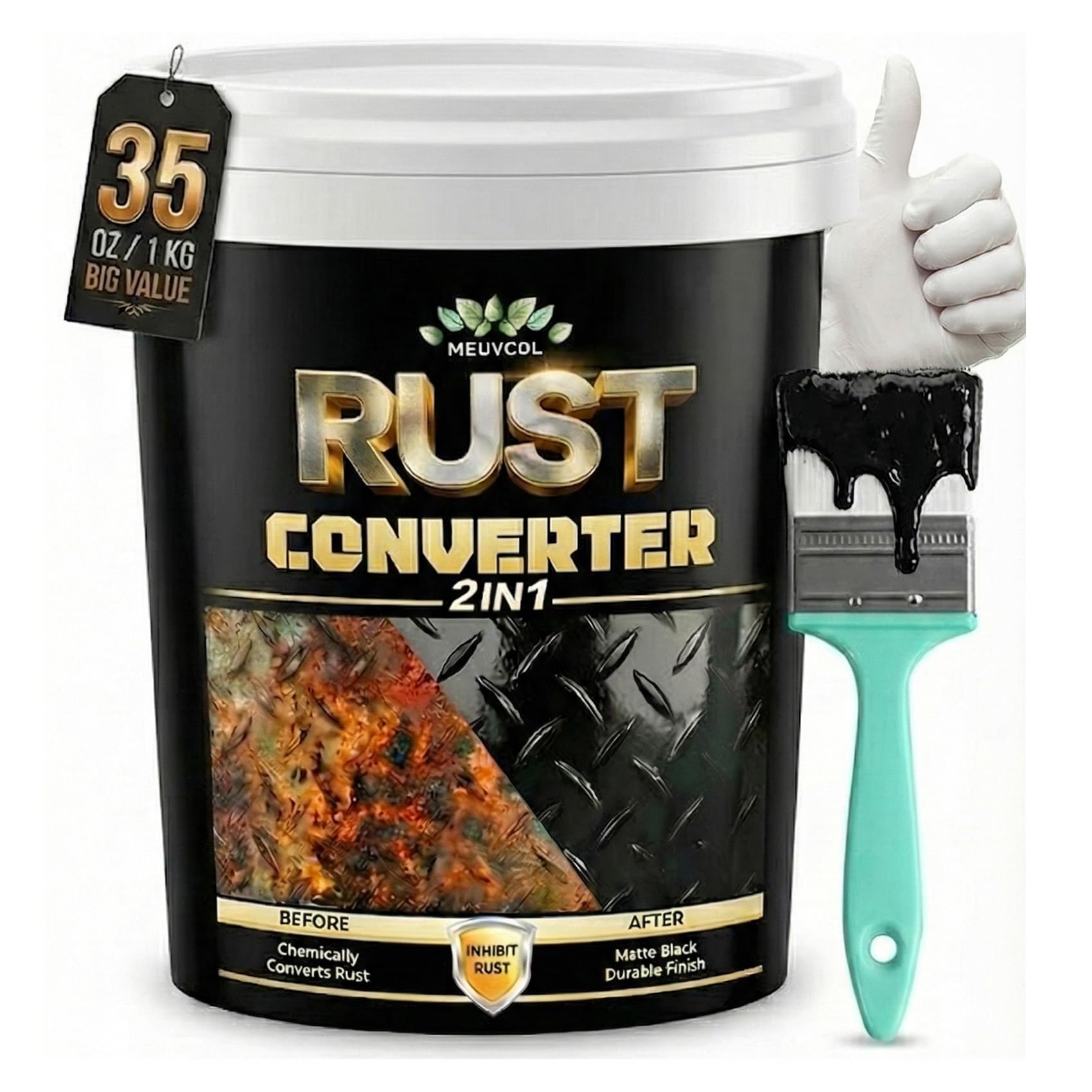
For surfaces that already show oxidation, a standard inhibitor simply coats the rust without stopping the chemical process underneath. Meuvcol takes a different approach by combining a rust converter with a high-build metal primer in a single can. The converter chemically neutralizes existing iron oxide, turning it into a stable, paintable surface, while the primer locks out oxygen and moisture to prevent new corrosion from forming. This is not a spray-and-forget product; it is designed for brushed application on bare or rusted metal.
The 35-ounce container comes with a brush, gloves, and instruction manual, making it a complete kit for a weekend project. Owners report using it on metal railings, truck frames, and even an antique metal statue with green oxidation. The finish dries to a durable matte black that accepts topcoats or can be left as a final layer. Unlike oil-based sprays, this converter requires a minimum of 24 hours of dry time to form its protective film, so application must be planned around weather and workspace conditions.
Data from user reviews indicates that the coating stays hard and does not chip after several months of outdoor exposure. A minority of units arrived with a leaking bag, which wasted some product, but the overall satisfaction rate is high for a converter that performs both chemical neutralization and physical sealing. It is the right choice when you need to stop active rust before applying a traditional inhibitor or paint.
What works
- Chemically neutralizes existing rust
- Large 35-ounce container covers broad surfaces
- Forms a hard, durable matte finish
What doesn’t
- Requires 24-hour drying time
- Leaking bag reports in some shipments
3. CorrosionX Heavy Duty Anti Rust Spray 12 oz

Where the standard CorrosionX provides a creeping thin film, the Heavy Duty variant delivers a thick, dripless gel that clings to vertical surfaces and stays pliable. The key feature here is a self-healing barrier that re-seals itself if scratched or scraped — critical for underbody components like boat trailer leaf springs, winch mounts, and axles that take regular abuse from debris and pressure washing. The manufacturer claims up to five years of indoor protection and two years outdoors, which is exceptional for a spray-applied product.
Owners working on saltwater trailers and heavy equipment consistently note that the coating stays active even when exposed to tidal moisture and road salt. The gel is non-conductive, so it can be used on battery posts and grounding lugs where a thick seal is needed without risking a short. It does not drip off when applied, which makes it easier to control compared to running oils. The trade-off is tackiness — the film remains slightly sticky, so it collects dust and grime in high-traffic areas.
User feedback highlights that the 12-ounce can is small for its intended use, and the thick consistency means you will use multiple cans to cover a full truck frame. Despite the higher per-ounce investment compared to waxy sprays, owners report that the corrosion protection is noticeably longer-lasting on high-exposure items like boat trailers and off-road equipment brackets.
What works
- Self-healing film resists washout and abrasion
- 5-year indoor longevity rating
- Stays put without dripping on vertical surfaces
What doesn’t
- Small can size for heavy-duty applications
- Remains tacky and attracts dust
4. POR-15 Rubberized Undercoating 22 oz

POR-15 has built a reputation in the restoration community for its three-step rust-prevention system, and this aerosol rubberized undercoating is designed as the final protective layer in that process — or as a standalone coating for wheel wells, undercarriages, and quarter panels. It applies as a thick, paintable liquid that dries to a satin-black finish with enough flexibility to resist chipping from road debris. The rubberized formula also adds sound-dampening properties that reduce road noise and vibration in the cabin.
The 22-ounce can covers roughly 20 to 25 square feet per coat, which translates to a truck bed floor or the interior of cab corners. Owner reports emphasize that thorough surface prep is non-negotiable: loose rust, grease, and wax must be removed before application. Many users combine it with POR-15 Rust Preventive Coating as a base layer for maximum adhesion and longevity. The product handles exposure to moisture, salt, and temperature swings without cracking or peeling.
Review data shows that users who follow the recommended prep and application process — needle scaling, degreasing, metal prep, base coat, then rubberized topcoat — are the ones reporting multi-year performance. The can sprays well right-side up, but some users note that spraying upside down for tight frame sections requires careful technique. It is the best choice when you want a visible, durable finish that also quiets the cabin.
What works
- Excellent sound deadening properties
- Flexible satin finish resists chipping
- Part of a trusted 3-step rust prevention system
What doesn’t
- Requires extensive surface preparation
- Difficult to spray evenly on upside-down access
5. CRC Heavy Duty Corrosion Inhibitor 10 oz 4‑Pack

CRC Heavy Duty Corrosion Inhibitor uses a wax-based formula that dries to a firm, solvent-resistant film. Unlike oil-based sprays that stay wet and can drip onto driveways, this product sets up so that it does not remain tacky to the touch, making it ideal for visible underbody areas where you want protection without an oily residue. The 4-pack format brings the per-can cost into the budget-friendly range while giving you enough volume to coat a full-size truck frame and suspension components.
The formula is designed for electrical connections, engine components, fasteners, and steering linkages exposed to salt spray and high humidity. Owners in snow-belt states report using it as an annual winter treatment applied inside door panels, rocker panels, and along frame rails. Many pair it with an oil-based inhibitor like Fluid Film in hidden cavities, relying on CRC for areas where a dry finish matters more than creep. The spray nozzle works best with an extension wand for reaching inside closed sections.
User reviews highlight two trade-offs. First, because the film dries hard, it can crack or peel if applied over loose rust or an unprepared surface. Second, a small number of cans from the 4-pack arrived with leaking spray nozzles, which is a packaging issue rather than a formula problem. For the budget-conscious owner who needs solid winter protection and does not want the mess of an oil-based spray, this multi-pack delivers the best value on the list.
What works
- Dries to a non-tacky, firm finish
- Multi-pack provides excellent value
- Effective for annual winter undercoating
What doesn’t
- Wax film can crack in extreme cold
- Nozzles reported leaking in some multi-packs
Hardware & Specs Guide
Polar Bonding Technology
CorrosionX uses a molecular bonding process that creates a film chemically attracted to metal surfaces at the atomic level. This contrasts with simple barrier products that rely solely on physical thickness. Polar bonding allows the inhibitor to displace moisture directly and bond to the substrate, making it effective even on slightly imperfect surfaces where a waxy barrier would lift and trap water underneath.
Dielectric Strength Rating
Dielectric strength measures the voltage an insulating material can withstand before breaking down. CorrosionX Heavy Duty and standard formulations both exceed 39,000 volts per mil, which provides a wide safety margin for 12V and 48V automotive electrical systems. When using an inhibitor near sensors, ECUs, or battery terminals, a high dielectric rating is essential to prevent unwanted conductivity that could cause parasitic drain or component damage.
Self-Healing Barrier
The Heavy Duty CorrosionX and certain wax-based coatings contain polymers that allow the film to re-flow and close small scratches or gaps after application. This is critical for components exposed to rock chips, pressure washing, or sliding contact. A self-healing film extends the reapplication interval significantly compared to rigid coatings that crack and require spot repairs.
Chemical Conversion vs. Physical Barrier
Rust converters like the Meuvcol product chemically react with iron oxide (rust) to form a stable, inert layer of iron tannate. This stops the oxidation reaction at the molecular level. Traditional inhibitors only block oxygen and moisture from reaching the surface. For components that already show active corrosion, a converter must be used before a barrier inhibitor to seal the surface permanently.
FAQ
Can I apply a corrosion inhibitor over existing rust?
How often should I reapply undercoating?
Is automotive corrosion inhibitor safe for oxygen sensors and wiring?
What is the difference between a rust converter and a corrosion inhibitor?
Final Thoughts: The Verdict
For most buyers, the best automotive corrosion inhibitor winner is the CorrosionX 16 oz because it offers proven military-grade polar bonding, safe dielectric protection for electronics, and deep creeping penetration that standard sprays cannot match. If you need to stop active rust before sealing it, grab the Meuvcol Rust Converter. And for a thick, self-healing shield on a boat trailer or off-road chassis, nothing beats the CorrosionX Heavy Duty for long-term outdoor protection.

Certification: BSc in Mechanical Engineering
Education: Mechanical engineer
Lives In: 539 W Commerce St, Dallas, TX 75208, USA
Md Amir is an auto mechanic student and writer with over half a decade of experience in the automotive field. He has worked with top automotive brands such as Lexus, Quantum, and also owns two automotive blogs autocarneed.com and taxiwiz.com.