A battery that fails at the wrong moment can leave you stranded, cost you a tow, and damage your alternator in the process. The difference between a battery that cranks confidently through a blizzard and one that fades after twelve months comes down to chemistry, construction quality, and honest cold-cranking amp ratings that match what the label claims. Group 34 batteries span a wide range from budget AGM units to premium spiral-cell designs, and knowing which specs actually matter — and which are marketing fluff — separates a smart purchase from a costly mistake.
I’m Amir — the founder and writer behind Four Wheel Ask. My approach to automotive components relies on analyzing technical specifications, studying owner-reported long-term reliability data, and comparing build quality across brands to identify which products deliver consistent performance over years of real-world use.
After analyzing specs and owner feedback, the best automotive battery group size 34 delivers reliable cold starts and long life.
How To Choose The Best Automotive Battery Group Size 34
Group 34 is one of the most common battery sizes for trucks, SUVs, and full-size sedans, but not every battery with that footprint delivers the same real-world performance. Understanding a few key specifications helps you match the battery to your vehicle’s electrical demands and your local climate conditions without overpaying for features you do not need.
Cold Cranking Amps and Reserve Capacity
Cold Cranking Amps measure how much current a battery can deliver at zero degrees Fahrenheit for thirty seconds while maintaining at least 7.2 volts. Higher CCA matters most in cold climates where oil thickens and engines require more starter torque. Reserve Capacity indicates how many minutes the battery can run essential electrical loads if the alternator fails — a critical number for drivers who rely on winches, lights, or long accessory usage.
AGM vs. Flooded vs. Lithium Chemistry
AGM (Absorbent Glass Mat) batteries use fiberglass mats to hold electrolyte against the plates, making them spill-proof, vibration-resistant, and capable of faster recharging than traditional flooded batteries. Flooded batteries cost less but require periodic water checks and venting. Lithium iron phosphate (LiFePO4) options offer extreme weight savings and deep-cycle capability, but most lack the burst CCA needed for cold-engine starting in daily drivers.
Terminal Type and Physical Fit
Group 34 batteries typically use SAE top-post terminals, but some dual-terminal designs add side posts for vehicles with factory side-mount cables. Always verify that the terminal configuration matches your battery cables and that the height and width leave clearance for the hold-down bracket and hood. A battery that is too tall can short against the hood insulation or prevent proper clamping.
Quick Comparison
On smaller screens, swipe sideways to see the full table.
| Model | Category | Best For | Key Spec | Amazon |
|---|---|---|---|---|
| OPTIMA 34 REDTOP | AGM Spiral Cell | Reliable cold starts and vibration resistance | 800 CCA, 100 min RC | Amazon |
| Interstate MTX-34 | AGM | High accessory power and long cycle life | 740 CCA, 115 min RC | Amazon |
| Odyssey ODX-AGM3478 | AGM Extreme | Extended deep-cycle and high endurance | 850 CCA, high cycle life | Amazon |
| ACDelco Gold 49AGM | AGM Silver-Calcium | European car replacement with high CCA | 900 CCA, 95 Ah | Amazon |
| Full Throttle FT825-78 | AGM | High-draw audio and truck applications | 825 CCA, copper terminals | Amazon |
| Lithova 12V 100Ah LiFePO4 | Lithium | Deep-cycle solar and RV energy storage | 1280 Wh, 4000+ cycles | Amazon |
| HRBEENERGY 12.8V 100Ah LiFePO4 | Lithium | Lightweight marine and off-grid power | 1280 Wh, IP67 rated | Amazon |
| MARXON Group 34 AGM | AGM | Budget-friendly start-stop replacement | 650 CCA, 55 Ah | Amazon |
| Goodyear 35-AGM Platinum | AGM | Jeep and auxiliary battery replacement | 650 CCA, 100 min RC | Amazon |
| Autocessking Group 35 AGM | AGM | Compact start-stop passenger car fit | 650 CCA, 55 Ah | Amazon |
| Mighty Max ML-GROUP34 | SLA Deep Cycle | Power wheelchair and mobility replacement | 60 Ah, deep cycle rated | Amazon |
In‑Depth Reviews
1. OPTIMA Batteries High Performance 34 REDTOP

OPTIMA’s REDTOP 34 uses SpiralCell technology that wraps the lead plates in a tight spiral rather than stacking flat plates, which increases surface area and packs more pure lead into the same footprint. Owner reports consistently describe eight- to ten-year service lives in daily drivers, with one user logging eight years in a 2001 Grand Cherokee before the battery developed a bulge — still never left them stranded. The 800 CCA rating holds up in verified cold starts, and the 100-minute reserve capacity provides a genuine safety margin for accessory loads.
The sealed AGM construction eliminates any need for watering and makes the battery resistant to vibration damage, a real advantage for off-road and truck applications. Multiple owners note that the REDTOP cranks large V8 engines with authority even after short commutes that typically strain conventional batteries. Adapter plates are included for vehicles that require side-terminal connections, expanding compatibility beyond top-post-only designs.
The upfront investment is higher than standard flooded batteries, but the per-year cost lands near entry-level pricing when spread across the typical eight-year lifespan. A few owners report failures within the first year, which seems tied to charging system issues or extended deep discharges — OPTIMA recommends a dedicated AGM charger below 10 amps for optimal longevity.
What works
- SpiralCell construction delivers exceptional vibration resistance and long service life
- Consistent cold-cranking performance across extreme temperature ranges
- Adapter plates included for side-terminal compatibility
What doesn’t
- Premium pricing requires higher upfront investment
- Requires proper AGM charger to avoid damage from deep discharge
- Warranty fulfillment may vary depending on seller channel
2. Interstate Batteries MTX-34 AGM
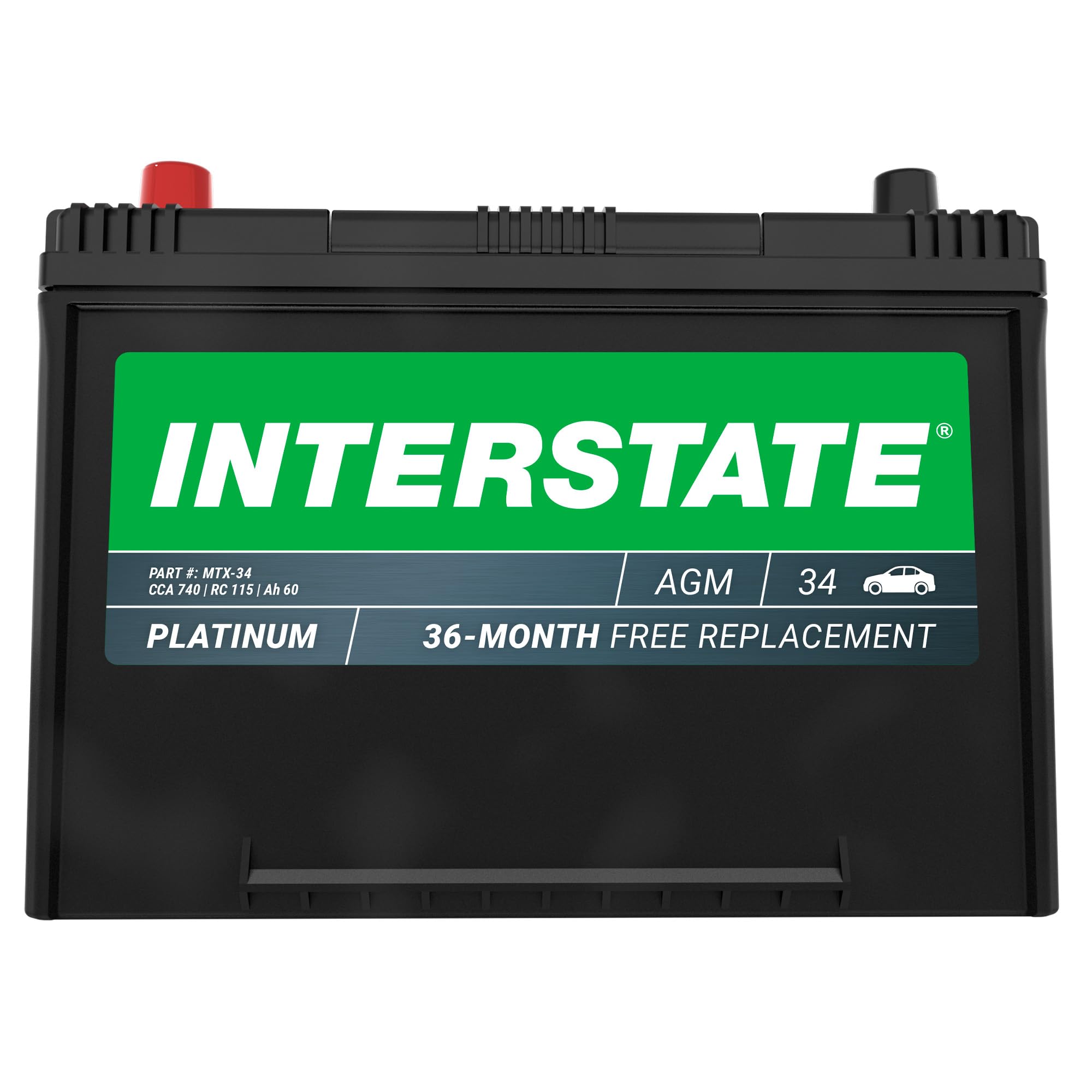
Interstate’s MTX-34 is built on absorbed glass-mat technology with a focus on delivering twice the cycle life of conventional flooded batteries at 80% depth of discharge. The 115-minute reserve capacity is among the highest in the Group 34 category, making this battery a strong candidate for vehicles with heavy accessory loads like winches, auxiliary lighting, or aftermarket sound systems. Owners report that the MTX series holds voltage more consistently than standard AGM units during extended accessory use.
The 740 CCA rating provides ample starting power for V6 and V8 engines across a wide temperature range, and the sealed AGM design eliminates corrosion at the terminals — a common failure point in humid climates. The battery fits over 580 vehicle configurations according to the manufacturer’s fitment data, and the included handle makes installation significantly easier than wrestling a bare case into tight engine bays. Several owners mention that the MTX-34 resolved slow-cranking issues they experienced with previous batteries.
One owner reported that the battery failed to hold a charge after two days of inactivity, even with a jump box, and switched back to a conventional battery. This appears to be an isolated compatibility issue possibly related to charging voltage rather than a widespread defect. The 36-month warranty provides reasonable coverage for a premium-priced battery.
What works
- Exceptional 115-minute reserve capacity for accessory-heavy vehicles
- Doubles cycle life compared to conventional flooded batteries
- Wide vehicle fitment with over 580 configurations
What doesn’t
- Premium price point limits value for basic commuter applications
- Occasional compatibility issues with specific charging systems
- Heavier than some competing AGM options at 41.4 pounds
3. Odyssey Battery ODX-AGM3478 Extreme Series
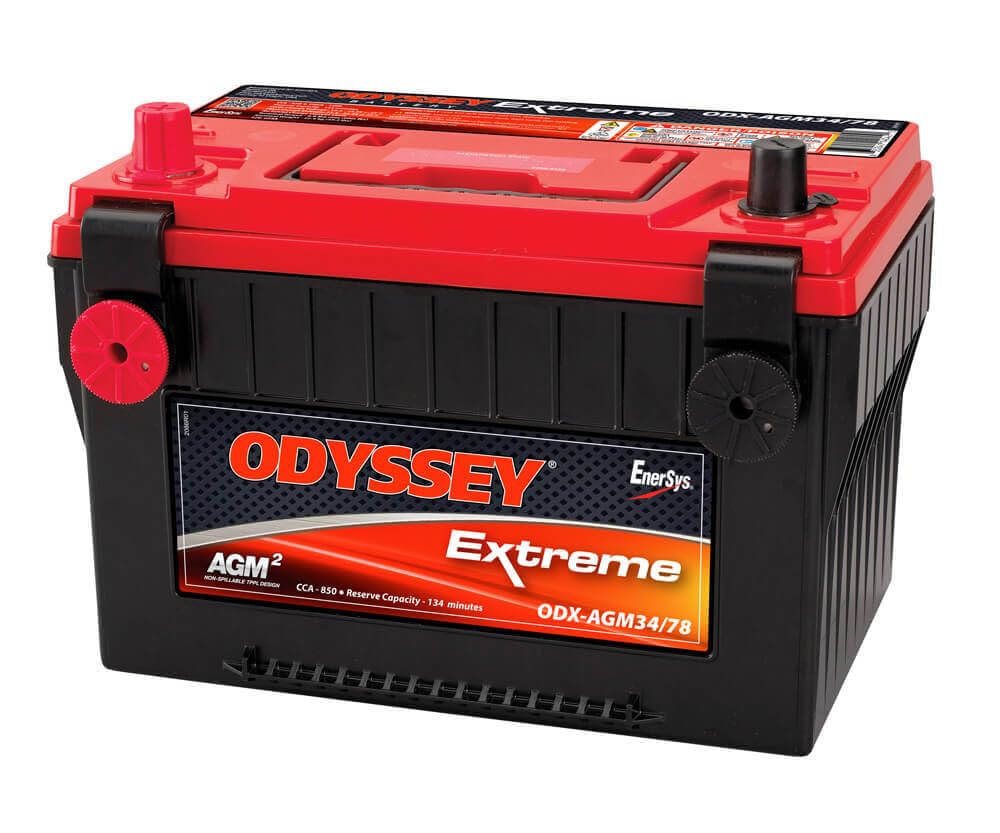
Odyssey’s Extreme Series AGM battery is engineered for applications that demand both high starting current and deep-cycle endurance. Rated at 850 CCA with a claimed 70% longer cycle life than conventional deep-cycle batteries, the ODX-AGM3478 uses pure lead plates and a compression-fit AGM design that minimizes internal resistance. Owner reports highlight a unit that lasted over eight years in a work truck where other brands failed within one to two years, making it a frequent recommendation for commercial and heavy-use vehicles.
The battery weighs 51.8 pounds, reflecting the dense plate architecture that enables its high power density. Owners of large-displacement engines — including a 454 in a Chevy C-3500 — report effortless cranking with no voltage sag during cold starts. The robust SAE terminal design accepts high-torque cable connections without stripping, and the battery arrived at most owners’ doors with sufficient charge for immediate installation.
A small number of owners experienced failures within the first 13 months and encountered difficulties with the warranty process, noting that Odyssey directs Amazon purchasers to a third-party warranty administrator. The four-year manufacturer warranty is generous on paper, but the claims process has frustrated some buyers. Despite this, the long-term reliability data from owners who have used Odyssey batteries for years remains compelling.
What works
- Proven eight-year service life in heavy-use applications
- 850 CCA provides strong starting for large-displacement engines
- Deep-cycle capability outperforms standard starting batteries
What doesn’t
- Significant weight at 51.8 pounds complicates installation
- Warranty claims may require third-party administrator interaction
- High price point limits value for basic daily drivers
4. ACDelco Gold 49AGM (88864539)
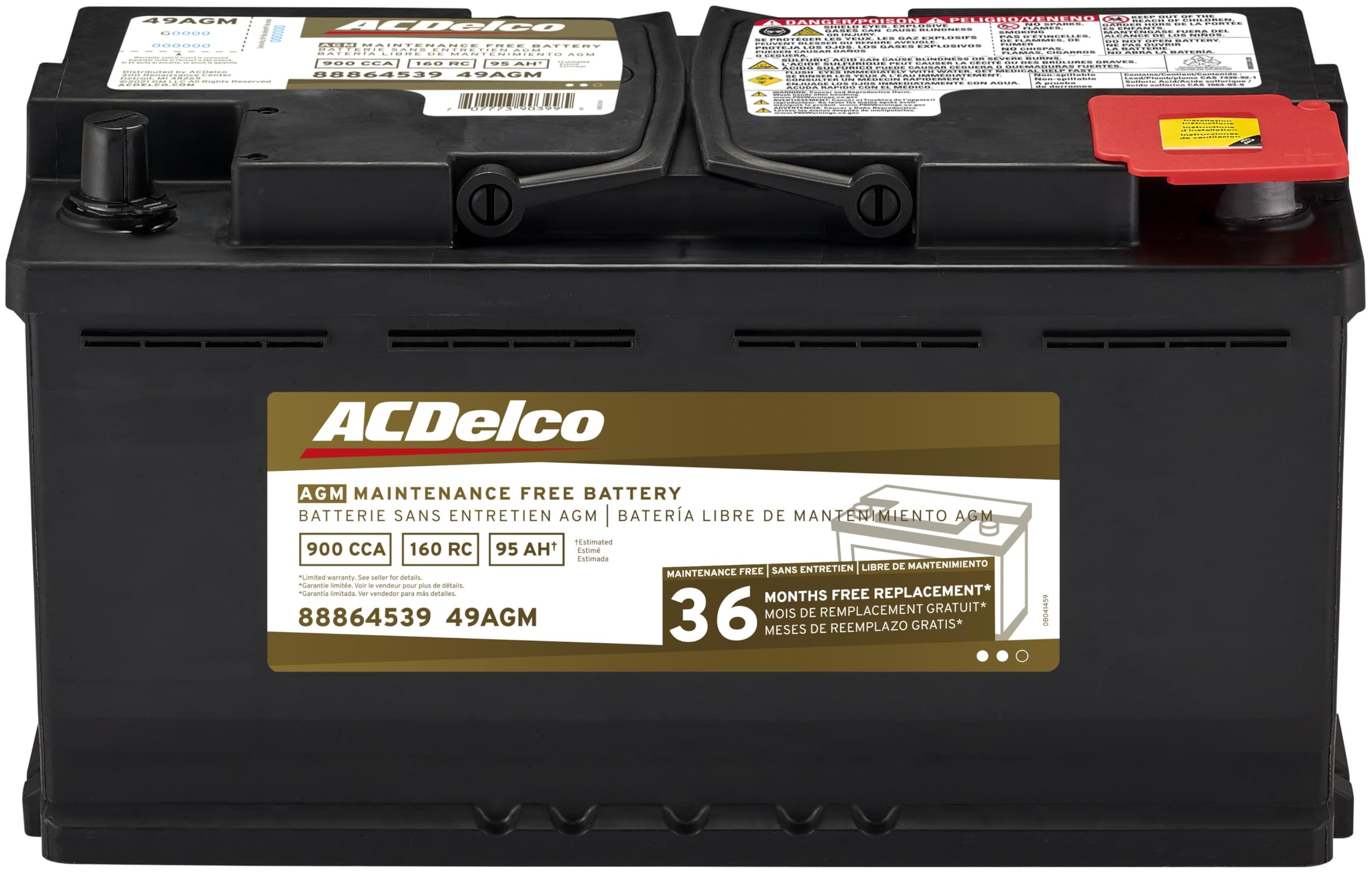
ACDelco’s Gold 49AGM uses silver-calcium stamped alloy grids that maximize conductivity and reduce internal resistance compared to traditional lead-calcium designs. The 900 CCA rating puts this battery at the top of the starting-power spectrum for Group 49 size, and owner reports confirm perfect fits in BMW X5, Mercedes-Benz E350, and other European platforms that require high-density AGM batteries. The 95 Ah capacity provides generous reserve for vehicles with continuous accessory draw.
The robust envelope separator with puncture-resistant backing prevents internal shorts — a known failure mode in cheaper AGM batteries — while the precision-ribbed case is 100% pressure tested to avoid future leaks. Owners consistently note that the battery starts their vehicles with noticeably more authority than OEM units, and the fraction-of-dealer-cost pricing makes it a popular alternative for German-brand owners looking to avoid dealer markup.
One owner received a dead battery that could not be charged, resulting in additional costs for replacement and labor. This appears to be a shipping or quality-control lapse rather than a systemic issue, but it is worth noting that large, heavy AGM batteries can be damaged during transit if not properly packaged. The 36-month free replacement warranty provides reasonable protection against such defects.
What works
- 900 CCA delivers exceptional starting power for demanding engines
- Silver-calcium stamped grids improve conductivity and cycle life
- Pressure-tested case and puncture-resistant separators enhance durability
What doesn’t
- Receiving a dead unit on arrival is a documented risk
- Group 49 size may not fit all battery trays without adapter
- Premium pricing reflects the high CCA rating
5. Full Throttle FT825-78 (Group 34)

Full Throttle’s FT825-78 targets enthusiasts who need high current delivery for demanding applications, from large V8 engines to car audio systems that draw substantial current at idle. The 825 CCA rating is supported by copper-alloy terminals that reduce resistance at the connection point — a detail that matters when battery cables are torqued down hard for a reliable electrical bond. Owners of Silverado 1500 trucks report that the FT825 outperforms factory batteries in both cold cranking speed and reserve capacity.
The 48-pound weight indicates substantial plate mass, which translates to the kind of reserve energy that can start a truck after three nights of parasitic drain — a common complaint with newer vehicles that have always-on electronics. One owner specifically noted that their Silverado’s phantom drain would kill a standard battery in two nights, but the Full Throttle unit still cranked strong on the third morning. This suggests above-average tolerance for deep discharge conditions.
The battery has been on the market since early 2019, and the owner feedback available is overwhelmingly positive with no reports of early failure or charging issues. The dual-voltage compatibility rating (12V and 24V) is unusual for a starting battery and may indicate internal architecture that can handle series configurations for specialty applications.
What works
- Copper-alloy terminals reduce resistance for high-current applications
- Handles parasitic drain better than standard AGM batteries
- Consistent strong cranking in large-displacement V8 engines
What doesn’t
- Limited long-term owner data compared to legacy brands
- Heavy at 48 pounds for its size class
- Premium pricing positions it above mid-range alternatives
6. Lithova 12V 100Ah LiFePO4 Group 24
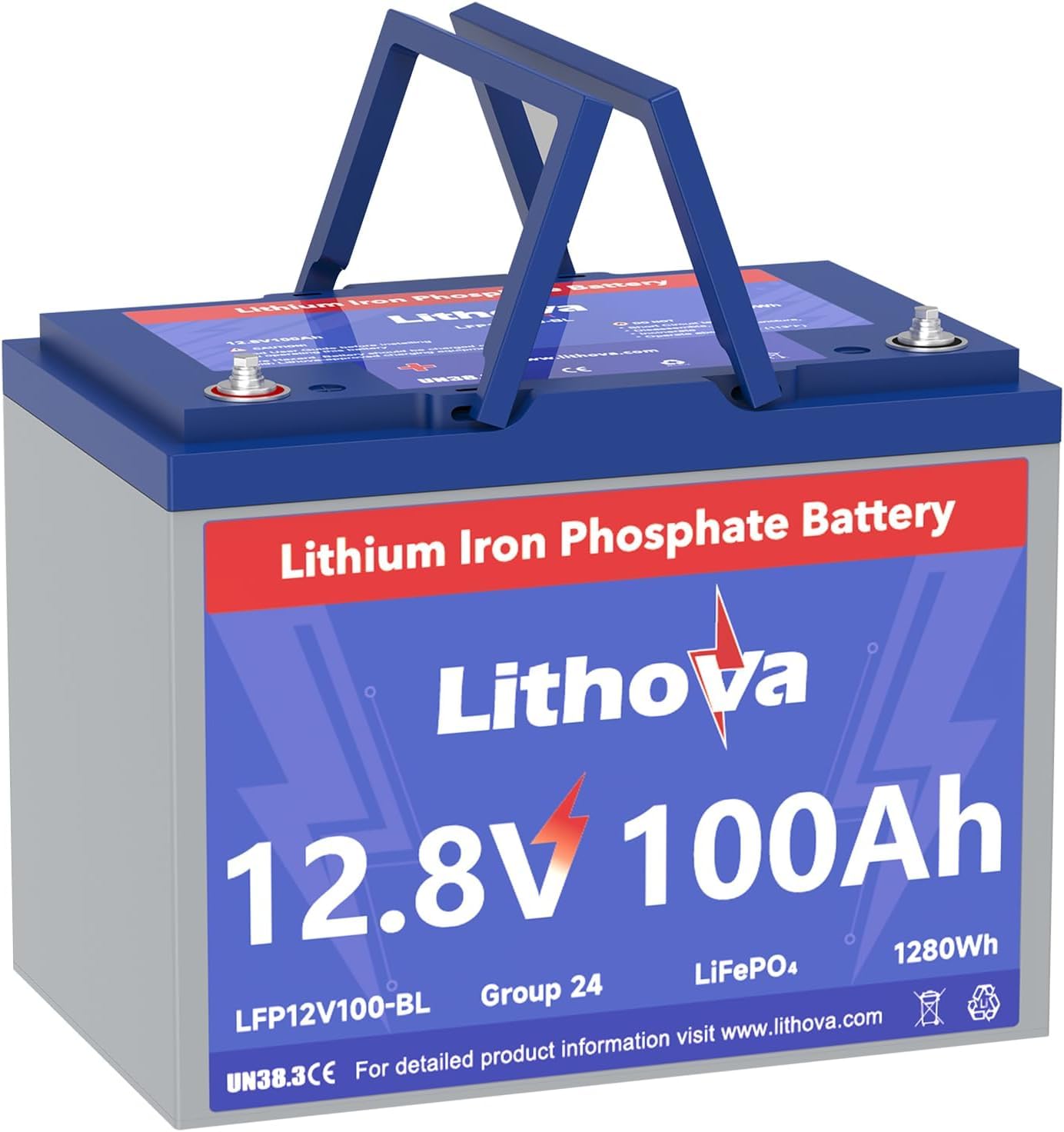
Lithova’s 100 Ah LiFePO4 battery is designed for deep-cycle energy storage rather than engine starting, making it a strong choice for RV solar systems, trolling motors, and off-grid cabin power. The 4000-plus cycle rating at 100% depth of discharge far exceeds what any lead-acid or AGM battery can deliver, and the 1280 Wh capacity provides real runtime data: 106 hours for a 12W lamp or 2.5 hours for a 500W heater. The Group 24 form factor matches the most common BCI size, allowing direct replacement of existing lead-acid boxes.
Owners report that the battery delivers slightly more than its rated 100 Ah when new, and the built-in 100A BMS provides overcharge, over-discharge, short-circuit, and temperature protection without requiring Bluetooth monitoring. The 22.57-pound weight is roughly a third of a comparable lead-acid battery, making installation in boats or campers significantly easier. Several users power small workshops and sheds with 150W solar panels, reporting that the battery keeps up even on overcast days.
This battery is not recommended for engine starting applications — the BMS typically limits instantaneous discharge current below what a cold starter motor demands. Owners who try to use it as a starting battery will likely trigger the over-current protection. The charging voltage requirement of 14.6V also means that some older alternator systems may not fully charge the battery without a compatible LiFePO4 charger.
What works
- 4000+ deep-cycle rating provides years of daily use in solar or marine setups
- Weighs 70% less than equivalent lead-acid batteries
- Built-in BMS delivers comprehensive protection without external hardware
What doesn’t
- Not suitable for engine starting due to BMS current limits
- Requires 14.6V charging voltage for full capacity
- Group 24 size differs from Group 34 dimensions
7. HRBEENERGY 12.8V 100Ah LiFePO4 Group 24

HRBEENERGY’s 100 Ah LiFePO4 battery stands out for its IP67 waterproof rating, making it a natural fit for marine environments, wet bilge compartments, and exposed RV battery trays. The 8000-plus deep-cycle rating with Grade A cells and a built-in 100A smart BMS provides protection against overcharge, deep discharge, and temperature extremes. At 19.4 pounds, it is 40% lighter than an equivalent AGM battery and roughly half the weight of a flooded deep-cycle unit.
Owners report using six of these batteries in a mixed series-parallel configuration for a golf cart, achieving ten hours of runtime, and three units wired in parallel for an RV lasting three to four days off-grid. One owner noted that even though the battery is not marketed as a starting battery, it delivered enough current to spin a 60 hp Mercury outboard starter motor with authority. The expandable design supports up to 16 units in parallel for 20 kWh of total storage capacity.
Some owners initially had charging issues when using standard lead-acid chargers that do not reach the required absorption voltage for LiFePO4 chemistry. This is a common learning curve with lithium conversions — a dedicated LiFePO4-compatible charger resolves the problem. The Group 24 case size is slightly smaller than Group 34, so fitment in existing Group 34 trays may require a spacer or adapter bracket.
What works
- IP67 waterproof rating enables use in wet and marine environments
- Ultra-light 19.4-pound weight simplifies transport and installation
- 8000-plus cycle rating delivers extreme long-term value for off-grid use
What doesn’t
- Group 24 case requires adapter for Group 34 battery trays
- LiFePO4 chemistry demands compatible charger for full performance
- Not rated as a primary engine starting battery
8. MARXON Group 34 Start and Stop AGM

MARXON’s Group 34 AGM battery targets the value-conscious buyer who needs a reliable start-stop compatible battery without paying for premium branding. The 650 CCA and 55 Ah rating match OEM specifications for many modern passenger cars with auto stop-start systems, including the 2023 Mitsubishi Outlander PHEV auxiliary battery slot and the 2021 Toyota RAV4. The AGM construction handles the repeated deep cycling that stop-start systems impose better than flooded batteries.
Owner feedback over nearly a year of use shows consistent performance with no starting issues or capacity degradation. The battery includes a drain hose fitting, which is a specific requirement for certain European and Asian vehicles that vent battery gases through a tube. Several owners noted that the price was roughly two-thirds of local retail options for equivalent AGM batteries, and the lack of a core deposit simplifies the replacement process.
The 42-pound weight is standard for a Group 34 AGM, and the A1 terminal configuration fits most top-post applications. The three-year warranty from a US-based office provides reasonable peace of mind for a budget-priced battery. One owner reported that the battery survived a discharge to 11 volts and recovered to 97-98% capacity after recharging, demonstrating the AGM’s tolerance for accidental drain events.
What works
- Cost-effective entry point for AGM technology
- Compatible with start-stop systems and includes drain hose fitting
- Good recovery from deep discharge events
What doesn’t
- 650 CCA may be insufficient for large V8 engines or cold climates
- Limited long-term owner data beyond one year of use
- 55 Ah capacity is below premium Group 34 options
9. Goodyear 35-AGM Platinum Series
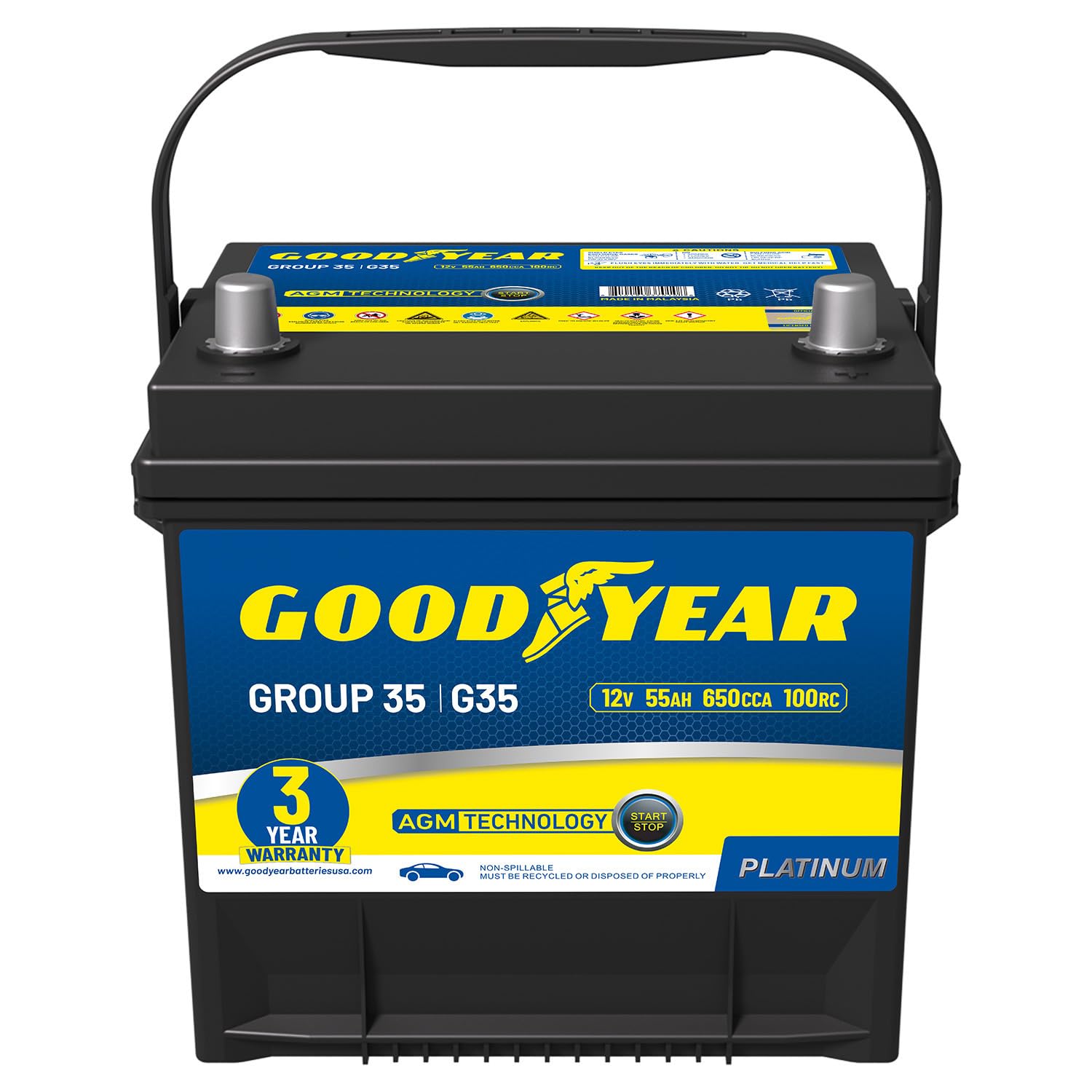
Goodyear’s 35-AGM Platinum Series battery brings AGM technology to the Group 35 footprint with 650 CCA and a 100-minute reserve capacity, making it a direct replacement for vehicles originally equipped with an auxiliary or primary Group 35 battery. Owners of 2021 Jeep Wrangler Rubicon and Chrysler Pacifica report that the battery serves as an exact-fit replacement for the Mopar auxiliary battery, clearing auto stop-start error codes after installation. The screw-in terminal posts match the factory configuration, avoiding the need for adapter hardware.
The AGM design provides higher consistent voltage than the flooded OEM units it replaces, which one owner noted fixed LED headlamp flicker and low brightness at idle — a common symptom of voltage sag in vehicles with electrical loads that exceed the alternator’s low-RPM output. The battery is CE certified and built in an ISO-certified factory, meeting modern quality standards. The 36-month warranty is competitive with other premium brands in this size class.
One owner reported a catastrophic failure days after installation that led to engine, radiator, and alternator damage in a Chrysler Pacifica, advising professional installation. This is a single negative report among overwhelmingly positive feedback, but it highlights the importance of verifying alternator output and charging system health before installing any new battery. The 39.7-pound weight is average for the size.
What works
- Exact-fit replacement for Jeep and Chrysler auxiliary battery applications
- Higher consistent voltage resolves flicker and dimming issues
- Screw-in terminal posts match factory Mopar configuration
What doesn’t
- Catastrophic failure reported in one vehicle with possible charging system issues
- Group 35 size limits compatibility with standard Group 34 trays
- 650 CCA rating is adequate but not exceptional for cold climates
10. Autocessking Group 35 AGM Start-Stop
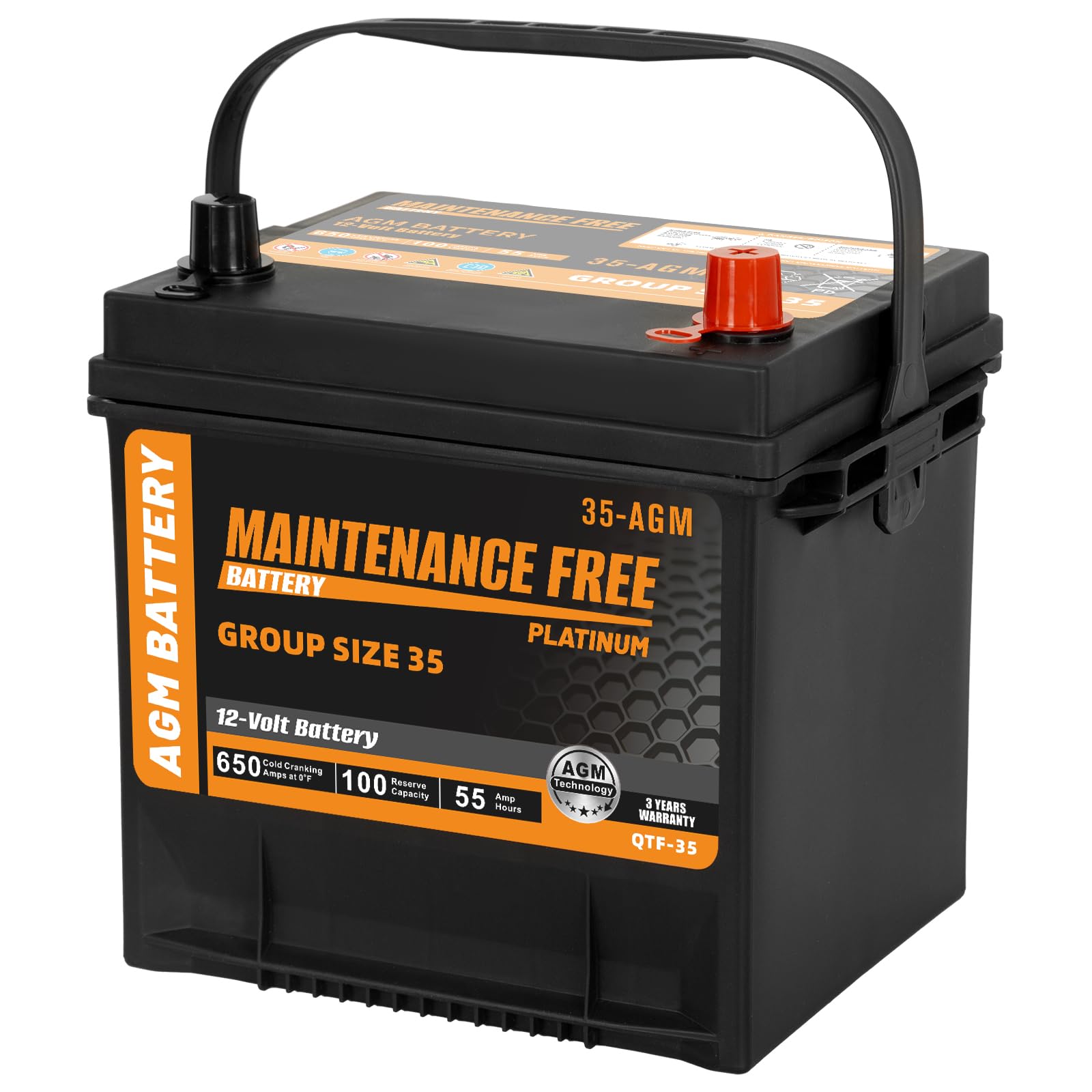
Autocessking’s Group 35 AGM battery offers an economical entry into sealed, maintenance-free starting power for passenger cars and light trucks. The 650 CCA and 55 Ah capacity match the specifications of many Honda Civic, Toyota Corolla, and compact SUV applications, and the AGM design provides spill-proof operation and improved vibration resistance compared to flooded batteries. Owners of 2022 Honda Civics report a perfect fit with immediate start-up and resolution of previous battery-related issues.
The battery weights 38 pounds, making it one of the lighter AGM options in this category, and the integrated handle simplifies installation in tight engine bays. The AGM construction reduces self-discharge rates compared to flooded batteries, which helps maintain starting voltage during periods of infrequent use. Multiple owners confirm that the battery started their vehicles immediately upon installation and continued to perform well over the following weeks.
This battery is explicitly labeled as a starting battery and should not be used in deep-cycle applications such as solar storage or trolling motors. The three-year warranty provides standard coverage. One owner ordered the wrong size and successfully returned it through Amazon’s return policy, noting the process was straightforward. The Group 35 footprint is slightly smaller than Group 34, so verify your vehicle’s battery tray size before purchasing.
What works
- Very competitive pricing for a sealed AGM battery
- Perfect fit and immediate start in modern compact cars
- Low self-discharge suits vehicles driven infrequently
What doesn’t
- Group 35 size may not fit Group 34 battery trays
- Not suitable for deep-cycle or solar applications
- Limited long-term reliability data available
11. Mighty Max ML-GROUP34 SLA Deep Cycle

Mighty Max’s ML-GROUP34 is a UL-certified sealed lead-acid battery built for deep-cycle applications such as power wheelchairs, mobility scooters, and backup power systems rather than engine starting. The 60 Ah capacity at the 20-hour rate provides sustained runtime for electric mobility devices, and the internal thread terminal design accepts bolt-on connectors that resist vibration loosening. Owners of Permobil M300 wheelchairs report that this battery serves as a direct replacement that costs significantly less than dealer-sourced options.
The battery delivered strong performance in real-world tests, passing a full hour of ramp and hallway operation with charge remaining, and multiple owners note that their wheelchairs feel like new after the swap. The sealed AGM construction allows mounting in any position without acid leakage, and the factory-activated design requires no initial acid filling or electrolyte checking. One owner reported that the battery lasts three to four days of normal wheelchair use before needing a recharge.
This battery is optimized for deep-cycle discharge rather than high-cranking current, so it is not recommended as a primary automotive starting battery. The 41-pound weight is substantial for its capacity class, and the UL certification adds a layer of safety verification. The one-year warranty is shorter than some competitors, but the price point reflects the lower cycle-life expectations of SLA chemistry compared to premium lithium alternatives.
What works
- UL-certified construction for safety-critical mobility applications
- Direct replacement for Permobil M300 and similar power wheelchairs
- Sealed AGM design allows any-position mounting
What doesn’t
- Optimized for deep cycle, not automotive starting duty
- One-year warranty is shorter than AGM starting batteries
- 41-pound weight is heavy for a 60 Ah SLA battery
Hardware & Specs Guide
Cold Cranking Amps (CCA)
CCA measures the battery’s ability to start an engine in cold temperatures. For Group 34 batteries, ratings range from 650 CCA in budget models to over 900 CCA in premium units. Vehicles with V8 or diesel engines in northern climates benefit from higher CCA ratings. The actual current a battery can deliver decreases as temperature drops, so starting with a higher-rated battery provides a safety margin on the coldest mornings.
Reserve Capacity (RC)
Reserve capacity tells you how many minutes the battery can run the vehicle’s essential electrical loads if the alternator fails. A 100-minute RC means the battery can supply 25 amps for 100 minutes before dropping below 10.5 volts. Higher RC matters for vehicles with winches, emergency lighting, or long accessory runs. Premium Group 34 batteries typically offer 100 to 115 minutes of reserve capacity.
AGM vs. Flooded vs. Lithium
AGM batteries use glass fiber mats to absorb electrolyte, making them spill-proof, vibration-resistant, and capable of faster recharging than flooded batteries. Flooded batteries cost less but require periodic water checks and produce hydrogen gas during charging. Lithium iron phosphate (LiFePO4) batteries offer extreme weight savings and deep-cycle endurance but generally lack the burst current needed for reliable engine starting in cold weather.
Terminal Configurations
Group 34 batteries typically use SAE top-post terminals, which are the standard J-post design found on most American and Asian vehicles. Some models add side terminals for vehicles with factory side-mount cables. Dual-terminal designs offer flexibility but add cost. Always verify that the terminal orientation matches your battery cable length — the positive post should be on the right or left depending on your vehicle’s OEM layout.
Physical Dimensions and Fitment
A standard Group 34 battery measures approximately 10.25 inches long, 6.8 inches wide, and 7.9 inches tall. Variations exist between brands, so measuring your existing battery tray is essential before ordering. Group 34/78 dual-terminal batteries share the same footprint but add side posts. Group 24, 35, and 49 batteries have different dimensions and will not fit Group 34 trays without modification.
Battery Chemistry and Cycle Life
Flooded lead-acid batteries typically last three to five years and tolerate only limited deep discharges before suffering permanent capacity loss. AGM batteries extend lifespan to four to seven years and handle moderate deep cycling much better. Lithium LiFePO4 batteries can exceed ten years and thousands of deep cycles but require compatible charging systems. Matching battery chemistry to your vehicle’s charging voltage and usage pattern is critical for maximum service life.
FAQ
What is the difference between Group 34 and Group 35 batteries?
Can I use a LiFePO4 battery for engine starting?
How do I know if my vehicle needs an AGM battery?
What does reserve capacity mean for daily driving?
Final Thoughts: The Verdict
For most buyers, the best automotive battery group size 34 winner is the OPTIMA 34 REDTOP because it combines proven spiral-cell durability, reliable 800 CCA cold starts, and a track record of eight-plus year service lives in real owner reports. If you want maximum reserve capacity and accessory power, grab the Interstate MTX-34. And for extreme deep-cycle endurance at a lower price point, nothing beats the MARXON Group 34 AGM for budget-conscious buyers who still demand start-stop compatibility.

Certification: BSc in Mechanical Engineering
Education: Mechanical engineer
Lives In: 539 W Commerce St, Dallas, TX 75208, USA
Md Amir is an auto mechanic student and writer with over half a decade of experience in the automotive field. He has worked with top automotive brands such as Lexus, Quantum, and also owns two automotive blogs autocarneed.com and taxiwiz.com.