An automatic transmission that runs too hot is a ticking time bomb. One long uphill grade with a trailer or a heavy foot in stop-and-go traffic can push fluid temperatures past the safe zone, leading to burnt clutches, varnished valves, and a rebuild bill you didn’t budget for. A quality temperature gauge turns guesswork into a clear number so you can back off before damage sets in.
I’m Amir — the founder and writer behind Four Wheel Ask. I’ve spent years analyzing product specs, wiring diagrams, and owner-reported durability data to help drivers choose gear that actually holds up under load.
For anyone towing or upgrading an automatic transmission, selecting the right best automatic transmission fluid temperature gauge is critical to prevent overheating and extend transmission life.
How To Choose The Best Automatic Transmission Fluid Temperature Gauge
Every gauge kit on the market claims to keep your transmission safe, but real-world reliability depends on three core factors: sensor integration, display usability, and build quality that survives a hot, vibrating cab.
Sensor Type and Installation
The most common sender thread is 1/8-27 NPT, which fits many test ports, aftermarket pans, or cooler‑line T‑fittings. Look for a kit that includes adapters (3/8″ or 1/2″ NPT) if your transmission uses non‑standard ports. Electrical senders keep fluid inside the pan; mechanical capillary tubes require routing a thin line into the cabin — each has trade‑offs for safety and simplicity.
Display and Readability
A gauge is useless if you can’t read it at a glance while driving. Analog dials with bold numbers are time‑tested, but digital readouts offer precision to the degree. Multi‑color backlighting helps match factory dash lights, but dimming ability is crucial for night driving. Some hybrid gauges combine an analog sweep with a digital window — best of both worlds if the digital display remains visible in direct sunlight.
Build and Support
Housings made of metal or reinforced plastic handle engine‑bay heat and road vibration better than cheap polycarbonate. A brand that offers a one‑year warranty and free technical support adds safety net value. Customer reviews often highlight wiring harness quality and sender longevity — details that separate a five‑year gauge from a six‑month disappointment.
Quick Comparison
On smaller screens, swipe sideways to see the full table.
| Model | Category | Best For | Key Spec | Amazon |
|---|---|---|---|---|
| GlowShift Tinted 7 Color | Mid-Range | Customizable dash look | Analog, 80‑260°F, 7 color modes | Amazon |
| MaxTow Double Vision | Mid-Range | Digital + analog clarity | Hybrid digital/analog, blue LED | Amazon |
| Auto Meter Z-Series 2640 | Premium | Proven race reliability | Analog, incandescent, 2‑1/16″ | Amazon |
| B&M 80212 | Mid-Range | Full kit with T‑fittings | Analog, 100‑350°F, full wiring | Amazon |
| AEM 30‑4402 | Premium | Data logging & engine management | Digital, 100‑300°F, 0‑5V analog out | Amazon |
| TCHENPART 7‑Color | Budget | Entry‑level price, color options | Analog, 80‑260°F, 7‑color LED | Amazon |
| Auto Meter Ultra‑Lite 4332 | Premium | Mechanical accuracy (water temp) | Mechanical analog, 2‑1/16″ | Amazon |
In‑Depth Reviews
1. GlowShift Tinted 7 Color Transmission Temperature Gauge

The GlowShift kit delivers the best mix of style, accuracy, and value for daily drivers and weekend towers. Its 7‑color backlight lets you match factory dash lighting or create a custom look, while the smoked lens and aluminum housing give a premium appearance that holds up over time. The 1/8‑27 NPT sender threads into most test ports or cooler‑line T‑fittings, and the included step‑by‑step instructions simplify a job that scares many DIYers.
Owner feedback across Jeeps, trucks, and RVs consistently praises the gauge’s readability — the illuminated red needle stands out even in bright daylight. The color‑cycle modes are a nice touch, though some users note the button can rattle against the lens and that the color doesn’t save after shutdown. The wiring harness uses thin leads; a few owners reinforced connections with solder, but most found the kit straightforward.
For the price, GlowShift backs the unit with a one‑year warranty and free lifetime tech support, which adds confidence for a part that lives under constant vibration. If you want a do‑it‑all analog gauge with customizable aesthetics and proven community support, this is the one to beat.
What works
- Vibrant, adjustable backlight blends with any interior
- Accurate readings according to multiple long‑term owners
- Complete kit with sender, wiring, and visor
What doesn’t
- Thin wiring harness may need reinforcement
- Color selection resets after power cycle
- Bezel ring can jam the color‑change button
2. MaxTow Double Vision 260°F Transmission Temperature Gauge

The MaxTow Double Vision stands out by combining a traditional analog dial with a precise digital readout. This hybrid approach gives you the quick glance of a sweeping needle and the exact temperature of a digital number. The blue LED backlight offers three daytime and three nighttime dimming levels, making it usable in bright sun or dark cabins — though owners note the digital segment can wash out in direct sunlight.
Installation is straightforward with the included 1/8‑27 NPT sender and 9‑foot sensor harness. The gauge is popular among RV and tow‑rig owners who need to keep an eye on trans temps during long grades. One user reported saving his transmission on a mountain pass thanks to the early warning. The black dial with red needle feels premium, and the aluminum/steel housing handles engine‑bay heat well.
The main trade‑off is that the analog sweep partially covers the digital window at some temperature ranges, requiring a slight head tilt to read the numbers. Still, for those who want numeric precision without losing the familiar dial, this is the most practical dual‑readout option at a mid‑range price.
What works
- Digital and analog readouts offer best of both worlds
- Good dimming adaptability for night driving
- Saved transmissions for several users during heavy towing
What doesn’t
- Digital window partly blocked by analog needle arc
- Digital display hard to read in direct sunlight
- Hole‑saw installation requires careful positioning
3. Auto Meter Z‑Series 2640 Electric Transmission Temperature Gauge
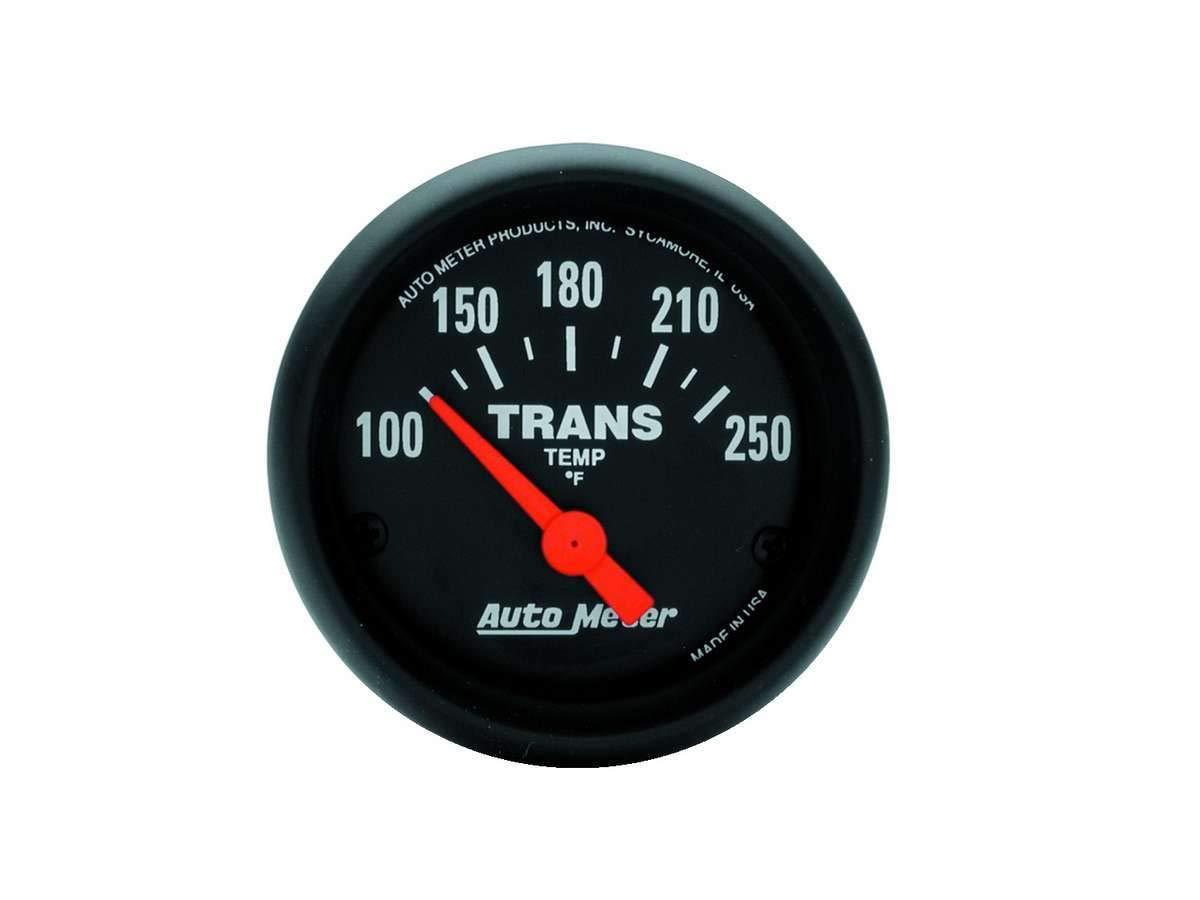
Auto Meter’s Z‑Series is a benchmark for analog gauge reliability. The 2640 uses a proven air‑core electric motor that keeps fluid out of the cabin — the sender mounts in the transmission while the gauge reads electrically. It works on 12 or 16‑volt systems and includes adapters for 3/8″ and 1/2″ NPT ports, covering most street and race applications. The incandescent perimeter lighting provides a classic glow that many enthusiasts prefer over harsh LEDs.
Owner reports from GM trucks, Jeeps, and Ford vans highlight the gauge’s accuracy: one user verified it within a degree using an IR gun. Installation is simple for anyone comfortable with basic wiring — you just need spade connectors, 18‑gauge wire, and a 5‑amp fuse. The sender threads directly into GM test ports without adapters. However, the kit does not include power wire or connectors, so plan a trip to the hardware store.
Build quality is exactly what you expect from Auto Meter: metal housing, glass lens, and a stepper motor that doesn’t drift. The one‑year warranty is standard, but the brand’s reputation for long‑term durability means this gauge will likely outlast the vehicle it’s installed in. If you want a no‑nonsense analog gauge that just works, this is the gold standard.
What works
- Superb accuracy confirmed by multiple owners
- Simple wiring — works with any 12V or 16V system
- High‑quality metal and glass construction
What doesn’t
- No wiring or fuse included in the box
- Sender is long; may not fit tight test ports without a shorter unit
- Incandescent bulb may need replacing sooner than LED
4. B&M 80212 Transmission Temperature Gauge Kit

B&M has a long history in high‑performance transmissions, and the 80212 kit reflects that focus on practicality. The analog dial reads from 100 to 350°F with a color‑code zone — green for safe, yellow for caution, red for danger — so you can interpret the needle instantly. The kit includes all wires, terminals, a sending unit, and T‑fittings for tapping into the cooler line, making it a true one‑box solution.
Owners of Ford E4OD and 4R100 transmissions praise the direct fit — the sender threads into the driver’s side test port without adapters. The anti‑glare ABS housing and simple bullet‑type backlighting look functional rather than flashy, which appeals to those who prioritize monitoring over aesthetics. Several users have used the B&M 80250 drain plug kit to mount the sender in the pan for a cleaner installation.
Accuracy is adequate for prevention: when the needle enters the red (above 240°F), you know it’s time to back off or upgrade the cooler. The main drawback is the dated amber backlight, which can feel dim in some interiors. Still, for a complete kit that includes everything except the desire to drill, the B&M offers outstanding value for dedicated towers.
What works
- Complete kit with T‑fittings and all wiring
- Color‑coded dial for instant reading
- Direct fit for Ford E4OD/4R100 test ports
What doesn’t
- Backlight is basic and not adjustable
- Gauge housing is plastic — less premium feel
- Requires a flat surface for mounting the gauge itself
5. AEM 30‑4402 100‑300°F Temperature Gauge

AEM’s 30‑4402 is a digital gauge designed for engine management integration. It measures temperature from 100 to 300°F and includes a 0‑5V analog output that can feed into an ECU, data logger, or standalone display — a huge advantage for tuned or race vehicles that already collect sensor data. The gauge comes with interchangeable bezels and face plates to match your interior style.
Build quality is exceptional: the housing feels solid, the LED digits are crisp, and the included sender provides accurate readings verified by owners running high‑boost turbo setups. The warning feature alerts the driver when preset temperature thresholds are exceeded. However, the sensor wire leads are short — many users wish they were double the length for easier routing into the engine bay.
This gauge is overkill for a simple daily driver, but if you’re building a dedicated tow rig, a race car, or a vehicle with a standalone engine management system, the AEM pays for itself through its data integration capability. The price reflects that level of sophistication, and the warranty and tech support are solid. For digital‑only precision with logging potential, this is the top choice.
What works
- 0‑5V analog output for data integration
- Very accurate digital readout with warning alerts
- Multiple face plates for custom look
What doesn’t
- Short sensor leads limit mounting options
- Price is high for basic monitoring
- No analog glance — solely digital
6. TCHENPART 7‑Color Transmission Temperature Gauge
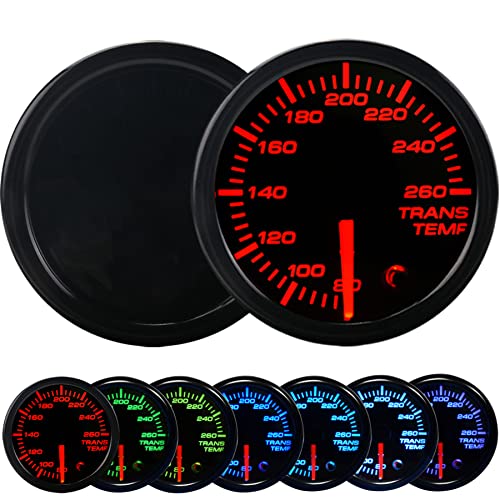
TCHENPART’s gauge brings 7‑color backlighting to the entry‑level market. The black dial reads 80‑260°F, the button on the lens cycles through colors (including red, blue, green, purple, yellow, white, and teal), and the red illuminated needle provides decent contrast. At its price point, it offers the same color‑matching capability as the GlowShift but with a simpler build.
Owner reports are mixed. Several users reported that the gauge worked well for 6‑7 months then the sensor failed — readings would drop out or stick at a single temperature. Others noted that the gauge never read above 105°F or spike to 260°F and stay there before dumping to zero. These failures point to inconsistent sender quality. On the positive side, some users had no issues and praised the easy installation and attractive lighting.
This is a true budget option: you get the look and the basic function, but long‑term reliability is a gamble. If you’re on a tight budget and willing to replace the sender if it fails, the TCHENPART works as an entry point. Otherwise, spending a bit more on a GlowShift or MaxTow buys significantly better durability.
What works
- Low entry price with 7‑color backlight
- Simple installation — wire and sensor included
- Matches interior lighting well when it works
What doesn’t
- Sender often fails within months
- Inconsistent accuracy reported
- Plastic construction feels cheap
7. Auto Meter Ultra‑Lite 4332 Mechanical Water Temperature Gauge

Note: This Auto Meter 4332 is designed as a mechanical water temperature gauge. With a capillary tube and bulb, it does not require electrical power to operate — the mechanical movement can even show temperature with the engine off. It can be adapted to measure transmission fluid temperature if you install the bulb in a suitable adapter or inline cooler fitting, but it is not a dedicated ATF gauge.
Owner feedback comes mostly from coolant applications, where users praise its accuracy and the clear analog display. The incandescent perimeter lighting is warm and easy on the eyes. Build quality is typical Auto Meter: a metal case and glass lens that withstands engine‑bay heat. However, the permanent capillary tube makes removal or repositioning difficult — if you cut it, the gauge is ruined.
We include this gauge for completeness, but we do not recommend it as a dedicated transmission temperature gauge. The mechanical line is fragile in the extreme heat of an exhaust or transmission case, and a leak would be messy. For the same budget, an electrical Auto Meter Z‑Series (product 3) is safer and easier. Only choose this if you specifically need a mechanical backup that works without power.
What works
- Works without any electrical connection
- Classic analog look, easy to read
- Proven Auto Meter build quality
What doesn’t
- Designed for coolant, not transmission fluid
- Capillary tube is permanent — can’t replace sender alone
- Condensation can fog the lens in wet conditions
Hardware & Specs Guide
Sender Thread & Adapters
Most aftermarket gauges use a 1/8‑27 NPT (National Pipe Taper) sender. This threads into many transmission test ports, aftermarket pans, or cooler‑line T‑fittings. Some kits include 3/8″ and 1/2″ NPT adapters for non‑standard ports. If your transmission has a dedicated temperature port (e.g., Ford E4OD driver’s side plug), you can often install the sender directly without adapters.
Display Type
Analog gauges use a needle and dial — excellent for quick glances and long‑term reliability. Digital gauges show exact numbers and often include warning thresholds. Hybrid dual‑display gauges combine both, giving you the visual sweep and a numeric readout. Consider sunlight readability; many digital screens wash out in bright conditions.
Backlight & Dimming
LED backlights offer long life and color options. Some gauges have 7‑12 colors that you can cycle through to match factory dash lights. Dimming features (manual or auto) are crucial for night driving — bright lights can be distracting. Look for gauges with multiple daytime/nighttime brightness settings if you drive in varying light.
Wiring & Installation
Electrical gauges require a 12V switched power, ground, and signal wire from the sender. Some kits include everything; others need you to supply fuse, wire, and connectors. Mechanical gauges have a capillary tube that must be routed into the cabin without kinks — avoid tight bends. Always follow the manufacturer’s wiring color code to avoid erroneous readings.
FAQ
What transmission temperature is considered too high?
Can I install a transmission temperature gauge myself?
Analog vs digital which is better for a transmission temperature gauge?
Do I need a temperature gauge if I don’t tow?
How do I install the temperature sender in the transmission?
Final Thoughts: The Verdict
For most buyers, the best automatic transmission fluid temperature gauge winner is the GlowShift Tinted 7 Color because it combines customizable style, reliable accuracy, and a complete kit at a mid‑range price that suits daily drivers and towers alike. If you want a dual analog/digital readout that leaves no doubt about the exact number, grab the MaxTow Double Vision. And for those who demand race‑proven build quality with zero frills, nothing beats the Auto Meter Z‑Series 2640 — a gauge that will outlast your transmission.

Certification: BSc in Mechanical Engineering
Education: Mechanical engineer
Lives In: 539 W Commerce St, Dallas, TX 75208, USA
Md Amir is an auto mechanic student and writer with over half a decade of experience in the automotive field. He has worked with top automotive brands such as Lexus, Quantum, and also owns two automotive blogs autocarneed.com and taxiwiz.com.