The gap between what your instruments tell you and what your vehicle is actually doing can be surprisingly wide. Factory speedometers are calibrated with intentional error, and analog gauges often lack the precision needed to monitor critical systems like coolant temperature or voltage in real time. A quality heads-up display closes that gap by pulling raw data straight from the vehicle’s brain or the sky above, projecting it directly into your line of sight so you can drive with full situational awareness.
I’m Amir — the founder and writer behind Four Wheel Ask. Over years of deep market analysis, I’ve compared hundreds of hardware configurations, studied engineering trade-offs between OBD2 and GPS signal processing, and tracked long-term owner feedback to isolate the units that truly deliver on their performance promises without introducing new distractions or reliability headaches.
What follows is a data-driven breakdown of the top contenders, from feature-dense diagnostic tools to rugged solar-powered options, filtered through real-world compatibility constraints and owner experiences across thousands of miles. This is the definitive research resource for finding the best auto heads up display that fits your vehicle, your driving habits, and your expectations for data accuracy.
How To Choose The Best Auto Heads Up Display
The market is flooded with HUDs that promise the moon but deliver inconsistent data, poor build quality, or frustrating compatibility gaps. Understanding the core technology choices upfront saves you the headache of receiving a unit that simply doesn’t work with your vehicle or driving style.
Data Source Accuracy: OBD2 vs. GPS
OBD2 HUDs connect directly to your vehicle’s ECU, providing real-time engine data like RPM, coolant temperature, voltage, and throttle position. This data is highly precise and immediate, but it requires your vehicle to support the OBD2 protocol (most gasoline cars after 2008). GPS HUDs calculate speed and position using satellites, making them universally compatible but less responsive in tunnels or dense urban areas. Many premium units combine both systems, using OBD2 for mechanical data and GPS as a fallback for speed and altitude.
Display Technology & Visibility
Not all HUDs look the same once installed. Direct LED screens are bright but can wash out in direct sunlight. Windshield projection units offer the most immersive experience but often suffer from ghosting on double-layered glass. Reflective transparent panels eliminate ghosting entirely by providing a dedicated focal plane. Regardless of type, look for units with auto-brightness adjustment and a wide brightness range to ensure comfortable reading during both midday glare and pitch-black night drives.
Real-World Compatibility & Installation
The single biggest source of buyer regret is discovering a HUD doesn’t work with their specific vehicle. Many OBD2 units have strict compatibility lists that exclude French and Italian brands, older Jeeps, Mazda 6s, and virtually all diesel and hybrid vehicles. Always verify that your vehicle’s OBD2 protocol is supported before purchasing. For those with unsupported vehicles, a GPS-only unit offers a reliable plug-and-play solution that works on any 12V or 24V system.
Quick Comparison
On smaller screens, swipe sideways to see the full table.
| Model | Category | Best For | Key Spec | Amazon |
|---|---|---|---|---|
| ScanGauge 3 | Premium | Ultimate Data Fanatic | 4.3″ Touch / 9 Gauges | Amazon |
| MH Head Up Display | Mid-Range | Best All-Around Value | OBD2+GPS / 10 Interfaces | Amazon |
| X100 Solar GPS | Premium | Off-Grid & Adventure | Solar GPS / IP67 | Amazon |
| Liiiyuan C2 | Mid-Range | Ghost-Free Image | Reflective Panel / Dual Mode | Amazon |
| wiiyii A8 | Mid-Range | Maximum Screen Size | 5.5″ Display / OBD2 | Amazon |
| AZIJYV P24 | Mid-Range | Feature Density | 3.5″ LCD / Slope Gauge | Amazon |
| MAIMEIMI A8 | Budget | Windshield Integration | Windshield Proj / Auto Bright | Amazon |
| MAIMEIMI P6 | Budget | Dual System Flexibility | OBD2+GPS / 10 Modes | Amazon |
| YAOUZICN C1 | Budget | Truck & Diesel Use | 24V USB / GPS Mode | Amazon |
| wiiyii P8 | Budget | Novel Installation | A-Pillar Mount / Dual System | Amazon |
| Arestech HT-006 | Budget | Basic Speed Check | 5.5″ Screen / Auto Dim | Amazon |
In‑Depth Reviews
1. ScanGauge 3

The ScanGauge 3 is not a typical HUD; it is a professional-grade data acquisition tool that happens to mount on your windshield. Instead of simply reflecting speed, it provides deep, customizable access to the vehicle’s ECU, displaying up to nine parameters simultaneously on a vibrant 4.3-inch capacitive touch screen. This is the unit you choose when the standard instrument cluster simply isn’t telling you enough.
The level of detail is staggering. You can monitor transmission temperature, individual TPMS readings, fuel trims, and even hybrid battery data. The device reads and clears Check Engine Light codes and updates its firmware wirelessly. The interface is snappy and responsive, far superior to the clunky button-based menus found on most budget HUDs.
It is not without its quirks—the screen can be overly bright at night even on the lowest manual setting, and the calculated fuel economy figures can be a bit optimistic compared to actual pump math. However, for the driver who values comprehensive, real-time vehicle analytics above all else, the ScanGauge 3 is an investment that pays dividends in mechanical awareness and peace of mind.
What works
- Unmatched depth of vehicle data
- Responsive capacitive touch display
- Wireless firmware updates
- Reads and clears diagnostic codes
What doesn’t
- High entry price point
- Screen brightness difficult to tame at night
- Mounting system feels dated for the price
2. MH Head Up Display P6
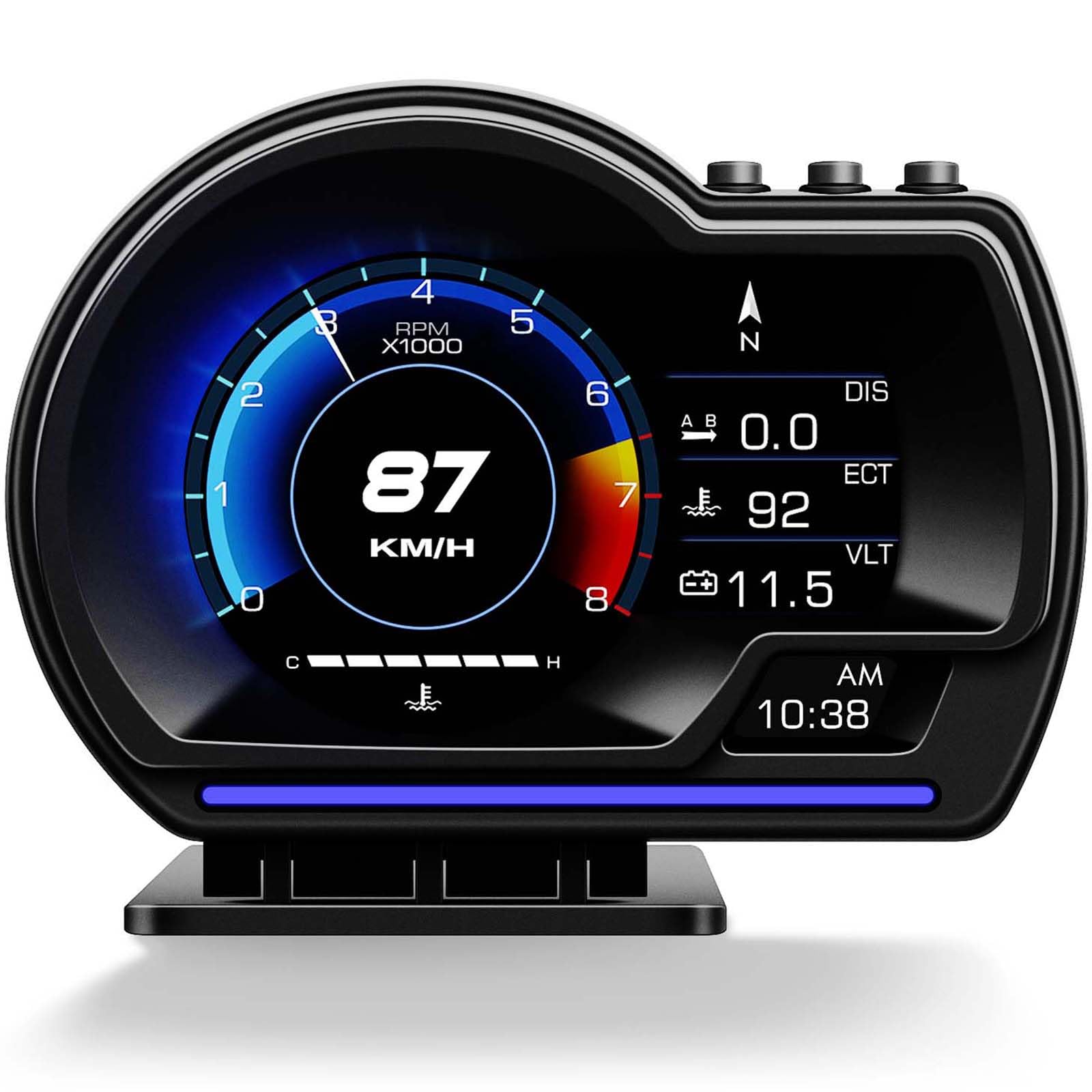
The MH P6 occupies the sweet spot in the HUD market, delivering a robust combination of OBD2 and GPS functionality at a price that undercuts most competitors with similar feature sets. It consistently earns high marks from owners for its stable performance and the sheer variety of data it can project, from basic speed and RPM to turbo pressure and fuel trims.
Setup is genuinely plug-and-play, and the 10 different interface options allow drivers to customize the layout to show exactly the data they care about. The inclusion of a built-in DTC scanner means you can investigate a check engine light without reaching for a separate tool. The brightness adjustment is adequate for most conditions, keeping the display legible without being distracting.
Some owners report that the timer shut-off feature doesn’t function reliably, requiring the unit to be unplugged on longer drives to prevent battery drain. The OBD2 connector is also slightly bulky for tight port locations. But for a mid-range device, the MH P6 offers the best balance of accuracy, features, and daily usability.
What works
- Excellent value for dual-system performance
- Clear and customizable display interfaces
- Integrated DTC scan and clear function
- Stable OBD2 data connection
What doesn’t
- Auto shut-off feature can be inconsistent
- OBD2 plug may not fit flush in tight ports
- Occasional software freezing requires reboot
3. X100 Wireless Solar GPS HUD
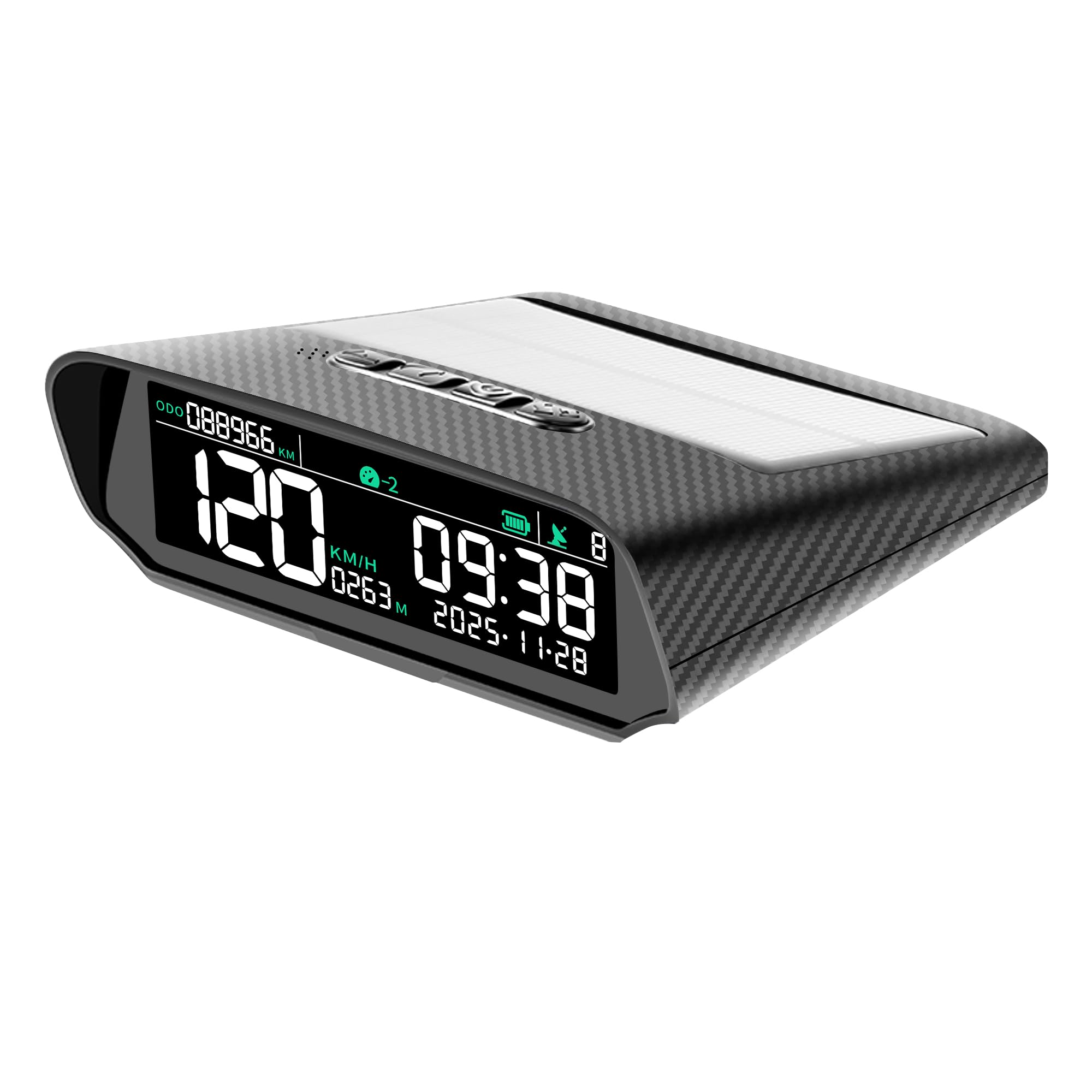
The X100 is a radical departure from the standard OBD2 HUD formula. It is a fully wireless, solar-assisted GPS speedometer designed for maximum versatility and resilience. With no cables to route and an IP67 waterproof rating, it is as much at home on a dual-sport motorcycle or off-road rig as it is on a daily driver.
The LCD screen is crisp and features a carbon fiber aesthetic that avoids looking cheap. The auto-brightness adjustment works effectively, and the large digits make it easy to read at a quick glance. The built-in solar panel helps extend battery life significantly, though the USB-C port is still necessary for continuous use on long trips. The vibration wake-up feature is a nice touch, automatically powering on the display when the engine starts.
The trade-off is that it offers no direct engine data—no RPM, coolant temperature, or voltage readings. It is purely a speed, altitude, and time display. The solar charging is more of a maintenance feature than a primary power source. If you want a clean, cable-free installation and universal compatibility, the X100 is the most elegant solution on the market.
What works
- Completely wireless installation
- Rugged IP67 waterproof construction
- Solar charging extends run time
- Universal GPS compatibility
What doesn’t
- No OBD2 engine data available
- Solar panel provides limited charge
- Adhesive mount is single-use
4. Liiiyuan C2 HUD
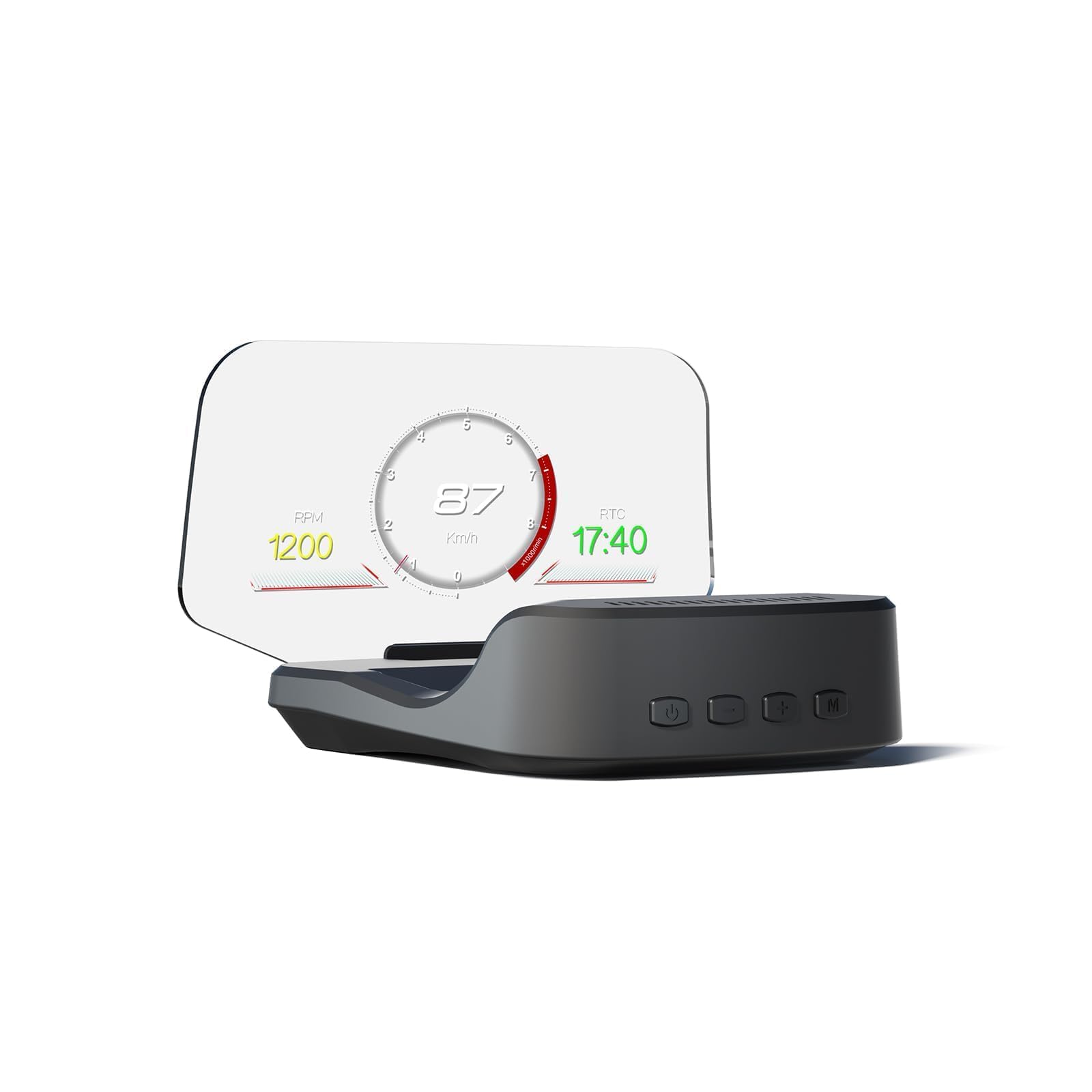
The Liiiyuan C2 addresses the most common complaint about windshield projection HUDs: ghosting. By using a dedicated transparent reflective panel, it creates a sharp, single-plane image that sits clearly in your field of view without the double-vision effect that plagues units projecting directly onto the glass.
It supports a full suite of OBD2 and GPS data, including speed, RPM, fuel consumption, water temperature, intake pressure, and turbo boost. The all-in-one design means it integrates the projector and display into a single unit that sits neatly on the dashboard. The menu system is reasonably intuitive, allowing for quick adjustments to layout and alarm thresholds.
Some owners find the magnified display can cause eye strain during extended night driving, and the unit’s wake-up cycle can occasionally require a manual unplug and replug. The build quality feels solid, but the interface can be slightly laggy when switching between screens. For visual clarity, however, it sets a high bar.
What works
- Crisp, ghost-free reflective display
- Extensive OBD2 parameter list
- Easy to install and configure
- Multiple alarm functions included
What doesn’t
- Can cause eye strain at night
- Occasional power cycle needed
- Interface can feel slightly laggy
5. wiiyii A8 5.5 Inch HUD
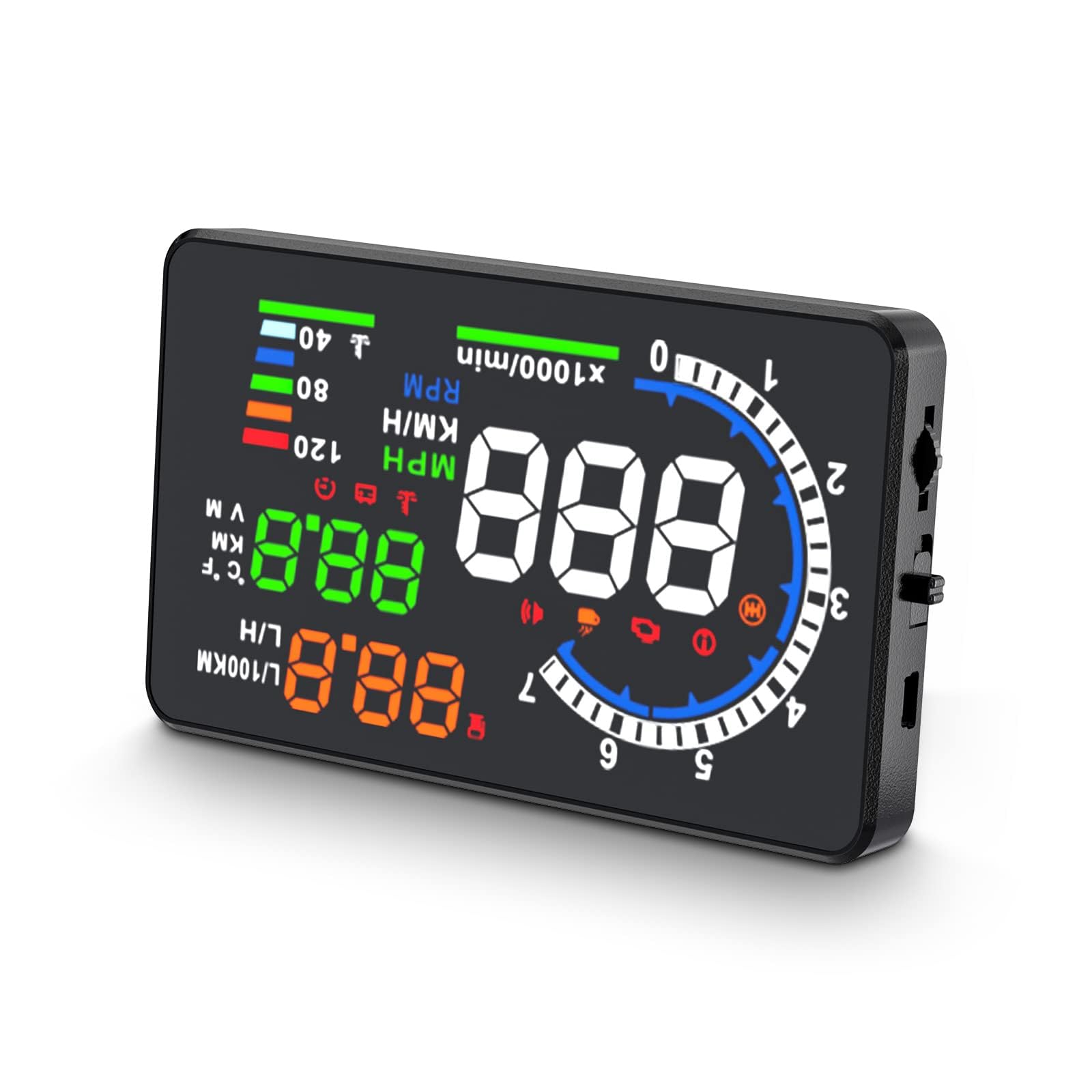
For drivers who prioritize readability above all else, the wiiyii A8 delivers the largest screen in this comparison at 5.5 inches. The bright, high-contrast display makes it incredibly easy to read speed, RPM, and water temperature without needing to refocus your eyes from the road ahead.
The A8 connects via OBD2 and pulls a solid range of data, including vehicle speed, voltage, fuel consumption, and mileage. It includes useful extras like voltage alarms, overspeed warnings, and the ability to read and clear diagnostic trouble codes. The display is fully customizable with multiple color schemes and layouts.
Long-term reliability appears to be a concern based on owner feedback, with some units failing after a year of service. It also lacks any GPS fallback, meaning compatibility with your vehicle’s OBD2 protocol is mandatory. The screen size is a clear advantage, but the trade-off in long-term durability is worth considering.
What works
- Very large, easy-to-read display
- Bright and adjustable backlight
- Includes DTC reading and clearing
- Multiple display themes
What doesn’t
- OBD2 only, no GPS backup mode
- Reliability concerns over 12+ months
- Warranty support can be difficult
6. AZIJYV P24 OBD2 Gauge Display

The AZIJYV P24 is perhaps the most feature-dense HUD in its price bracket, offering a 3.5-inch color LCD with a built-in slope and tilt indicator. This makes it uniquely suited for off-road use, where knowing your vehicle’s angle can be critical for safety and navigation.
On the OBD2 side, it reads an exhaustive list of parameters including intake temperature, oil pressure, air-fuel ratio, and turbine pressure. The GPS mode adds altitude, direction, and slope angle. The device supports 12 languages and offers 13 different display screens, along with customizable ambient lighting for a personalized look.
The sheer volume of features does come with a cost. The interface can be overwhelming to navigate, and some owners report that the device fails to hold settings or malfunctions after a short period. The build quality feels plastic and light. It is a compelling package for the adventurous tinkerer, but reliability remains a question mark.
What works
- Unique slope and tilt gauge for off-road
- Extremely detailed OBD2 parameter list
- Color LCD with ambient lighting
- Dual OBD2 and GPS operation
What doesn’t
- Complex and sometimes confusing interface
- Reliability and build quality concerns
- Some features may not work as advertised
7. MAIMEIMI A8 Windshield Projection
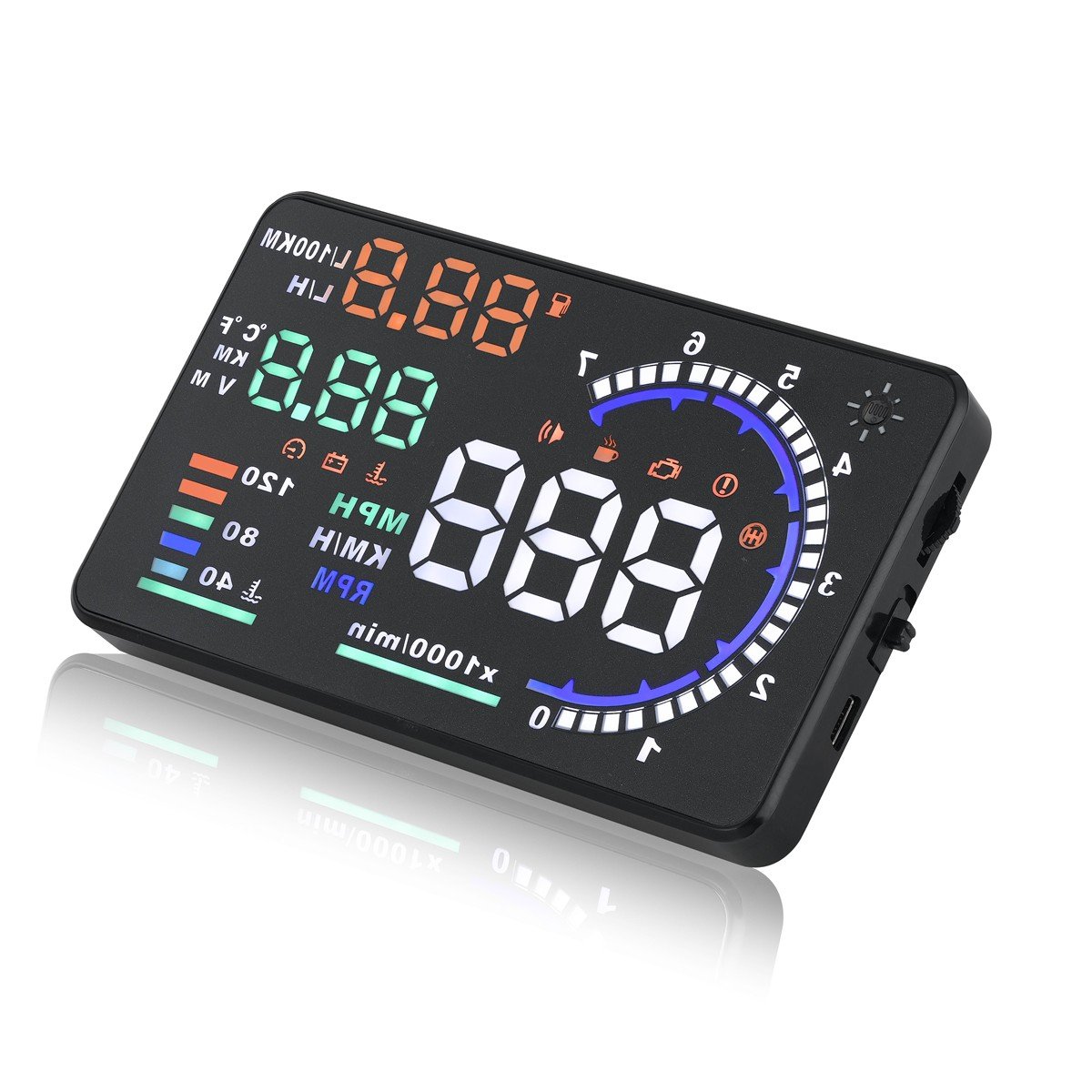
This MAIMEIMI model focuses on delivering a true heads-up experience by projecting data directly onto the windshield. The large, bold fonts ensure that critical information like current speed is always in your peripheral vision, reducing the need to glance down at the instrument cluster.
It functions as a multi-data monitor, displaying speed, RPM, trip distance, water temperature, and voltage. The built-in light sensor automatically dials in the brightness, keeping the display clear without being distracting. It includes four alarm functions for overspeeding, fatigue, and engine faults.
Compatibility is the major hurdle. It supports OBD2 and EOBD protocols only and has a long list of incompatible vehicle brands and types, including Dodge, Jeep, French and Italian models, hybrids, and diesels. Buyers must carefully verify compatibility before purchasing, as there is no GPS mode to fall back on for unsupported vehicles.
What works
- True windshield projection with large fonts
- Effective auto-brightness sensor
- Useful multi-alarm system
What doesn’t
- Strict OBD2 compatibility limitations
- No GPS mode for unsupported cars
- Many vehicle brands not supported
8. MAIMEIMI P6 OBD2+GPS HUD

The MAIMEIMI P6 offers the flexibility of a dual-mode system at a budget-friendly price point. It allows drivers to choose between OBD2 for direct engine data and GPS for universal compatibility, making it a versatile option for mixed vehicle use or as an introductory HUD.
The device offers 10 different interface modes, displaying data combinations that include speed, water temperature, voltage, fuel consumption, RPM, and time. The package includes a stand base for flexible positioning on the dashboard or windshield. The GPS mode works with any vehicle, providing a reliable fallback.
The build quality is noticeably lighter than more expensive options, and the OBD2 mode has significant compatibility gaps with certain brands and pre-2008 vehicles. The GPS mode can also exhibit lag in tunnels or areas with poor sky visibility. It is a functional entry point, but compromises are evident.
What works
- Affordable dual-system capability
- Multiple display modes and layouts
- Easy plug-and-play installation
What doesn’t
- Light and somewhat flimsy build quality
- OBD2 compatibility list is restrictive
- GPS signal lag in poor conditions
9. YAOUZICN Dual Mode HUD C1
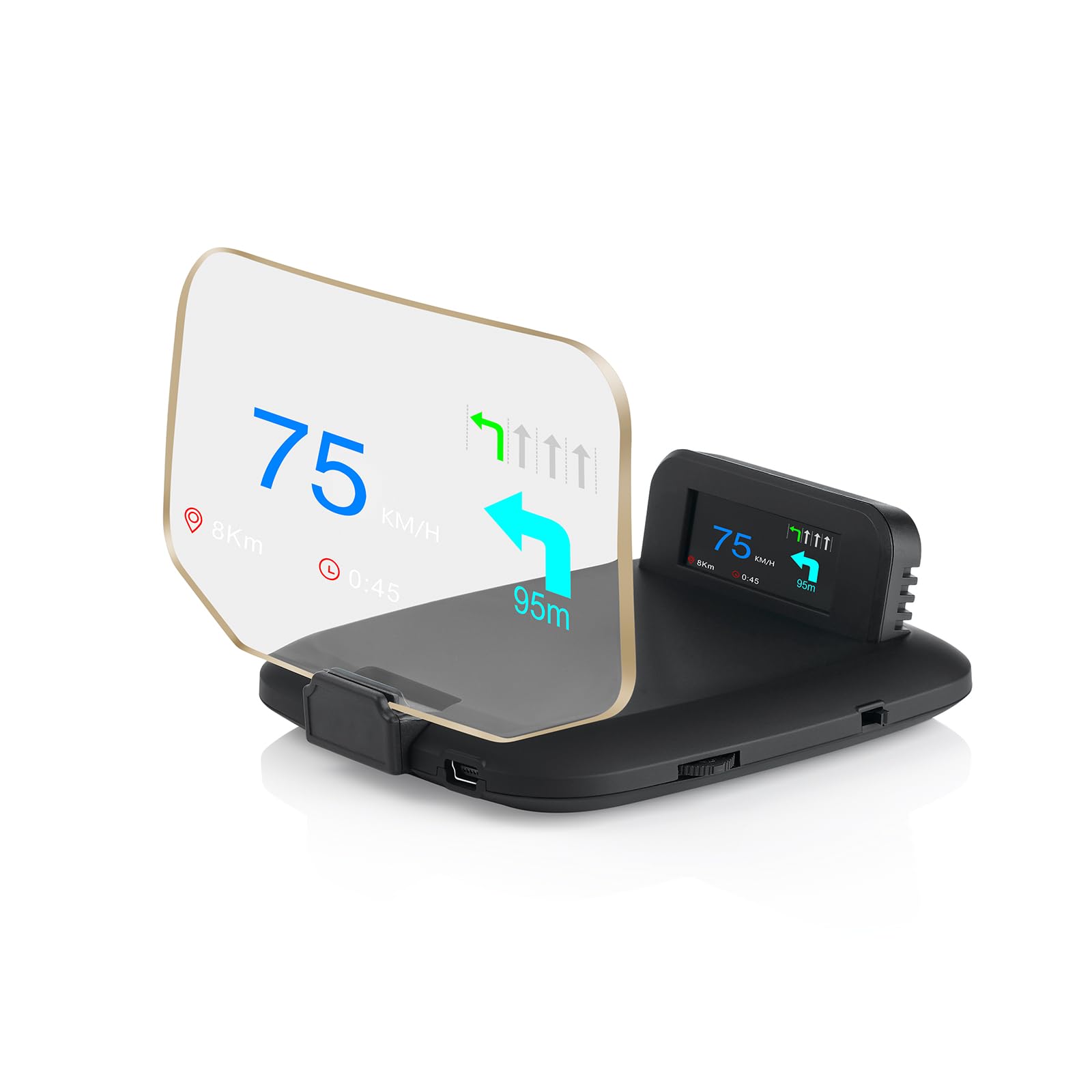
The YAOUZICN C1 is engineered for broad compatibility, explicitly supporting 24V electrical systems found in many trucks, commercial vehicles, and diesel engines. It combines an OBD2 interface with a universal GPS mode to cover as many vehicle types as possible.
The device projects over 20 real-time metrics, including speed, RPM, fuel consumption, voltage, coolant temperature, and turbo pressure. It also features live OBD2 diagnostics, allowing the driver to read and clear engine fault codes without a separate scanner. The extended USB cable included with the unit facilitates easy routing in larger vehicles.
The display clarity and overall build quality are adequate for the price point, though they don’t match the premium feel of higher-end units. The physical size of the HUD can make finding an ideal mounting location a challenge in some dashboards. It is a solid, functional choice for drivers who need a HUD that can handle a 24V environment.
What works
- Explicit 24V truck and diesel support
- Dual OBD2 and GPS operation
- Includes DTC scan and clear features
What doesn’t
- Average display brightness and clarity
- Unit size can be bulky on some dashes
- Limited long-term owner feedback
10. wiiyii P8 A-Pillar HUD

The wiiyii P8 differentiates itself with an unusual installation method: it can be mounted directly on the A-pillar trim, placing the display right in the natural line of sight for most drivers. This avoids cluttering the dashboard or windshield and can result in a cleaner overall look.
It features a dual OBD2 and GPS system with 8 different display interfaces. Setup is straightforward, simply requiring a power connection and a short wait for the GPS to acquire satellites. The device is intended to be an unobtrusive assistant that keeps data readily accessible.
The 2-inch screen is quite small compared to the competition, which limits how quickly you can parse the information at a glance. The build quality and overall aesthetic feel firmly budget-oriented. It is an interesting concept that works well for some, but the small screen and limited feature set hold it back.
What works
- Unique A-pillar mounting option
- Dual OBD2 and GPS systems
- Very simple and quick setup
What doesn’t
- 2-inch screen is quite small
- Budget build quality and materials
- Limited data display customization
11. Arestech 5.5 Inch OBD2 HUD

The Arestech HT-006 is a straightforward, no-frills heads-up display designed to project basic OBD2 data onto the windshield. Its main selling point is a large, colorful 5.5-inch screen that makes speed, RPM, and water temperature highly visible at a glance.
It supports automatic brightness adjustment and includes basic overspeed warnings. The included reflective film helps mitigate the ghosting effect common with direct windshield projection. The plug-and-play OBD2 installation is accessible for any driver comfortable locating their vehicle’s diagnostic port.
The unit’s long-term durability is its most significant weakness. A substantial number of owner reports indicate the device failing, resetting, or displaying garbled data after a few weeks or months of use. It is strictly an OBD2 device with no GPS backup, and it has a relatively high rate of returns. It serves as a low-cost introduction to HUD technology, but reliability is a gamble.
What works
- Very large and colorful display
- Easy OBD2 plug-and-play setup
- Low entry price point
What doesn’t
- High rate of reported failures
- OBD2 only, no GPS backup
- Metric units only in some modes
Hardware & Specs Guide
OBD2 vs GPS Data Sources
OBD2 connects directly to the vehicle’s ECU for real-time, highly accurate engine data (RPM, coolant temp, voltage, fuel trims). GPS relies on satellite signals to calculate speed, altitude, and heading. OBD2 is better for mechanical insight and has virtually no latency. GPS is universally compatible, works on any vehicle regardless of age or engine type, and draws no power from the car’s diagnostic bus when the ignition is off.
Display Types and Optical Paths
HUDs use direct LCD/LED screens, windshield projection, or transparent reflective panels. Windshield projection offers the most immersive heads-up feel but can suffer from ghosting on double-layered glass, which is mitigated by included reflective films. Reflective panels eliminate ghosting entirely by providing a dedicated focal plane. Screen brightness (measured in nits) and the quality of the auto-dimming sensor are critical for maintaining legibility without causing distraction or eye strain during night driving.
FAQ
Will an OBD2 HUD drain my car battery?
Why does my HUD show a different speed than my dashboard?
Can I use a HUD in a diesel truck or hybrid vehicle?
Final Thoughts: The Verdict
For most buyers, the best auto heads up display winner is the MH Head Up Display P6 because it packs the most useful feature set—including dual OBD2 and GPS modes, a clear multi-interface display, and onboard DTC scanning—into a reliable and fairly priced package. If you demand the deepest level of vehicle data and professional-grade build quality, the ScanGauge 3 is the definitive tool for the job. And for those who want a clean, wireless installation that works on absolutely any vehicle, the X100 Solar GPS is the most innovative and rugged choice on the market.

Certification: BSc in Mechanical Engineering
Education: Mechanical engineer
Lives In: 539 W Commerce St, Dallas, TX 75208, USA
Md Amir is an auto mechanic student and writer with over half a decade of experience in the automotive field. He has worked with top automotive brands such as Lexus, Quantum, and also owns two automotive blogs autocarneed.com and taxiwiz.com.