A flat tire at the wrong moment separates a minor inconvenience from a full-blown roadside ordeal. The difference comes down to having a compressor that actually delivers its rated pressure, maintains consistent airflow under load, and doesn’t overheat before finishing the job. Most inflators look identical on a product page but behave very differently when you need them most.
I’m Amir — the founder and writer behind Four Wheel Ask. I’ve spent years analyzing automotive accessory specifications, cross-referencing owner-reported performance data, and evaluating build quality across dozens of inflator models to separate reliable designs from marketing-driven compromises.
Whether you need a compact unit for emergency top-offs or a high-output machine for full reinflations, choosing the right best auto air compressor comes down to understanding duty cycle, real airflow ratings, and pressure accuracy under real-world conditions rather than advertised peak numbers.
How To Choose The Best Auto Air Compressor
Selecting the right inflator requires looking past the headline PSI number and understanding three core performance factors that determine whether a compressor will serve you reliably for years or end up failing at the worst possible moment.
Airflow Rate and Duty Cycle
The airflow rate, measured in liters per minute (LPM) or cubic feet per minute (CFM), directly dictates how fast a tire refills. A unit delivering 35 LPM will inflate a standard car tire roughly twice as fast as one rated at 18 LPM. Duty cycle refers to how long the compressor can run continuously before needing a cool-down period. Higher-duty-cycle units handle multiple tires in one session without thermal shutdown.
Power Source and Portability
Corded 12V models draw power directly from the vehicle’s cigarette lighter socket and never run out of battery, but they require the engine to be running. Cordless battery-powered units offer convenience and freedom of movement but introduce range anxiety and battery degradation over time. Some premium hybrids offer both options, giving you flexibility without compromise.
Pressure Accuracy and Auto Shut-Off
Digital gauges vary widely in precision. A unit with ±1 PSI accuracy and altitude compensation delivers reliable readings whether you’re at sea level or in the mountains. Auto shut-off prevents over-inflation, but implementation matters — the best systems use dwell technology that pauses, measures, and adjusts rather than simply cutting power at a single threshold.
Quick Comparison
On smaller screens, swipe sideways to see the full table.
| Model | Category | Best For | Key Spec | Amazon |
|---|---|---|---|---|
| Fanttik X8 APEX | Cordless Premium | All-around performance | 32 LPM, 150 PSI, 40 min runtime | Amazon |
| NOCO AIR15 | High-Output Corded | Heavy-duty rapid fills | 44 LPM, 15A, 15 min duty cycle | Amazon |
| Lamicall | Cordless Compact | Everyday glove-box carry | 35 LPM, 150 PSI, 15 tires per charge | Amazon |
| WEOLULI | Cordless Hybrid | Dual-power flexibility | 24 LPM, 150 PSI, 6000mAh battery | Amazon |
| GJOSYOI | Budget Cordless | Entry-level cordless convenience | 150 PSI, 40 dB, dual LCD display | Amazon |
| EPAuto | Value Corded | Reliable budget pick | 1.06 CFM, 12V DC, auto shut-off | Amazon |
| AstroAI | Entry-Level Corded | Basic emergency backup | 350 LPM, 12V, 9.8 ft cord | Amazon |
In‑Depth Reviews
1. Fanttik X8 APEX

The Fanttik X8 APEX represents the sweet spot where portability meets genuine performance. Its F8 high-performance motor delivers 32 LPM of airflow, filling a 215/55 R17 tire from 28 to 33 PSI in 56 seconds. The altitude adaptive calibration sets it apart — the internal sensor adjusts pressure readings automatically based on elevation, maintaining ±1 PSI accuracy whether you’re at sea level or climbing mountain passes.
Battery life reaches 40 minutes of continuous operation under normal outdoor temperatures, and the proprietary cooling function allows it to refill up to 17 tires without requiring a cooldown pause. Every unit undergoes 65 factory tests covering battery safety, drop resistance up to 1.2 meters, and inflation accuracy, which explains the high owner satisfaction rate across thousands of reviews.
The four preset modes cover bicycles, motorcycles, cars, and balls, with three pressure unit options. The Deluxe Package includes a storage case, car charger, Presta valve adapter, and ball needle. The compact form factor — roughly the size of a large water bottle — makes it easy to store under a seat or in a trunk organizer without sacrificing inflating capability.
What works
- Altitude-compensating gauge maintains accuracy anywhere
- Rapid 56-second fill time for standard car tires
- Extended 40-minute battery with smart thermal management
What doesn’t
- Higher initial investment compared to basic corded units
- Yellow color scheme may not appeal to all buyers
2. NOCO AIR15

The NOCO AIR15 sits in a class of its own for raw inflation speed. With a 15-amp motor delivering 44 liters per minute of airflow, it can take a completely flat tire from 0 to 40 PSI in just 2.9 minutes. For routine top-offs, a tire sitting at 35 PSI reaches 40 PSI in under 29 seconds. This is the fastest unit in this lineup by a significant margin.
The build quality reflects NOCO’s reputation for rugged construction. The housing is approximately 65% metal, contributing to a substantial 5.7-pound weight that signals durability rather than cheap plastic. The 15-minute continuous duty cycle means you can inflate all four tires from completely flat in a single session without waiting for cooldown — a capability most portable inflators simply cannot match.
Smart pressure technology with dwell functionality sets the AIR15 apart. The integrated sensor pauses inflation as the pump reaches the set pressure, then resumes to fine-tune the final reading, preventing the overshoot that plagues simpler auto-shutoff systems. The 10-foot power cord and 3-foot braided hose provide ample reach around any vehicle, and the 60-lumen LED flashlight with SOS mode adds genuine emergency utility.
What works
- Blazing 44 LPM airflow cuts inflation time dramatically
- Heavy-duty metal construction with 15-minute duty cycle
- Dwell technology prevents pressure overshoot for precise fills
What doesn’t
- Requires vehicle engine to be running due to 15A draw
- Heavier and bulkier than cordless alternatives
3. Lamicall
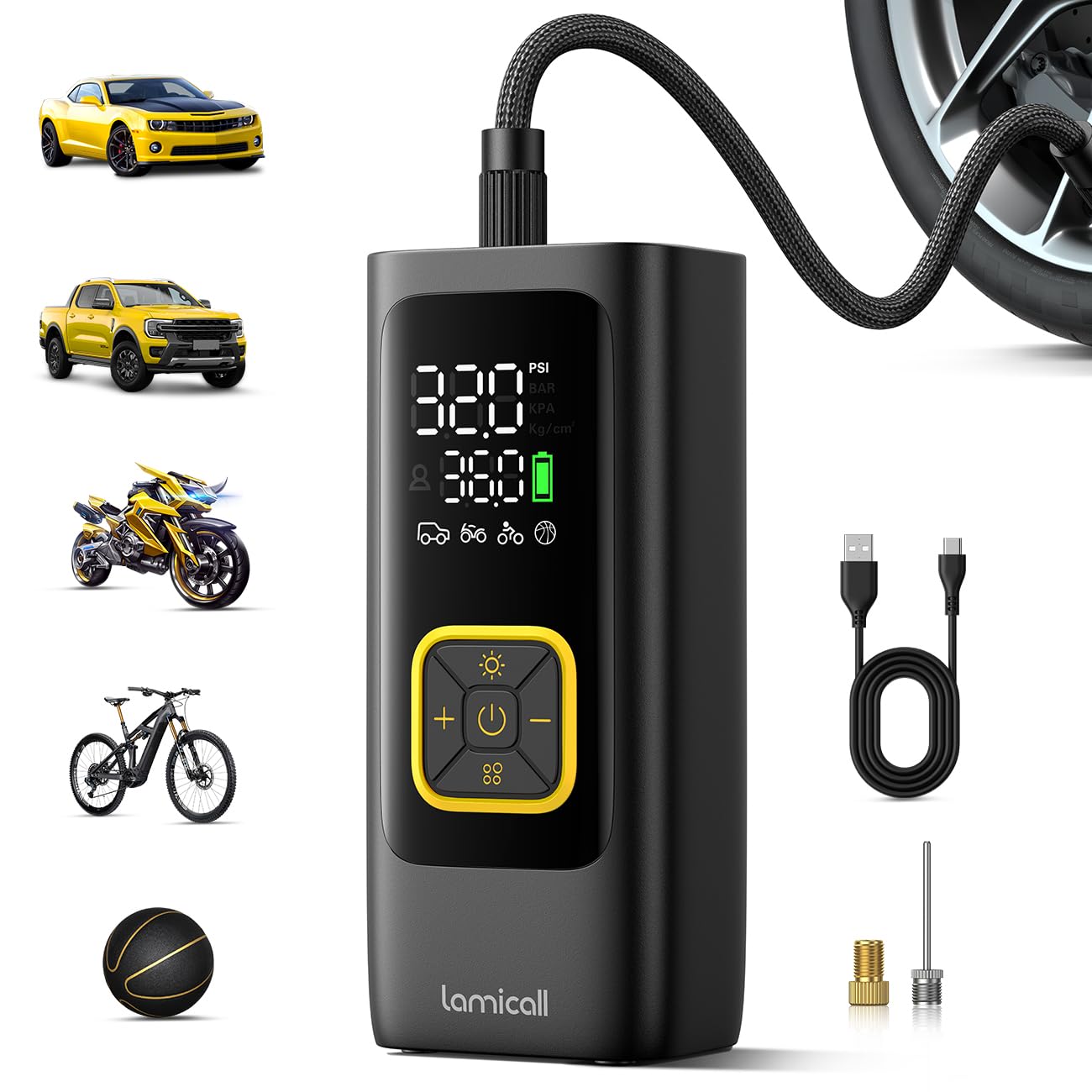
The Lamicall packs impressive specs into a genuinely compact footprint — 6.3 by 2.7 by 2.1 inches — making it one of the smallest high-output cordless inflators available. The 35 LPM airflow rating positions it near the top of the cordless category, capable of inflating a 195/65 R15 tire from 28 to 36 PSI in approximately one minute. This is not a compromise compact unit; it genuinely performs.
Battery endurance is a standout feature. A single charge handles up to 15 car tires, 25 bicycle tires, 20 motorcycle tires, or 125 basketballs. The 150 PSI maximum pressure covers everything from road bikes to full-size SUV tires, and the five one-touch preset modes — Car, Truck, SUV, Motorcycle, Bike, plus a Ball mode and custom manual mode — reduce guesswork when switching between inflation tasks.
The HD LED display shows both pressure readings and battery level clearly, and the integrated emergency light offers three modes: flashlight, SOS, and strobe. The auto shut-off engages at ±2 PSI of the preset target, which provides reliable protection against over-inflation. Owners consistently highlight the convenience of fitting this unit in a glove box or motorcycle tailbox without sacrificing inflation capability.
What works
- Exceptionally compact design fits in most glove compartments
- 35 LPM airflow rivals much larger competitors
- Outstanding battery life — up to 15 car tires per charge
What doesn’t
- Plastic housing may not withstand heavy drops as well as metal units
- Auto shut-off tolerance of ±2 PSI is slightly wider than premium rivals
4. WEOLULI
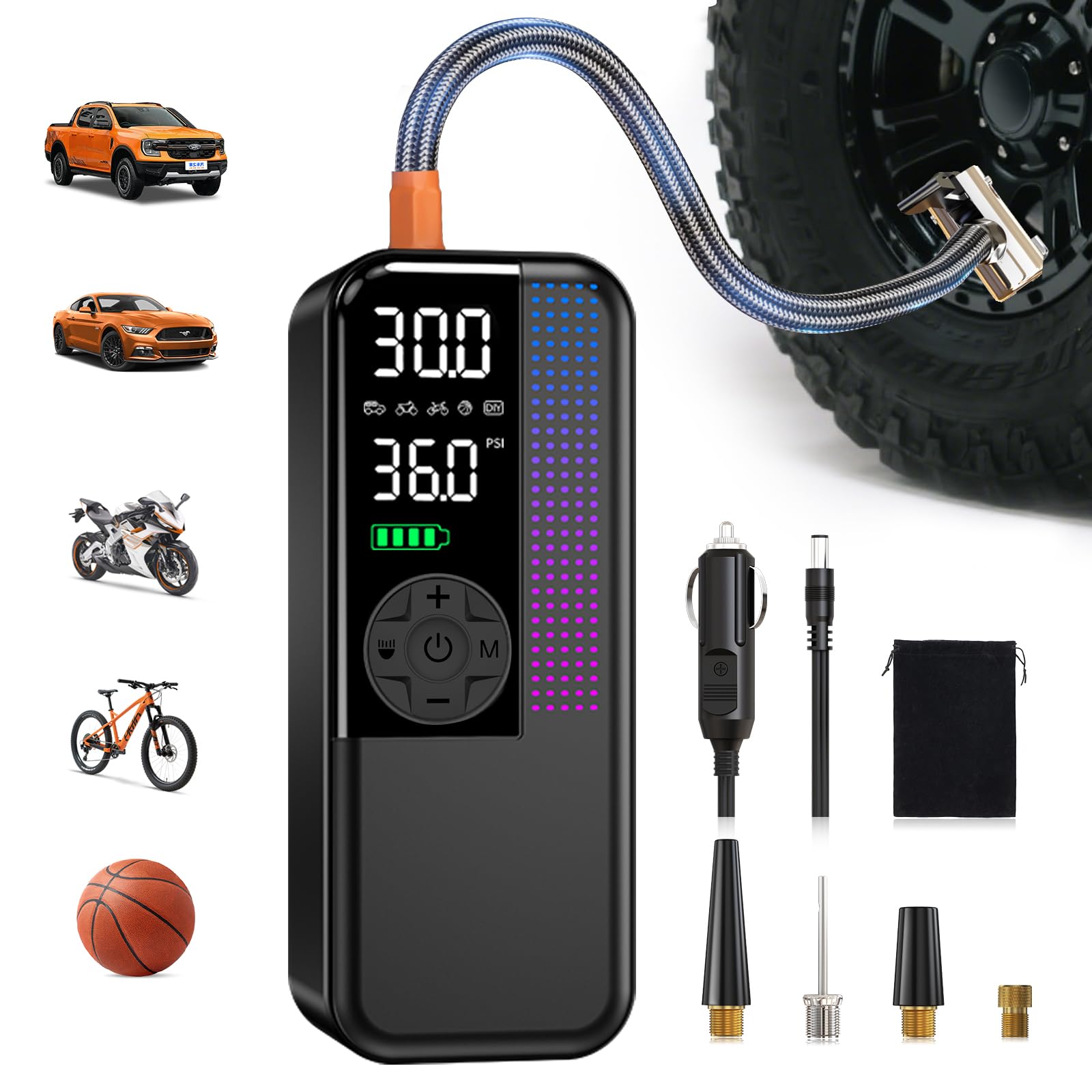
The WEOLULI delivers a compelling dual-power proposition at an accessible price point. It operates either from its built-in 6000mAh lithium-ion battery or via the included 12V car plug, giving you cordless convenience with a tethered fallback when the battery runs low. The 24 LPM airflow rating is moderate compared to premium units, but the smart cooling design prevents the overheating shutdowns that plague cheaper inflators during extended use.
The digital pressure gauge is calibrated with a positive tolerance of ±1 PSI, meaning readings land slightly on the safe side. When you disconnect the valve and lose that small puff of air, the final pressure still hits the target. This thoughtful calibration detail shows attention to real-world use rather than lab-spec optimization. The unit can inflate three standard car tires (195/65 R15) on a full charge without stopping.
Four smart preset modes cover Car, Bike, Motorcycle, and Balls, with one-touch operation that eliminates manual pressure setting guesswork. The included accessories — Presta valve adapter, ball needle, tapered nozzles, USB charging cable, and storage bag — cover most inflation scenarios out of the box. Owner feedback consistently praises the thermal efficiency and the peace of mind that comes from having both battery and 12V power options available.
What works
- Dual power source eliminates battery anxiety on long trips
- Positive-tolerance gauge calibration ensures accurate final pressure
- Smart cooling design prevents thermal shutdown mid-job
What doesn’t
- 24 LPM airflow is slower than higher-output competitors
- ABS plastic build feels less substantial than premium alternatives
5. GJOSYOI
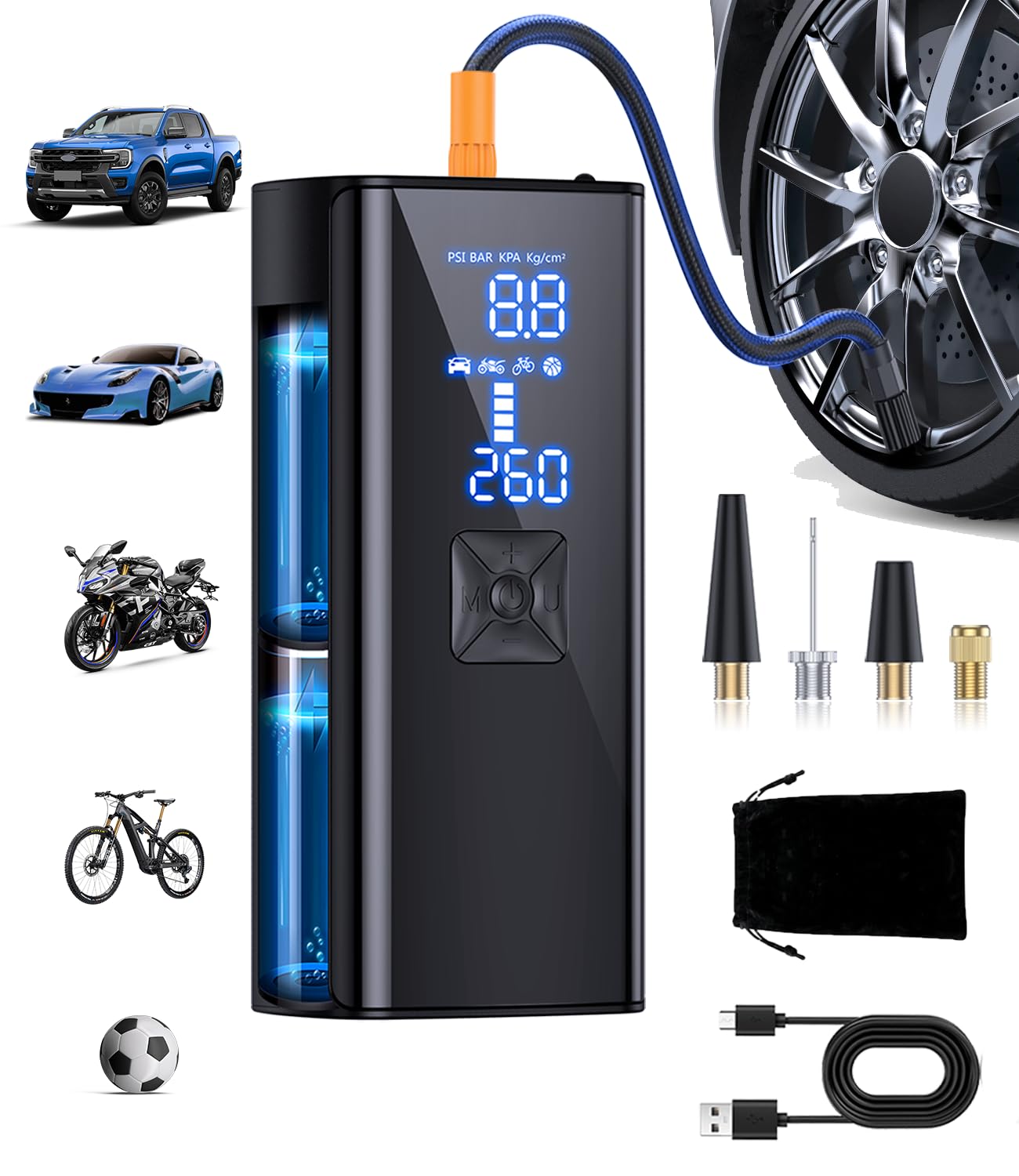
The GJOSYOI enters the cordless segment with a focus on user-friendly features at a manageable price. Its dual LCD display shows both real-time pressure and preset values simultaneously, eliminating the need to toggle between screens. The 150 PSI maximum pressure rating matches premium units, and the four preset modes plus a customizable manual mode cover the standard range of inflation tasks.
Noise output is rated at a low 40 dB, which makes it noticeably quieter than many compressors in this class. The built-in rechargeable battery enables cordless operation, while USB-C input allows for fast recharging and a USB-A output lets it double as a power bank for emergency device charging. The integrated LED light provides illumination for nighttime roadside use.
The kit includes four inflation nozzles, a USB charging cable, and a storage bag. The auto shut-off function engages when the preset pressure is reached, preventing over-inflation. While the build quality uses plastic rather than metal, the lightweight design — easily stored in a backpack or door pocket — makes it a practical choice for drivers who want cordless capability without a significant investment.
What works
- Dual LCD display shows target and current pressure side-by-side
- USB-A output provides emergency phone charging capability
- Quiet 40 dB operation is less disruptive than typical inflators
What doesn’t
- Plastic construction raises durability concerns over long-term use
- Limited real-world performance data from verified owner reviews
6. EPAuto

The EPAuto has earned a loyal following through years of reliable service, with numerous owner reports describing five-plus years of regular use without failure. This 12V DC corded unit plugs directly into the cigarette lighter socket and delivers 1.06 CFM of airflow, sufficient for topping off tires on cars, midsize sedans, and SUVs with engine displacements under 3.5 liters. It explicitly does not support heavy truck tires, which is an honest specification that prevents misuse.
The digital display offers four pressure units — PSI, KPA, BAR, and KG/CM — and the auto shut-off prevents over-inflation once the preset target is reached. Overheat protection adds a layer of safety by shutting down the compressor if it exceeds safe operating temperatures. The USPTO patent (D875,788) on the design indicates a level of engineering investment that budget clones lack.
Owners consistently note that the included accessories — needle valve for balls, short and long cone adapters for inflatables — cover most non-automotive needs. The 16-ounce weight makes it easy to store, and the built-in LED flashlight provides adequate illumination for dark conditions. The primary limitation is the 3-foot hose, which requires you to position the unit close to each tire, but the straightforward reliability has made this a perennial top seller.
What works
- Proven long-term reliability with many units lasting 5+ years
- Honest truck-tire limitation prevents misuse and overheating
- Patented design with overheat protection and auto shut-off
What doesn’t
- 3-foot hose requires close positioning to each tire
- Not suitable for large truck tires or high-volume commercial use
7. AstroAI

The AstroAI offers a straightforward, no-frills approach to tire inflation at the most accessible price point in this lineup. The 12V DC unit requires a running vehicle and draws power through the cigarette lighter socket, but the 9.8-foot cord provides generous reach to all four tires of most regular-sized vehicles without needing to reposition the compressor. The compact form factor — 8.4 inches cubed and weighing 2.2 pounds — fits easily into glove compartments or under seats.
The digital gauge displays pressure across four units, and the programmable auto shut-off lets you set a target pressure using the M, plus, and minus buttons. Once the preset level is reached, the compressor stops automatically, preventing over-inflation. The backlit screen and independent LED flashlight button make nighttime operation straightforward, a feature that owners consistently mention as valuable for emergency use.
The metal and plastic construction strikes a balance between weight and durability, and the two-year manufacturer warranty provides above-average coverage for this price segment. Owner feedback frequently highlights the value proposition — reliable performance at a cost that makes it easy to keep one in each vehicle. While the 350 LPM airflow rating is adequate for topping off tires, extended full-reinflation sessions will test the duty cycle limits of this entry-level unit.
What works
- Long 9.8-foot cord reaches all four tires without repositioning
- Compact size fits in glove box or small storage compartments
- Two-year warranty provides confidence at this price level
What doesn’t
- Requires vehicle engine to be running during operation
- Limited duty cycle for full reinflations from completely flat
Hardware & Specs Guide
Airflow Rate (LPM vs CFM)
Liters per minute (LPM) and cubic feet per minute (CFM) measure the volume of air the compressor moves. Higher numbers mean faster inflation. A unit rated at 35 LPM fills a standard car tire roughly twice as fast as one rated at 18 LPM. For reference, 1 CFM equals approximately 28.3 LPM. Always compare airflow ratings at the same pressure to get an accurate performance picture.
Duty Cycle and Thermal Management
Duty cycle indicates how long a compressor can run continuously before requiring a cooldown period. A 15-minute duty cycle means you can run the unit for 15 minutes straight before pausing. Premium units incorporate active cooling fins or smart thermal sensors that extend runtime. Overheating is the most common cause of portable compressor failure, making duty cycle a critical reliability metric.
Pressure Accuracy and Calibration
Digital pressure gauges vary in precision from ±1 PSI to ±3 PSI. Higher accuracy matters most when inflating to specific manufacturer-recommended pressures. Some premium units employ altitude-compensating sensors that maintain accuracy regardless of elevation, while budget units may drift at higher altitudes. Positive-tolerance calibration — where readings lean slightly high — helps compensate for the small air loss that occurs when disconnecting the hose.
Battery Capacity and Power Options
Cordless inflators use lithium-ion batteries measured in milliampere-hours (mAh). A 6000mAh battery typically provides enough capacity for 3-4 car tire reinflations or up to 15 top-offs. Dual-power units that support both battery and 12V operation offer the best flexibility, providing cordless convenience with a tethered fallback when the battery depletes. Consider whether USB-C fast charging and USB-A power bank functionality add value for your use case.
FAQ
What PSI rating do I need for my vehicle tires?
Can I use a 12V inflator without the engine running?
How long should a portable air compressor last?
What is the difference between a compressor and an inflator?
Final Thoughts: The Verdict
For most buyers, the best auto air compressor winner is the Fanttik X8 APEX because it combines genuine 32 LPM performance, altitude-compensating accuracy, and extended battery life in a portable package that handles everything from daily top-offs to emergency full reinflations. If raw inflation speed and heavy-duty construction are your priority, the NOCO AIR15 delivers the fastest fill times with a metal-bodied build that will last for years. And for those wanting cordless capability at a manageable investment, the Lamicall packs 35 LPM airflow into a glove-box-friendly size with outstanding battery endurance.

Certification: BSc in Mechanical Engineering
Education: Mechanical engineer
Lives In: 539 W Commerce St, Dallas, TX 75208, USA
Md Amir is an auto mechanic student and writer with over half a decade of experience in the automotive field. He has worked with top automotive brands such as Lexus, Quantum, and also owns two automotive blogs autocarneed.com and taxiwiz.com.