Few things kill the start of a ride faster than a dead battery after a few weeks of sitting. An ATV battery maintainer eliminates that frustration by keeping your battery at the perfect voltage, ready to fire up whenever you are, regardless of how long the machine has been parked.
I’m Amir — the founder and writer behind Four Wheel Ask. I’ve spent years studying battery charging technology, comparing multi-stage profiles across brands, and analyzing long-term owner feedback to separate real reliability from marketing claims.
This guide breaks down the top contenders using real-world performance data and technical specifications. Choosing the right best atv battery maintainer means checking voltage compatibility, amperage output, and multi-stage charging for your specific ride.
How To Choose The Best ATV Battery Maintainer
A battery maintainer is not just a charger — it’s a long-term partner for your ATV’s electrical system. Selecting the right one comes down to understanding charging stages, amperage needs, and battery chemistry compatibility. Here are the key factors to evaluate before you buy.
Charging Stages & Smart Automation
A basic trickle charger pumps current continuously, which can lead to overcharging and shortened battery life. A true maintainer uses multi-stage logic: bulk charge, absorption, float, and often a pulse desulfation phase. The best units switch between modes automatically based on battery voltage, so you can connect them and walk away for months without worry. Look for models that explicitly advertise a 4-step or 7-step charging program.
Amperage: Matching Output to Battery Capacity
Amperage determines how fast the unit can recharge a depleted battery. For an ATV battery — typically in the 12–30 Ah range — a 0.6A to 2A maintainer is sufficient for long-term storage and top-off charging. A 5A unit recovers a dead battery faster but still tapers down to a safe float mode. Higher amperage is useful if you juggle multiple vehicles or deal with deeply discharged batteries, but for pure maintenance, lower amperage is gentler on the cells.
Battery Chemistry: Lead-Acid vs. Lithium Compatibility
Lead-acid batteries (flooded, AGM, gel) and lithium-iron-phosphate (LiFePO4) batteries have different voltage thresholds and charging profiles. Using a standard lead-acid charger on a lithium battery can damage the cells or trigger the battery’s internal protection circuit. If you own a lithium ATV battery or plan to upgrade, choose a maintainer with a dedicated lithium mode that charges at the correct 14.4–14.6V absorption voltage and has a lower float stage.
Safety Features & Build Quality
Reverse polarity protection, spark-proof connectors, and overcharge safeguards are non-negotiable for a unit you plan to leave connected unattended. Temperature compensation is another critical feature — it adjusts the charge voltage based on ambient temperature, preventing undercharging in cold weather and overcharging in summer heat. Also examine cable length and connector quality: ring terminals allow permanent attachment to the battery, while alligator clips are better for occasional use.
Quick Comparison
On smaller screens, swipe sideways to see the full table.
| Model | Category | Best For | Key Spec | Amazon |
|---|---|---|---|---|
| NOCO GENIUS5 | Smart Charger | Dead Battery Recovery | 5A, 6V/12V, Lead-Acid & Lithium | Amazon |
| Battery Tender Plus | Maintainer | Extended Storage | 1.25A, 12V, 4-Step Charging | Amazon |
| DEWALT DXAEC2 | 3-in-1 Unit | Versatility & Cold Weather | 2A, 6V/12V, AGM/GEL/WET | Amazon |
| ECO-WORTHY 5A | Smart Charger | Lithium Battery Charging | 5A, 12V, LCD Display | Amazon |
| Tecmate Optimate 1 Duo | Maintainer | Motorcycle & ATV Long-Term Storage | 0.6A, 12V/12.8V, 4-Step | Amazon |
| NEXPEAK 4-Pack | 4-Pack Value | Multi-Vehicle Maintenance | 1.75A, 6V/12V, 7-Stage | Amazon |
| BatteryMINDer 1510 | Desulfator | Battery Recovery & Reconditioning | 1.5A, 12V, Up to 4 Batteries | Amazon |
In‑Depth Reviews
1. NOCO GENIUS5

The NOCO GENIUS5 is a 5-amp smart charger that works with both 6-volt and 12-volt lead-acid (AGM, gel, SLA, VRLA) and lithium-ion (LiFePO4) batteries. Its integrated thermal sensor dynamically adjusts the charge based on ambient temperature, preventing overcharging in summer and undercharging in winter. The unit is 34 percent smaller than the previous G3500 while delivering 65 percent more power, making it genuinely compact for the output it provides.
One of the standout features is Force Mode, which allows you to manually begin charging completely dead batteries down to zero volts — something most maintainers cannot do. The precision pulse charging automatically detects and reverses sulfation and acid stratification, restoring lost battery capacity over time. The included mounting bracket and velcro strap let you install it permanently near your battery for a clean, semi-permanent setup.
Owner reports consistently highlight the GENIUS5’s ability to recover deeply discharged batteries that other chargers reject. The 80-inch DC cable provides plenty of reach, and the integrated eyelet terminals make permanent connections simple. The 3-year warranty backs the build quality, and the compact design fits into tight spaces under ATV seats or in storage compartments.
What works
- Force Mode revives batteries from zero volts
- Thermal sensor compensates for hot and cold conditions
- Compact footprint for a 5-amp unit
- Compatible with both lead-acid and lithium chemistry
What doesn’t
- Unit runs warm during high-output charging
- No LCD screen for voltage readout
- Instruction guide not included in every retail package
2. Battery Tender Plus
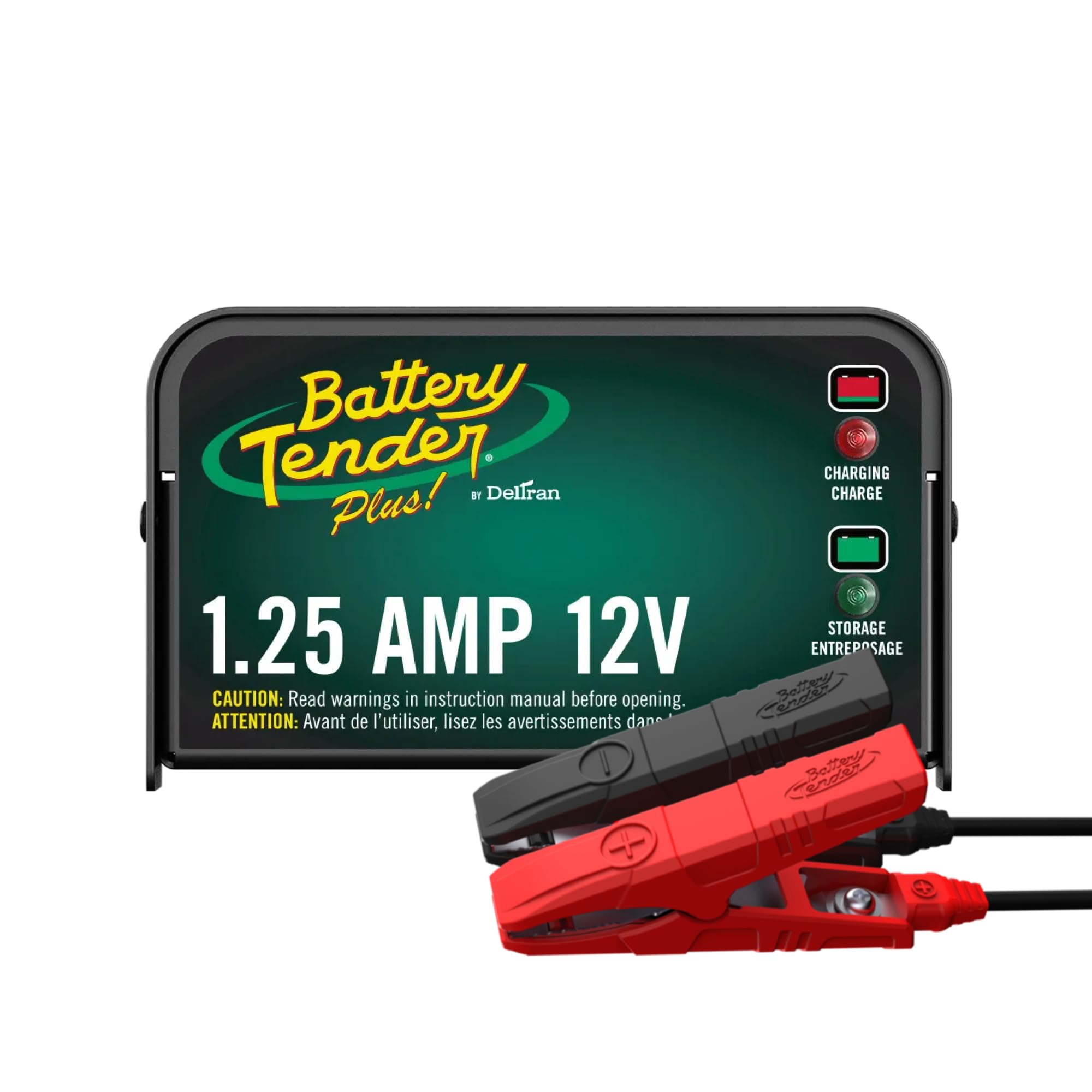
The Battery Tender Plus is the reference standard for 12-volt battery maintenance, and for good reason. It delivers 1.25 amps through a 4-step charging program that transitions from bulk charge to absorption, then to float, and finally to a full maintenance mode. The two-color LED provides immediate status feedback — red for charging, green for full — so you can confirm the battery’s condition at a glance.
The unit comes with both fused ring terminal and alligator clip accessory cables, plus a quick-disconnect harness that makes it easy to swap between vehicles without uninstalling the wiring. The 10-year manufacturer’s warranty is among the longest in the category, reflecting the company’s confidence in its long-term reliability. The case is compact and lightweight at 1.45 pounds, and the 4.4-inch height fits under most ATV seats without interference.
Owner feedback across decades of use confirms that this maintainer handles seasonal storage cycles without issue. Many users report leaving it connected for months at a time during winter, with the battery holding full charge through spring. The adaptive charging logic ensures that if the battery voltage drops under load, the unit resumes full output automatically, preventing the gradual drain that kills batteries during long storage periods.
What works
- Proven 10-year warranty and long-term reliability
- Quick-disconnect harness for easy vehicle swaps
- Simple two-color status LED at a glance
- True 4-step charging program prevents overcharge
What doesn’t
- 1.25A output is slow for deeply depleted batteries
- No lithium battery mode
- No LCD display or voltage readout
3. DEWALT DXAEC2

The DEWALT DXAEC2 is a 3-in-1 unit that functions as a battery charger, maintainer, and trickle charger in a single package. It delivers 2 amps and works with both 6-volt and 12-volt AGM, gel, and wet lead-acid batteries. The high-frequency charging restores lost battery performance for stronger engine starts, and the built-in circuit protection guards against overcharging, reverse polarity, and short circuits.
The unit includes a hanging hook for mounting in tight spaces, and the cable length is reasonable for most ATV storage setups. The yellow color scheme and rugged casing give it a distinctly job-site aesthetic, and the 1.68-pound weight makes it easy to move between vehicles. The automatic float mode ensures that once the battery reaches full charge, the unit switches to maintenance mode without user intervention.
Owner reports indicate that the DXAEC2 performs reliably in cold-temperature environments, with the float charge engaging consistently even when ambient temperatures drop below freezing. Some users note that the unit stopped working after a few weeks or months, though the majority report solid long-term performance. The basic float charger design means it lacks advanced features like desulfation or lithium compatibility, but for standard lead-acid maintenance at a reasonable price point, it delivers solid performance.
What works
- Works with both 6V and 12V lead-acid batteries
- Hanging hook simplifies mounting in tight spaces
- High-frequency charging improves battery recovery
- Circuit protection against overcharge and reverse polarity
What doesn’t
- No lithium battery support
- Inconsistent long-term reliability reported by some owners
- No LCD or advanced diagnostics
4. ECO-WORTHY 12V 5A

The ECO-WORTHY 12V 5A smart charger brings a clear LCD display and dual-chemistry compatibility to the table at a very competitive price point. It works with both 12-volt lead-acid (flooded, AGM, gel) and 12-volt lithium (LiFePO4) batteries, making it a versatile choice for households with multiple battery types. The 5-amp output is considerably faster than typical 1-amp maintainers, cutting recharge time for deeply depleted batteries.
The unit operates as a fully automated smart charger, not just a trickle charger. It automatically detects the battery type, selects the appropriate charging profile, and transitions through bulk, absorption, and float stages. When low voltage or sulfation is detected, the charger prompts the user to initiate a repair mode. The included SAE connector with a 10-amp fuse, along with battery clips and O-ring terminal cables, provides flexibility for permanent or temporary connections.
Owner feedback praises the LCD display for providing real-time voltage, current, and charge percentage information, which helps users track battery health over time. The compact dimensions (2.76 x 5.83 x 2.17 inches) and light weight make it easy to store with your ATV gear. Some users note that the unit runs warm during prolonged high-amperage charging, but the majority report dependable performance for maintaining RV, ATV, and motorcycle batteries across multiple seasons.
What works
- Clear LCD display shows voltage and charge percentage
- Works with both lead-acid and LiFePO4 lithium batteries
- 5A output recovers depleted batteries faster
- Includes both clips and ring terminals
What doesn’t
- Runs warm during extended high-output charging
- Not a battery booster for jump-starting
- Repair mode requires manual initiation
5. Tecmate Optimate 1 Duo

The Tecmate Optimate 1 Duo is a 4-step, fully automatic battery charger and maintainer designed specifically for both 12-volt lead-acid (AGM, gel, STD, deep cycle) and 12.8-volt lithium batteries. The DUO label means it automatically detects the battery chemistry and applies the correct charging profile, including the critical 14.4V absorption for lithium and 14.5V for lead-acid. The 0.6-amp output is intentionally low — it’s optimized for long-term maintenance rather than quick recovery of deeply drained batteries.
The unit is recommended by Honda, Yamaha, Kawasaki, KTM, and Husqvarna, as well as global battery manufacturers Antigravity, Super-B, and Earth-X. This level of OEM endorsement speaks to the precision of its charging algorithm and its ability to safely maintain batteries for extended periods without overcharging. The dustproof case is rated for indoor use, and the 1.22-pound weight includes both battery clips and a harness lead with a fused connection.
Owner reports consistently highlight the Optimate 1 Duo’s ability to recover batteries that other chargers have given up on. The built-in diagnostics monitor the battery continuously — if the battery is healthy, the unit keeps charging; if it detects a fault, it stops and warns the user. Motorcycle and ATV owners particularly appreciate the compact size and the ability to leave the unit connected 24/7 during storage seasons. The lower amperage is ideal for batteries in the 10–30 Ah range common on ATVs.
What works
- Automatic detection of lead-acid vs. lithium chemistry
- OEM recommended by major ATV and motorcycle brands
- Dustproof case for indoor storage conditions
- Continuous monitoring with fault detection
What doesn’t
- 0.6A output is too slow for deeply depleted large batteries
- No LCD or digital display
- Not suitable for fast charging or jump-starting
6. NEXPEAK 4-Pack

The NEXPEAK 4-Pack delivers four identical 1.75-amp smart chargers in one package, making it a practical solution for households with multiple vehicles — ATVs, motorcycles, lawn mowers, cars, boats, and more. Each unit functions as a battery charger, maintainer, trickle charger, and desulfator, with a 7-stage charging program that includes desulfurization, constant current, constant voltage, detection, compensation, and floating stages. The intelligent LCD screen on each unit displays charging status, percentage, voltage, and current.
The compact dimensions (2.2 x 3.8 x 1.02 inches per unit) mean each charger takes up minimal space, and the 6.6-foot SAE standard cord with detachable alligator and ring connectors provides flexibility for permanent or temporary installation. The pulse repair technology helps restore old or idle batteries by breaking down sulfation crystals that accumulate during storage. A memory function ensures that in the event of a power outage, the charger resumes operation in the correct mode once power is restored.
Owner feedback highlights the value proposition of getting four fully featured chargers at a package price that undercuts buying individual units. The automatic voltage detection works for most use cases, though some users note that it occasionally misidentifies the battery voltage — a manual override (hold the MODE button for 5 seconds) forces 12V mode if needed. The 2-year warranty provides peace of mind, and the ability to leave all four units connected indefinitely makes seasonal maintenance effortless across an entire fleet.
What works
- Excellent value for multi-vehicle households
- 7-stage charging with desulfation for battery recovery
- LCD display on each unit shows real-time data
- Memory function resumes charging after power loss
What doesn’t
- Automatic voltage detection can be inconsistent
- Connectors can be stiff to connect and disconnect
- Cannot charge lithium batteries
7. BatteryMINDer 1510

The BatteryMINDer 1510 is a specialized 12-volt charger, maintainer, and desulfator that focuses on reversing sulfation — the primary cause of early battery failure. Using a patented range of high frequencies, it safely removes lead sulfate crystals from battery plates, restoring batteries that were previously considered beyond recovery. The manufacturer claims this approach can extend battery life up to four times compared to batteries that are not properly maintained.
The unit includes an ambient temperature sensor that precisely adjusts charge voltage based on real-time temperature readings, ensuring proper charging in both hot and cold conditions. One of the most distinctive features is its ability to maintain up to four batteries simultaneously when connected in parallel using optional Y-connectors (model 210AY sold separately). This makes it ideal for winterizing a collection of vehicles — cars, trucks, ATVs, boats, and RVs — from a single location.
Owner reports consistently praise the BatteryMINDer 1510 for reviving batteries that had been dead for months or even years. Users with vintage vehicles, seasonal equipment, and multiple ATVs report leaving units connected 24/7, 365 days a year, with several years of trouble-free operation. The FCC certification and California Energy Commission approval confirm its efficiency standards. The 90–240V AC input allows worldwide use, and the reverse polarity, short-circuit, and over-temperature protection provide additional safety margin for permanent installation.
What works
- Patented desulfation revives sulfated batteries effectively
- Maintains up to four batteries at once
- Temperature compensation for accurate voltage in all climates
- FCC certified and energy efficient
What doesn’t
- Charging chart can be confusing to interpret initially
- No lithium battery compatibility
- Y-connectors for multi-battery use sold separately
Hardware & Specs Guide
Multi-Stage Charging Profiles
A multi-stage charging algorithm is what separates a true maintainer from a simple trickle charger. The typical profile includes a bulk phase where maximum current is delivered until the battery reaches roughly 80 percent capacity, an absorption phase where voltage is held constant and current tapers, and a float phase where voltage drops to a safe maintenance level (typically 13.2–13.6V for a 12V battery). Some units add a desulfation stage that uses high-frequency pulses to break down sulfate crystals. Units with 4 or more stages provide better long-term battery health than 2-stage chargers.
Desulfation Technology
Desulfation uses high-frequency electrical pulses to dissolve lead sulfate crystals that accumulate on battery plates during storage. If left unchecked, these crystals harden and permanently reduce the battery’s capacity. A desulfator-equipped maintainer applies short, high-voltage pulses that resonate with the sulfate crystals and break them back into the electrolyte. This process is most effective when applied regularly before the battery is deeply sulfated. Units with dedicated desulfation modes — like the BatteryMINDer 1510 and NEXPEAK 4-Pack — can extend battery life by 2–4 times over standard float charging alone.
Temperature Compensation
Temperature compensation adjusts the charging voltage based on ambient temperature readings. In cold weather, a battery requires higher voltage to reach full charge; in hot weather, lower voltage prevents overcharging and gassing. Maintainers with a built-in thermal sensor automatically adjust the output voltage up or down as temperatures change. This feature is critical in regions with seasonal temperature swings, as a fixed-voltage charger can undercharge in winter (leaving the battery partially discharged) or overcharge in summer (accelerating water loss and grid corrosion).
Amperage Selection & Battery Capacity
For ATV batteries, which typically range from 12Ah to 30Ah, a maintainer with 0.6A to 2A output is ideal for long-term float charging. A 5A unit provides faster recovery for deeply discharged batteries but still tapers down to a safe float mode. The general rule is that a charger’s amp rating should not exceed 10 percent of the battery’s amp-hour capacity for standard lead-acid batteries. For lithium batteries, lower amperage is generally preferred to avoid triggering the battery management system’s protection circuits.
FAQ
What makes a battery maintainer different from a standard charger?
Can I leave a battery maintainer connected all winter?
How do I choose between 0.6A, 1.25A, and 5A models for my ATV?
Are lithium-compatible maintainers necessary for LiFePO4 batteries?
What does the desulfation function do and when should I use it?
Final Thoughts: The Verdict
For most buyers, the best atv battery maintainer winner is the NOCO GENIUS5 because it combines 5-amp recovery power with temperature compensation, lithium compatibility, and a Force Mode that revives dead batteries from zero volts. If you want a proven, no-fuss solution with a 10-year warranty, grab the Battery Tender Plus. And for multi-vehicle households that need to manage several batteries at once, nothing beats the NEXPEAK 4-Pack for sheer value and convenience.

Certification: BSc in Mechanical Engineering
Education: Mechanical engineer
Lives In: 539 W Commerce St, Dallas, TX 75208, USA
Md Amir is an auto mechanic student and writer with over half a decade of experience in the automotive field. He has worked with top automotive brands such as Lexus, Quantum, and also owns two automotive blogs autocarneed.com and taxiwiz.com.