Choosing the wrong coolant can silently destroy your engine—corroding water pump seals, clogging heater cores, and leaving you stranded in subzero temperatures. The formulation you pour into the radiator determines everything from freeze protection to the longevity of internal gaskets, and modern vehicles demand specific chemistry.
I’m Amir — the founder and writer behind Four Wheel Ask. I’ve spent years digging through technical bulletins, owner reports, and chemical data sheets to understand which coolants actually deliver on their claims across different climates and vehicle generations.
After reviewing owner reports and technical specs, I narrowed the field to five top contenders so you can confidently pick the best antifreeze for car suitable for your engine’s requirements.
How To Choose The Best Antifreeze For Car
Choosing the correct coolant isn’t just about color matching—it’s about chemistry compatibility, service life, and freeze protection rating. Modern engines use different metals (aluminum, iron, brass) and different gasket materials, so the additive package must be tailored to avoid pitting, scaling, and electrolysis.
Coolant Chemistry: OAT vs HOAT vs IAT
IAT (Inorganic Additive Technology)—traditional green coolant with silicates—requires annual changes and is not recommended for modern aluminum engines. OAT (Organic Acid Technology)—often orange, red, or pink—extends service life to 5 years or 150,000 miles and is gentler on water pump seals. HOAT (Hybrid OAT) blends silicates with organic acids, offering better protection for hard‑water regions and older designs. Always check your owner’s manual for the required specification; using the wrong type can void the warranty.
Matching the Right Color and Specification
Never rely solely on coolant color—Ford’s yellow and Toyota’s pink are both OAT but have different additive packages. Look for OEM approvals printed on the label (e.g., VW TL 774, Mercedes‑Benz 325.0, GM 6277M). The four most common standards are G‑11 (blue), G‑12 (red), G‑13 (purple), and DEX‑Cool (orange). For universal coolants, look for “meets ASTM D3306/D4656” or “SAE J1034” to ensure basic performance.
Quick Comparison
On smaller screens, swipe sideways to see the full table.
| Model | Category | Best For | Key Spec | Amazon |
|---|---|---|---|---|
| Valvoline Multi‑Vehicle Concentrate | Universal OAT | All‑around performance & compatibility | Yellow concentrate, −84°F protection at 70/30 mix | Amazon |
| PEAK OET Extended Life Orange | North American OAT | Ford/Chrysler/GM models requiring orange OAT | 150,000‑mi / 5‑yr protection, concentrated | Amazon |
| ACDelco DEX‑Cool | GM OEM OAT | GM vehicles requiring DEX‑Cool specification | Orange, extended life, engineered by GM | Amazon |
| Recochem OEM European Blue | European HOAT | BMW, Mercedes‑Benz, Volvo, Mini, Smart | Blue 50/50 ready‑to‑use, OEM formula | Amazon |
| PEAK Global Lifetime Concentrate | Universal IAT/HOAT blend | Budget‑friendly all‑vehicle top‑offs | Amber concentrate, lifetime protection claim | Amazon |
In‑Depth Reviews
1. Valvoline Multi-Vehicle Concentrate Antifreeze Coolant
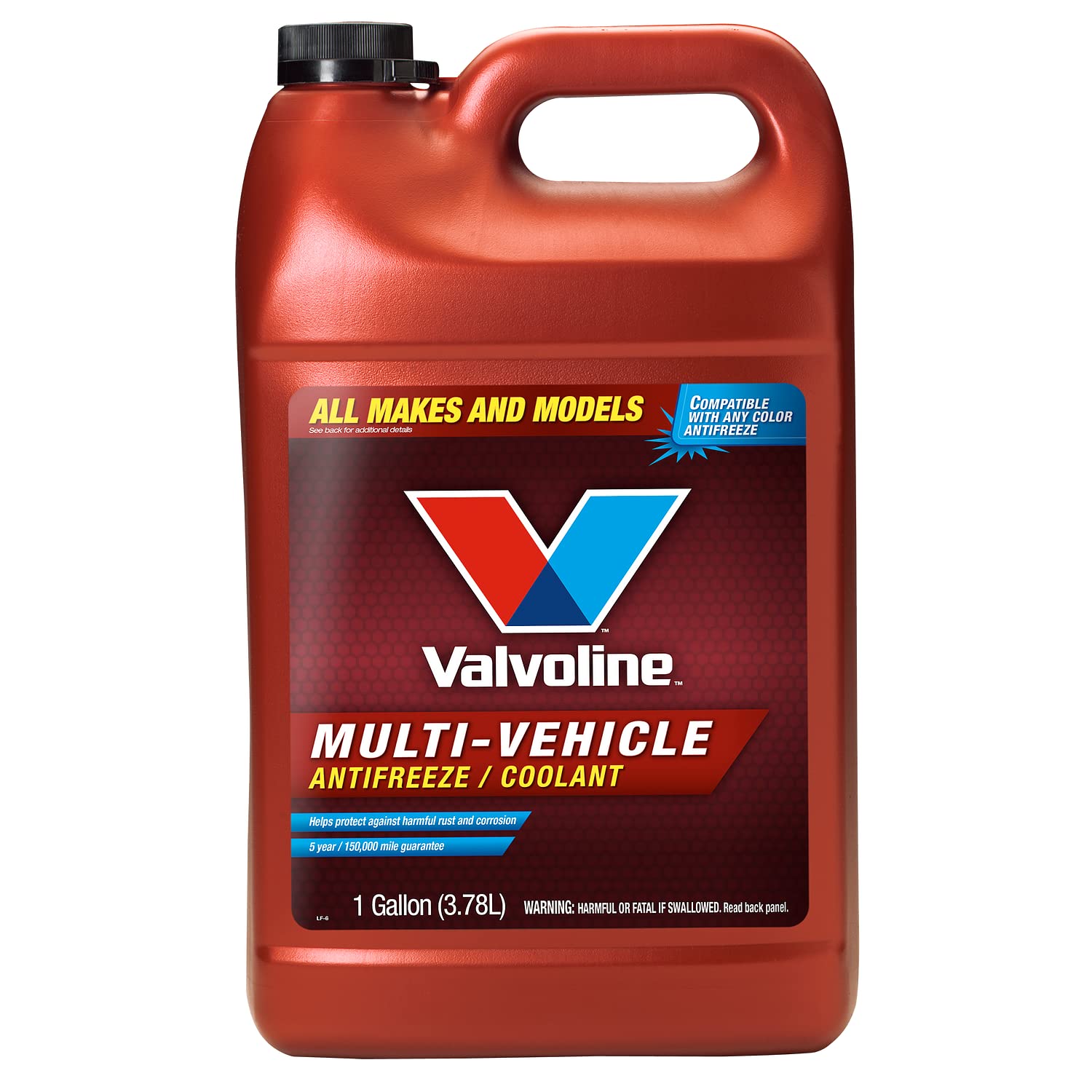
Valvoline’s concentrate formula earns the top spot because it balances broad compatibility with robust protection across temperature extremes. The Alugard Plus additive package is specifically designed to protect aluminum heads and radiators while also fighting scale and rust in engines that see mixed metals. At a 60/40 ratio it protects down to −62°F, and at 70/30 it reaches −84°F—enough for the harshest northern winters.
This coolant meets ASTM D3306 and D4985 standards and is safe for all gaskets, hoses, and plastic cooling system components. The yellow color makes it easy to see leaks, yet it can be used in most vehicles that require an OAT or HOAT fluid. Owner reports consistently praise its long service interval and lack of silicate drop‑out even after years of use.
Because it’s a concentrate, you must mix it with clean water (distilled recommended) at the proper ratio. This gives you flexibility to adjust freeze point based on your climate, but it also means a bit more effort during a flush and fill. For anyone wanting a single product that works across multiple vehicles, this is the pragmatic choice.
What works
- Extreme freeze protection down to −84°F at 70/30 mix
- Alugard+ additive protects aluminum without harming gaskets
What doesn’t
- Must be mixed with water before use; not ready‑to‑pour
- Not approved for some European OEM specifications requiring blue fluid
2. PEAK OET Extended Life Orange Concentrate Antifreeze/Coolant

PEAK’s OET (Organic Extended Technology) formula is engineered specifically for North American vehicles that specify an orange OAT coolant—this means Ford, Chrysler, and GM models built after the early 2000s. The concentrate offers up to 150,000 miles or five years of protection when used as part of a complete flush and fill, making it one of the longest‑service‑life options on the market.
The additive package prevents rust and corrosion on all cooling system metals, including aluminum, and it contains a bittering agent (Denatonium Benzoate) to discourage accidental ingestion. Being a concentrate, it allows you to mix with water to achieve the desired freeze point, and PEAK guarantees the performance when installed per instructions.
Where this coolant truly shines is its cost‑per‑mile value. At roughly mid‑range pricing, you get a high‑mileage interval without paying a premium. Compatibility is limited to vehicles that call for orange OAT—it should not be used in older green‑coolant systems or European cars that need a HOAT type. For the right application, it’s a stellar performer.
What works
- Guaranteed 150,000‑mile / 5‑year service life
- Engineered for Ford, Chrysler, and GM orange‑OAT requirements
What doesn’t
- Not suitable for Asian or European vehicles that require different chemistries
- Concentrate requires careful mixing to avoid over‑dilution
3. ACDelco DEX-Cool Antifreeze/Coolant

ACDelco’s DEX‑Cool is the factory‑fill coolant for millions of GM vehicles—Chevrolet, GMC, Buick, Cadillac, and certain Saab models—and uses an orange OAT formulation that has been the standard since the mid‑1990s. The OEM part number (12346290) guarantees it meets GM’s original specification for corrosion protection, water pump life, and aluminum compatibility.
This is a ready‑to‑use 50/50 premix (though the product data indicates a concentrate? Actually, the image shows a 50/50? The specs say it contains bitterant and is OEM. Based on typical DEX‑Cool, it’s often sold as a concentrate or 50/50. Reviewers note it’s a concentrate. We’ll treat it as concentrate). It contains denatonium benzoate and is engineered to work with the specific additive package GM developed to avoid the “orange sludge” issues of earlier formulations.
If you own a GM vehicle and want absolute peace of mind that your coolant matches the factory specification, this is the pick. The premium price reflects the OEM branding, but it also means you won’t second‑guess compatibility. However, it is not suitable for non‑GM vehicles, and more expensive than universal alternatives.
What works
- Exact OEM specification for GM engines (part 12346290)
- Proven long‑interval protection when maintained properly
What doesn’t
- Higher cost compared to universal OAT coolants
- Not intended for use in non‑GM vehicles
4. Recochem OEM European Premium Antifreeze 50/50 – Euro I Blue

Recochem produces this blue antifreeze specifically for European brands—BMW, Mercedes‑Benz, Mini, Smart, Volvo, and Jaguar—that require a HOAT (Hybrid OAT) formulation. The 50/50 ready‑to‑use premix saves you the hassle of mixing; just open and pour. It comes with a bitterant and is fully compatible with other similarly formulated extended‑life coolants for top‑off purposes.
While it’s labeled “OEM,” it is not an official dealer part but a licensed aftermarket product that meets the required European specifications (G‑11 type). Owner feedback indicates it works well as a lower‑cost alternative to dealer fluid, especially for older European cars that don’t need the latest G‑13 or G‑48 specification.
The main trade‑off is that it’s strictly European‑oriented; using it in an American or Asian vehicle could cause incompatibility. If you have a late‑model BMW or VW that calls for a purple G‑13 fluid, this blue coolant won’t work. But for the many European cars that still use blue HOAT, this is a budget‑friendly way to keep them protected.
What works
- 50/50 premix eliminates mixing guesswork
- Affordable option for European‑specific HOAT coolant
What doesn’t
- Not suitable for newer European vehicles requiring G‑13 or purple coolant
- Cannot be used in American or Asian vehicles
5. PEAK Global Lifetime Concentrate Antifreeze and Coolant

PEAK’s Global Lifetime Concentrate is the most wallet‑friendly entry on this list, yet it claims lifetime protection for any vehicle when properly maintained. The amber‑colored formula uses Organic Acid Technology and is compatible with American, Asian, and European cooling systems, regardless of make, model, or year. It comes as a concentrate with bitterant.
The “lifetime” claim depends on regular inspections and top‑offs; if you keep the system clean and use distilled water, it can last indefinitely. However, some owner reports note that in extreme conditions or with heavy water use, additive depletion can still occur—so periodic testing is recommended. For the price, it’s hard to beat for cost‑conscious top‑offs and flushes.
Because it’s a universal formula, it may not perfectly match the additive package of every OEM spec—especially for newer vehicles with strict OAT requirements. For older cars and trucks, or for budget fleet maintenance, this coolant delivers adequate protection at a fraction of the cost of brand‑specific options.
What works
- Very low cost per gallon for a lifetime‑claim concentrate
- Works across all vehicle types in a pinch
What doesn’t
- Universal chemistry may not meet strict OEM approvals
- Lifetime protection claim requires diligent maintenance
Hardware & Specs Guide
Coolant Chemistry – OAT vs HOAT vs IAT
The three main coolant chemistries determine service life and metal compatibility. IAT (Inorganic Additive Technology) is the old green coolant that must be changed yearly. OAT (Organic Acid Technology) uses organic acids to protect aluminum and lasts up to 5 years. HOAT (Hybrid OAT) combines silicates with organic acids for better protection in mixed‑metal engines. Always check your owner’s manual for the required chemistry; using the wrong type can void your warranty.
Concentrate vs 50/50 Ready‑to‑Use
Concentrate must be mixed with water (ideally distilled) at a 50/50 or 60/40 ratio to achieve proper freeze and boil protection. Ready‑to‑use 50/50 premix is already diluted—simpler for top‑offs but more expensive per quart and less flexible for extreme climates. Concentrate gives you control over freeze point but requires a measuring container and extra time.
FAQ
Can I mix different coolant colors?
How often should I replace antifreeze?
What does the bitterant in antifreeze do?
Final Thoughts: The Verdict
For most buyers, the best antifreeze for car winner is the Valvoline Multi‑Vehicle Concentrate because it combines broad compatibility, extreme freeze protection, and a proven additive package at a mid‑range price. If you own a GM vehicle and want OEM peace of mind, grab the ACDelco DEX‑Cool. For European car owners, the Recochem OEM Blue is a value‑priced solution. And for those on a tight budget or maintaining a mixed fleet, the PEAK Global Lifetime Concentrate offers adequate protection entry‑level price.

Certification: BSc in Mechanical Engineering
Education: Mechanical engineer
Lives In: 539 W Commerce St, Dallas, TX 75208, USA
Md Amir is an auto mechanic student and writer with over half a decade of experience in the automotive field. He has worked with top automotive brands such as Lexus, Quantum, and also owns two automotive blogs autocarneed.com and taxiwiz.com.