A flickering screen while navigating a busy intersection isn’t just annoying—it’s a safety risk. The wrong USB-C cable introduces intermittent disconnects that drop Android Auto mid-route, forcing you to fumble with your phone while driving. The core of a reliable in-car connection isn’t the phone or the head unit; it’s the cable bridging them, and most generic charging cords can’t handle the data stability required to keep the interface alive.
I’m Amir — the founder and writer behind Four Wheel Ask. I’ve analyzed hundreds of USB cables across data transfer rates, shielding quality, connector durability, and real-world owner reports to identify which models actually maintain a steady Android Auto session without the dreaded “connection lost” popup.
This guide provides the essential information to help you select a reliable android auto usb-c cable that delivers consistent data throughput and stable power delivery for your daily drive.
How To Choose The Best Android Auto USB-C Cable
Selecting a cable for Android Auto isn’t the same as picking one for charging your phone at home. The vehicle environment introduces heat, vibration, and constant plugging/unplugging that kill standard cables quickly. Beyond durability, the cable must maintain a stable digital handshake between your phone and the head unit—any data packet loss results in a dropped interface.
Data Transfer Speed: Why It Matters
Android Auto transmits screen rendering data, audio streams, and GPS information constantly. A cable rated at 480Mbps (USB 2.0) is the minimum requirement for stable operation. Higher-rated cables at 5Gbps (USB 3.0) or 10Gbps (USB 3.1 Gen 2) offer headroom but don’t necessarily improve Android Auto performance if your vehicle port is limited to USB 2.0 speeds—which most factory ports are. The cable’s shielding quality and conductor integrity matter more than raw speed ceiling.
Connector Type: USB-A to USB-C vs USB-C to USB-C
Most vehicles built before 2022 feature USB-A ports in the center console or dashboard. For these, a USB-A to USB-C cable is required. Newer models increasingly offer USB-C ports, making a USB-C to USB-C cable the correct choice. Using a USB-C to USB-C cable in a USB-A port requires an adapter, which introduces an additional failure point. Match the cable connector to your vehicle’s port type—don’t plan around adapters.
Cable Build: Silicone, Braided Nylon, and Coiled Designs
The interior of a car reaches extreme temperatures—well above 140°F in summer sun and below freezing in winter. Standard PVC jacket cables crack and become brittle within months. Premium nylon braided jackets offer abrasion resistance and flexibility across temperature swings, while silicone jackets provide exceptional softness and heat tolerance. Coiled cables eliminate the slack that interferes with shifting or footwell access, making them a favorite for daily drivers who prioritize cabin neatness.
Quick Comparison
On smaller screens, swipe sideways to see the full table.
| Model | Category | Best For | Key Spec | Amazon |
|---|---|---|---|---|
| LISEN Coiled USB C Cable | Coiled Silicone | Daily drivers wanting cabin tidyness | 480Mbps, -40°F to 392°F range | Amazon |
| CONMDEX Android Auto USB Cable 2-Pack | USB-A to USB-C | High-speed data transfers | 10Gbps, 3A charging | Amazon |
| W&X SCHUGS 240W Coiled USB C Cable | Coiled USB-C to USB-C | Newer vehicles with USB-C ports | 240W charging, -45°F to 397°F range | Amazon |
| UNIDOPRO Flat Design USB C Android Auto Cable | Flat USB-A to USB-C | Narrow console gaps | 5Gbps, 56kΩ resistor | Amazon |
| AKdoan USB A to USB C Cable 2-Pack | Nylon Braided | Budget-friendly 2-pack | 480Mbps, 60W charging | Amazon |
In‑Depth Reviews
1. LISEN Coiled USB C Cable 2-Pack
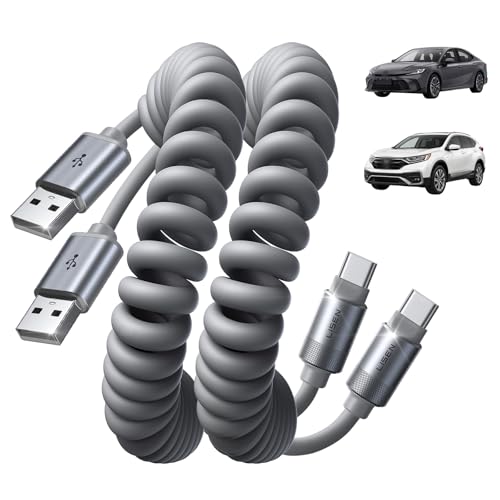
The LISEN coiled cable is purpose-built for the car cabin, addressing the two biggest pain points of Android Auto cables: cabin clutter and connection stability. The silicone jacket withstands temperature extremes from -40°F to 392°F, meaning it won’t crack in winter or soften into a sticky mess in summer sun—a common failure mode for standard PVC cables after a single hot season. The coiled design extends from a 1-foot natural length to a 4-foot maximum, providing just enough reach for the driver’s seat without leaving a tangled mess near the gear shifter or foot pedals.
The 480Mbps data transfer rate meets the minimum requirement for Android Auto, and the UV adhesive sealing combined with a molded unibody construction prevents the connector from loosening after repeated plugging and unplugging. On bumpy roads, this internal reinforcement keeps the data handshake intact where cheaper cables would glitch. LISEN claims one in ten US drivers uses their cables, a scale that suggests consistent manufacturing quality.
Each pack contains two cables, making it easy to keep one in the car and one as a backup. The silicone material is noticeably smoother and more flexible than nylon braided alternatives, which some users prefer for its tangle-free handling. The 480Mbps ceiling means this cable won’t bottleneck Android Auto data streaming, though it won’t accelerate large file transfers to a laptop either—that’s not its purpose.
What works
- Extreme temperature tolerance outperforms standard PVC cables
- Coiled design keeps the driver’s area free of slack
- Double reinforcement at connector joints prevents dropouts on rough roads
What doesn’t
- 480Mbps ceiling won’t accelerate large file transfers
- Silicone surface attracts dust and lint more than nylon braided
2. CONMDEX Android Auto USB Cable 2-Pack
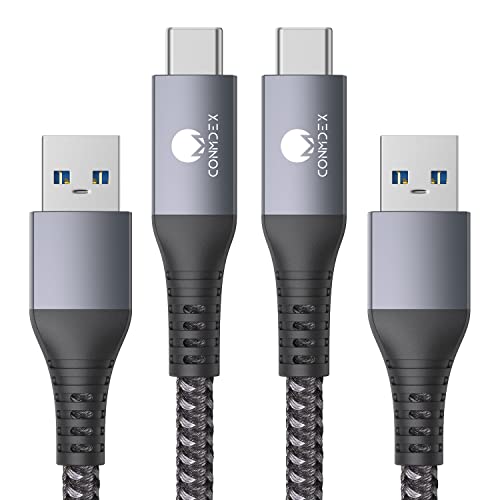
The CONMDEX cable differentiates itself with genuine USB 3.1 Gen 2 certification delivering 10Gbps data transfer, making it the fastest option on this list by a wide margin. While Android Auto itself doesn’t demand 10Gbps throughput, users who also connect their phone to a laptop or external SSD will appreciate the ability to move 4K video files or entire photo libraries in seconds. The aluminum alloy housing and premium nylon braiding address the mechanical weak point of most USB cables—the connector neck—by resisting fraying and loose wire connections near the plug.
The 3-foot length is deliberately short, optimized for center console USB ports where excess cable creates clutter. This design philosophy extends to the 3A/18W fast charging capability, which keeps a phone’s battery topped during navigation without triggering thermal throttling. The cable specifically advertises compatibility with Ford Raptor and other modern infotainment consoles, suggesting it has been tested against known finicky head units that reject generic cables.
This is a two-pack, offering redundancy for the price of a single premium cable from other brands. The 10Gbps rating is legitimate, not a marketing number—CONMDEX provides the spec sheet. Buyers should note that this cable is not designed for high-wattage laptop charging (65W+) and is strictly for mobile devices. If your vehicle uses a USB-C port, this USB-A to USB-C cable requires an adapter, which adds a failure point.
What works
- Legitimate 10Gbps USB 3.1 Gen 2 for fast file transfers
- Aluminum alloy housing resists connector damage
- Two-pack provides excellent value for daily use
What doesn’t
- USB-A connector limits compatibility with newer USB-C vehicle ports
- 3-foot length may be too short for rear-seat passengers
3. W&X SCHUGS 240W Coiled USB C Cable
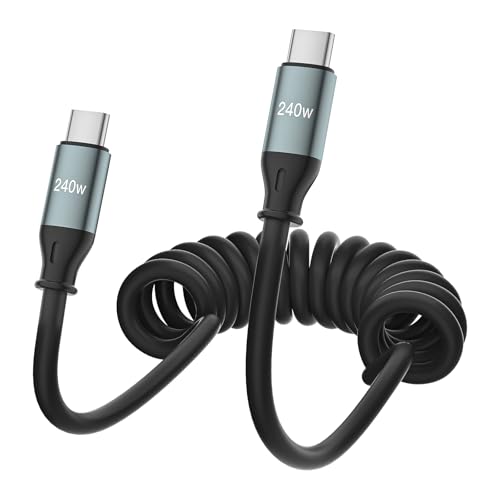
The W&X SCHUGS cable is the only native USB-C to USB-C option in this roundup, making it the correct choice if your vehicle has a USB-C port. The 240W charging capacity is massively overbuilt for Android Auto duty, but it ensures the cable will never be the bottleneck for any future device’s power needs. The coiled design extends from 1.25 feet to 6.25 feet, providing the longest reach of any coiled cable here—useful if your phone mount is positioned farther from the port than typical.
The silicone jacket matches the LISEN’s temperature resilience, rated from -45°F to 397°F, and uses the same UV adhesive sealing and molded unibody construction to prevent connection dropouts on uneven pavement. The 480Mbps data transfer rate is sufficient for Android Auto and media syncing, though this cable clearly prioritizes charging capability over data speed. The 1.9-meter actual cable length inside the coil (before coiling) means the 6.25-foot max extension is genuine, not a marketing exaggeration from shorter stock cable.
Compatibility spans the latest iPhone 17, Samsung S25, and Google Pixel 9 series, and the USB-C to USB-C design eliminates the need for adapters in newer vehicles. The all-silicone construction feels noticeably different from nylon braided cables—softer and more pliable, but also slightly stickier against interior panels. Users who prefer a clean factory look will appreciate the all-black aesthetic without visible logos or branding.
What works
- Native USB-C to USB-C for newer vehicles with no adapter needed
- 240W charging capacity is future-proof for power-hungry devices
- 6.25-foot max extension offers excellent reach flexibility
What doesn’t
- 480Mbps data ceiling limits external file transfer speed
- Silicone jacket attracts lint and dust more than braided alternatives
4. UNIDOPRO Flat Design USB C Android Auto Cable

The UNIDOPRO flat cable solves a specific problem that round cables can’t: tight console gaps where a round cable won’t fit or gets pinched. The flat ABS profile slides through narrow spaces between seat rails and center console trim pieces, and the 10,000+ bend test rating suggests the flat design doesn’t sacrifice durability for form factor. The 5Gbps USB 3.0 data transfer rate places it above the 480Mbps baseline, allowing faster media file transfers when needed.
A notable engineering detail is the inclusion of a standard 56kΩ pull-up resistor, which tells the connected device that this is a data-capable cable rather than a charge-only cord. This prevents the “connected device not recognized” error that some Android Auto users encounter with cheaper cables that skip this resistor. The 3-foot length is appropriate for center console ports, though the flat profile means it doesn’t retract or coil for storage—you’ll have to bundle it manually when not in use.
The ABS plastic jacket is stiffer than silicone or nylon braided options, which helps the cable hold its shape when routed through tight spaces but also means it takes a set if bent sharply. This cable is best suited for users who have a permanent routing path from the USB port to their phone mount and don’t plan to disconnect frequently. The matte black finish resists visible fingerprints and blends into dark interior plastics well.
What works
- Flat profile fits through narrow console gaps round cables cannot
- 56kΩ pull-up resistor prevents “device not recognized” errors
- 5Gbps data rate for faster file transfers
What doesn’t
- ABS plastic jacket is stiffer and less flexible than silicone alternatives
- Does not retract or self-coil, requiring manual bundling when stored
5. AKdoan USB A to USB C Cable 2-Pack
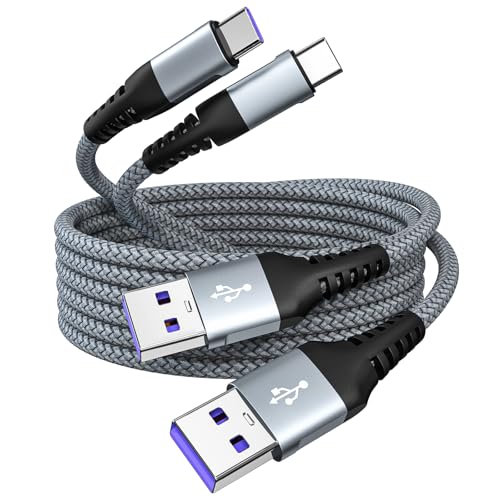
The AKdoan two-pack offers 6-foot cables at a very accessible price point, making it the most budget-conscious option here. The 60W charging capacity and 480Mbps data rate meet Android Auto requirements, and the nylon braided jacket provides basic abrasion resistance and tangle-free handling. The 35,000 bend test rating indicates reasonable durability for a cable at this tier, though the reinforcement near the connectors is less robust than the premium options above.
The 6-foot length is significantly longer than the 3-foot cables common in this category, which is either an advantage or a drawback depending on your setup. For backseat passengers or trucks with center consoles farther from the driver, the extra length is welcome. For drivers with short center console runs, the excess cable requires bundling. The built-in chipset provides over-current, over-voltage, and temperature protection—safety features that are increasingly standard but not universal at this price tier.
Compatibility covers the Samsung Galaxy S and Note series, Google Pixel, iPad, and iPhone 15/16 series for standard charging and data transfer. The two-pack means you can dedicate one cable to the car and keep one for the desk or travel. The nylon braiding is rougher in texture than silicone alternatives and may snag on certain interior materials, but it resists the UV degradation that eventually turns standard rubber cables sticky.
What works
- 6-foot length accommodates setups far from the USB port
- Two-pack provides excellent value for multi-location use
- Nylon braiding resists tangling and UV damage
What doesn’t
- Connector reinforcement is less robust than premium alternatives
- Excess cable length requires bundling in short-run installations
Hardware & Specs Guide
Data Transfer Speed: 480Mbps vs 5Gbps vs 10Gbps
Android Auto streams screen data at roughly 200-300Mbps during normal operation, so a 480Mbps (USB 2.0) cable is technically sufficient. However, cables that barely meet the spec can drop connection under vibration or temperature stress. Higher-rated 5Gbps (USB 3.0) and 10Gbps (USB 3.1 Gen 2) cables typically feature better shielding and higher-quality conductors, which translates to more stable performance—not because Android Auto needs the extra speed, but because the cable construction is inherently more robust.
Charging Power: 3A vs 5A vs 240W
Android Auto simultaneously draws power and data. A cable rated at 3A (roughly 15-18W) is sufficient to maintain battery level during navigation for most phones. Higher-rated cables—5A (60W) or the new 240W USB-C standard—offer headroom for fast charging tablets or future devices but don’t affect Android Auto stability. The key spec to check is the charging protocol compatibility with your specific phone, as some fast-charging standards require e-marked chips inside the cable.
FAQ
Why does my Android Auto keep disconnecting with some cables?
Can I use a charging-only USB-C cable for Android Auto?
Does a longer cable reduce Android Auto performance?
Final Thoughts: The Verdict
For most buyers, the android auto usb-c cable winner is the LISEN Coiled USB C Cable because its silicone construction survives extreme cabin temperatures, the coiled design eliminates gear shifter interference, and the double-reinforced connector maintains the stable data handshake Android Auto demands. If you need fast file transfers between devices, grab the CONMDEX Android Auto USB Cable 2-Pack for its genuine 10Gbps USB 3.1 Gen 2 performance. And for drivers with newer vehicles equipped with USB-C ports, nothing beats the W&X SCHUGS 240W Coiled USB C Cable for native compatibility and future-proof 240W charging capacity.

Certification: BSc in Mechanical Engineering
Education: Mechanical engineer
Lives In: 539 W Commerce St, Dallas, TX 75208, USA
Md Amir is an auto mechanic student and writer with over half a decade of experience in the automotive field. He has worked with top automotive brands such as Lexus, Quantum, and also owns two automotive blogs autocarneed.com and taxiwiz.com.