Cranking your favorite track while the pavement blurs beneath you is one of the purest joys of two-wheel travel — until wind roar swallows every note before it reaches your ears. A dedicated amplifier built for motorcycle use solves that exact problem by delivering clean, undistorted power directly to handlebar- or fairing-mounted speakers, cutting through road noise so you hear bass punch and vocal clarity at cruising speeds rather than just a muffled hiss. Unlike car audio gear slapped into a saddlebag, a proper bike amp has to shrug off vibration, water spray, and tight real estate while still pushing enough wattage to overcome 70-mph airflow.
I’m Amir — the founder and writer behind Four Wheel Ask. I’ve spent years analyzing motorcycle audio systems, comparing RMS ratings against real-world output, and reading through hundreds of owner reports to understand which amplifiers actually survive the elements and deliver usable volume on two wheels.
Whether you ride a bagger, a naked bike, or an adventure rig, the amplifier for motorcycle you choose must balance waterproofing, compact dimensions, and sufficient channel count to drive your speaker setup without taxing your bike’s electrical system.
How To Choose The Best Amplifier For Motorcycle
Selecting a bike amp involves more than just looking at a price tag. Three factors dominate the decision: real-world power delivery, physical survivability, and the electrical load your charging system can handle.
RMS vs. Peak Power — the only number that matters at speed
Peak wattage is a marketing number that an amp can sustain for milliseconds. RMS (Root Mean Square) tells you the continuous power it can deliver to your speakers while you ride for hours. For a motorcycle at 65 mph, you generally need at least 40–60 watts RMS per channel to avoid the sound being completely buried by wind. Anything below that and you’ll be cranking the volume into distortion territory just to hear anything.
Water and vibration resistance — the survival specs
A motorcycle amplifier lives inches away from tire spray, rain, engine heat, and constant vibration. Look for conformal-coated PCBs, sealed potentiometers, and an IP rating such as IPx5 or higher. Class-D amplifiers generate less heat than Class A/B, which helps when the unit is tucked into a small saddlebag or under a fairing with limited airflow. A metal chassis with proper heatsinking is non-negotiable if you ride in stop-and-go traffic or hotter climates.
Channel count and wiring compatibility
Two-channel amps work for basic handlebar speaker setups. Four-channel amplifiers give you the option to run a pair of full-range speakers plus a small subwoofer, or bridge two channels for more power to the front. Verify that the amp accepts high-level (speaker-level) inputs if your bike still uses the stock head unit — many modern motorcycle amplifiers include auto-sense turn-on so you don’t need a separate remote wire.
Quick Comparison
On smaller screens, swipe sideways to see the full table.
| Model | Category | Best For | Key Spec | Amazon |
|---|---|---|---|---|
| Rockville RXM-S30 | Marine Class-D | High-output marine/ATV setups | 150W RMS x 4 @ 2Ω | Amazon |
| DS18 SXE-1200.4 | Class A/B | Sound quality with full crossover control | 60W RMS x 4 @ 4Ω | Amazon |
| KSPEAKER K2BL | All-in-one system | Plug-and-play handlebar audio | Built-in 3″ full-range speakers | Amazon |
| Velex VX505 | Bluetooth Marine | No head unit needed hidden install | 60W x 4CH + Bluetooth remote | Amazon |
| Taramps TS 400×4 | Digital Full-Range | Budget-friendly 4-channel flexibility | 100W RMS x 4 @ 2Ω | Amazon |
| PRV Audio QS400.4 | Mini Class-D | Tight spaces under fairings | 100W RMS x 4 @ 2Ω | Amazon |
| Recoil DI550.4 | Class-D Compact | Versatile 4-channel with bass EQ | 130W RMS x 4 @ 2Ω | Amazon |
In‑Depth Reviews
1. Rockville RXM-S30

The Rockville RXM-S30 is a premium marine/ATV amplifier that brings serious power to motorcycle audio without requiring a huge mounting footprint. Its Dyno-Certified rating of 150 watts RMS per channel at 2 ohms means you actually get the grunt you pay for, and the conformal-coated PCB protects against moisture ingress during rain rides or pressure-wash cleaning sessions. At just 6.7 inches wide, it fits under most touring fairings or inside saddlebag compartments with room to spare.
High-speed MOSFET power supply keeps distortion low even when you push the volume to drown out highway wind, and the signal-to-noise ratio exceeding 90dB ensures clean highs rather than hiss. The amplifier supports 4-channel stereo, 2-channel bridged, or 3-channel mixed-mono configurations, so you can run a pair of full-range speakers plus a small subwoofer from the same chassis without additional gear.
Installation is straightforward thanks to clearly labeled terminals and including mounting hardware, though the 8-pound weight is heavier than some class-D micro amps — worth the trade-off for the robust build quality. Riders who ride in wet climates or blast through backroads with high volume will appreciate this unit’s reliability and headroom.
What works
- True RMS power output at 2 ohms is verified and substantial
- Conformal-coated PCB offers genuine wet-weather durability
- Compact dimensions hide easily inside fairings or bags
What doesn’t
- Heavier than most micro class-D options at 8 pounds
- Does not include Bluetooth receiver — requires external source
2. DS18 SXE-1200.4/BK
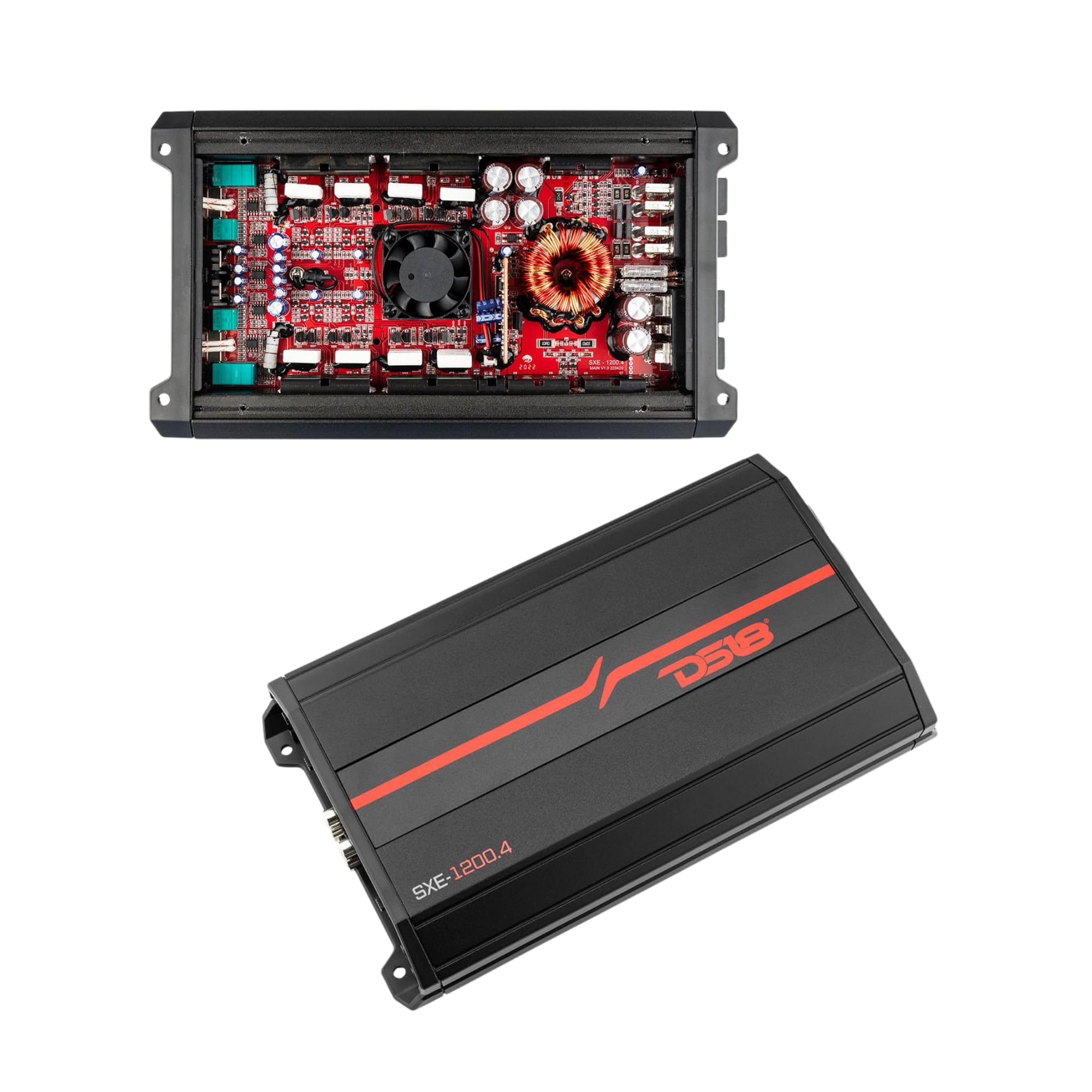
The DS18 SXE-1200.4 is a Class A/B four-channel amplifier built for riders who prioritize tonal accuracy over maximum brute wattage. Delivering 60 watts RMS per channel at 4 ohms, it shines when paired with quality component speakers that reward clean mids and detailed highs rather than just volume. The fully variable crossover lets you set the low-pass and high-pass frequencies precisely, which is especially useful if you integrate a subwoofer and want a seamless blend across the frequency range.
Its aluminum chassis stays cool under moderate loads, and the compact form factor (10 x 12 x 9 inches) fits under many touring seats or inside side panels without forcing you to relocate the battery. Bridged output of 200 watts per channel at 4 ohms gives you the option to run a single subwoofer channel while still powering a pair of main speakers — a clever layout for bikes with limited space but high expectations for bass response.
Installation requires running a proper power wire with the included fuse holder, and the Class A/B design is slightly less efficient than Class D, meaning it pulls more current from the charging system. Riders with smaller alternators or older charging systems should consider this trade-off against the superior audio clarity. The variable gain and crossover controls are accessible on the side panel, making tuning adjustments simple even after installation.
What works
- Class A/B delivers warmer, more natural sound than typical class-D
- Fully variable crossover matches subwoofer integration precisely
- Bridged output adds subwoofer channel flexibility
What doesn’t
- Lower efficiency draws more current than class-D alternatives
- 60W RMS per channel may lack headroom for very loud highway riding
3. KSPEAKER K2BL

The KSPEAKER K2BL is not a standalone amplifier but a complete handlebar-mounted audio system with a built-in power amplifier that eliminates the need for separate installation work. It comes with two 3-inch full-range speakers, Bluetooth streaming, FM radio, and an MP3 player all integrated into a waterproof metal housing that clamps onto 7/8-inch to 1.25-inch handlebars. For riders who want functional audio without cutting into fairings or hiding gear in saddlebags, this unit is about as plug-and-play as it gets.
The built-in amplifier is tuned specifically for the included speakers, so you don’t have to fiddle with gain structure or crossover points — just pair your phone, hit play, and ride. Sound quality is decent for handlebar speakers at lower speeds, though the 3-inch drivers naturally lack deep bass extension compared to a separate amp running larger 6.5-inch fairing speakers. Bluetooth range is rated at 10 meters, which keeps the connection stable even with a phone tucked in a jacket pocket.
Waterproofing covers the entire chassis and knob controls, so rain or a quick hose-down after a dusty ride won’t damage the electronics. The trade-off is that the sound output is limited by the small driver size — at sustained highway speeds above 70 mph, wind noise will start to overtake the volume ceiling. It’s an ideal solution for cruisers and city riders who want music on shorter runs without a permanent install.
What works
- True plug-and-play with no external amplifier wiring needed
- Waterproof metal housing survives rain and dusty roads
- Bluetooth, FM, and MP3 in one integrated unit
What doesn’t
- 3-inch speakers lack bass and cannot overcome high-speed wind noise
- Not compatible with larger speaker upgrades
4. Velex VX505

The Velex VX505 is a marine-grade Bluetooth amplifier that eliminates the need for a separate head unit, making it an excellent choice for hidden installations on motorcycles where dashboard space is at a premium. It delivers 60 watts per channel across four channels from a compact chassis, and the included wired remote controller with a 3-meter cable lets you adjust volume and switch sources without reaching into a bag or under a seat. The remote has a 3-color LED indicator for USB, AUX, and Bluetooth source status, so you know at a glance which input is active.
Rated IPx5 waterproofing means the amp can withstand direct water spray from rain or road splash, and the conformal-coated board adds an extra layer of corrosion protection for riders who encounter salt or moisture regularly. The Bluetooth streaming works reliably up to about 30 feet, and pairing is straightforward with any smartphone. The amp can also accept USB and AUX inputs, giving you backup options when Bluetooth connectivity is spotty in crowded areas.
One practical consideration is that the wired remote’s S-terminal connector must remain tight — loose connections cause intermittent signal dropouts. The 60W per channel output is sufficient for moderate volume on bikes with fairing-mounted speakers, but if you crave high-decibel highway cruising, you may want more power per channel. For commuters and weekend riders who prioritize stealth and convenience over earsplitting volume, this unit hits a strong balance.
What works
- Bluetooth streaming with no head unit reduces installation complexity
- IPx5 waterproof rating handles rain and spray well
- Wired remote keeps controls accessible while riding
What doesn’t
- 60W per channel may feel underpowered for loud highway use
- Remote S-terminal connector can loosen over time causing dropouts
5. Taramps TS 400×4
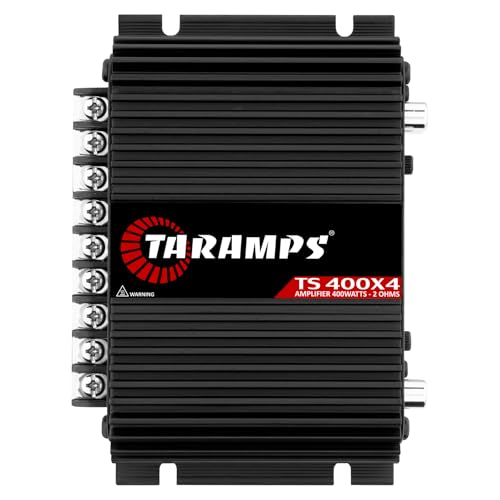
The Taramps TS 400×4 packs 100 watts RMS per channel at 2 ohms into a chassis that weighs under one pound, making it one of the lightest full-range 4-channel options suitable for motorcycle use. Its high-level input with automatic activation means you can wire it directly to factory speaker outputs without running a separate remote turn-on wire — a real time-saver on bikes with complex harnesses. The built-in crossover offers fixed 90Hz high-pass and low-pass filters, plus a full-range mode for flexible system design.
Rated for 11 AWG power and 15 AWG output wiring, the amp handles moderate current draw efficiently, and the 20-amp fuse protects against surges. The class-D topology keeps heat generation low, which is beneficial when the amplifier is sealed inside a saddlebag without direct airflow. Sound reproduction is clean across mids and highs, though the fixed crossover points limit fine-tuning compared to fully variable alternatives.
Bridgeable channels deliver 200 watts RMS each at 4 ohms, giving you the option to drive a small subwoofer without adding a second amplifier. The lightweight build also simplifies mounting with zip ties or double-sided tape in tight spots, and the unit’s compact footprint fits inside most rear fairings. For riders on a budget who want a genuine 100 watts per channel without the bulk of traditional amps, the Taramps delivers surprising capability.
What works
- 100W RMS per channel at 2 ohms for under 1 pound weight
- Auto-sense high-level input eliminates remote wire
- Bridgeable channels support subwoofer integration
What doesn’t
- Fixed 90Hz crossover points limit tuning precision
- No Bluetooth or DSP built-in
6. PRV Audio QS400.4

The PRV Audio QS400.4 crams 100 watts RMS per channel at 2 ohms into a chassis that measures just 4 inches wide by 5.4 inches long by 2 inches tall, making it arguably the most space-efficient 4-channel amplifier for motorcycle applications. The Brazilian class-D engineering prioritizes electrical efficiency, meaning less strain on your bike’s stator and battery compared to many competitors in this power bracket. True RMS certification means the 400-watt rating holds up under sustained use rather than being a fleeting peak figure.
The aluminum surface-mount chassis dissipates heat effectively despite the small size, and the 2-ohm stability lets you wire multiple speakers per channel for expanded coverage on long touring bikes. Bridging two channels delivers 200 watts RMS at 4 ohms, enough to drive a dedicated subwoofer without adding a second amp. The compact dimensions allow mounting in locations that would reject larger units — under the seat, inside a side cover, or even behind a small fairing pocket.
One trade-off is that the physical controls are small and close together, making gain and crossover adjustments fiddly without a small screwdriver. The amplifier also lacks built-in Bluetooth or DSP processing, so you need a separate source unit. For riders who have already maxed out available space and need genuine power in a package that disappears into the bike, the QS400.4 is a standout choice.
What works
- Extremely compact 4×5.4×2 inches fits impossible spaces
- True RMS certified power at 100W per channel
- Efficient class-D design reduces electrical load
What doesn’t
- Small controls make adjustments difficult without tools
- No Bluetooth or DSP integration
7. Recoil DI550.4

The Recoil DI550.4 delivers 130 watts RMS per channel at 2 ohms, placing it among the highest-output compact class-D amps suitable for motorcycle use. The high-speed MOSFET power supply and 4-way protection circuitry (thermal, short circuit, over-voltage, and under-voltage) provide peace of mind when the amplifier is subjected to the harsh electrical environment of a motorcycle charging system. Dimensions of 7.48 x 5.90 x 1.77 inches mean it fits under most seats or inside a Tour-Pak-style trunk without crowding.
The adjustable crossover with LPF, HPF, and bass EQ controls lets you tailor the output to match your specific speaker load, and the variable gain ensures clean signal matching with your head unit. At 1.77 inches tall, it is slim enough to mount vertically if horizontal space is limited. The metal heatsink design keeps temperatures in check during extended high-volume sessions, and the class-D efficiency means less current draw than equivalent A/B amps.
Bridged output of 260 watts RMS per channel at 4 ohms provides genuine subwoofer capability, and the amplifier’s 1040-watt peak rating gives marketing headroom, though the RMS numbers are what you’ll rely on daily. Beginning riders may find the gain structure delicate to set without a multimeter or oscilloscope, as over-driving the input can lead to clipping. For experienced installers chasing maximum clean output from a mid-sized chassis, this is a potent option.
What works
- 130W RMS per channel at 2 ohms offers class-leading power density
- 4-way protection circuitry guards against bike electrical issues
- Adjustable LPF/HPF and bass EQ provide fine-tuning
What doesn’t
- Gain setting requires careful adjustment to avoid clipping
- No weatherproofing rating for wet-weather bikes
Hardware & Specs Guide
RMS Power — the real output number
RMS (Root Mean Square) is the continuous wattage an amplifier can deliver without overheating or distorting. For motorcycle use, look for at least 40–50 watts RMS per channel with speakers rated to handle that power. An amp rated 100W RMS x 4 at 2 ohms can drive four speakers or two bridged channels for a subwoofer, giving flexibility for different bike layouts. Peak power numbers are marketing fluff — always compare RMS ratings.
Waterproofing and conformal coating
Motorcycle amps face rain, pressure-wash spray, and humidity that would kill a standard car amp. Look for the term “conformal-coated PCB” in the specs — this means the circuit board has a protective layer that prevents corrosion. IP ratings like IPx5 mean the amp can handle water jets from any direction. Even if you don’t ride in the rain, condensation inside saddlebags can accumulate and destroy unprotected electronics over a season.
Class-D vs. Class A/B topography
Class-D amplifiers use switching technology that runs cooler and draws less current, making them ideal for motorcycles where charging capacity is limited. Class A/B amps typically sound warmer but waste more power as heat. For a bike, class-D is almost always the better choice unless you have a high-output alternator and prioritize audiophile-grade sound quality over electrical efficiency.
High-level inputs and auto-sense turn-on
Many motorcycle amplifiers include high-level (speaker-level) inputs that connect directly to your bike’s existing speaker wires without needing an RCA adapter. Auto-sense turn-on detects when the audio signal is present and powers the amp on automatically, removing the need to run a separate remote turn-on wire to the ignition. This feature simplifies installation significantly on bikes with factory or aftermarket head units.
FAQ
Will a car amplifier work on my motorcycle?
How many watts RMS do I need to hear music at highway speed?
Do I need a separate head unit for a Bluetooth motorcycle amplifier?
What size fuse should I use for a motorcycle amplifier installation?
Final Thoughts: The Verdict
For most buyers, the amplifier for motorcycle winner is the Rockville RXM-S30 because it combines verified 150W RMS power per channel with genuine conformal-coated marine protection at a price that undercuts many lesser competitors. If you want plug-and-play simplicity without cutting into your bike, grab the KSPEAKER K2BL. And for extreme space-constrained builds where every millimeter counts, nothing beats the PRV Audio QS400.4.

Certification: BSc in Mechanical Engineering
Education: Mechanical engineer
Lives In: 539 W Commerce St, Dallas, TX 75208, USA
Md Amir is an auto mechanic student and writer with over half a decade of experience in the automotive field. He has worked with top automotive brands such as Lexus, Quantum, and also owns two automotive blogs autocarneed.com and taxiwiz.com.