Adding an amplifier to your factory or aftermarket stereo is the single most effective upgrade for audio clarity, headroom, and overall listening enjoyment. Without adequate power, even premium speakers sound strained and lifeless at higher volumes.
I’m Amir — the founder and writer behind Four Wheel Ask. For years I’ve studied amplifier topologies, crossover designs, and real-world owner reports to understand what separates a reliable performer from a headache waiting to happen.
Whether you are driving a daily sedan, a weekend cruiser, or a fully built show car, choosing the right amplifier requires matching power delivery, channel count, and physical footprint to your specific goals. I’ve analyzed real-world specs, owner feedback, and build quality to identify the best amp for car radio that fits your specific setup and budget needs.
How To Choose The Best Amp For Car Radio
Selecting the right amplifier means looking beyond peak power ratings and focusing on RMS output, channel configuration, and physical size constraints. The wrong amp can leave your system starved for power or introduce unwanted noise and distortion.
RMS Power vs. Peak Power
RMS (Root Mean Square) is the continuous power an amplifier delivers. Peak power is a marketing number that lasts milliseconds. Always compare RMS figures when matching speakers to an amplifier. A solid rule is to pair speaker RMS ratings with an amp that delivers 75 to 150 percent of that value for clean headroom without risking damage.
Channel Count Matters
Four-channel amplifiers are the most versatile choice for a full-range system. They can power front and rear speakers independently or run two channels bridged to a subwoofer while the remaining pair drives the doors. Mono amplifiers are purpose-built for subwoofers, while two-channel amps fit simpler setups or dedicated midrange builds.
Class Topology: A/B vs. D
Class A/B amplifiers deliver warm, clean sound but generate more heat and draw higher current. Class D units are more efficient, run cooler, and place less strain on the vehicle electrical system. Modern Class D designs have closed the sound quality gap significantly, making them the go-to for most installs.
Quick Comparison
On smaller screens, swipe sideways to see the full table.
| Model | Category | Best For | Key Spec | Amazon |
|---|---|---|---|---|
| Alpine S-A32F | 4-Channel | Clean full-range sound | 55W RMS x 4 at 4 ohms | Amazon |
| Kicker CXA360.4 | 4-Channel | High-power mids/highs | 360W RMS total, Class A/B | Amazon |
| Pioneer GM-A6704 | 4-Channel | Reliable daily driver amp | 60W RMS x 4 at 4 ohms | Amazon |
| Taramps TS 800×4 | 4-Channel | Compact high power output | 800W RMS at 2 ohms | Amazon |
| Rockford Fosgate R2-500X1 | Mono | Subwoofer dedicated power | 500W RMS x 1 at 2 ohms | Amazon |
| Taramps TS 400×4 | 4-Channel | Ultra-compact installs | 400W RMS at 2 ohms | Amazon |
| Pyramid PB717X | 2-Channel | Budget-friendly sub power | 1000W max, bridgeable | Amazon |
In‑Depth Reviews
1. Alpine S-A32F

The Alpine S-A32F is a compact 4-channel Class D amplifier that punches well above its physical footprint. Owners consistently report that it delivers exceptionally clean, distortion-free sound at high volume levels with zero noise floor hiss. The 55 watts RMS per channel at 4 ohms is honest, conservative power that drives component sets and coaxials with authority.
Build quality is what you expect from Alpine — solid aluminum extrusion, properly labeled terminals, and a low-profile design that fits under seats or in tight glovebox spaces. The variable high-pass and low-pass filters allow precise tuning for front-stage speakers or a bridged subwoofer channel. The included hex wrench hardware simplifies installation.
Owners note that the gain arrives set conservatively from the factory, often at half, which gives plenty of headroom for clean tuning. The Class D topology keeps heat minimal even during extended listening sessions, and the efficiency means less strain on the electrical system. This is a set-and-forget amplifier that rewards careful installation with years of reliable performance.
What works
- Crystal-clear sound with zero audible distortion at any volume
- Extremely compact footprint eases under-seat or dashboard mounting
- Runs cool thanks to efficient Class D design
What doesn’t
- Wire terminals use small set screws better suited for pin connectors
- Not designed for high-power subwoofer applications alone
2. Kicker CXA360.4

The Kicker CXA360.4 is a Class A/B 4-channel amplifier built around the brand’s reputation for durability and honest power ratings. Kicker has a long history in Car Audio, and this CX-Series amplifier continues that tradition with robust internal components and a variable 12 dB crossover network. Owners have bench-tested this unit and found it delivers above its advertised RMS rating, often exceeding 100 watts per channel before distortion becomes audible.
The variable KickEQ bass boost adds up to 6 dB of bump for those who want extra punch from their door speakers or a bridged subwoofer channel. The amplifier accepts input signals from 9 to 40 volts, making it compatible with factory speaker-level outputs as well as aftermarket preamp signals. The included vertical and horizontal mounting hardware gives flexibility for hidden installs.
Owners praise the clean, punchy sound and note that it powers four Kicker 6×9 speakers effortlessly without strain. The unit is larger than many compact Class D alternatives, so measure your mounting space carefully before purchase. Proper gain setting using a voltmeter is recommended to get the best performance and prevent premature speaker damage.
What works
- Delivers more than advertised RMS power on the bench
- KickEQ bass boost adds useful low-end punch
- Wide input voltage range suits factory and aftermarket systems
What doesn’t
- Physically larger than many compact Class D options
- Manual lacks detailed setup instructions for beginners
3. Pioneer GM-A6704

The Pioneer GM-A6704 is a 4-channel Class A/B amplifier that has been a consistent seller for good reason. With 60 watts RMS per channel at 4 ohms and a bridgeable design that yields 190 watts RMS per channel in 2-channel mode, this amplifier offers genuine flexibility for a wide range of systems. The variable high-pass and low-pass filters let you tailor the frequency range for door speakers, coaxials, or a dedicated subwoofer.
Pioneer uses a well-ventilated chassis and balanced Class A/B topology that stays surprisingly cool under normal use. Owners who have run this amplifier for several years report flawless performance with no degradation in sound quality. The plastic end caps and metal heat sink give a clean, professional appearance that looks at home in any install.
Long-term reviews from owners spanning three to five years highlight the GM-A6704 as a reliable workhorse that delivers clean output without fuss. The bridging feature allows flexible channel configuration — including 1, 2, or 3-channel modes — making it suitable for powering a subwoofer alongside front speakers. Proper gain adjustment with a voltmeter is essential for maximizing performance and preventing distortion.
What works
- Proven long-term reliability over years of daily use
- Flexible bridging options for subwoofer integration
- Runs cool with proper gain settings
What doesn’t
- Gain adjustment is critical and requires a voltmeter for best results
- Plastic end caps feel less premium than full-metal chassis
4. Taramps TS 800×4
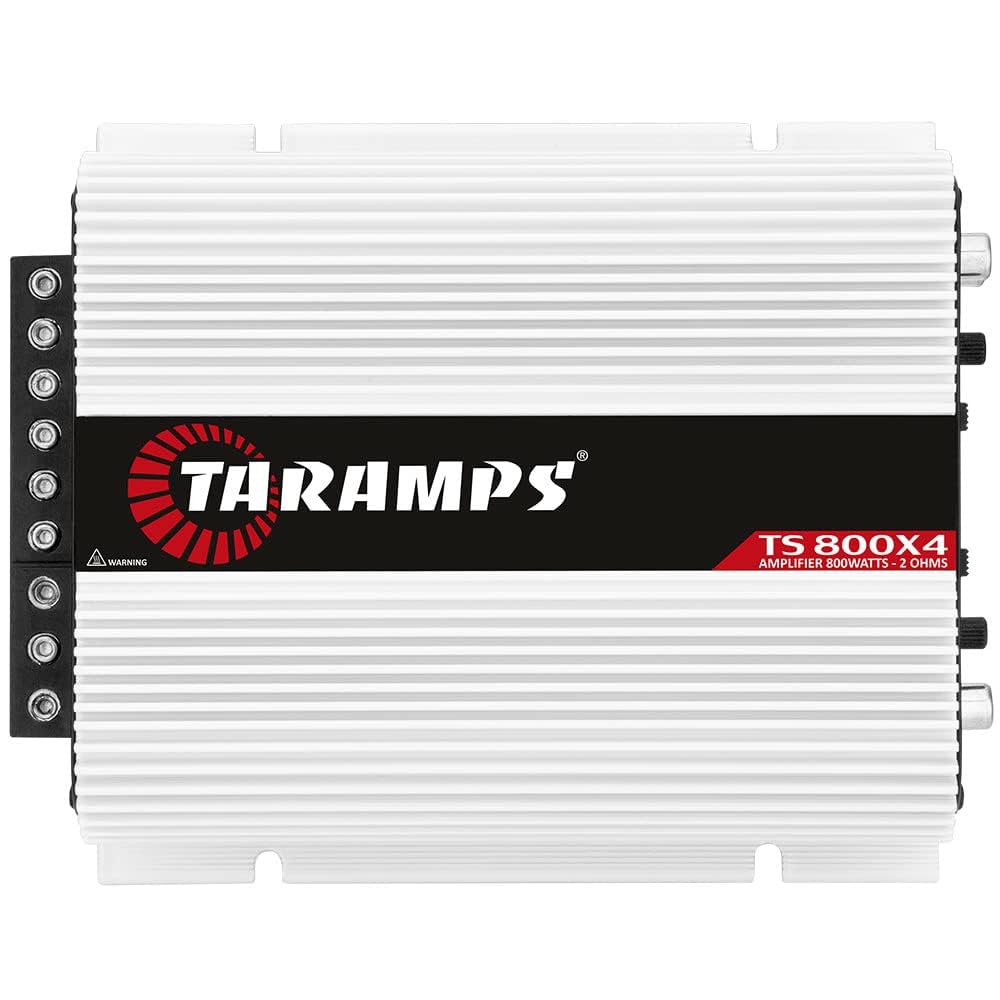
The Taramps TS 800×4 is a 4-channel Class D amplifier that delivers substantial power in a remarkably compact package. Rated at 800 watts RMS at 2 ohms — or 200 watts per channel — this amp is designed for those who want serious headroom without the bulk of traditional Class A/B designs. The aluminum heat sink and efficient Class D topology keep thermal buildup to a minimum even in enclosed spaces.
Owners consistently describe the sound as clean, clear, and surprisingly loud for the physical size. The fixed crossover provides high-pass and low-pass options at 90 Hz with a full-range mode for flexibility. The gain controls are actual knobs rather than screwdriver-adjust pots, making fine-tuning easier during installation. Recommended power and ground wire gauge is 7 AWG with a 40A fuse.
Real-world feedback highlights the TS 800×4 as a favorite for tight installations — under seats, in motorcycle fairings, or inside kick panels. Owners note that the amplifier wakes up speaker systems that previously sounded flat, adding life and clarity to door speakers. The short-circuit and overheat protection circuitry adds peace of mind for those pushing the amp near its limits.
What works
- Very high power output in a compact chassis
- Clean, clear sound quality that awakens door speakers
- Gain knobs allow easy adjustment without tools
What doesn’t
- Requires 14.4V electrical system to achieve full rated power
- Fixed crossover limits advanced tuning options
5. Rockford Fosgate R2-500X1

The Rockford Fosgate R2-500X1 is a mono Class D amplifier purpose-built for subwoofer duty. It delivers 300 watts RMS at 4 ohms and 500 watts RMS at 2 ohms, making it an ideal match for a single 10-inch or 12-inch subwoofer. Rockford Fosgate’s C.L.E.A.N. circuitry helps users set gain levels accurately without distortion, a feature that sets this amplifier apart from simpler budget options.
The variable infrasonic filter removes low-frequency noise that can waste power and damage subwoofers, while the integrated Punch EQ can boost bass by up to 18 dB. The included remote level control allows the driver to adjust subwoofer output on the fly without reaching behind the head unit. The P.O.W.E.R. supply generates additional output as voltage increases, rewarding a healthy electrical system.
Owners report that the R2-500X1 drives subwoofers with authority and precision. Long-term reviews note clean, distortion-free output even after years of regular use. The compact dimensions make it easy to mount under seats or in cargo areas. Build quality is typical Rockford Fosgate — robust and reliable, backed by a one-year warranty that reflects confidence in the design.
What works
- C.L.E.A.N. circuitry helps achieve distortion-free gain setting
- Compact mono design fits easily in tight spaces
- Remote level control offers convenient subwoofer adjustment
What doesn’t
- Designed exclusively for subwoofers, not full-range use
- Requires an 80 or 100 amp fuse for proper operation
6. Taramps TS 400×4
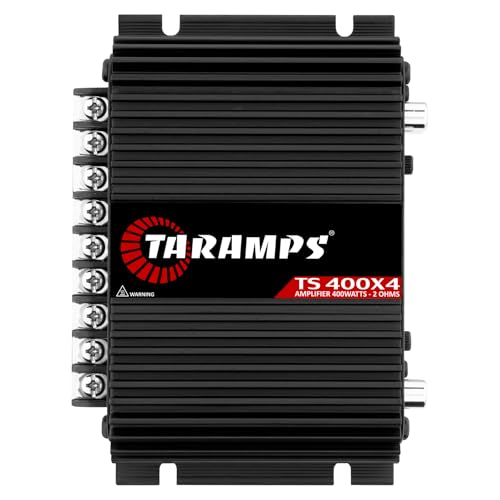
The Taramps TS 400×4 is a compact 4-channel Class D amplifier that offers genuine versatility at a digestible entry point. With 100 watts RMS per channel at 2 ohms, or 200 watts per channel bridged at 4 ohms, this amplifier can handle door speakers, tweeters, or even a lightweight subwoofer in smaller systems. The high-level input with automatic activation eliminates the need for a separate line output converter when integrating with factory radios.
Built-in fixed crossover filters at 90 Hz (high-pass and low-pass) plus a full-range option give flexibility for various speaker configurations. The amplifier weighs less than one pound, making it one of the lightest full-featured 4-channel units on the market. Owners have successfully used it in cars, trucks, motorcycles, golf carts, and marine applications, highlighting its adaptability.
Real-world feedback praises the TS 400×4 for its clean sound output and the ability to drive component sets with clarity. One owner replaced a factory amplifier in a Camry and noted the Taramps fit under the seat easily and tuned without hassle. The compact size and low heat output make it a strong candidate for installs where space is at a premium and the budget is constrained.
What works
- Extremely compact and lightweight for tight mounting locations
- Automatic high-level input simplifies factory radio integration
- Clean, clear sound that outperforms head unit power
What doesn’t
- Shared positive/negative terminals on speaker outputs can be confusing
- Fixed 90 Hz crossover limits advanced tuning options
7. Pyramid PB717X

The Pyramid PB717X is a 2-channel Class A/B amplifier that has been a budget staple for entry-level car audio builds. Rated at 1000 watts maximum power, its real-world continuous output is more modest, but owners have successfully used it to drive single or dual subwoofer setups with satisfying results. The variable crossover and gain controls allow basic system tuning without requiring advanced equipment knowledge.
Silver-plated RCA ports help minimize signal loss, and the MOSFET pulse width modulation power supply contributes to cleaner output than older budget designs. Thermal, overload, and short-circuit protection systems add a layer of safety for first-time installers. The slim chassis design is easier to mount than many full-size amplifiers, though the overall dimensions are still substantial.
Owner experiences show that the PB717X works well when paired with a subwoofer that matches its output capability. One user ran it for three months in a Baja Bug pushing a 10-inch Pioneer sub without issues, while another noted it powered two Kenwood 12-inch subs in a ported box with enough authority to rattle mirrors. Heat buildup in warm climates is a consideration, so mounting in a well-ventilated area is recommended.
What works
- Budget-friendly entry point for adding subwoofer power
- Built-in protection circuitry for beginner installations
- Silver-plated RCA ports reduce signal degradation
What doesn’t
- Peak power rating is much higher than real-world RMS output
- Runs warm in hot climates; requires good ventilation
Hardware & Specs Guide
Class D vs. Class A/B Topology
Class D amplifiers use switching technology that reduces heat generation and current draw by more than 30 percent compared to traditional Class A/B designs. This makes them ideal for modern vehicles where battery capacity is limited and installation spaces are tight. Class A/B amplifiers, while less efficient, are favored by some audiophiles for their linearity and warm tonal character at moderate power levels. The gap between the two has narrowed considerably as Class D design improves.
RMS Power and Speaker Matching
RMS power is the only honest measure of an amplifier’s continuous output capability. A good match delivers 75 to 150 percent of the speaker’s RMS rating. Underspeccing the amp results in distorted sound and potential speaker damage at high volume. Overspeccing is safer as long as gain is set correctly. Always trust RMS figures over peak power claims when comparing amplifiers for a Car Radio system.
Channel Configurations Explained
A 4-channel amplifier is the most versatile choice for a full-range system, allowing independent power to front and rear speakers or bridging two channels for a subwoofer. Mono amplifiers are optimized for subwoofer duty, often including features like variable low-pass filters and bass boost. Two-channel amps fit simpler setups or can be bridged for a single subwoofer. The right channel count depends on how many speakers you plan to power and whether you need subwoofer integration.
Crossover Filters and Tuning
High-pass filters block low frequencies from reaching small speakers, protecting them from distortion and damage. Low-pass filters do the opposite for subwoofers, preventing them from reproducing midrange and high frequencies. Variable crossovers offer the most flexibility, allowing you to dial in the ideal frequency point based on your speaker specifications and listening preferences. Fixed crossovers simplify setup but limit customization.
FAQ
Can I use a 4-channel amp to power a subwoofer?
What size power wire do I need for my amplifier?
Do I need a line output converter for a factory radio?
How do I set the gain on my amplifier correctly?
Why does my amplifier go into protection mode?
Final Thoughts: The Verdict
For most buyers, the amp for car radio winner is the Alpine S-A32F because it combines pristine sound quality, compact dimensions, and efficient Class D operation in a package that fits almost any vehicle. If you want high power output in a small footprint, grab the Taramps TS 800×4. And for dedicated subwoofer bass that you can control from the driver seat, nothing beats the Rockford Fosgate R2-500X1.

Certification: BSc in Mechanical Engineering
Education: Mechanical engineer
Lives In: 539 W Commerce St, Dallas, TX 75208, USA
Md Amir is an auto mechanic student and writer with over half a decade of experience in the automotive field. He has worked with top automotive brands such as Lexus, Quantum, and also owns two automotive blogs autocarneed.com and taxiwiz.com.