Nothing ends a summer drive faster than an AC compressor that chatters and fails within weeks of a replacement. The culprit is almost always debris and old oil left inside the lines. An AC flush tool uses pressurized solvent to purge those contaminants, saving a new compressor from instant death.
I’m Amir — the founder and writer behind Four Wheel Ask. I specialize in analyzing HVAC servicing equipment, studying material construction, pressure ratings, and real-world owner feedback to separate tools that truly clean from those that just rattle debris loose.
Choosing the right one comes down to canister size, pressure limits, and nozzle design. This breakdown covers the best ac flush tool options for both shop pros and weekend mechanics tackling a conversion or compressor swap.
How To Choose The Best AC Flush Tool
An AC flush tool is a pressure vessel that mixes shop air with solvent to blast through condenser, evaporator, and line sets. The right choice depends on canister capacity, maximum PSI rating, and the nozzle’s ability to seal against different line diameters.
Canister Volume and Material
Small 18-ounce canisters suit passenger cars with short line runs. Larger 33-ounce units handle heavy trucks, rear AC systems, or commercial refrigeration lines. Thick-walled aluminum alloy construction resists corrosion and prevents leaks at high pressure, while machined threads ensure a reliable seal with the cap.
Working Pressure Range
Effective flushing requires a steady 90 to 150 PSI at the nozzle. Tools rated below 120 PSI may struggle to dislodge compacted sludge or carbon deposits from compressor burnout events. Always verify the maximum safe pressure stamped on the canister — exceeding it risks sudden rupture.
Nozzle and Tip Design
A stepped or conical rubber tip allows the tool to seal against multiple hose diameters — typically 1/4-inch, 5/8-inch, and 3/4-inch. A trigger-style flush gun gives you one-handed control over solvent discharge, which helps pulse the flow to break loose stubborn debris without oversaturating the line.
Quick Comparison
On smaller screens, swipe sideways to see the full table.
| Model | Category | Best For | Key Spec | Amazon |
|---|---|---|---|---|
| Mastercool 91046-A | Premium | Professional shop use | 33 oz. canister, 150 PSI max | Amazon |
| OEMTOOLS 37377 | Premium | Reducing comebacks | Integrated blow gun, no spray-back | Amazon |
| Leak Saver AC Flush Kit | Premium | Pre-pressurized solvent | 140 PSI pre-charged canister | Amazon |
| Lisle 60800 | Mid-Range | Heater core flushing | Garden hose + air, stepped tip | Amazon |
| FJC 2710 | Mid-Range | Basic system cleaning | 18 oz. reusable canister | Amazon |
| Rossesay AC Flush Kit | Mid-Range | Compact storage | Gauge, 35.4-inch hose, case | Amazon |
| Nu-Calgon 4300-51 Rx11 | Budget | Nitrogen line clearing | Rubber tip fits 1/4 to 1-1/8 in. | Amazon |
In‑Depth Reviews
1. Mastercool 91046-A A/C System Flush Kit

The Mastercool 91046-A is the kit that professional technicians reach for when performing compressor replacements and refrigerant retrofits. Its 33-ounce aluminum canister holds enough solvent to flush both the condenser and evaporator circuits on a full-size SUV without refilling. Rated to 150 PSI, it delivers the high-velocity flow needed to scour sludge and carbon from a burned-out compressor system.
The included flush gun connects to a 36-inch hose, giving you precise one-handed control over solvent discharge. There are no fragile gauges or electronic parts — just a simple, durable blow-nozzle design that minimizes failure points on the shop floor. Mastercool has backed this kit with forty years of HVAC tool manufacturing and U.S.-based support.
You will need to supply your own flush solvent, but the kit is compatible with any lightweight cleaning agent. The 33-ounce canister may feel bulky for light-duty jobs on a single compact car, but the extra capacity avoids mid-job trips to refill. This is the set to buy if you want a single tool that covers everything from sedan interiors to commercial refrigeration lines.
What works
- Large 33-ounce canister handles long line sets without refilling
- Trigger-style gun gives excellent flow control during pulsing
- Solid aluminum build with no gauges to break
What doesn’t
- No quick-connect air fitting included
- Solvent must be purchased separately
2. OEMTOOLS 37377 AC System Flush Kit

OEMTOOLS designed the 37377 specifically to cut down on comebacks caused by residual debris contaminating a new compressor. The kit’s standout feature is the integrated air flush nozzle that directs solvent exactly where you aim it, preventing messy spray-back that can splash into your face or onto clean components. That directional control makes a real difference when working in tight engine bays.
The machined aluminum canister pressurizes with shop air and accepts any standard lightweight AC flush solvent. Owners report that the threaded parts sometimes arrive with metal shavings from manufacturing — a quick rinse with denatured alcohol before first use solves that. The rubber cone tip seals well on most line openings, though some users with larger tubing needed to swap in a wider nozzle.
This kit includes the canister, drain hose, blow gun, and cylinder cap in one package. It weighs about two pounds, so it travels easily between jobs. If you run a small shop and want to reduce repeat failures on compressor swaps, the 37377 delivers professional results at a mid-range investment.
What works
- Attached blow gun eliminates solvent spray-back
- Machined canister resists corrosion and high pressure
- Compact kit weighs just two pounds
What doesn’t
- Some units arrive with metal shavings that require pre-cleaning
- Rubber nozzle tip may be too small for 3/4-inch lines
3. Leak Saver AC Flush Solvent Kit
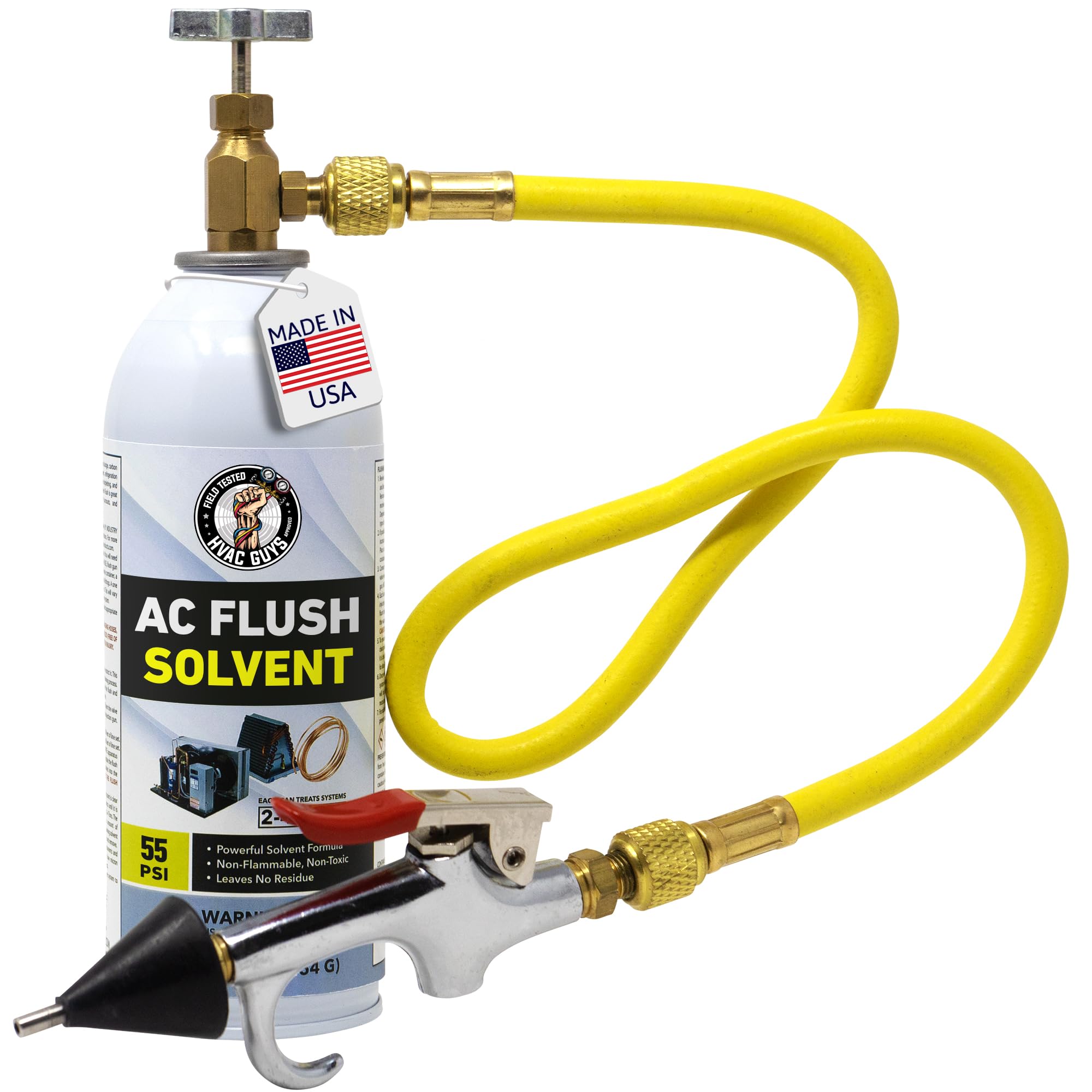
The Leak Saver kit breaks the mold by arriving pre-charged at 140 PSI with solvent already inside — no separate flush gun, no air compressor required. This is a game-changer for DIYers who do not own a shop compressor or who are working in an apartment parking lot. You simply attach the provided valve, connect a nitrogen tank to purge afterward, and flush the lines.
The pressurized formula is engineered to dissolve carbon residues, acids, and mineral oils left behind after a compressor burnout or during an R22-to-R410A conversion. The 2.29-pound canister is smaller than refillable tanks, so you will want to measure your line set length before starting. Some users found the can only did one full pass on a dual-zone system before running low.
A few buyers reported defective valve stems that leaked solvent during installation. Inspect the threads and o-ring immediately upon opening, and test the seal before pointing the nozzle at the line set. Despite that quality-control hiccup, this is the most convenient option for homeowners servicing mini-splits or refrigerators without shop air.
What works
- Completely self-contained — no compressor or external solvent needed
- 140 PSI pressure matches professional flush velocity
- Specifically formulated for compressor burnout cleanup
What doesn’t
- Canister volume is limited for long line sets
- Occasional valve defects reported by buyers
4. Lisle 60800 Heater Core Backflush Tool with Air

While not a traditional AC flush canister, the Lisle 60800 is the definitive tool for blasting clogged heater cores back to life. It attaches to a standard garden hose and adds compressed air through a side adapter, creating an aggressive water-air mixture that dislodges sediment that water alone cannot move. The stepped rubber tip seals against 1/2-inch, 5/8-inch, and 3/4-inch heater hose fittings — the exact range found under most dashboards.
The insulated handle lets you run hot water safely during flushing, which helps dissolve waxy coolant deposits. Owners of Jeep Wranglers and BMW sedans report that this tool restored heat after years of poor output without needing to pull the dashboard. The chrome-plated construction holds up well against coolant corrosion and repeated air hammer shocks.
This tool is strictly for heater cores and cooling system flushing — it is not designed to circulate solvent through AC lines. But if your project involves both an AC flush and a heater core flush, the Lisle 60800 covers the cooling side with authority. At roughly sixty dollars, it pays for itself the first time you avoid a dash removal labor bill.
What works
- Combines garden hose water pressure with air bursts for maximum cleaning force
- Stepped tip seals on 1/2-inch, 5/8-inch, and 3/4-inch fittings
- Insulated handle allows safe use with hot water
What doesn’t
- Not intended for AC refrigerant line flushing
- Requires both a water spigot and air compressor nearby
5. FJC 2710 A/C System Flush Kit

The FJC 2710 is the budget-friendly workhorse that has been flushing AC systems for years. Its 18-ounce reusable aluminum canister is straightforward: fill with solvent, attach shop air, open the valve, and flush. The kit’s simplicity means fewer parts to fail, and the included instructions lay out the process clearly for first-time users.
Many owners report that the canister arrives with fine metal shavings from the manufacturing process. A quick pre-rinse with denatured alcohol is essential before connecting it to any AC line. The o-ring seal on the cap is functional but not heavy-duty — expect to replace it after several uses if you work in a professional setting.
For a weekend project like flushing the lines on a single Chevy sedan during a compressor swap, the FJC 2710 does the job without overspending on capacity you will not use. The 18-ounce tank fills comfortably with a standard 16-ounce can of flush solvent. It will not match the throughput of a 33-ounce unit on a large truck, but at this price point it is hard to beat.
What works
- Simple, reusable aluminum canister design
- Very affordable entry point for DIY users
- Works with R12, R22, and R134A systems
What doesn’t
- Manufacturing shavings require cleaning before first use
- Small 18-ounce capacity limits use on large systems
6. Rossesay AC Flush Kit
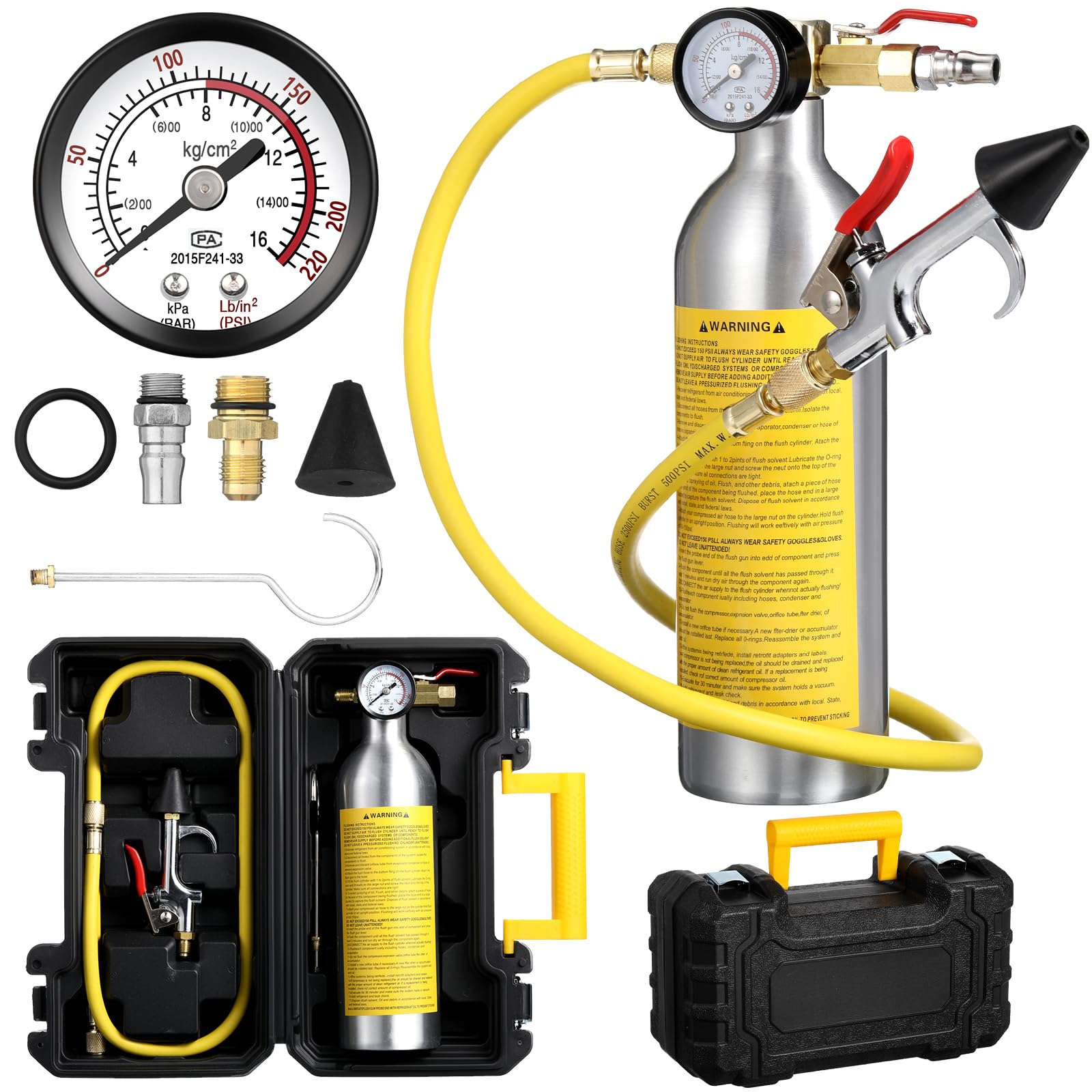
The Rossesay kit packs a pressure gauge, a 35.4-inch hose, a flushing head with a conical rubber tip, and a plastic storage box into a single affordable package. The gauge lets you monitor canister pressure in real time, which helps avoid over-pressurizing past the 150 PSI safe limit. The rubber conical nozzle seals directly into the pipe mouth to minimize solvent back-splatter during the flush cycle.
The canister is made from thickened aluminum alloy and feels solid in the hand, though several buyers noted it is surprisingly compact — roughly the size of a large thermos. That small footprint is convenient for storing in a tool bag, but it means you will refill often when working on long line sets or semi-truck systems. The kit includes spare o-rings and plastic gaskets, plus two brass adapters for standard SAE and NPT connections.
For the DIYer converting a classic car from R12 to R134A, this kit provides everything except the solvent and the air compressor. The gauge adds confidence that you are not exceeding the canister’s safe working pressure. If you prioritize portability and pressure visibility over canister volume, the Rossesay is a well-rounded mid-range pick.
What works
- Pressure gauge provides real-time monitoring
- Compact size stores neatly in a small tool bag
- Comes with extra seals, adapters, and a carrying case
What doesn’t
- Canister is too small for long line set or commercial jobs
- No quick-connect fitting for air hose included
7. Nu-Calgon 4300-51 Rx11 Flush Gun
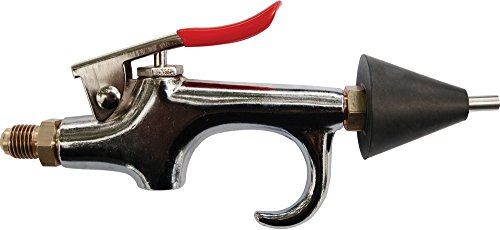
The Nu-Calgon Rx11 Flush Gun is a bare-bones tool for technicians who already own a nitrogen tank or a pressurized solvent source. It is just the gun — no canister, no hose, no gauge. The rubber flush tip fits line sizes from 1/4-inch up to 1-1/8 inches, making it versatile for both automotive and HVACR line clearing. The compact 3.5-inch by 9.6-inch body weighs almost nothing and stows in any toolbox drawer.
Some users report that the trigger mechanism does not always open fully, which restricts flow and makes the gun ineffective. This appears to be a quality-control issue rather than a design flaw, but it means you should test the trigger action before committing to a job. When the gun works correctly, it provides excellent control for blowing out refrigeration lines with nitrogen.
This is not a complete flush kit — you will need to pair it with a separate canister and solvent. But if you already own a Mastercool or OEMTOOLS canister and just want a backup nozzle, or if you prefer to build your own pressurized flushing rig, the Rx11 is the cheapest path to a professional-style flush gun. It serves best as a supplementary tool rather than a primary system.
What works
- Very compact and easy to store
- Versatile rubber tip handles multiple line diameters
- Budget-friendly price for a professional-style gun
What doesn’t
- Trigger may not open fully on some units
- No canister, hose, or adapter included
Hardware & Specs Guide
Canister Capacity: 18 oz vs 33 oz
The 18-ounce canister in the FJC 2710 is fine for a single-zone passenger car flush where you fill once and run the solvent through both lines. The 33-ounce canister in the Mastercool 91046-A holds nearly double the volume, letting you flush the condenser, evaporator, and all hoses on a large SUV or a dual-rear-AC system without stopping to refill. If you service trucks or multiple vehicles per session, the larger canister saves significant time.
Operating Pressure: 90–150 PSI
Effective flushing relies on solvent velocity, not just solvent volume. At 90 PSI, the stream breaks up loose debris and old oil. At 150 PSI, the force becomes strong enough to dislodge carbon crust from a compressor burnout event. Kits like the Mastercool and OEMTOOLS are rated to 150 PSI, while some budget canisters may have a lower safe working limit — always check the stamp before connecting to a full shop compressor.
Nozzle Sealing: Conical vs Stepped Tip
A conical rubber tip, found on the Rossesay and Nu-Calgon, forms a compression seal against the inside wall of the tube, which works well on smooth pipes but can slip on wet lines. A stepped tip, like the Lisle 60800 design, has multiple ridges that lock onto specific hose diameters — 1/2-inch, 5/8-inch, and 3/4-inch. The stepped style provides a more positive seal during high-pressure bursts.
Material: Aluminum Alloy vs Machined Steel
Most AC flush canisters use welded or machined 6061 aluminum alloy because it resists corrosion from solvent chemicals and is lightweight. The OEMTOOLS unit uses a machined aluminum body with tight threads that reduce the chance of cross-threading. Cheaper steel canisters can rust internally if solvent residue is left inside. Always rinse the canister with alcohol after each use regardless of the material.
FAQ
Can I flush an AC system without removing the compressor?
What solvent should I use in an AC flush canister?
Why does the flush canister need to be rinsed before first use?
Final Thoughts: The Verdict
For most buyers, the best ac flush tool winner is the Mastercool 91046-A because its 33-ounce canister and 150 PSI rating handle everything from compact cars to heavy trucks without running out of capacity. If you want an integrated blow gun that eliminates solvent spray-back, grab the OEMTOOLS 37377. And for a self-contained prepressurized solution that needs no compressor at all, nothing beats the Leak Saver AC Flush Kit.

Certification: BSc in Mechanical Engineering
Education: Mechanical engineer
Lives In: 539 W Commerce St, Dallas, TX 75208, USA
Md Amir is an auto mechanic student and writer with over half a decade of experience in the automotive field. He has worked with top automotive brands such as Lexus, Quantum, and also owns two automotive blogs autocarneed.com and taxiwiz.com.