Adding an eight-inch subwoofer is the smartest upgrade you can make when factory bass falls flat and a massive enclosure won’t fit your cabin. The right shallow or compact driver delivers punchy low-end without sacrificing trunk space or under-seat clearance — if you know which specs to prioritize and which compromises to avoid.
I’m Amir — the founder and writer behind Four Wheel Ask. I spend my time dissecting car audio specification sheets, comparing build materials across brands, and aggregating long-term owner feedback to separate genuine performance from marketing hype.
After thoroughly researching power specs, build materials, and verified owner feedback, this guide pinpoints the best 8 inch car sub for your vehicle and audio needs.
How To Choose The Best 8 Inch Car Sub
Eight-inch subwoofers occupy a sweet spot between compact installation and meaningful bass extension. Unlike larger drivers, they fit behind seats, under dashboards, or inside factory enclosures without major fabrication. But selecting the right one requires understanding how power handling, enclosure volume, and voice coil configuration interact with your vehicle’s electrical system and available space.
Power Handling: RMS Over Peak
Manufacturers advertise peak power figures that can be three to five times higher than continuous RMS ratings. A sub rated for 700W peak may only handle 250W RMS, and that RMS number is what your amplifier actually delivers. Always match the subwoofer’s RMS rating to your amplifier’s RMS output per channel at the correct impedance load. Overpowering a driver with a clean signal is less dangerous than underpowering and clipping, which can fry voice coils quickly.
Enclosure Type Dictates Bass Character
Sealed enclosures produce tight, accurate bass with a natural roll-off, ideal for music genres where clarity matters. Ported (vented) enclories extend low-frequency output and increase efficiency but introduce group delay and can sound boomy if the tuning frequency is too high. Shallow-mount subs often work best in sealed boxes around 0.5 cubic feet, while free-air or infinite-baffle setups require no enclosure at all but demand stiff suspension and careful sealing against the trunk or cabin.
Voice Coil and Impedance Considerations
Single voice coil (SVC) subs simplify wiring — a 2-ohm SVC sub needs a 2-ohm stable amp channel. Dual voice coil (DVC) subs offer flexibility: two 2-ohm voice coils can be wired in series for 4 ohms or parallel for 1 ohm, letting you match nearly any amplifier’s stable load range. DVC also allows running multiple subs from a single monoblock amp without exceeding its impedance floor.
Quick Comparison
On smaller screens, swipe sideways to see the full table.
| Model | Category | Best For | Key Spec | Amazon |
|---|---|---|---|---|
| Pioneer TS-A2000LD2 | Shallow-Mount | Tight Space Install | 2.625″ depth, 700W max | Amazon |
| Audioengine S8 | Powered Sub | Desktop / Home Audio | 250W, 8″ down-firing | Amazon |
| Cerwin-Vega VPAS10 | Powered Enclosure | Under-Seat Installation | 200W RMS, 2.6″ height | Amazon |
| Rockville RG212CA | Dual System | High Output Bass | 500W RMS, twin 12″ | Amazon |
| MTX TNE212D Bundle | Complete Bundle | All-in-One Upgrade | 1200W peak, incl. amp | Amazon |
| Atrend 8″ Vented | Enclosure Only | Custom Sub Build | 3/4″ MDF, 0.8 cu ft | Amazon |
| GEARit 16 AWG Wire | Wiring | Reliable Installation | 250 ft, OFC, CL3 rated | Amazon |
In‑Depth Reviews
1. Pioneer TS-A2000LD2 8″ Subwoofer

The Pioneer A-Series TS-A2000LD2 is engineered for installations where cubic inches are scarce. With a mounting depth of only 2.625 inches and a recommended sealed enclosure volume of 0.5 cubic feet, this driver slides into factory subwoofer locations in Toyota Tundras, Honda Civics, and Ford Mustangs with minimal modification. The glass-fiber and mica reinforced IMPP cone provides rigidity that keeps distortion low even when the 250W nominal rating is pushed toward the 700W ceiling.
Owner reports consistently highlight drop-in compatibility with premium factory systems — the 2-ohm single voice coil simplifies wiring and pairs naturally with many stock amplifiers after a head unit swap. The included trim ring, gasket, and mounting screws reduce guesswork, though some owners note that pre-drilled holes may require slight enlargement to match certain bolt patterns. Build quality feels sturdy for the price tier, and the push-type terminals accept bare wire cleanly without adapter nonsense.
Bass character is punchy and controlled rather than boomy, which suits rock, pop, and modern R&B well. The sub lacks the gut-punch of a larger driver in a ported box, but that is a physics constraint, not a design flaw. For anyone upgrading a factory sub location or building a space-efficient system, this Pioneer delivers measurable performance without demanding custom fabrication. The only real caveat is the 83 dB sensitivity — plan on feeding it clean RMS power in the 200–300W range to wake it up properly.
What works
- Genuine drop-in swap for many factory sub locations
- Shallow 2.625-inch depth fits tight cavities
- Clean, controlled bass with good power handling
What doesn’t
- 83 dB sensitivity requires a reasonably powerful amp
- Mounting holes may need drilling on some vehicles
2. Audioengine S8 Powered Subwoofer

The Audioengine S8 is a powered subwoofer that blurs the line between desktop audio and vehicle integration. Its down-firing 8-inch driver is paired with a 250W RMS amplifier inside a compact, furniture-grade enclosure that measures under 10 inches per side. The auto-on sleep mode detects signal and powers down after a period of inactivity, making it practical for systems where you want bass without constantly toggling power switches.
Build quality is clearly above the typical automotive budget tier — the dense MDF cabinet with a seamless ceramic-like finish resists resonance, and the variable low-pass filter adjusts between 50 Hz and 200 Hz to blend with main speakers. Owners report extremely clean, distortion-free bass down to around 35 Hz in small to medium rooms, and the sub integrates transparently with monitor speakers or home theater setups. The RCA inputs accept line-level signals from any preamp output or head unit with sub-out capability.
While the S8 is marketed primarily for home and studio use, its compact dimensions and powered design make it viable for custom vehicle installations where cargo space is a premium and AC power can be supplied via an inverter. The down-firing orientation needs clearance beneath the enclosure to breathe, so mounting requires some planning. For the buyer who demands studio-grade bass extension and build quality that outlasts multiple vehicle changes, this subwoofer justifies its position at the higher end of the scale.
What works
- Pristine, distortion-free bass across music genres
- Exceptional build quality with resonance-resistant cabinet
- Auto-on sleep mode saves power and simplifies use
What doesn’t
- Requires AC power or inverter for vehicle use
- Down-firing design needs clearance for proper airflow
3. Cerwin-Vega VPAS10 Powered Subwoofer

Cerwin-Vega brings decades of bass engineering into the VPAS10, a powered subwoofer enclosure that packs 200W RMS and a 10-inch driver into a chassis barely 2.6 inches tall. The PWM MOSFET power supply and thermal protection circuit keep the amplifier stable during extended play, while the variable bass boost (0 to +12 dB) and low-pass filter (85 to 150 Hz) let you dial in the tonal balance without needing external processing. The included wired remote bass knob puts gain control within reach of the driver’s seat.
Owner feedback across Ford F-150 SuperCab trucks, C5 Corvettes, and Toyota Corollas confirms that the slim profile slides under seats or behind rear panels with minimal fabrication. The 10-inch driver moves more air than typical 8-inch units, producing low-end thump that surprised many buyers expecting polite bass from a compact package. The high-level inputs with auto turn-on mean you can integrate it into factory stereo systems that lack dedicated sub outputs — a critical feature for late-model vehicles with integrated infotainment.
Some owners note that the sub starts to distort when pushed past three-quarters volume, and the enclosure can run warm after an hour of hard use. Installing a small cooling fan mitigates the heat buildup, and careful gain staging keeps distortion at bay. The terminal lugs make wiring straightforward, though the packaging could be more protective during shipping. For those who want real bass extension without giving up passenger or cargo space, this Cerwin-Vega delivers performance that punches above its physical footprint.
What works
- Ultra-slim 2.6-inch profile fits under most seats
- Integrated amplifier with bass boost and remote control
- High-level inputs work with factory head units
What doesn’t
- Distortion becomes audible at higher volume settings
- Runs warm during extended play; may need a fan
4. Rockville RG212CA Dual 12″ Powered Sub

The Rockville RG212CA is a powered dual 12-inch subwoofer enclosure that bundles high output with built-in amplification in a slim vented cabinet measuring just over 4 inches deep. The 500W RMS mono-block class-D amplifier drives two Kevlar-reinforced composite pulp cones with 2-inch high-temperature aluminum voice coils, producing bass that fills mid-size SUV cabins like the Jeep JKU and Chevrolet Equinox with authority. The vented enclosure is tuned to 40 Hz, balancing low-end reach with mechanical stability.
The included wired remote bass knob and auto-on music sense circuitry simplify daily use, and the low-pass crossover (50 Hz to 200 Hz) lets you blend the subs with your main speakers. Owner experiences are polarized: many report exceptional sound quality and ease of installation, citing the built-in amp as a major convenience that eliminates separate amplifier mounting. A subset of users, however, report internal plastic bracing that can fracture from sustained vibration, leading to rattling after a few months of use in vehicles with rough road characteristics.
Installation is straightforward with both RCA and speaker-level inputs, and the 25A fuse rating gives a reasonable safety margin. The enclosure dimensions require careful measurement before ordering — some truck owners found the box fit tight behind rear seats. For the buyer seeking maximum bass output per dollar in a compact vehicle, the RG212CA delivers impressive SPL, but the bracing durability concerns suggest it is best suited for daily-driven cars with decent road surfaces rather than off-road or high-vibration applications.
What works
- Powerful built-in amp eliminates separate component
- Slim profile fits behind seats in many vehicles
- Auto-on music sense for convenient daily operation
What doesn’t
- Internal bracing may crack from sustained vibration
- Box fitment can be tight in smaller trucks
5. MTX TNE212D Dual 12″ Bundle with Amp

The MTX TNE212D bundle packages a loaded dual 12-inch subwoofer enclosure, a Planet Audio 1500W monoblock amplifier, and a Soundstorm 8-gauge wiring kit into a single purchase that removes the guesswork from system assembly. The enclosure uses 5/8-inch MDF wrapped in aircraft-grade black carpet, and the sealed design produces clean, punchy bass that avoids the boominess of ported boxes. Measuring 26.63 inches wide by 14 inches tall by 13.5 inches deep, it requires real trunk space but rewards with authoritative low-end extension.
Owner feedback consistently praises the bundle as an outstanding entry point for first-time subwoofer buyers. The sealed box delivers tight, accurate bass reproduction in the 60–80 Hz low-pass range, integrating well with factory speakers without overpowering them. The included Planet Audio amplifier provides variable bass boost and a low-pass filter, though several owners recommend upgrading to a higher-quality amp and wiring kit for long-term reliability — the included 8-gauge kit and amplifier are functional but not premium.
The subwoofers themselves use durable materials and handle the 1200W peak rating without complaint when gain is set properly. Some owners note that the enclosure lacks grilles to protect the cones from cargo shifts, and the dual 12-inch footprint means it fits full-size sedans and SUVs but not compact cars. For the buyer who wants a turnkey bass solution with proven brand reputation and room to grow, this MTX bundle delivers a cohesive foundation that can be upgraded piece by piece over time.
What works
- Complete system with enclosure, amp, and wiring included
- Sealed box delivers clean, punchy bass
- Excellent value for entry-level to mid-range buyers
What doesn’t
- Included amp and wiring kit are budget-level quality
- Large footprint does not suit compact vehicles
6. Atrend 8″ Vented Subwoofer Enclosure
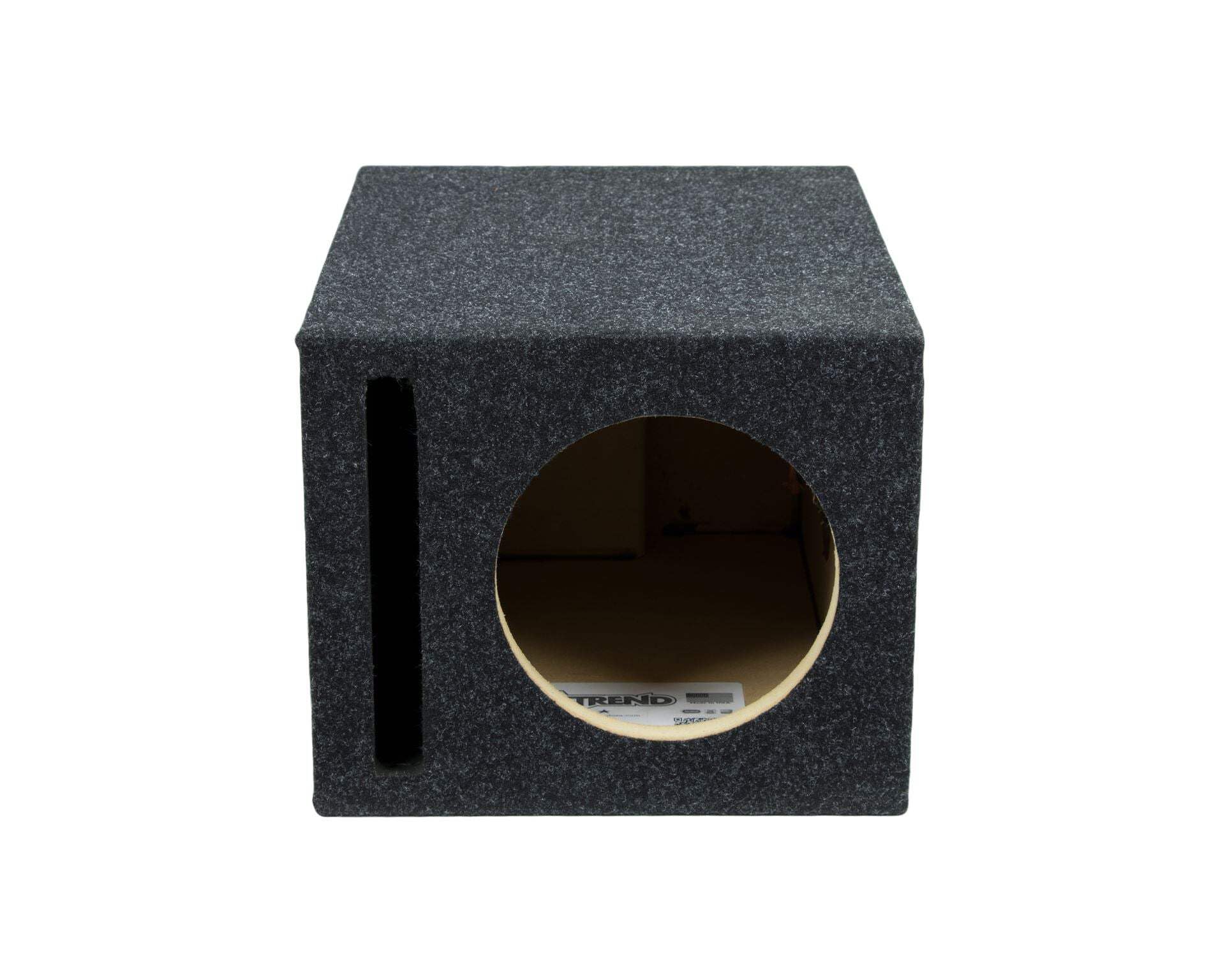
The Atrend 8-inch vented enclosure is a no-nonsense box built around a single 8-inch subwoofer cutout, designed for buyers who already own a driver and need a properly engineered cabinet. Constructed from CNC-mitered MDF — predominantly 3/4-inch with some 1/2-inch panels — it uses aliphatic wood glue and brad nails to create an airtight chamber that minimizes rattles and frequency cancellation. The charcoal carpet finish and nickel-plated terminal cup give it a clean appearance that blends into most trunks and cargo areas.
Owner reports reveal a mix of enthusiasm and practical feedback. Several users paired the box with Infinity and JL Audio subwoofers and reported excellent sound quality — earth-shaking bass in Mustang convertibles and full-size trucks. The vented design amplifies low-frequency output, but some owners note the factory port tuning sits around 45–50 Hz, which can cancel deeper bass notes. A simple field modification — partially obstructing the port with pool noodle or foam padding — drops the tuning closer to 31 Hz, significantly improving low-end extension for those willing to do a quick DIY fix.
Build quality observations are mixed regarding material consistency: some panels use 1/2-inch MDF rather than the advertised 3/4-inch, and staples left inside the enclosure during polyfill installation pose a minor safety hazard when handling the interior. These issues are addressable with staple removal and vacuuming before installing the subwoofer. For the budget-conscious builder who values output per dollar and is comfortable with minor modifications, the Atrend enclosure provides a solid foundation that can outperform enclosures costing considerably more once the tuning is optimized.
What works
- Solid MDF construction produces tight, rattle-free sound
- Vented design amplifies low-frequency output effectively
- Good value for DIY builders with their own subwoofer
What doesn’t
- Factory port tuning cancels some deep bass notes
- Inconsistent use of 1/2-inch versus 3/4-inch MDF panels
7. GEARit Outdoor Speaker Wire 16 AWG 250 ft
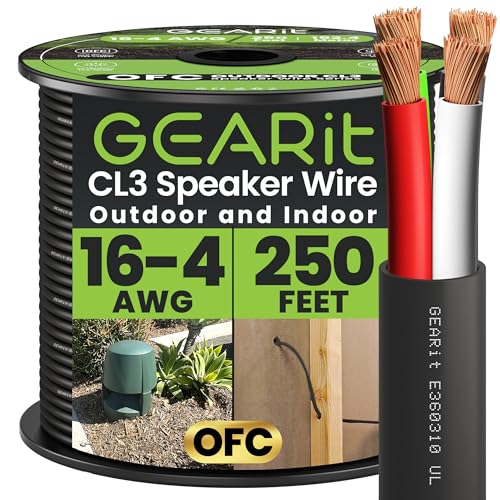
The GEARit 16 AWG speaker wire is a four-conductor, CL3-rated cable made from oxygen-free copper (OFC) for superior conductivity over long runs. At 250 feet per spool, it provides enough length to wire multiple subwoofers, full-range speakers, or an entire vehicle audio system without splicing or extending. The CL3 rating means it can be run inside walls, through vehicle panels, and even buried directly in the ground for outdoor installation without degrading over time.
OFC construction delivers measurable benefits over copper-clad aluminum (CCA) wire: lower resistance per foot, better signal transfer at higher power levels, and reduced oxidation over years of use. Owners who paired this wire with outdoor landscape speakers, Sonos Amps, and car audio systems consistently report clear sound transmission and easy termination with banana plugs or spade connectors. The flexible jacket makes routing through tight spaces and behind panels straightforward, and the clear polarity markings on every foot eliminate guesswork during installation.
For a subwoofer installation project, the four-conductor design allows bi-amping or running multiple sub channels from a single cable pull. The 16-gauge thickness is appropriate for runs up to 50 feet at 4 ohms impedance without significant voltage drop, covering virtually any vehicle routing scenario. Some users note that the spool does not include a winding core for easy re-spooling, so you will want to measure and cut carefully to avoid tangles. For the installer who values signal integrity and long-term durability over bargain-bin CCA wire, this GEARit spool is a reliable infrastructure investment that supports clean, noise-free bass reproduction.
What works
- OFC construction provides low resistance and clean signal
- CL3 rating allows use in walls, vehicles, and direct burial
- 250-foot length covers large systems without splicing
What doesn’t
- No winding core on spool; tangles possible if not careful
- 16 gauge may be light for very long high-power runs
Hardware & Specs Guide
RMS vs Peak Power
Peak power figures are marketing numbers that indicate what a subwoofer can survive for a fraction of a second. The RMS (continuous) rating tells you how much power the driver can handle for prolonged playback without mechanical failure or thermal damage. Always match your amplifier’s RMS output per channel to the subwoofer’s RMS rating at the targeted impedance. A sub with 250W RMS is best paired with an amplifier delivering 200–300W RMS — clean headroom prevents clipping, which is the primary cause of voice coil failure.
Sealed vs Ported Enclosures
Sealed boxes deliver tight, accurate bass with a natural 12 dB per octave roll-off below the enclosure’s resonance frequency. They are smaller, simpler to build, and forgiving of slight power mismatches. Ported enclosures use a tuned vent to reinforce low-frequency output, gaining 3–6 dB of efficiency at the tuning frequency but sacrificing transient response and introducing group delay. For 8-inch subs, sealed enclosures around 0.5 to 0.7 cubic feet are common, while ported boxes require larger volumes to avoid port noise and tuning instability.
Single vs Dual Voice Coils
A single voice coil sub has one set of terminals and one impedance rating — wire it directly to a matching amplifier channel. Dual voice coil subs provide two sets of terminals, allowing series wiring for double the impedance or parallel wiring for half. A DVC 2+2 ohm sub can be wired to 1 ohm (parallel) for maximum amplifier power or 4 ohms (series) for system stability. This flexibility makes DVC subs the preferred choice when integrating with modern monoblock amplifiers that optimize output at lower impedance loads.
Mounting Depth and Cutout Diameter
Eight-inch subwoofers typically require a cutout diameter of 7.0 to 7.25 inches and a mounting depth between 2.5 and 5 inches. Shallow-mount models with depths under 3 inches expand installation locations to include under-seat cavities and factory sub enclosures. Always measure available depth including the magnet structure and any terminal protrusions. Enclosure internal volume also depends on depth — a deeper sub in a shallow box can bottom out or exceed the recommended airspace, leading to poor damping and distorted bass.
FAQ
What size enclosure is best for an 8-inch car subwoofer?
Can I install an 8-inch sub under my car seat?
How much amplifier power do I need for an 8-inch sub?
Is a single voice coil or dual voice coil sub better for beginners?
Final Thoughts: The Verdict
For most buyers, the best 8 inch car sub winner is the Pioneer TS-A2000LD2 because it balances shallow-mount compatibility, clean power handling, and genuine drop-in replacement capability across dozens of popular vehicles. If you want studio-grade build quality and precise low-frequency accuracy for a home or inverter-powered vehicle setup, grab the Audioengine S8. And for ultra-slim powered bass that slides under most seats, nothing beats the space-efficient Cerwin-Vega VPAS10.

Certification: BSc in Mechanical Engineering
Education: Mechanical engineer
Lives In: 539 W Commerce St, Dallas, TX 75208, USA
Md Amir is an auto mechanic student and writer with over half a decade of experience in the automotive field. He has worked with top automotive brands such as Lexus, Quantum, and also owns two automotive blogs autocarneed.com and taxiwiz.com.