Factory 6×8 speakers are notorious for delivering thin, hollow sound that falls apart the moment a bass line drops. Upgrading to properly engineered aftermarket coaxials transforms the entire listening experience, turning muddy mid-bass into articulate lows that hit without distorting. The right set of 6×8 speakers breathes new life into your daily commute or weekend cruise with punch you can feel.
I’m Amir — the founder and writer behind Four Wheel Ask. I’ve spent countless hours analyzing car audio component specifications, comparing power handling curves, cone materials, and sensitivity ratings across dozens of models to identify which 6×8 drivers actually deliver meaningful low-frequency output.
This guide breaks down seven carefully vetted options, covering build quality, frequency response, and real-world bass performance. Finding the right 6×8 speakers for bass comes down to understanding which power handling specs and cone technologies translate to clean, deep reproduction in your specific vehicle.
How To Choose The Best 6×8 Speakers For Bass
Selecting 6×8 speakers that deliver real low-end punch requires more than just looking at a wattage number. You need to match power handling to your head unit or amplifier, understand how cone stiffness and surround compliance shape the bass response, and consider how sensitivity affects volume before distortion sets in. Here are the critical factors that separate bass-heavy performers from mediocre replacements.
Power Handling: RMS vs Peak Watts
RMS (continuous) power handling is the only number that matters for sustained bass output. A speaker rated for 80 watts RMS can play cleanly at higher volumes for longer periods than one rated for 60 watts RMS, regardless of the peak watt figure. If you plan to run these speakers off a factory head unit, look for RMS ratings around 60-80 watts and sensitivity above 90 dB to get reasonable volume without an external amp.
Cone Material and Surround Compliance
Polypropylene cones with mineral filling offer the ideal mix of stiffness and damping for 6×8 bass reproduction. They resist flexing under high cone excursion, keeping the sound clean at low frequencies. The surround material — preferably butyl rubber — determines how far the cone can travel without bottoming out. Stiffer surrounds limit deep bass, while compliant rubber surrounds allow longer excursion for more pronounced low-end impact.
Frequency Response and Sensitivity Matching
A frequency response curve that extends down to 30-40 Hz indicates the speaker is mechanically capable of reproducing sub-bass frequencies, but the actual output depends on the enclosure (your door cavity acts as the box). Sensitivity ratings of 90 dB or higher mean the speaker converts power into volume efficiently, giving you more apparent bass output at lower amplifier power levels. Pairing high sensitivity with low frequency extension is the sweet spot for bass-focused systems.
Quick Comparison
On smaller screens, swipe sideways to see the full table.
| Model | Category | Best For | Key Spec | Amazon |
|---|---|---|---|---|
| Rockford Fosgate Power T1682 | 2-Way Coaxial | High-powered OEM replacement | 80W RMS / 160W Max | Amazon |
| KICKER KS-Series 51KSC6804 | Coaxial | Concert-volume clarity | 4-Ohm impedance | Amazon |
| Rockford Fosgate Punch P1683 | 3-Way Coaxial | Wide frequency coverage | 65W RMS / 130W Max | Amazon |
| JBL Club 864F | 2-Way Coaxial | High-sensitivity builds | 93 dB sensitivity | Amazon |
| Pioneer TS-A683FH | 2-Way Coaxial | Extended high-frequency reach | 85W RMS / 370W Max | Amazon |
| JBL GX8628 | 2-Way Coaxial | Budget-friendly upgrade | 3-ohm DCR voice coils | Amazon |
| Pioneer TS-A6881F | 4-Way Coaxial | Stock replacement on a budget | 80W RMS / 350W Max | Amazon |
In‑Depth Reviews
1. Rockford Fosgate Power T1682

The Rockford Fosgate Power T1682 sits at the top of the 6×8 food chain for a reason. With an 80-watt RMS power handling and a carbon-fiber-infused polypropylene cone paired with a butyl rubber surround, this speaker delivers controlled, deep bass that remains articulate even when you push the volume. The integrated concealed crossover ensures the tweeter only sees frequencies above 3.5 kHz, keeping the midrange clean and undistorted.
What really sets the T1682 apart is the fitment flexibility. Rockford designed the FlexFit basket with slotted mounting holes that let you adjust the speaker position slightly to align perfectly with your vehicle’s factory bolt pattern. This matters for door installations where existing holes rarely line up perfectly. The included adapter plates and stainless-steel hardware make installation straightforward for anyone with basic tools.
The 4-ohm impedance works well with both aftermarket head units and external amplifiers. Sensitivity is respectable enough that you get solid output from a quality deck alone, but adding a dedicated amp unlocks the speaker’s full bass potential. For 6×8 owners who want true low-end authority without adding a subwoofer, this is the benchmark.
What works
- Precise bass control from the carbon-fiber composite cone
- FlexFit basket simplifies vehicle-specific alignment
- Clean crossover network keeps midrange free of tweeter bleed
What doesn’t
- Premium price may be overkill for basic head-unit-only setups
- Requires sufficient mounting depth for full cone excursion
2. KICKER 51KSC6804 KS-Series
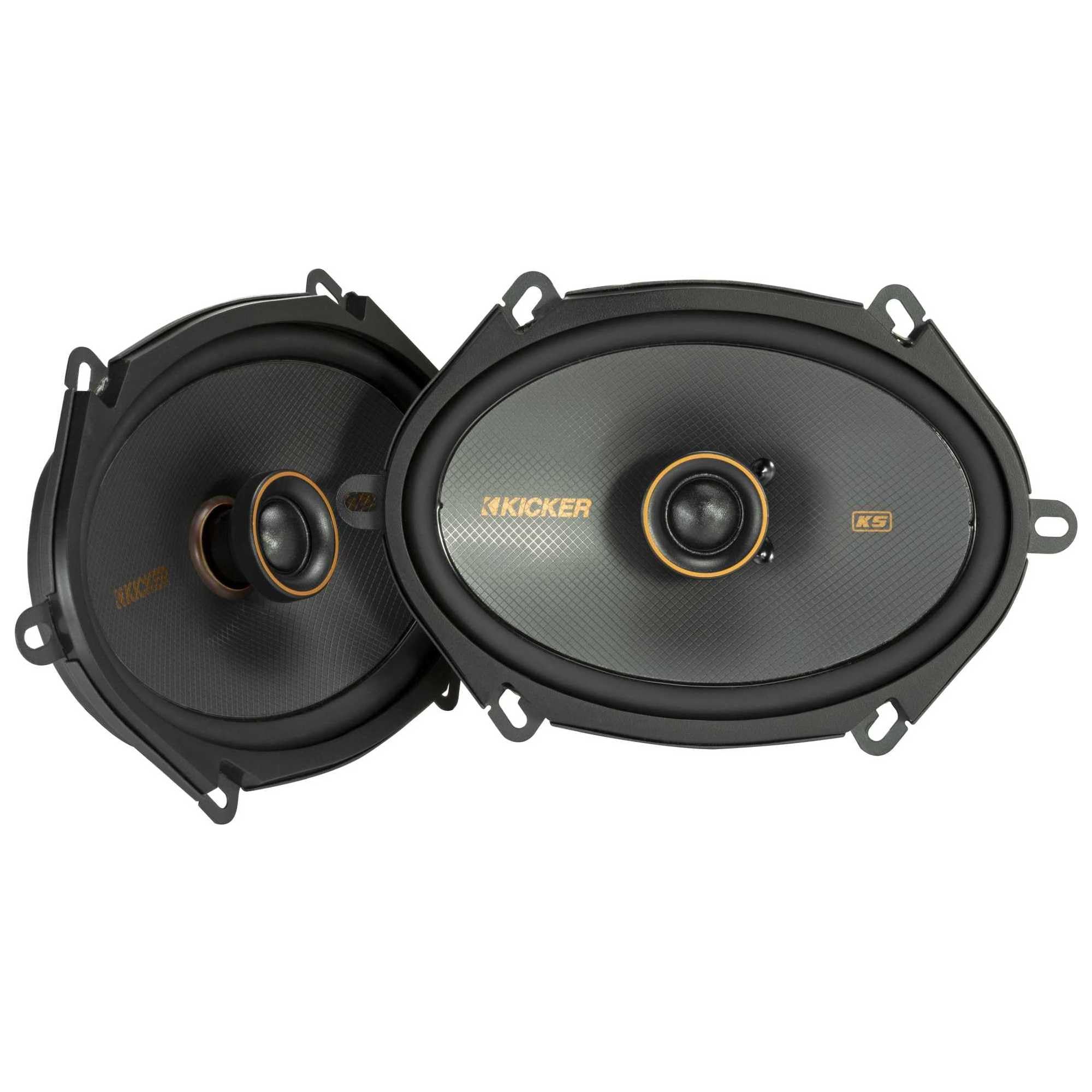
KICKER’s KS-Series 51KSC6804 is engineered for listeners who demand concert-level volume without sacrificing detail. The internally dampened polypropylene cone and robust rubber surround allow this 6×8 to handle heavy low-frequency loads without the cone breaking up. It reproduces kick drums and bass guitar lines with a physical presence that lesser speakers simply cannot match at high SPL.
The tweeter design features zero protrusion, which dramatically improves fitment in vehicles with tight grille clearance. Many 6×8 installations fail because the tweeter tower hits the door panel — KICKER solved that here. The redesigned voice coil and crossover network ensure the woofer and tweeter operate in their optimal frequency bands, resulting in a cohesive soundstage even when you crank the volume knob.
This speaker pairs exceptionally well with a dedicated 4-channel amplifier. The 4-ohm load is amplifier-friendly, and the increased power handling means you can feed these speakers serious wattage before they reach mechanical limits. For bass-heavy listeners who also value vocal clarity at high volumes, the KS-Series is a standout.
What works
- Internally dampened cone resists breakup at high excursion
- Zero-protrusion tweeter simplifies fitment in tight doors
- Handles amplifier power without distortion
What doesn’t
- Bass impact may still benefit from a dedicated subwoofer
- Premium tier pricing for a coaxial speaker
3. Rockford Fosgate Punch P1683

The Rockford Fosgate Punch P1683 brings a 3-way design to the 6×8 format, adding a dedicated super-tweeter to the standard woofer and tweeter arrangement. This extra driver extends the high-frequency response beyond 20 kHz, which helps create the illusion of deeper, more detailed bass by cleaning up the midrange overlap. The injection-molded mineral-filled polypropylene cone provides the stiffness needed for controlled low-end motion.
The butyl rubber surround is a key ingredient for bass reproduction here. Rockford’s material choice allows the cone to travel further without losing linearity, meaning the speaker can produce more physical low-end pressure before hitting mechanical limits. The integrated crossover ensures each driver only handles its intended frequency range, preserving clarity across the entire spectrum.
Installation is simplified by the FlexFit basket and included OEM adapter plate, which make this a direct drop-in replacement for most Ford, Mazda, and Mercury vehicles that use the 6×8 pattern. Owners report noticeable bass improvement over factory paper-cone speakers, with the 65-watt RMS rating providing ample headroom for amplifier integration.
What works
- 3-way design extends high-frequency reach for better perceived detail
- Butyl rubber surround enables deeper cone excursion
- Drop-in fitment for common Ford and Mazda vehicles
What doesn’t
- Extra tweeter can create harshness with low-quality head units
- Mounting depth may be tight in some door cavities
4. JBL Club 864F

The JBL Club 864F leverages JBL’s patented Plus One woofer cone architecture, which gives the speaker more effective cone area than standard 6×8 designs. More cone area means more air displacement, which directly translates to higher sensitivity and greater low-frequency output. The 93 dB sensitivity rating is among the highest in this class, meaning these speakers produce serious volume even from a factory head unit.
The edge-driven silk dome tweeter is a standout feature for bass-focused listeners who don’t want harsh highs ruining the mix. Unlike the hard dome tweeters found in many competitors, the silk dome stays smooth and non-fatiguing at all volume levels, allowing the bass to remain the star of the show. The acoustically damped polypropylene cone resists resonant coloration, keeping the mid-bass punchy and natural.
JBL spec’d a larger magnet structure on the Club series compared to previous generations, directly improving motor force and transient response. This translates to faster, tighter bass that doesn’t linger or sound boomy. The 3-ohm nominal impedance loads the amplifier slightly harder than a 4-ohm speaker, extracting a few extra watts from matching amplifiers.
What works
- Plus One cone increases surface area for louder bass output
- 93 dB sensitivity works well with low-power sources
- Silk dome tweeter provides non-fatiguing highs
What doesn’t
- 3-ohm impedance may not match all amplifier loads perfectly
- Frequency response roll-off above 20 kHz limits ultra-high extension
5. Pioneer TS-A683FH

The Pioneer TS-A683FH stretches the frequency response ceiling to an impressive 49 kHz, which is well beyond human hearing. The practical benefit here is that the crossover region between the woofer and tweeter is extremely clean, eliminating harshness and allowing the low end to sound more defined. The 85-watt RMS rating gives this speaker solid headroom for mid-level amplifier setups.
Pioneer incorporated a Bass Boost feature into the speaker design, which actively shapes the frequency curve to emphasize low-end output. Combined with the 90 dB sensitivity rating, the TS-A683FH produces noticeable bass punch even when powered solely by an aftermarket head unit. The two-way design keeps the installation simple while still delivering the frequency separation needed for clear bass reproduction.
Owners consistently praise the fit in F-150 models from 1997 through 2013, noting the included bottom mount brackets eliminate guesswork. The bronze-colored cone adds visual flair behind grilles, but the real value is the forward-facing engineering — Pioneer tuned these specifically for enhanced low-end response without sacrificing midrange clarity.
What works
- Bass Boost shaping emphasizes low-frequency output
- Extended 49 kHz response cleans up crossover region
- Perfect fit for many Ford F-150 model years
What doesn’t
- Bass Boost can sound artificial with certain music genres
- No tweeter level adjustment for custom tuning
6. JBL GX8628

The JBL GX8628 proves you don’t need to spend heavily to get meaningful bass improvement over factory speakers. The Plus One woofer cone gives these entry-level speakers a surprising amount of low-end presence, especially compared to the paper-cone drivers they’re replacing. The 3-ohm DCR voice coils allow the speaker to draw slightly more power from the amplifier, translating to higher output at the same volume setting as 4-ohm competitors.
HARMAN’s proprietary tweeter deflector helps spread high frequencies evenly throughout the cabin, preventing a focused hot spot that can make the soundstage feel unbalanced. While the GX8628 doesn’t have the ultimate bass authority of the higher-tier Club series, it delivers a well-rounded performance that leans slightly toward warmth. The 21 kHz frequency response covers the audible spectrum completely.
Installation is straightforward for most vehicles, with the shallow mounting depth accommodating doors with limited clearance. Owners report excellent results in Mustang, F-Series, and Mazda applications. The black and red aesthetic is subtle enough to look OEM behind factory grilles while providing a clear visual upgrade when the grilles are removed.
What works
- Affordable entry point with genuine bass improvement
- 3-ohm coils extract extra power from stock head units
- Shallow mounting depth fits tight door cavities
What doesn’t
- Not suitable for high-power amplifier setups
- Bass rolls off noticeably below 50 Hz
7. Pioneer TS-A6881F

The Pioneer TS-A6881F brings a 4-way configuration to the budget segment, adding extra driver elements to spread the frequency load across more components. This reduces the strain on any single driver, theoretically improving longevity and reducing distortion at higher volumes. The 30 Hz low-end extension is impressive at this price point, giving listeners a taste of sub-bass frequencies that most budget 6×8 speakers simply omit.
The 90 dB sensitivity rating ensures these speakers produce usable volume from a factory radio, making them a true plug-and-play upgrade. The included bottom mount brackets and multiple screw options cover a wide range of vehicle fitments, which is critical for first-time installers. Pioneer includes a one-year warranty, adding peace of mind for budget-conscious buyers.
Customer feedback highlights the noticeable bass improvement over OEM speakers in Ford F-150s and similar trucks. While the 4-way design introduces more crossover points that can sometimes create phase issues at extreme listening positions, the majority of listeners find the balance pleasing. For anyone looking to breathe life into a stock system on a tight budget, this is a solid choice.
What works
- Exceptional value with genuine low-frequency extension
- 4-way design reduces driver strain at high volumes
- Easy installation with included brackets and screws
What doesn’t
- Multiple crossover points can cause minor phase cancellation
- Build quality not on par with mid-range competitors
Hardware & Specs Guide
Power Handling (RMS Rating)
The continuous RMS wattage rating defines how much power a speaker can handle during normal operation without overheating or distorting. For 6×8 speakers, an RMS rating of 60-85 watts is ideal for aftermarket head unit setups, while 80+ watts RMS pairs well with dedicated amplifiers. Always match or exceed the RMS rating with your amplifier’s output to prevent clipping.
Cone Material and Surround Type
Polypropylene with mineral filling offers the best stiffness-to-weight ratio for 6×8 bass reproduction, resisting cone flex during high excursion. Butyl rubber surrounds provide the compliance needed for deep excursion while maintaining linearity. Paper cones found in factory speakers lack the rigidity needed for clean bass and should be avoided for any bass-focused upgrade.
FAQ
Will 6×8 speakers fit in my vehicle without modification?
Do I need an external amplifier for good bass from 6×8 speakers?
What is the difference between 2-way and 3-way 6×8 speakers for bass?
Final Thoughts: The Verdict
For most buyers, the 6×8 speakers for bass winner is the Rockford Fosgate Power T1682 because it combines 80-watt RMS power handling with a carbon-fiber cone and butyl rubber surround for unmatched bass control and clarity. If you want the best balance of high sensitivity and low-end presence, grab the JBL Club 864F. And for budget-conscious listeners seeking a genuine step up from factory speakers, nothing beats the Pioneer TS-A6881F.

Certification: BSc in Mechanical Engineering
Education: Mechanical engineer
Lives In: 539 W Commerce St, Dallas, TX 75208, USA
Md Amir is an auto mechanic student and writer with over half a decade of experience in the automotive field. He has worked with top automotive brands such as Lexus, Quantum, and also owns two automotive blogs autocarneed.com and taxiwiz.com.