Antifreeze is one of those products where grabbing the wrong chemistry can quietly destroy an engine from the inside out. While many shoppers focus on brand familiarity or bottle color, the real differentiators live in the additive package, the silicate content, and whether the formula matches your cooling system metallurgy. A mismatch here doesn’t just reduce performance — it accelerates corrosion, degrades gaskets, and shortens water pump life.
I’m Amir — the founder and writer behind Four Wheel Ask. My buying guides are built on cross-referencing technical data sheets, analyzing owner-reported failure patterns across forums, and comparing real-world lab results to manufacturer claims.
After analyzing hundreds of owner reports, finding the best 5 gallon antifreeze comes down to understanding your vehicle’s specific coolant chemistry.
How To Choose The Best 5 Gallon Antifreeze
Selecting the right coolant means decoding the label beyond the freeze point number. The chemistry class — OAT, HOAT, or IAT — dictates which metals, gaskets, and seal materials the formula protects. Using the wrong type can void warranties and trigger rapid corrosion inside the radiator and heater core. Understanding your vehicle’s OEM specification is the single most important step before buying any bulk coolant.
Concentrate vs Pre-Diluted
Concentrate requires mixing with distilled water at a 50/50 ratio to achieve the standard -34°F freeze point and 265°F boil protection. Pre-diluted is ready to pour straight from the jug, which eliminates measuring errors but adds significant weight and shipping cost per gallon of actual antifreeze. For bulk buyers, concentrate delivers more thermal protection per dollar and allows custom blend ratios for extreme climates.
OAT, HOAT, and IAT Chemistry
IAT (Inorganic Acid Technology) uses silicates and phosphates — common in older American and Asian vehicles but requires more frequent changes. OAT (Organic Acid Technology) provides longer service life with lower silicates, favored by many modern GM and Ford platforms. HOAT (Hybrid OAT) blends both approaches and is often specified by European manufacturers like BMW, Mercedes, and VW. Matching the correct chemistry to your engine block and gasket materials prevents electrolysis, cavitation, and additive dropout.
Freeze Point and Boil Over Margins
A 50/50 mix delivers protection down to -34°F and boil-over resistance up to 265°F under pressure. For northern climates, a 60/40 concentrate-to-water ratio drops the freeze point to -62°F. High-performance or heavy-tow applications benefit from waterless coolants that eliminate vaporization entirely, with boil points exceeding 375°F. Knowing your local temperature extremes and engine load profile guides the right blend decision.
Quick Comparison
On smaller screens, swipe sideways to see the full table.
| Model | Category | Best For | Key Spec | Amazon |
|---|---|---|---|---|
| PEAK OET Orange | Concentrate | North American Vehicles | OAT Formula, 5 Yr / 150K Mi | Amazon |
| EVANS Waterless | Waterless | High-Performance & Classic | 375°F Boil Point, Lifetime | Amazon |
| Motorcraft VC7DILB | Pre-Diluted | Ford / Lincoln / Mercury | Gold Formula, Ready-to-Use | Amazon |
| Valvoline Zerex G48 | Concentrate | European Vehicles | HOAT, Violet, 5 Yr / 150K Mi | Amazon |
| Zerex G40 | Concentrate | German / Mercedes / BMW | Si-OAT, Violet, 5 Yr / 150K Mi | Amazon |
In‑Depth Reviews
1. PEAK OET Extended Life Orange Concentrate

PEAK’s OET Orange formula uses an organic acid technology package designed specifically for North American vehicles from Ford, Chrysler, and GM. The concentrate formulation allows precise blending with distilled water to match your climate, and the additive package is engineered to protect aluminum, cast iron, and copper-brass radiators equally. Owner reports consistently note stable temperature readings after flush-and-fill procedures, with several users documenting drops in peak operating temperature compared to previous off-the-shelf coolants.
The chemistry meets extended-life requirements, with PEAK guaranteeing service life up to 150,000 miles or five years when installed as part of a complete system flush. The orange dye makes leak detection straightforward and the concentrate format means a single gallon produces two gallons of 50/50 mix, effectively doubling your coverage. Lab batch testing ensures consistent silicate and phosphate levels across production runs, which matters for vehicles sensitive to additive concentration shifts.
Owners of Chevy Volts, Ford F-150s, and Chrysler 300s report that the coolant matched or exceeded OEM temperature regulation after the swap. The formula includes a bittering agent to deter incidental ingestion, and the bottle seals reliably in transit with minimal leakage complaints. For a broad-spectrum OAT coolant that balances price and protection window, this is the most versatile option in the mid-range bracket.
What works
- Broad OEM compatibility with North American makes
- Concentrate delivers two gallons of ready mix per jug
- Proven 150K mile protection window in real-world use
What doesn’t
- Not formulated for most European or Asian OEM specs
- Orange dye can stain overflow tanks if spilled
2. EVANS Cooling Systems High Performance Waterless Coolant

EVANS takes a fundamentally different approach by removing water from the equation entirely. The waterless formula has a boiling point of 375°F, meaning it will not vaporize under normal operating conditions, which eliminates boil-over, after-boil, and the vapor pressure spikes that stress hoses and radiator caps. This also removes the primary driver of corrosion — water — so liner erosion, water pump cavitation, and electrolysis issues are effectively eliminated for the life of the coolant.
Installation requires a dry system with less than three percent water remaining, which typically means using EVANS Prep Fluid to evacuate old coolant completely. Once installed, the fluid never needs replacement and captured fluid can be filtered and reused. Owners of high-output Hemis, turbocharged diesels, and air-cooled engines report that the coolant stabilizes operating temperatures under heavy load, with one 800-horsepower HEMI owner noting a drop from 235°F to 209°F at WOT.
The trade-off is the upfront investment and the preparation effort required for a proper installation. Some owners report that the packaging is prone to leakage during shipping, and the fluid is not a drop-in replacement for conventional coolant — you cannot mix it with water-based antifreeze. For dedicated track cars, heavy-tow rigs, and vehicles that see extreme thermal stress, the EVANS system delivers a permanent cooling solution that traditional antifreeze cannot match.
What works
- Zero vaporization eliminates boil-over permanently
- Lifetime service reduces long-term maintenance cost
- Proven temperature reduction in high-HP builds
What doesn’t
- Requires thorough prep and dedicated flush procedure
- Bottle design has a higher leak rate in transit
3. Motorcraft VC7DILB Gold Prediluted Antifreeze

Motorcraft VC7DILB is the factory-fill coolant for Ford, Lincoln, and Mercury vehicles, meeting WSS-M97B51-A1 specification. The gold-colored formula is pre-diluted at a 50/50 ratio with deionized water, so it pours straight into a drained system without any mixing step. This eliminates the risk of incorrect blend ratios, which is especially valuable for owners who service their own cooling systems and want guaranteed freeze and boil protection right out of the jug.
The product provides year-round corrosion protection for aluminum, iron, and solder joints, with additive levels calibrated specifically for Ford engine metallurgy. Owner feedback from Crown Victoria, F-150, and Explorer owners confirms consistent temperature regulation and no issues with water pump seal compatibility. Multiple reviews note that the coolant matches the factory fill color and performance exactly, making it the safe choice for warranty-conscious buyers who want OEM-grade chemistry without dealership markup.
The pre-diluted format does mean you are paying for water weight, so the thermal protection per dollar is lower than concentrate options. The one-gallon jug covers systems with roughly one-gallon capacity, so larger trucks and SUVs will need multiple jugs. For owners of Ford platforms who prioritize convenience and OE-spec certainty over blend flexibility, the Motorcraft gold coolant is the most straightforward pick in the lineup.
What works
- Exact OEM formulation for Ford, Lincoln, Mercury
- Pre-diluted with no mixing required
- Proven long-term compatibility with Ford gaskets
What doesn’t
- Pre-diluted reduces value versus concentrate
- Limited to Ford-spec vehicles for optimal performance
4. Valvoline Zerex G48 Concentrate Antifreeze

Zerex G48 is a hybrid OAT (HOAT) concentrate formulated with silicates and organic acids to match the coolant requirements of European manufacturers, including BMW, Mercedes-Benz, and Volkswagen. The violet-colored formula meets BMW N600 and Mercedes MB 325.0 specifications, making it a direct replacement for factory purple coolant in late-model European platforms. Owner reports confirm that the color matches OE coolant exactly, and the concentrate format allows precise blending for different climate zones.
The dual-action additive package provides the immediate protection of silicates for aluminum surfaces while the organic acids extend the service life beyond traditional green coolant intervals. Mercedes and BMW owners specifically report stable temperature readings after switching from dealer-supplied coolant, with several noting significant cost savings over OEM-branded jugs. The formula includes a bittering agent to deter accidental ingestion and is batch-tested for consistent additive concentration.
As a concentrate, one gallon produces two gallons of 50/50 mix when combined with distilled water, effectively cutting the per-gallon cost versus pre-diluted alternatives. The product is not recommended for use in vehicles that specify phosphate-free or nitrite-free coolant, so checking your owner’s manual against the G48 spec sheet is mandatory. For European car owners seeking a spec-compliant HOAT concentrate at a sensible price point, this is the most widely recommended option in the category.
What works
- Meets BMW N600 and Mercedes MB 325.0 specs
- Concentrate doubles your coolant volume per dollar
- Color match verified by multiple European owners
What doesn’t
- Not suitable for phosphate-free or nitrite-free systems
- Requires careful mixing with distilled water
5. Zerex G40 Phosphate and Nitrite Free Concentrate
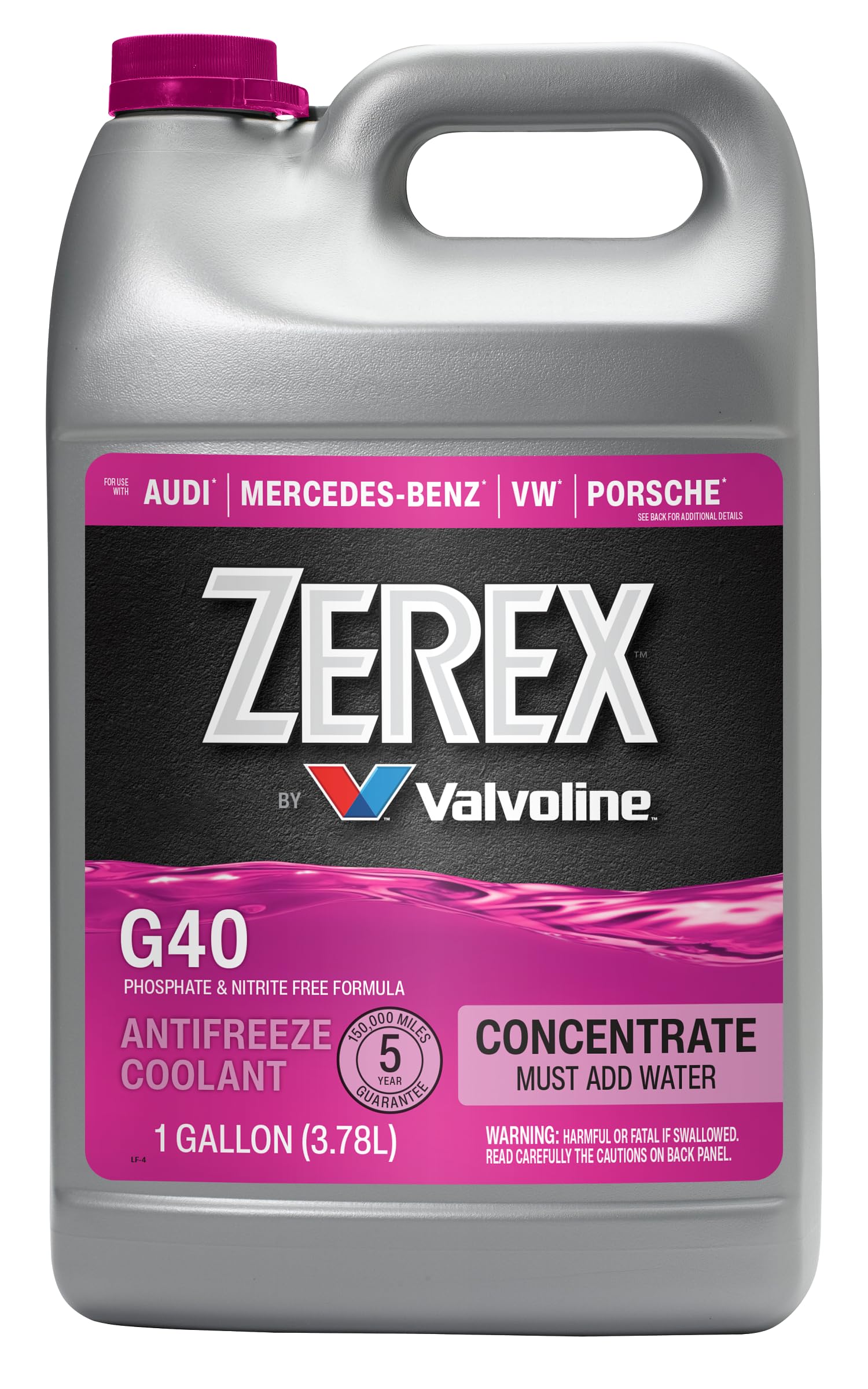
Zerex G40 is a phosphate-free and nitrite-free Si-OAT concentrate designed specifically for German-engineered vehicles, including Mercedes-Benz, BMW, Porsche, and Audi models that require low-silicate coolant. The violet formula matches the factory-fill color used by several German manufacturers and meets the strict additive limits that prevent gasket degradation in modern European engines. Owner reports from Mercedes GLE, BMW 3 Series, and Porsche Cayenne owners confirm trouble-free integration after flush and fill.
The silicon-organic acid technology resists corrosion across all cooling system metals — aluminum, cast iron, copper, and solder — without the phosphates that can react with hard water in some regions. The concentrate format allows blend ratios from 50/50 for standard protection up to 70/30 for extreme cold climates, giving owners flexibility that pre-diluted products cannot match. Valvoline backs the formula with a 5-year or 150,000-mile guarantee against freeze-up or boil-over damage, and the batch-testing protocol ensures consistent additive levels across production runs.
Owners note that the price per gallon undercuts dealer-branded coolant by a wide margin while delivering equivalent thermal performance. The product is not compatible with GM, Ford, or Asian OEM specifications, so verifying your vehicle’s coolant type before purchase is essential. For German car owners who want a spec-correct, phosphate-free Si-OAT concentrate at a budget-conscious price point, the G40 delivers factory-quality protection without the dealership premium.
What works
- Phosphate and nitrite-free for German OEM compliance
- Concentrate allows custom blend for extreme climates
- Significant cost savings versus dealer-branded coolant
What doesn’t
- Limited to vehicles requiring phosphate-free chemistry
- Not compatible with Asian or American coolant specs
Hardware & Specs Guide
Concentrate vs Pre-Diluted Ratios
A 50/50 mix of concentrate and distilled water delivers a freeze point of -34°F and a boil point of 265°F under a 15 psi cap. Concentrate allows custom blends: 60/40 drops freeze protection to -62°F, while 70/30 reaches -84°F. Pre-diluted coolant eliminates mixing errors but locks you into the standard 50/50 ratio. For bulk buyers, concentrate provides more thermal versatility and better value per gallon of actual antifreeze chemistry.
OAT vs HOAT vs IAT Chemistry
IAT (Inorganic Acid Technology) uses silicates and phosphates, requiring changes every 2-3 years. OAT (Organic Acid Technology) uses organic additives, lasting up to 5 years or 150,000 miles. HOAT (Hybrid OAT) combines both for extended life with silicate protection for aluminum components. Using the wrong chemistry can cause gasket failure, radiator clogging, and water pump seal degradation within months.
Additive Depletion Indicators
Coolant additive packages degrade over time, losing corrosion inhibition effectiveness. Visual indicators include color shift from bright orange or violet to brown or muddy tones, and the presence of rust-colored deposits in the overflow tank. pH test strips designed for antifreeze measure reserve alkalinity — readings below 7.0 indicate that the additive package is exhausted and coolant replacement is necessary to prevent internal corrosion.
Material Compatibility Chart
Aluminum radiators require low-silicate or silicate-free OAT formulas to prevent surface erosion. Cast iron blocks tolerate IAT chemistry well but benefit from HOAT extended-life formulations. Copper-brass systems are compatible with most coolant types but react poorly to high-chloride water used in mixing. Waterless coolants like EVANS eliminate material compatibility issues entirely since corrosion requires water to propagate.
FAQ
Can I mix different coolant colors or chemistries?
How often should I replace 5 gallon antifreeze in my vehicle?
Is concentrate cheaper than pre-diluted antifreeze?
What does the bittering agent in antifreeze do?
Final Thoughts: The Verdict
For most buyers, the best 5 gallon antifreeze winner is the PEAK OET Orange Concentrate because it offers broad North American vehicle compatibility, a proven 150,000-mile protection window, and the cost efficiency of a concentrate formula. If you want zero-maintenance cooling that eliminates boil-over forever, grab the EVANS Waterless Coolant. And for German car owners requiring phosphate-free chemistry with factory-spec accuracy, nothing beats the Zerex G40 for value and compliance.

Certification: BSc in Mechanical Engineering
Education: Mechanical engineer
Lives In: 539 W Commerce St, Dallas, TX 75208, USA
Md Amir is an auto mechanic student and writer with over half a decade of experience in the automotive field. He has worked with top automotive brands such as Lexus, Quantum, and also owns two automotive blogs autocarneed.com and taxiwiz.com.