Choosing the wrong oil for a four-stroke engine is one of the fastest ways to shorten its service life, yet most buyers grab whatever bottle is cheapest without reading the label. The viscosity grade, base stock type, and additive package all determine whether an engine runs cool, shifts smoothly, and resists wear over thousands of hours of operation. This guide cuts through the marketing noise and focuses purely on measurable performance data from verified owner reports and technical specifications.
I’m Amir — the founder and writer behind Four Wheel Ask. My recommendations come from months of cross-referencing owner reviews, viscosity data sheets, and additive package analysis across dozens of 4-stroke engine platforms, from air-cooled lawn mowers to high-RPM motorcycle engines and saltwater outboards.
After analyzing thousands of owner reviews and technical data sheets, this guide delivers a definitive answer for the best 4 cycle engine oil across every engine type.
How To Choose The Best 4 Cycle Engine Oil
Selecting the right oil requires matching the fluid’s physical properties to your engine’s design parameters. Air-cooled engines run hotter than liquid-cooled ones, wet clutches demand specific friction modifiers, and high-hour commercial equipment needs robust shear stability. Below are the four most critical factors to evaluate before making a purchase.
Understanding SAE Viscosity Grades
The Society of Automotive Engineers viscosity grading system defines how an oil flows at specific temperatures. The first number with a ‘W’ indicates cold-weather pumpability, while the second number represents flow characteristics at 100 degrees Celsius. A 10W-30 oil behaves like a 10-weight fluid in cold conditions and a 30-weight at operating temperature. Engines with tighter clearances typically require lower viscosities, while older or high-mileage engines often benefit from a thicker film. Always defer to the owner’s manual recommendation first, as using the wrong grade can lead to insufficient lubrication or excessive drag.
Synthetic vs. Conventional Base Oils
Conventional mineral oils are refined from crude oil and provide adequate protection for low-stress, low-hour applications like push mowers or backup generators. Full synthetic oils are chemically engineered from uniform molecular structures, offering superior oxidation resistance, higher viscosity index, and better low-temperature flow. Synthetic blends combine a conventional base with a percentage of synthetic stock to improve performance at a moderate cost. For engines that operate under heavy loads, extreme temperatures, or extended drain intervals, a full synthetic oil consistently delivers lower wear metals in used-oil analysis reports.
Additive Packages and What They Do
Zinc dialkyldithiophosphate is a critical anti-wear additive that forms a protective layer on metal surfaces under high pressure. While ZDDP levels have been reduced in modern automotive oils to protect catalytic converters, many 4-cycle small engines and performance motorcycles still benefit from higher concentrations. Detergents and dispersants keep combustion byproducts suspended so they don’t form sludge or varnish. Antioxidants extend oil life by slowing thermal breakdown, and anti-foam agents prevent air entrainment that can lead to cavitation wear in high-RPM engines.
OEM Certifications and Specifications
Manufacturers like Honda, Kawasaki, Yamaha, and Mercury engineer their engines with specific lubricant requirements. Using an oil that meets JASO MA2 certification ensures proper wet clutch performance in motorcycles and ATVs. NMMA FC-W certification is required for many marine four-stroke outboards to guarantee corrosion protection and shear stability in constant high-load operation. API service ratings such as SN or SP indicate the oil meets current industry standards for deposit control and wear protection. Ignoring OEM specs can void warranties and accelerate engine wear.
Quick Comparison
On smaller screens, swipe sideways to see the full table.
| Model | Category | Best For | Key Spec | Amazon |
|---|---|---|---|---|
| TRIAX Power SAE 30W | Full Synthetic | High-zinc small engine protection | SAE 30W, 1 Gallon | Amazon |
| Motul 7100 5W-40 | Full Synthetic Ester | European sport motorcycles | 5W-40, 4 Liters | Amazon |
| Royal Purple Max Cycle 10W-40 | Full Synthetic | Motorcycle wear reduction | 10W-40, 1 Quart | Amazon |
| Valvoline 4-Stroke ATV/UTV 10W-40 | Synthetic Blend | ATV/UTV wet clutch systems | 10W-40, Case of 6 | Amazon |
| Yamaha Yamalube 4M 10W-30 | Conventional Mineral | Yamaha 4-stroke outboards | 10W-30, 1 Gallon | Amazon |
| Mercury 25W-40 Marine | Synthetic Blend | Mercury/MerCruiser sterndrives | 25W-40, 1 Gallon | Amazon |
| Kawasaki K-Tech 20W-50 | Conventional | Kawasaki OEM replacement | 20W-50, 5 Quarts | Amazon |
| Honda OEM 10W-30 (Pack of 4) | Conventional | Honda small engines | 10W-30, 4 x 32 oz | Amazon |
| Kimpex 10W40 Moto/ATV | Synthetic Blend | Dirt bikes and ATVs | 10W-40, 3.78 Liters | Amazon |
| STP Premium Small Engine SAE-30 | Conventional | Lawn mowers and tractors | SAE 30, 32 oz | Amazon |
| Mannol SAE 30 Full Synthetic | Full Synthetic | Generators and power equipment | SAE 30, 1 Liter | Amazon |
In-Depth Reviews
1. TRIAX Power 4-Stroke SAE 30W Full Synthetic
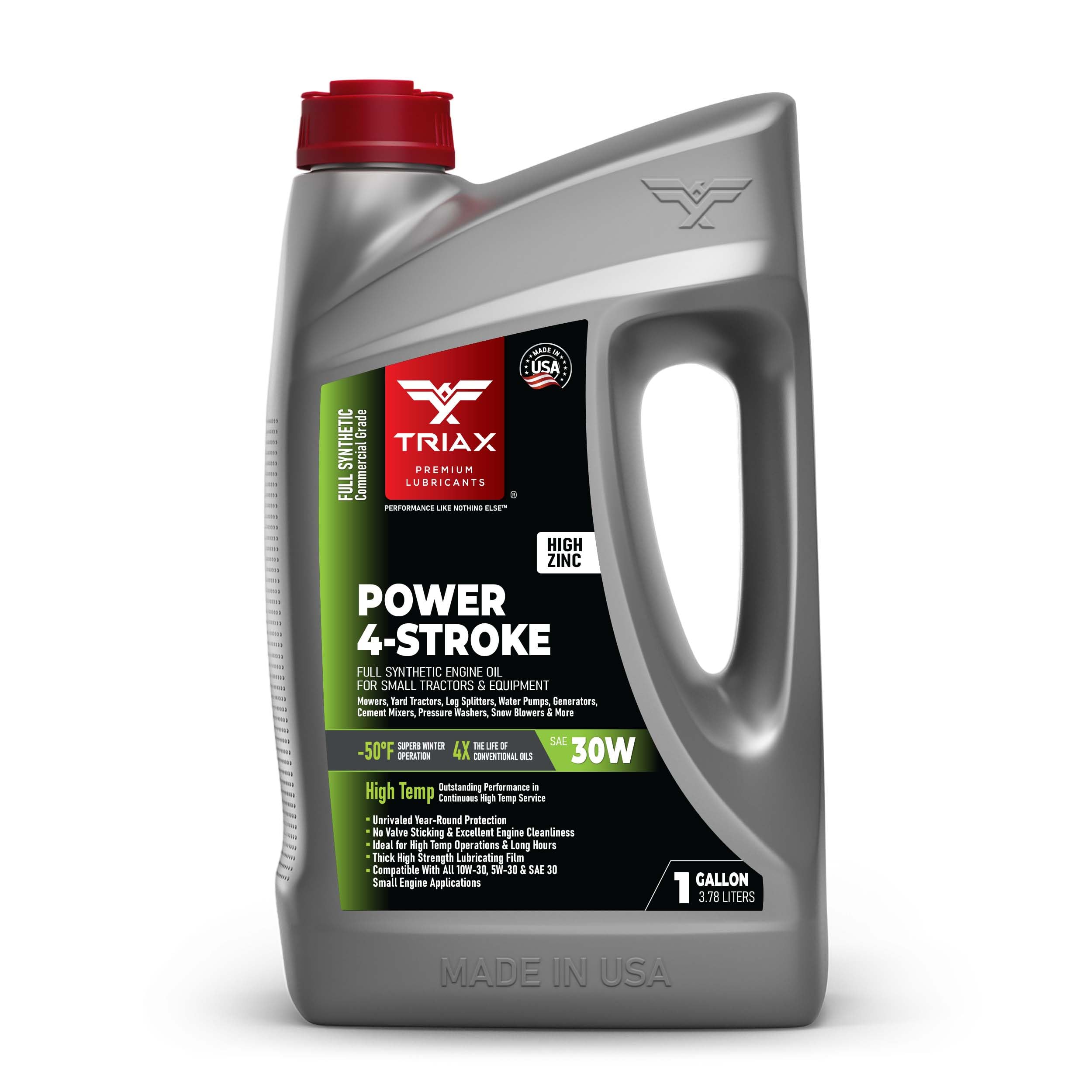
The TRIAX Power 4-Stroke SAE 30W is a commercial-grade full synthetic oil engineered specifically for air-cooled small engines that demand superior wear protection. Its high-zinc formula contains roughly double the zinc concentration found in typical OEM and competitor oils, which directly addresses the camshaft and lifter wear issues common in push mowers, generators, and log splitters operating under sustained high loads. The additive package also includes robust detergents that keep piston rings and valve stems free of carbon deposits across extended drain intervals.
Owner reports consistently highlight the oil’s ability to maintain viscosity across a wide temperature window, from cold starts down to minus 40 degrees Fahrenheit up to 130 degrees Fahrenheit operating conditions. Multiple users running ride-on mowers and pressure washers noted noticeably quieter valve train operation and reduced smoke compared to the conventional oils they previously used. The flash point of 230 degrees Celsius indicates excellent thermal stability, meaning the oil resists burning off in hot-running air-cooled engines.
For anyone running small engines in demanding applications — whether commercial landscaping, backup power generation, or heavy-duty property maintenance — this oil delivers measurable protection advantages over standard SAE 30 fluids. The one-gallon container with a built-in spout also simplifies refills without requiring a separate funnel.
What works
- Double the zinc content of most competitor oils ensures exceptional cam and lifter protection
- Extreme shear stability maintains film strength under continuous high-load operation
- Broad temperature range suits year-round use in varied climates
What doesn’t
- Overkill for low-hour residential equipment with light duty cycles
- Some automotive oils with similar zinc content cost less per quart
2. Motul 7100 4T 5W-40 100% Synthetic Ester
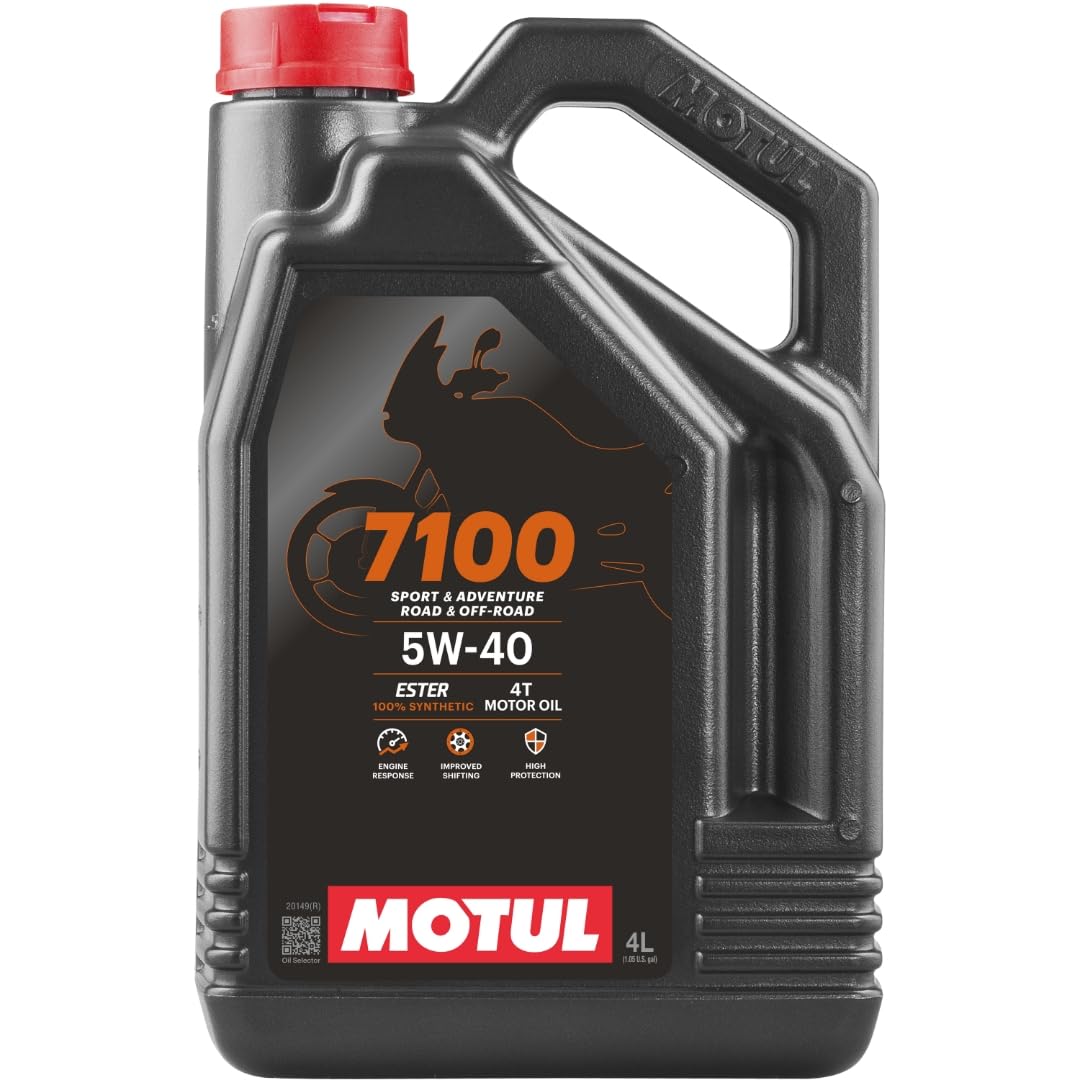
The Motul 7100 4T 5W-40 represents the upper tier of motorcycle engine lubrication, built on a 100 percent synthetic ester base stock derived from the same chemistry used in the brand’s 300V racing oil line. Ester molecules possess a natural polarity that causes them to adhere to metal surfaces, maintaining a resilient lubricating film at elevated temperatures where conventional and semi-synthetic formulations break down. The oil holds a flash point of 226 degrees Celsius and a viscosity index of 175, providing consistent protection from cold starts at minus 36 degrees Celsius through sustained high-temperature operation.
This oil carries JASO MA2 certification, confirming the precise friction profile required for wet clutch systems in motorcycles, ATVs, and scooters. Owners of BMW R1250GS, KTM 1290 Super Duke, and Aprilia RSV4 models report noticeably smoother gearbox engagement and no clutch slip even under aggressive acceleration. The API SP certification with FZG Failure Load Stage greater than 14 indicates exceptional gear wear resistance, which is critical for motorcycles where the transmission shares oil with the engine.
The 4-liter bottle is made from 50 percent recycled plastic and is fully recyclable, while the oil itself supports drain intervals up to 16,000 kilometers per OEM recommendations thanks to its 8.4 mg KOH/g total base number for acid neutralization. This is the right choice for riders who demand maximum protection for high-performance European motorcycles and are willing to invest in top-tier lubricant technology.
What works
- 100 percent synthetic ester chemistry provides unmatched film strength at high temperatures
- JASO MA2 certification ensures reliable wet clutch performance without slip or drag
- Excellent shear stability supports extended drain intervals up to 10,000 miles
What doesn’t
- Higher cost per quart than semi-synthetic or conventional motorcycle oils
- 5W-40 viscosity not suitable for engines requiring thicker grades like 20W-50
3. Royal Purple 01315 Max Cycle 10W-40 High Performance Synthetic

The Royal Purple Max Cycle 10W-40 is a full synthetic motorcycle oil formulated with the brand’s proprietary Synerlec additive technology, which modifies the oil’s molecular structure to reduce friction and enhance film strength. One verified owner report from an Arizona rider running a heavily modified air-cooled 98 XR650L documented oil temperature reductions from over 300 degrees Fahrenheit down to the 210-225 degree range on 105-degree days, along with extended rebuild intervals from 5,000 to 7,000-10,000 miles. That level of thermal management is significant for air-cooled engines that naturally run hotter than liquid-cooled designs.
The oil is designed to protect against rust and corrosion, which is particularly relevant for motorcycles that may sit during off-season months. Multiple owners of sport bikes and cruisers reported noticeably quieter engine operation and smoother shifting after switching from conventional or semi-synthetic oils. A 2001 CBR 600F4i owner with 48,000 miles noted that the Royal Purple oil eliminated rough warm shifts and completely resolved clutch engagement issues that had nearly led to selling the bike.
While the price per quart sits above most conventional motorcycle oils, the wear protection data and owner-reported temperature reductions make a strong case for riders who push their machines hard or ride in hot climates. The 10W-40 viscosity suits a wide range of Japanese and European motorcycles, and the 1-quart bottle size allows for precise top-offs between changes.
What works
- Demonstrated oil temperature reduction in air-cooled engines under extreme heat
- Noticeable improvement in shift smoothness and clutch engagement
- Effective rust and corrosion protection for seasonal storage
What doesn’t
- Premium price point may not justify the benefit for low-stress commuting
- Some owners find the 10W-40 grade too thin for older high-mileage engines
4. Valvoline 4-Stroke ATV/UTV SAE 10W-40 Motor Oil (Case of 6)

The Valvoline 4-Stroke ATV/UTV 10W-40 is a synthetic blend formulated specifically for the extreme operating conditions that off-road vehicles endure, including sustained high RPM, heavy loads, and dust ingestion. The oil is engineered with shear-stable viscosity improvers that resist oil film breakdown under the constant gear and clutch engagement demands of ATV and UTV transmissions. A blend of cleaning agents and dispersants helps prevent varnish and sludge formation that can clog oil passages in engines that see infrequent oil changes.
This oil is explicitly formulated to protect wet clutch systems, and owner feedback from Arctic Cat and Honda four-wheeler owners confirms no clutch slipping or dragging during normal riding. The case of six quarts provides a significant cost advantage over buying single quarts, with multiple owners noting the per-quart price is substantially lower than at big-box retailers. One verified review from an Arctic Cat owner switched from a premium brand costing significantly more per quart and reported identical performance and shift quality.
For ATV and UTV owners who change oil every 50 to 100 hours as recommended, the six-quart case provides roughly two complete oil changes for most machines. The 10W-40 viscosity covers the majority of modern utility and sport ATVs, and the oil’s compatibility with both gas and diesel 4-stroke engines adds versatility for farms and worksites with mixed equipment fleets.
What works
- Excellent value per quart when purchased in the six-pack case configuration
- Wet clutch compatible with no reported slip across multiple ATV brands
- Shear-stable formulation resists breakdown in high-RPM gearbox applications
What doesn’t
- Synthetic blend rather than full synthetic for maximum thermal protection
- Not ideal for extreme cold climates requiring a 5W or 0W winter grade
5. Yamaha Yamalube 4M 10W-30 4-Stroke Outboard Marine Oil

The Yamaha Yamalube 4M 10W-30 is a conventional mineral-based oil engineered specifically for Yamaha four-stroke outboard motors, though it is compatible with most brands of 4-stroke marine engines. Marine engines operate under fundamentally different stress profiles than automotive engines — they run at near-constant high load for hours on end, operate in a saltwater environment that promotes corrosion, and often experience wide throttle swings. The Yamalube formula incorporates specific anti-wear additives that account for these heavier-than-automotive loads and special shear-stable polymers that maintain viscosity despite the constant high-RPM operation.
Owner reports from boaters running Yamaha outboards confirm reliable cold starts and consistent oil pressure throughout long days on the water. The oil provides rust and corrosion protection that automotive oils simply are not formulated to deliver, which is critical for engines that sit for weeks between uses in humid marine environments. Multiple owners noted the price is competitive with aftermarket marine oils while providing the confidence of OEM-spec formulation.
The 1-gallon container is the standard size for most outboard oil changes, and the 10W-30 viscosity suits the majority of Yamaha four-stroke outboards from small portables up to large V6 offshore models. For boat owners who prioritize warranty compliance and want an oil specifically matched to their engine’s tolerances, this is the straightforward choice.
What works
- OEM-spec formulation engineered specifically for Yamaha four-stroke outboards
- Corrosion protection package designed for saltwater marine environments
- Shear-stable polymers maintain viscosity under continuous high-load operation
What doesn’t
- Conventional mineral base lacks the thermal stability of full synthetic marine oils
- Not ideal for extreme cold-water operation where a synthetic 5W grade performs better
6. Mercury 25W-40 4-Stroke Synthetic Blend Marine Engine Oil
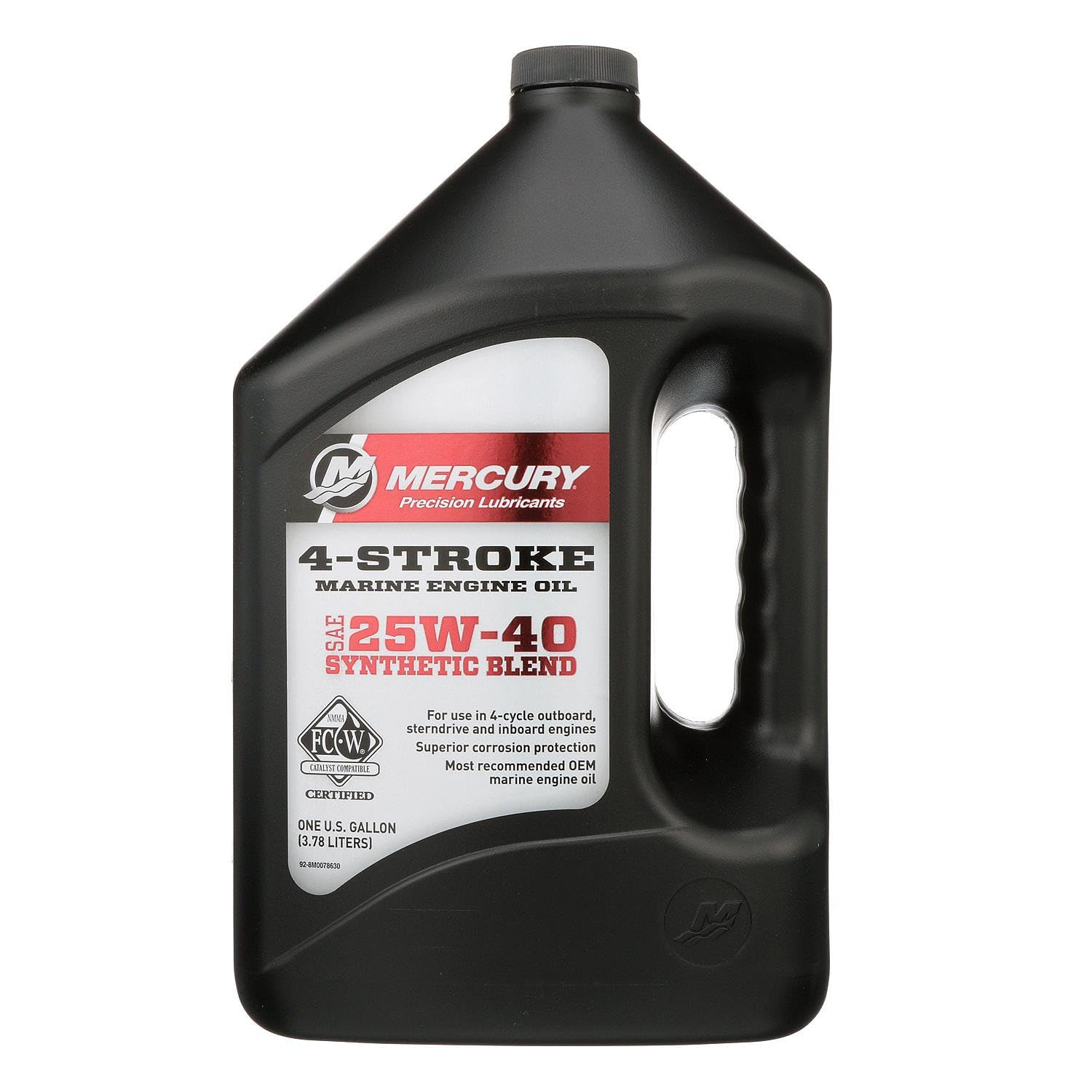
The Mercury 25W-40 4-Stroke Synthetic Blend Marine Oil is engineered to exceed NMMA FC-W certification requirements, which is the industry standard for corrosion protection and shear stability in four-stroke marine engines. This oil uses a specialized additive package designed for the rigors of the marine environment, including enhanced rust inhibitors that protect internal engine components from the corrosive effects of saltwater and humidity. The 25W-40 viscosity grade is specifically formulated for larger outboards and sterndrives that operate under sustained high torque at low to medium RPM.
Owner feedback from boaters running Mercury and MerCruiser engines confirms that the oil maintains viscosity even after extended periods of trolling or slow-speed maneuvering, which are conditions that generate high engine temperatures with minimal cooling airflow. The synthetic blend formulation provides better oxidation resistance than conventional mineral oils while keeping the cost lower than a full synthetic. The 1-gallon size aligns with the oil change capacity of most mid-range Mercury outboards.
For boat owners with Mercury, MerCruiser, or other leading brand four-stroke marine engines, this oil delivers the specific additive chemistry needed for reliable operation in saltwater. The NMMA certification provides peace of mind that the oil has been independently tested to meet the demands of continuous marine duty.
What works
- NMMA FC-W certified for marine corrosion and shear stability requirements
- Synthetic blend offers improved thermal resistance over conventional marine oils
- 25W-40 viscosity ideal for larger outboards and sterndrives under sustained load
What doesn’t
- Heavy 25W-40 grade not suitable for smaller portable outboards that require 10W-30
- Higher cost than conventional marine oils due to synthetic blend content
7. Kawasaki 99969-6298 Genuine OEM K-Tech SAE 20W-50 4-Cycle Engine Oil
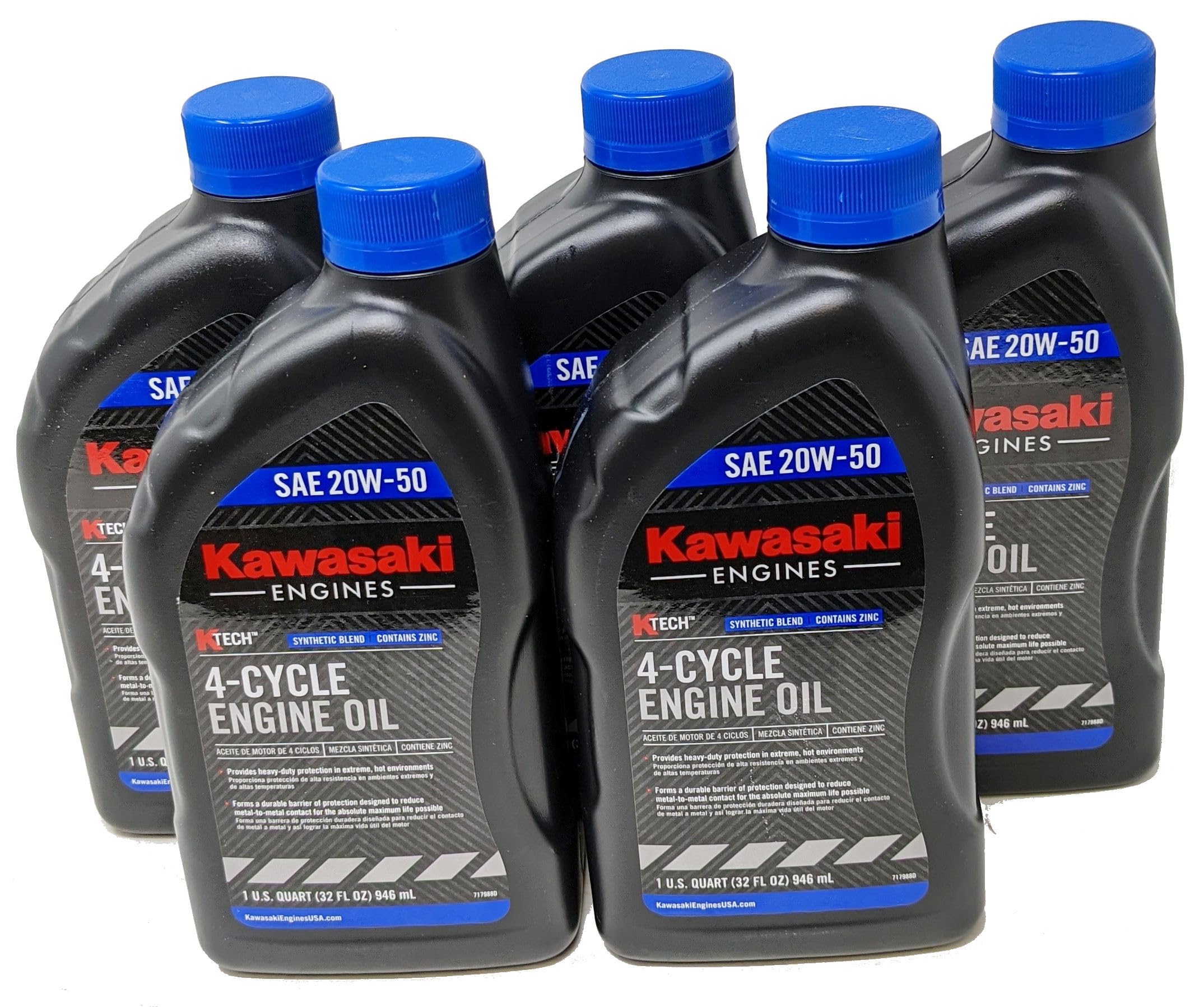
The Kawasaki 99969-6298 K-Tech oil is a genuine OEM lubricant formulated to meet the specific viscosity and additive requirements of Kawasaki 4-cycle engines, including many lawn and garden power equipment applications. The 20W-50 grade provides a thicker oil film at operating temperature compared to standard 10W-30 or SAE 30 oils, making it particularly suitable for engines that run hot or have higher mileage where bearing clearances have increased. The oil contains anti-foaming and anti-shear agents that maintain viscosity under the mechanical stress of gear-driven transmissions and heavy PTO loads.
Owner reports from Kawasaki mower and utility vehicle owners confirm that the oil provides excellent consumption control, with minimal topping off required between changes. The anti-foaming properties are particularly relevant for engines with splash lubrication systems where air entrainment can lead to inadequate oil delivery to critical components. The 5-quart package provides enough oil for multiple changes on most small engines or a single fill on larger equipment.
For Kawasaki-powered equipment still under warranty, using this genuine OEM oil ensures compliance with manufacturer requirements and eliminates any potential warranty disputes. The 20W-50 viscosity is also well-suited for engines that operate in consistently warm climates or during summer months.
What works
- Genuine OEM formulation guarantees compatibility with Kawasaki engine tolerances
- Thick 20W-50 film provides excellent protection for hot-running or high-mileage engines
- Anti-foaming agents ensure reliable lubrication in splash-fed systems
What doesn’t
- 20W-50 grade too thick for cold-weather starting in northern climates
- Conventional base oil lacks the extended drain capability of synthetic alternatives
8. Honda 32oz 08207-10W30 Engine Oil (Pack of 4)

The Honda 08207-10W30 is a genuine OEM engine oil designed for Honda small engines found in lawn mowers, generators, pressure washers, and other power equipment. The 10W-30 viscosity grade provides good cold-start flow characteristics while maintaining adequate film strength at operating temperature, making it a versatile year-round choice for most Honda GX and GC series engines. The oil is formulated with the specific additive package that Honda engineers determined provides optimal protection for their engine designs, including proper zinc levels for flat-tappet camshafts.
This pack of four 32-ounce bottles provides 128 ounces total, which roughly equates to a gallon at a price point that undercuts many big-box retailers selling smaller 20-ounce bottles. Owners of Honda generators and mowers consistently report reliable performance and clean oil at change intervals, with one WEN generator owner noting the oil kept the engine running smoothly under light to moderate loads. The packaging includes a plastic bag around each bottle to contain any leaks during shipping.
For owners of Honda-powered equipment who prefer to use the manufacturer’s recommended lubricant, this multi-pack offers a convenient supply that covers multiple oil changes. The 10W-30 viscosity is also compatible with many other brands of small engines that specify this grade, adding versatility for households with mixed equipment fleets.
What works
- Genuine Honda OEM formulation ensures correct additive package for GX and GC engines
- Four-bottle pack provides better per-ounce value than single bottles at retail stores
- 10W-30 viscosity offers reliable cold starts and solid high-temp protection
What doesn’t
- Conventional base oil requires more frequent changes than full synthetic alternatives
- 10W-30 may be too thin for engines specifying SAE 40 or 20W-50 in hot climates
9. Kimpex 10W40 Moto/ATV 4-Stroke Engine Oil

The Kimpex 10W40 Moto/ATV oil is a synthetic blend formulated for 4-stroke dirt bikes, ATVs, UTVs, and street bikes that require a 10W-40 viscosity grade. The synthetic blend composition provides better oxidation resistance and low-temperature flow than conventional oils while keeping the cost per liter accessible for riders who change oil frequently. The 3.78-liter container (approximately one gallon) provides enough oil for multiple changes on most single-cylinder dirt bikes or a single fill on larger ATVs with higher oil capacity.
Owner feedback from Arctic Cat and Honda ATV owners confirms smooth cold starts and consistent performance during normal riding conditions. One review from an Arctic Cat 400 owner noted quiet operation and reliable performance with no shifting issues. The oil meets the viscosity requirements for a wide range of Japanese and Chinese 4-stroke engines commonly found in recreational and utility off-road vehicles. The packaging arrived well-protected and on time according to multiple buyers.
For riders who need a dependable 10W-40 oil for their off-road vehicles at a competitive price point, the Kimpex synthetic blend offers a solid balance of performance and value. The large container size reduces the per-change cost compared to buying individual quarts, making it a practical choice for owners of multiple machines or those who ride frequently enough to change oil every season.
What works
- Synthetic blend offers improved thermal stability over conventional oils at a fair price
- Large 3.78-liter container provides excellent value for multi-machine owners
- Compatible with a wide range of 4-stroke ATV, dirt bike, and street bike applications
What doesn’t
- Not JASO MA2 certified, so wet clutch compatibility may vary by application
- Synthetic blend lacks the extreme-temperature performance of full synthetic options
10. STP Premium Small Engine 4 Cycle Oil Formula SAE-30

The STP Premium Small Engine SAE-30 is a conventional single-grade oil engineered for 4-cycle lawn mowers, push mowers, tractors, and other seasonal power equipment. The SAE 30 viscosity provides a thicker oil film than multi-grade oils like 10W-30, which can be beneficial for air-cooled engines that operate at higher temperatures during summer mowing. The formula includes anti-wear technology that cushions engine parts against friction, along with antioxidants that resist thermal breakdown and detergents that control carbon deposits.
Owner reviews highlight the oil’s ability to make lawn mowers run smoothly with improved fuel efficiency compared to older or degraded oil. The corrosion inhibitor package is specifically designed to protect engines during seasonal storage, which is a critical feature for equipment that sits unused for months at a time. One owner noted that this oil beats the price of OEM-branded oils like Briggs & Stratton while meeting the same SAE 30 specification, and STP is a trusted name in automotive lubricants with decades of market presence.
For budget-conscious homeowners who need a reliable SAE 30 oil for seasonal lawn mower changes, this STP formulation delivers the required protection at a competitive price. The 32-ounce bottle provides enough oil for most push mower changes, and the trusted brand name offers peace of mind for basic maintenance needs.
What works
- Competitive price point that undercuts many OEM-branded SAE 30 oils
- Corrosion inhibitors protect engines during off-season storage periods
- Anti-wear technology provides reliable protection for residential mowing duty
What doesn’t
- Conventional base oil requires more frequent changes than synthetic versions
- Single-grade SAE 30 not suitable for cold-weather starting below 40 degrees Fahrenheit
11. Mannol SAE 30 Full Synthetic Lawn Mower and Generator Oil
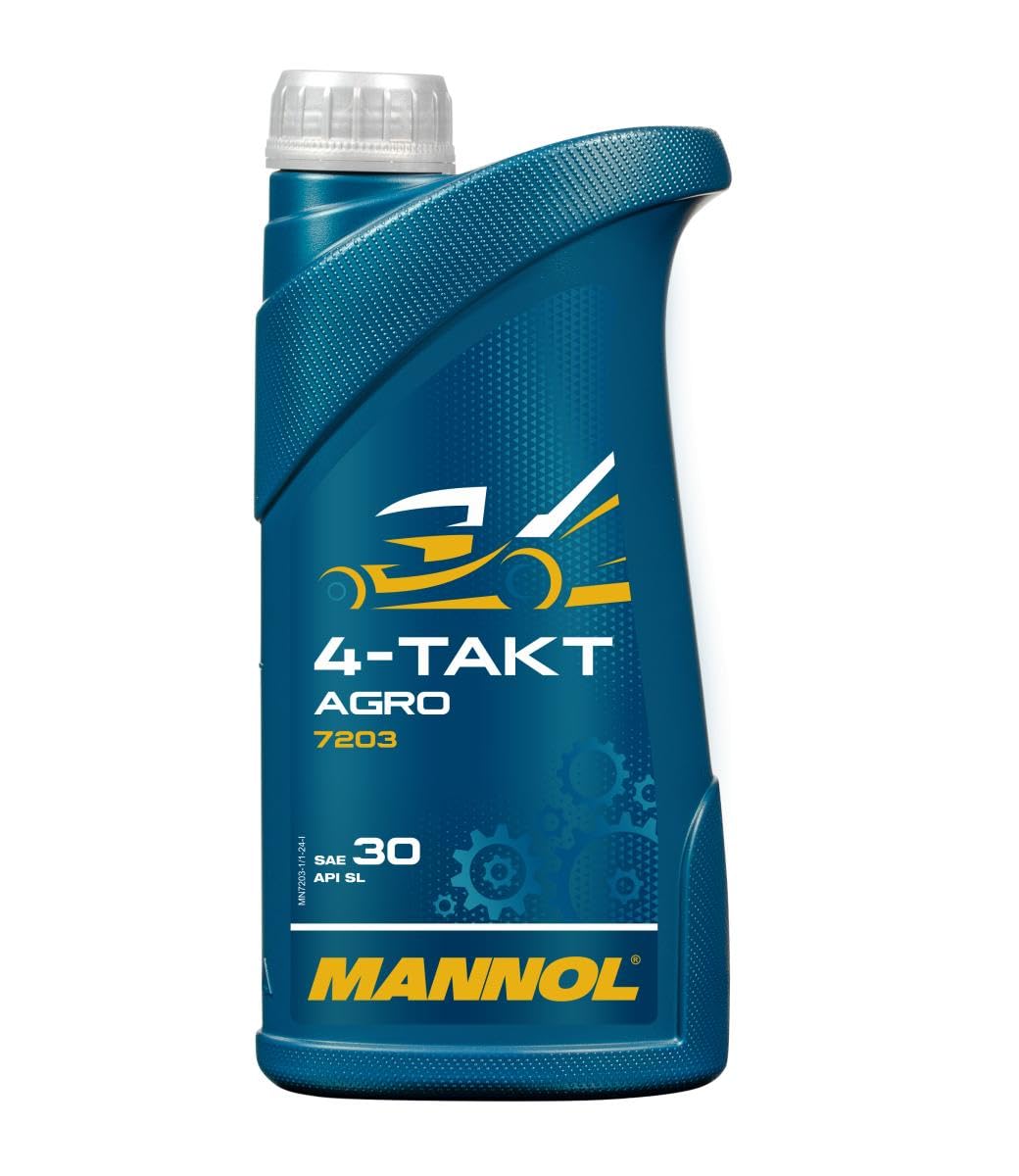
The Mannol SAE 30 Full Synthetic oil is a full synthetic formulation designed for 4-stroke small engines used in lawn mowers, generators, power cultivators, mini tractors, and powered pumps. Despite the full synthetic label, some buyers have noted that the packaging does not explicitly state synthetic on the jug, so it is worth verifying the specific batch. The oil is formulated with a high-viscosity base combined with performance reaction inhibitors that provide excellent anticorrosion and antifoam properties, along with high-temperature oxidation resistance that maintains oil film strength.
The 1-liter bottle size is convenient for single oil changes on most small engines, and the SAE 30 viscosity suits air-cooled engines that operate in warmer conditions. The oil claims compatibility with both mineral and synthetic oils for top-offs, though mixing base types is generally not recommended for optimal performance. Owners of Honda power equipment confirmed the oil works well in 4-stroke mowers, trimmers, and leaf blowers that specify SAE 30.
For homeowners who want the potential benefits of a full synthetic oil for their small engines at a price point closer to conventional oils, the Mannol SAE 30 represents an entry point into synthetic lubrication. The wide application range makes it a versatile option for households with a variety of 4-stroke garden equipment.
What works
- Full synthetic base provides better oxidation resistance than conventional SAE 30 oils
- Anticorrosion and antifoam properties protect engines during storage and operation
- Versatile compatibility with most 4-stroke garden and power equipment
What doesn’t
- Labeling ambiguity regarding synthetic content may confuse buyers
- Single-grade SAE 30 lacks the cold-start performance of multi-grade oils
Hardware & Specs Guide
SAE Viscosity Grades
The Society of Automotive Engineers grading system uses two numbers for multi-grade oils: the first with a ‘W’ indicates winter flow characteristics, and the second represents viscosity at 100 degrees Celsius. Lower winter grades like 5W flow better in cold starts, while higher second numbers like 40 or 50 provide thicker film at operating temperature. Single-grade oils like SAE 30 offer no cold-weather rating and are best suited for consistent warm-weather operation in air-cooled engines.
Synthetic vs. Conventional Bases
Conventional mineral oils are refined from crude oil with a natural mix of molecular sizes, while synthetic oils are chemically engineered for uniform molecular structure. This uniformity gives synthetics better low-temperature flow, higher resistance to thermal breakdown, and longer service life. Semi-synthetic blends mix conventional and synthetic bases to improve performance at a moderate cost, making them a practical upgrade for engines that see occasional heavy use.
Additive Technology
Zinc dialkyldithiophosphate remains the primary anti-wear additive for flat-tappet camshafts common in small engines and older motorcycles. Detergents and dispersants keep combustion byproducts suspended to prevent sludge, while antioxidants slow oil degradation at high temperatures. Anti-foam agents prevent air from being whipped into the oil by gear trains and crankshafts, maintaining consistent hydraulic pressure in valve train components.
Certification Standards
JASO MA2 certification indicates the oil provides the correct friction characteristics for wet clutch systems found in motorcycles and ATVs. API service ratings from SN through SP define minimum standards for deposit control, wear protection, and oxidation stability. NMMA FC-W certification is specific to marine four-stroke engines and requires passing corrosion protection and shear stability tests that automotive oils are not designed to meet.
FAQ
What happens if I use the wrong viscosity grade in my 4-cycle engine?
Can I use automotive engine oil in a lawn mower or generator?
How often should I change 4-cycle engine oil in small power equipment?
What does JASO MA2 certification mean for motorcycle oil?
Final Thoughts: The Verdict
For most buyers, the best 4 cycle engine oil winner is the TRIAX Power 4-Stroke SAE 30W because it delivers commercial-grade zinc protection and thermal stability that outperforms standard small engine oils without requiring the budget of premium motorcycle-focused lubricants. If you need JASO MA2 certified oil with ester chemistry for a high-performance European motorcycle, grab the Motul 7100 4T 5W-40. And for ATV and UTV owners who want reliable wet clutch protection at the best per-quart value, nothing beats the Valvoline 4-Stroke ATV/UTV 10W-40 case pack.

Certification: BSc in Mechanical Engineering
Education: Mechanical engineer
Lives In: 539 W Commerce St, Dallas, TX 75208, USA
Md Amir is an auto mechanic student and writer with over half a decade of experience in the automotive field. He has worked with top automotive brands such as Lexus, Quantum, and also owns two automotive blogs autocarneed.com and taxiwiz.com.