A motorcycle audio system is only as strong as its amplifier. Without clean, reliable power, even the best speakers sound thin and distorted once the wind and engine noise take over. The challenge is finding a four-channel amp that fits inside a fairing or saddlebag, withstands vibration and moisture, and delivers honest power without draining the battery.
I’m Amir — the founder and writer behind Four Wheel Ask. My work focuses on deep market research and analyzing product specifications, build quality, and owner feedback to identify the most reliable audio components for demanding vehicle environments.
After analyzing hundreds of owner reports and technical specs, I have identified the finest best 4 channel motorcycle amp for every type of build.
How To Choose The Best 4 Channel Motorcycle Amp
Selecting a four-channel amplifier for a motorcycle is different from choosing one for a car. Space is limited, electrical capacity is lower, and the environment is harsher. These factors demand a focused approach when evaluating options.
Power Ratings and Real-World Output
Pay attention to RMS power rather than peak or max ratings. A motorcycle charging system typically provides 30 to 50 amps of available current, so an amp that draws too heavily can cause voltage drop or battery drain. Look for units that deliver clean RMS output in the 40 to 100 watts per channel range — enough to drive speakers clearly at highway speeds without overloading the electrical system.
Physical Size and Mounting Flexibility
Motorcycle fairings, saddlebags, and under-seat compartments have tight dimensional constraints. Measure your available space before purchasing and look for amplifiers with compact footprints, ideally under eight inches in length and less than two inches in height. Surface-mount designs with side-mounted terminals make installation easier in confined areas.
Environmental Protection and Build Quality
Moisture, vibration, and temperature extremes are the enemies of motorcycle electronics. An amp with conformal-coated circuit boards, corrosion-resistant terminals, and an IPX-rated enclosure will last significantly longer than a standard car audio unit. Marine-grade certification is a strong indicator of durability in exposed installations.
Input Sensitivity and Integration Features
Many motorcycle builds retain the factory head unit or use a Bluetooth receiver without preamp outputs. High-level (speaker-level) inputs eliminate the need for a separate line output converter. Adjustable crossovers — high-pass, low-pass, and full-range modes — allow precise tuning for component speakers, coaxial speakers, and subwoofers within a single compact amp.
Quick Comparison
On smaller screens, swipe sideways to see the full table.
| Model | Category | Best For | Key Spec | Amazon |
|---|---|---|---|---|
| Alpine KTA-450 | Premium | Ultra-compact integration | 45W RMS x 4, DPP tech, 7″ long | Amazon |
| Kicker KEY2004 | Premium | Auto-EQ DSP tuning | 50W RMS x 4, smart amp | Amazon |
| Rockford Fosgate R2-500X4 | Premium | High-power clarity | 75W RMS x 4, C.L.E.A.N. circuitry | Amazon |
| NVX VADM4 v2 | Mid | Marine-rated builds | 80W RMS x 4, Micro Class D, 6.5″ long | Amazon |
| Alpine S-A32F | Mid | Clean entry-level upgrade | 55W RMS x 4, Class D | Amazon |
| SounDigital 800.4 EVO 4.0 | Mid | Compact high-power density | 800W max, aluminum chassis | Amazon |
| DS18 SXE-1200.4 | Mid | Class A/B warmth | 60W RMS x 4, variable crossover | Amazon |
| Taramps TS 1200×4 | Mid | Budget power per channel | 300W RMS x 4 at 2 ohms | Amazon |
| Soundstream ST4.1200D | Value | Ultra-small footprint | 100W x 4, hybrid alloy heatsink | Amazon |
| Recoil DI1200-4 | Entry | High output on a budget | 210W RMS x 4 at 4 ohms | Amazon |
| velex VX505 | Entry | All-in-one Bluetooth amp | 60W x 4, IPX5, wired remote | Amazon |
In‑Depth Reviews
1. Alpine KTA-450 Power Pack Amplifier

The Alpine KTA-450 redefines what a compact four-channel amplifier can achieve. Measuring just seven inches wide and slightly over an inch tall, it fits inside virtually any motorcycle fairing or under-seat cavity without requiring a dedicated power wire to the battery — it draws power directly from the Alpine head unit harness. The Dynamic Peak Power technology doubles output during transient musical peaks while preventing clipping, delivering 45 watts RMS per channel into either two or four ohms.
Owner feedback consistently highlights the clarity and punch this amp adds to factory or aftermarket speaker systems. In motorcycle builds where space is at a premium, the KTA-450 eliminates the complex routing and mounting challenges of traditional amplifiers. The Class D circuit runs cool enough for enclosed installations, and the straightforward setup makes it accessible for DIY installers. Several owners noted a dramatic improvement in soundstage depth and detail compared to head-unit-only power.
This amplifier is best suited for riders who want a significant audio upgrade without sacrificing storage space or adding electrical system strain. Pair it with a compatible Alpine head unit and a set of efficient speakers for a system that outperforms its size.
What works
- Exceptionally compact dimensions for tight motorcycle fairings
- DPP technology prevents clipping during dynamic passages
- No separate power wire needed with Alpine head units
- Runs cool in enclosed spaces
What doesn’t
- Requires Alpine head unit for drop-in installation
- Modest power output compared to larger chassis amps
- Limited crossover adjustability
2. Kicker KEY2004 Smart Amplifier

The Kicker KEY2004 brings integrated digital signal processing to the four-channel motorcycle amplifier category. Its built-in auto-EQ system uses the included microphone to analyze the listening environment and apply corrective filters, time alignment, and parametric EQ in under sixty seconds. This automated tuning eliminates the guesswork of manual crossover and gain adjustments while delivering a calibrated sound stage tailored to the vehicle’s acoustics.
Owners report that the KEY2004 transforms factory speaker systems with remarkable clarity and depth. Rated at 50 watts RMS per channel into four ohms, the amplifier uses a high-efficiency Class D topology that minimizes current draw — a critical advantage for motorcycles with limited alternator output. The compact chassis fits under seats or inside fairings, and the included wiring harness simplifies the connection process. Multiple users noted that the auto-EQ corrected timing and frequency response issues that manual tuning could not resolve.
This amplifier is ideal for riders who want professional-grade sound tuning without the expense of a separate DSP unit. The auto-setup feature makes it particularly attractive for those who lack experience with parametric equalizers and crossover networks.
What works
- Integrated DSP with automated microphone-based tuning
- Efficient Class D design reduces electrical system load
- Compact footprint fits confined spaces
- Works with factory and aftermarket head units
What doesn’t
- Requires remote turn-on wire in some applications
- Auto-EQ microphone must be positioned correctly
- Power output moderate for high-SPL builds
3. Rockford Fosgate R2-500X4 Prime Amplifier
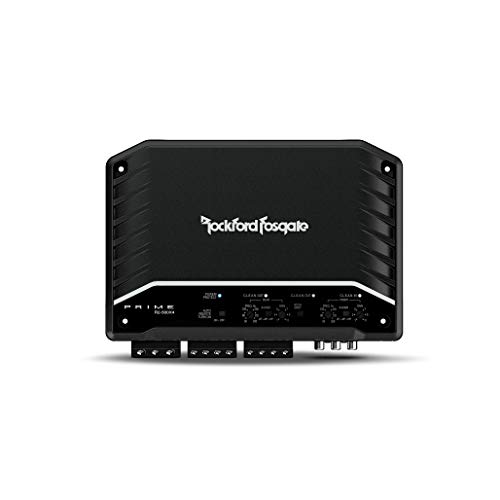
Rockford Fosgate’s R2-500X4 brings proven amplifier engineering to the motorcycle audio market. This full-range Class D amplifier delivers 75 watts RMS per channel into four ohms and 155 watts RMS per channel into two ohms, with bridged output reaching 250 watts per channel into four ohms. The C.L.E.A.N. (Calibrated Level Eliminates Audible Noise) circuitry provides a visual reference for setting input gain without distortion, while the integrated Punch EQ can boost bass output by up to 9 dB at 45 Hz.
Customer reports consistently praise the build quality and real-world power output. Several owners measured the amplifier’s actual RMS output exceeding the rated specification, with one birth sheet showing 580 watts total RMS. The fully adjustable 12 dB per octave high-pass and low-pass Butterworth crossovers provide precise control over frequency distribution, and the balanced differential inputs reject noise from the motorcycle’s electrical system. The amplifier measures 1.9 by 6.8 by 10.1 inches, fitting many fairings with careful placement.
This amplifier suits riders who want robust, verified power from a brand with a strong service network. The C.L.E.A.N. setup system reduces the risk of speaker damage due to improper gain settings, and the overall build quality justifies the investment for long-term use.
What works
- C.L.E.A.N. gain setup prevents distortion
- Real-world output often exceeds ratings
- Punch EQ adds adjustable bass boost
- Balanced differential inputs reject noise
What doesn’t
- Larger footprint than some competition
- Premium pricing tier
- No built-in DSP or auto-tuning
4. NVX VADM4 v2 Amplifier
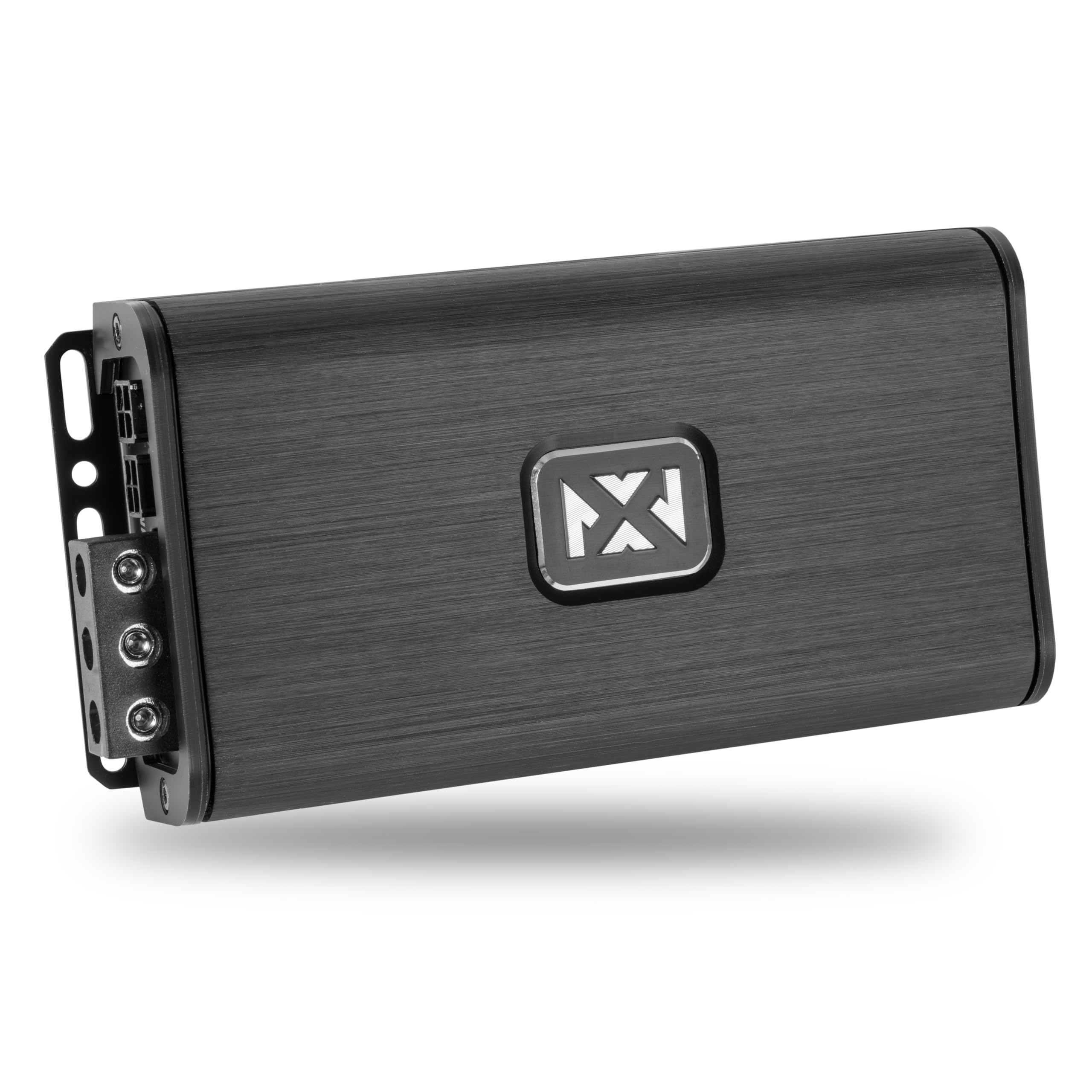
The NVX VADM4 v2 is engineered specifically for harsh environments. Its conformal-coated marine-grade circuit board resists moisture and corrosion, making it a strong candidate for exposed motorcycle installations. The Micro Class D design achieves a chassis measuring just 6.49 by 3.3 by 1.48 inches — roughly the size of a stacked pair of smartphone cases — while delivering 80 watts RMS per channel into four ohms and 125 watts RMS per channel into two ohms.
Owners who installed this amplifier on Harley-Davidson models, Goldwings, and adventure bikes report clean, loud sound with no static or noise floor issues. The selectable crossover modes — full-range, high-pass, and low-pass — along with variable filters from 40 to 400 Hz provide tuning flexibility for component and coaxial speaker setups. LED indicators for power and protection status simplify troubleshooting. The amplifier includes 4-way protection circuitry covering thermal, overload, short-circuit, and DC offset conditions.
This amplifier is best for riders who ride in wet conditions or store their motorcycle outdoors. The marine-grade construction provides peace of mind that standard car audio amps cannot match, and the tiny footprint opens up installation locations that would not accommodate larger chassis.
What works
- Marine-grade conformal coated circuit board
- Extremely compact Micro Class D design
- Selectable crossover modes with wide filter range
- Comprehensive protection circuitry
What doesn’t
- Runs hot without adequate airflow
- No auto turn-on in some installations
- Customer support reported as inconsistent
5. Alpine S-A32F S Series Amplifier

The Alpine S-A32F delivers the brand’s signature sound quality at a more accessible price point than the KTA series. Rated at 55 watts RMS per channel into four ohms, this Class D amplifier uses a compact chassis that fits into most motorcycle fairings without modification. The S-series topology prioritizes clean power delivery and low distortion, with Alpine’s engineering team tuning the output stage for natural, fatigue-free listening over long rides.
Owner reviews emphasize the dramatic improvement in clarity and speaker control this amplifier provides over head-unit-only power. Several users paired it with Infinity and Alpine speakers, reporting punchy bass, smooth midrange, and extended highs without harshness even at high volume levels. The amplifier’s efficient Class D operation keeps heat generation low, and the surface-mount design simplifies installation. Wire terminals use small set screws — owners recommend fork or pin connectors for a secure connection.
This amplifier is suited for riders who prioritize sound quality over raw SPL. The S-A32F shines in systems that value accurate reproduction and long-term reliability over maximum loudness, making it a strong choice for touring and cruiser motorcycles.
What works
- Alpine’s renowned sound quality and tuning
- Compact Class D chassis for easy mounting
- Efficient operation with minimal heat
- Competitive pricing for a brand-name amp
What doesn’t
- Lower power output than some competitors
- Small set-screw terminals need pin connectors
- Limited crossover adjustability
6. SounDigital 800.4 EVO 4.0 Amplifier

SounDigital has built a strong reputation in compact, high-output amplifier design, and the 800.4 EVO 4.0 exemplifies that engineering focus. This four-channel amplifier delivers 800 watts of total output through a Class D circuit housed in a machined aluminum chassis measuring 9.84 by 4.72 by 2.36 inches. Conformal-coated internal components provide moisture and vibration resistance suited for motorcycle environments, while the aluminum heatsink dissipates heat efficiently even during extended high-volume use.
Owners consistently describe this amplifier as surprisingly powerful for its size. Several installers mounted it inside Harley-Davidson fairings and reported clean, distortion-free output driving speakers rated at up to 350 watts RMS. The adjustable high-pass and low-pass filters provide crossover control for bi-amped or full-range configurations, and the bridgeable channels allow flexibility for adding a subwoofer. Users noted the build quality exceeds expectations at this price tier, with tight tolerances and high-quality terminals.
This amplifier works well for riders who want high power density in a package that fits within the constraints of a motorcycle fairing or saddlebag. The moisture-resistant construction adds durability for exposed or semi-exposed installations.
What works
- High power output in a compact chassis
- Conformal-coated components resist moisture
- Machined aluminum chassis for heat dissipation
- Adjustable crossovers for flexible tuning
What doesn’t
- Price can fluctuate significantly
- No auto turn-on feature
- Limited owner documentation included
7. DS18 SXE-1200.4 Amplifier
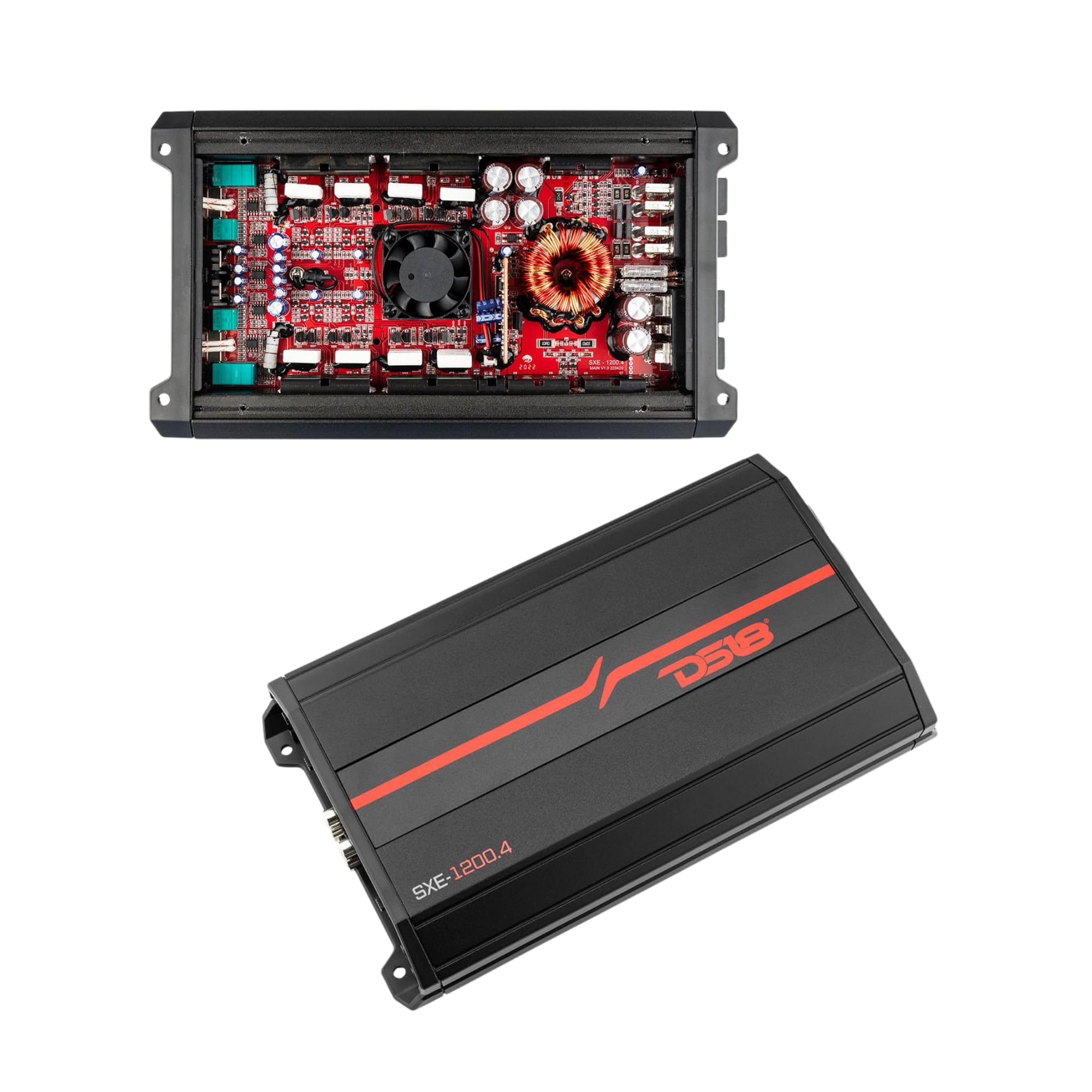
The DS18 SXE-1200.4 stands out in the four-channel category by using a Class A/B output topology rather than the Class D design dominant in this list. Class A/B amplifiers are known for their natural, warm sound reproduction and lower distortion at moderate listening levels. This amplifier delivers 60 watts RMS per channel into four ohms and 100 watts per channel into two ohms, with bridged output reaching 200 watts per channel into four ohms.
Owner reports indicate the SXE-1200.4 runs cooler than many competing Class A/B designs, thanks to an efficient transformer and aluminum heatsink construction. Multiple users installed it on Jeep and motorcycle platforms, driving DS18 coaxial speakers and component sets with clean, dynamic output. The fully variable crossover and adjustable gain input sensitivity allow precise system tuning. The amplifier measures approximately 10 inches wide, which fits larger fairings and saddlebag compartments.
This amplifier is a good choice for audio enthusiasts who prefer the sonic character of Class A/B amplification and have sufficient mounting space. The DS18 brand has built a following among off-road and powersports audio builders for its reliable performance and accessible pricing.
What works
- Warm, natural Class A/B sound signature
- Runs cooler than typical A/B designs
- Variable crossover offers flexible tuning
- Solid build quality for the price
What doesn’t
- Larger footprint than Class D alternatives
- Lower efficiency means higher current draw
- No marine rating or moisture protection
8. Taramps TS 1200×4 Amplifier

Taramps has established a strong following in the Brazilian and North American car audio markets by offering high power output at aggressive price points. The TS 1200×4 delivers 300 watts RMS per channel into two ohms, totaling 1200 watts RMS across four channels. This amplifier uses a fixed crossover system with high-pass, low-pass, and full-range modes, along with both RCA and high-level inputs with automatic signal sensing for turn-on.
Customer feedback shows a pattern of strong initial performance with occasional reliability concerns. Many owners report that the amplifier drives speakers with authority and clarity, producing clean output well beyond what the price suggests. The compact chassis measures 5.43 by 1.89 by 9.84 inches and weighs under three pounds, making it feasible for motorcycle installations with adequate air circulation. However, a minority of owners experienced early failure or noise issues, suggesting some unit-to-unit variability.
This amplifier is best suited for riders who want maximum power per dollar and are comfortable with potential warranty claims. The 2-ohm stability allows pairing with a wide range of speaker loads, and the automatic turn-on simplifies integration with factory or aftermarket systems.
What works
- Very high RMS output for the price
- Automatic signal-sensing turn-on
- Compact and lightweight chassis
- Both RCA and high-level inputs
What doesn’t
- Reliability concerns reported by some owners
- Fixed crossover limits tuning flexibility
- No marine-grade moisture protection
9. Soundstream ST4.1200D Stealth Amplifier

Soundstream’s Stealth series ST4.1200D packs four channels of Class D amplification into one of the smallest chassis in this comparison. Measuring just 7.75 by 3 by 1.5 inches, this amplifier fits under seats, inside dashboards, and in tight fairing compartments where larger units cannot go. It delivers 100 watts RMS per channel into four ohms and 150 watts RMS per channel into two ohms, with bridged output reaching 300 watts per channel into four ohms.
Owners report that this amplifier delivers clean, clear sound with low noise floor and efficient operation. Several users noted that the gains needed to be set near maximum to achieve desired volume levels, which is a characteristic of the amplifier’s conservative gain staging. The hybrid aluminum alloy heatsink keeps temperatures under control during extended use. The amplifier uses wire harness connections rather than traditional set-screw terminals, which simplifies installation in tight spaces but requires careful wire preparation.
This amplifier works well for riders who need the smallest possible four-channel amplifier for a confined installation space. The Soundstream brand has a long history in mobile audio, and the Stealth series represents a practical solution for space-constrained builds.
What works
- Very compact dimensions for tight spaces
- Hybrid aluminum alloy heatsink runs cool
- Low noise floor and clean output
- Efficient Class D operation
What doesn’t
- Gains need near-max setting for volume
- Wire harness connections instead of terminals
- Instructions are minimal
10. Recoil DI1200-4 Amplifier

The Recoil DI1200-4 delivers Class D amplification with a high-speed MOSFET power supply and 4-way protection circuitry in a chassis measuring 8.9 by 6.1 by 1.8 inches. It is rated at 210 watts RMS per channel into four ohms and 300 watts RMS per channel into two ohms, with bridged output reaching 610 watts per channel into four ohms. The adjustable gain, low-pass filter, high-pass filter, crossover, and bass EQ controls provide extensive tuning capability.
Owner reviews are generally positive, with many praising the amplifier’s power output and clean sound relative to its price. Several users noted it easily drives four 6.5-inch speakers to high volume levels without distortion. The efficient heatsink design keeps temperatures manageable during extended use. A few owners reported noise issues, but investigation revealed these were often caused by incorrect RCA cable selection — using directional coaxial cables instead of twisted-pair cables resolved alternator whine in those cases.
This amplifier is a solid choice for budget-conscious builders who want high power output and are comfortable troubleshooting installation details. The MOSFET power supply and protection circuitry add reliability, and the compact size fits in many motorcycle mounting locations.
What works
- High RMS output for the price point
- MOSFET power supply with protection circuitry
- Adjustable crossovers and bass EQ
- Compact chassis for easy mounting
What doesn’t
- Noise issues if cable selection is incorrect
- Screw-type speaker inputs require care
- No marine-grade construction
11. velex VX505 Marine Bluetooth Amplifier

The velex VX505 offers a unique all-in-one solution for motorcycle audio by integrating Bluetooth streaming, a three-meter wired remote controller, and IPX5 waterproofing into a single amplifier chassis. This eliminates the need for a separate head unit entirely — riders can stream music directly from their phone via Bluetooth 5.0, control playback and volume from the handlebar-mounted remote, and charge their phone through the built-in USB port. The amplifier delivers 60 watts per channel across four channels for a total of 240 watts.
Owner feedback from motorcycle and powersports users highlights the ease of installation and reliable performance. Several riders mounted this amplifier inside fairings on Harley-Davidson and touring motorcycles, reporting clear audio at speeds up to 85 mph. The IPX5 rating provides protection against rain and spray, making it suitable for exposed handlebar or dash-mounted installations. Owners noted the compact size fits well in tight spaces, though the included wiring gauge is relatively small for the power rating.
This amplifier is ideal for riders who want a simple, head-unit-free audio upgrade with Bluetooth convenience and weather resistance. The wired remote keeps controls within easy reach without requiring a separate display or smartphone interaction while riding.
What works
- Integrated Bluetooth eliminates need for head unit
- IPX5 waterproof rating for weather protection
- Wired remote with volume, track, and source control
- USB charging port for devices
What doesn’t
- No bass or treble adjustment without app
- Small-gauge wiring limits current capacity
- Moderate power output compared to larger amps
Hardware & Specs Guide
Class D vs Class A/B Topology
Class D amplifiers use switching transistors that rapidly toggle on and off, achieving efficiency ratings above eighty percent. This means less current draw from the motorcycle’s charging system and less heat generation inside fairings or saddlebags. Class A/B amplifiers offer a more linear output stage with inherently lower distortion at low to moderate volumes, but they typically operate at fifty to sixty percent efficiency. For motorcycles with limited alternator output, Class D is generally the more practical choice.
RMS Power and Electrical System Load
RMS (Root Mean Square) power represents the continuous output an amplifier can sustain, not the brief peaks advertised as max or peak power. A motorcycle’s charging system typically provides 30 to 50 amps at 12 to 14.4 volts. An amplifier drawing more than 40 amps at full output can deplete the battery at idle or low RPM. Selecting an amp with realistic RMS ratings that match the electrical system capacity prevents voltage sag and premature component failure.
Crossover Controls and Channel Configuration
Adjustable high-pass filters (HPF) and low-pass filters (LPF) allow the amplifier to direct appropriate frequency ranges to different speaker types. A HPF set to 80 Hz protects tweeters and midrange speakers from damaging bass frequencies, while a LPF set to 80 Hz sends bass to a subwoofer. Full-range mode bypasses filters for coaxial speakers. Bridgeable channels combine two channels into one for higher power output to a single speaker, typically a subwoofer.
Environmental Protection Ratings
IPX ratings indicate an amplifier’s resistance to moisture and particulate ingress. IPX5 withstands water jets from any direction, making it suitable for exposed installations. Conformal coating — a thin protective layer applied to circuit boards — resists corrosion from humidity, salt spray, and condensation. Marine-grade certification covers both moisture resistance and UV protection for components exposed to sunlight. These features significantly extend service life in motorcycle applications.
FAQ
Can I install a 4 channel motorcycle amp without a head unit?
How do I know if my motorcycle’s electrical system can handle a four-channel amp?
What size amplifier do I need to hear music at highway speeds?
Do I need a marine-rated amplifier for my motorcycle?
What is the difference between bridging channels and running all four channels?
Final Thoughts: The Verdict
For most buyers, the best 4 channel motorcycle amp winner is the Alpine KTA-450 because it combines ultra-compact dimensions, Dynamic Peak Power technology, and straightforward installation into a package that fits virtually any motorcycle fairing. If you want automated DSP tuning that adapts to your bike’s acoustics, grab the Kicker KEY2004. And for a weather-resistant build with integrated Bluetooth that eliminates the head unit entirely, nothing beats the velex VX505.

Certification: BSc in Mechanical Engineering
Education: Mechanical engineer
Lives In: 539 W Commerce St, Dallas, TX 75208, USA
Md Amir is an auto mechanic student and writer with over half a decade of experience in the automotive field. He has worked with top automotive brands such as Lexus, Quantum, and also owns two automotive blogs autocarneed.com and taxiwiz.com.