Maneuvering a full-size truck, RV, or trailer in tight spaces demands more than just mirror adjustments — one blind spot can turn a simple parking scenario into a costly repair. A multi-camera surround-view system eliminates those hidden zones by stitching together feeds from cameras mounted on the front, rear, and both sides, giving you a complete bird’s-eye perspective of your vehicle’s perimeter.
I’m Amir — the founder and writer behind Four Wheel Ask. My approach relies on weeks of cross-referencing technical datasheets, comparing video processor performance across brands, and analyzing long-term owner reports to separate systems that deliver genuine 360° awareness from those that merely check a box.
After in-depth evaluation of wired and wireless systems across multiple brands, this guide reveals the best 360° truck camera system for your vehicle.
How To Choose The Best 360° Truck Camera System
Selecting the right surround-view system involves weighing trade-offs between signal stability, image clarity, screen real estate, and physical robustness. Understanding the core variables ensures you invest in a setup that matches your vehicle type and driving environment rather than overpaying for features you won’t use.
Wired vs Wireless Signal Reliability
A hardwired connection delivers zero latency and uninterrupted video because the signal travels through dedicated copper lines rather than over radio frequencies that can encounter interference from nearby electronics, metal structures, or adverse weather. Wireless systems offer faster installation since you avoid fishing cables through the vehicle frame, but they rely on transmitter range and line-of-sight conditions — a critical consideration for trucks exceeding fifty feet in length where obstacles between cab and trailer can degrade signal strength.
Camera Resolution and Image Sensor Quality
1080p (Full HD) has become the baseline for identifying license plates, reading signage, and spotting pedestrians in dim conditions. Systems still using CVBS (analog) technology produce noticeably softer images with lower contrast, whereas AHD (Analog High Definition) maintains crisp detail over longer cable runs without signal degradation. The optical sensor size — typically 1/3-inch or 1/2.8-inch CMOS — determines low-light sensitivity; larger sensors collect more photons and produce cleaner night footage with less digital noise.
Monitor Size, Split-Screen Layout, and Interface
A larger display reduces eye strain when monitoring four camera feeds simultaneously. Screens around 10 inches allow quad-view layouts where each quadrant remains large enough to spot obstacles without squinting. Touch-capacitive interfaces streamline menu navigation for adjusting guidelines, switching camera angles, or accessing DVR playback — features that become cumbersome with physical button arrays while driving.
Number of Cameras and Blind Spot Coverage
Four cameras (front, rear, left, right) provide full perimeter coverage, but some configurations use wide-angle lenses with 170° fields of view on the sides to minimize blind spots near the B-pillar and trailer edges. Five-channel systems add an interior cabin camera for monitoring cargo or passengers, which is beneficial for commercial operators who need both external and internal surveillance from a single monitor.
Durability: IP Ratings, Vibration Resistance, and Temperature Tolerance
Cameras mounted on truck exteriors face rain, pressure washes, road salt, and constant vibration. IP69K certification indicates the housing can withstand high-temperature, high-pressure spray without water ingress, while IP69 offers similar protection without the extreme-pressure rating. For off-road or construction equipment, look for vibration ratings of 20G or higher — standard automotive cameras may fail within months on a heavy-duty chassis that experiences repeated shock loads. Operating temperature range is equally important; systems rated from -35℉ to 167℉ ensure reliable performance in both northern winters and desert summers.
Quick Comparison
On smaller screens, swipe sideways to see the full table.
| Model | Category | Best For | Key Spec | Amazon |
|---|---|---|---|---|
| WOOCARTY Y4 | Heavy-Duty Wired | Rugged Equipment & Commercial Use | 4 Cam, 20G Vibration, IP69K | Amazon |
| AUTO-VOX Campsync | Wireless Premium | Quick Installation & Long Trailers | 7.2” Screen, 500ft Range | Amazon |
| VOONOA Carplay | Wired + Carplay | Tech-Integrated Daily Driving | Android 13, 5 Cam, BT 5.0 | Amazon |
| LASTBUS Dual Monitor | Dual Screen | Maximum Side Awareness | 2x 10.36” Screens | Amazon |
| Seventour 5-Channel | 5-Channel Wired | Multi-Angle Recording | 5x 1080P, 49ft Cables | Amazon |
| Losuudy L-A2 | Wired Value | Budget-Conscious Truck Owners | 10.1” IPS, 4 Split | Amazon |
| Xrizuo Wired | Budget Wired | Entry-Level Blind Spot Coverage | 10.36” Touch, 64GB Card | Amazon |
| VOONOA Wireless | Wireless Mid-Range | No-Wiring Convenience | 9” 1080P, IP69K, 500ft | Amazon |
| DJI Osmo 360 | Motorcycle 360 | Immersive Ride Recording | 8K 360°, 1” Sensor | Amazon |
In‑Depth Reviews
1. WOOCARTY Y4 Wired Backup Camera System
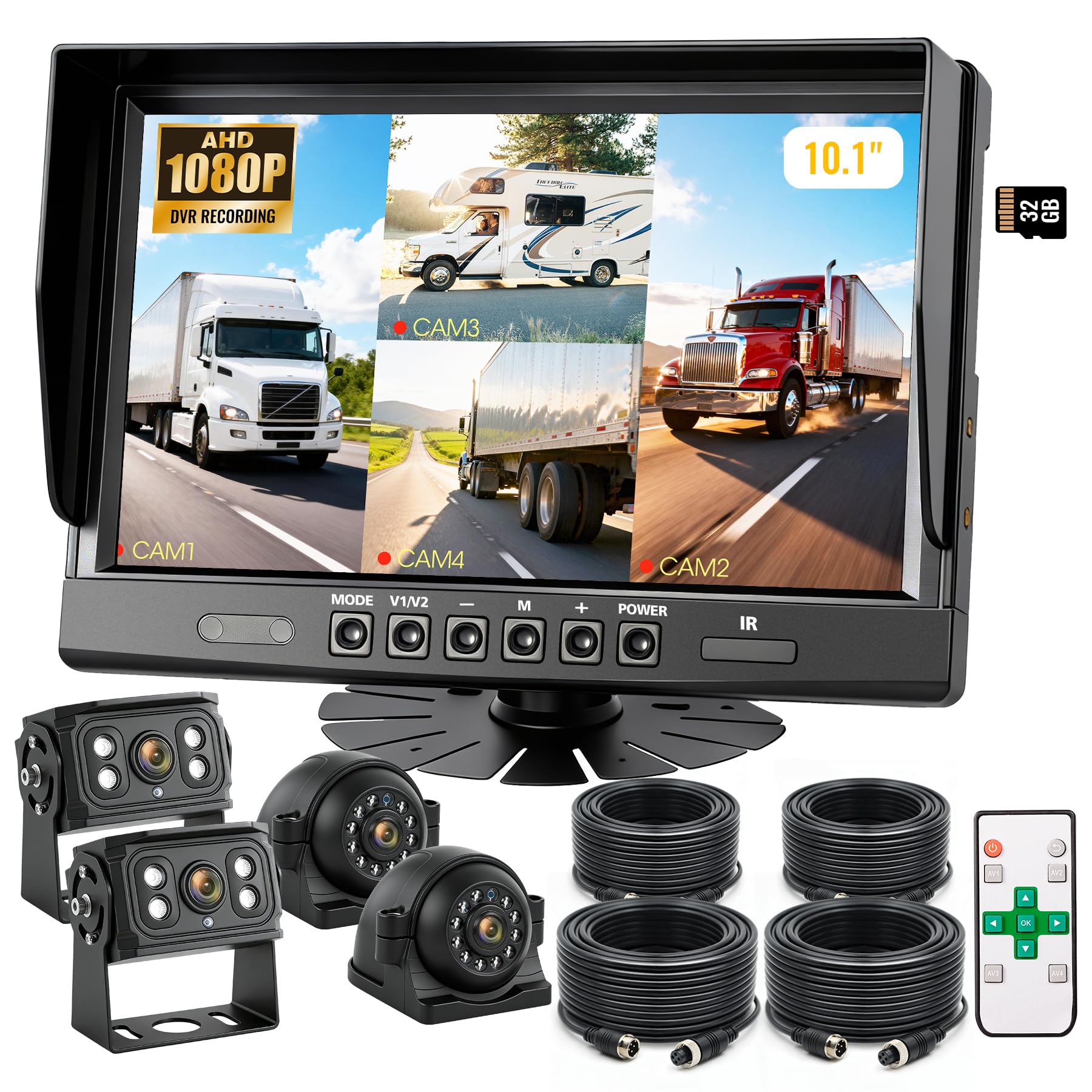
The WOOCARTY Y4 is engineered specifically for environments where standard automotive electronics fail — its all-metal housing and 20G vibration rating mean it can survive on tractors, excavators, skid steers, and heavy-duty trucks that see constant shock loads. The 10.1-inch monitor delivers crisp 1080P AHD video from four cameras, and the included remote control lets you switch between single, dual, and quad views without reaching for the screen.
Each camera uses a 149° wide-angle lens with enhanced IR LEDs that provide useful visibility in complete darkness, while the IP69K waterproof rating ensures no moisture ingress during pressure washing or heavy rain. The built-in DVR supports loop recording with the included 32GB SD card and can be expanded up to 128GB, giving you continuous archival footage for incident documentation or trip logging.
Installation requires basic wiring knowledge — you connect the monitor to 12-24V DC power and run the camera extension cables to each mounting point. The system includes a reverse trigger wire for automatic camera activation when shifting into reverse, and adjustable parking guidelines help with precise maneuvering around obstacles. For commercial operators and off-road users who prioritize durability over consumer-grade convenience, this is the most robust four-camera package available.
What works
- Exceptional 20G vibration tolerance suits heavy equipment and construction vehicles
- IP69K waterproof rating withstands high-pressure spray without leaks
- Remote control offers convenient view switching without touching the monitor
What doesn’t
- Wired installation requires more time than wireless alternatives
- Monitor brightness could be higher for direct-sunlight readability
2. AUTO-VOX Campsync Wireless RV Backup Camera System
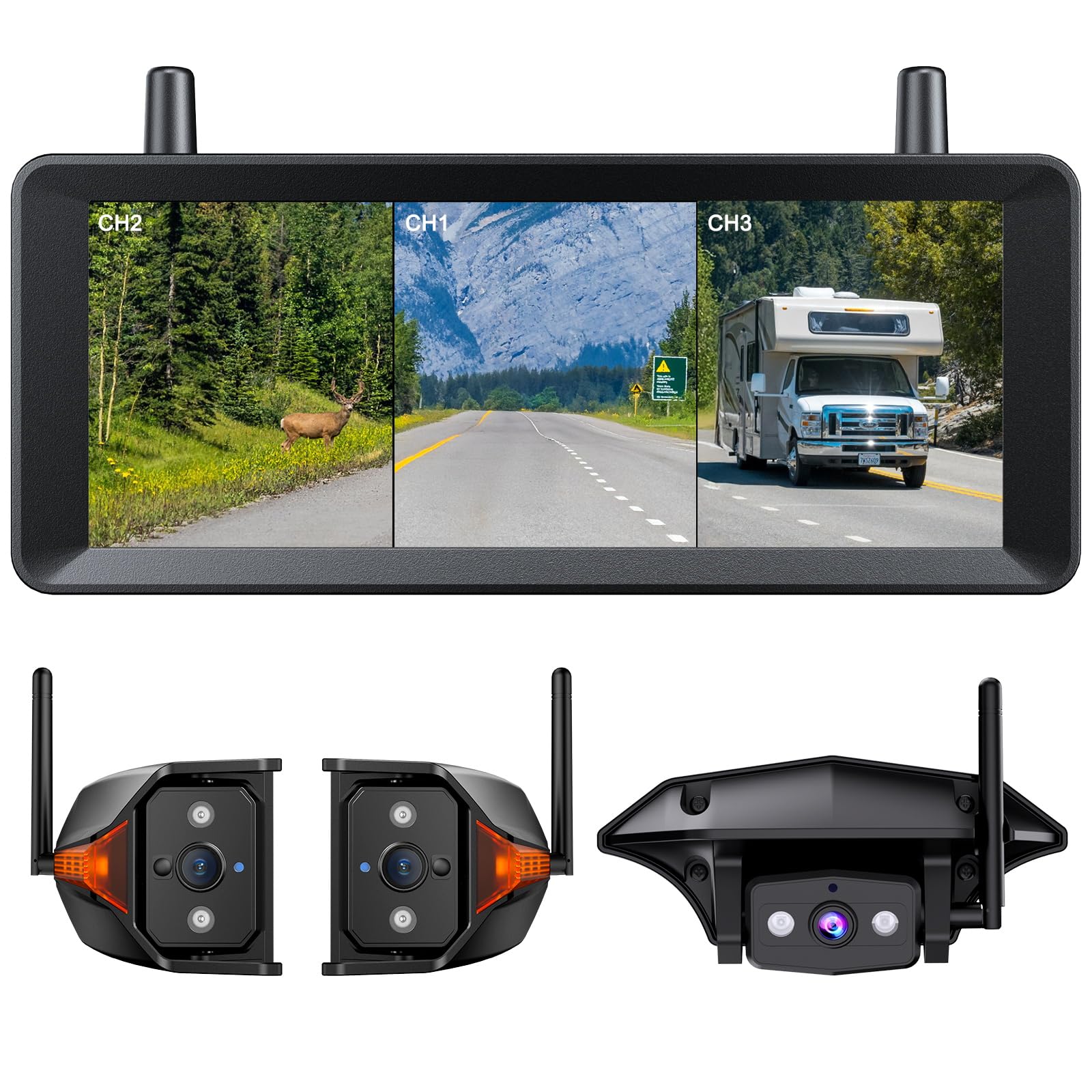
The AUTO-VOX Campsync addresses the single biggest complaint about wireless camera systems — signal dropout — by employing dual antennas that maintain stable 1080P video transmission up to 500 feet, tested on rigs exceeding 60 feet. The 7.2-inch HD monitor supports triple split-screen (rear plus both sides), giving you a clear picture of the area behind your trailer and the blind spots alongside it during lane changes.
Infrared night vision automatically activates in low light, revealing animals, pedestrians, or posts that would otherwise remain hidden until morning. The included 32GB SD card powers the built-in DVR with loop recording, so every trip is documented without requiring manual file management. Power options include USB and 12V car charger, giving you flexibility to route the monitor cable cleanly across the dashboard.
Installation is straightforward because the cameras communicate wirelessly with the monitor — each camera still needs a power connection via the vehicle’s lighting circuit or a dedicated 12V source, but you avoid the labor of running video cables from the trailer to the cab. The system is compatible with pre-wired Furrion mounts on many modern RVs, further reducing setup time. For owners who value quick installation and reliable wireless performance, this is a strong contender.
What works
- Dual antennas deliver stable video across long trailer lengths without dropout
- Fast installation using Furrion-compatible mounts simplifies retrofit
- Dual power options (USB/12V) provide flexible monitor placement
What doesn’t
- 7.2-inch screen is smaller than many wired competitors at 10 inches
- Camera field of view is 105° rather than the 170° found on wider-angle lenses
3. VOONOA RV Camera System with Carplay & Android Auto
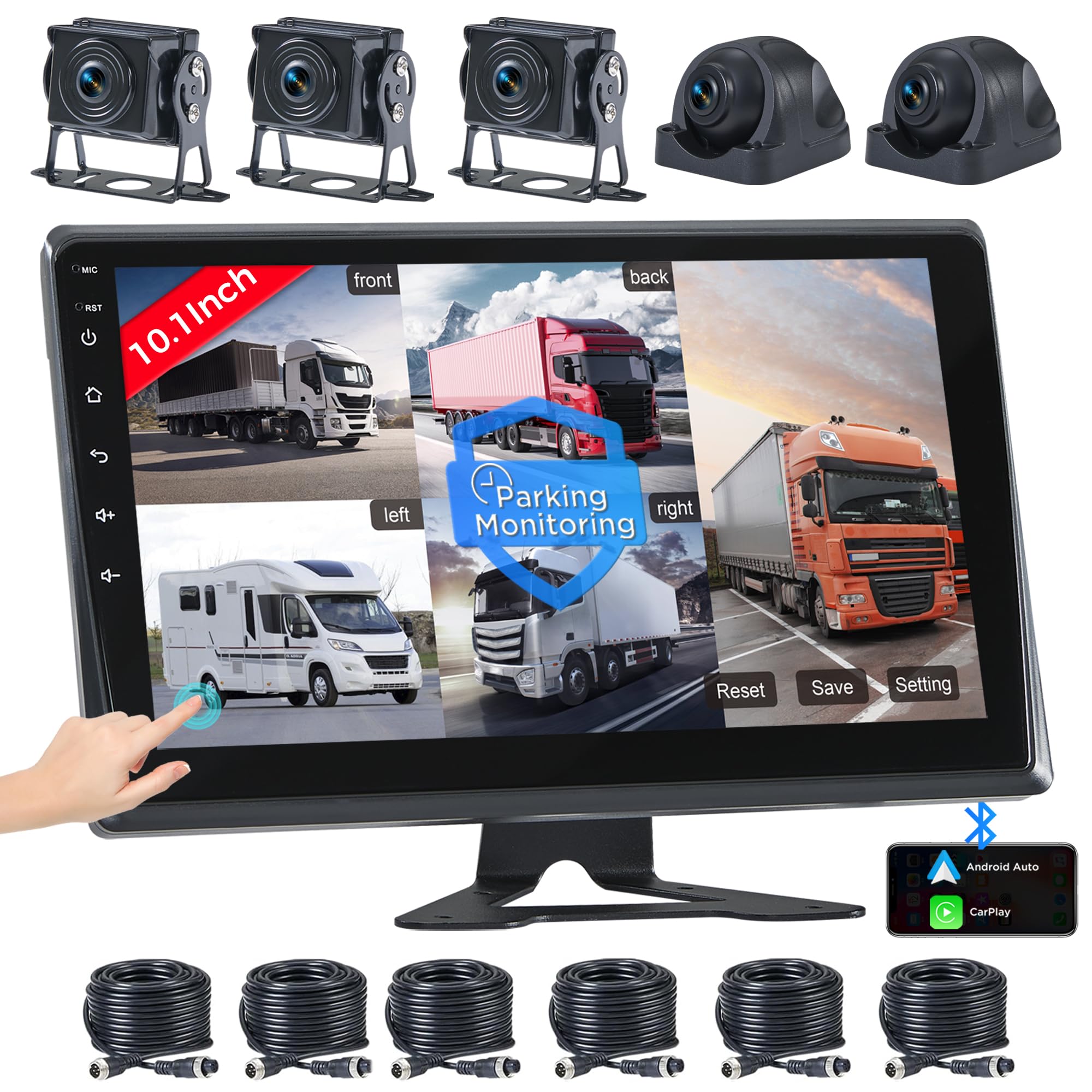
The VOONOA system merges a full five-camera surround-view setup with a modern Android 13 infotainment head unit, making it one of the most feature-dense packages in the mid-range price tier. The 10.1-inch IPS touchscreen supports wireless Apple CarPlay and Android Auto, giving you turn-by-turn navigation, music streaming, and hands-free calling directly on the camera monitor — no need for a separate dashboard screen.
All five cameras capture 1080P video, and the DVR records continuously with loop overwrite, so you always retain the most recent footage without manually clearing storage. The built-in Bluetooth 5.0 module syncs with your smartphone for hands-free calls, and the WiFi connection allows app downloads from the Google Play Store — you can run Google Maps, Waze, Netflix, or YouTube while parked. The parking monitoring function keeps recording even after the ignition is off, offering 24/7 surveillance against hit-and-run incidents.
Wiring the system requires connecting the monitor and cameras to 12-36V DC power, and the included cables are long enough to reach across a 40-foot RV or semi-trailer. The trade-off for this level of integration is that the system is more complex to set up than a dedicated camera-only monitor, and the Android interface adds features that some drivers may not use. For those who want a single screen that handles both camera feeds and daily infotainment, this delivers exceptional value.
What works
- Wireless CarPlay and Android Auto eliminate the need for a separate head unit
- Five cameras provide comprehensive coverage including an interior cabin option
- Parking monitoring records while the vehicle is parked and unattended
What doesn’t
- Android-based interface can feel overwhelming for users who just want camera views
- Wired installation is more involved due to the number of connection points
4. LASTBUS Dual Monitor Truck Camera System
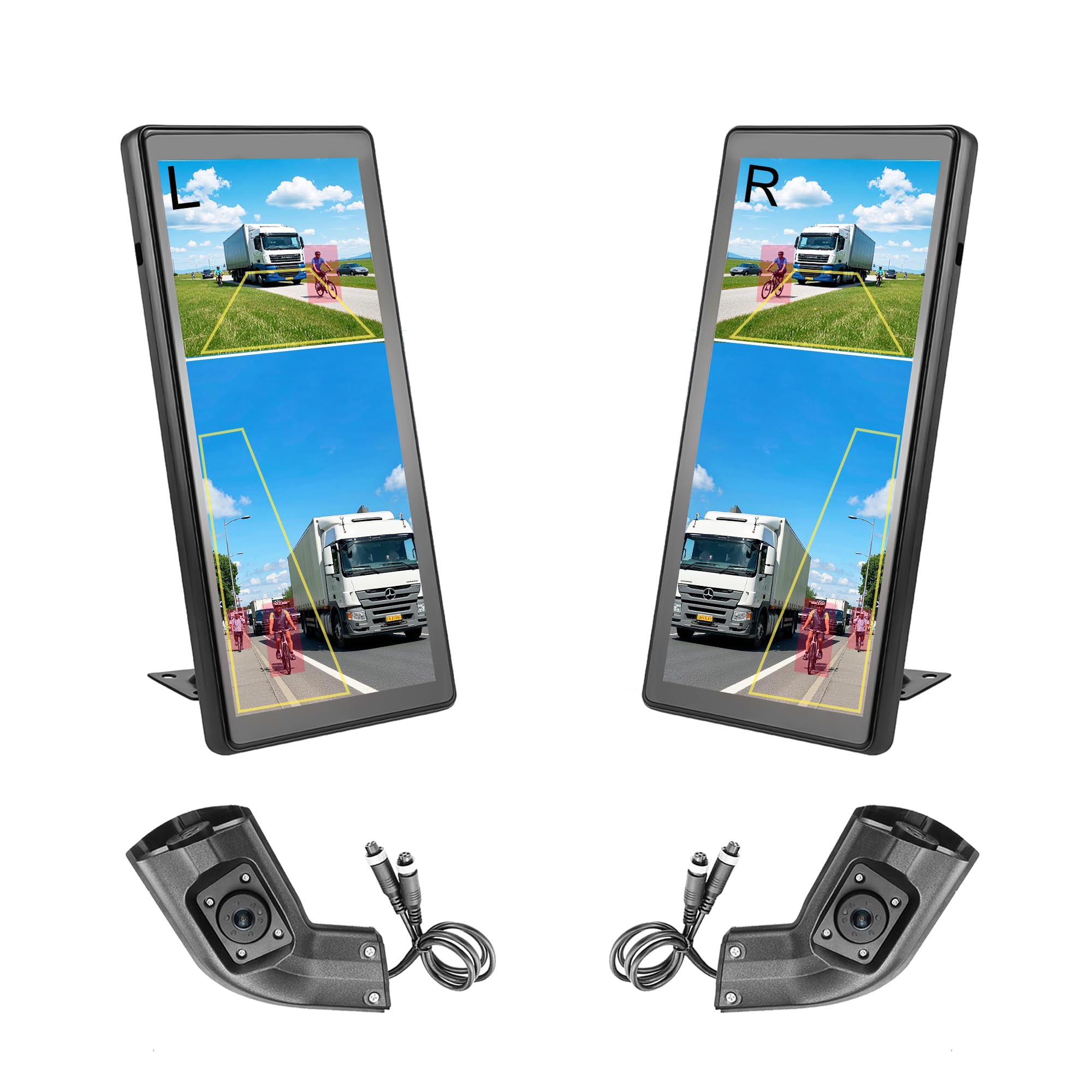
The LASTBUS system departs from the single-monitor paradigm by providing two separate 10.36-inch touchscreen displays — one dedicated to the left side camera and one to the right. This configuration mirrors the layout of traditional towing mirrors but with video clarity that eliminates the optical blind spots inherent in convex mirror glass, particularly for buses, box trucks, and agricultural equipment where side clearance is tight.
Each screen displays 1080P AHD video from its corresponding camera, and both monitors integrate DVR recording so you can capture left and right feeds simultaneously. The IP69K waterproof cameras use CMOS infrared sensors with automatic IR cut filters, switching to clear black-and-white night vision when ambient light drops. A blind spot detection alert appears on the monitors when pedestrians or objects enter the preset warning zone near the vehicle sides.
The dual-screen design occupies more dashboard space than a single monitor, which may be a consideration in smaller cabs. Wired connection requires running separate camera cables to each side of the vehicle, and the 18-pin power harness must be properly routed to avoid interference. For operators of wide-body vehicles where side visibility is the primary concern, the dedicated left-right screen layout offers a more intuitive visual reference than a split-screen quad view.
What works
- Dedicated left/right screens mirror traditional mirror viewing for easy adaptation
- Blind spot detection alerts add an extra layer of safety during lane changes
- IP69K waterproof rating handles harsh weather and pressure washing without issue
What doesn’t
- Two monitors consume significant dashboard real estate
- System does not include front or rear cameras for full 360° coverage
5. Seventour 5-Channel 1080P Backup Camera Dash Cam
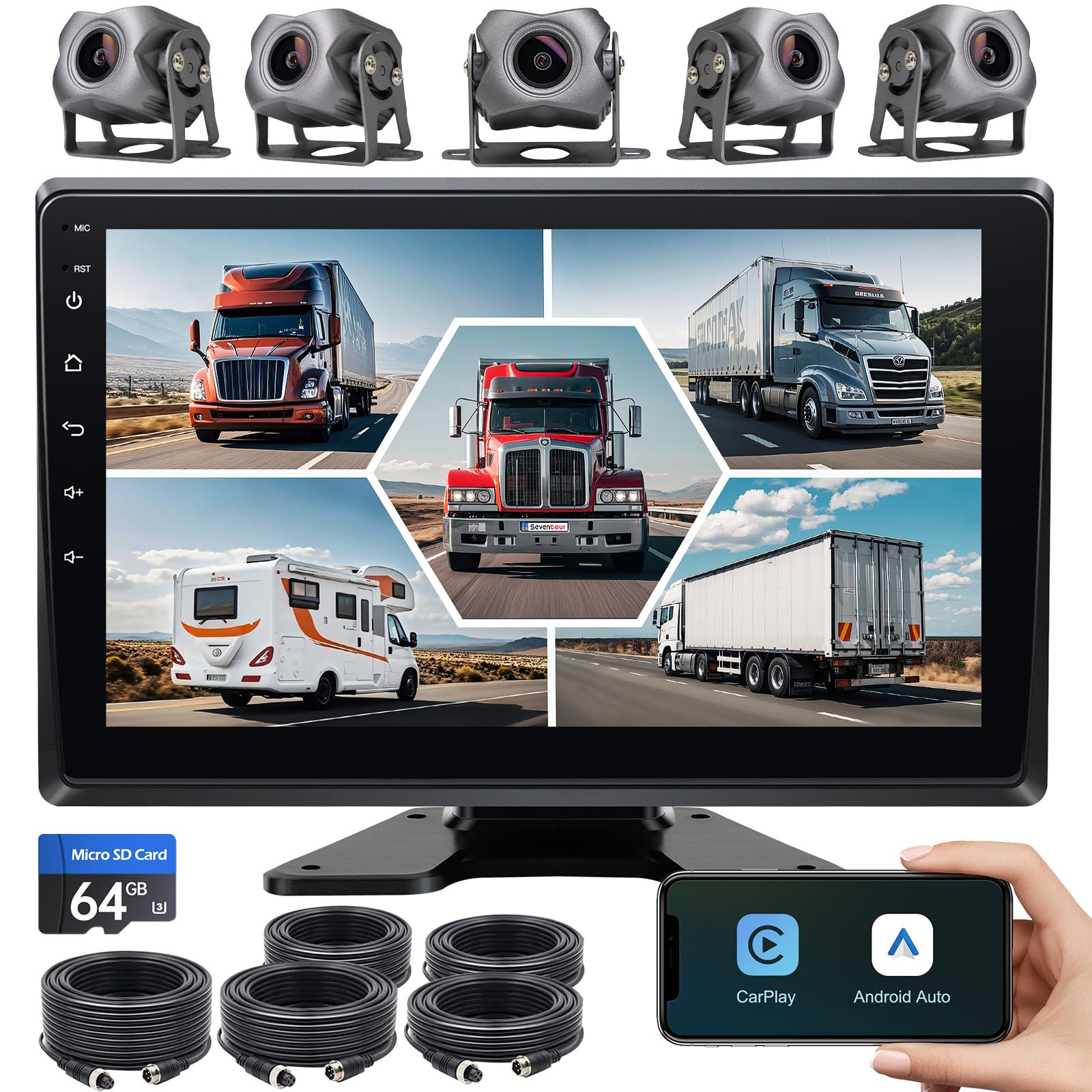
The Seventour system provides five camera channels with individual 1080P resolution, giving you the ability to monitor front, rear, both sides, and an interior cabin view simultaneously on a single 10.2-inch IPS touchscreen. The longest cable reaches 49 feet, which is sufficient for full-size trucks and medium-length trailers without requiring extension adapters that can introduce signal loss.
Beyond the camera functionality, the unit runs Android 11 with wireless CarPlay and Android Auto, so you can access navigation apps, streaming services, and hands-free calling directly on the camera display. The IP69 waterproof rating and aluminum alloy camera housings ensure the external units survive rain, snow, and road debris. Two mounting options are included — dashboard adhesive or overhead screw mount — giving you flexibility in monitor placement depending on cab layout.
The DVR records all five channels simultaneously with loop recording, and the USB 2.0 port allows playback from a flash drive. The reverse trigger auto-switches to the rear camera view when you shift into reverse, while the front-facing camera can double as a standard dash cam for accident documentation. For commercial users who need both external and internal monitoring — such as delivery drivers or passenger transport — the five-channel architecture is a clear advantage over four-camera systems.
What works
- Five independent channels allow simultaneous external and interior monitoring
- 49-foot cables suit long vehicles without needing signal boosters or extensions
- Aluminum alloy camera housings provide better impact resistance than plastic shells
What doesn’t
- Android 11 interface may feel slower than purpose-built camera UI
- Six-month replacement warranty is shorter than industry average
6. Losuudy Wired Backup Camera System with 10.1” IPS Monitor

The Losuudy system strips away infotainment extras and focuses on delivering clean 1080P AHD video from four cameras to a 10.1-inch IPS monitor at a price point that undercuts most multi-camera competition. AHD technology provides noticeably sharper image quality than older CVBS cameras, especially at night when the 0.1 Lux rating and IR LEDs maintain usable visibility without excessive digital noise.
The monitor supports four-camera split-screen viewing, and individual image mirror/flip controls let you orient each camera correctly regardless of mounting position. Guide lines can be set to always-on, triggered by reverse gear, or disabled entirely, giving you flexibility depending on your preference. Power is supplied through a cigarette lighter adaptor, which simplifies installation for drivers who want to avoid hardwiring — just plug the monitor into the 12V outlet and connect each camera via the single-cable harness.
Recording capability is included, but the system does not ship with an SD card, so you will need to supply your own. The 170° field of view on each camera covers the typical blind spot zones, and the IP69 waterproof rating matches systems at twice the price. For truck owners who want a straightforward four-camera setup with large-screen visibility and reliable night performance without paying for CarPlay or Android features they won’t use, this represents solid value.
What works
- AHD 1080P delivers significantly better image quality than CVBS cameras in the same price range
- Cigarette lighter power avoids the need for hardwiring the monitor
- 10.1-inch IPS screen provides clear quad-view visibility
What doesn’t
- No SD card is included for DVR recording despite marketing
- Monitor mounting bracket design is less adjustable than suction cup alternatives
7. Xrizuo Wired Backup Camera System with 10.36” Touch Screen

The Xrizuo system brings a 10.36-inch touchscreen monitor and four 1080P cameras to the entry-level segment, making 360° wired coverage more accessible for budget-conscious truck owners. The touch-capacitive interface allows intuitive navigation through split-screen modes — single, dual, triple, quad, or even five-channel if you add an extra camera — without reaching for hard buttons.
Smart BSD (blind spot detection) alerts appear on screen when motion is detected in preset zones around the vehicle, providing an audible warning during lane changes or reversing maneuvers. The IP69 waterproof rating and IR night vision maintain image quality in rain, snow, and darkness, while the operating temperature range of -35℉ to 167℉ ensures reliability in extreme climates. A 64GB micro SD card is included, so you can begin recording immediately without a separate purchase.
The system also supports video and music playback for entertainment during breaks, and the reverse trigger line automatically switches the display to the rear camera when in reverse gear. Wiring requires connecting the monitor power cable and routing the RCA camera lines to each mounting point — the process demands basic electrical familiarity but rewards you with a zero-latency signal that wireless systems cannot guarantee. For drivers entering the multi-camera category for the first time, this offers a balanced feature set at a controlled investment.
What works
- Touchscreen interface simplifies menu navigation while driving
- BSD alerts provide audible warnings for blind spot activity
- Included 64GB card adds value and eliminates an immediate accessory purchase
What doesn’t
- Touchscreen responsiveness can lag in very cold temperatures
- 90° field of view per camera is narrower than most competitors
8. VOONOA Wireless RV Backup Camera System with 9” Monitor
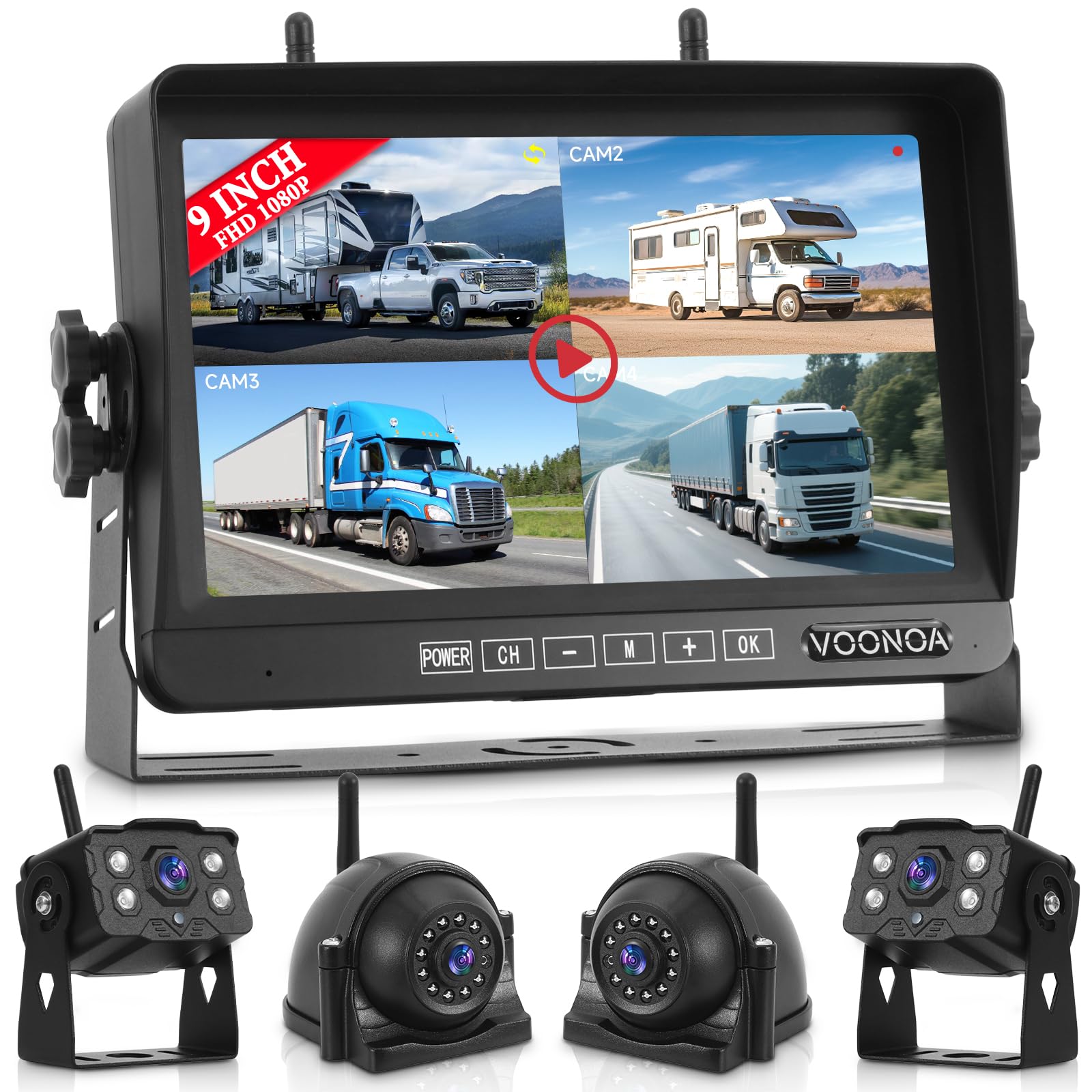
The VOONOA wireless system eliminates the most labor-intensive part of camera installation — running video cables from the trailer or truck bed to the cab — while still delivering 1080P resolution on a 9-inch HD monitor. Each camera requires its own 12V power connection, but the wireless video transmission means you only need to mount the cameras, connect power, and pair them with the monitor through a simple binding process.
The four cameras offer 170° wide-angle lenses that cover the rear and both sides, and the quad split-screen view shows all feeds simultaneously on the 9-inch display. The digital signal maintains stable transmission up to 500 feet with minimal lag, and the IP69K waterproof rating with IR night vision ensures clear images in rain, dust, and darkness. Adjustable reverse guidelines assist with precision backing into campsites or loading docks.
Recording is handled by the monitor’s DVR, but you need to supply your own SD card since one is not included in the package. The monitor supports both dashboard and surface mounting, giving you placement flexibility depending on cab layout. For RV owners who are comfortable powering cameras near their existing tail lights or side markers but want to skip the headache of fish tape and trim removal, this wireless approach significantly reduces installation time while maintaining solid image quality.
What works
- No video cables needed between cameras and monitor simplifies installation
- 170° wide-angle lenses provide broad side coverage for lane changes
- Stable 500-foot wireless range tested on long trailer configurations
What doesn’t
- SD card not included despite DVR functionality
- Wireless signal can experience interference in dense urban environments
9. DJI Osmo 360 Motorcycle Multi-POV Combo
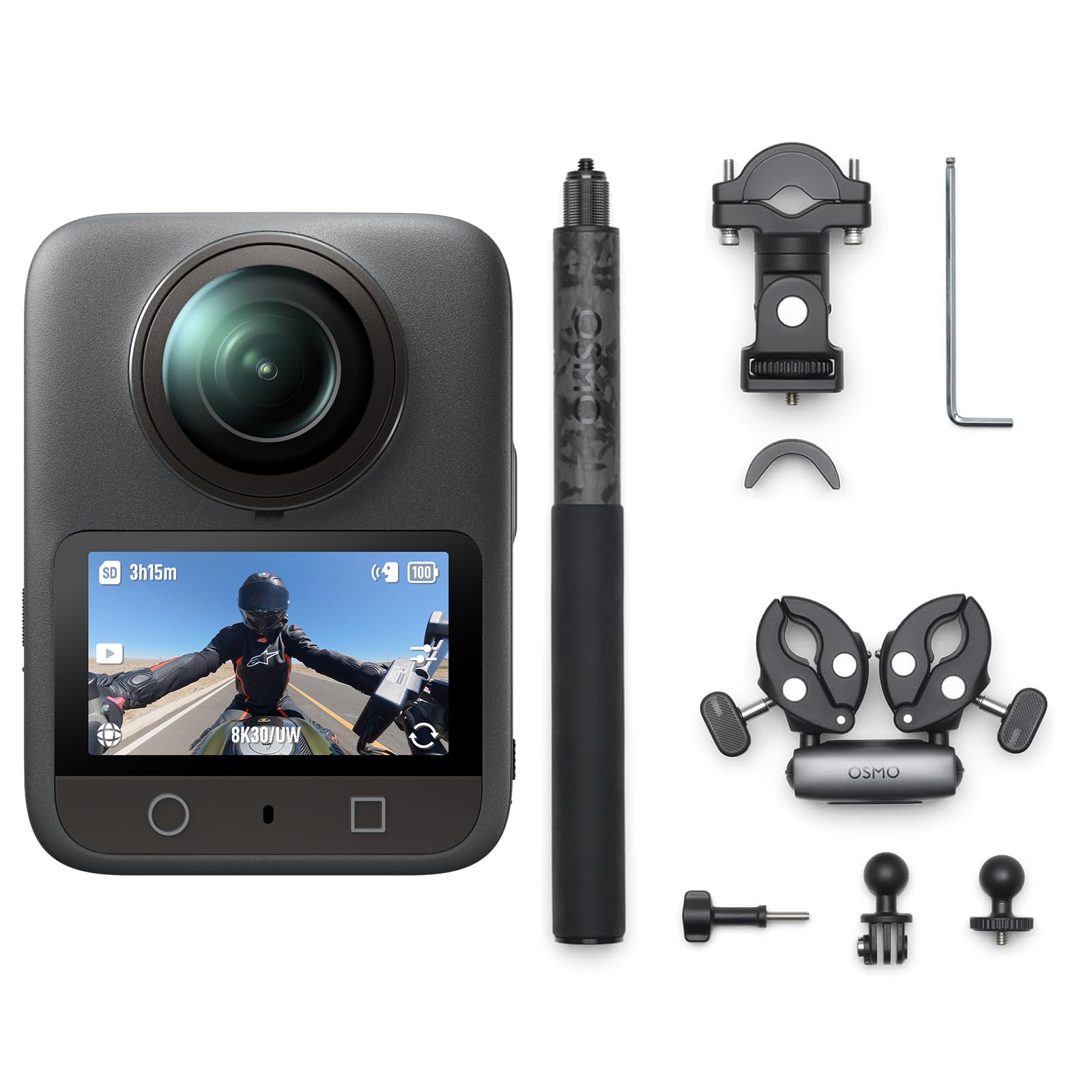
The DJI Osmo 360 takes a fundamentally different approach to vehicle awareness by using a single 1-inch sensor that captures a full 360° spherical image rather than stitching together multiple discrete camera feeds. While it is designed primarily for motorcycles and powersports recording, its 8K 360° video and 120MP photo capability make it the highest-resolution surround-view option in this comparison, suitable for riders who want both situational documentation and cinematic footage.
The Multi-POV Combo includes a heavy-duty handlebar clamp and a high-strength carbon fiber invisible selfie stick, allowing you to mount the camera in positions that capture both the rider and the surrounding road. The magnetic quick-release system lets you switch between 360° mode and single-lens action cam mode in seconds. Super-smooth 4K/120fps and a 170° ultra-wide boost mode capture fast maneuvers without motion blur, while the 1-inch sensor delivers excellent low-light performance compared to smaller action camera sensors.
Battery life is rated at 90 minutes of continuous recording, which is sufficient for most rides but requires planning for all-day trips. The camera connects to your smartphone via Bluetooth and WiFi for live preview and file transfer, but it does not function as a real-time blind spot monitoring system — it records footage for later review rather than displaying a live feed while riding. For motorcyclists who want the highest quality 360° documentation of their rides with the flexibility to repurpose the camera for other activities, the Osmo 360 sets the benchmark.
What works
- 1-inch sensor delivers superior image quality and low-light performance
- 8K 360° video allows post-production reframing to any angle
- Magnetic quick-release mount enables fast switching between bike and handheld use
What doesn’t
- Does not provide real-time blind spot or live-view monitoring while riding
- 90-minute battery life requires charging for extended trips
Hardware & Specs Guide
Wired vs Wireless Signal Stability
A wired connection uses a dedicated coaxial or RCA cable running directly from each camera to the monitor, which eliminates radio-frequency interference and delivers sub-millisecond latency regardless of vehicle length. Wireless systems compress the video and transmit it over a 2.4 GHz or 5.8 GHz band; the effective range varies based on obstacles, antenna placement, and environmental noise. For vehicles over 40 feet, wired systems offer more predictable performance, while wireless suits setups where cable routing is impractical.
IP Ratings & Environmental Durability
IP69K cameras can withstand high-pressure steam cleaning and immersion in water up to one meter for 30 minutes — critical for trucks that go through automatic washes or operate in muddy conditions. IP69 (without the K) offers similar water resistance but lacks the highest-pressure steam rating. Look for an operating temperature range spanning at least -20℉ to 150℉ if you drive in seasonal extremes; systems rated only for consumer-grade environments may suffer lens fogging or sensor failure within a single winter.
AHD vs CVBS Video Technology
AHD (Analog High Definition) transmits 1080P video over standard coaxial cable without compression artifacts, maintaining full resolution at distances up to 300 feet. CVBS (Composite Video Baseband Signal) is limited to standard definition (480i equivalent) and produces softer images with visible banding and lower contrast. All modern 1080P truck camera systems should use AHD encoding; if a product still relies on CVBS sensors, the image quality will look noticeably dated on any monitor larger than 7 inches.
DVR Recording & Storage Options
Built-in DVR functionality records camera feeds to a micro SD card, with loop recording overwriting the oldest footage when the card is full. Cards between 32GB and 128GB typically store between six and twenty-four hours of continuous 1080P recording depending on the number of channels. Some systems support only FAT32-formatted cards with file size limits, so confirm compatibility before purchasing a high-capacity card. Parking monitoring modes activate recording via motion detection or impact sensors even when the vehicle is off, drawing power from the vehicle battery.
FAQ
What is a 360° truck camera system and how does it work?
Wired or wireless — which is better for a truck camera system?
How many cameras do I need for full truck coverage?
Can I install a 360° camera system myself?
What does IP69K waterproof rating mean for truck cameras?
Final Thoughts: The Verdict
For most buyers, the best 360° truck camera system winner is the WOOCARTY Y4 because it combines commercial-grade 20G vibration resistance, four-camera AHD 1080P coverage, and a 10.1-inch monitor with DVR recording at a price that undercuts true industrial systems while outperforming consumer-grade alternatives. If you want CarPlay integration and a single-screen infotainment hub, grab the VOONOA with Android 13 and wireless CarPlay. And for quick wireless installation on pre-wired RVs, nothing beats the AUTO-VOX Campsync with its 500-foot range and Furrion-compatible mounting.

Certification: BSc in Mechanical Engineering
Education: Mechanical engineer
Lives In: 539 W Commerce St, Dallas, TX 75208, USA
Md Amir is an auto mechanic student and writer with over half a decade of experience in the automotive field. He has worked with top automotive brands such as Lexus, Quantum, and also owns two automotive blogs autocarneed.com and taxiwiz.com.