A 3-inch intake tube sits at the heart of any serious forced-induction or high-flow naturally aspirated build. The wrong bend radius, a cheap alloy, or thin wall thickness can introduce turbulence, restrict volume, or crack under heat cycling — robbing the very power you are chasing.
I’m Amir — the founder and writer behind Four Wheel Ask. I spend my time digging through material certifications, comparing mandrel-bend quality across brands, and cross-referencing owner feedback to separate tubing that flows from tubing that only looks the part.
Diameter alone does not guarantee performance; wall gauge, alloy grade, and centerline radius define real airflow. Selecting the right best 3-inch intake tube directly impacts your engine’s airflow efficiency and overall performance gains.
How To Choose The Best 3-Inch Intake Tube
A 3-inch intake tube must balance internal volume, bend smoothness, and material resilience. Three factors separate a part that delivers consistent airflow from one that introduces restriction or fails prematurely.
Bend Radius and Mandrel Quality
Centerline radius (CLR) determines how sharply the tube turns. A 1.5D radius (4.5-inch CLR for 3-inch tubing) preserves cross-sectional area through the bend better than tighter 1.3D options. Mandrel bending ensures the inner diameter remains constant — crushed or wrinkled bends create turbulence that reduces flow velocity.
Alloy and Wall Thickness
T6061 aluminum offers a good strength-to-weight ratio for intercooler piping, while T304 stainless steel handles higher exhaust-side temperatures without corrosion. Wall thickness around 0.065 to 0.071 inch provides enough rigidity for clamp retention without adding unnecessary weight. Thinner walls risk collapse under boost or overtightened clamps.
End Preparation and Fitment
Straight leg length at each end gives couplers enough surface area to seal. Humps or rolled beads near the ends help silicone hoses stay put under pressure. Vehicle-specific designs from brands like Airaid incorporate factory mounting points and MAF sensor provisions, reducing the need for custom fabrication.
Quick Comparison
On smaller screens, swipe sideways to see the full table.
| Model | Category | Best For | Key Spec | Amazon |
|---|---|---|---|---|
| Airaid AIR-200-996 M.I.T. | Vehicle Specific | Direct-fit factory replacement | Modular tube with MAF provisions | Amazon |
| BIGREAT 30″ Straight 2-Pack | Stainless Steel | Custom fabrication with corrosion resistance | T304 SS, 30″ length, 2-pack | Amazon |
| 8SC82 T304 Straight 48″ | Exhaust Grade | Long straight runs for exhaust or intake | T304 SS, 48″ length, 0.065″ wall | Amazon |
| AICARS Universal Cold Intake Kit | Complete Kit | All-in-one intake upgrade with filter | Aluminum pipe, dry filter, clamps included | Amazon |
| Podavelle 90 Degree 1.5D | Aluminum Elbow | Turbo intercooler piping with gentle radius | T6061, 1.5D CLR, 0.071″ wall | Amazon |
| AC PERFORMANCE 90 Degree 1.3D | Aluminum Elbow | Tighter engine bay clearance | T6061, 1.3D CLR, 0.071″ wall | Amazon |
| Podavelle 45 Degree 1.5D | Aluminum Elbow | Gentle directional changes in piping | T6061, 1.5D CLR, 0.071″ wall | Amazon |
In‑Depth Reviews
1. Airaid AIR-200-996 M.I.T. Modular Intake Tube
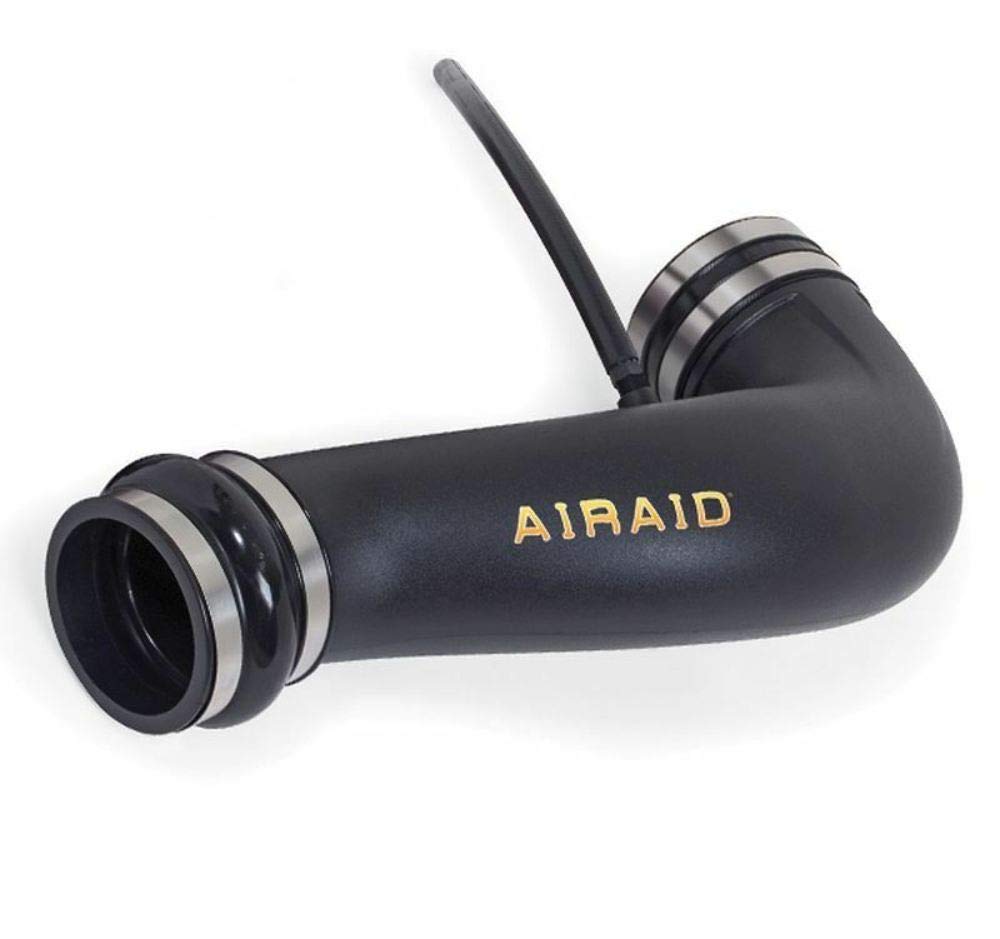
Airaid’s M.I.T. tube replaces the restrictive factory intake pathway with a smoother, larger-diameter alternative designed specifically for the vehicle’s existing mounting points and sensor locations. This is not a universal piece of pipe — every contour and bracket location is engineered to drop in without cutting, splicing, or adapting.
The modular construction means the tube can be installed in stages or combined with Airaid’s filter systems for a complete cold air setup. The material and finish resist underhood heat soak better than stamped factory plastic, maintaining consistent inlet air temperatures across driving conditions.
For owners who want a proven, vehicle-specific solution without fabricating custom piping, the Airaid M.I.T. delivers predictable fitment and measurable flow improvement. The trade-off is a higher entry investment compared to raw tubing, but the elimination of trial-and-error installation time offsets that cost for most builders.
What works
- Precision vehicle-specific fitment with factory sensor provisions
- Modular design allows staged upgrades
- Smoother internal surface than OEM plastic tubes
What doesn’t
- Limited to compatible vehicle applications only
- Higher cost than universal raw tubing
2. BIGREAT 3″ Stainless Steel Straight Tube 2-Pack

The BIGREAT straight tube set provides two 30-inch sections of T304 stainless steel, giving fabricators enough material to build complete charge pipes or intake routes without splicing multiple short pieces. T304 offers superior corrosion resistance compared to 409 stainless, especially in regions with road salt or humidity.
Each tube features humps near both ends that improve clamp retention — a small detail that prevents silicone couplers from walking off under boost pressure. The brushed surface finish accepts welding cleanly and matches the aesthetic of polished intercooler cores.
At 0.065-inch wall thickness, these tubes balance rigidity with moderate weight. The 2-pack configuration means you get a spare section or enough length for a dual-inlet setup. The main limitation is the straight-only geometry — you will need separate elbows for directional changes.
What works
- T304 stainless offers long-term corrosion resistance
- Humped ends prevent coupler slip under boost
- Two tubes provide ample material for custom runs
What doesn’t
- Straight sections only — elbows must be purchased separately
- Heavier than equivalent aluminum tubing
3. 8SC82 T304 Stainless Steel Straight Pipe 48″

The 8SC82 straight pipe offers nearly four feet of continuous T304 stainless steel tubing, making it one of the longest single-piece 3-inch sections available for custom intake or exhaust work. The mandrel-formed straight run ensures a consistent inner diameter from end to end, eliminating the weld joints that can introduce turbulence.
T304 stainless handles sustained high temperatures without scaling or oxidation, which is critical when the tube is used on the hot side of a turbocharger or in an exhaust system. The 0.065-inch wall thickness provides enough structural integrity for long unsupported spans without buzzing or vibrating against surrounding components.
This tube is a raw building block — it requires cutting, welding, and coupler fitting to integrate into a complete system. The universal fit means it works across platforms, but there are no pre-formed bends or mounting tabs. For experienced fabricators, this length offers maximum flexibility at a competitive material cost.
What works
- Full 48-inch continuous length reduces weld joints
- T304 stainless withstands exhaust-side heat
- Mandrel-formed bore stays consistent through entire run
What doesn’t
- No pre-formed bends — pure straight section only
- Requires fabrication skills and tools to use
4. AICARS 3 Inch Universal Cold Intake Pipe Kit
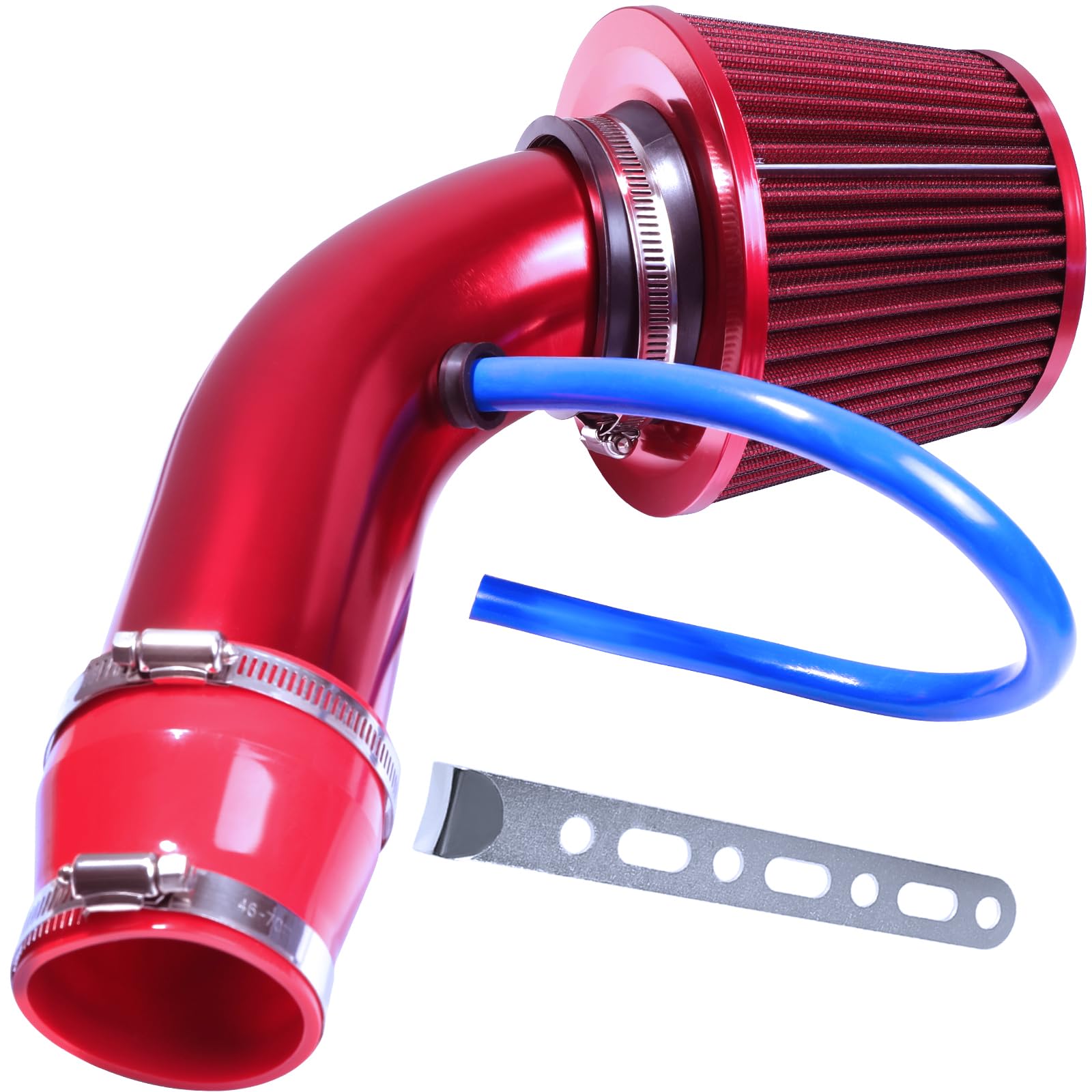
The AICARS kit bundles a 3-inch aluminum intake pipe with a dry-filter element, silicone couplers, and clamps — everything needed to replace a factory airbox assembly. The red anodized finish adds visual appeal under the hood while the aluminum construction sheds heat faster than plastic intake tubes.
The dry conical filter uses density-layered fibers to trap debris without requiring oil, eliminating the risk of over-oiling MAF sensors. The kit is designed for universal fitment but may require minor modifications or cutting to align with existing intake routing and sensor locations.
Note that this kit does not include a MAP or MAF sensor adapter, so vehicles with inline sensors will need additional parts. For applications where the sensor mounts in the factory airbox, this kit works best on setups that relocate the sensor or use a standalone ECU that does not require a MAF signal.
What works
- Complete kit includes pipe, filter, couplers, and clamps
- Dry filter element eliminates MAF oil contamination risk
- Red anodized finish adds underhood style
What doesn’t
- No MAF or MAP sensor adapter included
- Universal fit may require trimming or modification
5. Podavelle 90 Degree 3 Inch Aluminum Elbow 1.5D
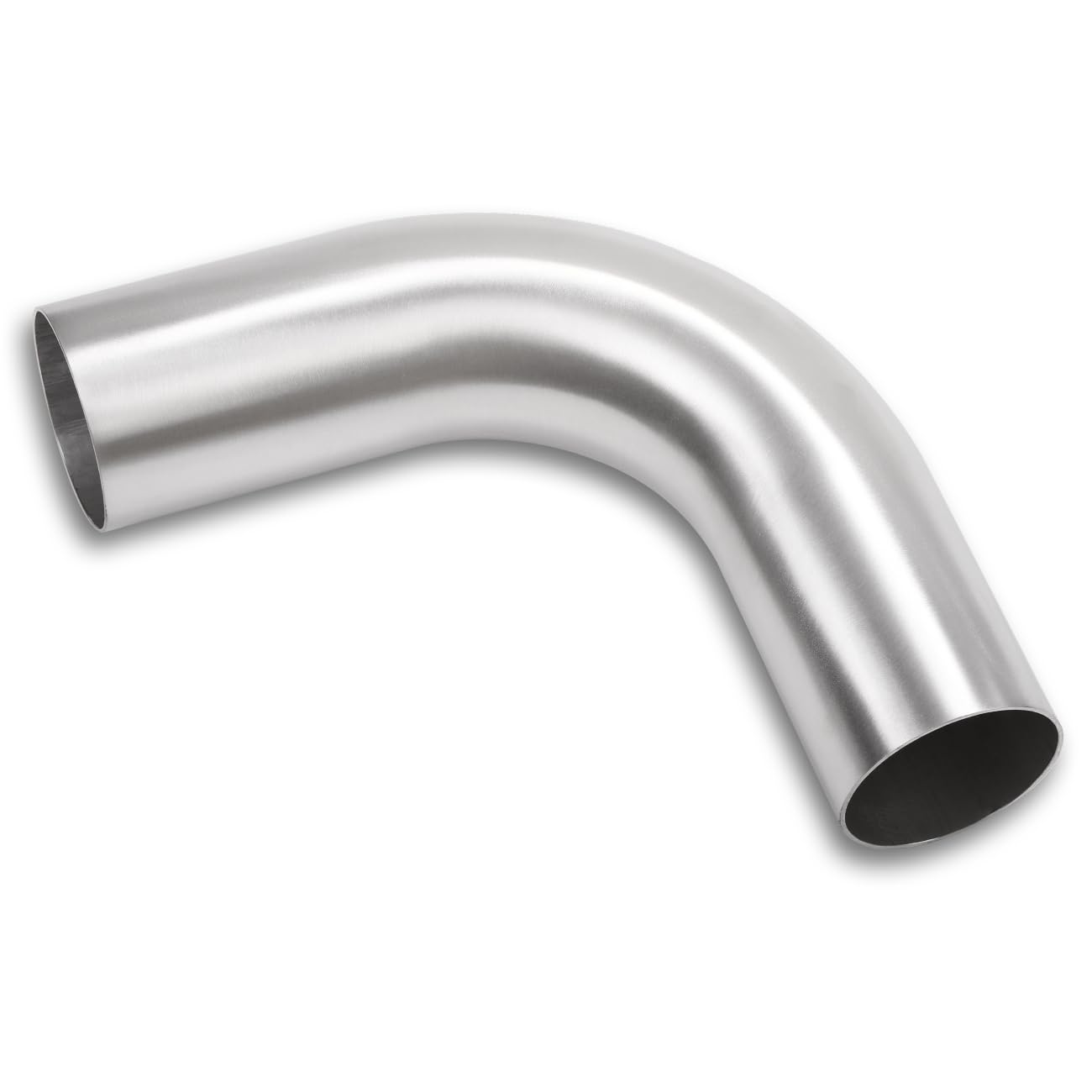
Podavelle’s 90-degree elbow uses a 1.5D centerline radius (4.5 inches) to turn airflow with minimal restriction. The gentler bend preserves velocity better than tighter-radius elbows, making this a strong choice for intercooler piping where every psi of pressure drop matters.
Constructed from T6061 aluminum with a 0.071-inch wall, this elbow offers good resistance to vibration fatigue and clamp compression without adding unnecessary heft. The brushed finish provides a consistent texture that blends well with other polished or brushed aluminum components in the engine bay.
The straight leg length of 3.94 inches on each side gives couplers enough bite for secure sealing. This part is designed to be cut, spliced, or welded, so it adapts to custom layouts. The 1.5D radius does require slightly more clearance than tighter bends, which could be a factor in cramped engine compartments.
What works
- 1.5D radius minimizes flow restriction through the bend
- T6061 alloy with 0.071-inch wall for durable service
- Brushed finish matches other aluminum intake components
What doesn’t
- Requires more clearance than tighter-radius elbows
- No rolled beads or humps for coupler retention
6. AC PERFORMANCE 3 Inch 90 Degree Aluminum Elbow 1.3D
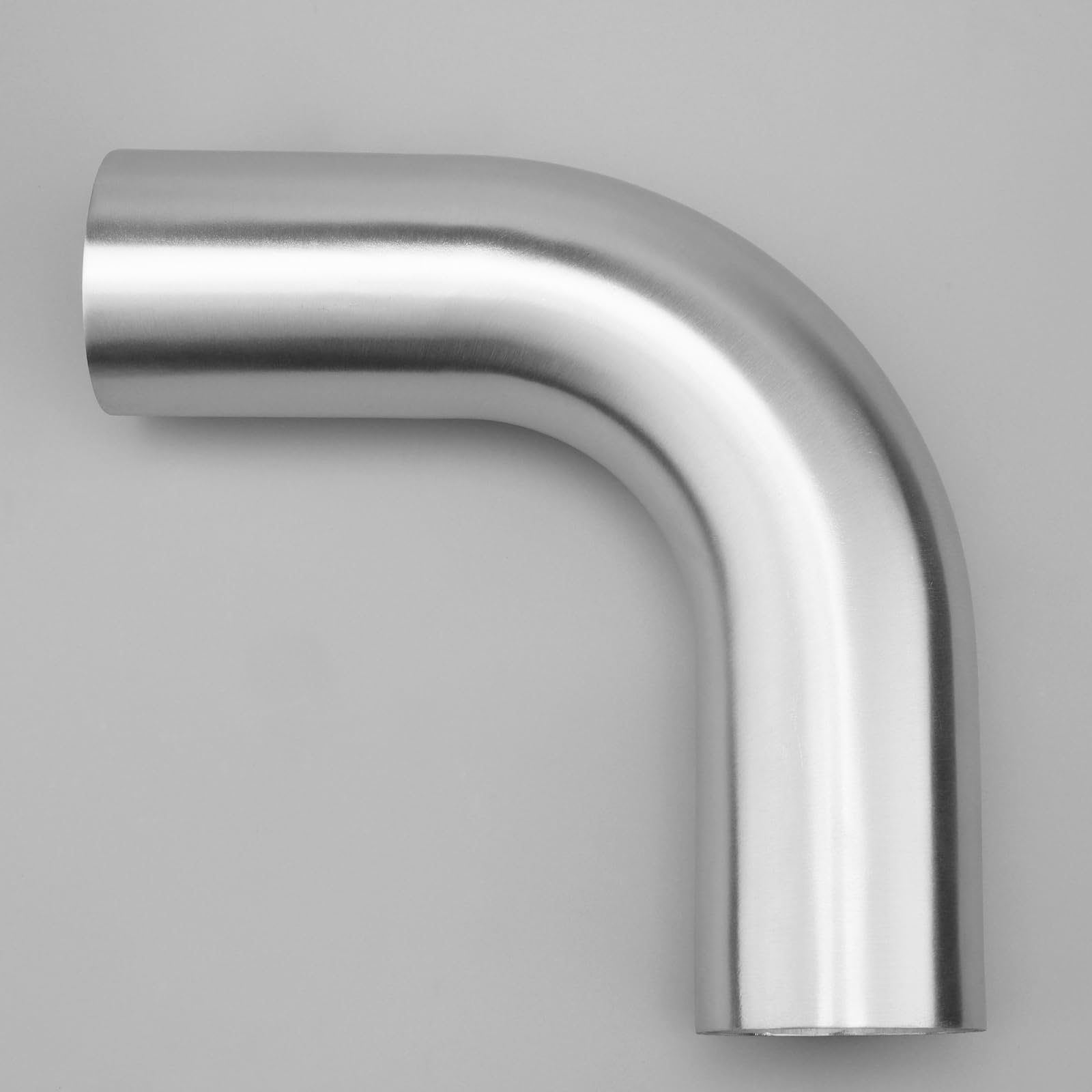
AC PERFORMANCE offers a 90-degree elbow with a 1.3D centerline radius, which fits into tighter engine bay spaces where a larger 1.5D bend simply will not clear. The mandrel-bent T6061 aluminum construction maintains a smooth internal surface through the turn, keeping turbulence in check despite the more compact geometry.
The 4-inch leg length on each side provides solid coupler engagement, and the 0.071-inch wall thickness matches the durability standard of premium elbows. The brushed surface treatment resists corrosion and gives the part a uniform appearance suitable for visible intake routing.
This elbow is well-suited for intercooler piping, cold air intake tubes, or cooling system routing where space is limited. The tighter radius does introduce slightly more flow restriction than a 1.5D bend, but in many real-world builds the clearance advantage outweighs the marginal pressure drop difference.
What works
- Compact 1.3D radius fits tight engine bay spaces
- T6061 aluminum with robust 0.071-inch wall
- 4-inch straight legs provide good coupler surface area
What doesn’t
- Tighter bend creates slightly more restriction than 1.5D
- No retention features on tube ends
7. Podavelle 45 Degree 3 Inch Aluminum Elbow 1.5D
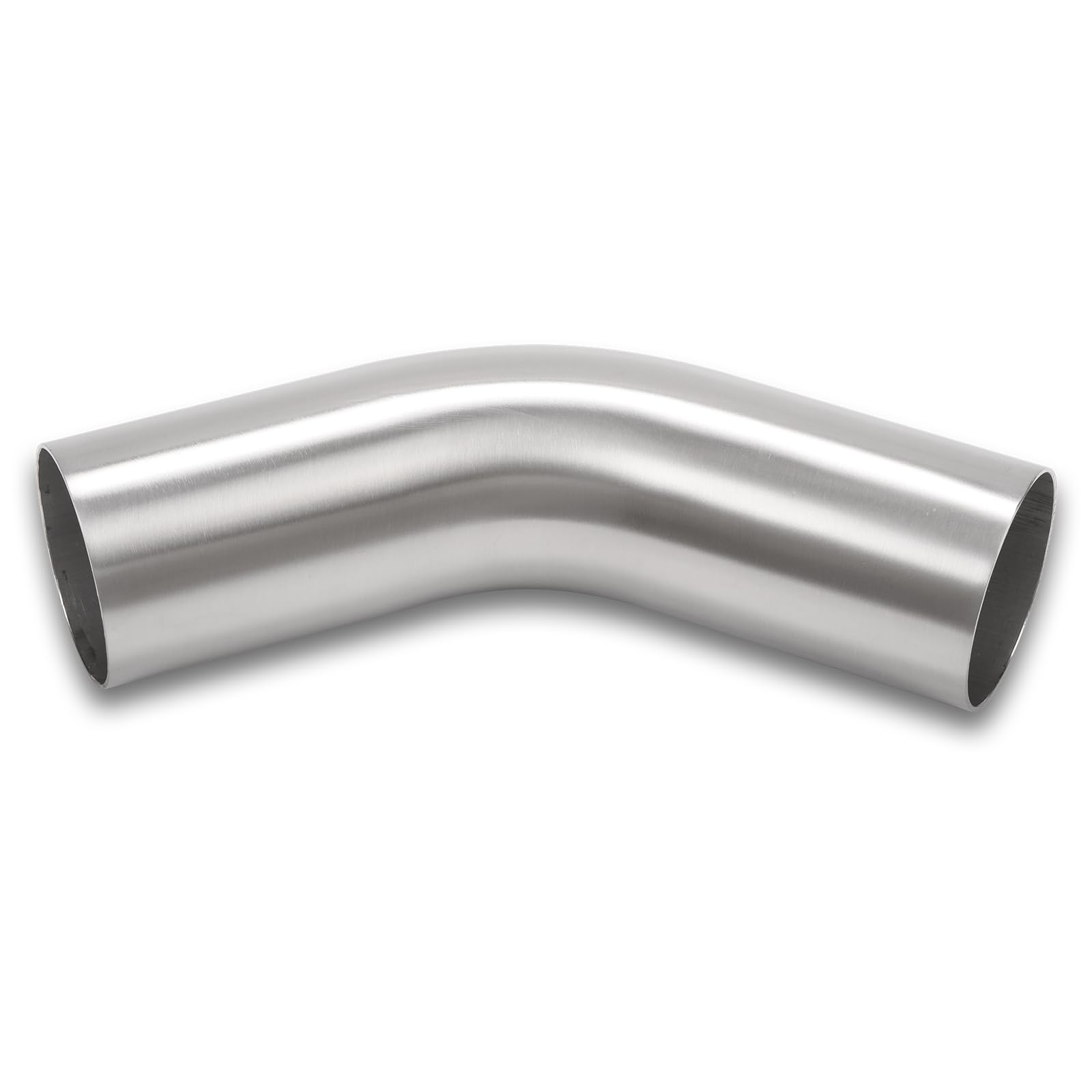
Podavelle’s 45-degree elbow rounds out the intake plumbing options with a gentle directional change that introduces minimal flow disturbance. The 1.5D centerline radius and mandrel-bent T6061 construction deliver the same unrestricted internal bore as the 90-degree sibling, but at a shallower angle suited for gradual transitions.
With a 0.071-inch wall thickness and brushed aluminum finish, this elbow integrates seamlessly with other Podavelle components or mixed-brand piping. The 3.94-inch straight legs give couplers enough purchase for a leak-free seal, and the lightweight construction reduces overall system mass.
This is an entry-level priced component that does not compromise on material quality or bend smoothness. It works well for intake tubes, intercooler piping, or any 3-inch system requiring a mild angle change. The 45-degree bend limits its use to specific routing situations — not a primary bend for tight 90-degree turns.
What works
- Gentle 45-degree angle with 1.5D radius for smooth flow
- Same T6061 alloy and wall thickness as premium elbows
- Lightweight construction reduces system mass
What doesn’t
- Limited to applications needing a 45-degree bend
- No humps or beads on ends for clamp retention
Hardware & Specs Guide
Mandrel Bending vs. Press Bending
Mandrel bending uses an internal support rod that prevents the tube wall from collapsing or wrinkling during the bend process. The result is a consistent inner diameter throughout the curve, which maintains cross-sectional area and prevents localized velocity spikes. Press bending, often found on cheaper tubing, flattens the inside radius and creates turbulence. Every product in this guide uses mandrel-formed bends.
T6061 Aluminum vs. T304 Stainless Steel
T6061 aluminum offers good strength, light weight, and easy weldability — ideal for intercooler and cold-side intake piping where temperatures stay below 400°F. T304 stainless steel handles higher exhaust-side temperatures (up to 1500°F) and resists corrosion from road salt and moisture. The trade-off is weight: stainless sections weigh roughly three times more than equivalent aluminum pieces. Choose based on the tube’s location in the system.
Wall Thickness and Clamp Load
Intake and intercooler tubes typically use 0.065 to 0.071-inch wall thickness. Thinner walls (0.049 inch) can collapse under worm-gear clamp torque or boost pressure spikes. Thicker walls (0.083 inch and above) add unnecessary weight and make welding more difficult without a chamfered edge. The 0.071-inch wall found on most products here provides a good balance of rigidity and workability.
Centerline Radius (CLR) and Flow
Centerline radius refers to the distance from the center of the tube to the center of the bend arc. A 1.5D CLR (4.5 inches for 3-inch tube) produces lower pressure drop than a 1.3D CLR (3.9 inches) because the air changes direction more gradually. For forced-induction systems where every tenth of a psi counts, the 1.5D radius is preferred. For naturally aspirated setups or clearance-limited builds, the 1.3D radius is a practical compromise.
FAQ
What does 1.5D radius mean for a 3-inch intake tube?
Can I weld aluminum intake tube to stainless steel piping?
Is a 3-inch intake tube too large for a naturally aspirated engine?
How do I prevent silicone couplers from blowing off under boost?
Final Thoughts: The Verdict
For most buyers, the best 3-inch intake tube winner is the Airaid AIR-200-996 M.I.T. because it delivers vehicle-specific fitment, modular expandability, and eliminates the guesswork of custom fabrication. If you want corrosion-resistant material for a custom charge pipe layout, grab the BIGREAT 30-inch stainless 2-pack. And for a complete budget-friendly drop-in system, nothing beats the AICARS Universal Cold Intake Kit.

Certification: BSc in Mechanical Engineering
Education: Mechanical engineer
Lives In: 539 W Commerce St, Dallas, TX 75208, USA
Md Amir is an auto mechanic student and writer with over half a decade of experience in the automotive field. He has worked with top automotive brands such as Lexus, Quantum, and also owns two automotive blogs autocarneed.com and taxiwiz.com.