A failed catalytic converter turns your daily driver into a constant source of warning lights, failed emissions tests, and that unmistakable rotten-egg smell. Choosing the right replacement means understanding the difference between a part that quietly does its job and one that creates new headaches. The three-inch format is common on trucks, vans, and performance builds, where exhaust volume demands a larger core.
I’m Amir — the founder and writer behind Four Wheel Ask. I spend my time digging through emissions compliance documentation, comparing substrate density claims, and cross-referencing thousands of owner reports to separate the converters that actually keep the check engine light off from those that create more diagnostic trouble codes.
Whether you are chasing a persistent P0420 code or prepping a vehicle for its next smog check, the right choice depends on fitment strategy, precious metal loading, and legal jurisdiction. Based on emissions data and owner reports, the best 3-inch catalytic converter delivers compliance without sacrificing exhaust flow.
How To Choose The Best 3-Inch Catalytic Converter
Selecting a replacement catalytic converter involves more than matching pipe diameter. Emissions legality, substrate quality, installation method, and vehicle-specific fitment all factor into whether the part solves your problem or creates new ones. Understanding these variables helps you avoid the common pitfalls of premature failure, persistent codes, and failed inspections.
EPA vs CARB Compliance — Know Your State
Federal EPA-compliant converters are legal in most states, but California, Colorado, New York, and Maine require CARB-approved units with an executive order number. Installing an EPA-only converter in a CARB-restricted state means automatic inspection failure. Always verify your state’s aftermarket converter regulations before purchasing. The product data provided clearly labels which units carry CARB certification and which are restricted to federal emissions standards only.
Direct-Fit vs Universal Installation
Direct-fit converters use vehicle-specific flanges and hangers for bolt-on installation, making them the faster choice for DIY replacements. Universal converters require cutting the existing exhaust pipe and welding or clamping the new unit in place, which allows flexibility in placement but demands more fabrication skill. Direct-fit units typically come with all necessary gaskets and hardware, while universal converters require you to source sealing components separately.
Substrate Quality and Cell Count
The ceramic substrate inside the converter contains the precious metal catalysts — platinum, rhodium, and palladium — that drive the chemical conversion of CO, HC, and NOx. Higher cell density (typically 400 to 600 cells per square inch) increases surface area for better conversion efficiency but can restrict flow. Standard-grade converters use lower cell counts suitable for older OBDI vehicles, while HM (High-Mileage) grade units pack extra catalyst material for improved conversion on higher-mileage engines.
Build Quality Indicators
Stainless steel shells resist corrosion far better than aluminized steel, particularly in regions with road salt. Weld quality matters — inconsistent welds can lead to shell separation or exhaust leaks within a few years. The presence of properly positioned O2 sensor bungs, heat shields, and reinforcement dimples in the shell all signal a manufacturer that invested in durability testing over basic cost reduction.
Quick Comparison
On smaller screens, swipe sideways to see the full table.
| Model | Category | Best For | Key Spec | Amazon |
|---|---|---|---|---|
| MagnaFlow 93419 | Direct-Fit | OEM-grade replacement | HM Grade, 5yr/50k mi warranty | Amazon |
| Walker CalCat 80907 | Universal | CARB-required states | 3″ ID, stainless steel body | Amazon |
| Anytek | Direct-Fit | GM truck owners | 409L stainless, EPA compliant | Amazon |
| Flowmaster 2230125 | Universal | Budget-conscious builds | 2.5″ ID, Federal EPA | Amazon |
| MagnaFlow 94009 | Universal | True 3″ pipe conversion | 3″ in/out, 5yr warranty | Amazon |
| maXpeedingrods | Direct-Fit | Chrysler/Dodge/Jeep 2.4L | EPA compliant, bolt-on | Amazon |
| ZHRUIHAN | Direct-Fit | Ford E-Series vans | 4.6L V8, lifetime warranty | Amazon |
In‑Depth Reviews
1. MagnaFlow 93419 Catalytic Converter

The MagnaFlow 93419 is a direct-fit HM Grade converter designed for 1999–2006 Chevrolet Silverado 1500 and 2000–2006 Tahoe applications. State-of-the-art 3D scanning ensures the flanges, hanger positions, and pipe routing match the OEM layout exactly, so installation requires no cutting or custom fabrication. The clamshell stainless steel body uses mandrel-bent piping and precisely manufactured flared receivers to maintain consistent flow diameter through every joint.
Owner reports on 5.3L applications consistently note that the check engine light stayed off after installation and that the converter eliminated the exhaust smell that straight-piped trucks produce. The HM Grade designation means additional catalyst loading compared to standard-grade units, which translates to higher conversion efficiency — particularly important for higher-mileage engines that produce more raw emissions. The included hardware covers all mounting points, though one owner noted the donut gasket was slightly oversized and chose to reuse the original.
Thread quality on the O2 sensor ports drew a mixed response: most installations went smoothly, but one report documented stripped threads that made sensor removal difficult on future service. This appears to be an occasional QC variance rather than a design flaw. The 5-year/50,000-mile warranty provides construction and emissions coverage that matches or exceeds what most OE converters carry.
What works
- Direct-fit design eliminates cutting and welding
- HM Grade extra catalyst loading improves conversion on high-mileage engines
- Stainless steel clamshell construction resists corrosion
- Owners report noticeable performance gain and quieter exhaust
What doesn’t
- Donut gasket may need to be swapped with original for perfect seal
- Occasional reports of O2 sensor threads stripping
- Premium pricing places it above budget alternatives
2. Walker CalCat 80907 Universal Catalytic Converter

The Walker CalCat 80907 is one of the few universal converters that carries full CARB approval with executive order D-182-55, making it legal for installation in California, Colorado, New York, and Maine. It accepts 3-inch inlet and outlet connections and uses expandable bushings that adapt to slight pipe diameter variances, which simplifies fitment on older vehicles where the exhaust tubing may not be perfectly round. The stainless steel body is paired with aluminized pipe sections and integrated heat shields for thermal management.
Owner feedback on pre-OBDII applications is remarkably consistent: vehicles that had been failing smog checks for years with NOx readings above 1,800 ppm dropped to single-digit NOx levels after installing this converter. One 1993 Chevy K1500 owner reported NOx fell from over 1,800 ppm to just 2–15 ppm, with CO2 and HC readings in the low 20s, after the 100-mile break-in period. The initial burning smell during the first heat cycle is normal as the catalyst materials cure and fades after a few drive cycles.
Installation requires cutting the existing exhaust and either welding or using heavy-duty clamps. The universal design means you position the converter exactly where it fits best under the vehicle, which helps avoid clearance issues that sometimes plague direct-fit units on modified chassis. The 50,000-mile emissions warranty provides solid coverage, though the lack of pre-attached flanges means installation quality is entirely dependent on the installer’s fabrication skill.
What works
- Full CARB approval for restricted states
- Dramatically reduces NOx emissions based on owner test data
- Expandable bushings accommodate imperfect pipe dimensions
- Stainless steel body with heat shields for durability
What doesn’t
- Requires cutting and welding for installation
- Universal design lacks vehicle-specific mounting hardware
- Not designed for OBDII vehicles in CARB states
3. Anytek Catalytic Converter for Chevy/GMC Trucks
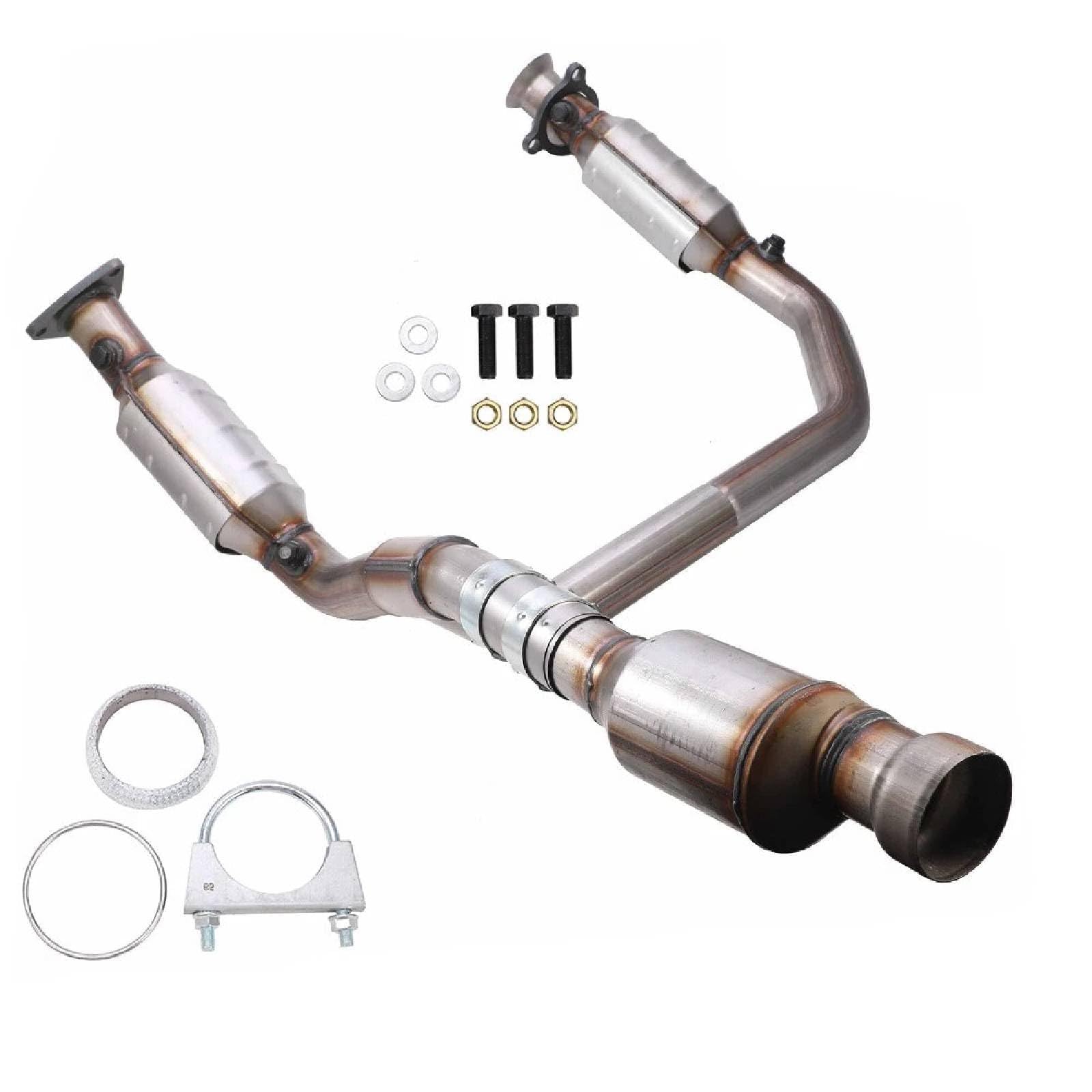
The Anytek converter targets the massive installed base of Chevrolet Silverado 1500, Suburban, GMC Sierra, and Yukon trucks with 4.3L V6 and 5.3L V8 engines from 2014 through 2020. It references OEM numbers 645159, 50497, 50563, 60499, and 52642, which covers the most common left-side and right-side positions on these platforms. The 409L stainless steel shell provides good corrosion resistance at a price point that undercuts OEM replacement by a wide margin.
Owner reports indicate substantial savings — one buyer replaced two converters for roughly per side versus local shop quotes of – per converter. The vehicle passed emissions and inspection without issue. Another owner on a 2014 Silverado 5.3L noted that the clamped seams did not seal completely and required welding to eliminate exhaust leaks, which is a common expectation with universal-style joints even on direct-fit chassis.
A detailed report on a 2009 Hummer H3 3.7L installation revealed a more specific concern: after several heat cycles, the collector flange warped slightly and began contacting the bellhousing, producing a vibration under acceleration. This suggests the shell thickness or material temper may be lighter than OEM specifications. The unit resolved the P0420 code and passed emissions, so the functional outcome was positive, but the clearance shift warrants attention during installation fitment checks.
What works
- Direct-fit design for popular GM truck platforms
- Significant cost savings versus OEM and local shop pricing
- Resolves P0420 codes and passes emissions tests
- 409L stainless offers solid rust resistance
What doesn’t
- Clamped seams may need welding for complete seal
- Shell warpage reported after thermal cycling on some installs
- Not CARB approved — restricted in four states
4. Flowmaster 2230125 Universal Catalytic Converter
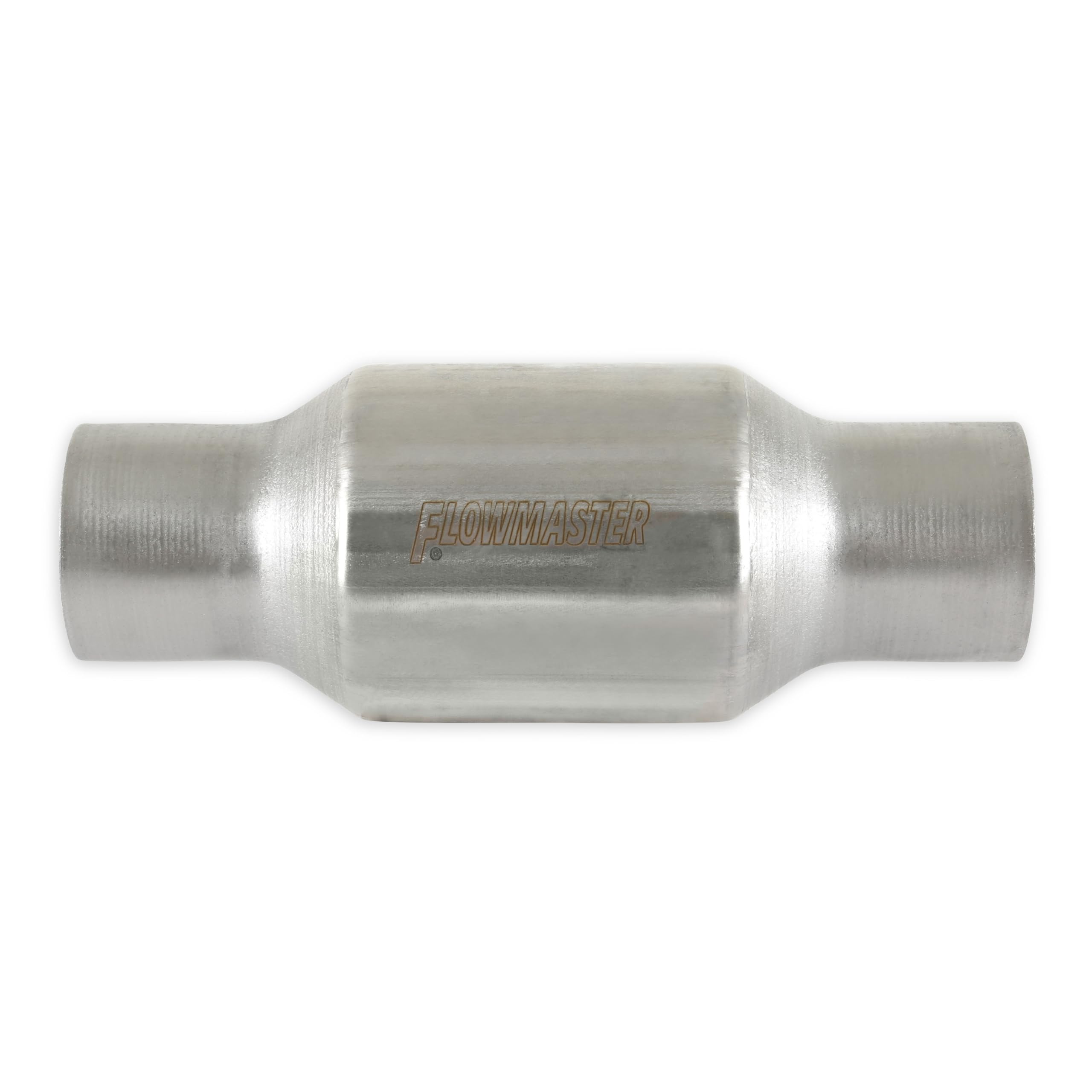
The Flowmaster 2230125 is a universal 2.5-inch standard-duty converter from a brand known primarily for performance exhaust systems. It carries Federal EPA certification for pre-OBDII and OBDII applications where CARB approval is not required. The unit measures roughly 10.5 by 4 by 4 inches, making it compact enough to fit in tight underbody spaces where longer converters would contact frame rails or body panels.
Owner reports cover a wide range of builds. A 1969 Coronet with a 6.4 Hemi passed Arizona emissions after installing this converter, with the owner noting significant smog reduction and the elimination of exhaust fumes inside the cabin. A G8 owner reported the unit fit perfectly and kept the check engine light off after two weeks of driving. However, the 2.5-inch dimension refers to the inner diameter — the outer diameter is larger, which means standard 2.5-inch exhaust clamps will not fit without modification unless the installer accounts for this difference.
Long-term durability data is mixed. One Subaru owner reported the core rattled and broke out after approximately two years of service, which is a short lifespan compared to higher-grade units. The plastic component material listed in the specifications raises questions about shell integrity over time, though many owners report multiple years of trouble-free service. The faint gas smell noted by some owners during the break-in period is typical for standard-grade converters and should diminish as the catalyst bed stabilizes.
What works
- Compact size fits tight installation spaces
- Helps older vehicles pass emissions tests
- Budget-friendly entry point for Federal EPA compliance
- Good flow characteristics for performance builds
What doesn’t
- 2.5″ ID means standard clamps don’t fit OD directly
- Core durability concerns with some units failing around two years
- Welding quality reported as inconsistent on some samples
5. MagnaFlow 94009 Universal Catalytic Converter

The MagnaFlow 94009 is a universal standard-grade converter with true 3-inch inlet and outlet piping, making it a straightforward choice for anyone building or repairing an exhaust system that already uses 3-inch tubing. It is EPA pre-OBDII compliant, meaning it is designed for 1995 and older vehicles, though it can be used on OBDII vehicles outside the four CARB-restricted states. The stainless steel clamshell body uses continuous seam welding for thermal insulation that keeps heat inside the substrate where it belongs.
Owner feedback on this unit is remarkably consistent. Multiple buyers describe it as a well-built converter that eliminated the raw exhaust smell from previously straight-piped vehicles. One owner running a turbo project car reported that the vehicle passed its OBD self-test within two miles of installation, indicating that the catalyst lights off quickly. A motorhome owner with a Workhorse W-22 chassis confirmed the fitment worked perfectly and that the converter was still functioning after 7,000 miles of heavy-duty use.
The universal design means you must cut the existing exhaust and weld or clamp the converter in place, and professional installation is recommended. The integrated O2 ports are positioned to match OEM locations on most applications, though you may need to extend or modify sensor wiring depending on where the converter lands in the exhaust path. The 5-year/50,000-mile construction warranty with a 25,000-mile emissions warranty provides solid protection for the price tier.
What works
- True 3-inch piping matches aftermarket exhaust systems
- Eliminates exhaust smell from straight-piped vehicles
- Quick catalyst light-off based on OBD self-test data
- Continuous seam weld improves thermal efficiency
What doesn’t
- Universal installation requires cutting and welding
- Not CARB compliant — restricted in four states
- Pre-OBDII designation limits legal use on some newer vehicles
6. maXpeedingrods Catalytic Converter for Chrysler/Dodge/Jeep
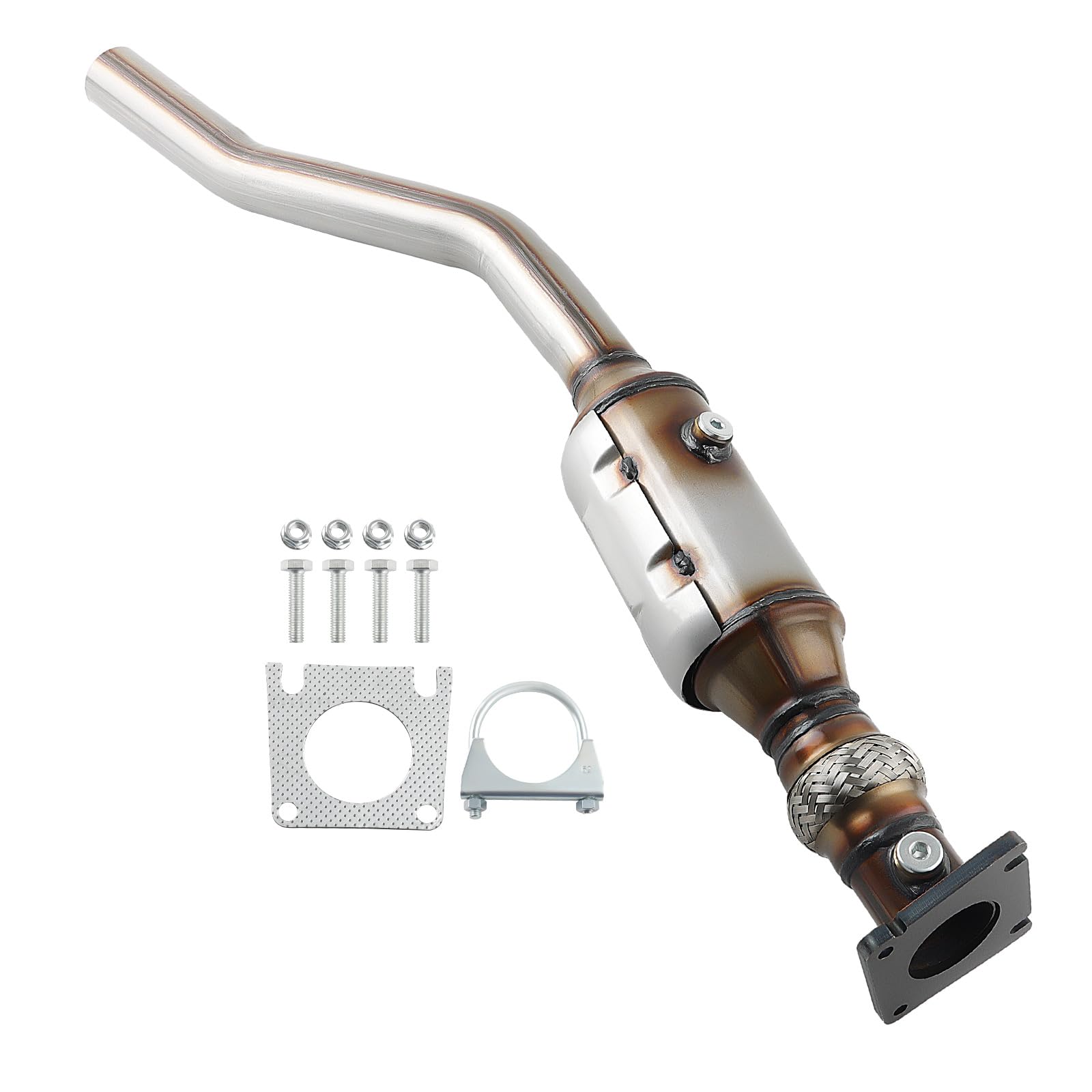
The maXpeedingrods converter is a direct-fit EPA-compliant unit covering a broad range of Chrysler, Dodge, and Jeep platforms with 1.8L, 2.0L, and 2.4L engines from 2007 through 2018. Vehicle coverage includes the Chrysler 200 and Sebring, Dodge Avenger, Caliber, and Journey, plus the Jeep Compass and Patriot. The converter ships with all required gaskets and hardware, so no additional parts need to be sourced for installation.
Owner reports consistently highlight the ease of installation. Multiple buyers completed the swap in one to four hours using basic hand tools and penetrating oil on the flange bolts. The check engine light turned off after a few miles of driving in every documented case, confirming that the converter resolved the P0420 code that prompted the replacement. One owner noted that the converter is noticeably louder than the factory California-emissions unit, describing a sound similar to an exhaust leak despite no actual leak being present — likely a characteristic of the high-flow substrate design.
The internal ceramic substrate uses platinum, rhodium, and palladium catalysts, and the honeycomb structure is designed to convert CO, HC, and NOx efficiently. The 12.35-pound weight and 41.73-inch overall length indicate this is a full-length assembly that replaces the entire converter section from the manifold flange to the intermediate pipe connection. One owner cautioned that keeping the engine properly tuned is important to prevent premature catalyst burnout, which is good advice for any converter installation.
What works
- Bolt-on direct-fit with all gaskets and hardware included
- Covers a wide range of Chrysler/Dodge/Jeep applications
- Check engine light turns off within a few miles
- Full-length assembly replaces entire converter section
What doesn’t
- High-flow design produces more exhaust noise than factory unit
- Not CARB compliant — restricted in four states
- Long-term durability still unproven as a relatively new product
7. ZHRUIHAN Catalytic Converter for Ford E-Series
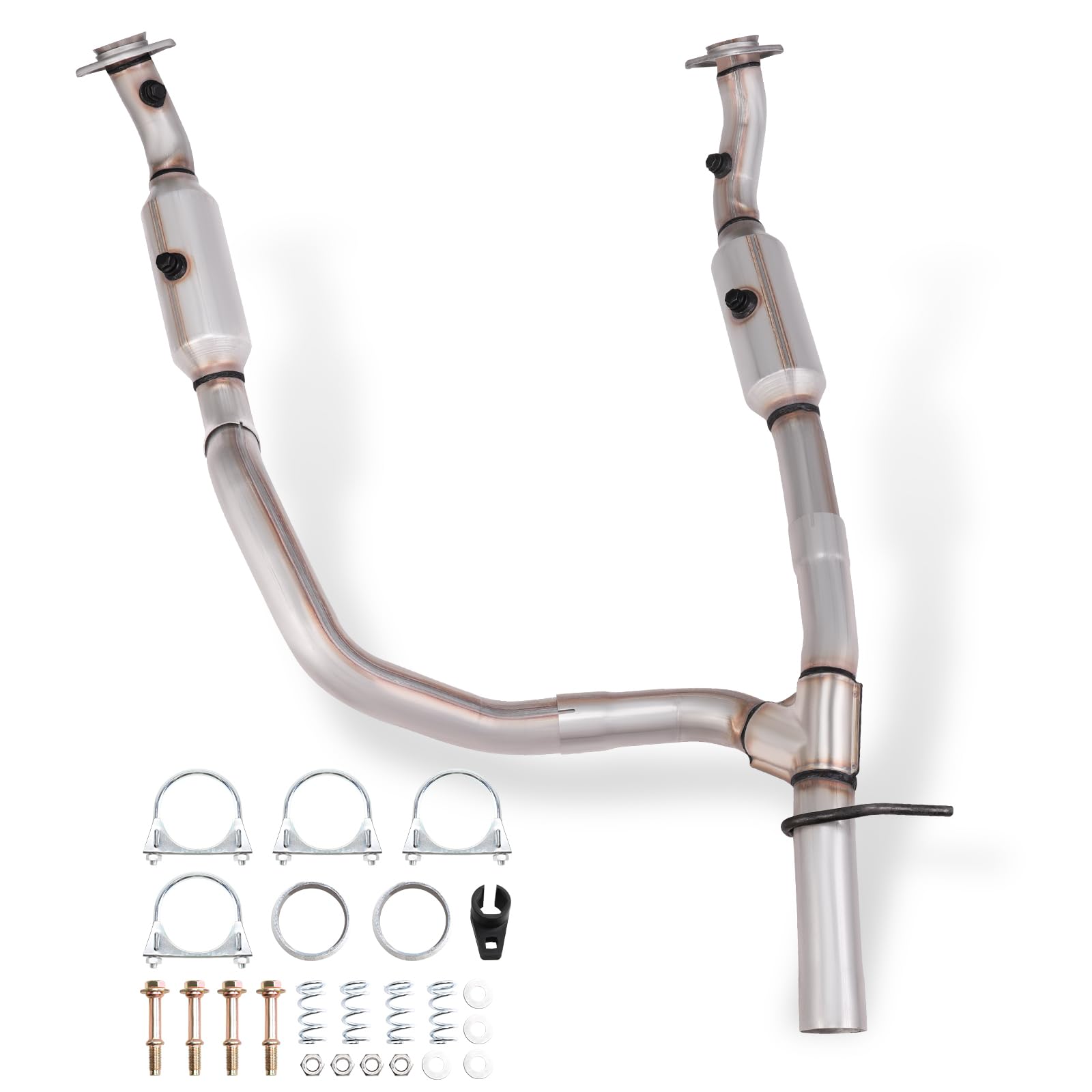
The ZHRUIHAN converter is a direct-fit unit engineered for Ford E-Series vans — the E150 and E250 — with the 4.6L V8 engine from 2009 through 2014. It references OEM numbers 645789 and 3041038, covering the most common replacement positions on these workhorse platforms. The body is constructed from thickened stainless steel with automated welding, and the internal ceramic substrate contains platinum, rhodium, and palladium catalysts. The manufacturer backs the unit with a lifetime warranty, which is unusually strong for this price tier.
Owner feedback is mixed. Positive reports confirm the converter fits exactly on 2006 F-250 and 2020 F-150 5.0L applications — notably broader than the listed E-Series fitment — and one buyer specifically praised the included oxygen sensor tool and the quality of the packaging. Another owner reported the installation was straightforward and the part functioned correctly. However, one detailed complaint documented a worst-case scenario: installing the converter to resolve a bank 2 code resulted in six new diagnostic trouble codes all related to the replacement part, with the check engine light illuminated continuously.
The 25-pound weight and substantial 29 by 18 by 9-inch package dimensions suggest robust construction, but the mixed review data indicates quality control may be inconsistent. The lifetime warranty mitigates some of the risk — if the unit fails or causes issues, replacement is covered — but the labor cost to R&R a van converter is not insignificant. This unit is best suited for buyers who are comfortable troubleshooting potential post-installation issues and who value the warranty safety net over guaranteed first-time fitment.
What works
- Heavy-gauge stainless steel construction
- Lifetime warranty provides long-term coverage
- Includes useful installation tools like an O2 sensor socket
- Direct-fit design simplifies installation on E-Series vans
What doesn’t
- Quality control issues reported with some units causing multiple new codes
- Listed fitment may be narrower than actual vehicle coverage
- Heavy weight makes handling during installation more difficult
Hardware & Specs Guide
Substrate Cell Count and Precious Metals
The ceramic honeycomb inside a catalytic converter is measured in cells per square inch (CPSI). Standard-grade converters typically use 200–300 CPSI substrates, which flow freely but convert less efficiently. HM Grade and CARB-approved units often use 400–600 CPSI substrates with higher loading of platinum, rhodium, and palladium. More cells mean more surface area for chemical reactions but also more exhaust restriction. Vehicles with larger engines or performance modifications benefit from the flow of standard-grade units, while high-mileage daily drivers need the extra conversion capacity of HM Grade.
Stainless Steel vs Aluminized Shells
The outer shell protects the ceramic substrate from physical impact and corrosion. Stainless steel shells — 409L or 304 grades — resist rust far longer than aluminized steel, especially in regions where road salt is used during winter. Continuous seam welding, as used on MagnaFlow clamshell designs, provides better thermal insulation than spot-welded shells because it prevents heat from escaping through gaps in the seams. Heat retention is critical for maintaining catalyst operating temperature, particularly on short trips where the converter may not reach light-off temperature.
O2 Sensor Port Placement
Proper oxygen sensor positioning is essential for accurate air-fuel ratio readings. Universal converters typically include one or two threaded bungs that you position during installation, while direct-fit units have pre-welded ports that match the OEM locations. The distance between the sensor and the converter face affects how quickly the sensor reads the exhaust stream. Ports that are too close to the converter can read artificially clean exhaust, causing the ECU to lean out the mixture and potentially damage the engine.
Welding vs Clamp Installation
Universal converters require the installer to cut the existing exhaust pipe and attach the new converter using either welding or mechanical clamps. Welding creates a permanent, leak-free joint but requires skill and equipment. Clamps are easier to install and allow future removal, but they are more prone to leaking over time, especially on systems that experience thermal cycling. Many owners who start with clamps eventually weld the joints after experiencing leakage. Direct-fit converters with factory flanges eliminate this decision entirely, providing a gasket-sealed joint that matches the original assembly.
FAQ
Will a universal catalytic converter work as well as a direct-fit unit?
How do I know if a converter is legal in my state?
Why does my new catalytic converter smell like exhaust during the first few drives?
Can I install a 3-inch converter on a vehicle with smaller exhaust piping?
How long should a catalytic converter last before needing replacement?
Final Thoughts: The Verdict
For most buyers, the best 3-inch catalytic converter winner is the MagnaFlow 93419 because it combines direct-fit convenience with HM Grade catalyst loading that actually keeps the check engine light off and passes emissions. If you need CARB compliance for a restricted state, grab the Walker CalCat 80907 — its NOx reduction performance is backed by consistent owner test data. And for the best value on a tight budget, nothing beats the Anytek if your truck needs a quick, cost-effective fix for a P0420 code.

Certification: BSc in Mechanical Engineering
Education: Mechanical engineer
Lives In: 539 W Commerce St, Dallas, TX 75208, USA
Md Amir is an auto mechanic student and writer with over half a decade of experience in the automotive field. He has worked with top automotive brands such as Lexus, Quantum, and also owns two automotive blogs autocarneed.com and taxiwiz.com.