A 3/8-inch drive torque wrench is the precision instrument that bridges the gap between brute force and delicate assembly, ensuring critical fasteners on engines, suspension components, and machinery are tightened to exact specifications without the risk of stripping threads or distorting gaskets. Unlike a standard ratchet, this tool delivers a controlled, repeatable force that protects both the hardware and the component it secures, making it indispensable for anyone who values mechanical integrity over guesswork.
I’m Amir — the founder and writer behind Four Wheel Ask. I’ve spent years analyzing torque wrench designs, from micrometer click mechanisms to split-beam systems, digging into build materials, calibration standards, and real-world accuracy across countless user reports to find the models that consistently deliver reliable performance.
After evaluating dozens of options based on precision tolerances, build durability, and ease of use, I’ve narrowed the field to the most trustworthy picks. This guide breaks down everything you need to know to confidently select the best 3/8 torque wrench for your specific work.
How To Choose The Best 3/8 Torque Wrench
Selecting the right 3/8-inch drive torque wrench requires understanding the specific demands of your projects — a 20-100 ft-lb range works well for engine work and suspension bolts, while a 50-250 in-lb range is better suited for delicate fasteners on small engines and bicycles. Your choice between a micrometer click and a split-beam design will directly affect both ease of use and long-term accuracy.
Micrometer Click vs. Split-Beam Mechanism
The vast majority of 3/8 torque wrenches use a micrometer-style adjustment where you turn the handle to set the desired torque value, and an audible click signals when that value is reached. These wrenches must be stored at their lowest setting to preserve spring tension and calibration accuracy. Split-beam wrenches, by contrast, use a separate beam to set the torque value, allowing them to be stored at any setting without degrading accuracy — a clear advantage for shop use where frequent adjustments are the norm.
Torque Range and Accuracy Ratings
A 3/8-inch drive is the mid-size workhorse, typically covering torque ranges from around 10-80 ft-lb up to 20-100 ft-lb or even higher for some premium models. Accuracy is rated by standards like ASME B107.300-2010, with common claims of +/- 4% or +/- 3% accuracy. Stick to the middle 80% of the wrench’s range for best accuracy — avoid operating at the extreme low or high ends of the scale where precision degrades.
Build Quality, Ratchet Teeth, and Handle Design
The internal ratchet mechanism’s tooth count determines how much swing arc you need to engage the next tooth — a 45-tooth gear requires roughly 8 degrees of rotation, while a 72-tooth gear requires just 5 degrees, making it invaluable in tight engine bays. The handle material and grip design affect comfort during repeated use, and a reversible ratchet head allows you to apply torque in both clockwise and counterclockwise directions.
Quick Comparison
On smaller screens, swipe sideways to see the full table.
| Model | Category | Best For | Key Spec | Amazon |
|---|---|---|---|---|
| TEKTON TRQ62103 | Split-Beam | All-Day Shop Work | 20-100 ft-lb / 72-tooth | Amazon |
| GEARWRENCH 85062M | Micrometer | Precision Assembly | 10-100 ft-lb / Flex Head | Amazon |
| Wera Click-Torque B2 | Micrometer | European Metric Work | 20-100 Nm / +/- 3% | Amazon |
| Park Tool TW-6.2 | Micrometer | Bicycle & Small Engine | 10-60 Nm / 3/8-Inch Drive | Amazon |
| DEWALT DWMT75463 | Micrometer | General Automotive | 20-100 ft-lb / Locking Trigger | Amazon |
| eTORK C2250 | Micrometer (in-lb) | Low-Torque Precision | 50-250 in-lb / 45-Tooth | Amazon |
| LEXIVON LX-182 | Micrometer | Entry-Level Value | 10-80 ft-lb / Cr-V Alloy | Amazon |
In‑Depth Reviews
1. TEKTON 3/8 Inch Drive 72-Tooth Split Beam Torque Wrench (TRQ62103)

The TEKTON TRQ62103 redefines shop-floor efficiency with its split-beam architecture, allowing you to store it at any torque setting without spring fatigue — a feature that makes it a permanent fixture in any pro toolbox. Its 72-tooth ratchet requires only 5 degrees of swing arc, which is a massive advantage when working on cramped suspension components or deep inside an engine bay. Each unit ships with a serialized calibration certificate traceable to ASME B107.300-2010, verifying its +/- 4% accuracy across the entire 20-100 ft-lb range.
The smooth-turning thumbscrew lets you dial in precise settings quickly, and the flip-up lock cover secures the value during use, eliminating accidental bumps mid-job. The polished alloy steel finish resists corrosion, and the included storage case keeps everything organized. Unlike micrometer wrenches that require a cumbersome lock ring at the base, TEKTON’s design relies purely on the thumbscrew and cover, which feels more intuitive and faster to operate.
Owner reports consistently praise its repeatable click feel and the confidence it inspires on critical fasteners like cylinder head bolts and control arm nuts. The only trade-off is the lack of a reversible ratchet direction switch on the head — you have to flip the square drive manually. Still, for a wrench that eliminates the need to reset to zero after every use, this is a minor concession for exceptional daily usability.
What works
- Can be stored at any torque setting without losing calibration
- 72-tooth ratchet provides a tight 5-degree swing arc for tight spaces
- Smooth thumbscrew adjustment with positive lock cover
What doesn’t
- Ratchet head does not have a built-in direction lever
- Higher initial investment compared to basic micrometer models
2. GEARWRENCH 3/8″ Drive Micrometer Torque Wrench 10-100 ft/lbs (85062M)

The GEARWRENCH 85062M brings a micrometer-style mechanism to the premium tier with a twist — a quick-adjustment collar on the handle that lets you change torque values without fumbling with a lock ring at the base. Its flex-head design pivots to reach fasteners that would otherwise require awkward extensions or universal joints, and the thin-profile teardrop head slips into tight clearance zones around suspension turrets and engine brackets. The knurled aluminum handle reduces hand fatigue during extended sessions, and the high-visibility markings are printed in large, easy-to-read characters.
Accuracy is rated at +/- 4% with calibration certification included, and the reversible ratchet works smoothly in both directions. The 10-100 ft-lb range gives you a wider low-end than the TEKTON, making this a better fit for lighter-duty fasteners like intake manifold bolts while still covering the full spectrum of chassis work. The polished chrome finish resists garage grime effectively.
Long-term users report that the quick-adjustment collar remains smooth even after years of use, and the flex head holds its position without sagging mid-pull. The main criticism is that the flex mechanism can feel slightly loose to some users, though this is inherent to the design and does not affect accuracy. For mechanics who need a do-it-all micrometer wrench with excellent ergonomics, this is a top contender.
What works
- Flex head provides access to awkward fasteners without extensions
- Quick-adjustment collar simplifies torque setting changes
- Wider 10-100 ft-lb range covers light to medium torque applications
What doesn’t
- Flex head may feel loose to some users during use
- Must be stored at lowest setting to maintain calibration
3. Wera Click-Torque B2 3/8″ Drive Torque Wrench (5075611001)

The Wera Click-Torque B2 is a testament to German engineering focus on feel and precision, delivering the tightest accuracy rating in this lineup at +/- 3% per DIN EN ISO 6789-1:2017-07. Its 45-tooth ratchet provides a solid engagement feel with a crisp release when the preset torque is reached, and the two-component handle is sculpted for right-hand use, offering a secure grip even with oily gloves. The adjustment mechanism requires you to pull a locking ring before rotating the handle, which prevents accidental changes but adds a step to the process.
The 20-100 Nm range (approximately 14.7-73.7 ft-lb) is ideal for metric fasteners common on European vehicles and industrial machinery, though it may not cover the higher torque demands of truck or large SUV suspension bolts. The square drive is reversible, and the brushed finish gives it a professional look that resists shop grime. Wera includes a certificate of calibration with each unit, confirming its tighter tolerance out of the box.
Users consistently note the exceptional repeatability of the click mechanism — it delivers the same tactile feedback pull after pull without softening. The main downside is that the locking ring adjustment is stiffer than competitors, and the torque range is expressed in Nm only, with no direct ft-lb scale on the handle. For anyone working primarily with metric hardware and valuing top-tier accuracy, this wrench is hard to beat.
What works
- Industry-leading +/- 3% accuracy for critical fasteners
- Ergonomic 2-component handle reduces hand fatigue during repetitive use
- Secure locking ring prevents accidental torque value changes
What doesn’t
- Nm-only scale may require conversion for SAE users
- Locking ring adjustment feels stiff and requires two hands
4. Park Tool TW-6.2 Ratcheting Torque Wrench 10-60Nm

Park Tool has long been the gold standard for bicycle-specific tools, and the TW-6.2 reflects that specialization with a 10-60 Nm range that perfectly matches the torque requirements of carbon frame components, disc brake calipers, and derailleur bolts. The dial-adjust click system is intuitive and tactile, with a clear index that makes it easy to set values without squinting at a scale. The 3/8-inch drive is standard for bicycle sockets, and the reversible ratchet head works seamlessly for both drive directions.
The build quality is exceptional — the handle is both comfortable and grippy, and the ratchet mechanism uses 3/8-inch drive fittings that are standard in the bike world. Park Tool includes a protective case, and the tool is designed to be serviced and recalibrated through their network. The blue and black finish is distinctive and easy to spot among other tools in a busy shop drawer.
Bicycle mechanics and serious enthusiasts love the repeatable click and the confidence it brings to carbon frame work where overtightening can cause catastrophic damage. The only limitation is that its metric-only scale (newton-meters) means ft-lb users will need to convert, and the upper torque limit of 60 Nm (roughly 44 ft-lb) excludes automotive suspension and engine work. For its intended niche, this is the definitive choice.
What works
- Perfect 10-60 Nm range for bicycle and small engine fasteners
- Clear dial adjustment with tactile click feedback
- Built to Park Tool’s high serviceability and recalibration standards
What doesn’t
- Nm-only scale requires conversion for SAE and ft-lb users
- Limited to lower torque ranges, not suitable for most automotive work
5. DEWALT Torque Wrench, 3/8 inch Drive, 20-100 FT-LB (DWMT75463)
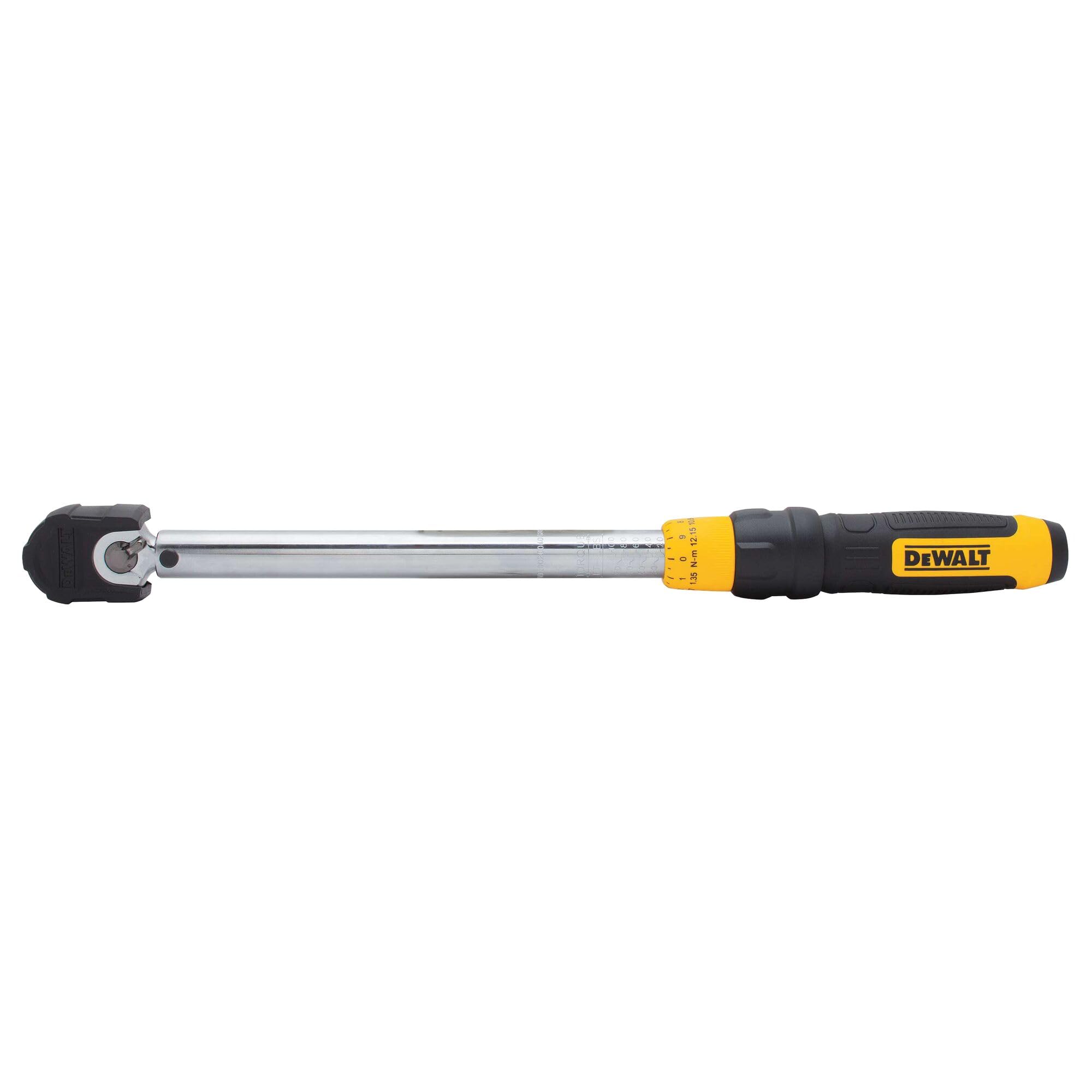
DEWALT brings its brand promise of durability and ergonomic design to the DWMT75463, a micrometer click-style torque wrench with a locking trigger mechanism that prevents accidental adjustment during use. The bi-material grip is comfortable for extended sessions, and the protective head bumper adds an extra layer of security against drops on concrete garage floors. The torque range covers 20-100 ft-lb, which is the sweet spot for most automotive work including lug nuts, suspension bolts, and intake manifolds.
The scale is marked in both ft-lb and Nm, with 1 ft-lb increments that allow fine adjustments. The reversible ratchet works smoothly, and the heavy-duty storage case keeps the wrench protected when not in use. DEWALT claims compliance with ASME/ISO/TAA standards, and the brushed finish is low-profile and resists corrosion. The locking trigger is a unique safety feature that locks the handle in place after setting, which prevents the torque value from creeping during use.
Users note that the wrench feels solid in hand and clicks distinctly at the set torque, though some have reported that the locking trigger can occasionally bind and feel stiff to unlock. The 20.3-inch length provides good leverage, but it can be unwieldy in tight spaces. For a mid-range option from a major brand with widespread dealer support, this is a dependable choice.
What works
- Locking trigger securely holds torque setting during use
- Bi-material grip improves comfort during long jobs
- Clear dual-scale markings in ft-lb and Nm
What doesn’t
- Locking trigger can bind and become stiff to operate
- Long handle difficult to maneuver in tight engine compartments
6. eTORK Click-Style Torque Wrench 3/8″ Drive 50-250 in-lb (C2250)

The eTORK C2250 fills an important niche for mechanics who need precise low-torque control in inch-pounds rather than foot-pounds, making it the go-to tool for small engine work, motorcycle fasteners, gunsmithing, and bicycle components. Its torque range of 50-250 in-lb (approximately 5.65-28.25 Nm) allows you to accurately tighten delicate bolts that a standard ft-lb wrench cannot even read. The high-visibility window design shows the torque setting clearly, eliminating parallax errors from looking at a traditional scale sleeve.
The 45-tooth ratchet provides a 8-degree swing arc, and the alloy steel construction feels solid despite the wrench’s compact 12.2-inch length. The green finish and carrying case make it easy to identify in a crowded toolbox. eTORK includes a protective case and positions this as an essential tool for both DIY and professional mechanics who deal with torque-critical small fasteners.
Users specifically highlight the clear click feedback at such low torque values — unlike some miniature wrenches that produce a muted click, the eTORK gives an audible and tactile release. The only common complaint is that the adjustment sleeve can be slightly stiff initially, requiring a firm grip to rotate. For anyone assembling firearms, rebuilding small engines, or maintaining modern bicycle groupsets, the inch-pound eTORK is the right specialized tool.
What works
- Inch-pound scale fills a gap for low-torque fastener precision
- High-visibility window reduces reading errors
- Clear audible and tactile click at low torque settings
What doesn’t
- Adjustment sleeve can be stiff to rotate initially
- Limited to 250 in-lb maximum, cannot handle higher torque jobs
7. LEXIVON 3/8-Inch Drive Click Torque Wrench 10~80 Ft-Lb (LX-182)

The LEXIVON LX-182 proves that you don’t need to spend a fortune for a usable click-type torque wrench. Its 10-80 ft-lb range covers the most common automotive and motorcycle fasteners, and the dual-range scale displays both ft-lb and Nm with highlighted yellow markings for low-light garage visibility. The reinforced ratchet gear head is made from hardened Chrome Vanadium alloy steel, and the Electro-Black finish treatment provides corrosion resistance that exceeds standard painted coatings.
Each unit ships pre-calibrated to +/- 4% accuracy with a traceable calibration certificate — the same accuracy rating as wrenches costing several times more. The reversible ratchet head drives in both directions, and the 14.76-inch length provides sufficient leverage for the upper torque range without being too long for confined spaces. The fixed square head design keeps the mechanism simple and reduces potential failure points.
DIY owners consistently mention that the wrench feels more substantial than budget sticker-type wrenches, with a clear click that inspires trust on oil pan bolts and caliper brackets. The trade-off is that the powder-coated finish can chip over time if dropped repeatedly, and the adjustment mechanism, while functional, lacks the silky smooth action of premium micrometer wrenches. For the entry-level buyer who needs reliable torque control on a budget, this is the clear winner.
What works
- Excellent value with pre-calibrated +/- 4% accuracy at entry-level price
- Highlighted yellow markings improve readability in low light
- Rust-resistant Electro-Black finish extends tool life
What doesn’t
- Powder-coated finish can chip with heavy use or drops
- Adjustment feel lacks the refinement of higher-end micrometer wrenches
Hardware & Specs Guide
Micrometer Click Mechanism
This is the most common design where you rotate the handle to compress a calibrated spring, and when the fastener reaches the preset torque, the mechanism releases with an audible “click” and a slight break in the handle. The spring tension is critical — always store these wrenches at their lowest setting to prevent spring fatigue and maintain calibration accuracy. The adjustment is typically locked using a knurled or locking collar at the base of the handle.
Split-Beam Mechanism
Split-beam wrenches use a separate beam and a mechanical stop to set the torque value, meaning the main spring is never under tension during storage. This design allows you to store the wrench at any setting without degrading accuracy over time. The adjustment is usually done via a thumbscrew on the body of the wrench rather than the handle, and the beam system provides a more distinct release feel compared to standard micrometer designs.
Accuracy Standards and Calibration
Most quality torque wrenches are rated to +/- 4% accuracy per ASME B107.300-2010, while premium models like the Wera Click-Torque B2 achieve +/- 3% per DIN EN ISO 6789-1:2017-07. These ratings apply when using the wrench in the middle 80% of its torque range. For optimal accuracy, you should recalibrate your torque wrench annually or after every 5,000 cycles, whichever comes first. Many manufacturers, including TEKTON and GearWrench, offer recalibration services.
Drive Size and Tooth Count
A 3/8-inch drive splits the difference between the larger 1/2-inch and the smaller 1/4-inch, offering the best combination of compact head size and torque capacity for medium-fastener jobs (10-100 ft-lb). The ratchet tooth count determines the minimum swing arc needed to engage the next click: 45 teeth = 8 degrees, 60 teeth = 6 degrees, and 72 teeth = 5 degrees. Higher tooth counts are essential for tight engine bays where swing space is limited.
FAQ
Should I store a micrometer torque wrench at its lowest setting?
What does a 3/8 torque wrench typically cost?
How do I know if my torque wrench needs recalibration?
Why would I need a split-beam over a micrometer torque wrench?
Final Thoughts: The Verdict
For most buyers, the best 3/8 torque wrench winner is the TEKTON TRQ62103 because its split-beam design eliminates storage worries while delivering a crisp, repeatable click and a 72-tooth ratchet for tight-space access. If you need a flex-head for awkward fastener angles and prefer a micrometer adjustment with a quick collar, grab the GEARWRENCH 85062M. And for low-torque precision in inch-pounds for small engines or bicycle work, nothing beats the eTORK C2250.

Certification: BSc in Mechanical Engineering
Education: Mechanical engineer
Lives In: 539 W Commerce St, Dallas, TX 75208, USA
Md Amir is an auto mechanic student and writer with over half a decade of experience in the automotive field. He has worked with top automotive brands such as Lexus, Quantum, and also owns two automotive blogs autocarneed.com and taxiwiz.com.