That rusted brake caliper bracket bolt that’s been soaking in penetrating oil for an hour? A 3/8 impact wrench is the tool that turns a twenty-minute fight into a thirty-second victory. The 3/8-inch drive platform offers the perfect middle ground: enough nut-busting torque to handle suspension and engine bay fasteners, yet compact enough to snake between control arms and behind wheel wells. This guide cuts through the marketing noise to identify the wrenches that genuinely deliver on power, access, and durability.
I’m Amir — the founder and writer behind Four Wheel Ask. I’ve spent years analyzing torque specifications, anvil retention systems, and battery platform ecosystems across hundreds of impact wrench models, while cross-referencing real-world owner reports from heavy-use garages and mobile mechanics to separate true performers from spec-sheet contenders.
Whether you are building out a pro tool kit or looking to speed up weekend projects, this breakdown of the best 3/8 impact wrench options focuses on the torque curves, weight profiles, and access features that actually matter under the hood and under the car.
How To Choose The Best 3/8 Impact Wrench
Selecting a 3/8 impact wrench requires more than checking the highest foot-pound number on the box. The drive size’s main advantage is its ability to fit into tight engine bays and suspension nooks that a bulky 1/2-inch gun cannot reach. Prioritizing the wrong spec leads to a tool that is either too weak to break loose a control arm bolt or too long to fit between the frame rail and the strut tower.
Torque Ratings: Nut-Busting vs. Working Torque
Manufacturers often advertise the maximum nut-busting torque, which is the peak force applied in short bursts to loosen a stubborn fastener. The working torque — the continuous rotational force the tool sustains — is typically lower and more relevant for driving long bolts or running nuts down threads. For a 3/8 impact wrench, a nut-busting range between 250 and 475 foot-pounds covers 90 percent of automotive fasteners. Anything above 400 foot-pounds starts to overlap with 1/2-inch territory but risks over-torquing smaller M8 and M10 bolts on plastic trim.
Anvil Retention: Friction Ring vs. Hog Ring vs. Detent Pin
The anvil is the output shaft that holds the socket. A friction ring uses a spring-loaded collar to grip the socket’s square drive hole — it allows quick socket changes but can let go under heavy side-load. A hog ring uses a split wire ring that snaps into the socket’s detent groove, providing a stronger hold without the risk of a pin getting stuck. A detent pin locks the socket via a spring-loaded ball that seats into a hole on the socket. Detent pins offer the most secure retention but require manual effort to swap sockets. For a 3/8 impact wrench used in general repair, a friction ring offers the best balance of speed and security.
Air vs. Cordless vs. Electric: Power Source Trade-Offs
Air-powered 3/8 impact wrenches deliver consistent torque output without battery fade, but they tether you to an air compressor with sufficient CFM output. Cordless models give you unrestricted mobility around the vehicle and under the car, but peak torque performance depends on battery charge level and the specific battery platform. Corded electric wrenches offer unlimited runtime and steady power but require a nearby outlet and typically have a bulkier head design. Your choice boils down to whether you prioritize continuous high-RPM power (air) or maneuverability (cordless).
Quick Comparison
On smaller screens, swipe sideways to see the full table.
| Model | Category | Best For | Key Spec | Amazon |
|---|---|---|---|---|
| Milwaukee FUEL 2854-20 | Cordless | Versatile daily driver on M12 battery platform | 250 ft-lb nut-busting torque | Amazon |
| Ingersoll Rand 2115TiMAX | Air | Pro-grade shop use with titanium case | 300 ft-lb max torque | Amazon |
| Ingersoll Rand 15QMAX | Air | Quiet operation in tight engine bays | 475 ft-lb nut-busting torque | Amazon |
| Astro Pneumatic 1838 ONYX | Air | Angled nano head for extreme clearance | 415 ft-lb nut-busting torque | Amazon |
| Astro Pneumatic 1833 Nano Flex | Air | Flex-head for hard-to-reach brake bolts | 400 ft-lb nut-busting torque | Amazon |
| CRAFTSMAN CMCF910B | Cordless | Entry-level home mechanic on V20 platform | 165 ft-lb max torque | Amazon |
| RYOBI PCL250B ONE+ | Cordless | Budget entry on popular ONE+ battery system | 18V brushless motor | Amazon |
In‑Depth Reviews
1. Milwaukee FUEL 2854-20

The Milwaukee FUEL 2854-20 sits at the top of the 3/8 impact wrench category because it delivers professional-grade reliability in a compact cordless package. Its brushless motor generates 250 foot-pounds of nut-busting torque, sufficient for loosening suspension bolts, brake caliper brackets, and engine mount fasteners on most passenger vehicles. The friction ring anvil enables rapid socket swaps without the hassle of detent pins, which is critical when working through multiple fastener sizes on a single job.
Milwaukee’s 4-Mode Drive Control gives the user precise command over the tool’s output. The Auto-Shut-Off mode prevents over-torquing when reinstalling fasteners, while the Bolt Removal mode applies maximum torque in short bursts followed by reduced speed to prevent the socket from spinning off once the fastener breaks loose. The compact head length of roughly 5 inches allows access behind strut towers and between tight frame rails where full-size 1/2-inch wrenches simply do not fit.
The trade-off is the bare-tool nature of this purchase — the 2854-20 ships without a battery or charger, locking you into Milwaukee’s M12 battery system. If you already own M12 batteries, this wrench integrates seamlessly and offers impressive runtime from a single 4.0 Ah pack. For new buyers, the upfront cost climbs when adding a battery and charger, though the tool’s long-term durability justifies the investment for regular use.
What works
- Auto-Shut-Off mode protects against over-torquing delicate fasteners
- Compact head length accesses tight engine bay spaces
- Brushless motor provides consistent power across the battery charge curve
What doesn’t
- Bare tool only — requires separate battery and charger purchase
- 250 ft-lb torque may struggle with large truck suspension bolts
- M12 platform limits cross-compatibility with other brands
2. Ingersoll Rand 2115TiMAX
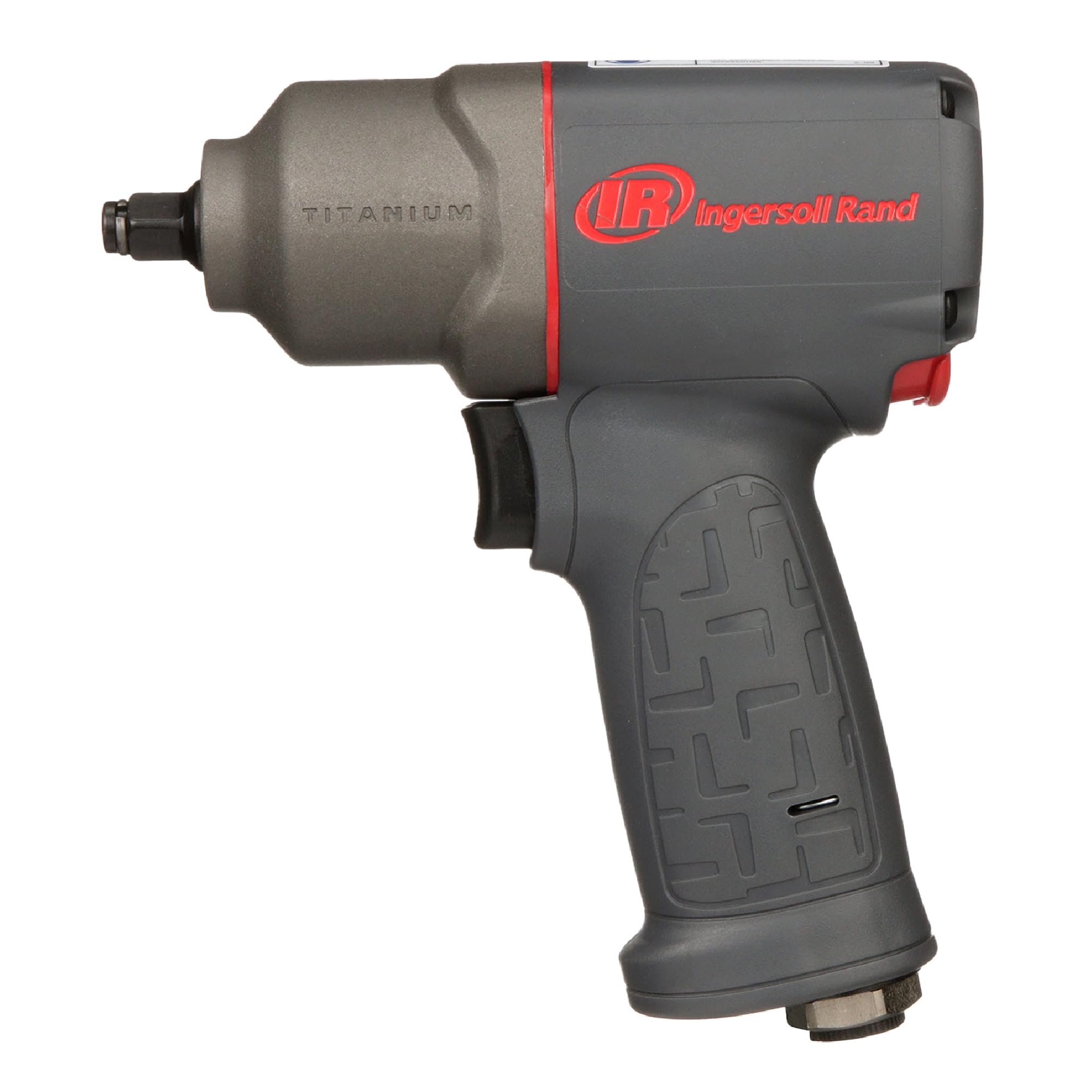
The Ingersoll Rand 2115TiMAX is the air-powered benchmark that professional mechanics have relied on for years. Its titanium hammer case reduces overall weight to just over 2.5 pounds while maintaining the durability required for daily shop use. The 7-vane motor delivers 300 foot-pounds of torque — a figure that comfortably handles brake caliper bolts, strut nuts, and control arm fasteners on most cars and light trucks. The composite housing withstands drops and chemical exposure common in repair environments.
The 4-position power regulator dial on the 2115TiMAX gives the operator precise control over the output torque. This feature is especially valuable when working with aluminum components or plastic trim where over-torquing can cause damage. The feather-touch trigger allows incremental speed modulation, making it easier to break a bolt loose without immediately spinning the socket off. The one-hand forward/reverse switch is ergonomically positioned near the trigger for quick directional changes during repetitive work.
The primary limitation of the 2115TiMAX is its dependence on a compressed air supply. To reach its full torque potential, the tool requires an air compressor delivering at least 4 CFM at 90 PSI. In a home garage with a small pancake compressor, the wrench may struggle to maintain full power during continuous use. The friction ring anvil holds sockets securely, but users working with heavily rusted fasteners may prefer the security of a hog ring or detent pin retention.
What works
- Titanium hammer case reduces fatigue during extended use
- 4-position power dial provides precise torque control
- Composite housing resists impact damage and chemical spills
What doesn’t
- Requires a high-output air compressor for full performance
- Friction ring may drop sockets under heavy side-loading
- Higher upfront cost compared to pneumatic entry-level options
3. Ingersoll Rand 15QMAX

The Ingersoll Rand 15QMAX stands out as the highest-torque 3/8 impact wrench on this list, delivering 475 foot-pounds of nut-busting power in a compact 4.6-inch body. That torque figure is competitive with many 1/2-inch impact wrenches, yet the 15QMAX maintains the smaller head profile that makes 3/8 the go-to drive size for automotive work. The patented quiet tool technology reduces noise output to approximately 80 decibels, making it significantly less fatiguing during extended use in enclosed shop spaces.
The ultra-compact design is the result of Ingersoll Rand’s engineering focus on access. At only 4.6 inches in length, the 15QMAX fits into spaces where larger air guns cannot reach — behind the engine block for bellhousing bolts, between the subframe and oil pan, or alongside the steering rack for tie-rod removal. The twin-hammer impact mechanism delivers consistent torque pulses without the vibration-induced hand fatigue common in older pneumatic designs. The friction ring anvil enables quick socket changes between fastener sizes.
The downside of the 15QMAX’s compact package is its weight distribution. At 2.4 pounds, the tool is light, but the short length places the center of gravity closer to the anvil, which can feel nose-heavy during overhead work. The noise reduction comes from internal porting that also slightly restricts maximum airflow, meaning the wrench requires a consistent 5 CFM supply at 90 PSI to maintain peak performance. Users running undersized air lines or small compressors may notice power drop-off during sustained fastening.
What works
- 475 ft-lb nut-busting torque rivals many 1/2-inch wrenches
- Compact 4.6-inch length accesses tight engine bay locations
- Quiet operation reduces hearing strain in closed shops
What doesn’t
- Short nose length creates nose-heavy balance during overhead use
- Requires robust air supply to maintain full torque output
- Friction ring may not suit users who prefer detent pin locking
4. Astro Pneumatic 1838 ONYX

The Astro Pneumatic 1838 ONYX redefines what a 3/8 impact wrench can access. Its nano angle head design places the anvil at a 90-degree angle to the main body, allowing the tool to reach fasteners that are positioned directly against a firewall, frame rail, or inner fender. Despite the angled configuration, the 1838 delivers 415 foot-pounds of nut-busting torque through a twin-hammer impact mechanism, making it powerful enough to break loose rusted brake caliper bolts and exhaust manifold fasteners.
The ultra-short overall length of just 3.46 inches from the back of the head to the anvil tip makes the 1838 the most compact impact wrench in this comparison. This stubby profile is a lifesaver when working on brake calipers where the bolts face inward toward the knuckle, or when removing transmission pan bolts that sit close to the exhaust tunnel. The aluminum housing keeps the weight at 3.2 pounds, and the polished finish resists corrosion from brake fluid and road salt exposure.
The angled head design introduces a trade-off in feel and control. The tool cannot be used with a conventional inline grip; the operator must hold the handle at roughly a right angle to the fastener, which can feel awkward during initial positioning. The 360-degree swivel handle provides some ergonomic relief, but the overall feel is unlike a standard straight-body impact wrench. Additionally, the 415 foot-pound rating comes with a caveat — the tool achieves this peak torque only when supplied with 90 PSI at 5 CFM minimum.
What works
- Nano angle head accesses fasteners unreachable by straight wrenches
- 415 ft-lb torque handles rusted brake and suspension bolts
- Ultra-compact 3.46-inch length fits in the tightest engine bay corners
What doesn’t
- Angled grip feels unnatural for users accustomed to straight-body wrenches
- Requires high-CFM air supply for peak torque output
- Not suitable for general-purpose fastening with standard inline sockets
5. Astro Pneumatic 1833 Nano Flex-Head

The Astro Pneumatic 1833 Nano Flex-Head combines the access of an angled impact wrench with the versatility of an adjustable head. The flex-head pivots 180 degrees, allowing the operator to rotate the anvil to any angle relative to the handle. This design is particularly effective for brake caliper bolts that sit deep inside the rotor shield, or for transmission bolts positioned above the crossmember where a straight-bodied wrench cannot align with the fastener axis. The 400 foot-pounds of nut-busting torque comes from a dual air intake motor paired with a twin-hammer mechanism.
At only 3.34 inches in overall length, the 1833 is even shorter than the ONYX, making it the most compact impact wrench in the Astro lineup. The powder-coated aluminum construction keeps weight at 3.5 pounds, and the 360-degree swivel handle allows the operator to position the grip optimally regardless of the flex-head angle. This combination of adjustability and compactness makes the 1833 the premier choice for accessing suspension bolts on struts and control arms where the fastener axis runs parallel to the frame rail.
The flex-head mechanism introduces additional complexity and potential wear points. Over extended use, the pivot joint may develop play, reducing precision when aligning with the fastener. The twin-hammer impact mechanism generates significant vibration, which becomes more noticeable when the head is set at extreme angles. Users who primarily work on easily accessible fasteners may find the flex-head feature unnecessary and prefer the simpler design of a fixed-head impact wrench. Like the ONYX, this tool demands a robust air compressor to reach its full torque potential.
What works
- 180-degree flex head reaches fasteners at any angle
- Shortest overall length at 3.34 inches for extreme access
- Dual air intake motor provides consistent power delivery
What doesn’t
- Flex-head pivot can develop play over extended use
- Vibration becomes more pronounced at extreme head angles
- Higher complexity compared to fixed-head impact wrenches
6. CRAFTSMAN CMCF910B

The CRAFTSMAN CMCF910B offers a solid entry point into cordless 3/8 impact wrenches for the home mechanic. Its brushless motor delivers 165 foot-pounds of maximum torque, which is sufficient for brake caliper bolts, strut nuts, and most engine bay fasteners on passenger cars. The hog ring anvil provides secure socket retention, preventing accidental loss when reaching into deep wheel wells or behind engine components. The variable-speed trigger gives the user control over the output speed, which is helpful when reinstalling fasteners to avoid over-torquing.
Built on the V20 battery platform, the CMCF910B integrates with CRAFTSMAN’s expanding cordless tool ecosystem, allowing battery sharing with drills, saws, and other tools. The built-in LED worklight illuminates the work area without requiring a separate flashlight, which improves visibility when working under the car or inside the engine bay. At just under 2 pounds with the battery, the wrench is light enough for one-handed operation during repetitive fastening tasks.
The 165 foot-pound torque ceiling is the primary limitation of this wrench. It will struggle with heavily rusted suspension bolts, large truck fasteners, or engine components that have been torqued to high factory specifications. The tool ships as a bare unit without a battery or charger, so new buyers need to factor in the cost of a V20 battery to get started. The 8.5-inch overall length is longer than some competitors, which can limit access in extremely tight engine bay spaces.
What works
- Hog ring anvil provides secure socket retention
- Lightweight design reduces arm fatigue during extended use
- V20 battery platform shares compatibility with other CRAFTSMAN tools
What doesn’t
- 165 ft-lb torque may not break loose severely rusted bolts
- Longer 8.5-inch body limits access in tight spaces
- Bare tool requires separate battery and charger investment
7. RYOBI PCL250B ONE+

The RYOBI PCL250B ONE+ impact wrench provides an accessible entry point for homeowners and DIY mechanics who need a 3/8 impact wrench for light to moderate automotive work. The brushless motor improves runtime and durability compared to older brushed designs, and the friction ring anvil enables quick socket changes between fastener sizes. At 2.8 pounds, the tool is light enough for one-handed operation, reducing fatigue when removing multiple fasteners during brake jobs or suspension work.
The primary appeal of the PCL250B lies in the ONE+ battery ecosystem. RYOBI offers over 200 tools on the same battery platform, making this wrench a logical addition for anyone who already owns RYOBI cordless tools. The 18V lithium-ion battery delivers consistent power without the memory effect of older nickel-cadmium packs. The variable-speed trigger provides reasonable control for driving fasteners, and the built-in LED light improves visibility in dim under-car conditions.
The PCL250B’s torque output is modest compared to the higher-tier wrenches on this list. It will handle interior trim removal, plastic undertray fasteners, and lightly torqued engine bay bolts, but it will struggle with suspension components, brake caliper bracket bolts that have been heat-cycled, or any fastener that requires more than 200 foot-pounds to break loose. The tool is also limited by the 18V platform — while adequate for light work, the voltage ceiling restricts the maximum torque potential compared to 20V or higher systems.
What works
- Accessible entry point for the RYOBI ONE+ battery ecosystem
- Light 2.8-pound weight reduces hand fatigue
- Brushless motor improves efficiency and longevity
What doesn’t
- Torque output insufficient for rusted suspension and brake bolts
- 18V platform limits maximum power compared to 20V systems
- Friction ring may not hold sockets securely under heavy use
Hardware & Specs Guide
Twin Hammer vs. Pin Clutch Impact Mechanisms
The impact mechanism determines how rotational energy is converted into torque pulses. Twin hammer designs use two rotating hammers that strike an anvil with each revolution, producing high peak torque in a compact package. Pin clutch mechanisms use spring-loaded pins that engage and disengage with each rotation, creating a vibration profile that is smoother but generally produces lower peak torque. For a 3/8 impact wrench where access and power-to-size ratio matter, twin hammer mechanisms are the standard in professional-grade tools, while pin clutch designs are more common in consumer-level impact drivers that prioritize smoothness over raw nut-busting force.
CFM and PSI Requirements for Air Wrenches
Pneumatic 3/8 impact wrenches consume compressed air to drive their motors, and the tool’s torque output is directly tied to the air supply’s volume and pressure. The critical spec is CFM (cubic feet per minute) at a given PSI (pounds per square inch). Most professional-grade air impact wrenches require between 4 and 6 CFM at 90 PSI to achieve their advertised torque ratings. A small pancake compressor delivering 2.5 CFM at 90 PSI will cause the tool to run slowly and with reduced power. Buyers must match the compressor’s CFM output to the tool’s requirement — or accept significantly reduced performance from a supply-limited setup.
FAQ
What size air hose is best for a 3/8 pneumatic impact wrench?
Can I use 1/2-inch sockets on a 3/8 impact wrench with an adapter?
How many foot-pounds do I actually need for automotive work?
Final Thoughts: The Verdict
For most buyers, the best 3/8 impact wrench winner is the Milwaukee FUEL 2854-20 because its 250 foot-pound torque, compact head length, and 4-Mode Drive Control deliver professional-grade versatility without the tether of an air hose. If you want extreme torque in an ultra-compact air-powered package, grab the Ingersoll Rand 15QMAX. And for accessing the tightest engine bay and brake caliper fasteners, nothing beats the Astro Pneumatic 1833 Nano Flex-Head with its 180-degree articulating head.

Certification: BSc in Mechanical Engineering
Education: Mechanical engineer
Lives In: 539 W Commerce St, Dallas, TX 75208, USA
Md Amir is an auto mechanic student and writer with over half a decade of experience in the automotive field. He has worked with top automotive brands such as Lexus, Quantum, and also owns two automotive blogs autocarneed.com and taxiwiz.com.