A fuel filter that looks like a bargain at the counter can turn into a tow-truck bill when its media collapses or its housing cracks under vibration. The 3/8-inch size sits at a sweet spot — common enough for classic muscle cars and modern EFI swaps, yet varied enough in build quality that a wrong choice quietly starves your engine of flow or lets abrasive particles reach your injectors.
I’m Amir — the founder and writer behind Four Wheel Ask. My approach relies on cross-referencing technical data sheets, owner forums, and build quality reports to separate genuine value from marketing claims.
After examining owner reports and technical specs, I have identified the best 3/8 fuel filter that deliver reliable filtration without restricting flow.
How To Choose The Best 3/8 Fuel Filter
Selecting the right 3/8 fuel filter means balancing filtration depth, flow capacity, and serviceability for your specific fuel system. The wrong choice can either starve your engine of volume or let contaminants bypass filtration entirely.
Micron Rating and Flow
Lower micron numbers trap smaller particles but create more restriction. A 30-micron sintered bronze element works well for carbureted and many EFI setups, while a 200-mesh screen (roughly 70 microns) is better for gravity-fed systems or mechanical pumps that cannot pull through dense media. Verify that the filter’s flow rating in liters per hour exceeds your engine’s peak demand at wide-open throttle.
Housing Material
Billet aluminum offers corrosion resistance and structural integrity under high pressure, making it suitable for EFI systems. Clear plastic or glass housings allow visual inspection of fuel condition but may degrade with ethanol-blended fuels over time. Chrome-plated steel resists rust but can flake internally if the plating process is poor. Match the material to the fuel type and operating environment of your vehicle.
Serviceable vs Disposable
Sintered bronze filters are reusable — you clean them with solvent and reinstall — which lowers long-term cost. Disposable paper or mesh filters are simpler but add recurring expense and waste. For a daily driver, a reusable element reduces maintenance intervals; for a race car where you inspect everything between events, a disposable may be simpler.
Vehicle-Specific vs Universal
Universal inline filters work for custom builds, classic cars, and swaps where you supply your own hose and clamps. Vehicle-specific units, particularly for modern diesel trucks, include the correct mounting bracket, o-ring seals, and bypass valve specifications. Mixing the two categories can cause leaks or improper filtration, so confirm fitment before buying.
Quick Comparison
On smaller screens, swipe sideways to see the full table.
| Model | Category | Best For | Key Spec | Amazon |
|---|---|---|---|---|
| CarBole 9748 | Glass/Universal | Visual fuel inspection on custom builds | 200 mesh screen, chrome-plated barb ends | Amazon |
| EVIL ENERGY 3/8 Barb | Billet/Universal | High-flow EFI and carb systems | 30 micron sintered bronze, 900 LPH | Amazon |
| Podavelle 3/8 Billet | Billet/Universal | Compact engine bay installations | 30 micron element, 52.6 mm housing | Amazon |
| Riyhch 10-Pack | Plastic/Universal | Multi-vehicle fleet maintenance | Clear plastic shell, brass ends | Amazon |
| Doc’s Diesel DFD4625 | Diesel Specific | Ford 6.7L Powerstroke 2017+ | 3 micron at 96.92% efficiency | Amazon |
In‑Depth Reviews
1. CarBole 9748 Universal 3/8 Inlet/Outlet Fuel Pump Filter

The CarBole 9748 stands out for its glass housing, which lets you inspect fuel condition at a glance — a feature that can catch rust, water, or debris before it reaches your carburetor or injectors. The chrome-plated barbed ends provide positive retention on 3/8-inch hose, and the 200-mesh screen (roughly 70 microns) offers a balanced level of filtration for mechanical pump and gravity-fed applications where excessive restriction would cause problems.
With an overall length of 4.2 inches and an outside diameter of 1.07 inches, this filter fits neatly into tight engine bays, vintage restorations, and custom fuel rail layouts. The reference part number FFC1003 (09748) cross-references to many OEM-style replacements, and the universal fitment covers everything from passenger cars and trucks to lawn mowers and marine engines. The five-pack adds redundancy for multi-vehicle owners or seasonal equipment.
Owner feedback consistently highlights the clear housing as a diagnostic advantage — many report spotting sediment buildup immediately during routine checks. The main trade-off is that glass is more brittle than aluminum or steel, so careful mounting away from direct impact points is recommended for long-term reliability.
What works
- Transparent housing enables instant visual inspection
- Chrome-plated barb ends resist corrosion and hold hose securely
- Five-pack provides excellent value for multiple vehicles
What doesn’t
- Glass housing is more fragile than aluminum or steel
- 200-mesh screen may not filter fine particles for sensitive EFI systems
2. EVIL ENERGY 3/8 Barb Billet Inline Fuel Filter
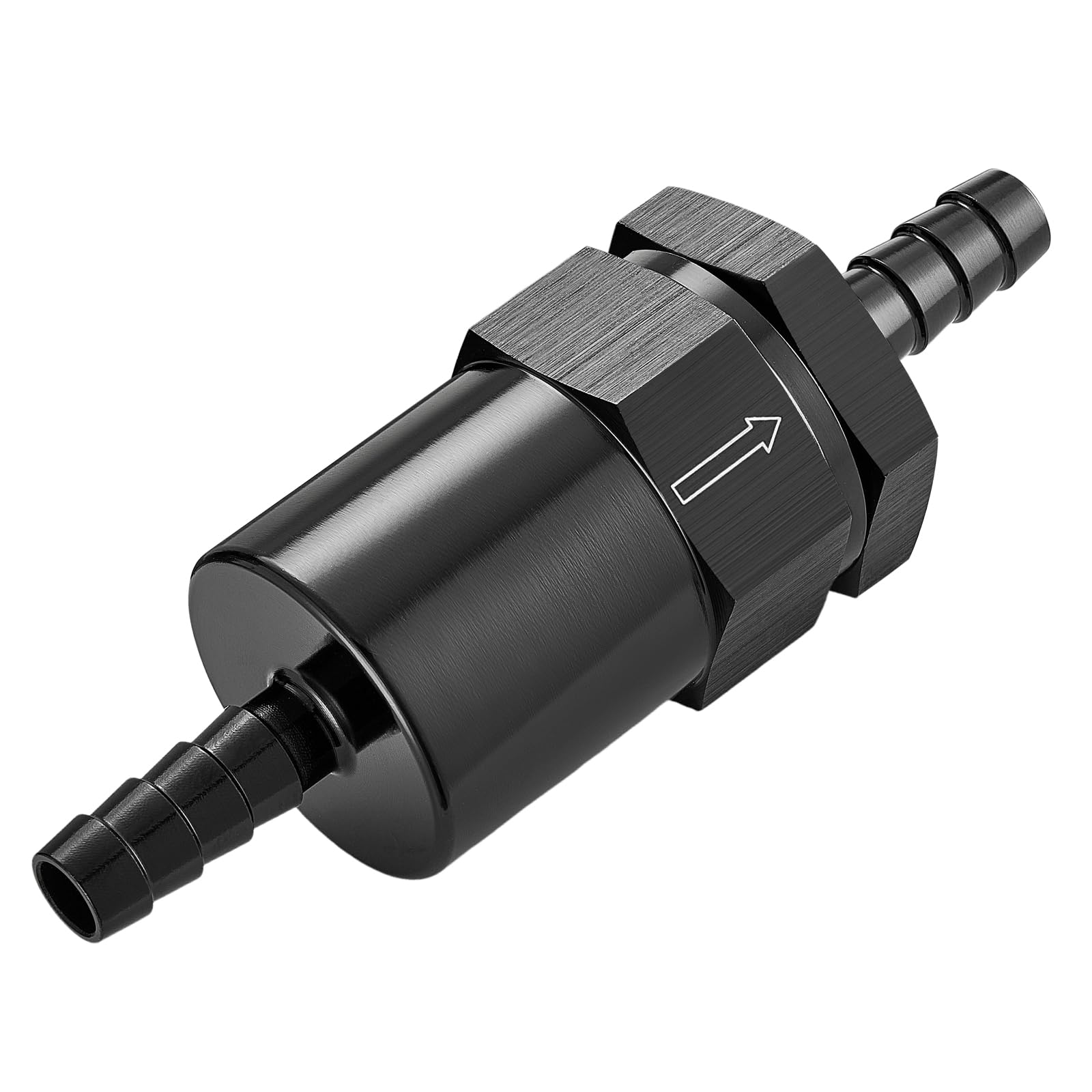
The EVIL ENERGY inline filter uses a 30-micron sintered bronze element that traps fine contaminants while maintaining flow rates up to 900 liters per hour with less than 1 PSI of pressure drop. This makes it suitable for both EFI and carbureted systems where consistent fuel delivery is critical. The billet aluminum housing measures just 2.07 inches in length (excluding barbs), which simplifies mounting in cramped engine compartments.
The rubber O-ring seal between the housing and end caps prevents fuel leaks when installed correctly, and the sintered bronze element is removable and cleanable — you can soak it in solvent and reuse it indefinitely rather than replacing the entire unit. The black anodized finish resists corrosion from gasoline and diesel, though the manufacturer notes it is not compatible with E85 fuel, which can degrade certain seal materials over time.
Application data shows wide compatibility across cars, motorcycles, and boats, and the universal 3/8-inch barb fitting works with standard fuel hose and clamps. Some owners report that the O-ring can shift during initial assembly, so careful tightening and a post-installation leak check are advised to avoid drips.
What works
- Reusable sintered bronze element lowers long-term replacement costs
- Compact size fits tight engine bay layouts
- High flow rate with minimal pressure drop
What doesn’t
- Not recommended for E85 fuel blends
- O-ring seal needs careful alignment during installation
3. Podavelle 3/8 Billet Inline Fuel Filter 30 Micron

The Podavelle filter is machined from 6061-T6 billet aluminum and finished with a black anodized coating that provides resistance to fuel corrosion and physical wear. Its housing measures approximately 52.6 mm in length — just over two inches — excluding the barb fittings, which makes it one of the most space-efficient options for builds where every millimeter counts, such as motorcycle restorations or tight engine bay swaps.
The 30-micron sintered bronze element is removable and reusable, and the filter flows 900 liters per hour with a pressure drop of under 1 PSI, matching the flow capacity of the EVIL ENERGY unit in a slightly different form factor. The universal 3/8-inch barb inlet and outlet fit standard fuel line, and the filter weighs only 0.09 kilograms, adding negligible mass to the fuel system.
Research across owner forums indicates that the anodized finish holds up well against underhood heat and road grime, though some users note that the barbs are relatively short, requiring double hose clamps on high-pressure EFI setups for secure retention. The filter is marketed for passenger cars and trucks, and the build quality feels consistent with components typically found in custom fuel system kits.
What works
- Lightweight 6061-T6 aluminum resists corrosion
- Reusable sintered bronze element reduces waste
- Compact length eases installation in tight spaces
What doesn’t
- Short barb length may need two clamps for high-pressure applications
- No included mounting bracket for hard-line installations
4. Riyhch 10 Pcs 3/8 Universal Inline Fuel Filters
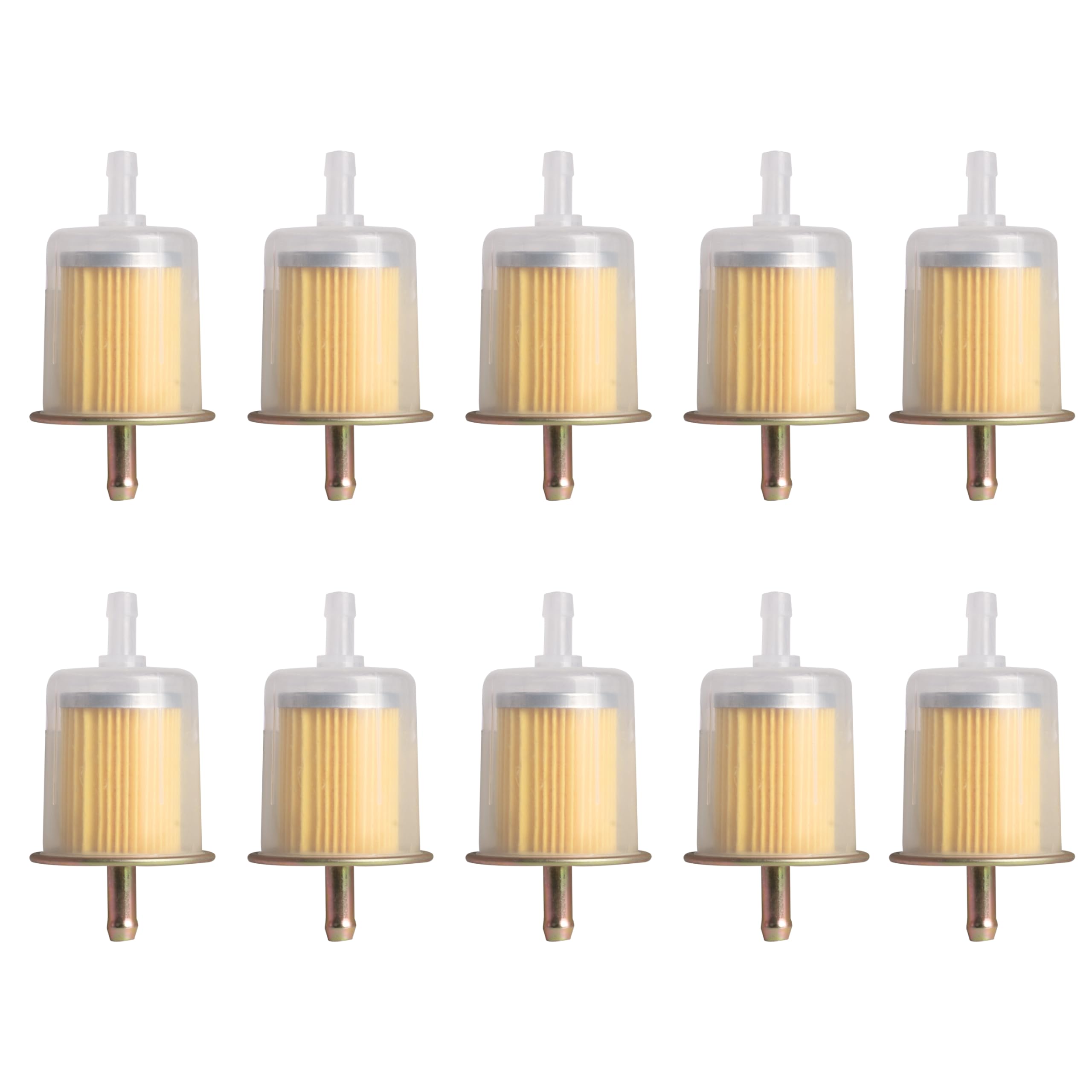
The Riyhch 10-pack delivers a quantity-oriented solution for owners managing multiple power equipment, farm machinery, or a fleet of small-engine vehicles. Each filter uses a clear plastic shell with metal brass end caps and a 3/8-inch inlet and outlet, measuring 96.5 mm by 53 mm. The see-through body allows quick visual checks for sediment or water contamination without disassembly.
These filters are suited for gravity-fed and mechanical pump systems on industrial tractors, trucks, motorcycles, and any gasoline-powered engine where moderate filtration is adequate. The brass end caps resist corrosion better than plain steel, and the 10-pack means you can stock spares for seasonal equipment or perform simultaneous swaps during maintenance days.
Owner reports indicate that the plastic housing can become brittle after prolonged exposure to ethanol-blended fuels, so these are best used in applications where the filter is replaced annually rather than treated as a permanent component. The universal fitment is genuine, though the housing size may be too large for some compact engine bays or motorcycle frame tunnels.
What works
- Ten-pack provides substantial savings per unit
- Clear housing enables easy visual inspection
- Brass end caps resist corrosion
What doesn’t
- Plastic shell may become brittle with ethanol exposure
- Not suited for high-pressure EFI systems
5. Doc’s Diesel Fuel Filter DFD4625

The Doc’s Diesel DFD4625 is a direct replacement for the Motorcraft FD4625 and cross-references to Baldwin PF46174, Premium Guard DF4624K, and Purolator F71448. It is designed specifically for 2017-2025 Ford 6.7L Powerstroke F250, F350, and F450 trucks, making it a vehicle-specific choice rather than a universal inline filter. Third-party testing shows a 96.92 percent efficiency rating at 3 microns, which is the level of filtration required to protect modern high-pressure diesel injectors.
This filter removes contaminants such as dirt, rust, and debris from diesel fuel and includes o-rings needed for installation. The metal housing construction withstands the higher operating pressures of diesel fuel systems, and the recommended replacement interval is every 5,000 to 10,000 miles, or 15,000 miles maximum, per manufacturer guidelines. The focus on maximizing filtration media surface area supports consistent fuel flow and pressure, which contributes to stable acceleration and fuel economy.
Owner feedback on diesel-specific forums indicates that the Doc’s Diesel filter performs comparably to the Motorcraft OEM unit at a more accessible price point. The main limitation is exclusivity — it fits only the Ford 6.7L Powerstroke platform and cannot be adapted to universal 3/8-inch hose applications, so it belongs strictly in the diesel truck category.
What works
- Third-party verified 3-micron filtration at 96.92 percent efficiency
- Complete with o-rings and cross-references to OEM and aftermarket numbers
- Engineered for high-pressure diesel fuel systems
What doesn’t
- Vehicle-specific fit limits use to Ford 6.7L Powerstroke trucks
- Higher cost compared to universal inline filters
Hardware & Specs Guide
Micron Rating
Micron rating measures the smallest particle size the filter can trap. Lower numbers (e.g., 3 microns) capture finer debris and are required for modern diesel injectors, while 30-micron sintered bronze elements balance flow and filtration for gasoline EFI and carbureted systems. A 200-mesh screen (roughly 70 microns) is suitable for gravity-fed or low-pressure applications where flow resistance must be minimized.
Housing Material
Billet aluminum (typically 6061-T6) offers structural strength, corrosion resistance, and light weight, making it the preferred choice for high-pressure EFI and marine environments. Glass housings allow visual inspection but are brittle and should be mounted away from impact zones. Clear plastic and chrome-plated steel are budget-friendly options but may degrade with ethanol fuels or flake internally over time.
Flow Capacity
Flow capacity is measured in liters per hour (LPH) and indicates how much fuel can pass through the filter at a given pressure drop. A filter rated for 900 LPH with less than 1 PSI drop is adequate for most gasoline V8 engines up to around 600 horsepower. Diesel filters must handle higher pressure differentials and often include water-separation media as part of the filtration sandwich.
Barb Size
True 3/8-inch barb fittings have an outer diameter of 0.375 inches, but some brands use 5/16-inch or 10 mm barbs and label them as 3/8. Always measure the barb diameter with calipers before installation. The hose inside diameter should match the barb size exactly, and double hose clamps are recommended for EFI systems where fuel pressure exceeds 30 PSI.
FAQ
What does a 30-micron fuel filter protect against?
Can I clean and reuse a sintered bronze fuel filter?
Is a glass fuel filter safe for a street car?
Will a 3/8 fuel filter fit 5/16 fuel line?
Final Thoughts: The Verdict
For most buyers, the best 3/8 fuel filter winner is the CarBole 9748 because it combines visual diagnostic capability with broad universal fitment and a five-pack that covers multiple applications. If you want a reusable high-flow element for a performance EFI build, grab the EVIL ENERGY 3/8 Barb. And for a Ford 6.7L Powerstroke diesel that demands 3-micron filtration, nothing beats the Doc’s Diesel DFD4625.

Certification: BSc in Mechanical Engineering
Education: Mechanical engineer
Lives In: 539 W Commerce St, Dallas, TX 75208, USA
Md Amir is an auto mechanic student and writer with over half a decade of experience in the automotive field. He has worked with top automotive brands such as Lexus, Quantum, and also owns two automotive blogs autocarneed.com and taxiwiz.com.