Finding a 3/4 helmet with a face shield that balances open-air freedom with reliable eye protection without turning your head into a sail at speed is the challenge every urban rider and cruiser enthusiast eventually faces. The market is flooded with options that either rattle at highway speeds, fog up the moment you stop, or simply don’t fit the shape of your head, leaving you to wonder if the classic open-face look is even worth the compromise. A well-engineered shield system changes everything—it cuts wind noise, blocks debris, and transforms a vintage silhouette into genuinely practical daily gear.
I’m Amir — the founder and writer behind Four Wheel Ask. I’ve spent years studying helmet construction methods, analyzing owner-reported long-term durability data, and mapping how real-world feedback on shield mechanisms, liner materials, and retention systems translates into buying confidence for riders who want substance with their style.
Whether your priority is a drop-in tinted sun visor, a flip-down clear shield for night riding, or a shell that doesn’t make you look like a bobblehead at stoplights, the right choice comes down to understanding how each system performs in the conditions you actually ride. After evaluating build quality reports, owner forums, and technical spec sheets, I’ve found the options that deliver genuine protection and daily usability. The best 3/4 motorcycle helmet with face shield combines a secure fit, reliable optics, and a shell that earns its place on your head mile after mile.
How To Choose The Best 3/4 Motorcycle Helmet With Face Shield
A 3/4 helmet with a face shield sits at the intersection of visibility, protection, and convenience. Getting the right one means understanding how the shield integrates with the shell, how the liner handles sweat and pressure points, and whether the retention system holds firm when the wind picks up. These four criteria will help you separate a well-engineered lid from a compromise you’ll regret after the first long ride.
Shell Material & Impact Absorbency
The outer shell is your first line of defense against impact and abrasion. Most mid-range 3/4 helmets use an injection-molded ABS shell that offers solid rigidity at a reasonable weight. Premium options shift to fiberglass composite or polycarbonate blends that shave ounces and improve energy distribution during a strike. Beneath the shell, the EPS (expanded polystyrene) liner does the actual work of absorbing impact energy. A multi-density EPS liner handles a wider range of impact speeds than a single-density block, which matters more in a 3/4 format since the open face leaves the jaw and chin exposed. Look for a liner that extends deep into the occipital area at the back of the head — that’s where a 3/4 shell often falls short in coverage.
Face Shield & Visor System Design
The face shield is the defining feature of this category, and its mechanism determines how much you’ll use it. The best designs integrate a flip-down internal sun visor that tucks away when not needed, paired with a clear outer shield that protects against wind, rain, and debris. Some helmets offer a detachable front cover or visor that converts the helmet between configurations. Pay close attention to the detent mechanism that holds the shield in place — cheap designs rely on friction alone and will drop mid-ride. Anti-scratch and anti-fog coatings are non-negotiable if you ride in variable weather or transition between tunnels and open road. A quick-release shield mechanism that doesn’t require tools for cleaning or replacement will save you frustration over the long term.
Safety Certifications & Standards
DOT (FMVSS 218) is the minimum legal standard in the United States. Every helmet on this list meets that baseline, but some also carry ECE 22.05 certification, which is a more rigorous standard that includes impact testing at multiple speeds and off-axis angles, as well as shell penetration and retention system tests. ECE certification is recognized in over 50 countries and is widely considered the gold standard for real-world protection. A helmet that holds both DOT and ECE marks has passed a broader battery of tests than a DOT-only model. Do not confuse novelty helmets or “decorative only” lids with certified gear — if the DOT sticker is missing or looks suspiciously cheap, move on. A genuine certification is your only guarantee that the shell and EPS liner were designed to perform under impact.
Fit, Sizing, & Liner Quality
A 3/4 helmet relies entirely on the liner and retention system to stay planted on your head during a ride. Unlike a full-face helmet that wraps around the chin and jaw for additional stability, an open-face design puts more responsibility on the cheek pads and the crown liner to eliminate wobble. Removable and washable liners are a practical necessity if you ride in warm weather or commute daily — sweat buildup will degrade foam density and breed odor. The quick-release chin strap (micro-metric or ratchet style) is vastly superior to the traditional D-ring system for convenience, especially when wearing gloves. Sizing varies significantly between brands; measuring your head circumference in centimeters at the widest point above the ears and comparing it to the manufacturer’s size chart is the only reliable method. Several reviewers across these models confirm that sizing up by one increment is often necessary for a comfortable fit without pressure points.
Quick Comparison
On smaller screens, swipe sideways to see the full table.
| Model | Category | Best For | Key Spec | Amazon |
|---|---|---|---|---|
| BEON B-120 | 3/4 Retro | All-weather shield versatility | Dual visor, ECE & DOT | Amazon |
| Bell Custom 500 | 3/4 Classic | Fiberglass shell quality | Fiberglass composite | Amazon |
| ILM Z302 | 3/4 Multi-Config | Convertible riding modes | 4 configurations, camera mount | Amazon |
| LS2 Bagger | Half Shell | Low-profile cruiser look | Removable liner, micro-metric | Amazon |
| Daytona Cruiser | 3/4 Graphic | Vintage style on a budget | Quick-release chin strap | Amazon |
| Westt Rover | 3/4 Lightweight | Ultralight commuter lid | 1100g, built-in sun visor | Amazon |
| 1STorm HJK316 | Full Face Dual | Dual visor full coverage | Inner sun visor, DOT | Amazon |
| Favoto 815 | Full Face Dual | Anti-fog and extreme temps | 2 visors, anti-fog film | Amazon |
| Yesmotor 618 | 3/4 Retro | Budget retro with clear visor | Clear visor, removable liner | Amazon |
| VCAN V88 | 3/4 Open Face | ECE certified entry pick | Integrated sun visor, ECE | Amazon |
| AHR RUN-O5 | 3/4 Vintage | Classic pilot helmet style | Detachable visor, goggle strap | Amazon |
In‑Depth Reviews
1. BEON B-120 3/4 Retro Helmet

The BEON B-120 delivers the most complete visor ecosystem of any 3/4 helmet in its range. You get a clear outer face shield with anti-scratch treatment, a retractable inner sun visor with UV protection, and an additional extended long visor for high-speed wind deflection. Owners consistently praise the optical clarity of both shields, noting they operate smoothly without binding or rattling. The Click-n-Secure quick-release buckle is easy to manipulate with a single gloved hand, and the metal visor base unscrews by hand for cleaning or replacement — small engineering touches that add up over months of daily use.
Shell quality stands out in owner feedback. The advanced thermoplastic shell combined with high-density EPS foam gives the helmet a substantial feel without excessive weight. The removable and washable mesh inner liner is well-constructed and comfortable against the skin, with ear pockets that accommodate speaker systems without pressure points. At this spec level, the inclusion of both ECE 22.05 and DOT certifications confirms the impact design went through rigorous testing across multiple speed and angle scenarios.
The retro aesthetic — available in glossy white with a tan PU leather liner option — matches vintage scooters and cafe racers beautifully. Owners of Vespas, Royal Enfields, and Triumph Bonnevilles report that the proportions avoid the oversized “bubble head” look that plagues many 3/4 shells. If you want one helmet that covers morning commutes, weekend canyon rides, and evening cruising without needing to swap shields or carry sunglasses, the BEON B-120 is the most thoughtfully integrated package available.
What works
- Dual shield system with retractable sun visor and included long visor
- ECE and DOT dual certification for proven impact performance
- Tool-free metal visor base simplifies cleaning and customization
- Retro proportions avoid the oversized shell look
What doesn’t
- Premium price point compared to budget 3/4 options
- Limited colorway availability on the dual-visor model
2. Bell Custom 500

The Bell Custom 500 is the helmet that defined the retro open-face category, and the current Apex Gloss Black Flake iteration continues that legacy with a fiberglass composite shell that sets the benchmark for lightweight strength in this form factor. Fiberglass offers superior vibration damping compared to ABS, which translates to less transmitted road noise and a shell that absorbs energy more progressively during impact. The Ionic+ quick-drying interior padding actively manages sweat and fights odor-causing bacteria — a real advantage for riders who log daily miles in warm climates.
Owner feedback consistently highlights the fit consistency across sizes. The intermediate oval shape accommodates the most common head profile, and multiple reviewers confirm that the sizing runs true to Bell’s chart, though some with rounder head shapes recommend sizing up. The lack of ventilation ports is a deliberate design choice — the unibrow shell maintains structural integrity without cutouts, but riders in hot climates should expect less passive airflow compared to vented alternatives. The thick jaw padding is snug at first but relaxes over the first few rides to create a secure, wobble-free seal.
This is not a modular or multi-configuration helmet. The Bell Custom 500 is a purist’s piece — a single-piece fiberglass shell with a snap-on visor and a high-quality liner. The chin strap uses a traditional snap closure that some owners find less convenient than a micro-ratchet, but the build quality of the snap itself is undeniably robust. If your priority is owning a heritage piece from a brand with decades of racing pedigree, and you value shell composition over visor features, the Custom 500 is the definitive choice in the premium 3/4 segment.
What works
- Fiberglass composite shell offers class-leading strength-to-weight ratio
- Ionic+ liner resists odor and wicks moisture effectively
- Consistent sizing and intermediate oval shape fits most heads well
- Heritage design with genuine Bell racing pedigree
What doesn’t
- No built-in sun visor or retractable shield
- Snap chin strap is less glove-friendly than micro-ratchet systems
3. ILM Z302 3/4 Open Face Helmet

The ILM Z302 redefines what “open-face” means by offering a detachable front cover, a detachable brim with two adjustable angles, and an integrated camera mount — giving riders four distinct configurations from a single helmet. You can run it as a classic 3/4 shell, add the brim for sun shading, attach the front cover for extra chin protection, or combine both for maximum coverage. This modularity is rare in the 3/4 category and makes the Z302 a compelling option for riders who want one helmet for both city cruising and light touring. The nine ventilation openings, combined with an aerodynamic intake system, keep airflow moving even at low speeds.
Owner reports emphasize the lightweight feel despite the ABS and EPS construction, with multiple reviewers noting it fits well under a balaclava and accommodates glasses comfortably. The included tinted lens blocks sunlight effectively, and the quick-release chin strap adds daily convenience. A notable detail is the rear strap buckle that secures goggles in place — a thoughtful addition for riders who swap between shield and goggles depending on conditions. The clear lens is sold separately, which some owners discovered only after purchase, so factor that into your decision if you need a clear option for night riding.
The DOT certification is confirmed on the shell, and several owners noted the helmet’s ability to muffle wind noise effectively for a 3/4 design. The anti-scratch outer lens holds up well against road grit, and the closable vents allow you to adjust airflow based on temperature. The Z302 is the most adaptable helmet in this lineup for riders who want to change their look or coverage level without maintaining multiple helmets. Just be prepared to source the clear lens separately and confirm the camera mount bracket is included with your specific color option.
What works
- Four riding configurations from one shell with detachable front cover and brim
- Nine vents with closable intake for temperature management
- Integrated camera mount for ride recording
- Goggle strap buckle at the rear is a practical addition
What doesn’t
- Clear lens for night riding not included with all variants
- Nose piece may feel close for riders with longer faces
4. LS2 Bagger Half Helmet

The LS2 Bagger is a half-shell design engineered specifically for cruisers and bagger riders who want a low-profile silhouette that sits lower on the head than traditional 3/4 helmets. The compact shell avoids the mushroom-top look that many riders dislike, and the micro-metric chin strap provides a precise, glove-friendly closure that’s a clear step up from standard D-rings. The removable and washable liner is upholstered with quality materials that resist pilling, and the overall fit is optimized for riders who spend long hours behind a windshield. Ventilation ports are present but multiple owners note they don’t deliver significant airflow — this is a shell designed for minimalism rather than active cooling.
Sizing feedback is consistent: the Bagger runs slightly small, and owners with intermediate-to-round head shapes should expect a snug fit that may require a break-in period. The chin strap lacks a padded cover and some reviewers with sensitive skin reported irritation from the nylon webbing against stubble. The helmet sits lower on the forehead — roughly at mid-forehead level above the eyebrows — which provides a different field of view compared to taller 3/4 shells. This works well with a windshield but reduces upward peripheral visibility when looking at overhead signs or traffic lights.
Despite being marketed as a half helmet, the Bagger’s coverage extends lower on the back of the head than many half-shell designs, offering a middle ground between a true half helmet and a 3/4 profile. The five-year manufacturer warranty is among the best in this price tier and reflects LS2’s confidence in their build quality. If your riding consists primarily of highway cruising behind a tall windscreen and your priority is a clean, low-profile look with reliable DOT protection and a premium liner, the LS2 Bagger delivers exactly that formula without excess.
What works
- Low-profile shell design eliminates the bubble-head look
- Micro-metric chin strap is precise and easy to use with gloves
- Five-year manufacturer warranty provides long-term confidence
- Removable liner with quality upholstery resists wear
What doesn’t
- Ventilation ports provide minimal airflow during low-speed riding
- Chin strap lacks a padded cover and may irritate bare skin
5. Daytona Helmets Cruiser Graphics

The Daytona Cruiser Graphics helmet brings a distinctively American custom-paint aesthetic to the 3/4 format with graphics that range from classic flames to patriotic motifs. The low-profile shell avoids the oversized appearance that plagues many budget-friendly 3/4 lids, and the polyester-fiber construction keeps weight manageable for all-day wear. The quick-release chin strap is a welcome inclusion at this price level, and the removable liner allows for periodic cleaning. Owners note that the shell accommodates speaker systems like the SENA 30S without creating uncomfortable pressure points, which is a practical advantage for riders who rely on communication gear.
Fit feedback reveals a consistent pattern: the Daytona runs small compared to the size chart. Multiple reviewers report that ordering one size up from their measured head circumference is necessary for a comfortable fit, and some caution that the return process involves paying return postage and a restocking fee if the helmet doesn’t fit. The visor included with the base model is a straightforward clear option, and the helmet accepts the optional full-face visor attachment for riders who want extra coverage. The ratchet chin strap is secure and easy to operate, even with heavy winter gloves, and the ear pockets are generously sized for natural hearing and speaker placement.
The shell’s low-profile design is one of the most frequently praised features — owners of Harley-Davidson cruisers and Indian baggers specifically mention that the Daytona avoids the bobblehead effect more effectively than many helmets at twice the price. The included cloth drawstring bag and keychain are small touches that add perceived value. This is a strong choice for the rider who wants a distinctive look, a lightweight shell, and the convenience of a quick-release chin strap without paying a premium for brand names. Just verify the return policy before ordering if you’re between sizes.
What works
- Low-profile shell avoids oversized bubble-head proportions
- Distinctive graphic options for personalized style
- Quick-release chin strap is secure and glove-friendly
- Ear pockets accommodate comm speakers without pressure
What doesn’t
- Runs small — sizing up is often required for proper fit
- Return policy includes restocking fee and shipping costs
6. Westt Rover Open Face Helmet

The Westt Rover punches well above its weight in terms of weight — at 1100 grams, it’s one of the lightest DOT-certified 3/4 helmets you can buy, regardless of price. The ABS shell and EPS impact liner deliver certified protection while keeping neck fatigue to a minimum during long days in the saddle. The built-in flip-down sun visor is actuated by a center tab rather than side levers, which owners describe as intuitive and easy to manipulate with gloves. The quick-release buckle adds to the daily convenience, and the removable, washable liner keeps the interior fresh after sweaty commutes. Customizable side panels let you swap colors to match different bikes without buying a whole new helmet.
Owner reviews consistently highlight the comfort-to-value ratio. Multiple riders who own helmets costing several times more reported that the Westt is the lightest in their collection and doesn’t feel top-heavy. The ear pockets are pre-formed for speaker installation, which simplifies adding Bluetooth communication systems. The chin strap is secure yet releases easily, and several reviewers noted that sizing down is the correct approach — the Rover fits larger than expected, so following the manufacturer’s advice to size down if between sizes is essential. The five-year warranty is an outlier at this price point and suggests confidence in long-term durability.
The included DIY side panels provide a customization option that no other helmet in this price range offers. You can match the panels to your scooter, moped, or cruiser color scheme without painting or vinyl wrapping the shell itself. The breathable interior padding is adequate for moderate temperatures, though riders in extreme heat may want additional airflow. The Westt Rover is the smartest budget-conscious choice for commuters and scooter riders who prioritize low weight, practical features, and the ability to personalize their gear without spending premium money. The five-year warranty alone makes it a low-risk purchase.
What works
- Remarkably lightweight at 1100 grams reduces neck fatigue
- Five-year warranty provides exceptional long-term value
- DIY side panels allow easy color customization
- Built-in sun visor with center tab operates smoothly
What doesn’t
- Snug fit requires caution — sizing down is often necessary
- Limited ventilation for extremely hot weather riding
7. 1STorm HJK316 Full Face Helmet

The 1STorm HJK316 offers the security of a full-face shell with the visor versatility many riders look for in a 3/4 experience. The dual-lens system pairs a clear outer shield with a flip-down inner sun visor, giving you instant adaptation to changing light conditions without carrying separate eyewear. The thermoplastic alloy shell is lightweight and aerodynamic, with a glossy UV-protective finish that resists fading. The quick-release buckle and removable washable padding are practical touches that elevate the daily usability of this DOT-certified helmet. Nine adjustable vents allow you to dial in airflow, with owners noting that closing the vents significantly reduces wind noise at highway speeds.
Owner reviews emphasize the surprising quality-to-cost ratio. Multiple riders who upgraded from budget helmets reported that the 1STorm feels substantially more refined than its price suggests, with solid hardware, comfortable padding, and a flip-down visor that clicks into position securely. The sizing runs large — owners strongly recommend ordering at least one size smaller than your measured head circumference. The visor mechanism requires deliberate force to open, which prevents accidental deployment but can feel stiff during the first few uses. The chin curtain padding does an effective job of reducing wind noise compared to open-bottom helmets, though it’s still a full-face design with inherent ventilation limits.
Several owners noted that the company offers free replacement padding for the life of the helmet, which is an unusual and valuable commitment to customer satisfaction. The speaker cutouts are perfectly positioned for standard Bluetooth headsets, eliminating the need for adhesive mounting pads. The 1STorm HJK316 is the right choice for the rider who values the protection of a full-face shell but wants the quick-visor convenience and airflow control that make it practical for mixed urban and highway use. The dual visor system alone justifies the consideration for anyone who rides through changing light.
What works
- Dual visor system with flip-down inner sun shield works day and night
- Free replacement padding for the life of the helmet from the manufacturer
- Adjustable vents with wind noise reduction when closed
- Speaker cutouts align perfectly for Bluetooth installation
What doesn’t
- Runs large — careful sizing down is required for proper fit
- Visor requires significant force to open, especially when new
8. Favoto 815 Full Face Helmet
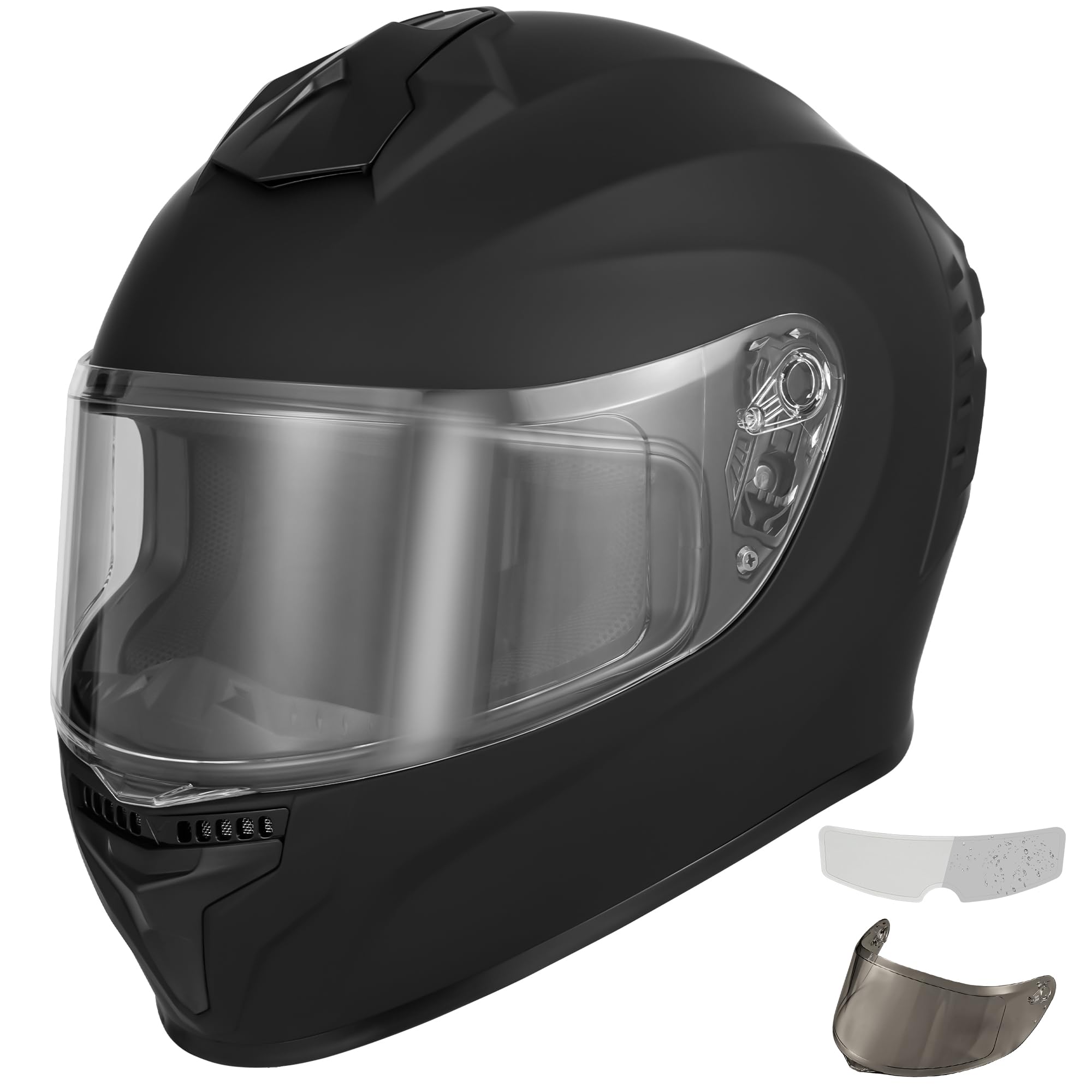
The Favoto 815 is engineered for riders who refuse to let weather dictate their schedule. The dual-visor system includes a clear anti-fog outer shield treated with an included anti-fog film, plus a tinted inner sun visor, giving you all-season optical versatility. The high-strength ABS shell exceeds FMVSS 218 standards and is built as a non-modular, non-flip-up design, which provides structural rigidity that flip-up models can’t match. The nine ventilation ports include chin, forehead, and exhaust vents that create effective airflow for temperature regulation. The manufacturer specifically highlights all-weather reliability in extreme temperatures, from freezing trails to desert heat, without any electronic components that could fail.
Owner reports confirm the fit is precise, with riders around the 23-inch head circumference finding the large size snug and secure. The 3D-molded inner liner is designed to eliminate pressure points, particularly for women and riders with different head shapes. Several owners appreciated the premium packaging, which makes the helmet suitable for gifting. The anti-fog film helps reduce condensation, though some reviewers noted that fogging still occurs in extreme humidity or during heavy exertion. The clear and tinted visors are separate units that require swapping — they are not linked, so you need to carry the spare if you anticipate light changes during a ride.
Surviving a crash is the ultimate test, and at least one owner reported that the Favoto protected them without head injury in a severe accident. The top visor padding can shift over time, but this is fixable with simple adhesive or staples. The helmet is lightweight for a full-face design, and the ratchet chin strap is secure without being bulky. The Favoto 815 is best suited for riders who want DOT-certified full-face protection with dual-visor flexibility, anti-fog capability, and robust ventilation, all at a price that undercuts premium brands significantly. It’s a practical choice for commuters and touring riders who face variable weather and road conditions.
What works
- Dual visor system with anti-fog film for all-weather riding
- Nine vents deliver effective airflow in extreme temperatures
- Non-modular shell design offers structural rigidity exceeding flip-ups
- Premium packaging makes it gift-ready
What doesn’t
- Visors are separate units requiring manual swap, not linked
- Top visor padding may shift and need periodic adjustment
9. Yesmotor 618 3/4 Retro Helmet
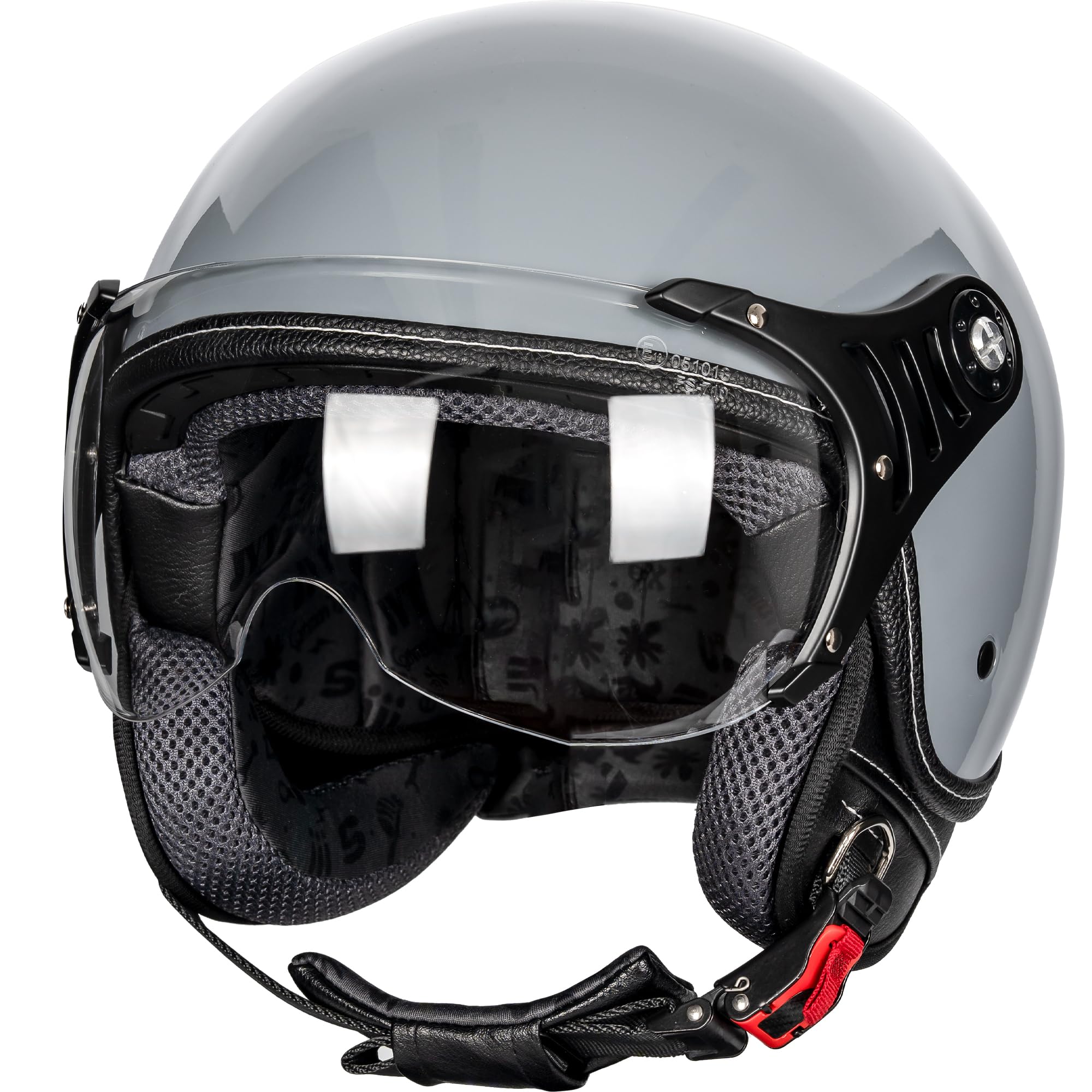
The Yesmotor 618 delivers a clean, retro aesthetic with a detachable clear visor that provides solid eye protection for urban and suburban riding. The ABS shell is lightweight without feeling flimsy, and the removable, washable liner and cheek pads help maintain hygiene for daily commuters. The quick-release buckle is straightforward and secure, and the classic shell shape in gray or black pairs naturally with vintage scooters, mopeds, and cruisers. This is a no-frills approach to the 3/4 format that focuses on the essentials: certified protection, comfortable padding, and a clear view forward.
Owner reviews are consistently positive about the value proposition. Multiple riders noted that the helmet fits well for its price tier, with a comfortable interior that doesn’t create pressure points. The DOT certification is officially labeled, providing peace of mind for riders who need legal compliance. Some owners pointed out that the visor has slight optical distortion at the edges, though none considered it dangerous or distracting during normal riding. The lightweight build (well under 3 pounds) is appreciated by scooter commuters who make frequent stops. A few owners reported that the medium size had insufficient padding for a secure fit and required aftermarket foam to eliminate wobble — worth noting if you’re between sizes.
The retro design garners compliments, with the gray option particularly popular among Vespa and Piaggio owners who want a period-correct look without spending vintage-Lid money. The Yesmotor 618 is ideal for low-speed urban riding, scooter commutes, and riders who want a certified helmet they can toss in a top case without worrying about cosmetic damage. It is not designed for high-speed highway use, where the moderate noise levels and visor distortion become more noticeable. For the rider who needs a functional, good-looking 3/4 helmet for city miles and occasional weekend puttering, the Yesmotor delivers exactly what it promises without waste or pretense.
What works
- Clean retro styling that matches vintage scooters and cruisers
- Lightweight ABS shell reduces fatigue during stop-and-go riding
- Removable washable liner for easy maintenance
- DOT certified with official labeling
What doesn’t
- Visor has minor edge distortion noticeable on close inspection
- Some sizes may require aftermarket padding for a wobble-free fit
10. VCAN V88 3/4 Open Face Helmet

The VCAN V88 is one of the most affordably priced helmets to carry both ECE 22.05 and DOT certifications, which is a significant advantage in the budget 3/4 segment. The thermoplastic resin shell is paired with an integrated sun visor, a removable washable liner, and a micro-metric retention system that punches well above its price tier. The top air vent provides heat circulation, and the anti-scratch visor is designed to resist the daily wear of urban riding. With over 30 years of manufacturing history behind the brand, the V88 benefits from production expertise that many generic budget helmets lack.
Owner feedback is solid across the board. Reviewers describe the helmet as comfortable, well-padded, and secure, with a sunshade that works effectively over prescription glasses. The micro-metric chin strap is a standout feature at this price — owners consistently praise its ease of use compared to traditional D-rings. The fit is true to size for most head shapes, with a medium accommodating the average adult head comfortably. The airflow is adequate but not exceptional, and the sun visor can be slightly finicky to operate with glasses, though not impossible. The gloss black finish is deep and well-applied, resisting scratches better than expected.
A notable limitation is that the sun visor does not click into a full-down detent with the same positive feedback as premium helmets — it’s held in place by friction, which some owners found acceptable and others wished was more secure. The one-year manufacturer warranty is standard for the price tier. The VCAN V88 is the smart choice for the budget-conscious rider who refuses to compromise on certification standards. The dual ECE and DOT marks mean this helmet has passed a broader and more demanding set of impact tests than any DOT-only helmet at a similar price. If you need a certified 3/4 helmet with a built-in sun visor and a quality retention system, the V88 is the value benchmark.
What works
- ECE 22-05 and DOT dual certification at a budget price point
- Micro-metric chin strap rivals premium helmet convenience
- Integrated sun visor works effectively over prescription glasses
- Established manufacturing pedigree with 30+ years of experience
What doesn’t
- Sun visor detent is friction-based rather than positive-click
- Airflow is moderate compared to vented premium alternatives
11. AHR RUN-O5 Vintage Retro Helmet

The AHR RUN-O5 captures the 1950s pilot-helmet aesthetic with a deliberately classic 3/4 shell that pairs naturally with bobbers, cruisers, and vintage scooters. The ABS outer shell combined with high-density EPS foam provides DOT-certified protection, and the removable sun visor can be taken off for an authentic open-face experience. A rear buckle with a strap is specifically designed to secure goggles in place, which is a rare and thoughtful detail for riders who prefer goggles over a visor. The quick-release buckle makes on-and-off easy, and the lightweight 2.3-pound construction reduces neck strain during long rides.
Owner reviews are enthusiastic about the vintage proportions. Riders who struggled with other 3/4 helmets fitting their head shape found the AHR’s sizing more accommodating, with multiple reviewers noting that the XXL fits larger heads comfortably. The helmet is well-made with durable materials, and the classic design elements — the visor shape, the shell contour, the rear goggle strap — all contribute to an authentic period look that stands out from modern streamlined designs. The removable and washable cheek pads help maintain freshness, and the ample interior space works well with both goggles and glasses.
The visor is detachable but does not offer a tinted or retractable option — what you see is what you get with the clear shield, so be prepared to ride with sunglasses or goggles in bright conditions. The quick-release chin strap is a modern improvement that complements the vintage shell. The AHR RUN-O5 is the niche pick for riders who prioritize authentic retro styling above all else and are willing to work with a clear-only visor and a classic shell that prioritizes looks over vents. It’s also an excellent choice for riders with larger head sizes who find modern 3/4 shells too snug. This helmet lives and breathes vintage character, and for the right buyer, that’s exactly the point.
What works
- Authentic 1950s pilot-helmet design with period-correct proportions
- Rear goggle strap buckle is a unique and practical detail
- XXL sizing accommodates larger head sizes comfortably
- Removable washable cheek pads for hygiene maintenance
What doesn’t
- Only includes a clear visor — no tinted or retractable sun shield
- Classic shell design lacks modern ventilation porting
Hardware & Specs Guide
ABS vs. Fiberglass Composite Shells
The shell material dictates the helmet’s weight, impact energy distribution, and long-term durability. Acrylonitrile Butadiene Styrene (ABS) is the most common material in mid-range and budget 3/4 helmets. It offers good impact resistance at a low cost, but it is heavier than fiberglass and can become brittle over time if exposed to extreme temperature cycling. Fiberglass composite shells, found on premium models like the Bell Custom 500, use woven glass fibers bonded in a resin matrix. Fiberglass distributes impact energy more efficiently across the shell, weighs less than ABS, and maintains its structural properties over a longer lifespan. Multi-layer fiberglass shells with aramid reinforcement offer the best strength-to-weight ratio in the 3/4 category but come at a significant price premium.
EPS Impact Liner Density
Expanded Polystyrene (EPS) is the foam layer that absorbs the kinetic energy of an impact. The density and thickness of the EPS liner directly determine how much force reaches your head. Single-density EPS liners are cost-effective but optimized for a narrow range of impact speeds, typically around 12-15 mph. Multi-density EPS liners use layers of different densities to handle impacts at both low and high speeds, providing better protection across a wider range of crash scenarios. In a 3/4 helmet, the EPS liner must extend deep into the occipital region at the back of the head to compensate for the open face. Some premium helmets use a dual-layer EPS construction with a softer inner layer for low-speed impacts and a denser outer layer for high-speed energy absorption.
Retention System Types
The chin strap retention system is the component that keeps the helmet on your head during a crash. Traditional D-ring systems consist of two metal rings through which the strap is threaded — they are secure and durable but require two hands and significant dexterity to operate. Micro-metric ratchet systems use a toothed plastic buckle that clicks into place and releases with a single lever, making them far easier to use with gloves and much faster for daily on-and-off. Quick-release buckles with a center-button release are the third common type, offering one-handed operation but relying on mechanical plastic components that can wear over time. For a 3/4 helmet that you’ll be removing and replacing frequently during a ride, a micro-metric or push-button quick-release system adds meaningful daily convenience.
Visor Retention & Detent Mechanisms
The mechanism that holds your face shield in the open or closed position is a critical reliability point. Friction-based visor systems rely on the tightness of a pivot screw or the resistance of a plastic detent to hold position. Over time, friction-based systems lose tension and allow the visor to drop or rattle. Positive-click detent mechanisms use a spring-loaded ball bearing or plastic tooth that locks into a groove at set positions (typically fully open, partially open, and fully closed). These provide audible and tactile feedback when the visor engages and maintain their tension for the life of the helmet. Retractable inner sun visors use a sliding or flip-down mechanism with a separate detent track. Testing the smoothness and positive engagement of the visor mechanism is the most reliable way to predict long-term satisfaction with any 3/4 helmet that includes a face shield.
FAQ
What is the difference between a 3/4 helmet and a half helmet?
Can I wear glasses with a 3/4 helmet that has a face shield?
How do I determine the correct helmet size for my head?
Are DOT-only helmets less safe than ECE-certified helmets?
How often should I replace a 3/4 motorcycle helmet?
Final Thoughts: The Verdict
For most riders, the best 3/4 motorcycle helmet with face shield winner is the BEON B-120 because it integrates a retractable sun visor, a clear flip-down shield, and an extended long visor into one shell with ECE and DOT dual certification, all while maintaining proportions that avoid the oversized bubble look. If you prioritize a heritage fiberglass shell and premium liner materials over shield versatility, the Bell Custom 500 is the uncompromising pick. And for the rider who needs the lightest possible certified 3/4 helmet with a sun visor and a five-year warranty at a friendly price, the Westt Rover delivers value that’s difficult to beat. Each of these helmets earns its place by solving a specific set of riding requirements — match your priorities to the design, and you’ll have a lid that feels right from the first mile.

Certification: BSc in Mechanical Engineering
Education: Mechanical engineer
Lives In: 539 W Commerce St, Dallas, TX 75208, USA
Md Amir is an auto mechanic student and writer with over half a decade of experience in the automotive field. He has worked with top automotive brands such as Lexus, Quantum, and also owns two automotive blogs autocarneed.com and taxiwiz.com.