A blown fuse at the wrong moment can strand a vehicle, damage expensive electronics, or worse—start a fire. The difference between a fuse that protects and one that merely occupies space comes down to materials, voltage rating, and real-world current handling, not marketing claims on the packaging.
I’m Amir — the founder and writer behind Four Wheel Ask. I’ve spent years analyzing electrical system specifications, sourcing data from owner forums, and comparing build quality across dozens of high-current fuse options to understand what separates a reliable protection device from a liability.
This guide breaks down five contenders that cover the spectrum from budget-conscious builds to marine-grade installations. Choosing the best 250 amp fuse means prioritizing reliable overcurrent protection for your vehicle’s alternator, inverter, or battery bank setup.
How To Choose The Best 250 Amp Fuse
Selecting a high-current fuse involves more than matching the amp number on the label. The form factor, voltage ceiling, mounting style, and internal construction all determine whether the fuse protects your gear or becomes a bottleneck that generates heat under load.
Form Factor: ANL, MEGA, or MRBF
ANL fuses are the most common for aftermarket audio and inverter installations because they fit standard in-line holders with set-screw terminals. MEGA fuses use a bolt-down design and are often found on factory battery terminals and modern alternator circuits. MRBF fuses mount directly to a battery post or distribution stud with a single bolt, saving space but requiring careful washer placement to avoid resistance. Choose the form that matches your existing holder or terminal layout.
Voltage Rating and System Voltage
A 250 amp fuse rated for 32V DC works safely on a standard 12V or 24V system, but if you plan to use it on a 48V solar bank or higher-voltage inverter, the voltage rating must exceed your system voltage. Fuses with a 58V or higher rating cover nearly all automotive, marine, and low-voltage solar applications without concern.
Material Quality and Heat Dissipation
Copper or silver-plated terminals conduct heat better than zinc or brass alternatives. Ceramic fuse bodies withstand arcing and high temperatures better than plastic. Tin-plated rings resist corrosion in engine bays and marine environments. A fuse that runs hot at 80% of its rating indicates poor materials or undersized contact surfaces, not a problem with the circuit itself.
Quick Comparison
On smaller screens, swipe sideways to see the full table.
| Model | Category | Best For | Key Spec | Amazon |
|---|---|---|---|---|
| Blue Sea Systems 5131 | Premium | Marine & RV inverter protection | Silver-plated blades, ANL form | Amazon |
| Bussmann AMG-250 | Premium | Factory replacement & custom stud-mount | Tin-plated copper, bolt-down MEGA | Amazon |
| Fastronix 250 Amp MEGA | Mid-Range | Alternator-to-battery protection | Ceramic body, time-delay | Amazon |
| InstallGear IGLSANL250 | Mid-Range | Car audio & general inline use | Complete holder with 250A ANL fuse | Amazon |
| HUAREW MRBF 250A | Budget | Compact battery terminal protection | 58V rating, ceramic + PA66 housing | Amazon |
In‑Depth Reviews
1. Blue Sea Systems 5131 Fuse ANL 250-Amp

Blue Sea Systems has built a reputation in marine and RV electrical circles for producing components that exceed the mechanical and corrosion-resistance demands of saltwater environments. This ANL-style 250 amp fuse carries that same ethos into a package designed for high-current DC circuits where failure is not an option. The silver-plated connector blades provide a measurable reduction in contact resistance compared to standard tin-plated fuses, which translates to less heat generation at sustained loads near the rating limit.
Owner feedback consistently highlights the visual health indicator window, which allows instant confirmation of fuse status without removal. Multiple reviewers running inverters in Class A motorhomes and off-grid solar banks report that this fuse holds up under continuous draws that caused generic ANL fuses to heat excessively or rupture unpredictably. The fuse is manufactured in Mexico under quality controls that meet ABYC standards for overcurrent protection.
The trade-off is a higher investment per fuse compared to commodity options. For a one-time installation in a critical circuit such as a main battery-to-inverter feed, the reliability margin justifies the cost shift. This fuse is not the choice for a temporary test circuit or a low-budget audio build, but for permanent installations where a blown fuse means a tow truck or a lost weekend, it earns its place.
What works
- Silver-plated terminals resist corrosion and reduce resistance
- Visual inspection window for quick status checks
- Consistent performance at high continuous loads
What doesn’t
- Premium cost compared to generic ANL fuses
- Requires compatible ANL holder (sold separately)
2. Bussmann AMG-250 AMG High-Current Stud Mount Fuse

Bussmann is a name that appears on OEM fuse blocks in vehicles from nearly every major manufacturer, and the AMG-250 reflects that engineering heritage. This stud-mount MEGA-style fuse uses a bolt-down design with rugged tin-plated copper terminals that handle repeated tightening without stripping or deformation. The color-coded body makes amperage identification immediate during installation or troubleshooting, a small detail that saves time when tracing circuits in tight engine bays.
User reports from custom automotive wiring projects and motorhome inverter installations describe the AMG-250 as a direct fit for Bussmann HMEG fuse blocks as well as generic MEGA holders. Several owners purchased spares across multiple amperage ratings and reported zero issues after years of storage, indicating stable materials that do not degrade over time. The 32V DC rating covers standard 12V and 24V systems without margin concern.
The primary limitation is the voltage ceiling—32V DC means this fuse should not be used on 48V solar arrays or higher-voltage inverter inputs. It also requires a compatible MEGA-style holder or direct stud mounting, so it is not a drop-in replacement for ANL holders. For factory alternator circuits, battery distribution boxes, and custom builds that already use MEGA fuses, this is a reference-grade component.
What works
- Proven OEM-quality construction from a leading fuse manufacturer
- Color-coded body for instant amperage identification
- Tin-plated copper terminals resist corrosion in engine bay environments
What doesn’t
- 32V DC limit unsuitable for 48V systems
- Requires MEGA-style holder or direct stud mounting
3. Fastronix 250 Amp MEGA/AMG Bolt Down Fuse

Fastronix positions this MEGA bolt-down fuse as a solution for alternator-to-battery protection, and the engineering choices reflect that use case. The ceramic body provides superior arc-quenching properties compared to standard plastic housings, which matters during a high-energy fault where the plasma can sustain a conductive path across melted plastic. The time-delay characteristic allows brief high-current inrush events—like an alternator field flash or capacitor bank charging—without nuisance blowing.
Customer reviews from both passenger vehicle and race car applications confirm the fuse performs exactly as specified during short-circuit events. One owner reported that the fuse saved his race car from a wiring fire by blowing cleanly when a short developed, while another used it as a replacement for a dealer-only Cadillac battery fuse and found the dimensions identical. The component is manufactured by Littelfuse, adding another layer of sourcing confidence.
The 32V DC rating limits this fuse to standard automotive and marine systems, and the single-fuse package means you need to purchase additional units for multi-circuit installations. Some users noted that the mounting holes could benefit from slightly tighter tolerances, but overall fitment in standard MEGA holders is reliable. For anyone running a high-output alternator and wanting a fuse that tolerates startup surges without nuisance trips, this is a strong candidate.
What works
- Ceramic body for high-energy arc quenching
- Time-delay feature prevents nuisance trips during inrush
- Manufactured by Littelfuse for consistent quality
What doesn’t
- 32V DC rating limits higher-voltage use
- Single fuse per package
4. InstallGear 0/2/4 Gauge AWG In-Line ANL Fuse Holder With 250 Amp Fuse
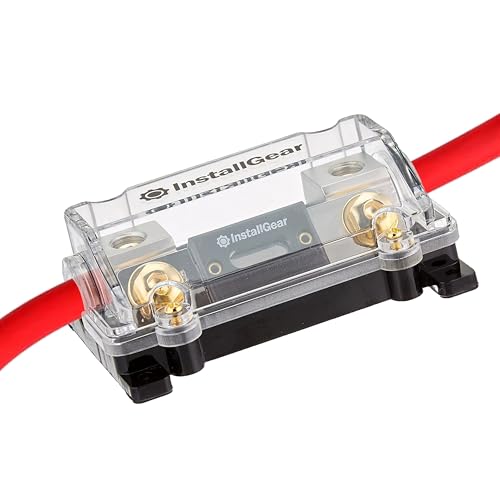
InstallGear addresses one of the most common friction points in wiring projects by bundling a 250 amp ANL fuse with a compatible in-line holder, eliminating the guesswork of matching fuse dimensions to an aftermarket holder. The holder features a clear polycarbonate cover that allows visual inspection of the fuse element, and the anodized aluminum base provides corrosion resistance in under-hood and chassis-mounted locations. The design accepts 4, 2, and 0 gauge wire without requiring separate ring terminals, using set-screw clamping instead.
Owner feedback reveals broad satisfaction across automotive audio, camper, and muscle car applications. Multiple users running 2/0 welding cable reported that the holder accommodated the oversized insulation with minor trimming, confirming the terminal openings are generous enough for true 1/0 AWG. The mounting ears with screw holes simplify secure attachment to flat surfaces, and the O-ring sealed wire entry points add weather protection.
The included fuse is a standard ANL type without silver plating or ceramic body upgrades, so applications near the full 250 amp continuous rating may benefit from upgrading to a premium replacement fuse later. Additionally, the clear cover can become brittle if exposed to prolonged engine bay heat cycles. For the builder who wants a complete, ready-to-install solution at a sensible investment, this kit delivers convenience and solid baseline performance.
What works
- Complete kit with fuse and holder in one purchase
- Accepts 4 to 0 AWG wire without ring terminals
- Clear cover for easy fuse status inspection
What doesn’t
- Included fuse is standard ANL, not premium construction
- Clear cover may become brittle under prolonged engine bay heat
5. HUAREW 250 AMP MRBF Terminal Block Fuse Holder Single Stud

HUAREW delivers a compact MRBF solution that combines a 250 amp fuse and stud-mount holder in a single assembly designed to bolt directly to a battery terminal or distribution stud. The 58V DC rating is a standout specification at this level, making the kit suitable for 48V solar systems, electric vehicle conversions, and higher-voltage inverter feeds that would exceed the 32V limit of many alternatives. The ceramic fuse element sits inside a PA66-RG301 thermoplastic housing with an insulating cap that prevents accidental shorts.
User reports from LiFePO4 battery builds and RV installations praise the small footprint and straightforward installation. One owner running a 2.3kW inverter at approximately 190 amps noted significant heat buildup at the fuse, which suggests that the thin metal ring terminals used in this design can generate resistance under sustained high loads. Proper installation with direct metal-to-metal contact—no washers between the fuse ring and the battery lug—is critical to minimizing this effect.
The value proposition is clear: a fuse and holder combination that covers up to 58V at a modest investment. However, the thermal performance under continuous loads near the rating limit raises caution for applications where the fuse will see sustained current above 200 amps. For lower-draw circuits or intermittent loads such as winches and bow thrusters, this MRBF kit offers a space-efficient and voltage-flexible solution.
What works
- 58V DC rating covers 48V solar and higher-voltage systems
- Compact single-stud design saves space at the battery terminal
- Insulating cap prevents accidental short circuits
What doesn’t
- Thin ring terminals can generate heat under sustained high loads
- Washer placement critical to avoid resistance buildup
Hardware & Specs Guide
ANL vs MEGA vs MRBF Form Factors
ANL fuses feature a rectangular blade with a visual inspection window and are designed for in-line holders with set-screw terminals, commonly used in car audio and inverter installations. MEGA fuses use a bolt-down stud-mount design with color-coded bodies for amperage identification, often found in OEM battery boxes and alternator circuits. MRBF fuses are compact single-stud units that mount directly to battery terminals or distribution posts, saving space but requiring careful attention to contact stacking order.
Voltage Ratings and System Compatibility
A fuse must have a voltage rating equal to or greater than the system voltage. For 12V and 24V automotive and marine systems, a 32V rating provides adequate margin. For 48V solar arrays, electric vehicle conversions, or higher-voltage inverters, a 58V or higher rating is necessary. Exceeding the voltage rating can cause an arc to sustain across the blown fuse element, defeating the protection purpose entirely.
Material Selection and Heat Management
Copper and silver-plated terminals offer lower electrical resistance than zinc or brass, which reduces heat generation at the contact point. Ceramic fuse bodies withstand high-energy arc events better than plastic, which can melt and sustain a conductive path. Tin plating adds corrosion resistance for marine and engine bay environments. The combination of materials directly affects how much temperature rise occurs at a given current level.
Continuous Current vs Intermittent Loads
A 250 amp fuse rated for continuous duty can carry its full rating indefinitely under normal conditions. Time-delay fuses tolerate momentary inrush spikes from capacitor banks, motor starts, or alternator field flashing without nuisance blowing. Fast-acting fuses provide tighter protection for sensitive electronics but may trip during normal startup surges. Matching the fuse response time to the load characteristics prevents unnecessary failures.
FAQ
What is the difference between ANL, MEGA, and MRBF fuses?
Can I use a 250 amp fuse for my inverter setup?
How do I know if a 250 amp fuse is genuine quality?
Final Thoughts: The Verdict
For most buyers, the best 250 amp fuse winner is the Blue Sea Systems 5131 because its silver-plated terminals and proven reliability under sustained loads make it the safest choice for permanent inverter and battery bank installations. If you want a bolt-down MEGA design for an alternator circuit or factory fuse block, grab the Bussmann AMG-250. And for a complete ready-to-wire kit at a sensible investment, nothing beats the convenience of the InstallGear ANL holder with included fuse.

Certification: BSc in Mechanical Engineering
Education: Mechanical engineer
Lives In: 539 W Commerce St, Dallas, TX 75208, USA
Md Amir is an auto mechanic student and writer with over half a decade of experience in the automotive field. He has worked with top automotive brands such as Lexus, Quantum, and also owns two automotive blogs autocarneed.com and taxiwiz.com.