A battery tester that misreads internal resistance or misses a failing alternator can leave you stranded at the worst possible moment — or send you to buy a replacement battery that still has months of service life. The gap between a reliable diagnosis and a costly mistake comes down to the tool in your hand.
I’m Amir — the founder and writer behind Four Wheel Ask. My work focuses on deep market research, comparing product specifications, build quality, and owner feedback to identify which tools deliver consistent, trustworthy results under real workshop and roadside conditions.
This guide cuts through the marketing noise to highlight the models that actually perform when you need them most. After analyzing dozens of models alongside thousands of verified owner reports, I rank the most accurate reliable options for the best 24v battery tester.
How To Choose The Best 24V Battery Tester
Selecting the right battery tester for 24V systems goes beyond picking the first model with good Amazon ratings. You need to match the tool to your specific use case — whether that is professional fleet maintenance, DIY garage work, or roadside emergency diagnosis. Understanding a few core specifications will save you both time and money.
Conductance vs. Multimeter vs. Load Testers
Conductance testers send a small AC signal through the battery to measure internal resistance and estimate state of health without draining the battery. Multimeters measure voltage and resistance but cannot assess real cranking ability under load. Dedicated load testers apply a physical load to simulate starter draw. For 24V systems, a conductance-based tester offers the best balance of speed, safety, and diagnostic depth without the risk of sparks or battery damage.
CCA Range and Voltage Compatibility
Cold Cranking Amps (CCA) indicates the battery’s ability to start an engine in cold conditions. A good 24V tester should cover at least 100–2000 CCA to handle everything from small equipment to heavy-duty truck batteries. Voltage compatibility must explicitly include 24V alongside 12V and ideally 6V for maximum versatility. Models that support multiple standards — SAE, EN, DIN, IEC, JIS — offer broader application across different vehicle types and regional battery specifications.
Build Quality and Safety Protections
Reverse polarity protection, spark-free clamps, and overload safeguards are non-negotiable features when working with 24V systems that can deliver high short-circuit current. Look for insulated alligator clips, thick copper cabling, and rugged ABS housings that survive drops in oily workshop bays. A tester with firmware upgradeability also protects your investment as battery chemistries evolve toward AGM, EFB, and lithium varieties.
Quick Comparison
On smaller screens, swipe sideways to see the full table.
| Model | Category | Best For | Key Spec | Amazon |
|---|---|---|---|---|
| TOPDON BT300P | Conductance Tester | Shops needing printed receipts | 12V/24V, 100–2000 CCA, Built-in Printer | Amazon |
| LAUNCH BST-500 | Conductance Tester | DIYers wanting broad compatibility | 6V–30V, 100–2000 CCA, Multi-Standard | Amazon |
| Autel MaxiBAS BT506 | Battery Analyzer | Pros needing smartphone integration | 6V/12V, 100–2000 CCA, Adaptive Conductance | Amazon |
| KONNWEI KW710 | Battery Analyzer | Enthusiasts wanting waveform analysis | 6V–24V, 100–2000 CCA, Waveform Display | Amazon |
| ANCEL BA101 Pro | Conductance Tester | Fleet managers needing data storage | 12V/24V, 100–2000 CCA, 2.8″ TFT Display | Amazon |
| AUTOPHIX BAS100 | Conductance Tester | Value-conscious home mechanics | 12V/24V, 100–2000 CCA, 99.98% Accuracy | Amazon |
| Acclope BT90 PRO | Battery Analyzer | Techs requiring cloud reporting | 6V/12V/24V, 30–3800 CCA, Cloud Printing | Amazon |
| Autel PowerScan | Circuit Tester | Electrical system diagnostics | 12–24V, 20ft+20ft Cable, Component Test | Amazon |
| VDIAGTOOL V200 Pro | Circuit Tester | Wire tracing and breaker finding | 12–24V, 2-in-1 Probe+Breaker Finder | Amazon |
| KAIWEETS HT118E | Multimeter | General electrical measurement | 20000 Counts, TRMS, Multi-Function | Amazon |
| FNIRSI HRM-10 | Resistance Tester | Internal resistance analysis | 100V/200Ω, Kelvin 4-Wire, TFT Display | Amazon |
In‑Depth Reviews
1. TOPDON BT300P

The TOPDON BT300P earns the top spot because it combines professional-grade print capability with robust conductance testing at a price that undercuts most shop-grade analyzers. Its built-in thermal printer produces diagnostic receipts instantly, eliminating the need to photograph screens or scribble results on paper. The 2.4-inch color display remains readable under direct sunlight and dim workshop lighting alike, which reduces eyestrain during repeated testing.
Testing accuracy is rated at 99.5 percent, and the device covers 12V and 24V starting and charging systems across flooded, AGM flat plate, AGM spiral, GEL, and EFB batteries within the 100–2000 CCA range. The spark-free copper clamps and automatic reverse polarity protection add a layer of safety that is often missing from lower-priced alternatives. The 31.5-inch cable provides enough reach to test batteries mounted in awkward positions without requiring additional extensions.
Owner feedback consistently highlights the convenience of having printed records for customer invoices and fleet maintenance logs. The only compromise is that the BT300P does not support 6V batteries, which limits its use on classic cars or small equipment. For anyone running a service bay or managing multiple vehicles, the combination of printout traceability and rapid test speed makes this the most practical all-rounder on the market.
What works
- Thermal printer delivers instant paper receipts for customer records
- Spark-free clamps and reverse polarity protection improve shop safety
- Fast 3-second test cycle keeps service bay throughput high
What doesn’t
- No 6V battery support limits classic car and small equipment use
- Thermal paper rolls require periodic restocking
2. LAUNCH BST-500

The LAUNCH BST-500 delivers broad voltage coverage from 6V to 30V, making it one of the most versatile options for mixed fleets that include motorcycles, passenger cars, trucks, boats, and gardening equipment. Its 100–2000 CCA range accommodates nearly every lead-acid battery type, including flooded, AGM flat plate, AGM spiral, GEL, and EFB constructions. The device supports CCA, BCI, CA, MCA, JIS, DIN, IEC, EN, SAE, and GB standards, which removes guesswork when testing batteries from different regions or manufacturers.
Safety features include fully insulated alligator clips that prevent sparking during connection, plus reverse polarity protection that shuts down the circuit if clamps are attached backward. The conductance-based test method does not generate heat, light, or sparks, so it poses no ignition risk near fuel vapors or battery venting. Cranking and charging tests evaluate both starter motor draw and alternator output, giving a complete picture of the electrical system rather than just the battery itself.
Multi-language support covering English, Spanish, French, German, Russian, Polish, Italian, and Portuguese makes it a strong candidate for international workshops. The main trade-off is the monochrome LCD screen, which lacks the visual clarity of color displays found on competitors at similar price points. For technicians who prioritize voltage range and standard compatibility over screen aesthetics, the BST-500 remains a consistent performer.
What works
- 6V–30V coverage handles nearly any lead-acid battery configuration
- Spark-free insulated clamps improve safety in workshop environments
- Multi-language interface suits international repair shops
What doesn’t
- Monochrome LCD is harder to read in bright sunlight
- No built-in printer or data export option
3. Autel MaxiBAS BT506
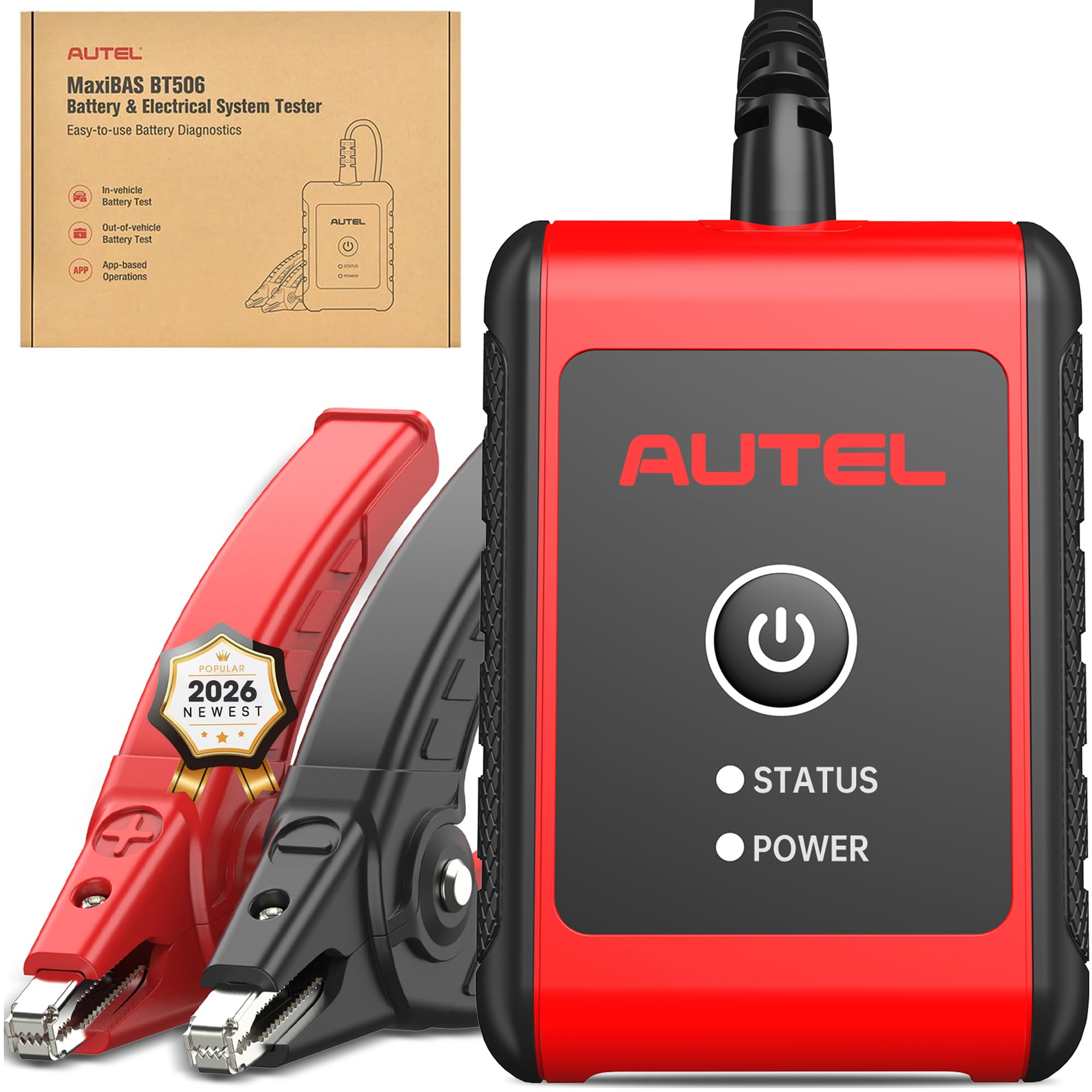
The Autel MaxiBAS BT506 represents the next step in battery diagnostics with its adaptive conductance technology that analyzes individual cell performance rather than applying a blanket resistance calculation. This approach improves detection rates for abnormal batteries and reduces the misjudgment rate that plagues simpler testers when dealing with sulfated or deeply discharged units. The device works with 6V and 12V regular batteries from 100 to 2000 CCA and supports standards including CCA, SAE, CA, EN, IEC, DIN, JIS, and MCA.
Wireless connectivity via Bluetooth pairs the BT506 with Autel scan tools or the MaxiAP200 smartphone app, which unlocks features like battery location diagrams, test report sharing, and data logging. Cranking and charging tests measure starting voltage, run-up time, charging current, and ripple to isolate alternator diode failures or regulator issues. The ability to upgrade firmware over the air ensures the tester stays current as battery chemistries evolve.
This tester also works with 99 percent of Autel wireless scanners, making it a logical upgrade path for shops already invested in the Autel ecosystem. The premium price is easier to justify for professionals who need detailed reporting and smartphone integration. The main limitation is the lack of standalone 24V heavy-truck testing without pairing to a compatible scanner, which may frustrate buyers expecting out-of-box full-system support.
What works
- Adaptive conductance improves accuracy on sulfated or weak batteries
- Bluetooth pairing enables report sharing and firmware updates
- Integrates with Autel wireless scan tools for expanded diagnostics
What doesn’t
- Requires Autel scanner or app for full 24V system testing
- Higher price point than standalone conductance testers
4. KONNWEI KW710

The KONNWEI KW710 stands out for its voltage waveform graphing capability, a feature usually reserved for professional oscilloscope-based tools. The device captures voltage changes at up to 20 data points per second and displays the result as a real-time waveform on a large color screen. This allows users to spot intermittent voltage drops, alternator ripple patterns, and starter draw anomalies that a simple numerical readout would miss entirely.
Coverage extends from 6V to 24V systems with a 100–2000 CCA range, supporting flooded, AGM, GEL, and EFB batteries. The 8.8-foot cable and enhanced clamp design reduce measurement error caused by poor contact or lead resistance. Cranking and charging tests evaluate the entire starting and charging loop, and the waveform data can be uploaded to a computer for side-by-side comparison across multiple test sessions.
Lifetime firmware updates are available, ensuring the tester gains new features over time without requiring hardware replacement. The trade-off is the price, which sits above basic conductance testers and may exceed the budget of casual home users. For technicians who value waveform data for diagnosing elusive electrical gremlins, the KW710 delivers a capability that few competitors at any price point can match.
What works
- Real-time voltage waveform graphing reveals intermittent faults
- Large color screen improves readability in varied lighting
- Lifetime firmware updates protect long-term investment
What doesn’t
- Higher price limits appeal to casual DIY users
- No built-in printer for on-the-spot documentation
5. ANCEL BA101 Pro
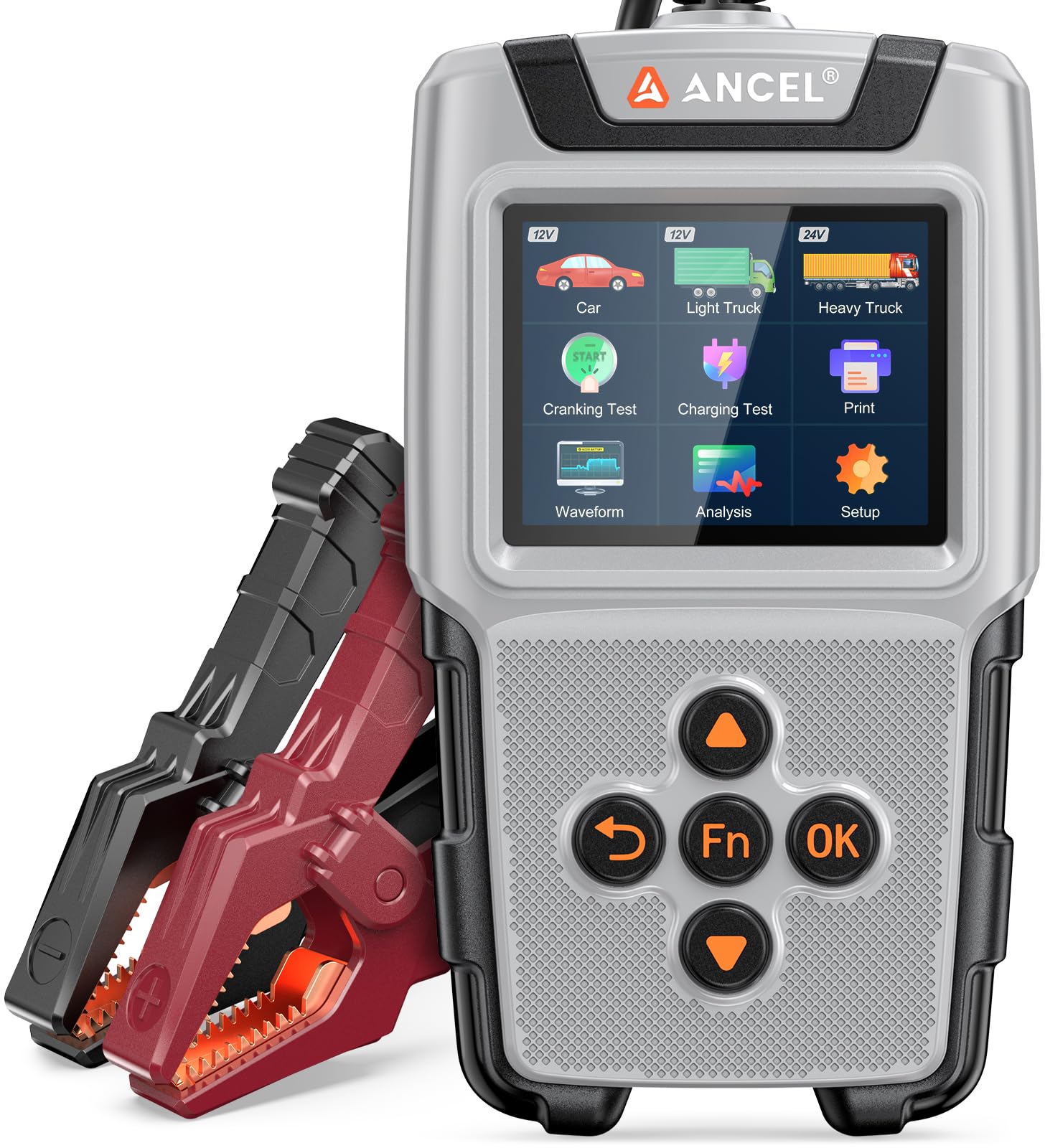
The ANCEL BA101 Pro delivers a 2.8-inch TFT color display at a price point where most competitors still use monochrome LCDs. The larger screen makes navigating test menus and reading results significantly easier, especially for users who work in low-light garage environments or have difficulty with small text. The device handles both 12V and 24V lead-acid batteries across the 100–2000 CCA range and supports CCA, IEC, EN, SAE, and DIN standards.
Three core tests — battery health, cranking, and charging — provide a complete electrical system evaluation in a single workflow. The BA101 Pro stores up to 1400 detailed test records internally and includes a Type-C port for printing diagnostic reports via a PC connection. The 120-second voltage waveform replay captures startup events for trend analysis, helping to differentiate between a weak battery and a failing starter.
Built-in reverse polarity and short-circuit protection add safety margins during connection, and the upgraded clamps offer stronger grip and better insulation than earlier ANCEL models. The requirement to install a dedicated printing driver may trigger security warnings on some PCs, but the software itself is verified safe. For the price, the color screen and extensive record storage offer exceptional value for small shop owners.
What works
- 2.8-inch TFT color display outperforms monochrome competitors
- Stores 1400 test records for fleet maintenance tracking
- 120-second voltage waveform replay aids intermittent fault diagnosis
What doesn’t
- Printing software may trigger security alerts on Windows
- No wireless connectivity for mobile app integration
6. AUTOPHIX BAS100

The AUTOPHIX BAS100 gained widespread recognition after being recommended by the Project Farm YouTube channel, a reputation backed by its claimed 99.98 percent diagnostic accuracy. The high-conductivity copper alligator clips with anti-slip coating maintain stable contact even when testing batteries with corroded terminals, which reduces the fluctuating readings that plague testers with cheap leads. Its AI smart chip processes measurement data in seconds and delivers a straightforward Good/Recharge/Replace verdict.
Compatibility covers 12V and 24V batteries from 100 to 2000 CCA, including flooded, AGM flat plate, AGM spiral, GEL, and EFB types. The tester supports CCA, BCI, CA, MCA, JIS, DIN, and SAE standards, which makes it suitable for cars, trucks, SUVs, motorcycles, boats, ATVs, and heavy equipment. A 4-in-1 smart protection system detects and prevents reverse connections, short circuits, over-voltage, and over-current conditions.
The intuitive LCD display and simple connect-and-go operation make it accessible for beginners, while the durable ABS shell withstands the rough handling typical of busy workshops. The only notable omission is the lack of internal resistance measurement, which some experienced technicians use to track battery aging trends. For the price, the BAS100 offers a proven track record of accuracy and ease of use that appeals to both DIYers and professionals.
What works
- Project Farm endorsement confirms real-world accuracy claims
- High-conductivity copper clamps reduce false readings from poor contact
- 4-in-1 protection system prevents damage from user error
What doesn’t
- No internal resistance readout for battery aging analysis
- Monochrome LCD lacks the clarity of color display alternatives
7. Acclope BT90 PRO
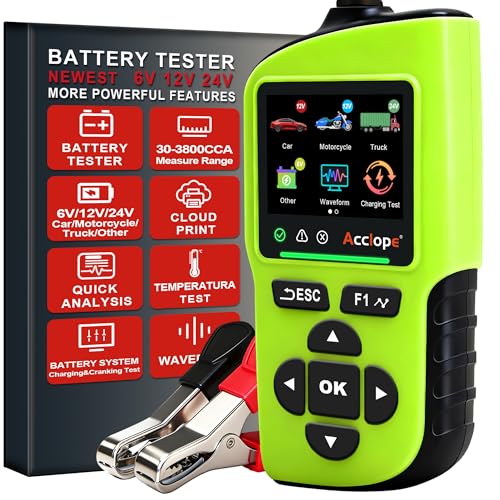
The Acclope BT90 PRO distinguishes itself with cloud-based report printing that generates a QR code on-screen for each test result. Scanning the code with a phone or tablet opens a web-based report that includes SOH, SOC, voltage, internal resistance, cranking data, and charging analysis. This eliminates the need for on-board thermal paper or manual transcription, making it ideal for shops that want digital records without investing in a separate printer or software system.
Ambient temperature sensing is integrated into the testing algorithm, which adjusts CCA and internal resistance calculations to compensate for cold or hot conditions. This reduces the winter under-read and summer over-read errors that can lead to false pass or fail verdicts. The BT90 PRO covers 6V, 12V, and 24V systems across a 30–3800 CCA range and supports flooded, AGM, EFB, GEL, and lithium battery chemistries.
The device also includes vehicle-specific modes for cars, motorcycles, and trucks, plus thickened clamp contacts and reverse polarity alerts for reliable signal capture. Firmware upgradability ensures the tester evolves with future battery technologies. The main drawback is that the cloud printing feature requires internet access via a connected device, which may not be available in all workshop environments. For data-driven shops, the digital traceability is a significant step forward.
What works
- Cloud-based QR code reports simplify digital record keeping
- Ambient temperature compensation improves accuracy in extreme weather
- Wide 30–3800 CCA range covers small bikes to heavy trucks
What doesn’t
- Cloud printing requires internet-connected device nearby
- Lithium battery support is limited to specific chemistries
8. Autel PowerScan
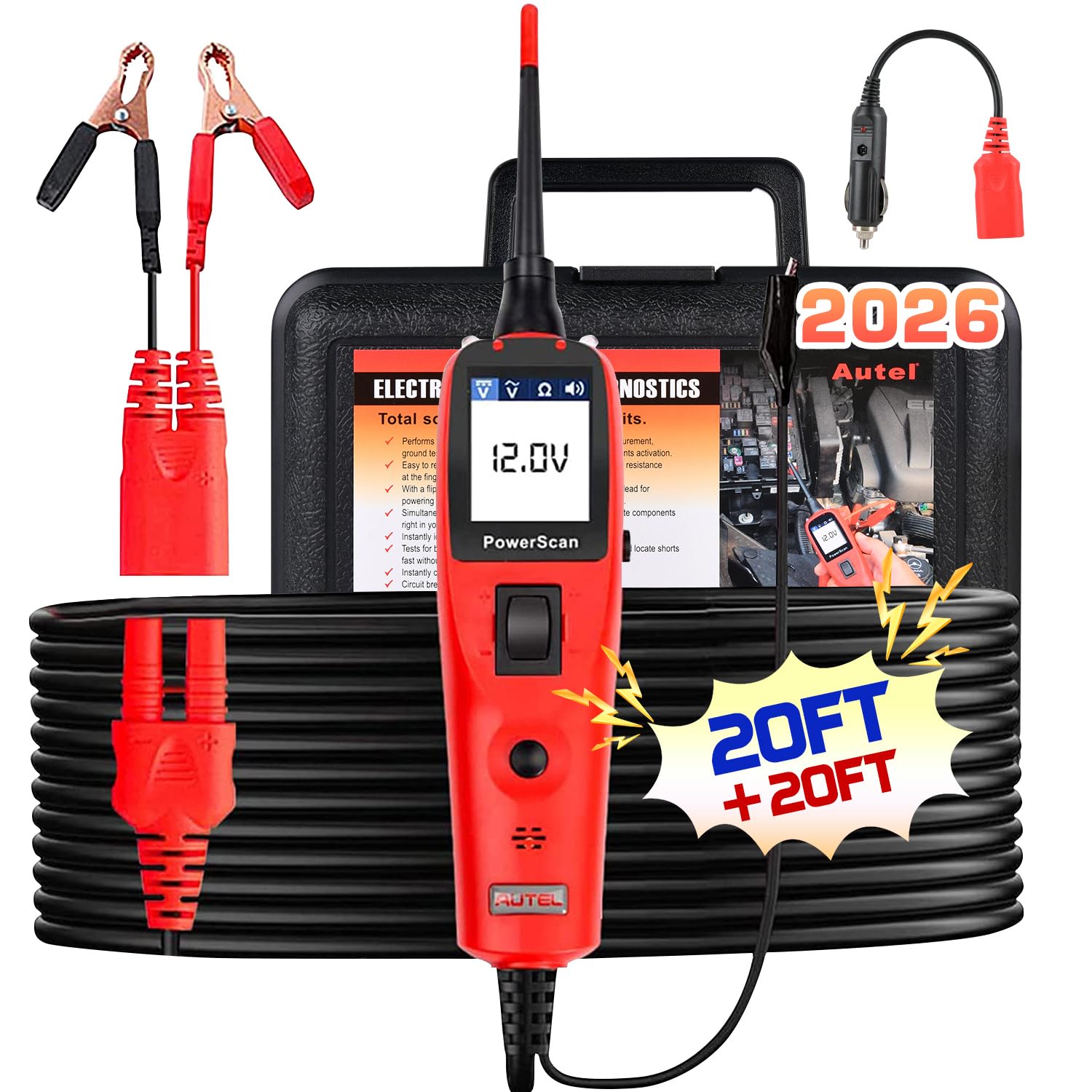
The Autel PowerScan is not a dedicated battery tester in the traditional sense — it is a power circuit probe that provides a different but complementary diagnostic function. It can test 6 to 30 volt vehicle electrical systems for voltage, polarity, continuity, signal circuits, and ground integrity. Its ability to activate components such as blower motors, window regulators, fuel injectors, and cooling fans makes it invaluable for diagnosing electrical faults that a standalone battery tester cannot address.
The unit comes with a 20-foot main cable plus an additional 20-foot extension cord, allowing full vehicle coverage without repositioning the ground connection. A built-in flashlight aids work in dark areas, and the overload protection circuit breaker trips automatically to prevent damage to the tool or vehicle electronics. Four operating modes — DC voltage, AC voltage, resistance, and tone-based continuity — cover the vast majority of circuit diagnosis scenarios.
Owner feedback from professional mechanics emphasizes the time saved by having a single tool that can power components, trace shorts, and verify ground paths without switching between multiple devices. The trade-off is that the PowerScan does not perform conductance-based battery health analysis or CCA testing, so it is best used alongside a dedicated battery tester rather than as a replacement. For electrical system troubleshooting beyond simple battery checks, this tool is a force multiplier in any shop.
What works
- 40-foot total cable reach covers any vehicle position without relocation
- Component activation function tests motors, relays, and injectors directly
- Overload protection prevents damage from accidental short circuits
What doesn’t
- No conductance-based battery health or CCA testing capability
- Requires connection to vehicle battery or cigarette lighter for power
9. VDIAGTOOL V200 Pro
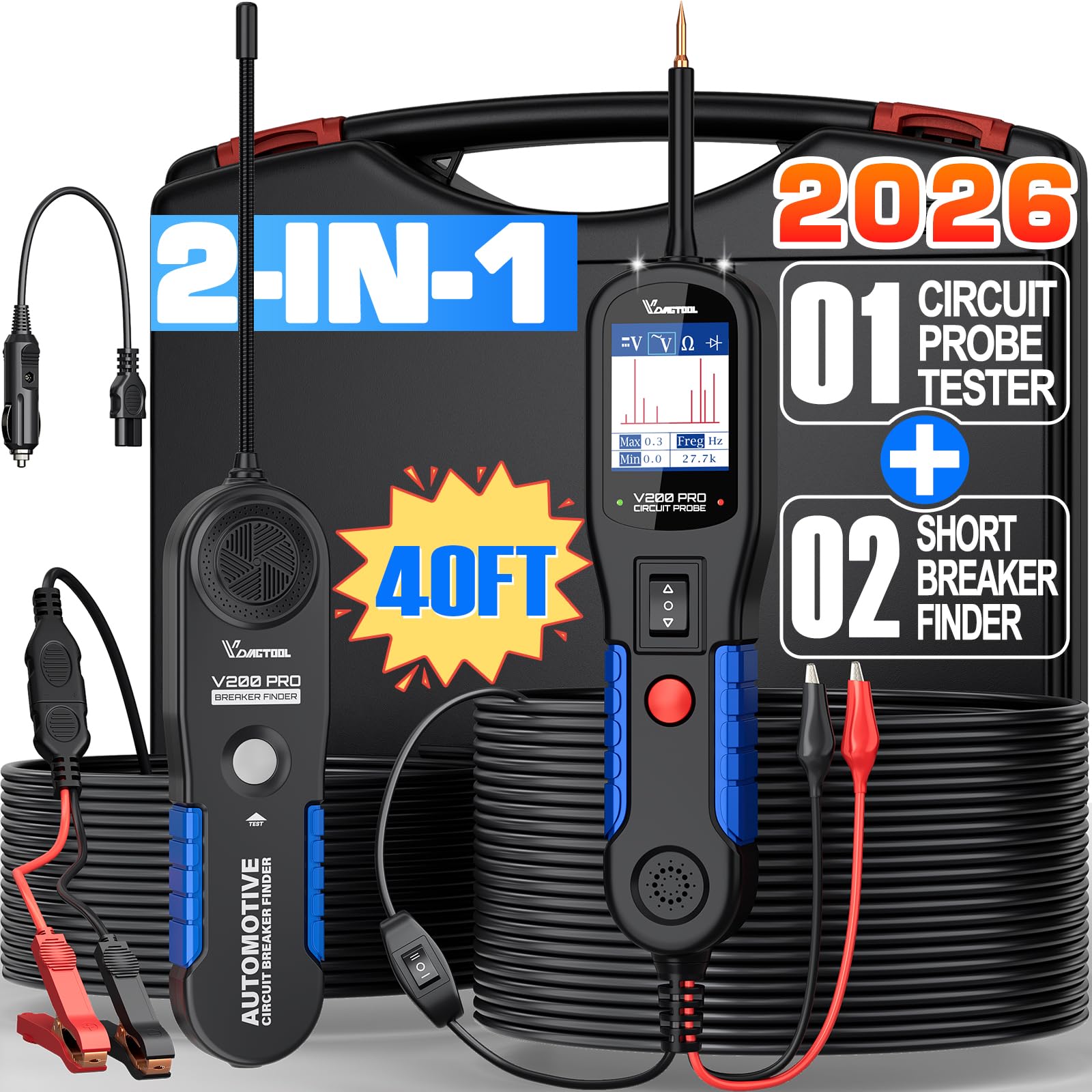
The VDIAGTOOL V200 Pro combines a power circuit probe tester with a circuit breaker finder in a single device, effectively replacing two separate tools in the toolbox. In Mode I, it functions as a full-featured circuit probe that tests AC/DC voltage, resistance, polarity, continuity, and component activation. In Mode II, it becomes a wire tracer and breaker locator that uses tone changes to identify open connections, broken wires, and current leaks without damaging insulation.
The 20-foot main cable plus a second 20-foot extension provides the same long-reach advantage as the Autel PowerScan at a lower price point. Power can be drawn from either the vehicle battery or the cigarette lighter socket, offering flexibility in different test scenarios. The built-in short circuit protection triggers an automatic shutdown if the load exceeds safe limits, protecting both the tool and the vehicle electronics.
Approval from PP official technical engineers adds credibility, and the 3-year warranty provides above-average coverage for long-term ownership. The device works on 6 to 42 volt DC systems, covering everything from motorcycles to heavy trucks. The dual-mode design means users need to carry only one tool for both circuit testing and wire tracing, which reduces bench clutter and speeds up diagnosis on complex electrical faults.
What works
- Dual-mode design replaces separate circuit tester and breaker finder
- 40-foot total cable reach suits large vehicles and trailers
- 3-year warranty exceeds standard industry coverage
What doesn’t
- Mode II breaker finder requires a separate 9V battery
- No dedicated conductance battery health testing mode
10. KAIWEETS HT118E

The KAIWEETS HT118E is a true RMS digital multimeter rather than a dedicated battery tester, which gives it a broader diagnostic scope for users who also need to measure current, resistance, capacitance, frequency, duty cycle, and temperature. The 20000-count resolution provides finer granularity than the standard 6000-count meters found at similar price points, making it more useful for detecting small voltage variations in charging circuits or sensor outputs.
A standout design feature is the LED lighting on the input jacks that illuminates the correct probe port based on the dial setting. This reduces the chance of connecting the test leads to the wrong input, which is a common source of blown fuses in multimeters. The backlit LCD display, built-in flashlight, and stable kickstand make the HT118E usable in dim under-hood conditions without requiring a second light source.
Safety certifications include CAT III 1000V and CAT IV 600V ratings, with double ceramic fuses and thermistor protection to prevent damage from voltage spikes. The 36-month after-sale service period is significantly longer than the typical one-year warranty. The main limitation is that this is not a conductance-based battery tester, so it cannot directly assess battery health or CCA capability. For users who want one tool for general electrical work plus basic battery voltage checks, the HT118E offers exceptional measurement range and build quality.
What works
- 20000-count TRMS resolution captures fine voltage and current details
- LED jack lighting prevents lead misconnection errors
- CAT III 1000V safety rating with dual ceramic fuse protection
What doesn’t
- No conductance-based battery health or CCA testing
- Requires manual interpretation of results rather than pass/fail verdict
11. FNIRSI HRM-10

The FNIRSI HRM-10 specializes in measuring internal resistance and voltage simultaneously using a customized Kelvin four-wire connection method. This configuration eliminates the influence of wire and contact resistance from the measurement path, delivering accurate values down to milliohm resolution. The TFT HD color display presents the results in a clear layout that is a noticeable upgrade over the monochrome screens found on most basic resistance meters.
Measurement range extends to 100V and 200Ω, covering everything from automotive starter batteries to small household cells. Users can manually adjust the voltage and resistance ranges for more granular control over specific test scenarios. The device stores up to 8 sets of historical readings and supports data export via the included date cable, allowing users to track battery degradation trends over multiple testing sessions.
The HRM-10 is particularly useful for sorting through large batches of batteries to identify those with elevated internal resistance that are nearing end of life but still showing acceptable voltage. The main caveat is that the device must not be used with DC voltage above 100V, and AC voltage must never be applied. For technicians who focus on battery quality assessment and cell matching rather than starting and charging system diagnosis, the HRM-10 provides focused functionality at a reasonable entry cost.
What works
- Kelvin four-wire measurement eliminates lead resistance errors
- TFT HD color display improves readability versus monochrome meters
- Data export capability supports battery aging trend analysis
What doesn’t
- No cranking or charging system test functionality
- Cannot be used with AC voltage under any circumstances
Hardware & Specs Guide
Conductance Testing Technology
Conductance testers apply a small, low-frequency AC signal across the battery terminals and measure the resulting current flow. This value correlates directly with the battery’s plate surface area and electrolyte condition, allowing the tester to calculate state of health (SOH) and cold cranking amp (CCA) capacity without discharging the battery. Unlike traditional load testers that require a full charge before testing, conductance testers work accurately on partially discharged batteries, making them faster and safer for routine shop use. The technology is particularly effective at detecting early-stage sulfation and internal short circuits that voltage-only tests will miss entirely.
Internal Resistance and Aging Trends
Internal resistance rises as a battery ages due to plate corrosion, sulfation, and electrolyte stratification. A new lead-acid battery typically exhibits internal resistance between 2 and 10 milliohms, while a failing unit may show values above 20 milliohms. Dedicated resistance testers like the FNIRSI HRM-10 use a four-wire Kelvin connection to isolate the true cell resistance from the resistance of the test leads and clamps. Tracking internal resistance over time provides a quantitative curve that predicts battery failure weeks before voltage or cranking tests indicate a problem.
Cranking and Charging System Analysis
A cranking test measures the minimum voltage during engine start — a healthy 12V system should stay above 9.6V, while a 24V system should remain above 19.2V. The charging test evaluates alternator output voltage, current, and ripple. Alternator ripple above 100mV AC typically indicates diode failure, while voltage outside the 13.8V–14.4V range (12V systems) or 27.6V–28.8V range (24V systems) signals regulator problems. Testers that combine these three measurements in a single workflow provide a complete picture of the electrical system rather than isolating the battery alone.
Safety Certifications and Protections
Look for testers certified to CAT III or CAT IV safety ratings, which indicate the tool can withstand transient voltage spikes common in automotive electrical systems. Reverse polarity protection prevents damage when clamps are attached to the wrong terminals, while spark-free operation eliminates ignition risk near battery venting or fuel vapors. Overload protection and thermal shutdown circuits add another layer of safety during prolonged testing sessions. Insulated alligator clips with PVC-coated wiring reduce the risk of accidental short circuits when working in tight engine bays with conductive metal surfaces nearby.
FAQ
What is the difference between a multimeter and a dedicated battery tester?
Can I use a 12V battery tester on a 24V system?
What does CCA mean and why does it matter?
How often should I test my vehicle battery?
Are lithium batteries compatible with standard battery testers?
Final Thoughts: The Verdict
For most buyers, the best 24v battery tester winner is the TOPDON BT300P because it combines printed diagnostic receipts, professional-grade accuracy, and robust safety features at a justifiable price point that suits both independent shops and serious DIYers. If you need waveform analysis to catch intermittent electrical faults, grab the KONNWEI KW710. And for those who prioritize smartphone integration and firmware upgradability, nothing beats the Autel MaxiBAS BT506.

Certification: BSc in Mechanical Engineering
Education: Mechanical engineer
Lives In: 539 W Commerce St, Dallas, TX 75208, USA
Md Amir is an auto mechanic student and writer with over half a decade of experience in the automotive field. He has worked with top automotive brands such as Lexus, Quantum, and also owns two automotive blogs autocarneed.com and taxiwiz.com.