Snug in a tight engine bay, a rounded-off O2 sensor nut can turn a thirty-minute job into a weekend of frustration and expensive trips to the exhaust shop. The difference between a smooth repair and a stripped disaster often comes down to one tool: a properly designed 22 mm socket that grips the sensor hex without slipping, clears the wiring harness, and reaches past heat shields and tight frame rails.
I’m Amir — the founder and writer behind Four Wheel Ask. Over the years I’ve analyzed hundreds of tool specifications, studied owner installation reports across dozens of vehicle platforms, and tracked failure patterns in budget versus professional-grade O2 sensor sockets to understand what actually holds up under real-world torque.
This guide breaks down the critical differences in drive size, socket depth, material hardness, and wire-gate geometry so you can buy with confidence. Through extensive analysis of build quality, owner feedback, and real-world performance data, this guide identifies the best 22 mm o2 sensor socket for every scenario.
How To Choose The Best 22 Mm O2 Sensor Socket
Every 22 mm O2 sensor socket looks similar at a glance, but small differences in drive interface, slot geometry, and steel treatment determine whether the tool slips or bites. Focus on these four factors when comparing options.
Drive Size: 3/8-Inch Versus 1/2-Inch
A 1/2-inch drive socket withstands higher torque without flexing, making it the safer choice for sensors that have been seated for years in a high-heat environment. The 3/8-inch drive fits into tighter spaces and works well with compact ratchets, but the thinner wall can deform under extreme force. Many professionals prefer a set that includes both drive sizes so they can match the tool to the access constraints of a specific vehicle.
Socket Depth and Wire-Gate Slot Length
Deep sockets with a long cut-away slot allow the sensor wire harness to pass through without damage, but if the slot is too short the socket cannot fully seat over the sensor hex. Measure the depth needed for your vehicle’s upstream and downstream sensors — some require a socket depth of 2.75 inches or more to clear the sensor body and heat shield.
Material and Surface Treatment
Chrome vanadium steel with heat treatment resists deformation and corrosion far better than untempered alloys. A manganese phosphate or black oxide coating adds a layer of rust protection that matters when tools sit in a damp garage or road-salt environment. Avoid painted or plated sockets that chip easily, as exposed bare metal can rust and bind to the sensor nut.
Offset and Crowfoot Configurations
Offset sockets offset the drive axis from the sensor axis, providing clearance for tight angles near the exhaust manifold. Crowfoot designs allow you to attach the socket to a wrench for even tighter spots. For vehicles with upstream sensors tucked behind heat shields, an offset or crowfoot socket can save you from having to remove multiple components just to gain access.
Quick Comparison
On smaller screens, swipe sideways to see the full table.
| Model | Category | Best For | Key Spec | Amazon |
|---|---|---|---|---|
| Lisle 12390 | Socket Wrench | Stubborn sensors & high torque | 1/2 & 3/8 in dual drive, forged steel | Amazon |
| OEMTOOLS 27110 | 3-Piece Set | Versatility & universal fit | 3/8 & 1/2 drive, deep & crowfoot | Amazon |
| ARES 70323 | Offset Socket | Tight engine bay access | 1/2 in drive, offset, Cr-V steel | Amazon |
| ATPEAM 3-Piece | Socket Set | Affordable coverage for DIY | 3/8 & 1/2 drive, deep & crowfoot | Amazon |
| Lisle 12100 | Single Socket | Reliable standard replacement | 3/8 in drive, heat-treated alloy | Amazon |
| Powerbuilt 648442 | Single Socket | Budget-friendly standard duty | 1/2 in drive, Cr-V steel, side gate | Amazon |
| bylikeho 5-Piece | Socket Set | Complete kit with thread chasers | 3/8 & 1/2 drive, ultra deep, pry bar | Amazon |
| CRAFTSMAN CMMT98372 | Single Socket | Lifetime warranty & brand trust | 3/8 in drive, polished alloy steel | Amazon |
| Dobur 5-Piece | Socket Set | Thread repair & offset reach | 3/8 in drive, Cr-Mo steel, thread chasers | Amazon |
| Rlokciy 5-Piece | Socket Set | Forged strength at low cost | 3/8 & 1/2 drive, forged Cr-V, chasers | Amazon |
| ABN Flexible Head | Wrench | Downstream sensor in tight spots | 22 mm flex head, cold-forged steel | Amazon |
In-Depth Reviews
1. Lisle 12390 Dual Drive Oxygen Sensor Wrench

The Lisle 12390 is the tool that experienced technicians reach for when penetrating fluid alone won’t break a corroded sensor free. Its forged, heat-treated steel body accepts both 1/2-inch and 3/8-inch drive tools, giving you the option to use a breaker bar for maximum torque or a compact ratchet where space is limited. The six-point design engages the full sensor hex, distributing force evenly to minimize the risk of rounding.
Owner reports consistently highlight how this socket outperformed cheaper alternatives on sensors that had been seated for over a decade. The dual-drive capability is not a gimmick — the detent ball holds the ratchet or breaker bar securely, and the thicker wall construction prevents the flex that causes slip in thinner sockets. Several users noted that the tool allowed them to remove sensors without resorting to heat or impact tools, preserving the threads in the exhaust bung.
One detail that sets the Lisle 12390 apart is the deliberate fit tolerance. Owners measured less than 1 mm of play on the sensor hex, which translates to immediate bite with minimal rotational slop. The tool also doubles as a handle, so you can apply direct hand torque for initial loosening before attaching a breaker bar. For anyone who deals with rust-belt vehicles or high-mileage repairs, this is the socket that inspires confidence on the first try.
What works
- Accepts both 1/2-inch and 3/8-inch drive tools for maximum flexibility
- Forged, heat-treated steel resists deformation under high torque
- Tight hex fit minimizes play and prevents rounding
- Works as a standalone handle for initial loosening
What doesn’t
- Higher price point than basic socket designs
- Bulkier shape may not fit in the tightest access zones
2. OEMTOOLS 27110 3-Piece Oxygen Sensor Socket Set

The OEMTOOLS 27110 kit covers the three most common O2 sensor socket configurations in one storage case: a 3/8-inch drive deep socket, a 3/8-inch drive crowfoot socket, and a 1/2-inch drive deep crowfoot socket. This range means you can tackle upstream sensors tucked behind the intake manifold and downstream sensors near the catalytic converter without buying separate tools. The offset design of the crowfoot sockets allows the wire harness to exit from the side, eliminating the need to disconnect the sensor pigtail.
Build quality is consistent across all three pieces — solid alloy steel with chrome plating on the deep socket and black oxide on the crowfoot variants. Owners have used the set on Honda Civic, Toyota Highlander, and Ford F-150 platforms with success, noting that the chrome socket held up against a stuck sensor that had triggered a check-engine light for months. The storage case keeps the sockets organized and prevents the crowfoot pieces from rolling away in a crowded toolbox drawer.
One practical observation from multiple reviews is the importance of confirming whether the sensor requires a 7/8-inch (22.225 mm) or true 22 mm socket — the slight size difference matters for a precise fit. The OEMTOOLS set labels sockets clearly, and the 6-point design grips firmly without wallowing out over repeated use. For a home mechanic who works on multiple vehicles, this set provides the right mix of depth and drive options without unnecessary duplicates.
What works
- Three distinct socket styles cover a wide range of access scenarios
- Chrome and black oxide finishes resist corrosion effectively
- Compact storage case prevents tool loss
- Offset crowfoot design clears wiring without disconnection
What doesn’t
- Crowfoot sockets can feel tight on some ratchet heads
- Some owners noted cosmetic marks on dark-finished sockets
3. ARES 70323 22 mm Heated Oxygen Sensor Socket

The ARES 70323 is a dedicated 1/2-inch drive offset socket engineered for accessing oxygen sensors in confined engine compartments. The offset shifts the drive axis away from the sensor centerline, providing knuckle clearance when working near the exhaust manifold or frame rails. A manganese phosphate coating adds corrosion resistance that holds up better than basic paint when the tool contacts hot exhaust components.
Owners report that the socket reaches sensors on BMW, Toyota, Nissan, and Ford platforms where straight sockets simply cannot align with the ratchet. The side wire gate is wide enough to pass the sensor connector without forcing or pinching the wires. On a 2006 Honda Pilot bank 2 sensor 2 job, the ARES socket provided the extra length needed to clear the heat shield that defeated a shorter tool.
One limitation noted by users is the relatively short flange, which can prevent the flex head of some breaker bars from engaging at certain angles. A 6-inch extension resolves this issue in most cases, but it is worth verifying clearance before starting the job. The socket performed reliably on sensors that were pre-soaked with penetrating fluid, though owners caution that a severely seized sensor may still require heat regardless of the tool used.
What works
- Offset design improves access in tight engine bays
- Manganese phosphate coating resists corrosion and heat
- Wide wire gate accommodates sensor connectors
- Compatible with European and Asian makes
What doesn’t
- Short flange limits breaker bar flex-head engagement
- Requires 1/2-inch drive; not ideal for 3/8-inch-only setups
4. ATPEAM 3-Piece Oxygen Sensor Socket Set

The ATPEAM set delivers three distinct socket configurations at a price that undercuts most single-socket offerings from legacy tool brands. You get a 3/8-inch drive deep socket, a 3/8-inch drive crowfoot, and a 1/2-inch drive deep crowfoot socket, all made from heat-treated chrome vanadium steel. The powder-coated finish provides a basic layer of protection, and the plastic carrying case keeps the set organized in a toolbox or glovebox.
Owner feedback emphasizes the convenience of having both deep and crowfoot options in one kit. The deep socket works well for upstream sensors with moderate clearance, while the crowfoot designs excel at reaching sensors positioned directly above the exhaust pipe or in tight corners. Multiple users reported that the set allowed them to complete sensor replacements they had previously abandoned due to lack of tool access.
The primary trade-off at this price point is surface finish quality. The powder coating can chip if dropped on concrete, though the underlying steel remains functional. The sockets fit standard 7/8-inch sensor hexes without excessive slop, and the 6-point internal geometry distributes torque evenly. For a weekend DIYer who needs basic coverage without investing in a premium single-brand set, this kit offers a practical balance of capability and cost.
What works
- Three socket types cover standard, offset, and deep needs
- Heat-treated chrome vanadium steel provides adequate strength
- Carrying case keeps pieces organized and portable
- Affordable entry point for home mechanics
What doesn’t
- Powder coating can chip with rough handling
- Not compatible with impact tools
5. Lisle 12100 Oxygen Sensor Socket

The Lisle 12100 is the straightforward, single-socket solution that has been a staple in automotive toolboxes for years. Its 7/8-inch (22 mm) six-point design is cut from heat-treated alloy steel and finished with a durable coating that resists garage corrosion. The cutaway slot runs along the side of the socket, providing clearance for the sensor wire harness so you can remove or install the sensor without unplugging the connector.
Owners consistently describe the socket as heavy-duty and well-proportioned. It accepts a 3/8-inch square drive ratchet or a 1-inch open-end wrench, giving you two ways to apply torque depending on the access. On a 2008 Toyota Camry upstream sensor job, the socket fit snugly and transferred force without any detectable flex. The depth is adequate for most standard sensors, and the wall thickness inspires confidence compared to lightweight stamped alternatives.
One consideration is that the socket walls are thick enough that some heat-shield designs may prevent full seating. In those cases, removing the heat shield adds a few minutes to the job but avoids the risk of the socket slipping. The wire slot is generously sized, though a few owners noted that very long sensors with angled connectors require careful alignment to pass through cleanly. For a no-fuss, proven design that simply works, the Lisle 12100 remains a benchmark.
What works
- Heat-treated alloy steel construction holds up to repeated use
- Works with both 3/8-inch ratchet and 1-inch open-end wrench
- Deep cutaway slot clears sensor wires effectively
- Proven track record across multiple vehicle platforms
What doesn’t
- Thick walls may not fit past some heat shields
- Single socket offers no offset or crowfoot alternative
6. Powerbuilt 648442 22 mm Oxygen Sensor Socket
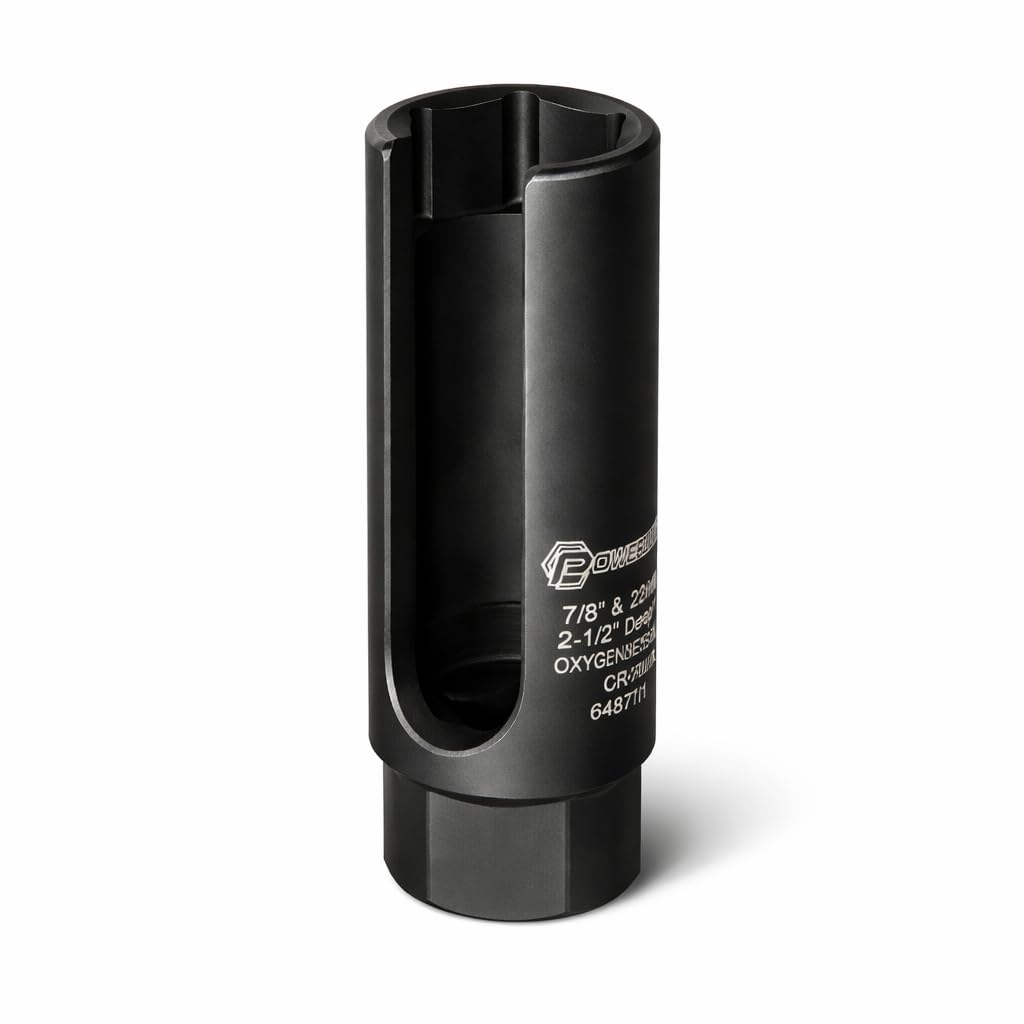
The Powerbuilt 648442 is a no-frills 1/2-inch drive socket that prioritizes strength over complexity. Chrome vanadium steel construction with heat treatment and phosphating gives this tool the toughness needed to break loose sensors that have been fused by years of thermal cycling. The side wire gate measures 0.3 inches wide by 2.2 inches long, offering a clear path for the sensor wiring during removal and installation.
Owners who used this socket on a 2006 Honda Accord described it as a key enabler for a quick 30-minute repair that would have cost over four hundred dollars at a shop. The 2.5-inch depth accommodates long-reach sensors, and the slotted square drive design helps keep the ratchet seated during high-torque applications. For the price, the material quality and finish punch well above expectations.
One important detail that emerges from owner reports is that the socket requires a 1/2-inch drive ratchet — it does not accept 3/8-inch tools. Several buyers missed this specification and had to borrow or purchase a 1/2-inch drive setup. Additionally, a small number of users found that the socket fit slightly loose on certain sensor hexes, which led to slipping on extremely corroded units. Pre-soaking with penetrating fluid and confirming the sensor hex size beforehand mitigates this risk.
What works
- Chrome vanadium steel with heat treatment offers real durability
- Deep 2.5-inch socket accommodates long sensors
- Side wire gate protects wiring during removal
- Very competitive pricing for the build quality
What doesn’t
- 1/2-inch drive only; incompatible with 3/8-inch ratchets
- Fit tolerance may be loose on some sensor hexes
7. bylikeho 5-Piece O2 Sensor Socket Set

The bylikeho 5-piece set expands the standard O2 socket kit by adding two thread chasers (M12 x 1.25 mm and M18 x 1.5 mm) alongside three socket configurations. The ultra-deep 3/8-inch drive puller socket measures 3-1/8 inches long, making it one of the deepest options available for sensors that sit deep within the exhaust bung. A short 3/8-inch pry bar socket and a 1/2-inch drive offset socket round out the tool selection, giving you multiple angles of attack.
Owner feedback highlights the thread chasers as a genuine value-add — cleaning corroded threads before installing a new sensor reduces the risk of cross-threading and ensures accurate torque readings. The black oxide finish on the sockets provides corrosion resistance, and the included storage case keeps everything organized. Users on Chevy Avalanche and other full-size trucks reported that the offset socket was essential for reaching the rearward sensors without dropping the exhaust.
The set’s primary compromise is surface refinement. Some owners noted that the black oxide finish marks up more easily than chrome plating, though this is cosmetic and does not affect function. The socket fitment is accurate on standard 22 mm sensor hexes, and the six-point geometry provides a solid bite. For a DIYer who wants thread-chasing capability built into the same kit as the removal sockets, this set offers a complete solution in one package.
What works
- Includes M12 and M18 thread chasers for thread cleanup
- Ultra-deep 3-1/8-inch socket reaches long sensors
- Three different socket types cover varied access needs
- Storage case keeps the complete set organized
What doesn’t
- Black oxide finish marks more easily than chrome
- Some users wanted longer offset socket design
8. CRAFTSMAN CMMT98372 Oxygen Sensor Socket
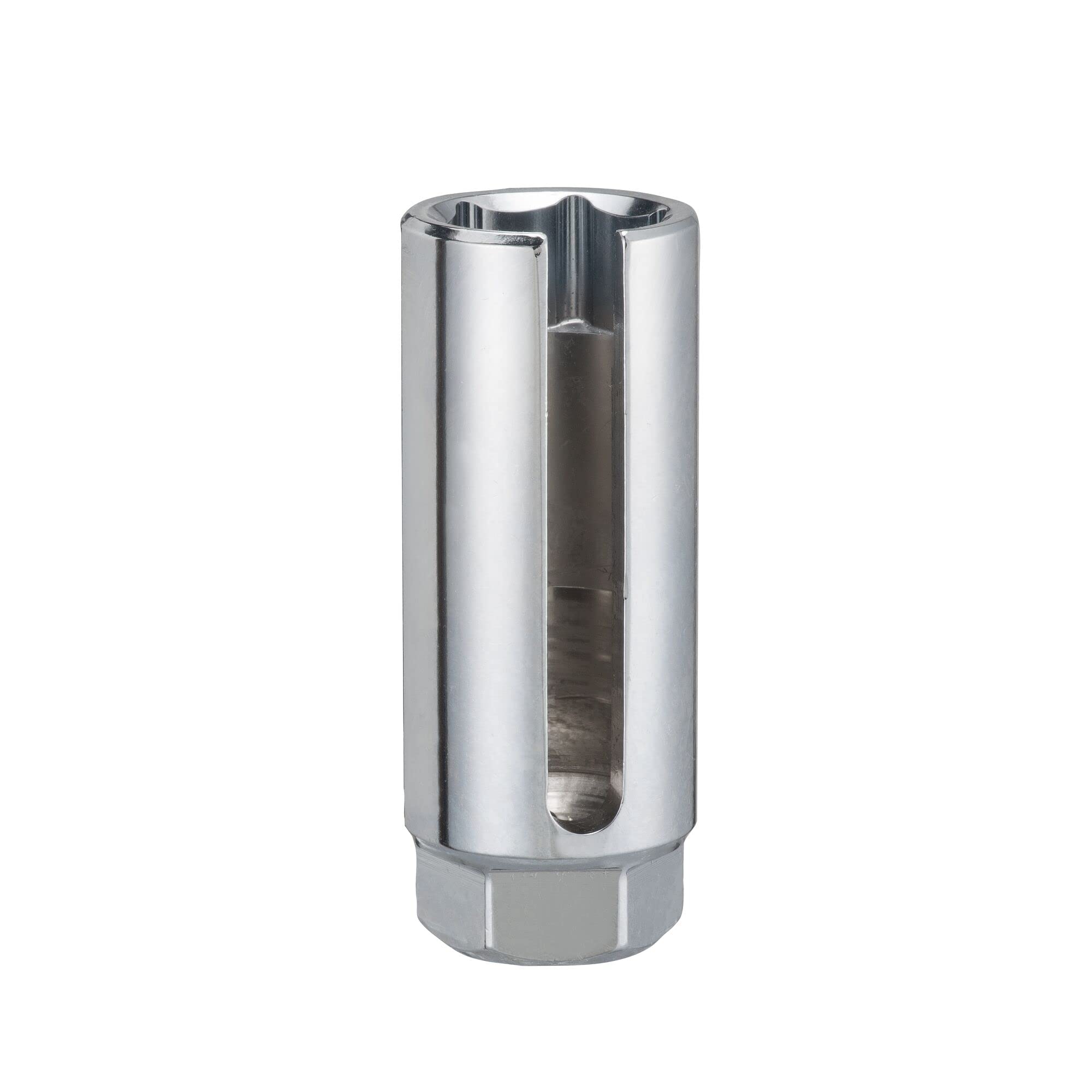
The CRAFTSMAN CMMT98372 is a polished alloy steel socket designed for 3/8-inch drive ratchets, backed by the brand’s full lifetime warranty. The cutaway slot runs along the side to clear the wire connector, and the polished finish resists rust and wipes clean easily after greasy jobs. For buyers who prioritize warranty support and brand availability at local retailers, this socket offers peace of mind beyond the purchase price.
Owners report that the socket works as intended for standard removal and installation tasks, with the six-point internal profile gripping the sensor hex without slipping. The 3/8-inch drive format keeps the tool compact, which helps in moderately tight engine bays. On the positive side, the heavy-duty construction feels solid in hand, and the polished surface slides into tight spots without dragging on adjacent components.
However, the slot depth is a notable limitation. Multiple owners found that the 2.50-inch slot was too shallow for sensors requiring 2.75 inches of clearance, such as the upstream sensor on a 2004 Honda Civic 1.7L. The socket’s outside diameter of 1.255 inches is also slightly smaller than the typical 1.300 inches, which can affect fit on some sensor designs. For jobs where the clearance slot depth matches the sensor requirements, this socket performs well, but it is not a universal fit for all applications.
What works
- Full lifetime warranty from a major national brand
- Polished finish resists rust and cleans easily
- Compact 3/8-inch drive format fits moderate spaces
- Solid alloy steel construction feels durable
What doesn’t
- Clearance slot too short for many long-reach sensors
- Slightly smaller OD may not fit all sensor hexes
- Some units had sharp edges from chroming process
9. Dobur 5-Piece O2 Oxygen Sensor Socket Set
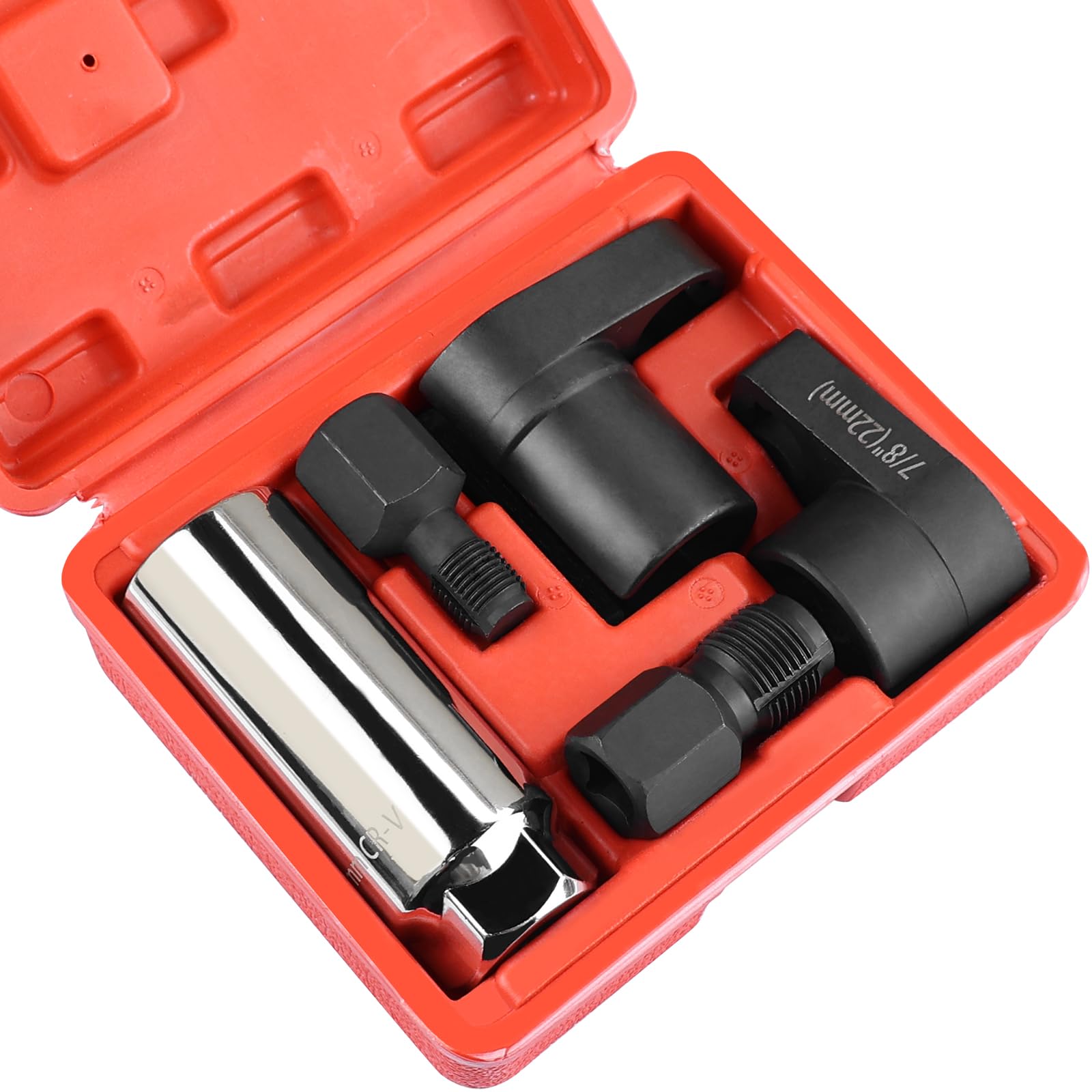
The Dobur 5-piece set uses chrome molybdenum carbon steel, a material choice that delivers higher torsional strength than standard chrome vanadium at a comparable price point. The set includes a 7/8-inch (22 mm) 3/8-inch drive socket, two offset O2 sensor wrenches, and two thread chasers (M12 and M18), all housed in a compact storage case. The offset wrenches provide an alternative access method when a socket and ratchet combination cannot physically fit into the workspace.
Owner reports consistently praise the set’s ability to handle stubborn sensors. The thread chasers were specifically noted as effective at cleaning up exhaust bung threads contaminated with rust and carbon deposits, ensuring the new sensor seats correctly. The offset wrenches provide excellent leverage in tight spots, and the socket itself delivered clean removal on three separate sensors during one job without any signs of wear.
A limitation that surfaced in owner feedback is the socket depth — the standard-length socket is too short for some SUV applications, such as the Lexus LX470 upstream sensors. The longer slotted socket in the set also falls short of the sensor body length in those cases, requiring the use of the open-design offset wrench, which is less convenient. For passenger cars and light trucks with standard sensor depths, this set performs admirably, but owners of full-size SUVs should verify the sensor length before purchasing.
What works
- Chrome molybdenum steel offers excellent torsional strength
- Offset wrenches provide access in extremely tight spaces
- Thread chasers clean bung threads for proper sensor seating
- Storage case keeps all five pieces organized
What doesn’t
- Standard socket depth insufficient for some large SUV sensors
- Offset wrenches are less convenient than a deep socket for straightforward access
10. Rlokciy 5-Piece Forged O2 Sensor Socket Set

The Rlokciy 5-piece set leverages forged chrome vanadium steel for its socket bodies, a manufacturing process that aligns the grain structure of the metal for greater impact resistance and longevity. The set includes a 1/2-inch drive offset socket, a 3/8-inch drive offset socket, a 3/8-inch drive long socket, plus M12 x 1.25 mm and M18 x 1.5 mm thread chasers. The wide wire gate on the offset sockets allows the sensor harness to pass through without strain.
Owner feedback emphasizes the heavy-duty feel of the forged pieces, with several users noting that the sockets did not deform or slip on sensors that required significant force to break loose. The thread chasers fit standard ratchets and cleaned rust from bung threads effectively, reducing the effort needed to install the new sensor by hand. The storage case keeps the set compact enough for mobile tool kits.
The set’s main consideration is that the offset sockets are relatively short in overall length, which can limit reach on deeply recessed sensors. The 3/8-inch drive long socket provides additional depth, but it lacks the offset feature, meaning you lose the wire-clearance benefit on deeper applications. For typical passenger car sensors that sit close to the bung opening, this set offers excellent forged strength and thread-repair capability at a very accessible price point.
What works
- Forged chrome vanadium steel delivers superior strength
- Two offset sockets cover both 3/8-inch and 1/2-inch drive preferences
- Thread chasers effectively clean rusted bung threads
- Compact storage case for organized portability
What doesn’t
- Offset sockets are relatively short for deep-set sensors
- Long socket lacks offset, limiting wire-clearance options
11. ABN 7/8-Inch 22 mm Flexible Head Oxygen Sensor Wrench

The ABN flexible head wrench takes a different approach from conventional sockets by integrating a 22 mm hex into a pivoting, long-reach handle. The flex head rotates to approach the sensor from various angles, and the curved handle provides leverage and clearance when working around exhaust pipes and subframe members. Cold-forged steel construction gives the tool a dense, robust feel that resists bending under high torque.
Owners who used this tool on downstream sensors — where the sensor points upward into a tight pocket between the exhaust pipe and the vehicle floor — reported that the flex head and curved handle were the only combination that could reach the sensor without dropping the exhaust system. The ability to flip the handle and change the curve direction adds versatility for left-side versus right-side applications. Pre-soaking with penetrating oil is recommended, as the wrench applies torque directly without the mechanical advantage of a ratchet.
The main concern from owner reports is variability in the flex head’s durability. While many users found the tool strong enough for sensors that had been in service for 15 to 20 years, a small number experienced deformation or breakage at the pivot joint when applying extreme force with a cheater bar. The tool is best suited for sensors that yield to reasonable hand torque after penetrating fluid treatment. For extremely seized sensors, a 1/2-inch drive socket with a breaker bar remains the safer primary option.
What works
- Flex head design accesses sensors unreachable by straight sockets
- Curved handle provides leverage and pipe clearance
- Cold-forged steel feels dense and substantial
- Flippable handle adapts to left and right side access
What doesn’t
- Flex head pivot can deform under extreme torque
- No ratcheting mechanism; requires full wrench swing
Hardware & Specs Guide
Drive Size Compatibility
The square drive interface connects the socket to your ratchet or breaker bar. A 1/2-inch drive handles higher torque without twisting, making it the preferred choice for breaking loose sensors that have been seated for years. A 3/8-inch drive fits into tighter spaces and works well with compact ratchets, but the thinner wall can flex under extreme loads. Some sockets accept both drive sizes through a dual-drive design, or you can use an adapter, though this adds bulk and reduces torque transfer efficiency.
Wire Gate Slot Geometry
The side cutaway slot allows the sensor wiring harness to pass through the socket wall so you can remove the sensor without unplugging the connector. Slot width and length determine which sensors fit — wider slots (0.3 inches or more) accommodate thicker connectors, and longer slots (2.5 inches or more) clear sensors with extended wire exits. If the slot is too short, the socket cannot fully seat over the sensor hex, forcing you to disconnect the harness or use a different tool.
Material Selection and Heat Treatment
Chrome vanadium steel (Cr-V) and chrome molybdenum steel (Cr-Mo) are the two primary alloys used in quality O2 sensor sockets. Cr-V offers good strength and corrosion resistance at a moderate cost, while Cr-Mo provides higher torsional strength for demanding applications. Heat treatment processes such as quenching and tempering increase the hardness and fatigue life of the steel. Surface coatings like manganese phosphate, black oxide, or chrome plating add corrosion protection — phosphate and oxide coatings are more durable than basic paint.
Socket Depth and Offset Configurations
Standard-depth O2 sockets measure roughly 2 to 2.5 inches from the drive face to the bottom of the socket. Deep sockets extend to 3 inches or more, necessary for sensors that project far from the bung or that sit behind a heat shield. Offset sockets shift the drive axis away from the sensor centerline, providing knuckle clearance near the exhaust manifold. Crowfoot sockets are open-ended and attach directly to a wrench, offering the lowest profile for the most restricted access points.
FAQ
What is the difference between a 22 mm and 7/8-inch O2 sensor socket?
Can I use an impact wrench with an O2 sensor socket?
Why does my O2 sensor socket keep slipping off the sensor?
How deep should an O2 sensor socket be for most vehicles?
Do I need a thread chaser for O2 sensor installation?
Final Thoughts: The Verdict
For most buyers, the best 22 mm o2 sensor socket winner is the Lisle 12390 Dual Drive Wrench because it combines forged steel durability, dual-drive versatility, and a tight hex fit that resists rounding on the toughest sensors. If you want comprehensive coverage with offset and thread-chasing capability, grab the bylikeho 5-Piece Set. And for straightforward, budget-conscious DIY work on standard-access sensors, nothing beats the practicality of the ATPEAM 3-Piece Socket Set.

Certification: BSc in Mechanical Engineering
Education: Mechanical engineer
Lives In: 539 W Commerce St, Dallas, TX 75208, USA
Md Amir is an auto mechanic student and writer with over half a decade of experience in the automotive field. He has worked with top automotive brands such as Lexus, Quantum, and also owns two automotive blogs autocarneed.com and taxiwiz.com.