A dim or dead brake light isn’t just annoying — it’s a safety hazard that invites rear-end collisions and, in many areas, a fix-it ticket. Upgrading to LED eliminates the warm-up lag of halogen filaments and delivers instant, full-intensity illumination every time you tap the pedal. The challenge is that the 2057 socket is shared with a handful of near-identical bases (1157, 2357, 7528), and not every LED bulb on the shelf is built to handle voltage fluctuations or heat build-up inside a sealed housing.
I’m Amir — the founder and writer behind Four Wheel Ask. My approach to automotive lighting is rooted in cross-referencing datasheets, tearing down bulb construction details, and aggregating owner feedback across multiple vehicle platforms to separate genuine performance from marketing wattage claims.
After deep analysis of specs and owner feedback, here are the best 2057 led bulb picks to help you find the right brightness and fit for your vehicle.
How To Choose The Best 2057 LED Bulb
Not all 2057‑compatible bulbs deliver the same output or longevity. Three factors separate a satisfying upgrade from a flickering disappointment: actual lumen output, thermal management, and confirmed socket compatibility. Here is what to look for.
Lumen Output & Chip Configuration
Manufacturers often quote raw lumen numbers measured in an open-air bench test, but real-world output inside a reflector housing can be 20–30 percent lower. Look for bulbs that specify a per-bulb lumen rating — 800 lumens is adequate for tail/brake duty, while 1200+ lumens provides a noticeable safety margin during daytime braking. Chip count alone is meaningless; a bulb with 21 quality 2835 chips can outperform a 50-chip design that uses cheaper, lower-flux LEDs.
Heat Dissipation & Build Quality
LEDs generate heat at the junction, and a sealed tail-light housing traps that heat. Bulbs with a machined aluminum body (6063 or similar) and a projected lens that doubles as a heat path will maintain consistent brightness and survive years of stop-and-go driving. Avoid all-plastic bodies or designs that rely solely on tiny ventilation holes — they are prone to thermal degradation in warm climates.
Socket Fitment & Polarity
The 2057 base is a BAY15D (offset pin) design shared with 1157, 2357, and 7528. While the physical lock-in is identical, the wattage draw that triggers your vehicle’s bulb-out detection varies. Some modern cars expect a specific resistive load; if your new LED triggers a dash warning or hyper-flash, you will need a load resistor or an aftermarket flasher relay. Non-polarity (plug-and-play regardless of orientation) is a convenience feature that simplifies installation but does not guarantee error-free operation.
Quick Comparison
On smaller screens, swipe sideways to see the full table.
| Model | Category | Best For | Key Spec | Amazon |
|---|---|---|---|---|
| PHINLION 1157 2800L | Premium | Maximum brightness & safety | 2800 lm per set, 100x 3014 chips | Amazon |
| Antline Extremely Bright 1157 | Performance | Balanced output & value | 1260 lm per bulb, 21x 2835 chips | Amazon |
| PHINLION Switchback Dual Color | Design | Front turn signal & parking lights | White+Amber, 106 chips per bulb | Amazon |
| LEDYOTRY 1157 Red Brake Light | Value | Budget-conscious 4-pack upgrade | 24x 2835 chips, 3W per bulb | Amazon |
| BlyilyB 10-Pack 6500K White | Budget | RV, camper & interior lighting | 2W per bulb, 300 lm, 18 SMD chips | Amazon |
In‑Depth Reviews
1. PHINLION 1157 LED Brake Light Bulbs — 2800 Lumens

PHINLION’s 1157 brake light bulbs top the list because they deliver genuine 1400 lumens per bulb — 2800 lumens per set — using 100 pieces of 3014 LEDs plus three 2835 chips arranged for 360-degree output. That kind of flux transforms a stock reflector housing into a conspicuously bright stop signal that grabs attention even in direct sunlight. The intelligent constant-current IC regulates power delivery across a wide 12–30V range, which matters for vehicles with slightly dirty electrical systems or voltage spikes from alternator load changes.
The 6063 aluminum body acts as a heat sink, pulling thermal energy away from the LED junctions. This keeps the bulb cool enough to run continuously inside a sealed tail-light without premature degradation. Owners report consistent color and brightness after thousands of miles, and the red tint means you get the correct light color without a separate lens filter washing out output. Both the brake/tail and turn signal functions benefit, though a load resistor or flasher relay is still recommended if you replace turn signals to prevent hyper-flash.
Fitment covers the full 1157 / 2057 / 2357 / 7528 / BAY15D family plus many cross-references such as 1016, 1034, 1196, 2397, and 3496. The non-polar design simplifies install — orientation does not matter. For a combination of brute-force brightness, build quality, and long-term thermal stability, this set is the reference point that other 2057‑compatible bulbs are measured against.
What works
- Exceptional 2800-lumen total output for maximum visibility
- Wide 12–30V operating range handles voltage fluctuations
- Machined 6063 aluminum body for efficient heat dissipation
What doesn’t
- Load resistor or relay still required for turn-signal duty
- Premium price relative to basic 18-SMD alternatives
2. Antline Extremely Bright 1157 — 1260 Lumens per Bulb

Antline’s 4-pack offers 1260 lumens per bulb using 21 pieces of high-power 2835 SMD chips packed into a BAY15D base. The output is roughly 300 percent brighter than a standard halogen, and the red-tinted lens delivers the correct color signal without needing an external filter. Each bulb draws 4.5 watts, which keeps electrical load low while providing enough light to make your brake pedal input unmistakable to following traffic.
Build quality leans on a full aluminum housing with a projection lens that focuses the light pattern more evenly than open-chip designs. The built-in constant-current IC driver stabilizes output against voltage dips and spikes, which is especially useful in older vehicles where the charging system output is less consistent. The 30,000-hour rated lifespan means you will likely replace the car before the bulbs give out.
Fitment covers the same broad family as the PHINLION — 1157, 2057, 2357, 7528, 1016, 1034, and more — with non-polarity for plug-and-play convenience. For a high-output 2057‑compatible bulb that still leaves money in your pocket for other upgrades, the Antline 4-pack strikes a very effective balance between cost and real-world performance.
What works
- 1260 lumens per bulb at a very efficient 4.5W draw
- Full aluminum heat sink with projection lens for focused output
- Broad compatibility across BAY15D socket vehicles
What doesn’t
- Load resistor needed for turn signals to avoid hyper-flash
- Red tint may appear slightly darker when off compared to clear bulbs
3. PHINLION Switchback Dual Color — White+Amber 1157

This PHINLION set is purpose-built for vehicles that use a single 1157/2057 bulb for both the parking light (white) and the turn signal (amber). The switchback logic cycles amber-off-amber rather than the more common amber-white-amber pattern, which makes the turn signal flash easier for other drivers to read — a detail that matters in heavy traffic or poor weather. Each bulb packs 100 pieces of 3014 LEDs plus six 2835 chips for a combined 106 SMDs, producing strong output in both color states.
The driver circuit uses a constant-current IC and wide 10–30V input range, so the bulb maintains consistent color temperature and brightness whether your engine is idling or the alternator is at full output. Aluminum body construction handles the thermal load from continuous daytime-running-light use, and the 360-degree chip layout ensures even illumination inside the reflector housing. Owners upgrading from halogen switchback bulbs report a dramatic improvement in both white light output and amber clarity.
Compatibility covers 1157, 2057, 2357, 7528, BAY15D, and related bases. As with any LED turn-signal swap, a 50W 6-ohm load resistor or compatible flasher relay may be required to eliminate hyper-flash. For front-end applications where you want clean white running lights that transition to a clear amber signal, this dual-color set is the most thoughtfully engineered option in the 2057 family.
What works
- Amber-off-amber flash logic improves signal clarity
- High chip count delivers strong output in both colors
- Wide voltage range suits 12V and 24V vehicles
What doesn’t
- Only works on dual-function (park/turn) sockets
- Almost certainly requires resistor or relay for turn signals
4. LEDYOTRY 1157 Red Brake Tail Lights — 4-Pack
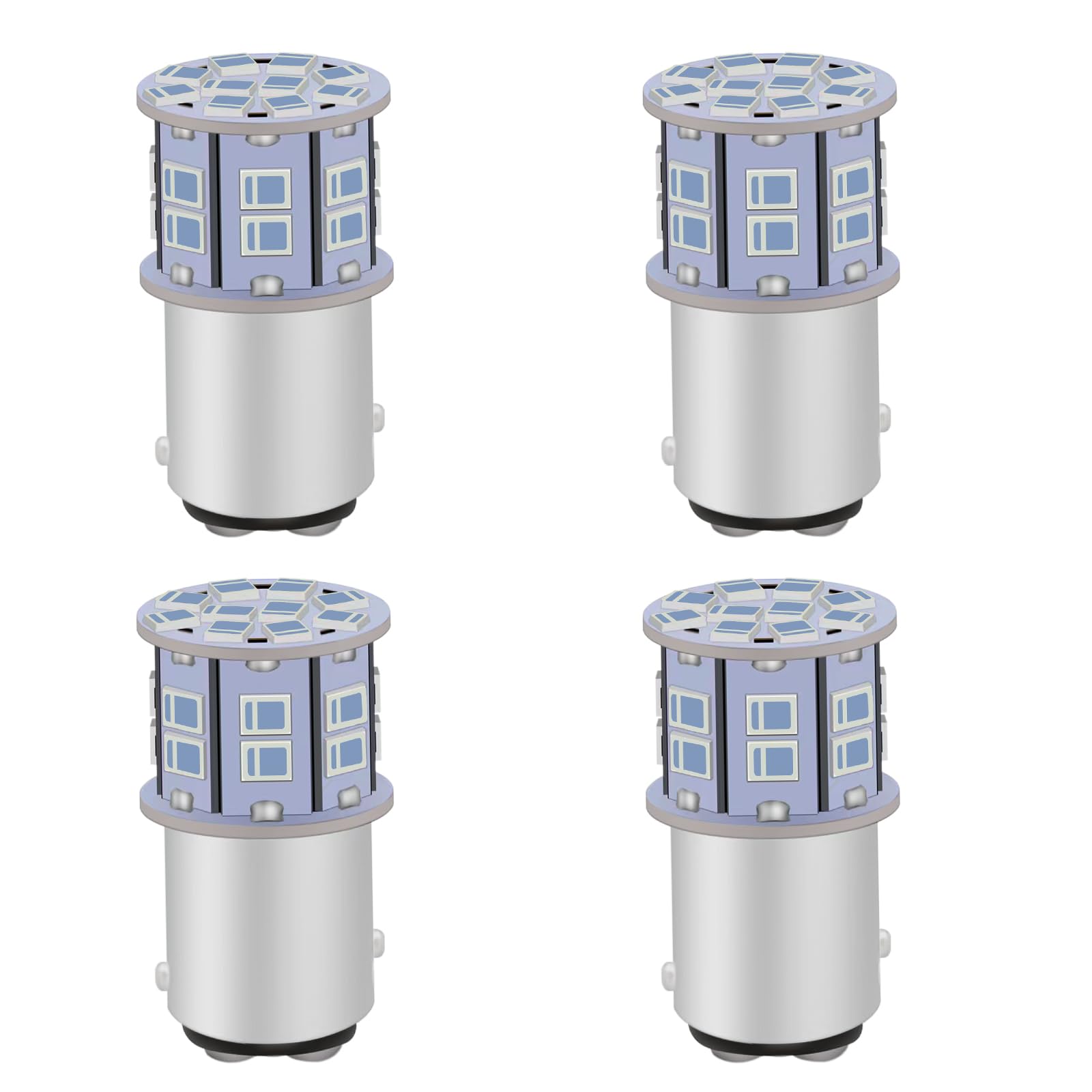
LEDYOTRY’s 4-pack brings the cost-per-bulb down significantly without cutting corners on chip quality. Each bulb uses 24 pieces of 2835 LEDs with a 360-degree lighting design, outputting enough light to be 400 percent brighter than a halogen equivalent while drawing only 3 watts. The red tint is integrated into the bulb, so you get the correct light color without the need for a red lens filter — a clean solution for brake, tail, and stop-light applications.
The intelligent IC driver regulates current to prevent flicker and maintains stable brightness across varying electrical loads. The 50,000-hour lifespan claim is backed by the thermal management built into the bulb body, though the construction uses more plastic than the full-aluminum PHINLION or Antline options. This makes the set lighter and cheaper, but heat dissipation is less effective in long-term high-temperature use.
Fitment covers 1157, 2057, 2357, 7528, BAY15D, and many cross-references such as 1016, 1034, 2397, and 3496. The non-polar design makes installation straightforward. For drivers who want a reliable LED upgrade across multiple vehicles or need to replace bulbs in several positions at once, the LEDYOTRY 4-pack offers the best per-unit value in this roundup.
What works
- Very low cost per bulb in a convenient 4-pack
- 24-chip 2835 design delivers solid brightness at 3W
- Plug-and-play non-polar installation
What doesn’t
- Less robust thermal management than aluminum-bodied options
- May require load resistor for turn-signal applications
5. BlyilyB 10-Pack 6500K White — 1157 2057 BAY15D

The BlyilyB 10-pack is an entry-level solution best suited for interior RV camper lighting, boat yard lights, side markers, and backup lights rather than primary brake/tail duty. Each bulb uses 18 SMD 5050 LEDs producing 300 lumens at 2W with a cool 6500K color temperature. For reference, 300 lumens is adequate for cabin illumination or a marker light but falls well short of the 800–1400 lumens recommended for brake lights that need to cut through direct sunlight.
Build quality is basic — the housing is largely plastic with minimal heat sinking, and the brightness is described by the manufacturer as “not so bright” for those expecting high-output performance. Voltage is limited to 12V DC only, so these bulbs are not suitable for 24V truck or heavy-equipment systems. The 10-pack quantity is attractive for fleet replacements or whole-vehicle interior swaps where multiple bulbs are needed at once.
Fitment covers 1157 BAY15D sockets and cross-references including 1157NA, 2057, 2357, 7528, 1178A, and 1196. The primary audience here is RV and camper owners looking to replace warm dim incandescent interior bulbs with a crisp white LED glow, or anyone needing a bulk pack for non-critical lighting positions. For brake-light safety, one of the higher-output options above is strongly recommended.
What works
- Extremely low cost per bulb in a 10-pack
- 6500K white light works well for interior RV and camper use
- Broad compatibility with BAY15D socket vehicles
What doesn’t
- 300 lumens is too dim for safe brake-light duty
- Plastic housing limits heat dissipation and durability
- 12V-only operation restricts use on 24V systems
Hardware & Specs Guide
LED Chip Technology
The 2835 and 3014 SMD packages dominate modern automotive LED bulbs. The 2835 chip typically handles higher current and produces more lumens per chip than the 3014, which is often used in large arrays to spread light evenly. A bulb using 21–24 pieces of 2835 chips (like the Antline or LEDYOTRY) can deliver 1200–1400 lumens at 3–5 watts. Switchback designs combine both chip types to balance white output with amber signal brightness.
Heat Sink & Driver Design
An LED’s lifespan is directly tied to junction temperature. Bulbs with a machined 6063 aluminum body (PHINLION, Antline) act as passive heat sinks, keeping the LED junctions below the 85°C threshold that accelerates lumen depreciation. Constant-current IC drivers prevent thermal runaway and flicker by regulating current regardless of input voltage swings between 10V and 30V. Plastic-housed bulbs lack this thermal pathway and are best suited for low-duty-cycle applications such as interior or marker lights.
FAQ
Are 2057 and 1157 LED bulbs interchangeable?
Do I need a load resistor or flasher relay for turn signals?
Can I use a 2057 LED bulb for my brake light and tail light at the same time?
Final Thoughts: The Verdict
For most buyers, the best 2057 led bulb winner is the PHINLION 1157 2800-lumen set because it delivers the highest verified brightness in a thermally competent aluminum package that will last years. If you want a strong 4-pack that balances cost and output, grab the Antline Extremely Bright 1157. And for a dual-color front turn signal upgrade that actually prioritizes signal clarity over flashy animation, nothing beats the PHINLION Switchback set.

Certification: BSc in Mechanical Engineering
Education: Mechanical engineer
Lives In: 539 W Commerce St, Dallas, TX 75208, USA
Md Amir is an auto mechanic student and writer with over half a decade of experience in the automotive field. He has worked with top automotive brands such as Lexus, Quantum, and also owns two automotive blogs autocarneed.com and taxiwiz.com.