That amber warning glow on your dash is more than an annoyance — it’s a safety system telling you one or more tire pressure sensors have stopped communicating. Ignoring it means losing real-time pressure data, reduced fuel efficiency, and uneven tire wear that shortens tread life. Replacing a failing TPMS sensor restores that critical link between your tires and your dashboard readout, and choosing the right replacement determines whether the fix lasts years or fails again within months.
I’m Amir — the founder and writer behind Four Wheel Ask. I’ve spent years analyzing TPMS sensor specifications, studying owner feedback across dozens of vehicle platforms, and comparing build quality data to identify the most reliable aftermarket options on the market today.
After analyzing thousands of owner reports and detailed technical specs, we compiled the definitive guide to choosing the best 2017 tire pressure sensor for your vehicle.
How To Choose The Best 2017 Tire Pressure Sensor
Selecting the right TPMS replacement means matching frequency bands, understanding the difference between pre-programmed and programmable units, and knowing whether your vehicle uses an auto-relearn or OBD-based relearn procedure. These factors determine whether your new sensors sync correctly on the first attempt or require multiple shop visits.
Frequency Compatibility Is Non-Negotiable
Every TPMS sensor operates on a specific radio frequency — most commonly 315MHz for Ford, Lincoln, and some Asian brands, or 433MHz/434MHz for GM, Chrysler, Jeep, and European vehicles. Installing a 315MHz sensor into a vehicle expecting 433MHz means zero communication. Always verify your vehicle’s required frequency before purchasing. This single spec determines if the sensor even talks to your receiver module.
Pre-Programmed vs Programmable Sensors
Pre-programmed sensors arrive ready to install with a fixed ID already set, but they still require a relearn procedure so the vehicle’s ECU recognizes the new ID. Programmable sensors need a TPMS programming tool to write the original sensor IDs into the new units — useful when you want to avoid a full relearn. For most DIY owners, pre-programmed sensors paired with an OBD relearn tool offer the simplest path.
Relearn Methods Matter for Installation Success
Three main relearn methods exist: auto-relearn (drive 20-30 miles and the system picks up the new sensors), OBD-based relearn (uses a scan tool to sync IDs via the diagnostic port), and manual relearn (using a magnet or pressure changes at each wheel). Auto-relearn is the most convenient but not all vehicles support it. Check your owner’s manual or look up the specific procedure for your year and model before installing.
Build Quality and Battery Chemistry
The battery inside a TPMS sensor determines its usable life. Quality units use CR2032 or CR2050 lithium cells rated for 5-8 years under normal driving conditions. Pressure rating matters too — most passenger sensors handle up to 130 PSI, which covers everything from compact cars to heavy-duty trucks. Look for sensors that specify operating temperature ranges from -40°C to 125°C for reliable performance in extreme climates.
Quick Comparison
On smaller screens, swipe sideways to see the full table.
| Model | Category | Best For | Key Spec | Amazon |
|---|---|---|---|---|
| A-Premium 4PCS TPMS | Premium | GM & Chrysler owners wanting OE-level reliability | 433MHz, NXP chip, CR2050 battery, ±0.06 Bar accuracy | Amazon |
| Masoll External TPMS | External | DIY users who want tool-free installation | 433MHz, includes EL-50448 relearn tool, ±1.5 PSI | Amazon |
| RLP 434MHz TPMS | Performance | Ram 1500/2500 and Jeep Cherokee owners | 434MHz, auto-relearn, replaces 68249197AA | Amazon |
| GEARMEISTER 315MHz TPMS | Mid-Range | Ford & Lincoln owners needing wide fitment | 315MHz, ±2 PSI accuracy, 5-8 year battery life | Amazon |
| Jsueng Ford TPMS | Budget | Budget-conscious Ford and Lincoln owners | 315MHz, 900Kpa chip, CR2032 battery, 5-8 year life | Amazon |
| Jsueng GM TPMS | Budget | Chevy, Buick, GMC owners on a budget | 433MHz, 900Kpa chip, replaces 13598773 | Amazon |
| RLP 433MHz TPMS | Budget | Jeep Wrangler JK and Dodge Charger owners | 433MHz, replaces 56029398AB, 30-50 PSI range | Amazon |
In-Depth Reviews
1. A-Premium 4PCS Pre-Programmed TPMS Sensor

The A-Premium TPMS set covers a massive vehicle range including Chevrolet Silverado 1500-6500 HD, GMC Sierra, Cadillac ATS through Escalade, and Buick Enclave through Lacrosse across 2016-2024 model years. Each sensor uses a high-precision NXP semiconductor chip with FCC and IC certification, and every unit undergoes in-house testing against SAE J2657 standards before packaging. The CR2050 lithium battery and upgraded aluminum valve stem offer extended service life over standard rubber valve assemblies.
What separates this kit from lower-priced alternatives is the documentation and quality control. Each sensor arrives in an individual color box with an installation manual, and the reference number list includes 15+ OEM cross-references (13516165 through 85110397), making fitment verification straightforward. The ±0.06 Bar measurement accuracy rivals OE specifications, and the 0-900 KPa pressure range covers everything from compact cars to heavy-duty pickups running high load pressures.
Owner feedback consistently highlights the value proposition — buyers report successful installation on 2019 Malibu, 2020 Sierra, and 2018 Yukon vehicles with proper relearn procedures. The 2-year guarantee provides additional peace of mind against premature battery failure or sensor drift. For owners of GM-family vehicles seeking a reliable pre-programmed replacement that does not require coding, this kit delivers the most consistent owner satisfaction across the widest platform range.
What works
- Wide GM and Chrysler platform coverage with 15+ OEM cross-references
- FCC and IC certified NXP chip with SAE J2657 testing
- Individually boxed sensors with clear installation documentation
What doesn’t
- Some 2018 Yukon owners reported compatibility issues
- Requires separate relearn tool or professional activation
2. Masoll TPMS Sensor for GM with Relearn Tool
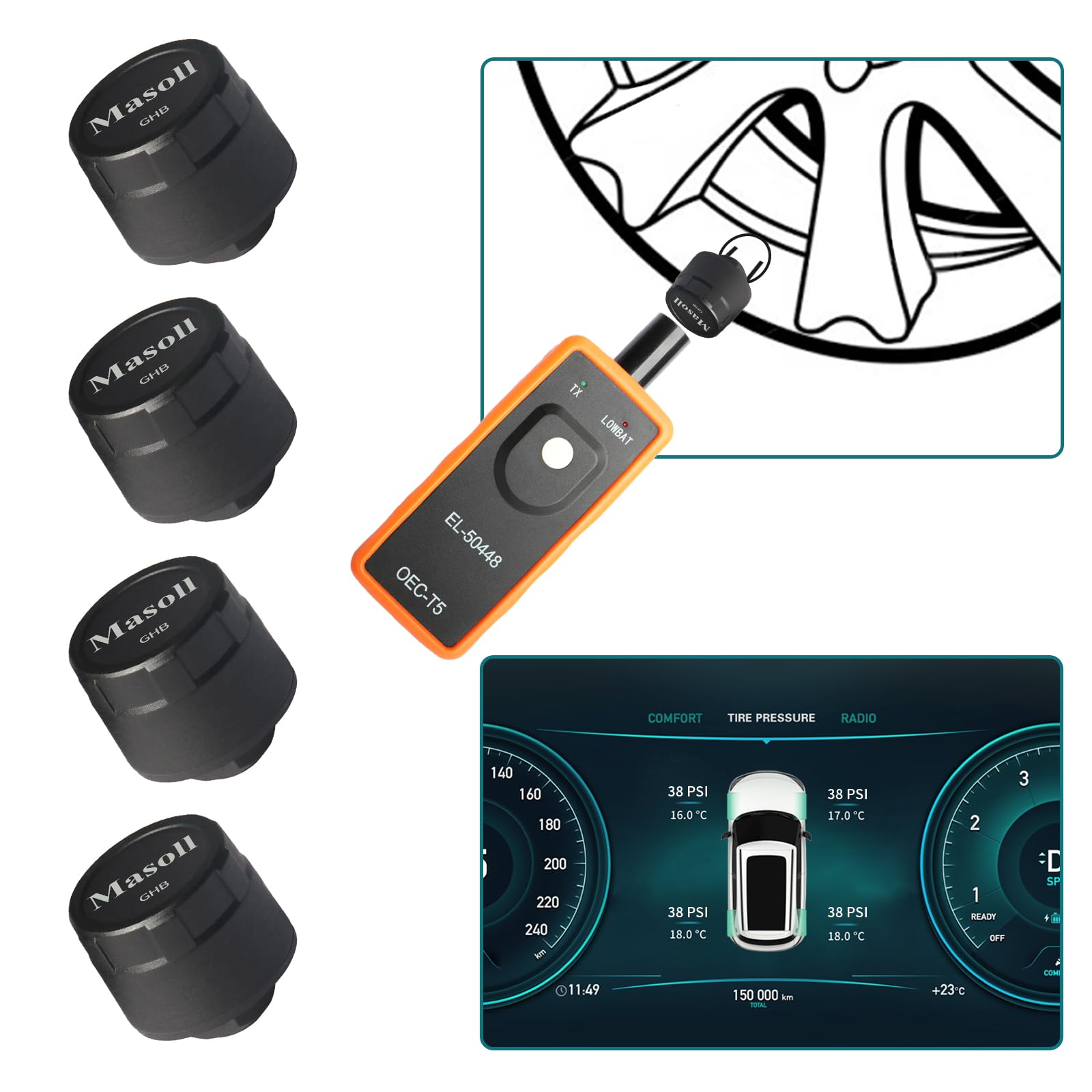
The Masoll system takes a fundamentally different approach to TPMS replacement — instead of internal sensors requiring tire dismounting, these external cap-style sensors screw directly onto the valve stem. This design eliminates the need for a tire shop visit entirely. The kit includes four sensors plus an EL-50448 TPMS relearn tool, allowing a complete DIY installation in roughly five minutes. The Generation 2 version launched in 2025 offers wider vehicle coverage and stronger transmission signals for pickup trucks like the Silverado.
Compatibility spans GM-branded vehicles manufactured after 2006, including Chevrolet, Buick, Cadillac, GMC, and Pontiac. The ±1.5 PSI measurement accuracy meets typical driving needs, though it is slightly less precise than the ±0.06 Bar found on premium internal sensors. Battery life is rated at approximately two years with a user-replaceable battery, which is shorter than internal sensors but offers the convenience of replacement without tire dismounting. The operating temperature range supports all-season driving conditions.
Owner reports highlight the ease of use — the 2025 GMC Sierra 2500 owner reported flawless setup through the dashboard menu, and the 2007 Silverado owner successfully eliminated the warning light without any shop work. The external design does increase the profile at the valve stem, which some owners note is visibly larger than a standard cap. For DIY-oriented owners who want to avoid tire shop fees and internal sensor installation costs, this system offers a compelling alternative to traditional replacements.
What works
- Tool-free external installation requires no tire removal
- Includes EL-50448 relearn tool for complete DIY solution
- User-replaceable battery extends overall product lifespan
What doesn’t
- Larger external profile compared to standard valve caps
- Shorter battery life than internal sensors
3. RLP 434MHz TPMS Sensor for Jeep Ram

The RLP 434MHz TPMS sensor targets the Ram truck and Jeep Cherokee owner with a design that emphasizes simplicity through auto-relearn capability. Compatible with 2014-2021 Ram 1500 through 5500 series and 2014-2021 Jeep Cherokee, these sensors are engineered to self-register after driving approximately 20-30 miles. The OEM design references 68249197AA and 68239720AA, and each unit is manufactured to OE standards with a digital output for accurate pressure and temperature data transmission.
The auto-relearn feature is the standout advantage here — no OBD scan tool required if your vehicle supports this protocol. Simply install the sensors, inflate tires to the correct pressure, and drive. The system picks up the new IDs during normal operation. For vehicles that do not auto-relearn, the recommended TS508 OBD tool provides a straightforward relearn path. The flange mount design matches factory sensor geometry, ensuring a proper seal with the valve stem and wheel bore.
Owners consistently report success on Ram 1500 Sport and Jeep Cherokee Trailhawk platforms, with one buyer logging over 10,000 miles without issues. The self-programming feature worked within minutes for most users. The 24-month free replacement warranty covers premature failure. For owners of Ram heavy-duty trucks or Cherokee models, this sensor delivers the most convenient installation experience available in this price tier.
What works
- Auto-relearn after 20-30 miles eliminates need for programming tools
- Accurate pressure and temperature data with digital output
- 24-month warranty covers premature failure
What doesn’t
- Limited to 434MHz vehicles only (Ram and Jeep platforms)
- Auto-relearn not supported on all vehicle model years
4. GEARMEISTER 315MHz TPMS Sensor for Ford Lincoln

The GEARMEISTER 315MHz TPMS kit focuses on Ford and Lincoln applications with coverage spanning F-Series Super Duty 2017-2022, Escape 2020-2022, Fusion 2017-2021, and Lincoln MKX 2016-2021 through Nautilus 2019-2021. The reference number FR3Z1A189A is the primary OE cross, and the sensors are pre-programmed to match factory specifications. An automotive-grade battery rated for 5-8 years or 90,000-120,000 kilometers powers each unit, with an operating temperature range of -40°C to 125°C for extreme climate reliability.
Measurement accuracy is specified at ±2 PSI, which aligns with industry standards for aftermarket TPMS sensors. The push-pull output type and 3-meter sensing distance provide reliable communication with the vehicle’s receiver module. Installation follows standard Ford relearn procedures using the DIC button sequence or OBD scan tool. The 2-year warranty covers manufacturing defects, and the manufacturer recommends verifying sensor detection with a scan tool before completing installation to avoid wasted labor.
Owner experiences show a split — many report successful installations on 2020 Ford Escape, 2019 Lincoln MKZ Hybrid, and 2016 Camaro platforms with correct programming. However, a notable report of three out of four sensors failing within one year raises a reliability concern. The pricing positions this kit below dealer OEM costs while offering the same frequency and form factor. For owners comfortable with performing a proper relearn and verifying sensor IDs before final installation, this kit represents a cost-effective alternative to OEM replacements.
What works
- Broad Ford and Lincoln platform coverage including Super Duty trucks
- Long 5-8 year battery life with automotive-grade cell
- Significant cost savings versus dealer OEM sensor pricing
What doesn’t
- Multiple owner reports of sensor failure within one year
- Requires careful verification with scan tool before installation
5. Jsueng Ford TPMS Sensor 4-Pack 315MHz
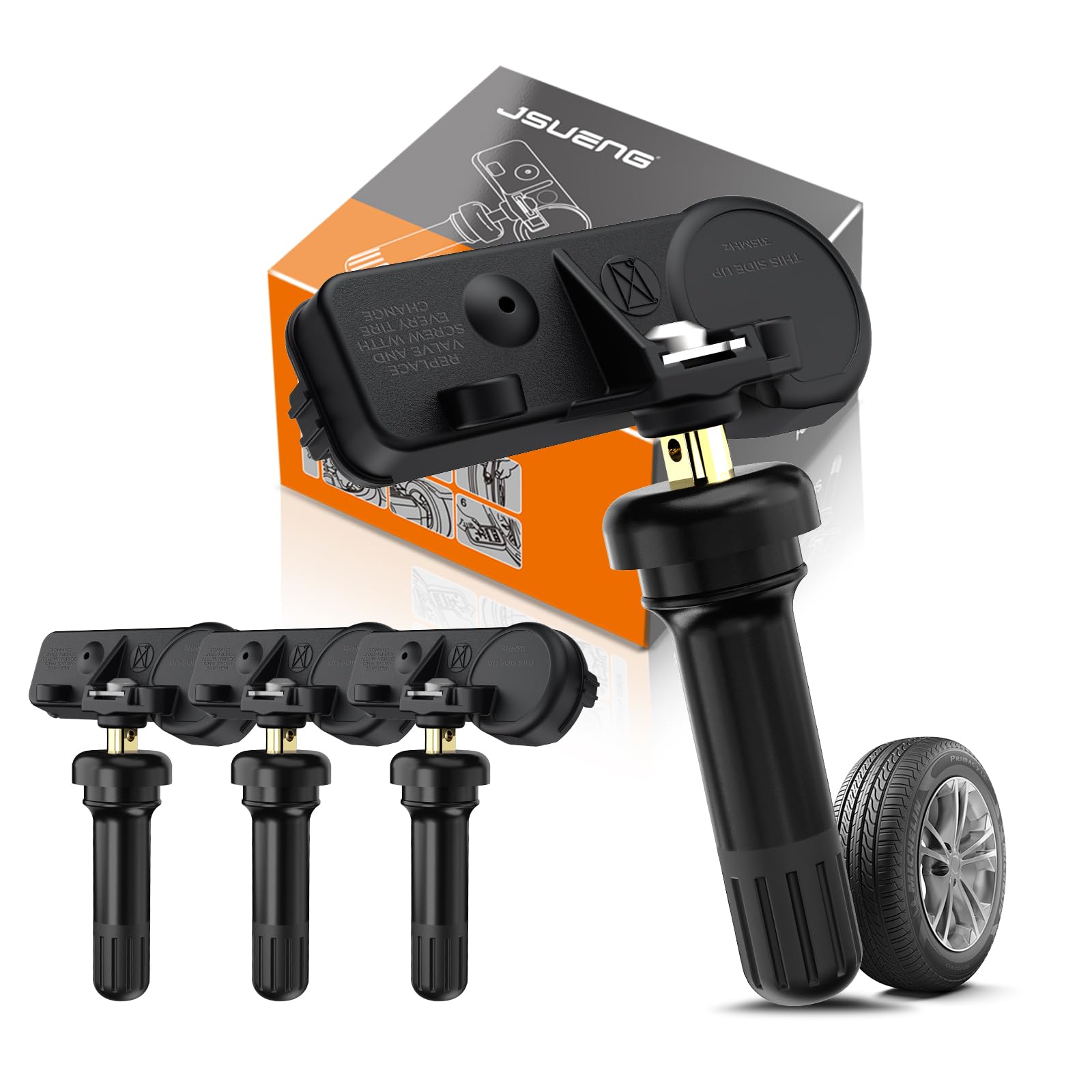
The Jsueng Ford TPMS 4-pack covers an extensive list of Ford, Lincoln, and Mercury vehicles from 2008 through 2021, including F-150, F-250 Super Duty, Expedition, Explorer, Mustang, Focus, Fusion, and Lincoln MKZ and MKS. The 900Kpa (130.53 PSI) pressure rating and CR2032 battery are rated for 5-8 years of normal use with an operating temperature range of -40°C to 125°C. Each sensor undergoes factory testing including durability, thermal shock, and environmental stress tests before shipment.
The pre-programmed sensors are designed to work with the Ford DIC button relearn procedure — inflate tires, turn ignition on, navigate to tire learn mode, and use an activation tool to trigger each sensor in sequence. No additional programming hardware is required beyond a TPMS activation tool. The OE cross-reference list includes 9L3Z1A189A, 9L3T1A180AF, DE8T1A180AA, and several other common Ford part numbers, simplifying compatibility verification.
Owner feedback shows a generally positive experience across multiple Ford platforms — successful installations reported on 2010 Mercury, 2011 Ford Escape, and 2011 Ford Focus. However, one owner reported a sensor failing within two days of installation, and another noted signal loss that eventually returned. The quality control consistency appears variable, making this kit best suited for owners who can tolerate a potential return process. For the price, the coverage range is unmatched, but reliability is less predictable than premium alternatives.
What works
- Extensive Ford and Lincoln platform coverage across 2008-2021 models
- High 900Kpa pressure rating suitable for trucks and SUVs
- Simple DIC button relearn procedure for Ford vehicles
What doesn’t
- Inconsistent quality control with some DOA sensors reported
- Signal reliability concerns reported after months of use
6. Jsueng GM TPMS Sensor 4-Pack 433MHz
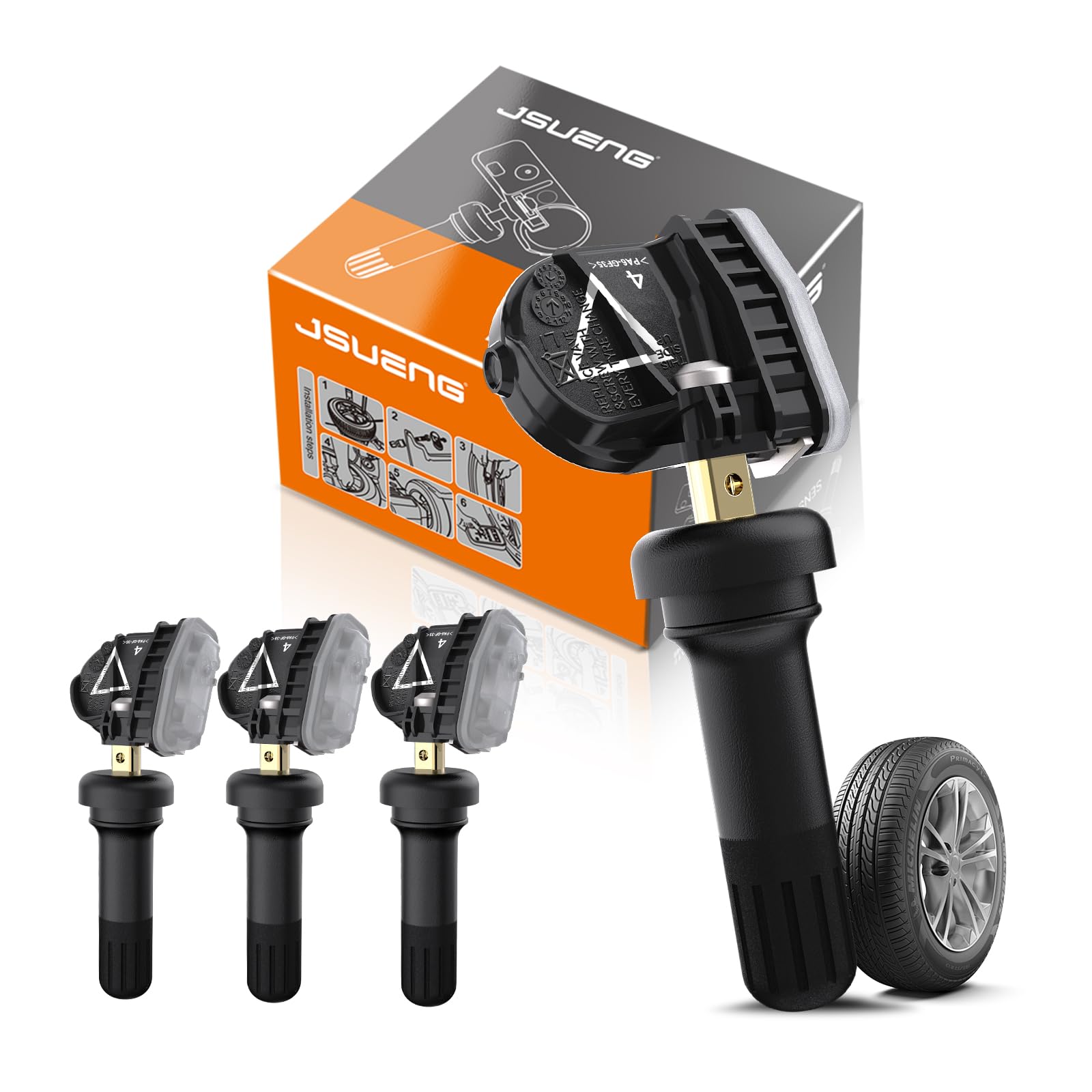
The Jsueng GM TPMS 4-pack targets Chevrolet, Buick, GMC, and Cadillac vehicles with a 433MHz frequency and primary OE cross-reference to 13598773. Compatible models include the Malibu, Silverado, Impala, Cruze, Regal, Lacrosse, and Escalade across 2013-2025 model years. The 900Kpa pressure chip and CR2032 battery mirror the Ford version’s specifications, with the same 5-8 year lifespan claim and -40°C to 125°C operating range. Factory testing includes high and low temperature cycles, vibration, and signal strength validation.
The OBDII relearn procedure is well-documented: install the sensors, inflate to placard pressure, activate each sensor with a TPMS tool starting at the left front, then use an OBD connector to transfer the data to the ECU. The manufacturer recommends driving at least five minutes at 28 MPH after the relearn to confirm stable communication. This process requires both a TPMS activation tool and an OBD scan tool, adding to the total investment if you do not already own these.
Owner reception is predominantly positive — reports on 2016 Malibu, 2017 Buick, and 2019 Silverado indicate successful programming and accurate pressure readings. One 2017 GMC Acadia Limited owner reported incompatibility, highlighting the importance of verifying fitment before installation. The cost savings versus dealer sensors are substantial, and the 1-year guarantee provides basic protection. For budget-focused owners of GM vehicles who already own or can borrow TPMS tools, this kit offers functional reliability at a minimal investment.
What works
- Wide GM platform compatibility with 8 OE cross-references
- Straightforward OBDII relearn procedure with clear instructions
- Substantial cost savings compared to dealership replacement
What doesn’t
- Requires both TPMS activation tool and OBD scan tool
- Incompatibility reported on some 2017 Acadia Limited models
7. RLP 433MHz TPMS Sensor for Jeep Dodge Ram
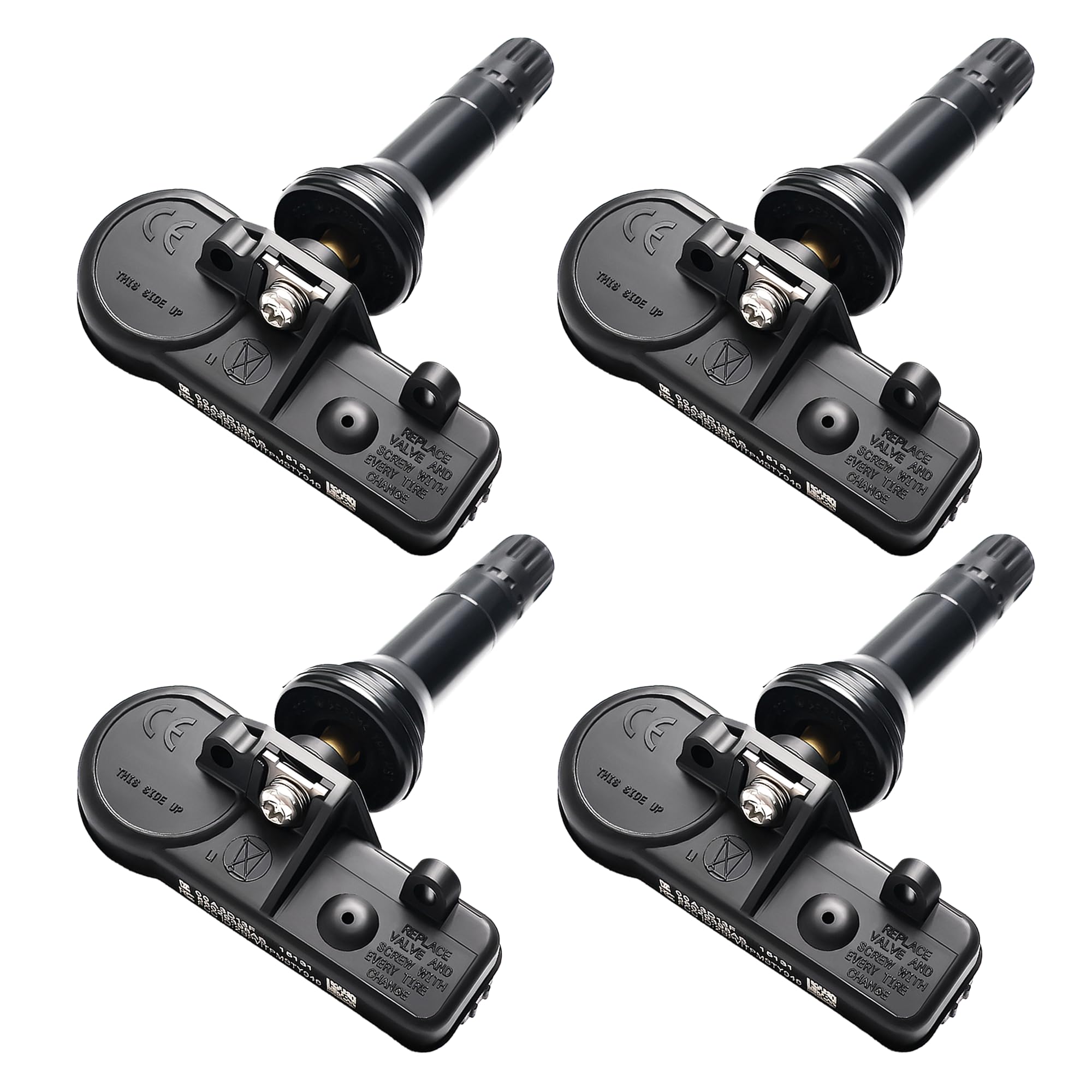
The RLP 433MHz TPMS sensor set covers Chrysler, Dodge, Jeep, Ram, and Fiat applications with OE cross-references including 56029398AB, 56029398AA, 68142397AA, and 68241067AB. Compatible vehicles span 2010-2020 Chrysler 300, 2011-2020 Dodge Charger and Challenger, 2011-2015 Jeep Grand Cherokee, 2013-2019 Wrangler, and 2010-2013 Ram 1500 and 2500. The flange mount design and digital output match factory specifications, and each unit is pre-programmed for direct installation without customer coding.
The manufacturer specifies a measuring range of 30-50 PSI with an upper temperature rating of 150 degrees Fahrenheit. This pressure range is suitable for passenger cars and light trucks but may not cover heavy-duty applications requiring higher cold pressures. The 24-month warranty is notable for a budget-priced kit, and the company offers free replacement or refund if sensors fail during the coverage period. Standard OE relearn procedures apply after installation using an OBD scan tool or the vehicle’s built-in relearn method.
Owner feedback shows strong satisfaction from Dodge Charger and Challenger owners, with multiple verified purchases reporting successful programming and accurate readings. One 2017 Jeep Wrangler JK owner reported that only one of four sensors worked, calling into question batch consistency. The pricing is among the lowest in the 433MHz category, and the 24-month warranty partially mitigates the quality risk. For owners of Chrysler and Dodge platforms with access to relearn tools, this kit offers the lowest entry cost, but the variable quality makes it a gamble for critical replacements.
What works
- Very competitive pricing for 433MHz Chrysler-platform sensors
- 24-month warranty exceeds typical budget-component coverage
- Strong owner satisfaction on Dodge Charger and Challenger models
What doesn’t
- Quality control inconsistent — reported failure rates on Jeep Wrangler
- Limited 30-50 PSI range unsuitable for heavy-duty truck applications
Hardware & Specs Guide
TPMS Frequency Bands
Two primary frequencies dominate the aftermarket: 315MHz and 433MHz (with some 434MHz variants). Ford, Lincoln, and most Asian manufacturers use 315MHz, while GM, Chrysler, Jeep, Ram, and European brands typically use the 433MHz band. Installing the wrong frequency produces zero communication with the receiver module. Always confirm your vehicle’s frequency before purchasing — this information is available in the owner’s manual or through online OE part number lookups.
Battery Chemistry and Lifespan
TPMS sensors use non-replaceable lithium coin cells, most commonly CR2032 or CR2050. Premium sensors specify 5-8 year lifespans under normal driving conditions, while budget units may deliver 3-5 years. Temperature extremes accelerate battery depletion — sensors in cold climates or vehicles exposed to direct sun may fail earlier. External sensors often use replaceable batteries, offering lower replacement cost but shorter intervals between changes.
Pressure Rating and Accuracy
Standard passenger TPMS sensors are rated up to 130 PSI, which covers most vehicles from compact cars to heavy-duty pickups. Measurement accuracy varies from ±0.06 Bar (approximately ±0.87 PSI) on premium units to ±2 PSI on budget options. Heavy-duty truck owners should verify the maximum pressure rating supports their cold inflation pressures, especially for dual-rear-wheel configurations requiring higher PSI.
Relearn Method Compatibility
Three relearn methods exist: auto-relearn (vehicle detects new sensors after driving), OBD-based relearn (scan tool updates the ECU via the diagnostic port), and manual relearn (magnet or pressure sequence at each wheel). Not all vehicles support auto-relearn — older models almost always require OBD or manual procedures. Check your vehicle’s specific relearn method before selecting sensors, as some aftermarket units only support certain protocols.
FAQ
What frequency TPMS sensor does my 2017 vehicle need?
Can I install TPMS sensors myself without a tire shop?
Do I have to reprogram my vehicle after replacing TPMS sensors?
How long do TPMS sensor batteries typically last?
Final Thoughts: The Verdict
For most buyers, the best 2017 tire pressure sensor winner is the A-Premium 4PCS Pre-Programmed TPMS Sensor because it combines NXP chip reliability, FCC certification, and the widest GM-platform coverage with consistently positive owner outcomes. If you want tool-free DIY installation, grab the Masoll External TPMS with Relearn Tool. And for Ram and Jeep owners seeking the most convenient installation experience, nothing beats the RLP 434MHz Auto-Relearn Sensor.

Certification: BSc in Mechanical Engineering
Education: Mechanical engineer
Lives In: 539 W Commerce St, Dallas, TX 75208, USA
Md Amir is an auto mechanic student and writer with over half a decade of experience in the automotive field. He has worked with top automotive brands such as Lexus, Quantum, and also owns two automotive blogs autocarneed.com and taxiwiz.com.