If your 2014 Honda Odyssey’s A/C blows warm or the vents carry a musty, damp smell every time you hit the defroster, the culprit isn’t the refrigerant or a clogged drain — it’s a neglected cabin air filter. That standard OEM-grade paper element is often the barrier between your family and the dust, pollen, and exhaust fumes that accumulate during a typical school-run or road-trip season. When that filter saturates, your blower motor works harder, airflow drops, and the HVAC system can’t keep the cabin comfortable in summer heat or winter chill.
I’m Amir — the founder and writer behind Four Wheel Ask. I’ve spent the last several years dissecting automotive replacement parts, comparing filtration media across dozens of brands, and analyzing owner feedback to pinpoint which aftermarket filters actually deliver on their claims of improved air quality and HVAC performance for popular minivan platforms like the Odyssey.
Whether you’re battling seasonal allergies or just want to keep the interior smelling fresh, choosing the right 2014 honda odyssey cabin air filter is a simple upgrade that pays off every time you drive.
How To Choose The Best 2014 Honda Odyssey Cabin Air Filter
Most Odyssey owners overlook the cabin filter until the first time the windshield fogs up on a rainy day and the defroster seems powerless. The standard replacement is a disposable pleated paper filter, but the market now offers carbon-impregnated media and even washable units. Understanding the trade-offs in filtration efficiency, airflow resistance, and longevity helps you pick the right element for your driving conditions and budget.
Filtration Media: Paper vs. Activated Carbon vs. Washable
Standard paper filters capture dust and pollen down to around 5-10 microns but offer no chemical odor defense. Activated carbon filters add a layer of carbon granules that trap VOCs, exhaust fumes, and musty smells — a real advantage if you commute through heavy traffic or tunnel routes. Washable filters like the K&N use layered synthetic media that you clean and re-oil every 25,000-50,000 miles; they flow more air but require a higher upfront investment and periodic maintenance.
Fitment and Dimensions: Why CF10134 Matters
The 2014 Odyssey uses the CF10134 form factor — a rectangular filter measuring 9.3 inches long, 8.8 inches wide, and 1.2 inches thick. Any filter claiming CF10134 compatibility should drop into the housing behind the glove box without trimming or adapters. Beware of filters labeled only by brand fitment but lacking the CF10134 reference; dimensional accuracy affects seal integrity and bypass leakage.
Airflow vs. Filtration Trade-Off
Higher filtration efficiency often means denser media and more airflow resistance. A filter that traps 99.9% of 0.3-micron particles may slow the blower enough to reduce cooling or heating output in high-demand conditions. The best filters strike a balance: multi-layer construction that traps fine particles while maintaining enough open area to keep the HVAC system moving the rated CFM comfortably.
Quick Comparison
On smaller screens, swipe sideways to see the full table.
| Model | Category | Best For | Key Spec | Amazon |
|---|---|---|---|---|
| K&N VF2033 | Washable | Long-term ownership, high mileage | Lifetime washable media | Amazon |
| KAX Premium | Carbon | Odor reduction, high traffic areas | Dual-layer carbon, 99.9% PM2.5 | Amazon |
| RICHWEI | Carbon | Budget carbon upgrade | Activated carbon media | Amazon |
| EPAuto CP182 | Carbon | Broad Honda/Acura compatibility | Soda & carbon blend media | Amazon |
| PHILTOP | Carbon | Budget-friendly filtration | 5-layer, 99.9% filtration | Amazon |
In‑Depth Reviews
1. K&N VF2033 Cabin Air Filter

The K&N VF2033 is the outlier in this lineup — a washable, reusable filter built from oiled polyurethane media instead of disposable paper or carbon felt. For owners planning to keep their 2014 Odyssey past 150,000 miles, the lifetime proposition eliminates the recurring expense of annual replacement filters. The synthetic pleats are designed to allow higher airflow than a standard paper element, which can translate to stronger cabin vent output during peak A/C or heat demand.
Odor control is treated chemically rather than mechanically: the filter is pre-treated to help prevent the musty smell that develops when moisture sits on a loaded disposable filter. K&N rates the airflow improvement over stock, and the media captures particles down to a reasonable size range — though it won’t match the laboratory-grade micron capture of dense carbon filters. The trade-off is that you trade absolute filtration efficiency for higher flow and reusability.
Installation is straightforward: the VF2033 drops into the same CF10134-sized housing as any disposable. The included lifetime limited warranty backs the product, and a dedicated cleaning kit is required every 25,000-50,000 miles depending on driving conditions. Given the unit’s price premium, it pays for itself after roughly three disposable replacements, assuming a typical 12-month change interval.
What works
- Washable and reusable for the vehicle’s lifetime.
- Higher airflow than dense carbon disposables.
- Lifetime limited warranty included.
What doesn’t
- High upfront cost compared to disposables.
- Requires periodic cleaning and re-oiling.
- Does not match 0.3-micron capture of heavy carbon filters.
2. KAX Premium Cabin Air Filter CF10134

The KAX ProSeries filter is the strongest all-arounder in this group for odor-prone driving environments. Its dual-layer activated carbon matrix is denser than the single carbon layer found on budget carbon filters, which means it adsorbs VOCs from diesel exhaust, construction zones, and tunnel air more effectively. KAX claims a 99.9% reduction of PM2.5 particles, and the media density is matched to a 15% reduction in airflow resistance versus basic OEM paper — so you don’t lose vent performance while gaining filtration.
Fitment is exact for the 2014 Odyssey’s CF10134 housing; the 9.3 x 8.8 x 1.2-inch dimensions match the factory specs, and the frame is rigid enough to avoid warping during insertion. The filter ships individually boxed with a manual, and customers report that the carbon layer does not shed black dust during the first week of use — a common complaint with cheaper activated carbon filters. The layered design includes electrostatic cotton that captures fine particles even in the gaps between pleats.
The only real downside is that the dual carbon construction makes it marginally thicker than a standard paper filter, so it can feel slightly snug when sliding into the housing. It is a disposable item with a 12-month or 12,000-mile service interval. For the price of a mid-range filter, you get near-premium carbon loading that genuinely neutralizes highway and city odors.
What works
- Superior odor adsorption with dual-layer carbon.
- Claimed 99.9% PM2.5 filtration.
- Reduced airflow resistance compared to standard paper.
What doesn’t
- Slightly snug fit in the housing.
- Disposable; not washable.
- Price sits above basic carbon filters.
3. RICHWEI Cabin Air Filter CF10134

The RICHWEI filter occupies the sweet spot between a basic paper element and a high-end carbon filter. It uses a nonwoven base media impregnated with activated carbon, giving it a mild odor-fighting capability without the cost of dual-layer carbon or specialty electrostatic media. For Odyssey owners who primarily drive in suburban or rural areas where diesel fumes and heavy traffic odors are rare, this filter provides adequate protection against pollen and road dust while keeping the purchase price low.
The dimensions are listed at 9.25 x 8.82 x 1.18 inches, which is within the CF10134 specification, though the frame feels slightly less rigid than the KAX or K&N units. It is a straight disposable replacement with a 12-month recommended change interval. The carbon loading is moderate — it will handle light odors but will saturate faster than the KAX’s dual-layer matrix if you regularly drive in congested city traffic.
Filter construction uses pleated nonwoven material rather than the electrostatic cotton found on pricier filters, so the particle capture efficiency is good for standard allergens but not as high for sub-micron particles. Given the low price point, this is a strong option for owners who want carbon without paying for premium media or for those who change their filter twice a year in heavy dust seasons.
What works
- Low cost for a carbon-impregnated filter.
- Decent light odor reduction.
- Fits the CF10134 housing without trimming.
What doesn’t
- Frame is less rigid than premium competitors.
- Carbon loading saturates faster in heavy traffic.
- Particle capture not as fine as electrostatic media.
4. EPAuto CP182 (CF11182) Cabin Air Filter
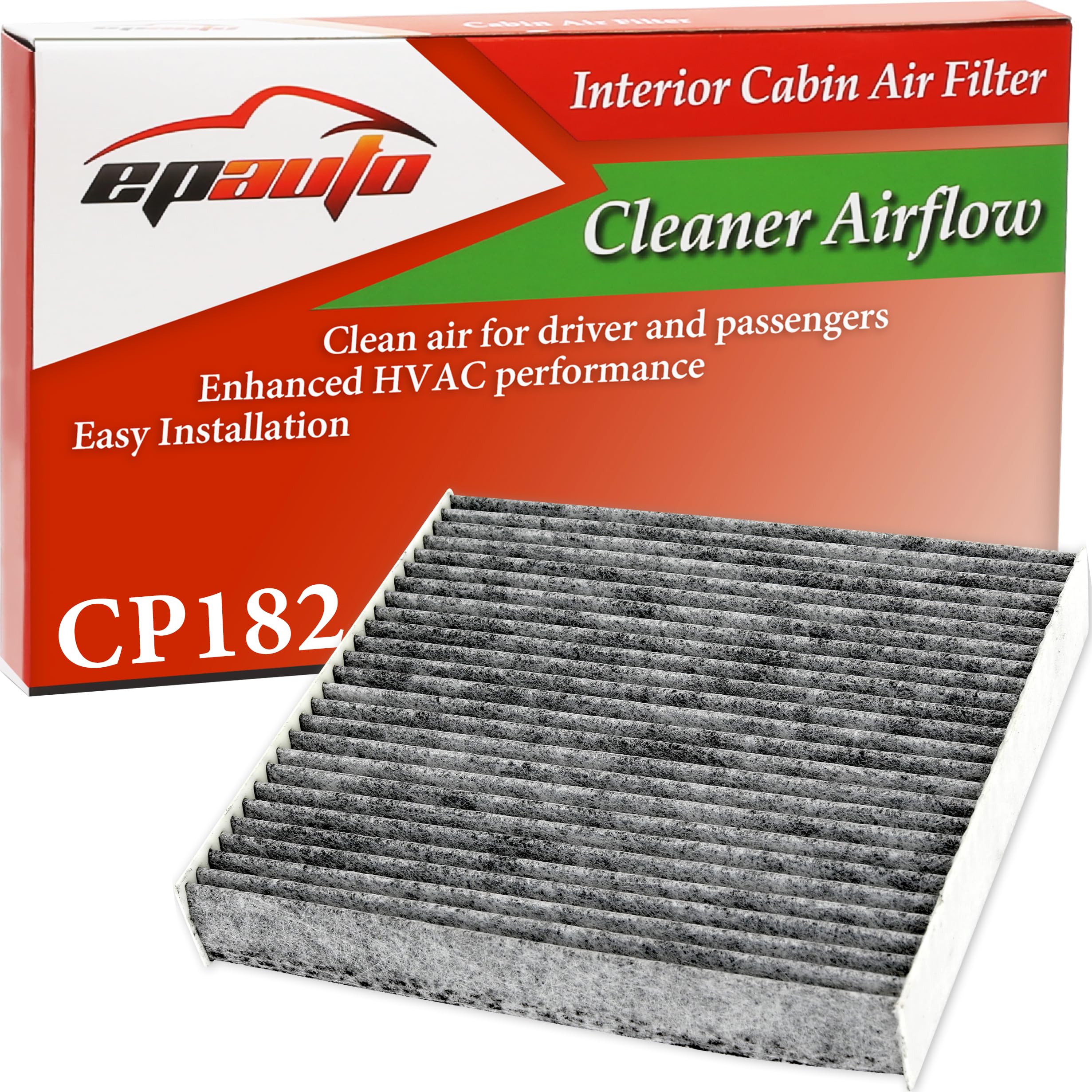
EPAuto’s CP182 filter uses a soda-and-carbon blend to generate what the manufacturer describes as a “fresh breeze” effect — a chemical approach that is distinct from raw carbon adsorption. The soda component helps neutralize acidic odors like pet smells or spilled milk, while the carbon layer handles VOCs. This dual-chemistry media makes the CP182 a solid choice for family-hauling Odyssey owners who deal with interior smells beyond just exhaust fumes.
Fitment is listed for the 2018-2025 Odyssey, but the CP182 (CF11182) shares the same housing footprint as the 2014 model when cross-referenced against the FRAM CF11182 and Honda part 80292-TBA-A11. The dimensions come in at 8.3 x 8.1 x 1.2 inches, which is slightly shorter in length than the standard CF10134, but the frame seals adequately against the housing walls in most reports. The media is a pleated synthetic blend that balances airflow with filtration.
The unit’s main strength is its broad compatibility across Honda and Acura models — owners with multiple vehicles in the driveway can stock one filter type. On the 2014 Odyssey specifically, verify the alignment tab orientation before closing the glove box. The soda additive does deplete over time, so the fresh-breeze effect fades after roughly 6,000 miles, though the carbon layer continues working for the full service interval.
What works
- Soda-and-carbon blend tackles acidic smells.
- Broad cross-vehicle compatibility.
- Good balance of airflow and filtration.
What doesn’t
- Slightly different dimensions than standard CF10134.
- Fresh-breeze effect fades before the filter is fully spent.
- Not specifically optimized for the 2014 housing.
5. PHILTOP Cabin Air Filter CF10134

PHILTOP’s entry is a five-layer filter that uses electrostatic long-fiber cotton and activated carbon to capture particles down to 0.1-0.3 microns at 99.9% efficiency. That level of micron capture is impressive for a budget-tier filter, and it directly addresses the allergy and asthma concerns that are common among minivan owners who spend hours on the road with children. The carbon layer is moderate but sufficient for neutralizing light road odors and pollen during the first half of its service life.
The dimensions are a precise 9.3 x 8.8 x 1.2 inches, matching the factory CF10134 specification exactly. Installation reports from owners confirm it slides in without excessive force and creates a good seal around the edges. The pleat count is higher than some competitors at this price point, which increases the surface area and helps maintain airflow even as the media loads with dust.
The main concession is that the carbon loading is thinner than the KAX dual-layer, so odor breakthrough occurs sooner in heavy traffic conditions. The frame is made of a denser cardboard-like material that holds shape well but is not as rigid as the plastic frame on the K&N or the RICHWEI unit. For owners on a strict budget who can commit to a 12-month change interval, this filter provides excellent particle filtration at a minimal cost.
What works
- Five-layer media captures 0.1-micron particles.
- Precise fit for the CF10134 housing.
- Very low purchase price.
What doesn’t
- Carbon loading is thinner; odors break through faster.
- Frame material is less rigid than plastic core filters.
- Not designed for extended 24-month intervals.
Hardware & Specs Guide
CF10134 Form Factor
The 2014 Odyssey uses the CF10134 cabin filter standard, which measures 9.3 inches long, 8.8 inches wide, and 1.2 inches thick. This rectangular element slides into a slot behind the glove box. Deviations in thickness or width by even 0.1 inch can cause bypass leakage — unfiltered air entering the HVAC plenum. Always confirm the OEM part cross-reference (Honda 80291-T5R-A01 or 80292-TBA-A11) to ensure exact dimensional fit.
Filtration Efficiency Ratings
Budget paper filters typically capture particles above 5-10 microns. Electrostatic or multi-layer media (like the PHILTOP’s five-layer design) can trap 99.9% of particles down to 0.1-0.3 microns — the range that includes fine dust, combustion soot, and bacteria. Carbon filters add adsorption of volatile organic compounds (VOCs) and odors, but the carbon layer has a finite capacity that depletes after roughly 6,000 miles of normal driving.
Activated Carbon vs. Washable Media
Activated carbon filters use a granular or impregnated layer that chemically binds odor molecules. They are disposable and typically last 12,000 miles. Washable filters (like the K&N) use oiled synthetic media that can be cleaned and reused indefinitely, but they rely on oil adhesion rather than electrostatic capture for fine particle filtration. Washable media flows more air but captures fewer sub-micron particles than a dense carbon filter.
HVAC Airflow Impact
A filter with very dense media improves particle capture but increases static pressure on the blower motor. This can reduce cabin vent velocity by 10-20%, making the A/C or heater feel weak during extreme temperature conditions. Filters with reduced airflow resistance (like the KAX’s 15% reduction claim) maintain strong vent output. The 2014 Odyssey’s blower motor can handle moderate resistance, but a severely clogged or overly dense filter will tax the motor and may shorten its lifespan.
FAQ
How often should I replace the cabin air filter on my 2014 Honda Odyssey?
Does a carbon cabin filter reduce airflow in the 2014 Odyssey?
Can a dirty cabin air filter cause the Odyssey’s A/C to blow warm air?
Is the K&N VF2033 washable filter worth the higher price for an Odyssey?
My Odyssey has a musty smell even after replacing the cabin filter. What else could be wrong?
Final Thoughts: The Verdict
For most buyers, the 2014 honda odyssey cabin air filter winner is the KAX Premium because its dual-layer carbon media provides industry-leading odor control and PM2.5 filtration without sacrificing HVAC airflow — a critical balance for a minivan that carries passengers through both suburban commutes and city traffic. If you want a washable filter that eliminates recurring replacement costs, grab the K&N VF2033. And for the tightest budget, nothing beats the PHILTOP for its five-layer particle capture at a minimal purchase price.

Certification: BSc in Mechanical Engineering
Education: Mechanical engineer
Lives In: 539 W Commerce St, Dallas, TX 75208, USA
Md Amir is an auto mechanic student and writer with over half a decade of experience in the automotive field. He has worked with top automotive brands such as Lexus, Quantum, and also owns two automotive blogs autocarneed.com and taxiwiz.com.