A battery failure in a 2007 Mazda 3 doesn’t just mean a no-start — it often triggers a cascade of electrical gremlins, from flickering headlights to erratic HVAC behavior, because this generation’s charging system is sensitive to voltage drop and internal resistance. Choosing the wrong replacement can turn a simple swap into a recurring headache, which is why understanding cold cranking amp delivery, reserve capacity, and plate composition matters more than brand stickers.
I’m Amir — the founder and writer behind Four Wheel Ask. My approach to automotive components relies on cross-referencing technical specifications, lab-style performance data, and long-term owner reports to separate genuine quality from marketing noise.
After extensive analysis of owner reports and technical data, this guide identifies the best 2007 mazda 3 battery for reliable starts.
How To Choose The Best 2007 Mazda 3 Battery
The 2007 Mazda 3 is not electrically demanding by modern standards, but its charging system was calibrated for a specific voltage window and internal resistance profile. Selecting a battery that mismatches these parameters can lead to chronic undercharging, shorter service life, or hard starts in cold weather. Three factors dominate the decision: physical fitment, cold cranking capability, and chemistry type.
Group Size and Physical Fitment
The factory battery tray in the 2007 Mazda 3 accepts a BCI Group 35 battery with standard SAE posts. The hold-down bracket and terminal orientation (positive on the right as you face the engine bay) are specific to this group size. A Group 34 or Group 48 battery will not drop into the tray without modification, and the cable length may not reach if polarity is reversed. Always confirm dimensions against the 9.06 x 6.89 x 8.82-inch Group 35 standard before purchasing.
Cold Cranking Amps and Climate
Mazda specified roughly 500 to 550 CCA for the 2.0L and 2.3L engines in this model year. Upgrading to 650 CCA or higher provides a meaningful cold-weather buffer without stressing the alternator — the charging system simply replenishes the same energy, not more. For owners in regions where winter temperatures regularly drop below freezing, a battery rated at 650 CCA or above is a wise upgrade that reduces voltage sag during cranking.
AGM vs. Flooded Lead-Acid
The 2007 Mazda 3 did not ship with start-stop technology, so an AGM battery is not required. However, AGM construction offers lower internal resistance, faster recharge acceptance, and superior vibration resistance compared to a flooded battery. The trade-off is higher upfront cost. For a daily-driven Mazda 3, a quality flooded battery will perform reliably; for vehicles that sit for days at a time or see rough roads, AGM’s lower self-discharge and spill-proof design justify the premium.
Quick Comparison
On smaller screens, swipe sideways to see the full table.
| Model | Category | Best For | Key Spec | Amazon |
|---|---|---|---|---|
| Interstate MTX-35 | AGM | Best Overall | Group 35, 650 CCA, 55Ah, Pure Lead AGM | Amazon |
| OPTIMA 34 REDTOP | Spiral AGM | Performance | Group 34, 800 CCA, 50Ah, SpiralCell | Amazon |
| Odyssey ODP-AGM35 | AGM | Premium Longevity | Group 35, 675 CCA, 55Ah, 110 RC | Amazon |
| Goodyear 35-AGM | AGM | Design & Reliability | Group 35, 650 CCA, 55Ah, 100 RC | Amazon |
| Wuldnmar G48 Lithium | LiFePO4 | Weight Savings | Group 48, 1100 CCA, 60Ah, 16 lbs | Amazon |
| Weize Platinum AGM 35 | AGM | Value AGM | Group 35, 650 CCA, 55Ah, 100 RC | Amazon |
| Forgetyo 48-H6-AGM | AGM | High Reserve Capacity | Group 48, 800 CCA, 70Ah, 132 RC | Amazon |
| Renogy 70Ah AGM H6 | AGM | Extreme Temperature | Group 48, 720 CCA, 70Ah, 120 RC | Amazon |
| MARXON Group 34 AGM | AGM | Start-Stop Compatible | Group 34, 650 CCA, 55Ah, 42 lbs | Amazon |
| Mighty Max MM-G35 | AGM | Budget AGM | Group 35, 650 CCA, 55Ah, 100 RC | Amazon |
| Autocessking Group 35 AGM | AGM | Entry-Level AGM | Group 35, 650 CCA, 55Ah, 100 RC | Amazon |
In‑Depth Reviews
1. Interstate Batteries MTX-35 AGM
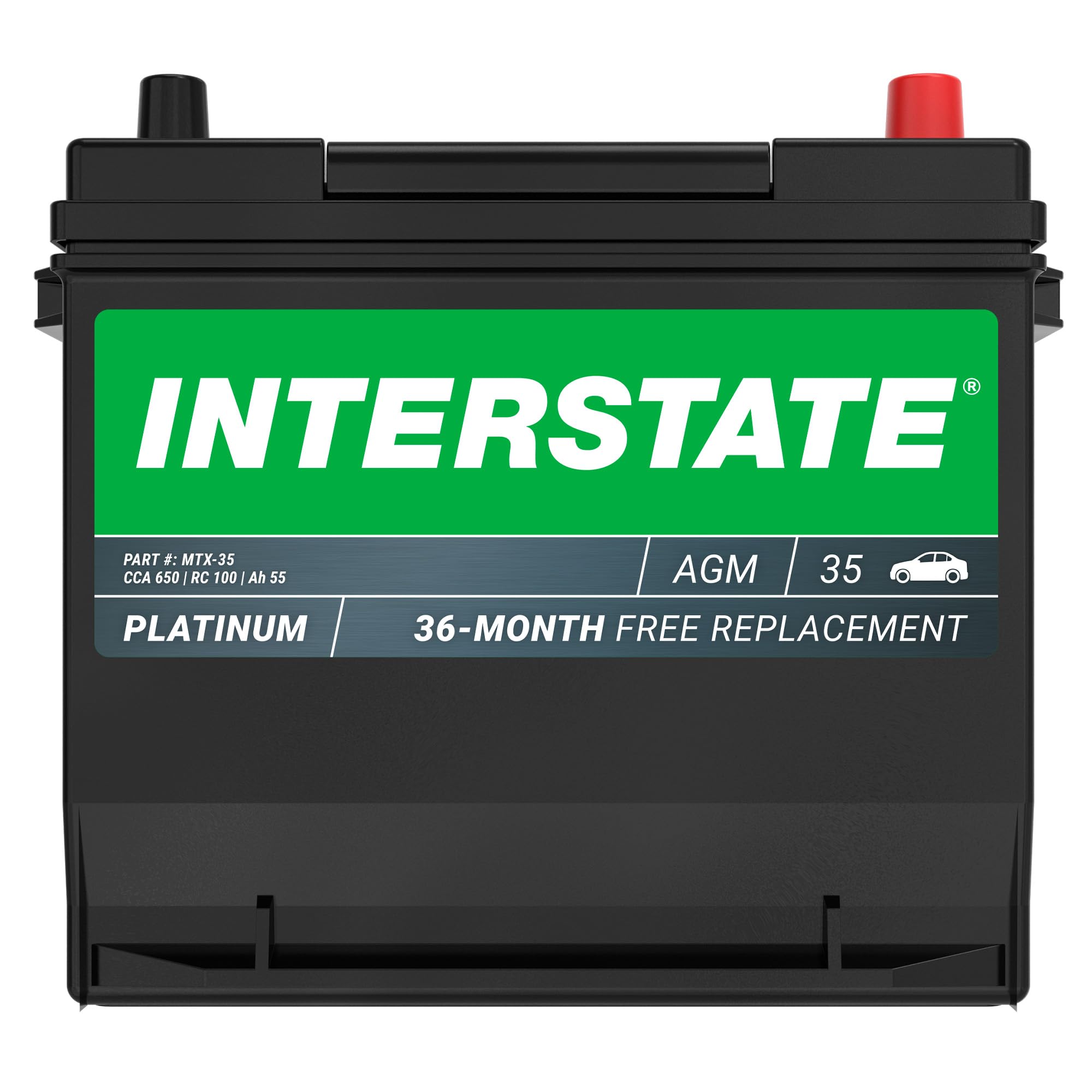
The Interstate MTX-35 uses a pure lead AGM construction that packs more active material into the same Group 35 footprint, which translates directly into higher reserve capacity and cycle life compared to conventional lead-alloy AGM designs. For a 2007 Mazda 3, this means the battery can handle parasitic drains from modern accessories — like dash cams or upgraded audio — without dropping below the critical 12.4V threshold during overnight parking. Owner reports consistently note that this battery delivers two to three times the service life of a standard flooded replacement, with one verified report of seven years of trouble-free service in a similar platform.
Fitment is straightforward: the Group 35 case matches the factory tray dimensions exactly, the SAE posts align with the stock cable ends, and the hold-down bracket secures without shims or adapters. The built-in handle simplifies installation, which is a welcome detail given the tight clearance in the Mazda 3 engine bay. Terminal polarity is correct for this application — positive on the right side as viewed from the front of the vehicle.
The primary drawback is the upfront investment, which sits at the higher end of the AGM category. Additionally, a small number of owners reported that the battery required an initial top-off charge before installation, suggesting it may have sat in inventory for an extended period. Verifying the manufacturing date code before installation is a prudent step.
What works
- Pure lead AGM delivers exceptional cycle life and reserve capacity
- Direct Group 35 fitment with correct terminal orientation
- Rugged case handles engine bay vibration without damage
- Sustained voltage stability supports aftermarket electrical loads
What doesn’t
- Premium price may exceed budget for some owners
- Occasional reports of inventory age requiring pre-charge
- Not widely stocked locally; shipping weight adds logistics cost
2. OPTIMA Batteries 34 REDTOP

The OPTIMA REDTOP is built around the company’s proprietary SpiralCell technology, which wraps pure lead plates into tightly packed cylindrical cells rather than flat plates. This design delivers 800 CCA from a relatively compact Group 34 case — roughly 200 more cold cranking amps than a standard Group 35 battery — which provides a substantial cold-weather margin for the 2007 Mazda 3’s 2.0L or 2.3L engine. Owner feedback across multiple vehicle platforms consistently reports eight to ten years of service life, with one verified account of a REDTOP lasting eight years in a V8 Grand Cherokee without a single failure.
Fitment requires a small adaptation for the Mazda 3. The Group 34 case is slightly shorter in height than the factory Group 35, and the terminal polarity is reversed: the positive post is on the left rather than the right. This means the factory cables will reach, but the positive cable must be rerouted carefully to avoid chafing against the radiator support. Most owners find the swap manageable with basic hand tools, though it is not a direct drop-in replacement. The included adapter plates help secure the smaller case in the factory tray.
The trade-off for the exceptional cranking power and vibration resistance is the cost per ampere-hour — the REDTOP carries a premium that exceeds many Group 35 AGM options. A small subset of owners reported receiving units with older manufacturing dates, and OPTIMA’s warranty support on Amazon requires handling through the retailer rather than local distribution. For owners who prioritize sheer cranking muscle over drop-in simplicity, this battery delivers benchmark performance.
What works
- SpiralCell design provides class-leading 800 CCA in compact package
- Exceptional vibration resistance outlasts standard AGM in harsh conditions
- Proven 8-10 year service life documented in owner reports
- High peak current supports cold-soaked engine starts
What doesn’t
- Group 34 case requires adapter plates and cable rerouting
- Terminal polarity reversed versus Mazda 3 factory orientation
- Premium cost per Ah compared to direct-fit Group 35 options
3. Odyssey ODP-AGM35 Performance Series

The Odyssey ODP-AGM35 is engineered around a pure lead, thin-plate AGM design that delivers 675 CCA and a pulse hot cranking amperage rating of 1200 — a spec that matters most during the split-second when the starter motor engages. For a 2007 Mazda 3, this translates to consistently fast cranking even after a week of cold-soaked parking, which is precisely the scenario that exposes weak batteries. Owner reports from Subaru and Honda platforms confirm that this battery holds voltage above 12.6V for extended idle periods without difficulty.
Fitment as a Group 35 is correct for the Mazda 3 tray, though one owner noted that the negative terminal required a thin lead shim to achieve proper clamp pressure on the SAE post — an occasional tolerance variance that is not unique to Odyssey. The case includes a built-in carry handle and the polarity matches factory orientation. At 45.9 pounds, this is one of the heavier AGM options in the category, which reflects the dense plate pack inside the case.
The most significant concern from owner feedback is the manufacturing date awareness: one buyer received a unit manufactured in 2019 that failed after one year, and Odyssey batteries carry a limited service life once the clock starts. Checking the date code stamped on the case before purchase is essential. The premium price also requires a longer ownership horizon to realize the value proposition. For owners who keep their Mazda 3 long-term, the build quality and power density justify the investment.
What works
- Pure lead thin-plate AGM delivers strong PHCA for instant engagement
- Group 35 case fits factory tray without modification
- Excellent voltage retention during idle and parasitic drain scenarios
- Dense plate construction supports deep discharge recovery
What doesn’t
- Heavy at 45.9 lbs — adds measurable weight for a Group 35
- Manufacturing date must be verified to avoid aged inventory
- Terminal fitment may require shim on some vehicles
- Premium price requires multi-year ownership to amortize
4. Goodyear 35-AGM Platinum Series
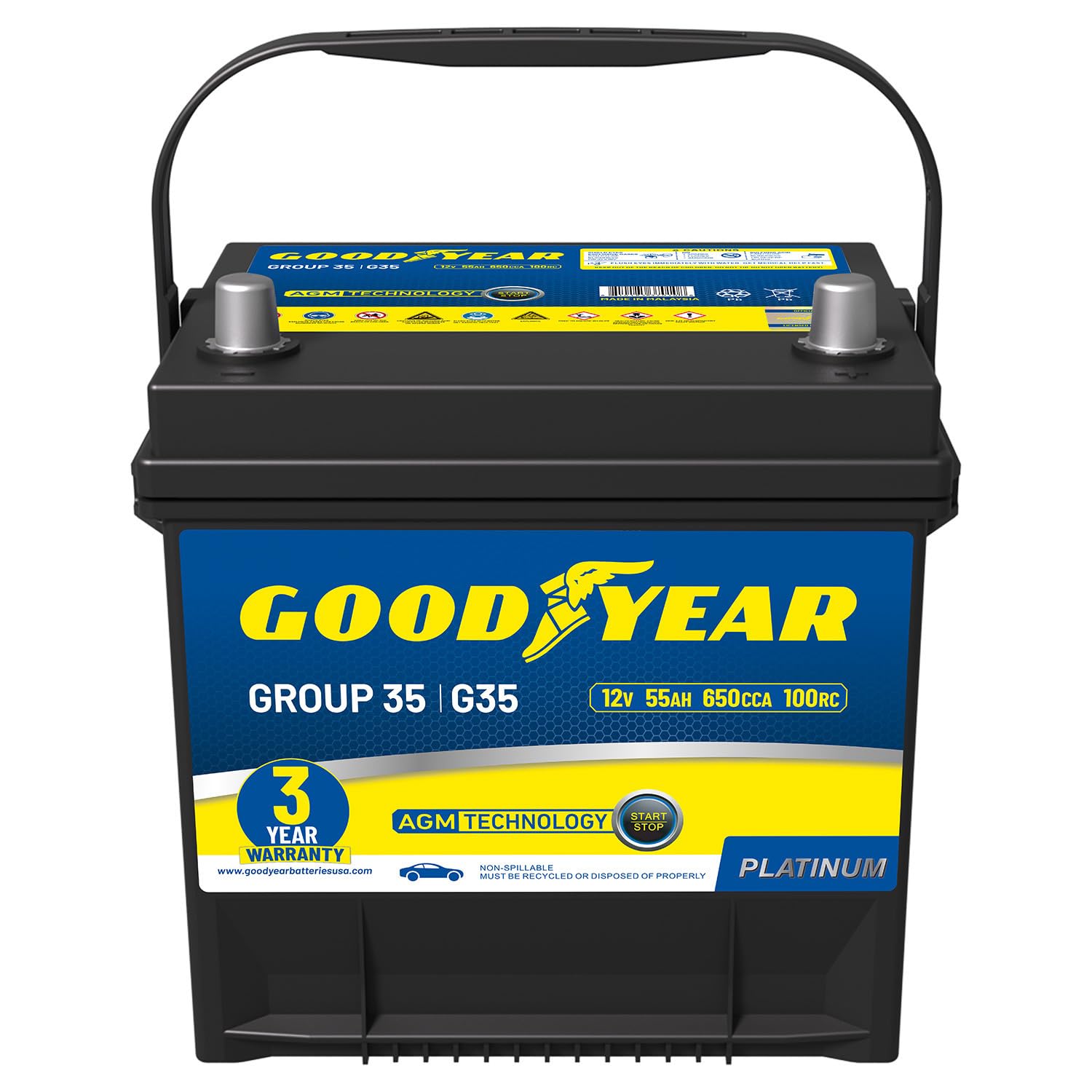
The Goodyear 35-AGM brings a familiar tire brand into the battery space with a Platinum series AGM built in an ISO-certified facility with CE safety certification. The spec sheet matches the Group 35 standard — 650 CCA, 55 Ah capacity, and 100 minutes of reserve capacity — but the real value lies in the 36-month warranty and the spill-proof AGM construction that resists vibration better than a flooded battery. Owner reports from Jeep and Chrysler applications highlight perfect fitment with factory terminals and immediate performance improvement over original equipment batteries.
For the 2007 Mazda 3, the positive-on-right SAE terminal orientation matches factory wiring, and the 9 x 7 x 8.87-inch case fits the stock tray without adapter plates or shims. Several owners noted that after upgrading from a flooded battery, their LED lighting became noticeably brighter at idle due to the AGM’s lower internal resistance reducing voltage sag. The battery arrived fully charged for most buyers, though a trickle charge before installation is always recommended for best results.
The concern that stands out from the owner data is a single detailed report of a failure — low pressure, overheating warnings, and subsequent alternator and radiator issues in a Chrysler Pacifica. The reviewer attributed the failures to the battery, though diagnosing causation from one report is difficult without confirming the vehicle’s pre-existing electrical health. The broader owner base reports strong performance and zero issues. The warranty support and brand recognition provide a safety net that budget options lack.
What works
- Direct Group 35 fitment with correct SAE terminal polarity
- AGM construction reduces voltage sag for brighter lighting at idle
- 36-month warranty provides long coverage window
- CE certification and ISO facility add quality assurance
What doesn’t
- Single owner report of vehicle electrical issues post-installation
- Brand new to batteries with limited long-term reliability data
- AGM price premium over comparable flooded batteries
5. Wuldnmar G48 Lithium Automotive Battery
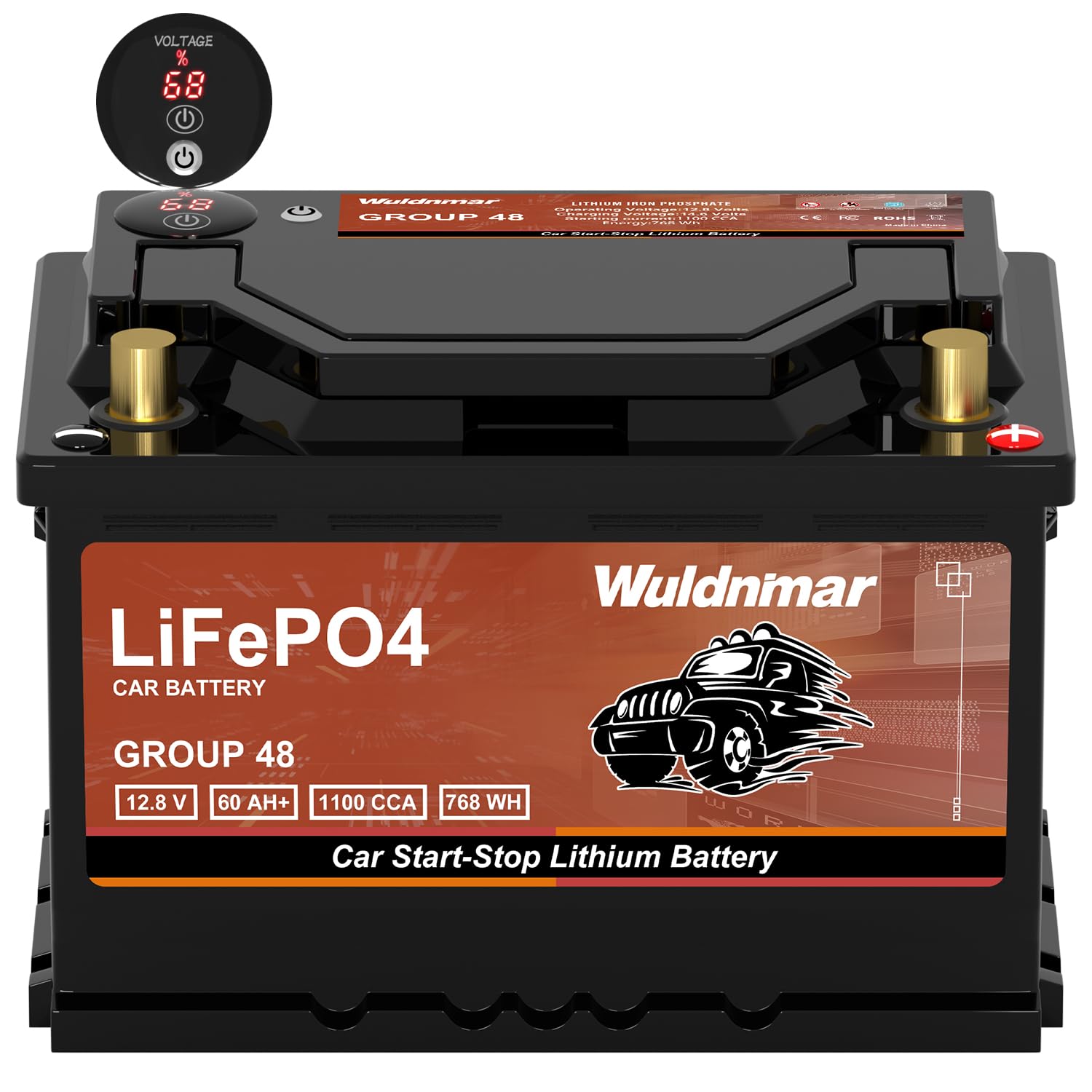
The Wuldnmar G48 lithium battery represents a significant departure from lead-acid chemistry, using a LiFePO4 cell pack with a built-in BMS to deliver 1100 CCA from a 16.1-pound package — roughly 30 pounds lighter than a comparable Group 48 lead-acid battery. For a 2007 Mazda 3, this weight reduction is small relative to the total vehicle mass, but the real performance benefit comes from the voltage stability: lithium maintains 12.8V under load far longer than any lead-acid chemistry, which means consistent starter motor speed regardless of temperature. Owner reports from cold climates confirm that this battery spins frozen V8 engines with the urgency of a summer start.
Fitment requires attention because this is a Group 48 case (10.83 x 6.88 x 7.48 inches) rather than the factory Group 35. The 2007 Mazda 3 tray can accommodate the longer case with some adjustment to the hold-down bracket, and the polarity orientation must be checked — the Wuldnmar uses a left-negative, right-positive configuration that matches the factory layout. However, the taller height may interfere with the engine bay cover on some trim levels, so measuring clearance before purchase is essential. The BMS provides protection against overcharge, over-discharge, and short circuits, which eliminates the risk profile that plagued early lithium starter batteries.
The primary barrier is the upfront cost, which significantly exceeds even premium AGM options. Owners who do not plan to keep the vehicle for five-plus years may not realize the total-cost-of-ownership advantage that lithium’s 2000-cycle lifespan provides. Additionally, lithium batteries require a compatible charger — standard lead-acid chargers will not properly terminate the charge cycle, and the alternator’s voltage profile must stay within the BMS’s acceptable range. For the enthusiast owner who values weight savings and cranking power above all else, this is a compelling but specialized choice.
What works
- 1100 CCA delivers extreme cold-weather starting margin
- 16.1 lbs saves significant weight over lead-acid options
- BMS protection eliminates overcharge and over-discharge risks
- 2,000-cycle lifespan outlasts AGM by years in normal use
What doesn’t
- Group 48 case requires tray modification for Mazda 3 fitment
- High initial investment requires long ownership to justify
- Requires lithium-compatible charger for maintenance
- BMS may conflict with certain alternator voltage profiles
6. Weize Platinum AGM Battery BCI Group 35

The Weize Platinum AGM Group 35 brings a 650 CCA, 55 Ah, 100 RC specification in an AGM package that undercuts the price point of legacy brands like Interstate and Odyssey by a meaningful margin. The construction uses absorbed glass mat technology with a tapered terminal layout that matches the 2007 Mazda 3 factory polarity — positive on the right, negative on the left — and the 9.06 x 6.89 x 8.82-inch case dimensions are a direct match for the stock battery tray. Owner reports from Honda Civic, Mini Cooper, and Subaru platforms confirm straightforward installation with no cable modifications required.
The performance data from owner feedback shows that this battery handles deep discharge recovery well — several reports mention the battery surviving an accidental drain to 11V and then recovering fully after a normal drive cycle, which is a stress test that kills many standard flooded batteries. The 36-month warranty provides a safety net that aligns with the expected service life for a mid-tier AGM in a daily-driven vehicle. One owner noted that the battery resolved persistent stop/start and door lock issues in their vehicle that three previous batteries had failed to fix.
The customer service experience appears to be a differentiator — one owner reported a failure after several months and received a replacement after providing documentation, with no pushback. The weight of 37.69 pounds is reasonable for a Group 35 AGM, though the case lacks the robust ribbing of premium competitors. For the owner who wants AGM performance without paying the full premium-brand tax, the Weize Platinum represents the most balanced value proposition in this category.
What works
- Direct Group 35 fitment with correct terminal orientation
- Recovers well from deep discharge events
- 36-month warranty with responsive customer support
- AGM performance at a fraction of premium brand pricing
What doesn’t
- Case construction feels less robust than Odyssey or Interstate
- Limited long-term reliability data compared to legacy brands
- Shipping weight still substantial despite thinner case
7. Forgetyo 48-H6-AGM Group 48
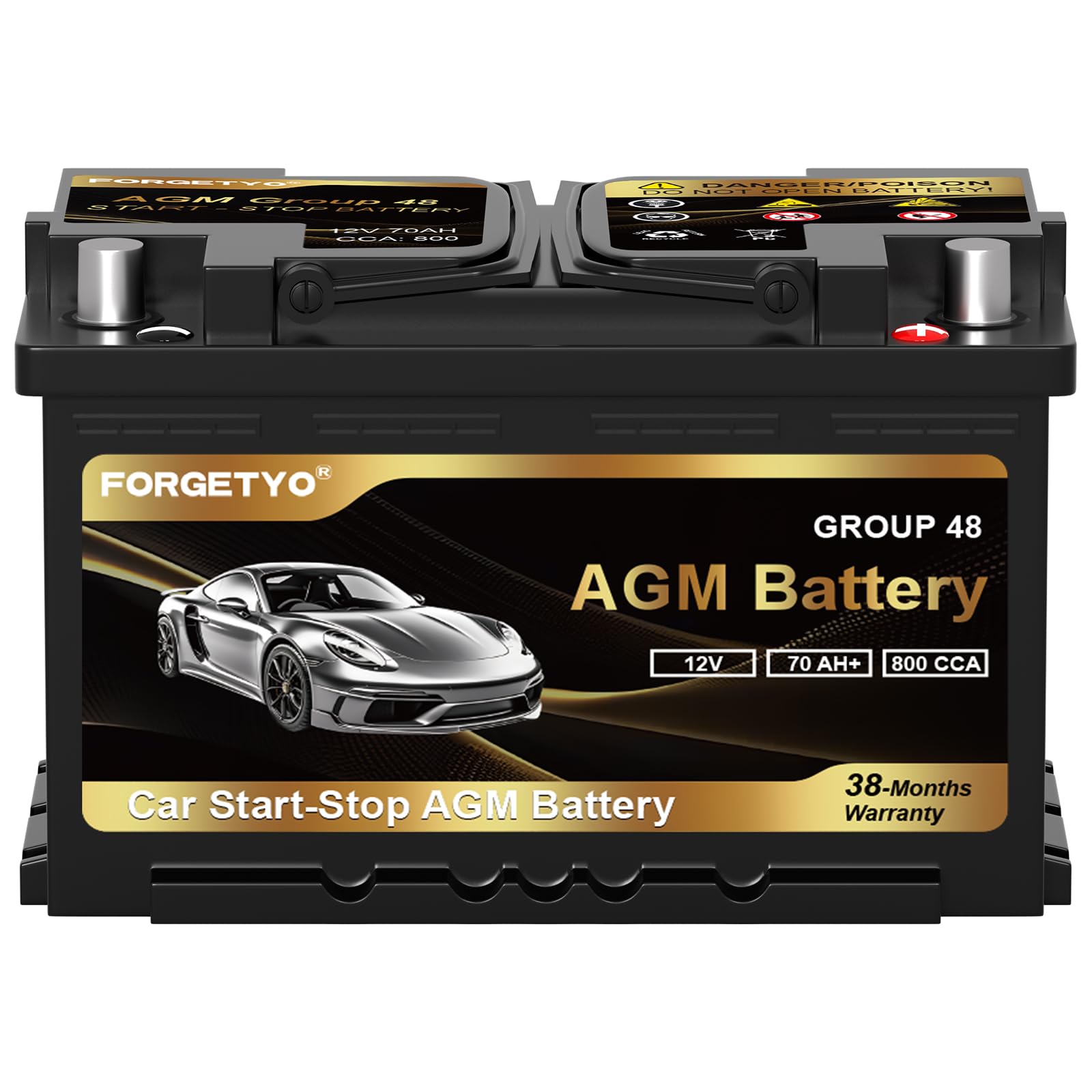
The Forgetyo 48-H6-AGM is a Group 48 battery with an unusually high 132-minute reserve capacity paired with 800 CCA, making it one of the most durable options in this comparison for owners who leave their Mazda 3 parked for days at a time. The reserve capacity spec directly correlates with how long the vehicle can run on battery power alone if the alternator fails — 132 minutes at 25 amps is roughly double what a standard Group 35 battery provides. Owner reports from Ram 1500, Chevy Colorado, and Lincoln Nautilus owners confirm direct fitment in their Group 48 applications, with one owner noting that the battery delivered 14.9V charging voltage without exceeding the vehicle’s 15V maximum threshold.
Fitment in the 2007 Mazda 3 requires an adapter because the Group 48 case is longer (10.9 inches) than the Group 35 tray. The terminal polarity is left-negative, right-positive, which matches the factory orientation, but the battery hold-down bracket will need modification or replacement to secure the longer case. The weight of 43 pounds is expected for a Group 48 AGM, and the tapered terminals accept factory cable clamps without issue. The 38-month warranty is among the longest in this comparison, providing meaningful peace of mind for the fitment adaptation required.
The owner feedback includes one report where a reviewer described this as a LiFePO4 battery in a review that appears mismatched to the product listing, creating some confusion about the actual chemistry. The vast majority of verified owners confirm this is an AGM battery that performs as advertised. For the Mazda 3 owner willing to make a minor tray modification in exchange for a massive reserve capacity and cranking amperage buffer, this is a compelling option that few competitors match at the same price tier.
What works
- 132-minute reserve capacity is class-leading for emergency power
- 800 CCA provides generous cold-weather starting margin
- 38-month warranty offers long defect protection
- AGM construction withstands deep discharge better than flooded
What doesn’t
- Group 48 requires tray modification for Mazda 3 fitment
- Heavier and bulkier than factory Group 35
- Some product listing confusion in owner reviews
8. Renogy 12V 70Ah AGM H6 Group 48
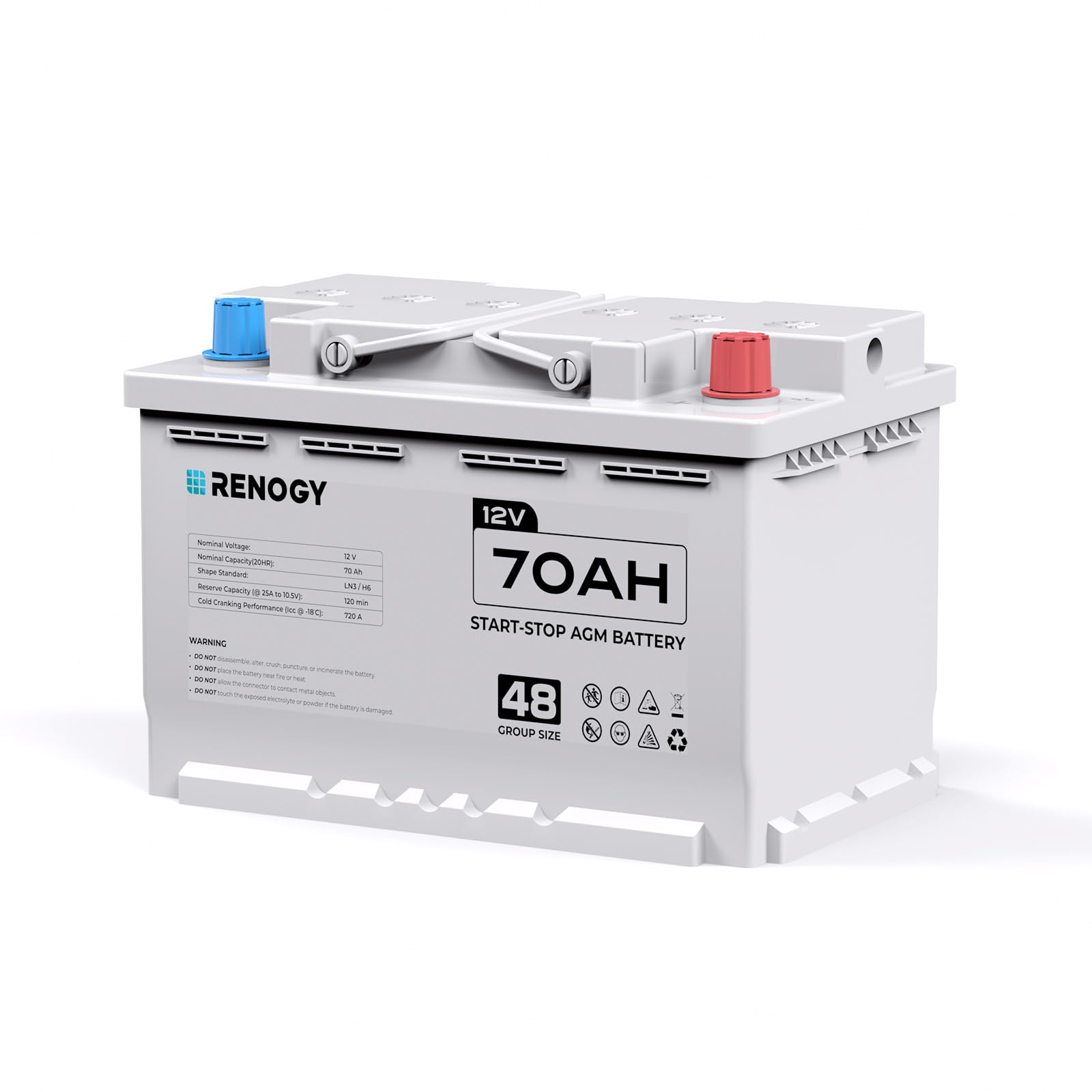
The Renogy 12V 70Ah AGM H6 is engineered with a wide operating temperature range of -30°C to 70°C, supported by 720 CCA and a 120-minute reserve capacity in a Group 48 case. For a 2007 Mazda 3 driven in extreme climates — whether that means subzero Canadian winters or desert Southwest summers — this battery maintains electrolyte stability and cranking current when standard batteries begin to fade. Owner reports from Jeep Grand Cherokee applications confirm the battery arrived fully charged and provided instant starts in cold conditions, with one owner specifically noting excellent deep cycle holdover during extended parking periods.
Fitment follows the Group 48 format, which means the Mazda 3’s factory Group 35 tray will require an adapter or modification to accommodate the longer 10.9-inch case. The terminal polarity is standard left-negative, right-positive, matching factory orientation. The weight of approximately 42 pounds is typical for this size class. Renogy includes a two-year material and workmanship warranty, which is shorter than some competitors but reflects the company’s focus on the solar and off-grid market rather than purely automotive starting batteries.
The primary risk flagged in owner feedback is a single report of complete failure after one month of light use, with the buyer noting the battery tested defective at an auto parts store. While this appears to be an isolated quality control issue rather than a systemic design flaw, it underscores the importance of testing the battery immediately upon arrival and exercising the warranty if voltage readings are abnormal. For the climate-conscious Mazda 3 owner who needs reliable performance at temperature extremes, the Renogy’s thermal design is a genuine differentiator that few direct-fit batteries can match.
What works
- Extended temperature range covers -30°C to 70°C for extreme climates
- 720 CCA with 120 RC provides strong cold-weather buffer
- AGM construction resists vibration and spill damage
- Excellent voltage holdover during extended idle periods
What doesn’t
- Group 48 case requires Mazda 3 tray modification
- Single owner report of early failure raises QC questions
- Two-year warranty is shorter than AGM competitor average
9. MARXON Group 34 Start and Stop AGM

The MARXON Group 34 is a 12V 55Ah AGM battery rated at 650 CCA, manufactured by Leoch — a well-known OEM producer in the battery industry — and backed by a three-year warranty with US-based support. Despite being advertised as a start-stop compatible battery, the AGM construction and 650 CCA rating make it a viable candidate for the 2007 Mazda 3, provided the installer addresses the Group 34 fitment differences. Owner reports from Mitsubishi Outlander, Toyota RAV4, and Hyundai Elantra applications confirm strong performance after several months, with one owner specifically noting the battery survived a deep discharge to 11V and still started the engine at 11.2V.
Fitment requires the same adaptation as any Group 34 battery in a Group 35 tray: the case is slightly shorter in height and the terminal polarity is reversed (positive on the left versus the factory right-side positive). The factory cables will reach but must be routed carefully to avoid tension or chafing. The battery weighs 42 pounds and features A1 terminals that accept standard SAE clamps. The price point undercuts most Group 35 AGM options, making this an entry-level AGM upgrade for owners willing to perform a small retrofit.
The most notable limitation is that the Group 34 case does not fill the Mazda 3 tray completely, which can leave the battery vulnerable to movement if the hold-down bracket is not adapted securely. Some owners have reported success using foam padding or 3D-printed spacers to eliminate play. Additionally, the start-stop marketing is irrelevant for this vehicle — the AGM technology is what matters, not the feature label. For the budget-conscious owner who wants the benefits of AGM without paying Group 35 pricing, this is a functional workaround with proven reliability in other platforms.
What works
- AGM construction with deep discharge recovery capability
- Three-year warranty with US-based support network
- Leoch manufacturing provides OEM-level quality baseline
- Aggressive pricing undercuts most Group 35 AGM options
What doesn’t
- Group 34 requires tray adaptation and cable rerouting
- Case size leaves gap in Mazda 3 tray if not secured properly
- Start-stop labeling is irrelevant for this vehicle
10. Mighty Max Battery MM-G35 Group 35
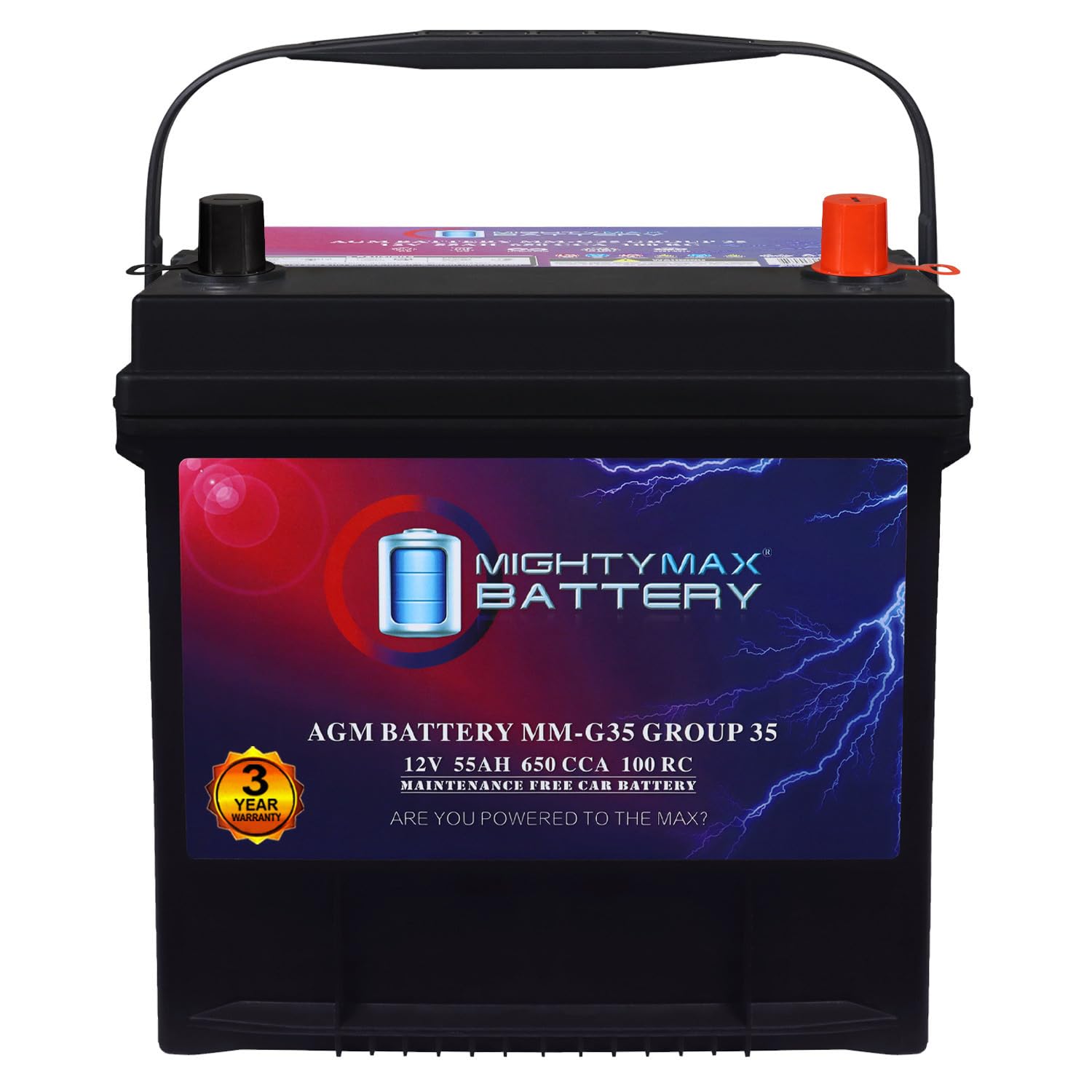
The Mighty Max MM-G35 is a Group 35 AGM battery rated at 650 CCA with 100 minutes of reserve capacity and 55 Ah of storage, packaged in a case that matches the factory 9.06 x 6.89 x 8.82-inch footprint. One owner tested the battery upon arrival and measured 930 CCA on a professional tester — significantly exceeding the stamped 650 CCA rating — which suggests conservative manufacturing margins that translate into real-world starting reliability. The battery has been used successfully in Honda CR-V, Toyota Tacoma, and Generac standby generator installations according to owner reports.
Fitment for the 2007 Mazda 3 is direct: the Group 35 case drops into the factory tray, the SAE tapered terminals align with the correct polarity, and the included mounting screws secure the hold-down bracket without modification. The three-year warranty provides standard coverage for this price tier. Several owners noted that the battery arrived with a charge level between 38% and 50%, requiring a top-off charge before installation to reach full capacity — a common occurrence with AGM batteries that ship without a full float charge.
The primary concern from owner feedback is a critical compatibility issue reported by a Mazda6 Grand Touring owner: the MM-G35 was marketed as compatible with the i-ELOOP regenerative braking system but, according to the owner, Mighty Max customer support warned that continued use could damage the Grand Touring’s features. The 2007 Mazda 3 does not have i-ELOOP, so this is not a direct issue for this vehicle. However, the incident suggests that Mighty Max’s fitment data may not be meticulously verified for every model variant, so owners should confirm group size and polarity independently rather than relying solely on the listing’s compatibility claims.
What works
- Direct Group 35 fitment with correct terminal polarity
- Measured CCA significantly exceeds rated 650 spec
- Three-year warranty provides adequate defect coverage
- Budget-friendly entry point for AGM technology
What doesn’t
- Compatibility claims may not be verified for all trims
- Often arrives partially charged and needs top-off
- Case lacks the reinforced ribbing of premium competitors
11. Autocessking Group Size 35 AGM
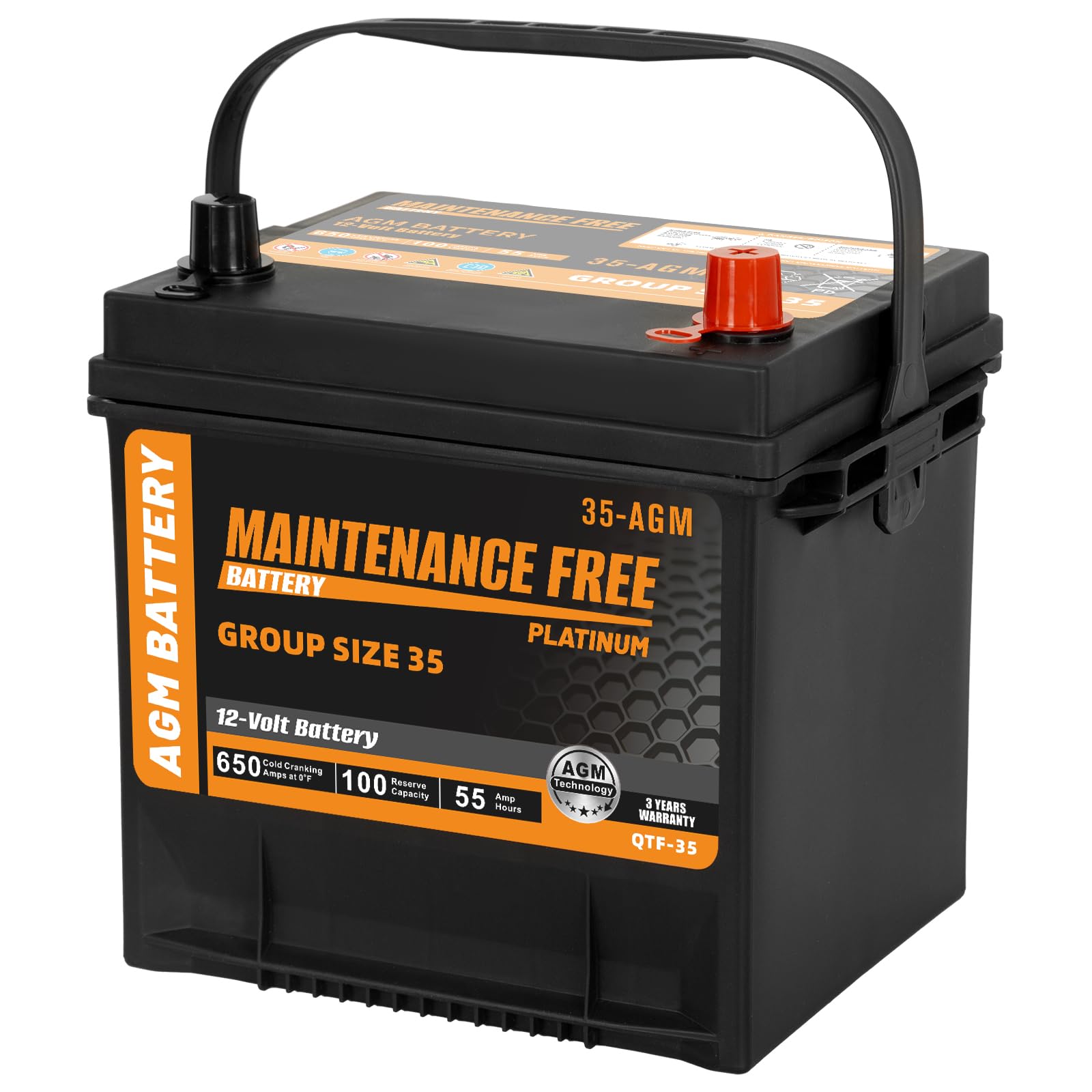
The Autocessking Group 35 AGM is a straightforward replacement battery that matches the factory specifications — 12V, 55 Ah, 650 CCA, 100 RC — in a Group 35 case that fits the 2007 Mazda 3 without modification. The AGM construction provides the standard benefits over flooded batteries: spill-proof operation, lower self-discharge during storage, and improved vibration resistance. Owner reports from Honda Civic applications confirm a perfect fit with immediate starting performance, though the long-term durability data is limited given the product’s relatively recent market introduction.
Fitment is the strong point here: the 9.06 x 6.89 x 8.82-inch case matches the factory tray, the tapered terminals align with the correct polarity orientation (positive on the right), and the 38-pound weight is manageable for installation. The manufacturer explicitly states that this is a starting battery and should not be used for deep-cycle applications such as solar projects, which is appropriate for automotive use. Several owners noted fast shipping and the battery arriving with sufficient charge for immediate installation.
The most significant concern is the lack of long-term owner feedback — the product has relatively few reviews compared to established brands, so the failure rate and real-world lifespan remain unproven. One owner ordered the wrong size and returned it, praising Amazon’s return policy rather than the battery’s performance. The three-year warranty provides a safety net, but warranty claims on newer brands can be inconsistent. For the owner who wants a brand-new AGM battery at a competitive price and is comfortable being an early adopter, this is a functional choice — but the absence of multi-year reliability data makes it a riskier bet than the Interstate or Weize options.
What works
- Direct Group 35 fitment with correct factory polarity
- AGM construction provides low self-discharge for infrequent driving
- Competitive pricing for an entry-level AGM
- Lightweight at 38 pounds for easy handling
What doesn’t
- Limited owner feedback and long-term reliability data
- Newer brand with unproven warranty support
- Early adopter risk compared to established competitors
Hardware & Specs Guide
BCI Group Size and Physical Dimensions
The 2007 Mazda 3 factory battery tray is designed for a BCI Group 35 battery with approximate dimensions of 9.06 inches in length, 6.89 inches in width, and 8.82 inches in height. The SAE terminal posts are positioned with the positive terminal on the right and the negative on the left when facing the engine bay. Group 34 batteries are approximately 10.25 inches long and 6.81 inches wide with reversed polarity, requiring tray modification and cable rerouting. Group 48 batteries measure roughly 10.9 inches in length, demanding an adapter or bracket extension to fit securely. Always measure the tray depth and cable reach before purchasing an alternative group size.
Cold Cranking Amps and Reserve Capacity
Cold Cranking Amps (CCA) measures the battery’s ability to start the engine at 0°F for 30 seconds while maintaining at least 7.2 volts. The 2007 Mazda 3 2.0L and 2.3L engines typically require 500-550 CCA, but upgrading to 650-800 CCA provides a meaningful cold-weather buffer without overloading the alternator. Reserve Capacity (RC) indicates how many minutes the battery can supply 25 amps at 80°F before dropping below 10.5 volts — a spec that matters more for vehicles with parasitic drains or extended idle periods. A Group 35 AGM with 100 RC will run the Mazda 3’s electrical system for roughly 90 minutes without alternator support.
FAQ
What group size battery does the 2007 Mazda 3 need?
Can I use an AGM battery in my 2007 Mazda 3?
How do I know when my 2007 Mazda 3 battery needs replacement?
Final Thoughts: The Verdict
For most 2007 Mazda 3 owners, the winner is the Interstate Batteries MTX-35 because it delivers pure lead AGM performance in a true direct-fit Group 35 package with a proven track record of longevity. If you want maximum cold-weather cranking power and are comfortable with a small Group 34 adaptation, grab the OPTIMA 34 REDTOP. And for the budget-conscious owner seeking AGM reliability without the premium price, nothing beats the Weize Platinum AGM Group 35.

Certification: BSc in Mechanical Engineering
Education: Mechanical engineer
Lives In: 539 W Commerce St, Dallas, TX 75208, USA
Md Amir is an auto mechanic student and writer with over half a decade of experience in the automotive field. He has worked with top automotive brands such as Lexus, Quantum, and also owns two automotive blogs autocarneed.com and taxiwiz.com.