A failing battery in a 2003 Jeep Liberty doesn’t just mean a slow crank—it means being stranded in a parking lot, waiting for a jump. The right replacement delivers reliable cold-start power and handles the demands of the Liberty’s electrical system without hesitation.
I’m Amir — the founder and writer behind Four Wheel Ask. I’ve spent countless hours analyzing technical specifications, reading owner feedback, and cross-referencing warranty data to separate reliable automotive batteries from short-lived disappointments.
The wrong choice leads to repeated replacements and frustrating no-start mornings. After vetting specifications, owner reviews, and build quality, this guide covers the best 2003 jeep liberty battery options across different performance levels to match any driving need.
How To Choose The Best 2003 Jeep Liberty Battery
Selecting the right battery for a third-generation Jeep Liberty is about more than just picking a brand. You need to match the physical group size, verify terminal position, and assess the cold cranking amps required for your climate. A mismatch in any of these areas leads to fitment issues or poor performance.
Group Size and Terminal Layout
The 2003 Jeep Liberty typically requires a Group 48 or Group 47 battery, depending on the specific engine and trim configuration. The terminals must be positioned correctly—positive on the right, negative on the left. Always measure your existing battery compartment and compare dimensions before purchasing; a battery that is too tall or wide will not seat properly and can cause cable strain.
Cold Cranking Amps (CCA) for Reliable Starts
Cold Cranking Amps measure a battery’s ability to start an engine in freezing temperatures. For the Liberty’s 3.7L V6, a CCA rating of at least 600 is recommended for moderate climates. If you live in an area with severe winters, look for a battery rated at 700 CCA or higher to ensure consistent cranking power when the mercury drops.
AGM vs. Flooded Lead-Acid
Absorbent Glass Mat (AGM) batteries are sealed, spill-proof, and more resistant to vibration than traditional flooded batteries. They also handle deep discharges better and recharge faster. While AGM batteries command a higher initial investment, they often deliver a longer service life, making them a strong choice for owners who keep their Liberty for the long haul.
Quick Comparison
On smaller screens, swipe sideways to see the full table.
| Model | Category | Best For | Key Spec | Amazon |
|---|---|---|---|---|
| Weize Platinum AGM Group 94R | Premium AGM | High-Capacity Use | 850 CCA, 140 RC, 80 Ah | Amazon |
| Weize Platinum AGM Group 35 | Premium AGM | Space-Constrained Fits | 650 CCA, 100 RC, 55 Ah | Amazon |
| Forgetyo Group 48 AGM | Premium AGM | Start-Stop Vehicles | 800 CCA, 132 RC, 70 Ah | Amazon |
| ACDelco Gold 51RAGM | OE-Spec AGM | OEM Replacement | 31.97 lbs, Group 51R | Amazon |
| Relistart Group 47 AGM | Mid-Range AGM | Balanced Value | 680 CCA, 105 RC, 60 Ah | Amazon |
| Autocessking Group 47 AGM | Mid-Range AGM | All-Weather Starts | 680 CCA, 100 RC, 60 Ah | Amazon |
| MARXON Group 34 AGM | Mid-Range AGM | Start-Stop Efficiency | 650 CCA, 55 Ah | Amazon |
| ACDelco Gold AUX14-200 | Auxiliary AGM | Dual Battery Systems | 200 CCA, AGM | Amazon |
| Goodyear AUX12-AGM | Auxiliary AGM | Compact Auxiliary Power | 200 CCA, 12 Ah | Amazon |
In‑Depth Reviews
1. Weize Platinum AGM Battery BCI Group 94R

The Weize Platinum AGM Group 94R is the standout choice for a 2003 Jeep Liberty owner who wants maximum cold-cranking power and reserve capacity without stepping into luxury-brand pricing. With an 850 CCA rating and 140 minutes of reserve capacity, this battery delivers ample headroom for harsh winter mornings and accessories like aftermarket lighting or audio systems. The 80 Ah capacity ensures consistent power delivery over time, and the self-discharge rate of less than 8% after 90 days of storage adds convenience for vehicles that sit idle for stretches.
Designed for start-stop technology and high electrical loads, this AGM battery is leak-proof and certified non-spillable, making it safer for engine bay mounting. The tapered terminal layout (left negative, right positive) matches the stock Liberty configuration. Its 12.4-inch length fits the Liberty’s Group 48/94R tray without modification, and the vibration-resistant construction handles off-road use better than a standard flooded battery.
Owner feedback consistently highlights the reliable cranking in subfreezing temperatures and the battery’s ability to recover quickly after deep discharges. The three-year warranty provides solid long-term coverage, and the competitive pricing for this performance tier makes it an easy recommendation for those who prioritize cold-weather reliability and accessory power.
What works
- Very high 850 CCA for severe winter starts
- 140-minute reserve capacity supports accessories
- Leak-proof AGM design resists vibration
- Strong 36-month warranty coverage
What doesn’t
- Heavier than standard flooded batteries
- May not fit Liberty models with smaller battery trays
2. Weize Platinum AGM Battery BCI Group 35

The Weize Platinum AGM Group 35 offers a more compact footprint than the Group 94R, making it a solid alternative for Liberty owners with tighter battery compartments or those running dual-battery setups. Its 650 CCA and 55 Ah capacity are sufficient for the 3.7L V6 in most climates, though those in extreme northern regions may want higher CCA. The battery operates in temperatures from -22°F to 158°F, which covers the vast majority of real-world driving conditions.
Weize has engineered this AGM battery with a tapered terminal layout that matches the Liberty’s stock polarity. The low self-discharge rate and enhanced heat resistance are notable advantages over flooded batteries, especially for owners who park their Liberty in direct sunlight or in hot garages. The three-year warranty is consistent with other premium AGM offerings in this price bracket.
From a build-quality perspective, the Group 35 uses high-density negative paste that improves conductivity and extends cycle life compared to conventional lead-acid units. Owner reports note that the battery holds voltage well during short trips, which is a common failure point for standard batteries. It is not intended for deep-cycle solar or marine use, but as a starting battery for a daily-driven Liberty, it performs admirably.
What works
- Compact size fits confined battery trays
- Maintenance-free AGM with spill-proof design
- Good heat and cold resistance
What doesn’t
- 650 CCA may be marginal for severe cold
- 55 Ah capacity is lower than Group 94R
3. Forgetyo Group 48 AGM Car Battery
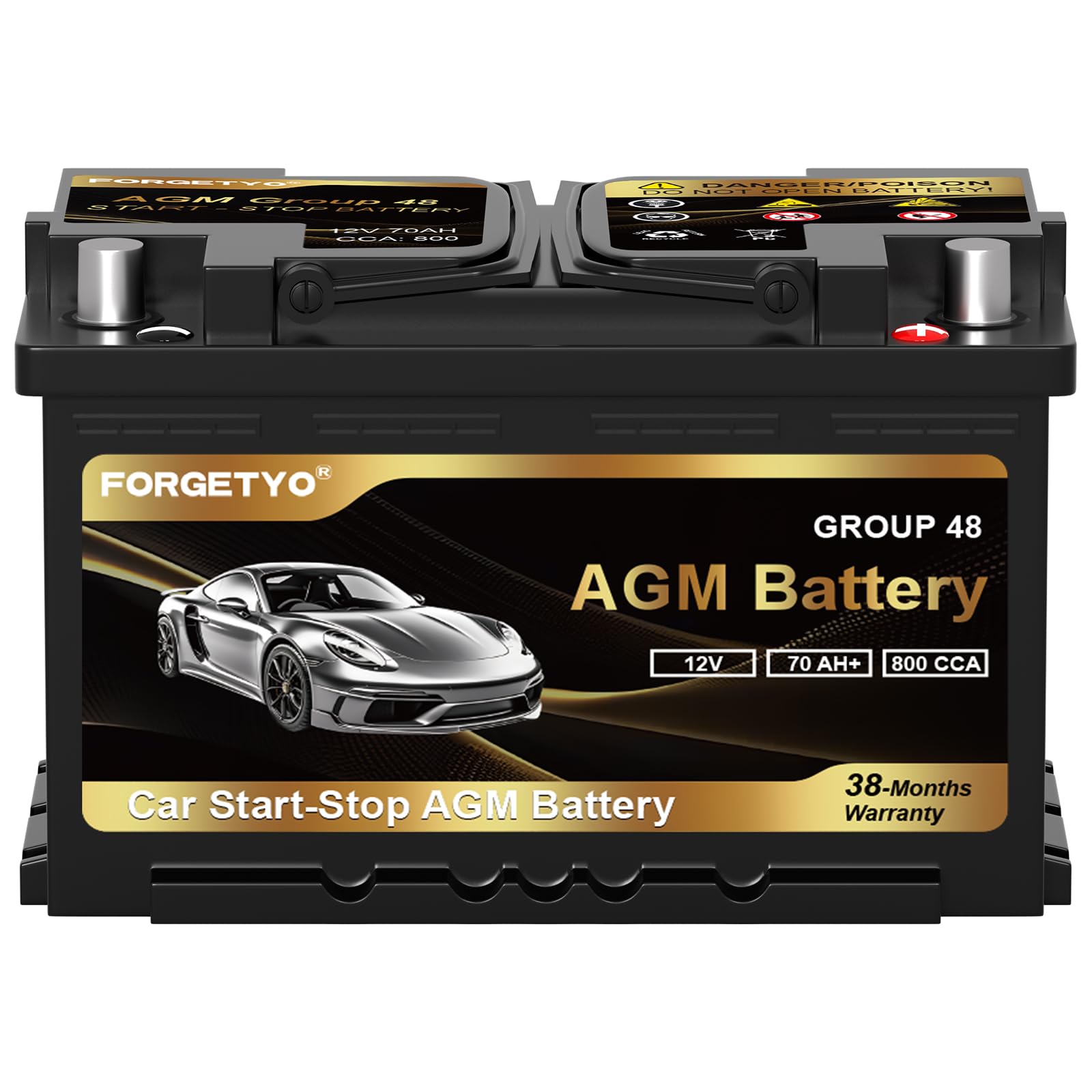
The Forgetyo Group 48 AGM battery is engineered for vehicles with start-stop technology, offering 800 CCA and a 132-minute reserve capacity. The 70 Ah capacity positions it between the smaller Group 35 and the larger Group 94R, making it a versatile middle-ground option. The operating temperature range from -40°C to 60°C covers extreme conditions, and the AGM construction resists vibration and leakage better than flooded alternatives.
Fitment for the 2003 Jeep Liberty requires careful measurement—this Group 48 battery measures 10.9 x 6.9 x 7.5 inches. If your Liberty uses a Group 47 or Group 48 tray, the dimensions should align. The tapered terminal placement (left negative, right positive) matches the stock orientation. Forgetyo backs this battery with a 38-month warranty, which is longer than many competitors at this price point.
Customer feedback emphasizes the battery’s ability to start reliably after extended periods of inactivity, thanks to the low self-discharge AGM chemistry. The higher CCA rating also provides a comfortable margin for cold-weather cranking. The only notable drawback is that the battery is on the heavier side at 43 pounds, but that is typical for a fully sealed AGM unit of this capacity.
What works
- High 800 CCA for cold climates
- 132-minute reserve capacity is generous
- 38-month warranty is above average
- Spill-proof AGM design
What doesn’t
- Heavier than many alternatives
- Requires precise dimension check before ordering
4. ACDelco Gold 51RAGM (88866315)
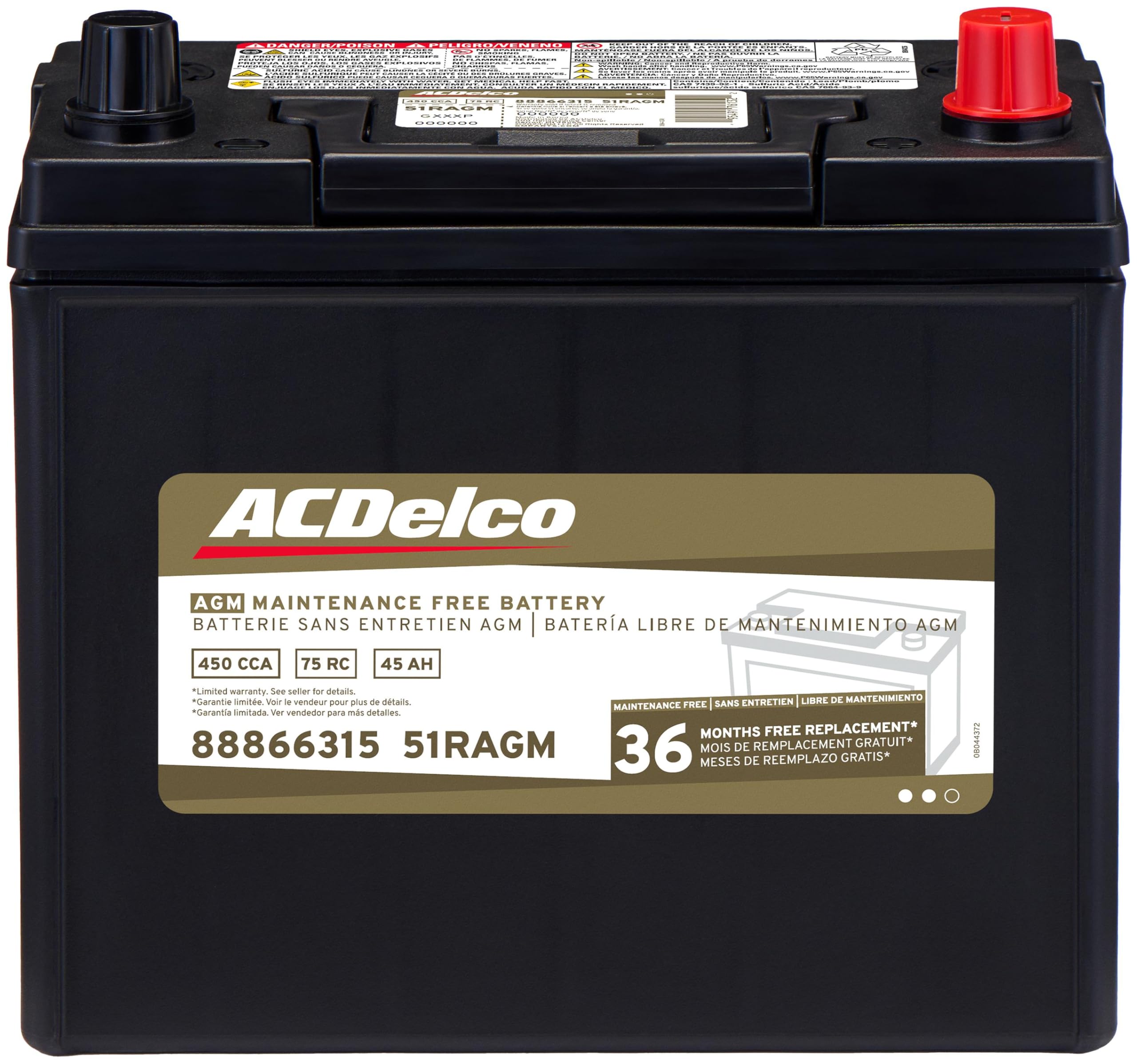
ACDelco’s Gold 51RAGM is a direct-replacement AGM battery designed to meet General Motors’ specifications for fit, form, and function. For the 2003 Jeep Liberty, which shares many electrical architecture traits with contemporary GM platforms, this battery offers a straightforward swap. The Group 51R form factor is smaller than the typical Liberty battery, so owners must verify tray dimensions and hold-down compatibility before purchasing.
The AGM construction means no maintenance is required, and the sealed design prevents acid leaks. ACDelco includes a 36-month free replacement warranty, which provides solid coverage for a battery in this category. The battery weighs just under 32 pounds, making it significantly lighter than larger AGM options—a benefit if you are looking to minimize overall front-end weight.
Owner feedback indicates that this battery works well as a replacement in vehicles that originally came with a Group 51R battery. For the Liberty, it may require an adapter or different hold-down bracket. The CCA rating is not published in the available data, but ACDelco Gold batteries typically offer competitive starting power for standard-duty applications. This is a good choice for owners wanting an OEM-level part with a maintenance-free design.
What works
- Lightweight compared to larger AGM batteries
- OEM-spec build quality from ACDelco
- Sealed AGM prevents corrosion
What doesn’t
- 51R size may not fit all Liberty trays
- CCA rating not explicitly specified
5. Relistart Group 47 AGM Battery
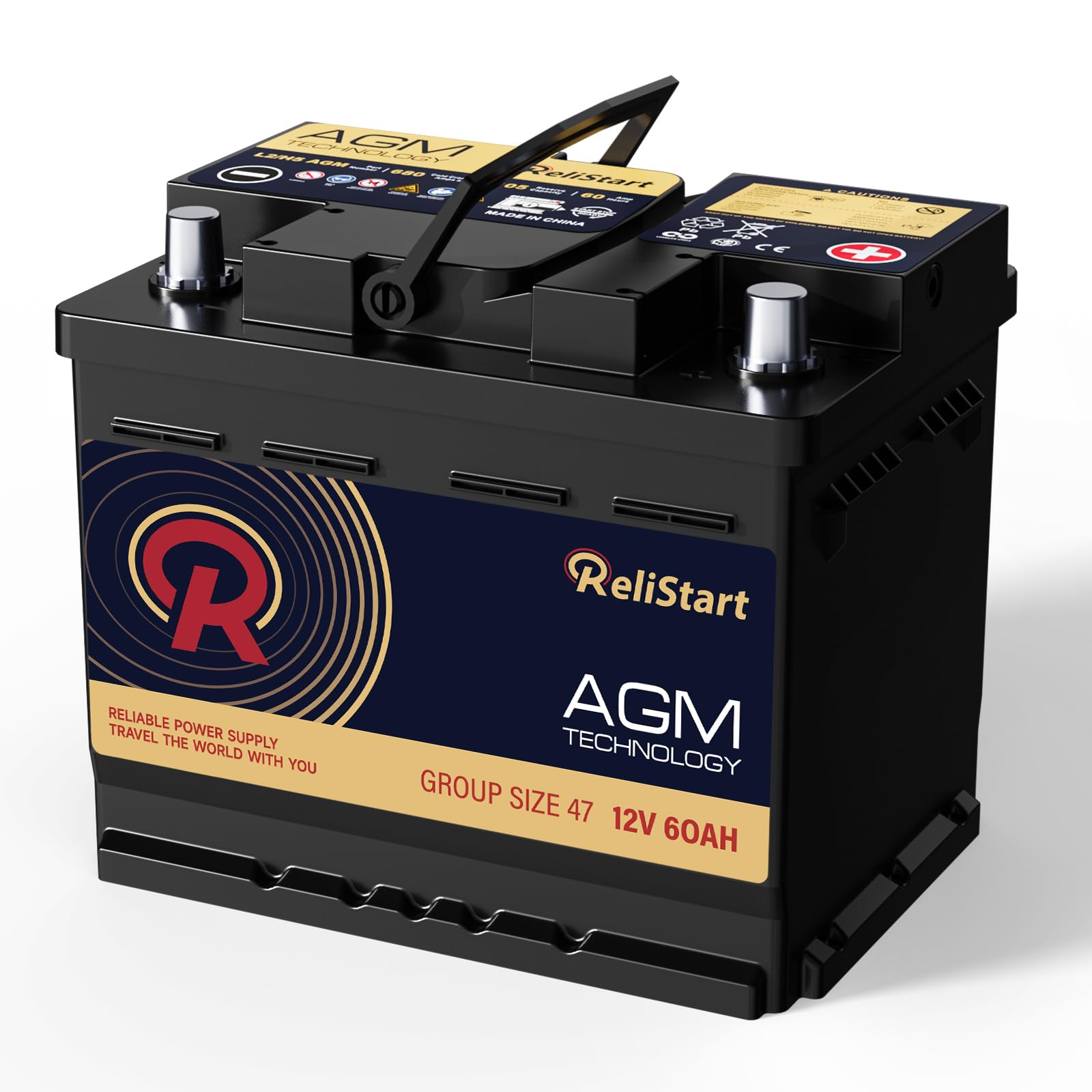
The Relistart Group 47 AGM battery hits the sweet spot between performance and cost, offering 680 CCA and 105 RC in a Group 47 size that directly fits many 2003 Jeep Liberty configurations. The 60 Ah capacity is adequate for daily driving and moderate accessory loads, and the battery operates across a wide temperature range from -22°F to 158°F. The AGM construction delivers four times the cycle life of standard flooded batteries, reducing the frequency of replacements.
Fitment is straightforward with the Liberty’s stock Group 47 tray. The tapered terminal layout matches the vehicle’s polarity, and the dimensions—9.53 x 6.85 x 7.48 inches—are a close match to the factory battery size. Relistart backs this battery with a 36-month warranty, which aligns with the industry standard for premium AGM products.
Owners report that the Relistart handles short-trip driving without suffering the voltage drop that plagues many conventional batteries. The self-discharge rate of less than 8% after 90 days is a practical advantage for vehicles that are not driven daily. One area to note is that the battery does not include a mounting bracket, so you will reuse your Liberty’s original hold-down hardware.
What works
- Good balance of CCA and price
- Direct Group 47 fitment for many Liberty models
- Four times the cycle life of flooded batteries
- 36-month warranty
What doesn’t
- Mounting hardware not included
- 680 CCA is adequate, not exceptional
6. Autocessking H5 Group Size 47 AGM Battery
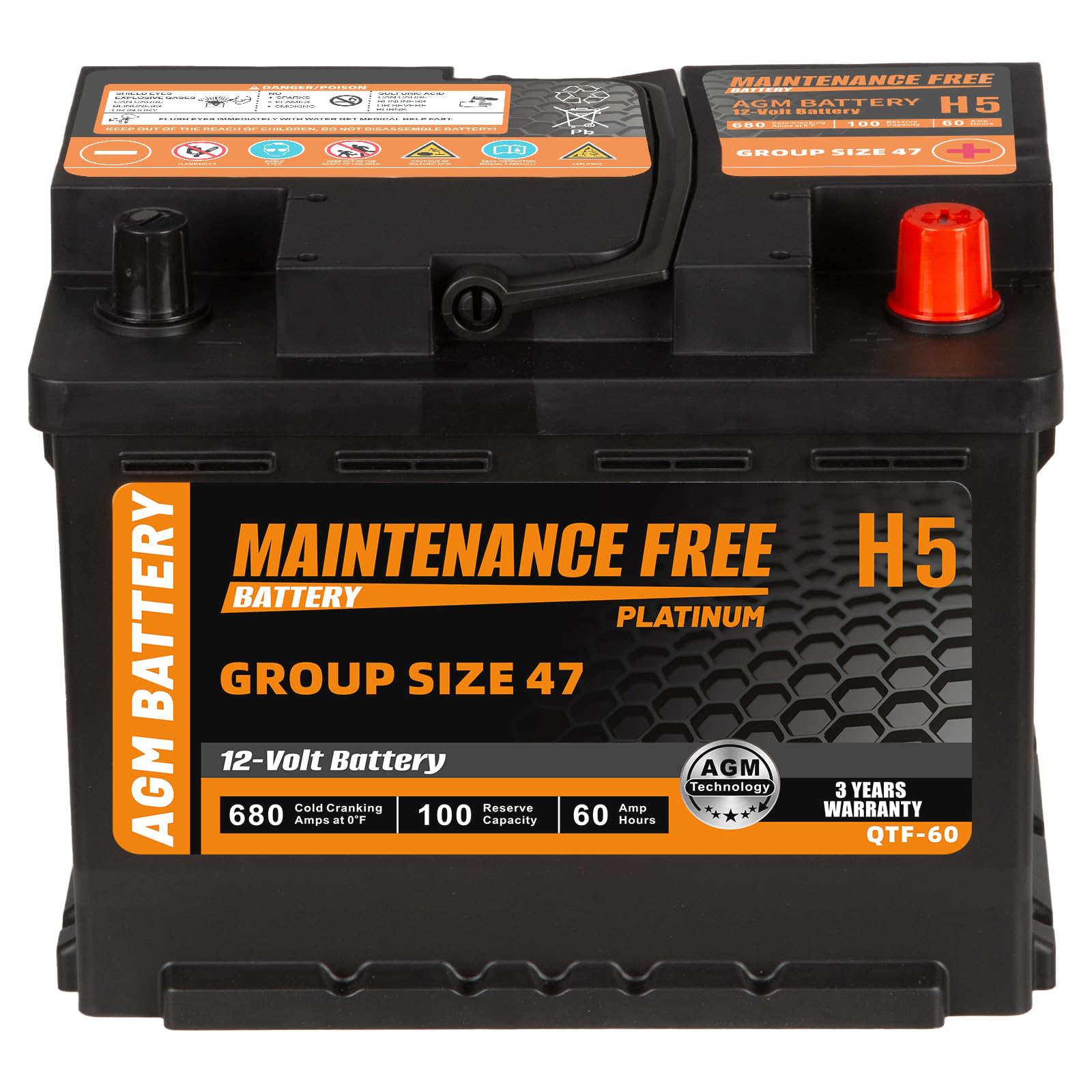
The Autocessking Group 47 AGM battery delivers 680 CCA and 100 RC in a package designed to fit the Liberty’s H5/Group 47 tray. Its operating range extends from -18°C to 60°C for continuous use, with short-term extremes from -40°C to 75°C. This makes it a dependable choice for owners in regions with both harsh winters and hot summers. The battery weighs 39 pounds and uses high-density negative paste to improve conductivity and extend its lifespan.
Vibration resistance is a key feature here—Autocessking rates this battery at 18 times more vibration resistant than standard flooded batteries. For a Jeep Liberty that sees light off-road duty or rough pavement, this durability translates into a longer service life. The AGM design is leak-proof, and the vent cap prevents acid leakage even if the battery is tilted during installation.
One important note from the manufacturer: this is a starting battery and should not be used in deep-cycle applications such as solar projects. For the Liberty’s starter and accessory needs, it performs reliably. Owners report consistent starts in cold weather and appreciate the maintenance-free nature of the AGM construction.
What works
- Excellent vibration resistance for off-road use
- Wide operating temperature range
- Leak-proof AGM design
What doesn’t
- Not suitable for deep-cycle applications
- 100 RC is lower than some competitors
7. MARXON Group 34 AGM Battery

The MARXON Group 34 AGM battery is engineered for start-stop applications, which can reduce fuel consumption by up to 10% according to the manufacturer. The 650 CCA and 55 Ah capacity provide adequate starting power for the Liberty’s 3.7L V6, though the battery is better suited to moderate climates than extreme cold. Its dimensions—10.87 x 6.61 x 6.89 inches—mean it will fit Liberty models with a Group 34 battery tray, but you should verify compatibility before purchase.
MARXON claims this battery charges 40% faster than standard SLA batteries due to new materials that improve charging acceptance. This is a practical benefit for drivers who make frequent short trips, as the battery recovers more quickly from each start. The AGM construction is maintenance-free and uses a patented alloy to improve corrosion resistance and prevent leaks.
A key advantage is MARXON’s US-based customer support and warehouse network, which simplifies warranty claims. The company offers a three-year warranty and promises a response within 12 hours. Owner feedback highlights the battery’s reliable performance in start-stop traffic and its ability to maintain voltage during accessory use.
What works
- Fast charging suits short-trip driving
- Corrosion-resistant alloy construction
- US-based support with quick response
What doesn’t
- 650 CCA may struggle in severe cold
- Group 34 size may not fit all Liberty models
8. ACDelco Gold AUX14-200
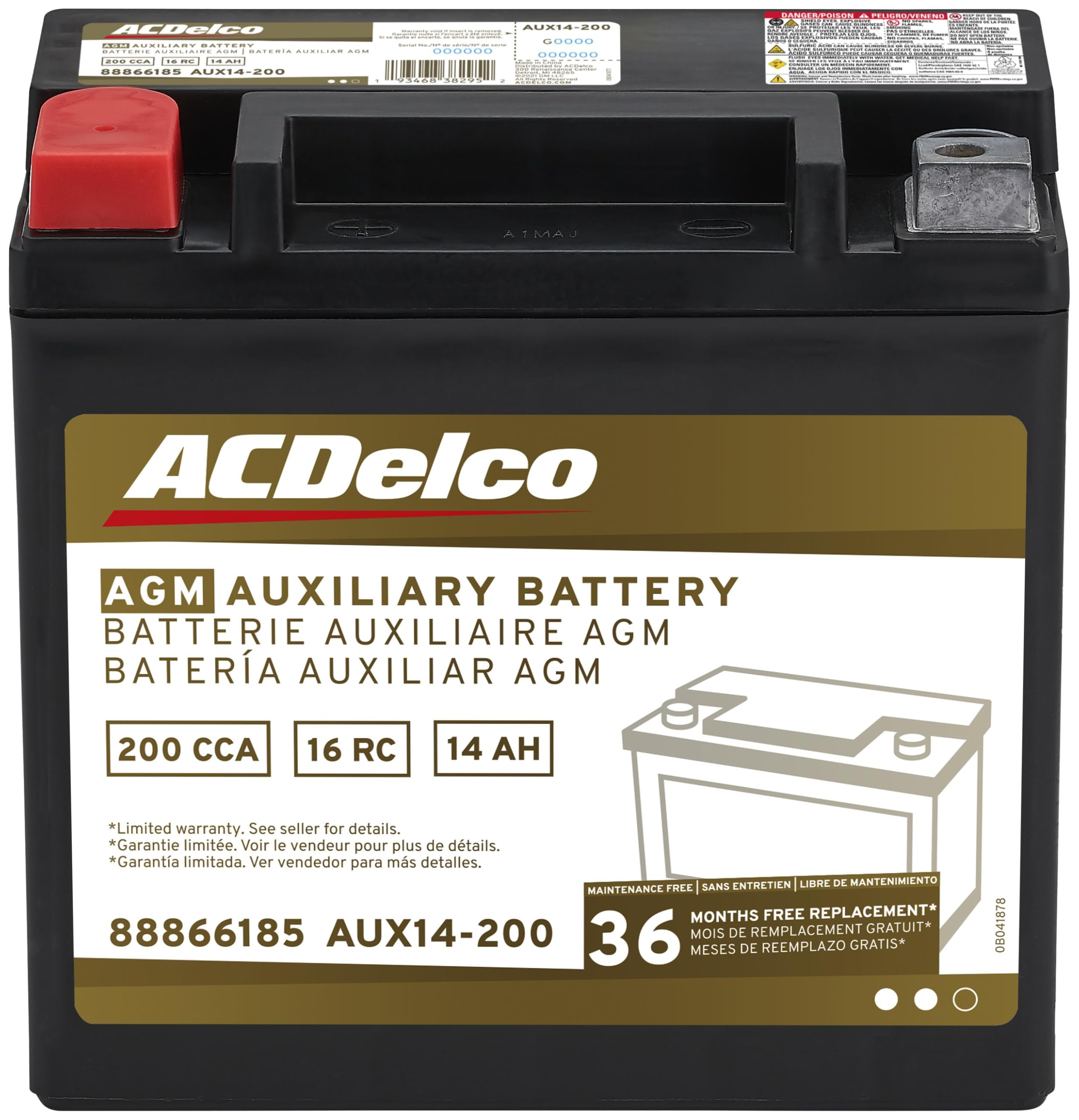
The ACDelco Gold AUX14-200 is a specialized auxiliary AGM battery designed for deep-cycle performance in dual-battery setups. With 200 CCA and a compact 3.4 x 5.9 x 5.7-inch footprint, this battery is intended to power accessories like winches, lighting, or audio systems while the main starting battery handles engine cranking. It is not suitable as a standalone starting battery for the Liberty’s V6.
ACDelco uses high-density plate oxide to maximize power-per-pound, and the pressurized valve system prevents acid dry-out and terminal damage. The brand’s reputation for quality is reinforced by a 36-month free replacement warranty. The battery is made to fit General Motors vehicles as well as most makes and models, making it a versatile addition to a custom auxiliary system.
This battery excels in applications where you need reliable power for extended accessory use without draining the main battery. For Liberty owners who frequently camp, overland, or run aftermarket electronics, the AUX14-200 provides a dedicated power source that isolates the starter battery from deep discharges.
What works
- Excellent for dual-battery accessory systems
- Compact size for tight mounting spaces
- Maintenance-free AGM design
What doesn’t
- Not a standalone starting battery
- Low CCA limits use to auxiliary role
9. Goodyear AUX12-AGM
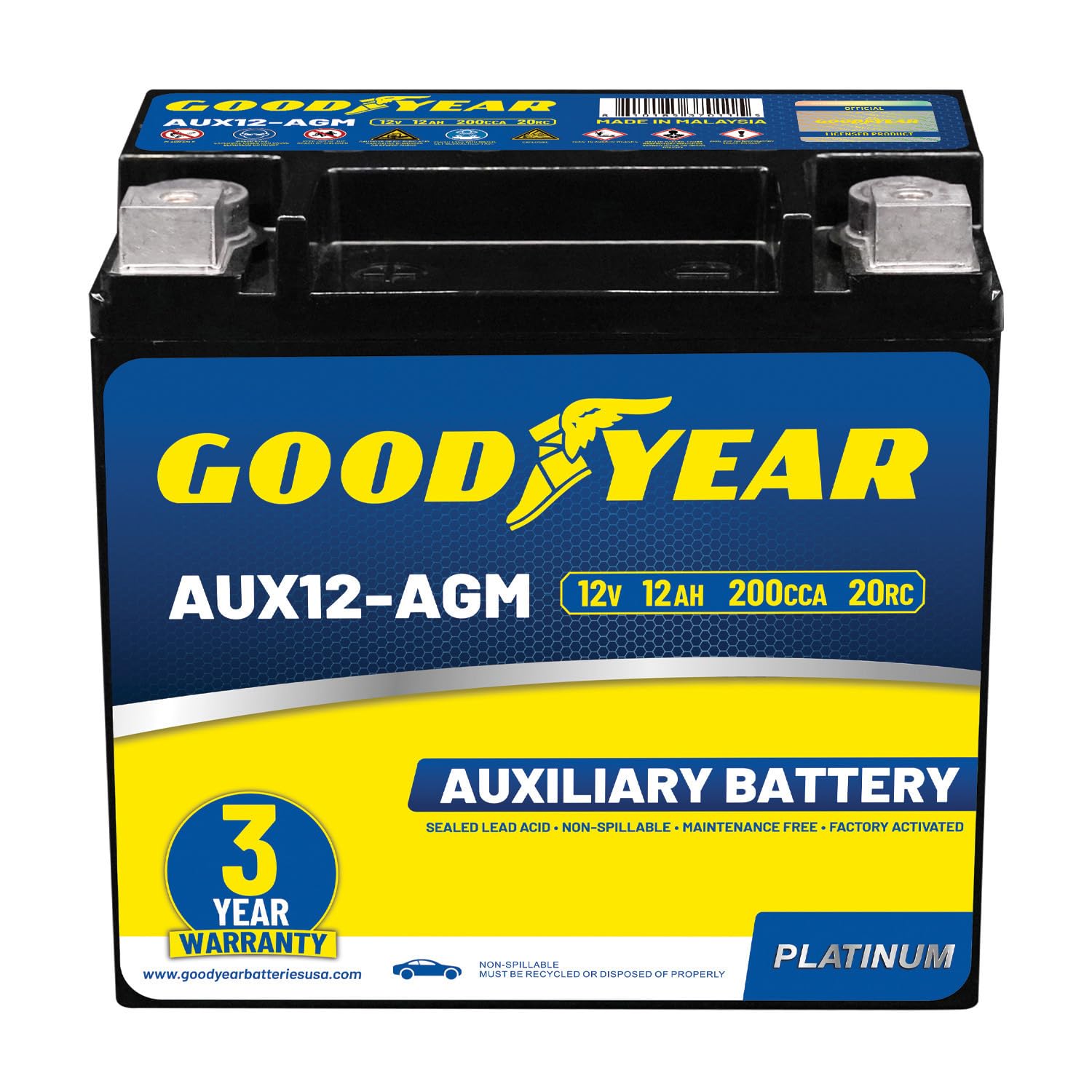
The Goodyear AUX12-AGM is an entry-level auxiliary battery offering 200 CCA and a 12 Ah capacity in a compact package measuring 5.87 x 3.37 x 5.62 inches. Like the ACDelco AUX14-200, this battery is intended for secondary power in dual-battery systems rather than as the Liberty’s primary starter. It is well-suited for powering small accessories, lighting, or electronics in a dedicated auxiliary bank.
Goodyear builds this battery with spill-proof AGM technology and claims it delivers up to twice the cycle life of conventional batteries. The 20-minute reserve capacity provides modest backup power for short-duration accessory use. The battery can be mounted in multiple positions (except upside down), offering flexibility when fitting it into tight engine bay spaces or under-seat compartments.
This battery is CE certified and built in an ISO-certified facility. Goodyear includes a 36-month warranty, which is generous for a battery at this price tier. Owners using it in ATV and small-vehicle applications report reliable performance, but for the Liberty, it should be considered strictly as an auxiliary unit.
What works
- Affordable entry point for auxiliary power
- Flexible mounting options
- 36-month warranty for peace of mind
What doesn’t
- Low capacity limits heavy accessory use
- Not a replacement for the primary starting battery
Hardware & Specs Guide
Cold Cranking Amps (CCA)
CCA measures a battery’s ability to start an engine at 0°F (-18°C). For a 2003 Jeep Liberty’s 3.7L V6, a CCA rating of 600 or higher is recommended for reliable starts in moderate climates. In severe winter regions, choose a battery with 700 CCA or more to maintain cranking speed when oil thickens and chemical reactions slow. Remember that CCA ratings are tested at a specific temperature, so real-world performance can vary based on battery age and charge state.
Reserve Capacity (RC)
Reserve capacity indicates how many minutes a battery can deliver 25 amps at 80°F before dropping below 10.5 volts. This matters for the Liberty if you run accessories with the engine off or if the alternator fails. A battery with 100 RC or higher provides a useful safety margin. Higher RC ratings also indicate thicker plates and generally longer overall battery life, as the battery can better handle deep discharges without damage.
AGM vs Flooded Technology
AGM (Absorbent Glass Mat) batteries hold electrolyte in fiberglass mats rather than free-flowing liquid. This makes them spill-proof, more vibration resistant, and capable of faster charging than flooded batteries. They also tolerate deep discharges better, which is beneficial if you frequently drain the battery with accessories. Flooded batteries are cheaper upfront but require periodic maintenance and are more vulnerable to damage from vibration and deep cycling.
Group Size and Terminal Orientation
The BCI group size defines a battery’s physical dimensions, terminal type, and terminal location. The 2003 Jeep Liberty commonly uses Group 47 (H5), Group 48 (H6), or Group 94R. Terminal orientation is critical—the Liberty requires left negative and right positive. Always measure your existing battery compartment and compare dimensions, including height, because a battery that is too tall can short against the hood or hold-down bracket.
FAQ
What battery group size does a 2003 Jeep Liberty use?
Can I install an AGM battery in my 2003 Jeep Liberty?
How many cold cranking amps do I need for a Jeep Liberty 3.7L V6?
Can I use a larger battery than the factory group size?
How long does a Liberty battery usually last?
Final Thoughts: The Verdict
For most buyers, the 2003 jeep liberty battery winner is the Weize Platinum AGM Group 94R because it delivers an outstanding 850 CCA and 140 RC at a competitive price, ensuring reliable starts and ample accessory power for years to come. If you need a compact option that still offers premium AGM performance, the Weize Platinum AGM Group 35 is a strong alternative. And for a solid balance of performance and value, the Relistart Group 47 AGM provides excellent reliability without stretching the budget.

Certification: BSc in Mechanical Engineering
Education: Mechanical engineer
Lives In: 539 W Commerce St, Dallas, TX 75208, USA
Md Amir is an auto mechanic student and writer with over half a decade of experience in the automotive field. He has worked with top automotive brands such as Lexus, Quantum, and also owns two automotive blogs autocarneed.com and taxiwiz.com.