A 16mm wrench sits in almost every automotive job — brake caliper brackets, suspension links, belt tensioners, and driveline bolts all torque to that size. The difference between fighting a fastener for twenty minutes and clicking it off in seconds comes down to ratcheting mechanism quality, jaw design, and handle length. This guide breaks down five real contenders so you know exactly which one belongs in your box.
I’m Amir — the founder and writer behind Four Wheel Ask. I’ve spent years analyzing owner-reported durability data, comparing build specs across brands, and studying how ratchet tooth counts, jaw geometries, and steel grades actually hold up under repeated use so you don’t have to guess.
Finding the best 16mm wrench means evaluating ratchet smoothness, bolt protection, and handle reach for your specific jobs.
How To Choose The Best 16mm Wrench
Not every 16mm wrench delivers the same experience on a stubborn fastener. Understanding three core factors — ratcheting mechanism, jaw geometry, and handle design — will steer you toward the tool that matches your actual work.
Ratcheting Tooth Count & Swing Arc
Tooth count directly determines how much you must rotate the wrench before it re-engages. A 72-tooth ratchet requires a 5-degree swing arc, while a 90-tooth ratchet drops that to 4 degrees. In tight areas like alternator brackets or strut tower bolts, those few degrees mean the difference between one fluid motion and repeatedly bumping into obstructions. Higher tooth counts also typically produce smoother engagement with less backdrag, reducing hand fatigue during repetitive work.
Bolt Grip & Rounded Fastener Prevention
Standard parallel jaw open ends grip only the flats of a fastener, which invites rounding when corrosion or high torque is present. Wrenches with off-corner loading or WaveDrive geometry contact the fastener closer to the corners rather than the flats, distributing force more evenly and reducing slip. Some designs double as bolt extractors, biting into bolts that are already partially rounded — a feature worth having if you frequently work on older, rust-prone vehicles.
Head Style & Handle Length
Fixed ratcheting box ends provide maximum strength and a compact profile, but flex head wrenches add the ability to pivot around obstacles without removing the tool. A flex head is invaluable for jobs like serpentine belt tensioners or intake manifold bolts where direct access is blocked. Handle length affects both leverage and clearance: longer handles deliver higher torque with less effort but may not fit into cramped engine bays, while shorter wrenches trade leverage for maneuverability in tight spaces.
Quick Comparison
On smaller screens, swipe sideways to see the full table.
| Model | Category | Best For | Key Spec | Amazon |
|---|---|---|---|---|
| TEKTON WRC23416 | Ratcheting | All-around daily use | 72-tooth, reversible, satin chrome | Amazon |
| GEARWRENCH 86716 | Flex Head | Hard-to-reach fasteners | 90-tooth, flex head, off-corner loading | Amazon |
| Capri Tools CP11750-M16XT | Bolt Extractor | Rounded or seized bolts | WaveDrive Pro, 40% longer handle | Amazon |
| TEKTON WRB35416 | Box End | Deep clearance & leverage | 12.7″ length, fixed/flex head, 12-point | Amazon |
| CRAFTSMAN CMMT39238 | Standard | Budget-friendly backup | 72-tooth, chrome finish, ASME rated | Amazon |
In‑Depth Reviews
1. TEKTON 16mm Reversible 12-Point Ratcheting Combination Wrench | WRC23416
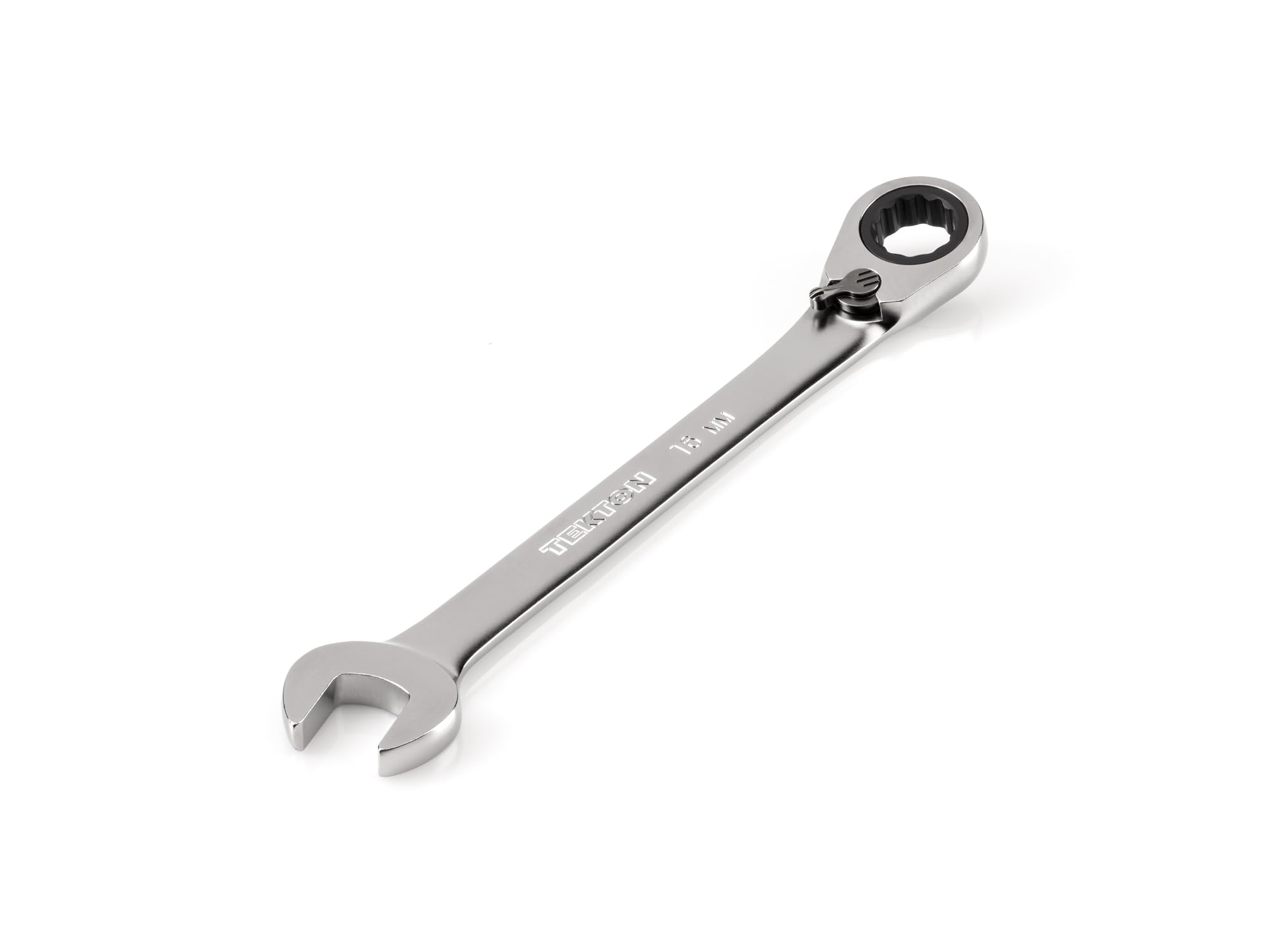
The TEKTON WRC23416 earns the top spot by combining a smooth 72-tooth ratcheting mechanism with a reversible drive switch — a feature rarely seen at this level of build quality. The 15-degree offset on the box end provides knuckle clearance without forcing your hand into an awkward angle, and the satin nickel finish resists corrosion better than high-gloss chrome that chips over time. Owner reports consistently praise the lever-style reverse as a practical upgrade over push-slider designs, especially when backing out nuts in tight quarters where switching direction matters mid-turn.
Beyond the ratchet, the open-end jaw is stamped cleanly and sized accurately — no slop on 16mm hex heads. The 12-point box end accommodates 6-point, 12-point, and square fasteners, which broadens its utility beyond standard bolts to include things like brake line fittings and certain suspension components. The 0.36-pound weight keeps it light enough for pocket carry during a multi-job session, and the permanently stamped markings on both sides make identification instant even in dim light.
Where this wrench really separates itself is the value proposition: you get a reversible ratchet, precise fit, and a no-time-limit warranty at a price that undercuts many non-reversible competitors. Owner feedback from driveline work on WJ Jeep Grand Cherokees and general maintenance confirms the build holds up under real torque loads without skipping or jamming.
What works
- Reversible lever is intuitive and reliable in tight spaces
- Satin nickel finish resists rust and looks professional
- Lifetime warranty with no receipt required
What doesn’t
- Not a flex head, so angled access is limited
- Some users prefer push-slider over lever reverse
2. GEARWRENCH 16mm 4 Degree Swing Arch 12 Point Flex Head Ratcheting Combination Wrench | 86716

The GEARWRENCH 86716 brings a 90-tooth ratchet with a 4-degree swing arc to a flex head platform, making it one of the most versatile 16mm wrenches for confined engine bay work. The flex head pivots smoothly without detents, allowing you to dial in exactly the angle needed when working around intake runners, alternator housings, or strut towers. The off-corner loading design on both the box end and open end actively reduces fastener rounding by contacting the bolt closer to the corners, which distributes torque more evenly than conventional jaw profiles.
Build quality aligns with GEARWRENCH’s reputation: the polished chrome finish is smooth and easy to wipe clean, the ratchet engagement feels crisp with minimal backdrag, and the overall weight is kept low despite the added complexity of a flex joint. Owner reports highlight its usefulness on Ford 5.4 oil pump jobs where the flex head allows access without dropping the pan, and on Civic water pump pulleys where clearance is measured in millimeters. The slim beam profile also helps in slots and brackets where a bulkier wrench simply won’t fit.
At this price point, you are paying for the tight swing arc, flex capability, and anti-rounding geometry in one package. For anyone who regularly works on modern vehicles with crowded engine compartments, the combination of features justifies the investment — especially when it eliminates the need to buy a separate flex head and a standard ratcheting wrench.
What works
- 90-tooth ratchet requires minimal swing angle
- Flex head pivots for obstructed fastener access
- Off-corner loading reduces bolt rounding on both ends
What doesn’t
- Higher cost than fixed-head alternatives
- Flex joint adds slight bulk at the head
3. Capri Tools 16mm WaveDrive Pro Combination Wrench
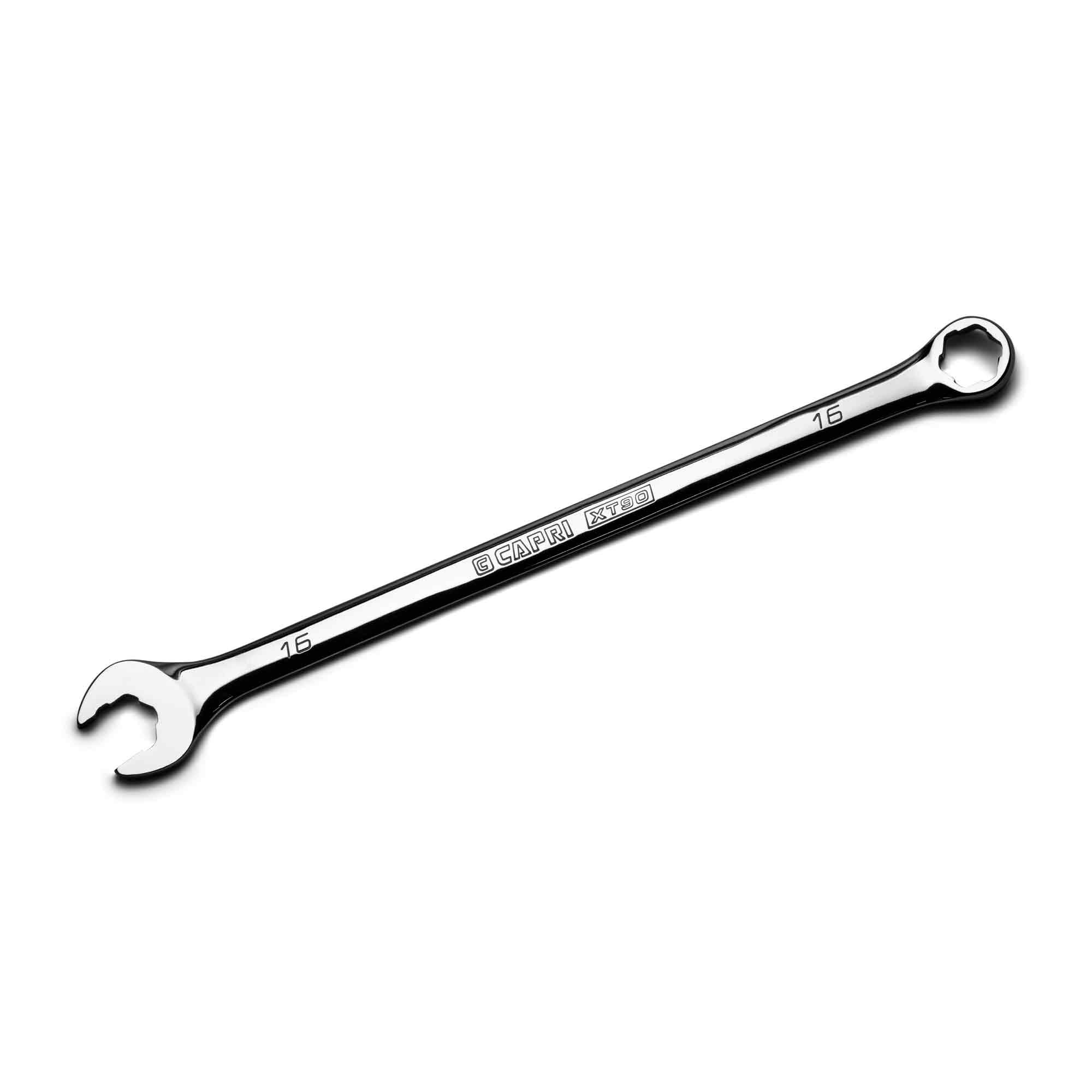
The Capri Tools WaveDrive Pro stands out because it is engineered specifically to handle bolts that are already compromised. The WaveDrive geometry on the open end uses a three-point contact pattern that grips the fastener closer to the corners rather than the flats, while the box end employs a six-point wave pattern that can extract bolts up to 90 percent rounded. This makes it a legitimate first-rescue tool before reaching for a dedicated bolt extractor or grinder, especially on corroded underbody hardware found on older vehicles.
Beyond the extraction capability, the handle is up to 40 percent longer than a standard combination wrench of the same size, providing noticeably more leverage for breaking loose stubborn fasteners. The chrome molybdenum steel construction with MaxChrome plating delivers corrosion resistance that holds up in wet or salty environments. Owner feedback from Xterra front driveshaft replacements and Civic water pump pulley jobs confirms that the 15-degree offset box end provides the clearance needed to avoid subframe removal, and the wave pattern grabs securely without slipping even when the fastener surface is compromised.
What makes this a value pick is that you get bolt extractor functionality without paying extractor-specific pricing, plus the leverage advantage of a longer handle. For the home mechanic who encounters rusted suspension bolts or rounded drain plugs regularly, the WaveDrive Pro addresses a genuine pain point that standard wrenches simply ignore.
What works
- WaveDrive grips rounded bolts up to 90 percent worn
- Extra-long handle provides superior leverage
- Chrome molybdenum steel offers high durability
What doesn’t
- Longer handle may not fit in very tight spaces
- Wave pattern can mark soft fasteners
4. TEKTON 16mm Long Fixed/Flex Head 12-Point Ratcheting Box End Wrench | WRB35416
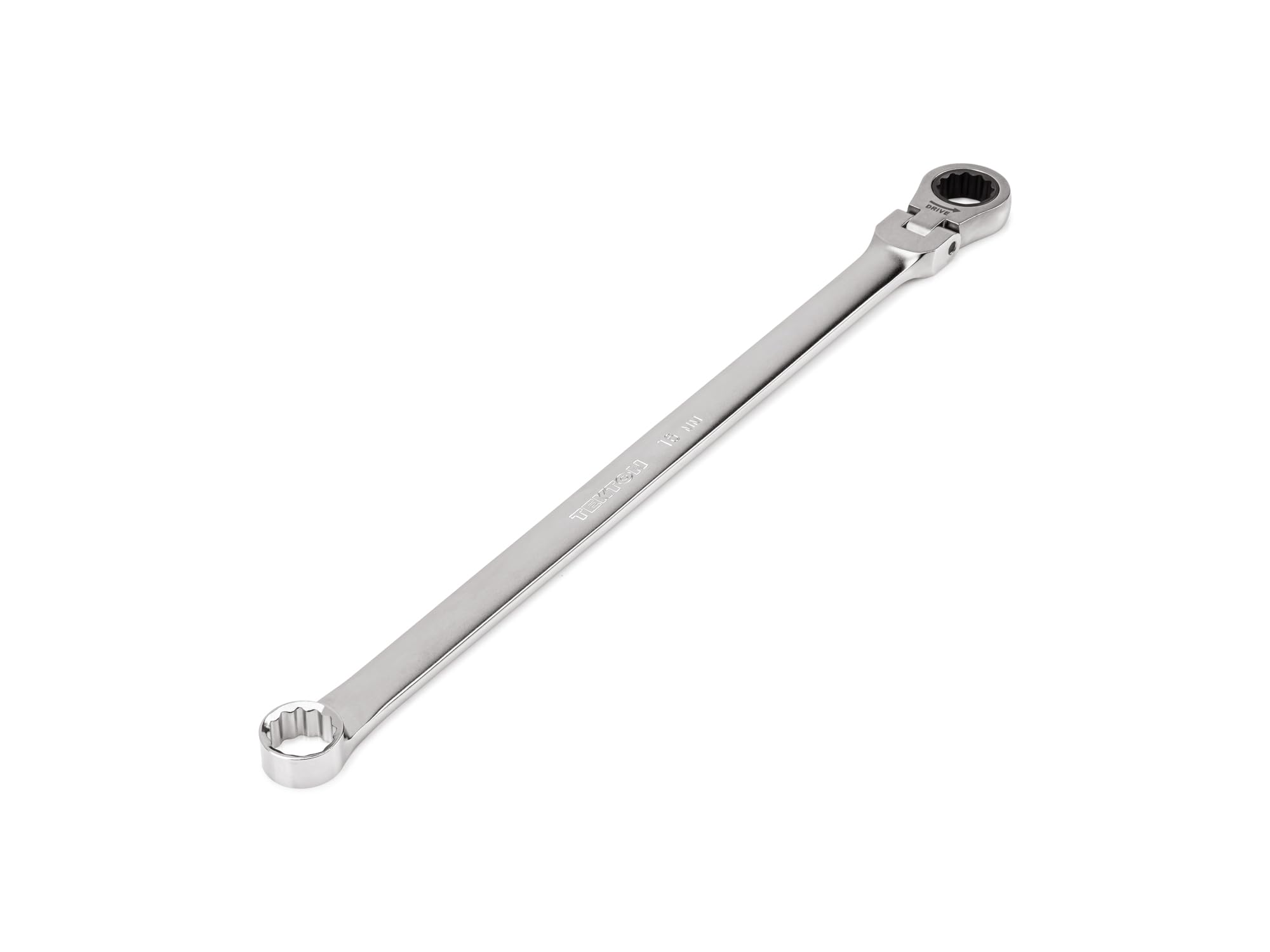
The TEKTON WRB35416 takes a specialized approach: both ends are the same 16mm size, but one side is a raised fixed head while the other is a ratcheting flex head. This dual-head layout is designed for jobs where you need to apply torque from two positions without constantly flipping the tool. The fixed head provides a flush contact surface for maximum engagement with the fastener, while the raised side offers finger clearance in recessed areas. The flex head sweeps through 180 degrees with no detents, allowing continuous adjustment around obstacles like intake manifolds or frame rails.
At 12.7 inches long, this is the longest wrench in the lineup, delivering substantial leverage for breaking loose torque-heavy fasteners. The 12-point ratcheting box end engages quickly and the 6140 Cr-V steel is heat-treated to 42–49 HRC for hardness without brittleness. The satin chrome finish provides a tactile grip that resists slipping even with oily hands, and the laser-etched markings remain legible after repeated solvent exposure. Owner reports from Harley intake manifold work and Nissan Rogue serpentine belt tensioner jobs confirm the narrow beam profile fits slots where standard wrenches bind.
This wrench is purpose-built for scenarios where reach and clearance are the primary constraints. The lack of an open end means it won’t replace a combination wrench for everyday use, but for specific tasks like belt tensioner adjustments or deep-set bolts on unibody vehicles, the length and flex head combination outperforms anything shorter.
What works
- Extra-long handle delivers serious leverage
- Flex head sweeps 180 degrees for tight access
- Narrow beam fits into confined slots
What doesn’t
- No open end for speed loosening
- Not reversible; one ratchet direction only
5. CRAFTSMAN Ratcheting Wrench, Metric, 16mm, 72-Tooth, 12-Point | CMMT39238

The CRAFTSMAN CMMT39238 represents the modern iteration of a classic nameplate: a functional 72-tooth ratcheting wrench with a chrome finish and ASME certification at a straightforward price. The 12-point box end provides quick engagement with 6-point and 12-point fasteners, and the 15-degree offset offers basic knuckle clearance for typical engine bay and underbody work. The large size markings printed on both sides are easy to read at a glance, which matters when you are reaching across an engine bay without seeing the tool directly.
Owner feedback indicates that while the wrench functions reliably, the build differs from vintage Craftsman USA tools — the overall length is shorter than older equivalents with the same part number, and the beam profile is slightly slimmer. This does not affect the tool’s ability to turn fasteners, but users replacing a lost wrench from a legacy set should verify length compatibility. The chrome finish holds up well against occasional solvent exposure and wipes clean easily, and the warranty replacement process remains straightforward through Craftsman’s current support channels.
For someone looking for a functional 16mm ratcheting wrench without needing premium features like flex heads or bolt extraction, this covers the basics competently. The price point keeps it accessible, and the ASME rating provides a baseline confidence in torque capacity. It is best suited as a backup or for light-to-moderate use where the more specialized tools in this guide would be overkill.
What works
- ASME certified for baseline strength assurance
- Chrome finish resists corrosion and cleans easily
- Warranty support is straightforward
What doesn’t
- Shorter handle length limits leverage
- Build differs from legacy Craftsman USA tools
Hardware & Specs Guide
Ratcheting Mechanism & Tooth Count
The ratcheting mechanism determines how smoothly and quickly you can turn a fastener without lifting the tool. A 72-tooth ratchet requires a 5-degree swing arc to engage the next tooth, while a 90-tooth ratchet reduces that to 4 degrees. In practice, this matters most when working in spaces where the wrench can only move a few degrees before hitting an obstruction — alternator brackets, strut tower bolts, and suspension pivot points are common examples. Higher tooth counts also tend to produce smoother engagement with less slack before the pawl catches, which translates to less hand fatigue during repetitive loosening or tightening cycles. Both 72-tooth and 90-tooth mechanisms are durable enough for general automotive use, but the finer-tooth designs offer a tangible advantage in confined areas.
Bolt Grip & Rounded Fastener Technology
Standard parallel-jaw open ends grip the flats of a fastener, which concentrates force in the middle of each face and can cause rounding when corrosion or high torque is present. Wrenches with WaveDrive or off-corner loading geometry shift the contact point toward the corners of the fastener, distributing force more evenly and reducing the risk of deformation. Some designs, such as the Capri Tools WaveDrive Pro, are engineered to bite into bolts that are already up to 90 percent rounded, functioning as a bolt extractor without requiring a separate tool. This technology is particularly valuable on older vehicles where underbody fasteners have years of road salt exposure, or on aluminum components where soft material is prone to stripping.
FAQ
What is the difference between 72-tooth and 90-tooth ratcheting wrenches?
Can a 16mm wrench remove rounded bolts?
Is a flex head wrench better than a fixed ratcheting wrench?
Final Thoughts: The Verdict
For most buyers, the best 16mm wrench winner is the TEKTON WRC23416 because it delivers a smooth reversible ratchet, precise fit, and a lifetime warranty at a mid-range price that outperforms its cost suggests. If you need bolt extraction capability and extra leverage, grab the Capri Tools WaveDrive Pro. And for tight engine bay access where every degree of swing counts, nothing beats the GEARWRENCH 86716 with its 90-tooth flex head design.

Certification: BSc in Mechanical Engineering
Education: Mechanical engineer
Lives In: 539 W Commerce St, Dallas, TX 75208, USA
Md Amir is an auto mechanic student and writer with over half a decade of experience in the automotive field. He has worked with top automotive brands such as Lexus, Quantum, and also owns two automotive blogs autocarneed.com and taxiwiz.com.