A mismatched thread or a poorly seated seal on a refrigerant tank turns a straightforward recharge into a frustrating mess of hissing gas and wasted time. Getting the right fitting between your cylinder and service hose is the difference between a clean job and a lost charge.
I’m Amir — the founder and writer behind Four Wheel Ask. I’ve spent years analyzing product specifications, manufacturing tolerances, and owner-reported failure modes across hundreds of HVAC service components to separate what lasts from what leaks.
After cross-referencing thread compatibility, seal design, and real-world feedback from technicians and DIYers, this lineup represents the most dependable options available today for the best 134a tank adapter across every use case and budget level.
How To Choose The Best 134A Tank Adapter
Selecting the right adapter comes down to thread pitch, seal method, and intended use frequency. A cheap mismatch can cost you a full tank of refrigerant or worse — introduce moisture into the system. Understanding the three key factors below will help you match the adapter to the job.
Thread Type and Size Compatibility
The two most common thread interfaces are 1/4-inch SAE flare for manifold hoses and 1/2-inch ACME for tank valves. Many adapters combine both, but some are dedicated to one side. Always verify that the adapter matches both your tank valve and your hose fitting — forcing mismatched threads damages both components and creates leak paths.
Material and Seal Construction
Machined brass offers the best balance of corrosion resistance, thread strength, and sealing reliability. Aluminum is lighter but more prone to galling. The seal itself matters just as much — look for integrated O-rings or gaskets rather than relying solely on flare-to-flare contact. Some adapters include valve core depressors, which allow you to purge air from the hose before opening the tank.
Application-Specific Features
If you work with multiple refrigerant types, an adapter that bridges R12, R134a, and even R1234YF ports saves time and money. Quick-coupler versions with ball-lock designs offer tool-free attachment, while traditional threaded adapters provide a more permanent seal. Consider whether you need a low-side-only adapter or a set covering both high and low pressure ports.
Quick Comparison
On smaller screens, swipe sideways to see the full table.
| Model | Category | Best For | Key Spec | Amazon |
|---|---|---|---|---|
| Aupoko R12/R22 to R134a Adapter Kit | Mid-Range | Multi-refrigerant bridging | 3-piece kit, brass, 1/4″ male to 1/2″ female + 1/4″ SAE female x 1/2″ ACME male | Amazon |
| Ketofa 134a Quick Coupler | Mid-Range | Quick-connect convenience | 2-piece set, brass, 1/4″ SAE male, color-coded knobs | Amazon |
| SURIEEN AC Charge Hose with Gauge | Mid-Range | All-in-one recharge kit | 15″ hose, 250 PSI gauge, 13mm low side coupler, piercing can tap | Amazon |
| Belleone R134a Recharge Kit | Mid-Range | Longer hose reach | 19″ hose, 350 PSI gauge, brass/metal construction, self-sealing can compatible | Amazon |
| Robinair 16301 Low Side Tank Adapter | Premium | Professional low-side connection | 1/2″ ACME female x low-side R-134a male, brass, knurled grip, USA made | Amazon |
| Orion Motor Tech R134a Quick Coupler Adapters | Premium | Durable quick-coupler set | 2-piece set, aluminum/nickel-plated bronze, 5/6-ball lock, 1/4″ flare | Amazon |
| OEMTOOLS 24554 Refrigerant Tank Adapter | Premium | Recovery machine hookup | Male low side R134a to female 1/2″ ACME, no valve core, lightweight | Amazon |
| gohantee R134a Recharge Hose Kit | Premium | Extended reach recharge | 51″ hose, 200 PSI gauge, self-sealing can tap, copper/rubber construction | Amazon |
| Boltigen R1234YF to R134a Adapter | Premium | Cross-system compatibility | 2-piece set, brass, 14mm/17mm female x 1/4″ SAE male, ball lock | Amazon |
| Robinair 10102 Side Can Tap | Premium | Can piercing and sealing | R12 and R134a compatible, plastic/metal hinge, Schrader valves, hinged can adapters | Amazon |
| Lichamp HVAC Manifold Gauge Set | Premium | Professional-grade complete system | 4-valve gauge, 4x 5FT hoses, R134A/R22/R32/R410A compatible, includes tank adapters | Amazon |
In-Depth Reviews
1. Robinair 16301 Low Side Tank Adapter

The Robinair 16301 is the adapter that seasoned technicians reach for when they need a guaranteed seal on a 30-pound retail cylinder. Its 1/2-inch ACME female thread connects to the tank valve, while the low-side R-134a male coupler mates directly to the service hose — no guesswork, no adapters stacked on adapters. The deeply knurled base provides confident grip even with oily gloves, and the all-brass construction resists the corrosion that plagues plated steel fittings after a few seasons of use.
Owner feedback consistently highlights how this adapter screws onto the tank with buttery-smooth threads and seals immediately without over-torquing. Multiple users report using it to fully evacuate cylinders before scrapping them, which requires a reliable seal at both ends. The simple design eliminates potential failure points — there are no moving parts, no valve cores to wear out, just a solid brass body machined to tight tolerances. Being made in the USA also means consistent quality control that aftermarket brands often lack.
This adapter does not include a valve core or valve core depressor, so it is strictly a pass-through fitting. That is fine for most recovery and recharge tasks, but if you need to purge hoses or control flow, you will need to add those components separately. The absence also keeps the price reasonable for what is essentially a precision-machined brass connector built to professional standards.
What works
- Machined from solid brass with excellent thread fitment
- Knurled grip allows hand-tightening without tools
- Made in the USA with consistent quality
What doesn’t
- No valve core or depressor included
- Limited to low-side R-134a applications only
2. OEMTOOLS 24554 Refrigerant Tank Adapter

The OEMTOOLS 24554 is designed specifically for the recovery side of the job — connecting an R-134a tank to a recovery machine. Its male low-side R-134a fitting threads into the female 1/2-inch ACME tank valve, creating a direct path for reclaiming refrigerant without extra adapters in the chain. Weighing just over half an ounce, this adapter adds negligible bulk to a tool kit, and its compact profile means it fits into tight spaces around the tank valve area.
Field reports from technicians confirm that this adapter screws onto 30-pound cylinders smoothly and creates a leak-free seal immediately. Several users specifically mention using it as a workaround when their recovery machine’s dedicated refill port failed — they simply ran the hose through the low-pressure port using this adapter and completed the job. The brass construction holds up well to repeated connect-disconnect cycles, and the lack of a valve core means there is one fewer component that can stick or leak over time.
This adapter is intended strictly as a pass-through fitting — it does not have a valve core or valve core depressor. That makes it unsuitable for applications where you need to control refrigerant flow or purge air from the hose. It is also sized specifically for R-134a low-side ports, so it will not work directly with R12 or R1234YF systems without additional adapters.
What works
- Extremely lightweight at under an ounce
- Direct fit for recovery machine hookup
- Solid brass build with consistent thread quality
What doesn’t
- No valve core or depressor for flow control
- Limited to low-side R-134a applications
3. Robinair 10102 Side Can Tap

The Robinair 10102 is not a simple adapter — it is a full can tap designed to pierce and seal refrigerant cans for both R12 and R134a systems. The built-in hinged adapters accommodate multiple can sizes, including the small oil charge cans, which eliminates the need for separate piercing tools. The Schrader valves on both fittings prevent refrigerant loss when disconnecting and allow partially used cans to be stored without leaking.
Long-term users consistently report this tap surviving fifty or more cycles without developing leaks. The combination of rigid plastic body and metal hinge pin provides enough durability for regular shop use while keeping the weight low. The squeeze-to-crack design gives precise control over refrigerant flow, and the seal integrity is notably better than aftermarket lookalikes that often fail after a few uses. Robinair’s reputation in the HVAC service world is earned through decades of consistent manufacturing, and this can tap reflects that engineering maturity.
The plastic body, while durable, can feel slightly less substantial than all-metal alternatives. Some users note that the alignment needs to be precise when clamping onto the can — rushing the process can lead to a poor seal. It is also designed primarily for side-mount can valves, so it will not work with every can style on the market without modification.
What works
- Durable construction with metal hinge pin
- Integral Schrader valves prevent leakage
- Works with multiple can sizes including oil cans
What doesn’t
- Plastic body may feel less robust than metal
- Requires precise alignment for proper seal
4. Boltigen R1234YF to R134a Adapter

The Boltigen adapter set bridges the gap between older R134a service equipment and newer R1234YF systems, with separate couplers for high and low side ports. The low side coupler uses a 14mm female port that connects to the 1/4-inch SAE male on your manifold, while the high side uses a 17mm female port. This allows a standard R134a gauge set to service vehicles that have been converted to or originally use R1234YF refrigerant — a growing need as more late-model cars hit the DIY market.
Users who have applied these adapters to inject UV dye or pull vacuum on 1234YF systems report that they hold vacuum without leaks and the ball-lock mechanism engages positively. The brass construction provides the necessary durability for repeated use, and the automatic closing function prevents refrigerant loss when disconnecting. The kit essentially future-proofs an existing R134a manifold for use on newer vehicles without requiring a complete gauge set upgrade.
These adapters add length to the connection, which can make them difficult to fit in tight engine bay locations. Some users also note that the locking mechanism does not always feel as positive as OEM equipment — the adapter may seem like it is not fully engaged even when it is. They are designed for adapting equipment, not for mixing refrigerants — using R134a in a 1234YF system requires different pressure tables and is not recommended.
What works
- Enables R134a gauges on 1234YF systems
- Brass construction with ball-lock sealing
- Automatic closing prevents refrigerant loss
What doesn’t
- Added length creates tight-fit challenges
- Locking feel may not match OEM precision
5. Aupoko R12 R22 to R134a Adapter Kit

The Aupoko kit bundles three essential adapters for bridging R12, R22, and R134a systems: a 1/4-inch male to 1/2-inch female, a 1/4-inch SAE female to 1/2-inch ACME male, and a valve core remover. This coverage makes it a practical starting point for anyone working with older R12 systems that need conversion to R134a service ports. The brass construction across all pieces provides consistent corrosion resistance and thread strength.
Owner experiences are generally positive, with multiple users confirming that the fittings thread smoothly and seal as expected. The valve core remover adds functionality that standalone adapters lack, allowing you to service Schrader valves without a separate tool. For the price point, the build quality is respectable — the brass has good heft and the threads are cleanly cut. Several users mention that these adapters saved them a trip to the supply house, where similar fittings would have cost significantly more.
Some quality control issues appear in the feedback — a few units arrived with rough flare cone finishes or sharp edges on the ACME threads that required stoning before sealing. The included seals can also have brass speckles embedded, which may compromise the seal on the first installation. These are not universal problems, but they suggest batch-to-batch variation that makes inspection upon arrival important.
What works
- Comprehensive 3-piece set covers multiple thread types
- Brass construction offers good corrosion resistance
- Includes valve core remover for added utility
What doesn’t
- Inconsistent thread finishing on some units
- Seals may require cleaning before first use
6. Ketofa 134a Quick Coupler Set
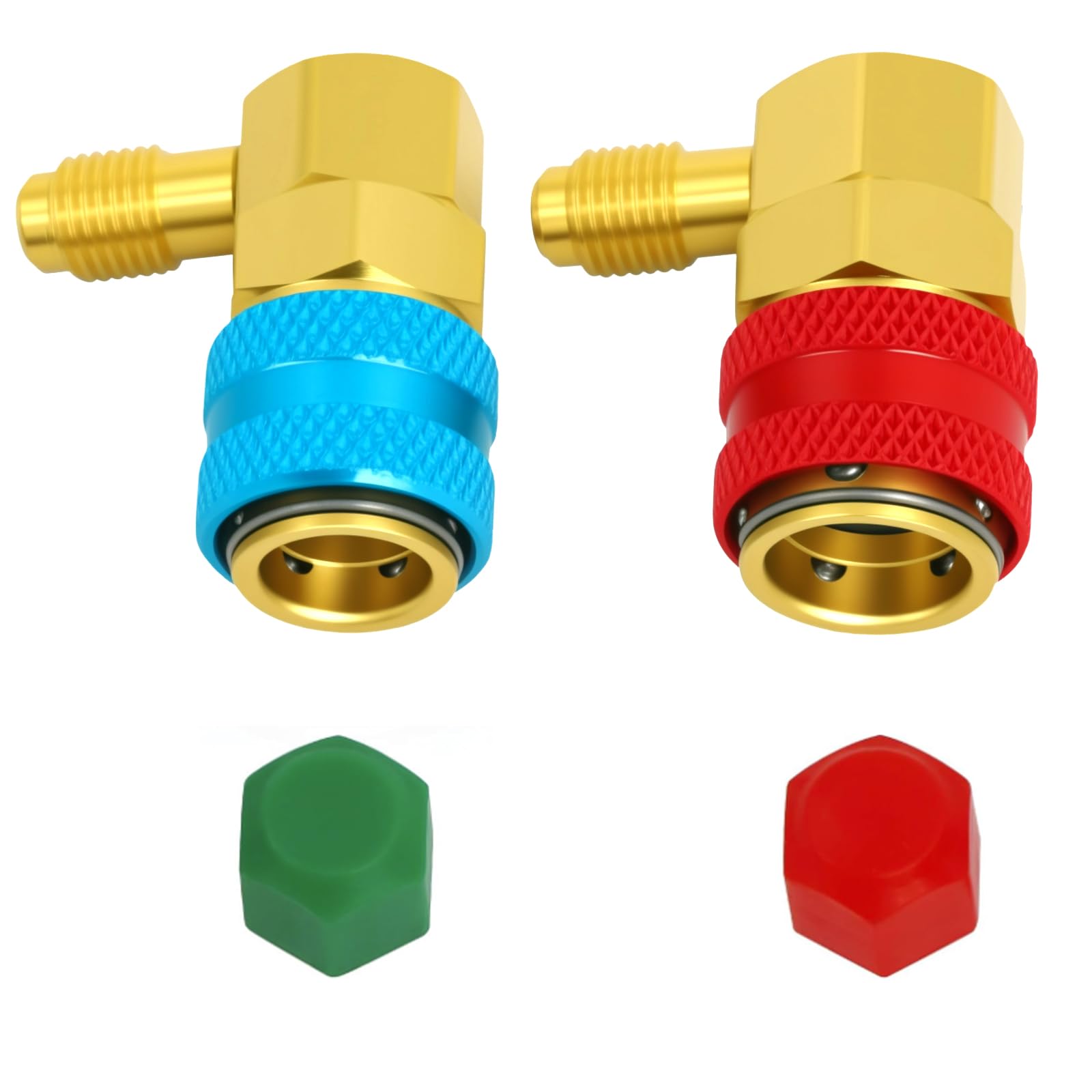
The Ketofa quick coupler set provides two adapters — one for high pressure and one for low pressure — with color-coded knobs for instant identification. The 1/4-inch SAE male fitting connects directly to standard manifold hoses, while the quick-couple end latches onto vehicle service ports without threading. The 90-degree angle on these couplers is a practical advantage when working in cramped engine bays where a straight connector would not fit.
Users consistently praise these adapters for solving fitment issues on older vehicles. Mechanics working on GM models from the mid-2000s report that the 90-degree design is essential for accessing the low-side port buried under the windshield cowl. The brass construction holds up well to repeated use, and the quick-connect mechanism engages positively with an audible click. Several reviewers note that these couplers saved them from having to buy specialized hoses for specific vehicle models.
The high-side port can sometimes feel stiff to engage initially. If the coupler does not lock immediately, pressing down manually on the terminal helps seat the internal mechanism. Some users also mention that the adapters are slightly bulky, which can be an issue in extremely tight spaces where every millimeter counts.
What works
- 90-degree design solves tight-access issues
- Color-coded knobs prevent port confusion
- Brass construction with positive locking action
What doesn’t
- High-side port may need manual seating
- Bulkier than straight-thread adapters
7. Orion Motor Tech R134a Quick Coupler Adapters

The Orion Motor Tech set uses a 5-ball and 6-ball locking design that provides superior resistance to accidental disconnection compared to standard 2-ball couplers. The body is machined from aluminum with nickel-plated bronze threading, offering a balance of light weight and corrosion resistance. The 1/4-inch male flare fittings are compatible with standard manifold hoses, and the snap-lock mechanism engages with a satisfying click that confirms proper connection.
Experienced users highlight how these couplers eliminate the annoying “pop-off” problem common with cheaper quick-connect fittings. The manual shutoff valves on each coupler allow you to control refrigerant flow before disconnecting, minimizing gas loss. The O-rings are standard sizes that are readily available for replacement, extending the service life of the adapters. Several technicians report that the color-coded design (red for high, blue for low) prevents cross-connection errors even in low-light conditions under the hood.
The direction arrows on the shutoff valves are reversed on some units — counterclockwise closes the port and clockwise opens it, which is the opposite of what most users expect. This does not affect function but requires a mental adjustment during use. The included flare adapters may not bottom out completely on all hoses, sometimes requiring the O-rings from the couplers themselves to create a proper seal.
What works
- 5/6-ball lock design resists accidental disconnection
- Nickel-plated bronze threading resists corrosion
- Standard O-rings available for replacement
What doesn’t
- Valve direction arrows may be reversed
- Flare adapters may not seat fully on all hoses
8. SURIEEN AC Charge Hose with Gauge

The SURIEEN kit bundles a piercing can tap, a 15-inch recharge hose, a 250 PSI gauge, and a low-side quick coupler into a single package. The piercing tap uses an internal pin to puncture self-sealing R134a cans, while the 1/2-inch ACME thread connects to standard refrigerant bottles. The gauge provides pressure readings in PSI with a maximum rating of 250 PSI, sufficient for residential and light automotive AC work.
DIY users report that this kit works well for topping off R134a systems on vehicles from the mid-2000s. The gauge helps prevent overcharging, which is the most common mistake made by weekend mechanics. The quick coupler attaches to the low-side service port with a push-and-lock action that is easier to operate than threaded fittings in tight spaces. Several owners mention that watching a few YouTube tutorials specific to their vehicle model made the process straightforward.
The hose length is notably short — approximately 15 inches — which may not reach the low-side port on some vehicles. Several users report the hose being only 6 inches long in practice, making it unusable for deep-access ports. The build quality also varies; some units arrived with the gauge needle not zeroed, requiring adjustment through the lid opening. The piercing mechanism can also be inconsistent, with some users experiencing difficulty getting a clean puncture.
What works
- All-in-one kit includes everything needed for recharge
- Gauge helps prevent overcharging
- Push-lock coupler is easy to operate
What doesn’t
- Hose is too short for many vehicle applications
- Gauge may need calibration before first use
9. Belleone R134a Recharge Kit

The Belleone kit improves on the basic recharge hose concept with a longer 19-inch hose and a gauge that displays scales for three refrigerant types: R134a, R12, and R22. The all-metal construction of the adapter fittings and the rubber hose body provide better durability than plastic alternatives. The kit works with both piercing cans and self-sealing cans, adding flexibility for different refrigerant sources.
Users note that the longer hose makes a meaningful difference in reach compared to budget kits. The gauge is considered easy to read, with clear markings that help identify proper pressure ranges for different refrigerants. Multiple reviewers report successfully using this kit on several different vehicles over multiple seasons. The internal gaskets at each port help prevent leaks, and the brass construction resists the corrosion that can occur from moisture exposure between uses.
The T-valve operation is not immediately intuitive — some users struggled to understand the correct open/close position without trial and error. The kit also requires the can to be screwed on quickly and the valve adjusted to stop leaks before connecting to the vehicle. Some owners recommend wearing gloves and eye protection, as the metal components can get cold enough to cause frostbite during extended use.
What works
- 19-inch hose provides better reach
- Multi-scale gauge works with R134a, R12, and R22
- Works with both piercing and self-sealing cans
What doesn’t
- T-valve operation requires learning curve
- Metal components can get very cold during use
10. gohantee R134a Recharge Hose Kit

The gohantee kit features a 51-inch charging hose that provides the longest reach among standalone recharge kits, making it practical for vehicles where the low-side port is buried deep in the engine bay. The self-sealing can tap uses a 1/2-inch ACME female thread and a 1/4-inch SAE male fitting, designed specifically for self-sealing cans rather than puncture-type can openers. The gauge reads up to 200 PSI and includes temperature scales for R-12, R-22, and R-134a.
Users consistently highlight the long hose as the standout feature — it allows the refrigerant can to sit on the ground while the coupler reaches the service port, keeping the can stable and upright during charging. The self-sealing tap mechanism eliminates the need to pierce the can, reducing the risk of leaks during setup. Multiple owners report successfully charging vehicles where shorter hoses would not reach, including Lexus RX350 and Mazda 3 models with deeply recessed ports.
The straight connector design can be problematic in tight spaces where a 90-degree fitting would be more appropriate. While the hose is long, the coupler itself adds length that may not fit in all locations. Some users also note that the gauge, while accurate, has markings that are smaller than ideal for quick reading in low-light conditions. The kit is designed exclusively for self-sealing cans, so it will not work with traditional piercing-type refrigerant bottles.
What works
- 51-inch hose reaches deeply recessed ports
- Self-sealing tap eliminates piercing issues
- Multi-refrigerant gauge with temperature scales
What doesn’t
- Straight connector may not fit tight spaces
- Not compatible with piercing-type cans
11. Lichamp HVAC Manifold Gauge Set
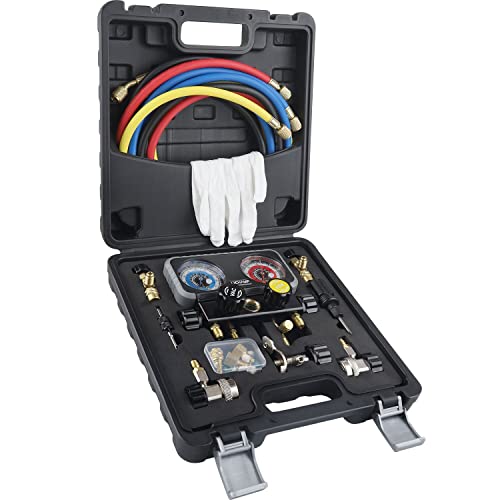
The Lichamp manifold gauge set is a comprehensive service system that includes a 4-valve manifold, four 5-foot hoses, two adjustable R134a adapters, two R410a liquid safety valves, an adjustable can tap, two tank adapters, and various accessories. This is a professional-grade setup that covers R134a, R22, R32, and R410a refrigerants in a single package. The large colored dials are rated at 800 PSI for the high side and 550 PSI for the low side, with a sight glass for observing liquid refrigerant flow.
Technicians who have used this set report that the hoses seal well with finger-tight connections and the manifold valves operate smoothly. The included adapter kit covers most common service scenarios without requiring additional purchases. The 5-foot hoses provide ample reach for both residential and automotive applications, and the 45-degree bend on one end of each hose aids access in tight spaces. The hard shell case keeps everything organized for transport and storage.
The low-side gauge uses 5 PSI increments, which makes precise readings difficult when targeting specific pressure ranges. The can tap included in the kit is noted as being lower quality than the rest of the set. The case is also reported to be difficult to close properly once all components are stored inside. Some users found the included Teflon tape was not needed — in fact, using it on flared ends with gaskets can actually cause leaks under high pressure and cold temperatures.
What works
- Comprehensive kit covers multiple refrigerants
- 5-foot hoses with 45-degree bend for access
- Large dials with sight glass for flow monitoring
What doesn’t
- Low-side gauge increments are too coarse
- Included can tap is lower quality than manifold
Hardware & Specs Guide
Thread Standards
The 1/4-inch SAE flare is the universal standard for manifold hose connections, while 1/2-inch ACME threads are used on tank valves. Some adapters also use metric threads for R1234YF ports (14mm low side, 17mm high side). Always match the thread type and pitch — forcing mismatched threads damages both components and creates leak paths that waste refrigerant.
Material Selection
Brass is the preferred material for refrigerant fittings due to its corrosion resistance, machinability, and thermal stability. Aluminum is lighter but more prone to thread galling. Nickel-plated bronze offers a good balance of durability and corrosion resistance. Avoid plated steel fittings, which can rust and contaminate the refrigerant system over time.
Valve Core Depressor
Some adapters include a built-in valve core depressor that opens the Schrader valve when connected, allowing refrigerant flow. Others are pass-through only and require the valve core to be removed separately. Having a depressor simplifies purging air from the hose before opening the tank, but adds another component that can fail or leak.
Quick-Coupler Mechanisms
Ball-lock couplers use 2 to 6 balls that engage into a groove on the service port, providing a tool-free connection. More balls generally mean better retention and lower leak risk. The rubber O-ring inside the coupler creates the actual seal — it should be lubricated periodically to prevent drying and cracking. Replace O-rings at the first sign of wear to avoid refrigerant loss.
FAQ
What is a 134A tank adapter used for?
Will an R134a adapter work on an R12 tank?
How do I know if an adapter will fit my gauge set?
Are brass adapters better than aluminum?
Can I use a 134A tank adapter with R1234YF refrigerant?
Final Thoughts: The Verdict
For most buyers, the best 134a tank adapter winner is the Robinair 16301 because it delivers USA-made brass precision at a reasonable cost with the simplest possible design: a direct, leak-free connection between tank and hose. If you need to bridge multiple refrigerant generations, grab the Aupoko 3-Piece Kit for its versatility and included valve core remover. And for professionals who service late-model vehicles, nothing beats the Boltigen R1234YF Adapter Set for future-proofing your existing R134a manifold against the expanding fleet of 1234YF-equipped cars.

Certification: BSc in Mechanical Engineering
Education: Mechanical engineer
Lives In: 539 W Commerce St, Dallas, TX 75208, USA
Md Amir is an auto mechanic student and writer with over half a decade of experience in the automotive field. He has worked with top automotive brands such as Lexus, Quantum, and also owns two automotive blogs autocarneed.com and taxiwiz.com.