Switching from lead-acid to lithium in a golf cart is one of the most impactful upgrades you can make. It transforms range, acceleration, and daily usability in ways that spec sheets alone do not fully capture.
I am Amir — the founder and writer behind Four Wheel Ask. I have spent years studying battery chemistries, comparing cycle life data, and analyzing real owner feedback to understand what separates a smart investment from a costly mistake.
When building a battery bank for your cart, the choice between flooded lead-acid, AGM, GEL, and LiFePO4 defines the entire ownership experience. By analyzing specs and compiling thousands of owner reports, these best 12 volt golf cart batteries stand apart for best reliability and performance.
How To Choose The Best 12 Volt Golf Cart Batteries
Selecting the right battery for a golf cart is not just about capacity. Voltage configuration, chemistry type, cycle life, and BMS quality all determine how your cart performs on the course and how long the investment lasts. Understanding these factors before buying saves money and prevents range issues down the line.
Chemistry: LiFePO4 Versus Lead-Acid
LiFePO4 lithium batteries deliver ten times the cycle life of traditional lead-acid designs while weighing half as much. They maintain steady voltage under load, so your cart does not slow down as the battery drains. Lead-acid options such as AGM and GEL cost less upfront but require regular maintenance and lose capacity with each partial discharge. For daily drivers and frequent use, lithium pays for itself within two years through longer range and zero maintenance.
Voltage and Capacity Planning
Most golf carts run on 36V or 48V systems. A 36V cart typically uses six 6V batteries, while a 48V cart uses six 8V or four 12V batteries. Using 12V batteries in a series configuration simplifies wiring and allows you to mix-and-match replacements. Capacity is measured in amp-hours (Ah) — a 100Ah 12V battery delivers roughly 1.28kWh of energy. Match your total bank capacity to your typical daily mileage and factor in a 20 percent reserve to avoid deep discharges that shorten battery life.
The Role of the Battery Management System
A BMS protects against overcharge, over-discharge, short circuits, and temperature extremes. Quality BMS units also balance individual cell voltages inside the pack, which prevents premature failure. Look for at least 100A continuous BMS rating for a single 12V battery used in a golf cart bank, and verify low-temperature cutoff if you park your cart in freezing conditions. Bluetooth monitoring is a convenience feature that lets you track voltage, current, and remaining capacity from your phone.
Quick Comparison
On smaller screens, swipe sideways to see the full table.
| Model | Category | Best For | Key Spec | Amazon |
|---|---|---|---|---|
| GOLDENMATE 12V 100Ah | LiFePO4 | Golf Cart / RV | 4000-15000 Cycles | Amazon |
| Wattcycle 12V 100Ah | LiFePO4 | RV / Solar | BCI Group 24 | Amazon |
| TEMGO 36V 100Ah | LiFePO4 Kit | Complete Upgrade | 200A BMS, App | Amazon |
| Elefast 48V 100Ah | LiFePO4 Kit | 48V Systems | 6000 Cycles | Amazon |
| DC HOUSE 48V 100Ah | LiFePO4 Metal | Premium Build | Metal Case, App | Amazon |
| Dumfume 2-Pack 150Ah | LiFePO4 Twin | High Capacity | 300Ah Bank | Amazon |
| OGRPHY 4 Pack 100Ah | LiFePO4 Multi | Large Conversions | Grade A Cells | Amazon |
| HeyFuture 12V 100Ah BT | LiFePO4 BT | Bluetooth Monitoring | Group 24 Size | Amazon |
| WOXABHSL 12V 200Ah | LiFePO4 | Extended Runtime | 200Ah Capacity | Amazon |
| Mighty Max ML100-12 | SLA AGM | Budget Build | 100Ah Lead Acid | Amazon |
| Mighty Max ML100-12 GEL | GEL Lead Acid | Extreme Temps | GEL Technology | Amazon |
In-Depth Reviews
1. GOLDENMATE 12V 100Ah LiFePO4 Battery

GOLDENMATE delivers a well-rounded 12V 100Ah LiFePO4 battery that hits the sweet spot between performance and cost. Built with automotive-grade lithium cells and backed by a 100A BMS, this Group 31 battery handles continuous discharge up to 100A and supports up to 15000 cycles under ideal conditions. Owner reports consistently highlight its stable voltage output and the ability to run trolling motors and RV appliances for extended periods without noticeable sag.
At 28.66 pounds, it weighs roughly half of a comparable lead-acid unit, making installation in tight battery compartments noticeably easier. The battery supports both series and parallel connections up to 4S or 4P, which allows users to build a 48V 400Ah bank for larger golf carts or off-grid solar setups. The included BMS covers overcharge, over-discharge, over-current, overheating, and short-circuit protection, and owner feedback indicates reliable low-temperature cutoff behavior.
Multiple long-term users report that after a full season of regular golf cart use, the battery holds capacity well and delivers consistent range. A small number of owners noted that the built-in handle can feel less robust than the rest of the build, and the battery is not waterproof — users in marine environments should take additional sealing precautions. Overall, the combination of cycle life, weight savings, and protection features makes this a standout choice for most golf cart conversions.
What works
- Excellent 4000-15000 cycle life with Grade A cells
- Lightweight 28.66 lb design eases installation
- Robust 100A BMS with full protection suite
- Supports series/parallel expansion up to 48V 400Ah
What doesn’t
- Not waterproof — requires added protection in wet environments
- Handle durability reported as average by some owners
2. Wattcycle 12V 100Ah LiFePO4 Battery
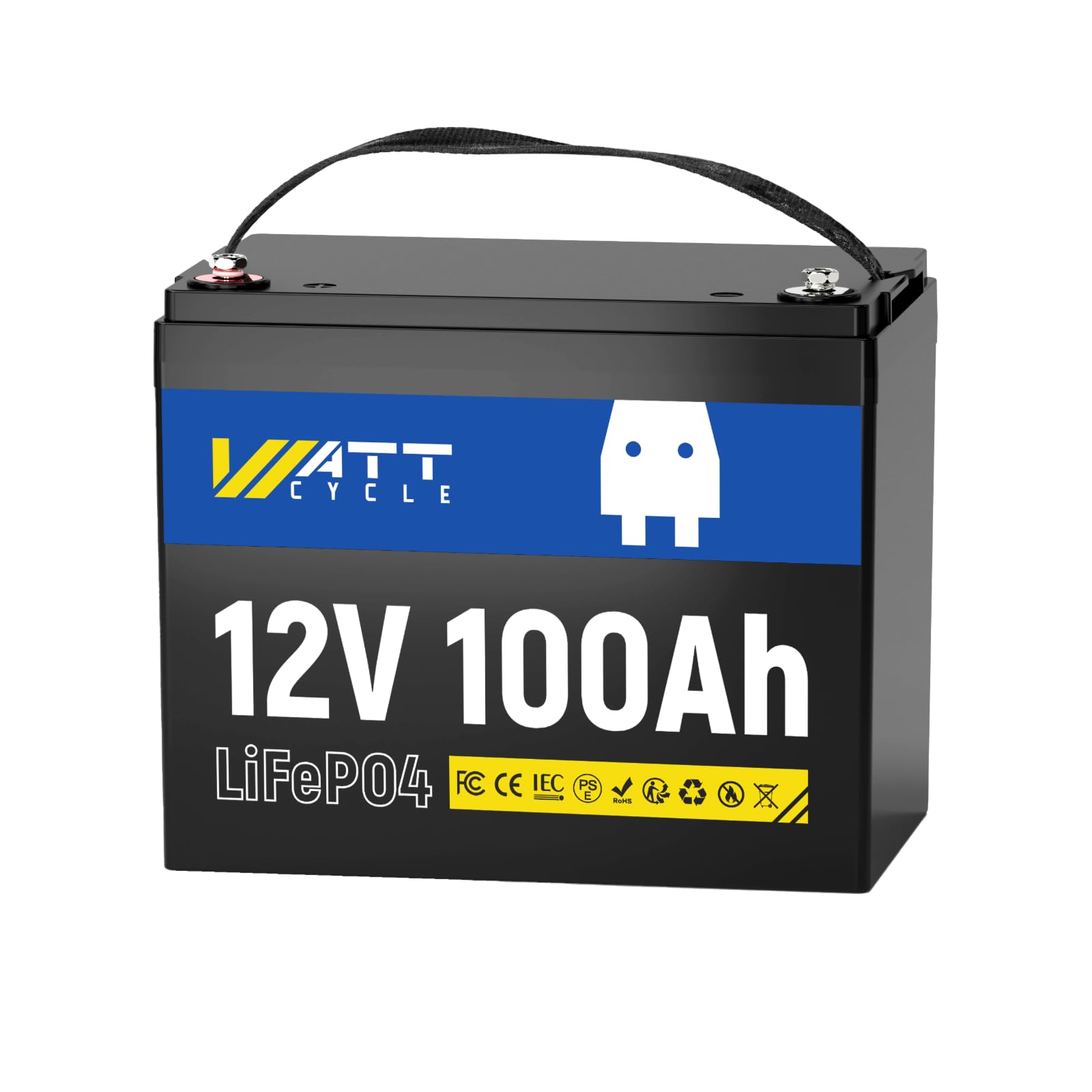
Wattcycle packs its 12V 100Ah LiFePO4 battery into a compact BCI Group 24 footprint, making it one of the more space-efficient options for golf cart battery trays. The battery measures 10.2 by 6.6 by 8.2 inches and weighs just 23.2 pounds, which allows owners to fit it into standard Group 24 boxes without modification. Built with A-plus grade cells, it carries SDS, UN38.3, FCC, CE, and ROHS certifications, confirming its safety and quality credentials.
The integrated 100A BMS includes low-temperature protection that cuts off charging below -4 degrees Fahrenheit, which is critical for owners in colder climates who park their carts outdoors. The battery supports up to four units in series or four packs in parallel, enabling a 48V 400Ah configuration with a total energy capacity of 20.48kWh. Owners using these batteries in series for trolling motors and RV house banks report that the 100A continuous discharge handles loads up to 42 amps without triggering the BMS.
Independent capacity testing by owners confirms the battery delivers close to its rated 100Ah, with one user measuring approximately 47Ah from a 50 percent state of charge. Some owners note the absence of Bluetooth monitoring as a limitation, and the supplied bolts are short — users building parallel connections should plan for M8 by 16mm replacements. Overall, Wattcycle offers a light, compact, and certified battery that performs well in moderate-load golf cart and RV applications.
What works
- Compact Group 24 size fits standard battery boxes
- Weighs only 23.2 lb for easy handling
- Low-temperature charging protection for cold climates
- Multiple safety certifications (SDS, UN38.3, FCC, CE, ROHS)
What doesn’t
- No Bluetooth monitoring capability
- Included bolts too short for parallel wiring
3. TEMGO 36V (38.4V) 100Ah Golf Cart Battery Kit
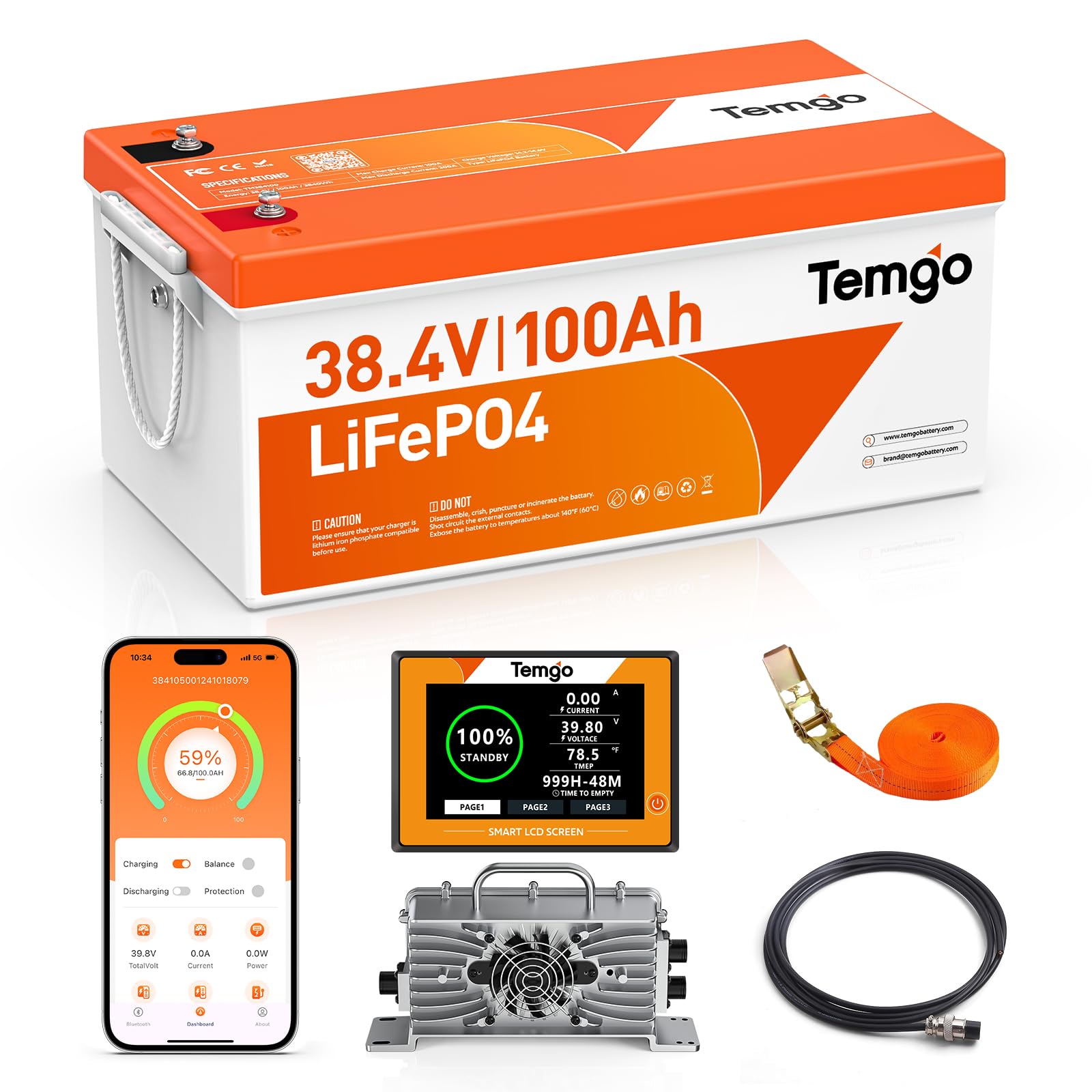
TEMGO delivers a turnkey 36V lithium conversion kit that eliminates the guesswork of assembling individual batteries. The package includes a 38.4V 100Ah LiFePO4 battery, a 42.6V 20A charger, a 2.8-inch LCD touch display, and a retention strap — everything needed to replace the traditional six 6V lead-acid batteries in a single afternoon. The battery uses premium A-grade LiFePO4 cells and is rated for over 5000 deep cycles at 80 percent depth of discharge, which translates to roughly ten times the lifespan of lead-acid.
The integrated Bluetooth-enabled 200A BMS provides real-time monitoring through the TEMGO mobile app, displaying voltage, current, state of charge, and fault alerts. The BMS also protects against overcharging, over-discharging, short circuits, and extreme temperatures. With a peak discharge of 600 amps for three seconds and a continuous 200A rating, this battery handles hill climbs and heavy acceleration without voltage sag. Owners report that the weight reduction from over 300 pounds of lead-acid to 61.73 pounds transforms the cart performance, with one user noting a speed increase from 12 to 16 mph.
Installation reports from EZGO and Club Car owners confirm the battery base fits standard 10-inch-wide trays, though some older models with struts in the battery bay require custom brackets. The included LCD screen mounts on the dash and gives accurate real-time feedback. A small number of owners mention that the battery compartment should be measured before purchase to avoid fit issues with narrower trays. Overall, the TEMGO kit is a complete, high-power solution for anyone ready to move away from lead-acid entirely.
What works
- Complete all-in-one kit with charger, LCD, and strap
- 200A continuous BMS with 600A peak for hill climbs
- Bluetooth monitoring via mobile app
- Dramatic weight reduction from lead-acid replacement
What doesn’t
- May not fit older carts with internal struts
- Higher upfront investment than individual batteries
4. Elefast 48V 100Ah Lithium Golf Cart Battery Kit
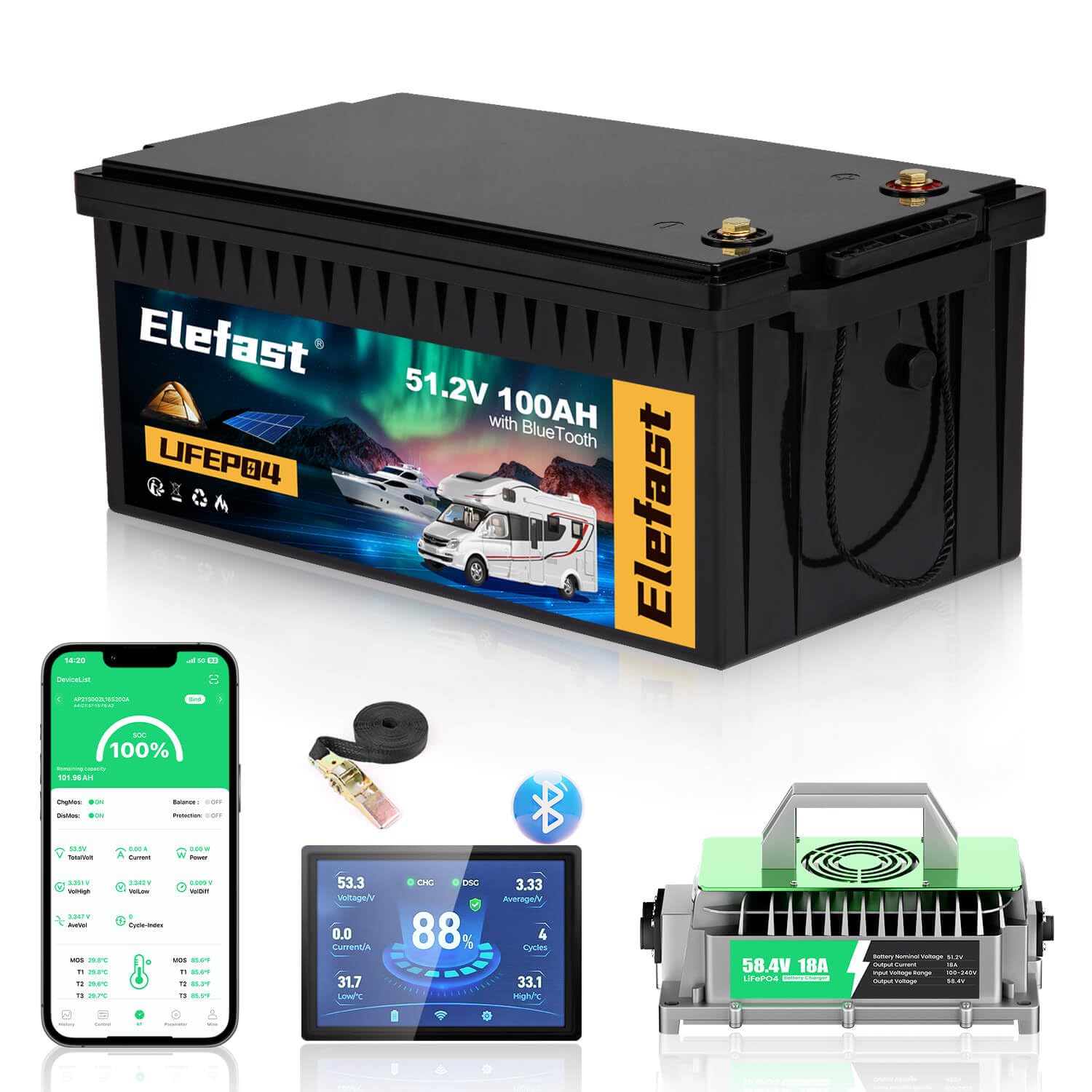
Elefast offers a 48V 100Ah LiFePO4 golf cart kit built around EVE A-plus grade 2C power cells, which support fast discharge and maintain balanced voltage across cycles. The complete kit includes the battery, a 58.4V 18A charger, a 2.8-inch LCD touch screen, mounting straps, and Bluetooth monitoring via a mobile app. Rated for 6000 deep cycles with 80 percent depth of discharge, the battery delivers 5.12kWh of usable energy and supports a peak current of 1000 amps for short bursts.
The built-in 200A smart BMS manages overcharge, over-discharge, overload, high temperature, and short-circuit protection, with automatic cutoff below -4 degrees Fahrenheit and above 158 degrees Fahrenheit. Owners report that a single charge provides up to 40 miles of continuous golfing, and the weight of 82.89 pounds replaces six lead-acid batteries weighing over 300 pounds. Installation feedback from Club Car, EZGO, and Yamaha owners confirms the universal fit with simple wiring — the hardest part reported is removing the old batteries and building a support platform for the single large unit.
Long-term user reports indicate that after multiple rounds of golf, the battery voltage remains stable and acceleration stays consistent even below 40 percent state of charge. A few owners experienced Bluetooth reconnection issues and noted that the supplied charger can get warm during extended charging sessions, recommending removing the seat for airflow. Elefast provides a 5-year warranty and US-based customer support, and multiple owners praise the quick response time for setup questions.
What works
- EVE A-plus grade cells for stable power delivery
- 6000-cycle lifespan with 80% DoD rating
- Complete kit with charger, LCD, and Bluetooth app
- 5-year warranty with responsive US support
What doesn’t
- Charger can overheat without adequate ventilation
- Bluetooth app described as basic by some owners
5. DC HOUSE 48V 100Ah Pro Lithium Golf Cart Battery
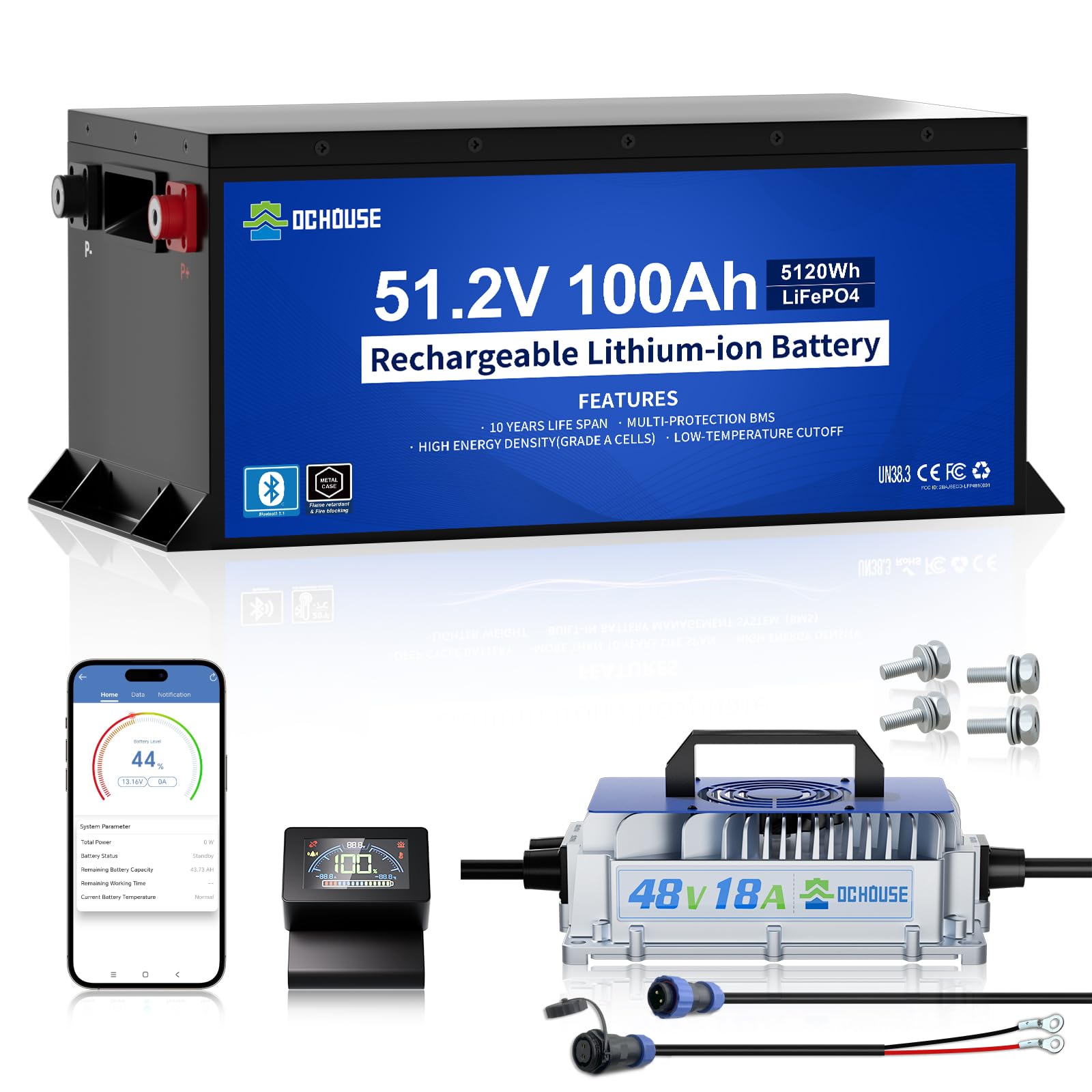
DC HOUSE differentiates its 48V 100Ah LiFePO4 battery with a fireproof, anti-collision sheet metal case that provides a level of physical protection far beyond typical ABS plastic housings. The metal casing includes a vent and a one-key safety switch that reduces power consumption when the cart is parked. Internal metal fixtures secure Grade A battery cells, lowering the risk of swelling and extending lifespan by an estimated 30 percent compared to standard designs.
The battery features a 200A BMS with six key protection layers, including enhanced low-temperature cutoff that allows charging between 32 and 131 degrees Fahrenheit and discharging between -4 and 131 degrees Fahrenheit. Peak current reaches 700 amps for one second, giving the cart strong climbing ability. The kit includes a 48V 18A charger that can fully recharge the battery in about 5.5 hours, with an automatic stop feature that works alongside the BMS for dual overcharge protection. Owners report covering 11 miles on a single charge while still having 76 percent capacity remaining.
Installation feedback from Club Car DS and Yamaha G22 owners confirms that the battery fits into the existing tray after building a simple plywood platform. The Bluetooth LCD monitor connects wirelessly and displays capacity, voltage, and fault information on a multi-page screen. Some owners mention that the mounting hardware requires longer M8 bolts when connecting multiple accessories, and the battery size should be verified against the cart dimensions before purchase due to varying tray designs. DC HOUSE offers a 3-year warranty with US warehouse support.
What works
- Fireproof metal case with anti-collision design
- One-key safety switch for storage energy savings
- 700A peak current for steep hill climbs
- Dual overcharge protection with auto-stop charger
What doesn’t
- Requires platform modification for some cart models
- Heavier than ABS-cased lithium batteries at 95.5 lb
6. Dumfume 2-Pack 12V 150Ah LiFePO4 Batteries
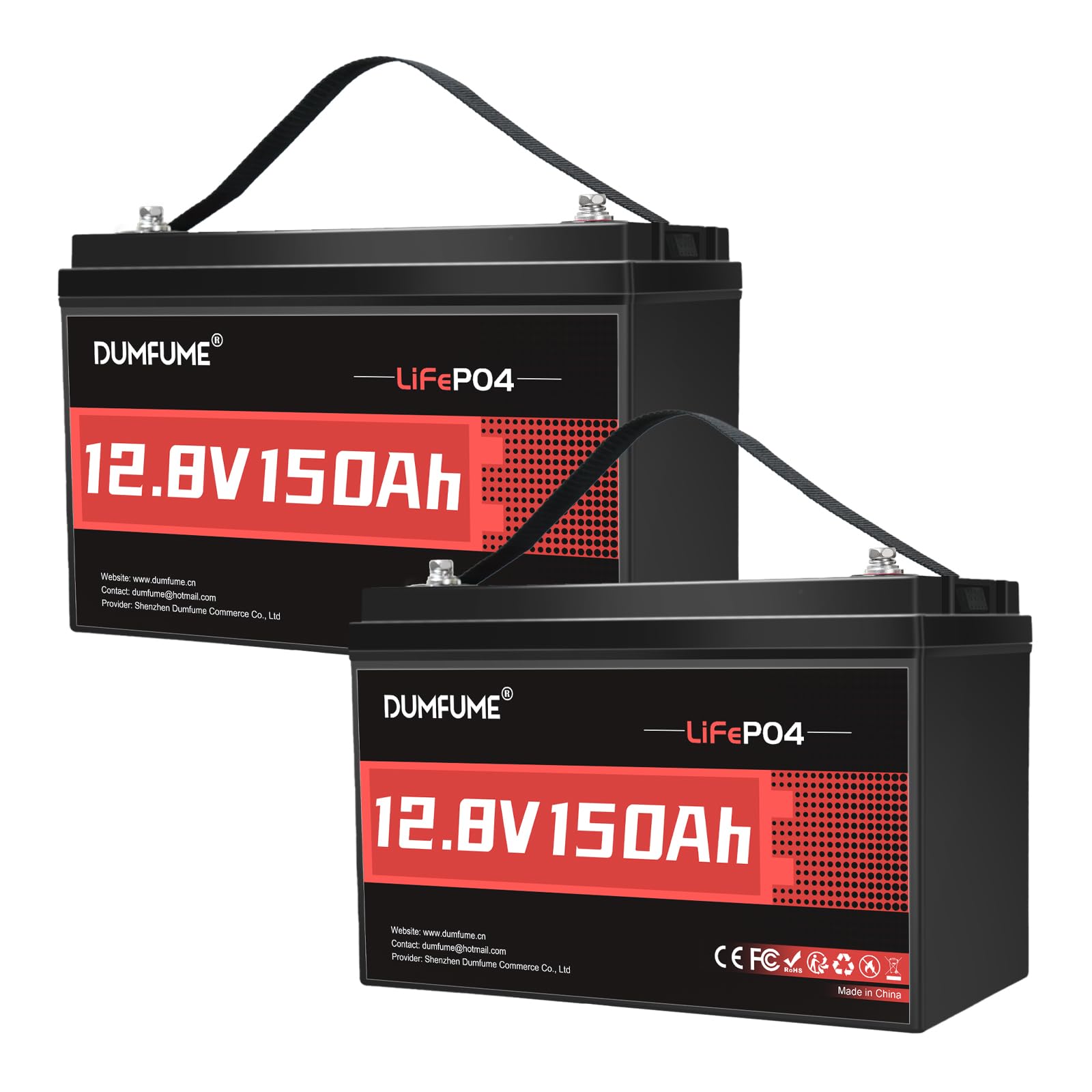
Dumfume offers a twin-pack of 12V 150Ah LiFePO4 batteries that together create a 300Ah bank for larger energy demands. Each battery features an independent 100A BMS, providing redundant protection when wired in parallel for solar systems, RV house banks, or extended golf cart range. The batteries weigh 24.5 pounds each, making them easily portable compared to a lead-acid bank of equivalent capacity that would exceed 130 pounds.
The pack supports parallel expansion up to 4S or 4P, allowing users to build a 48V 600Ah system for off-grid applications. Independent capacity testing by owners shows that individual units slightly exceed their 150Ah rating, delivering around 157Ah in real-world use. The batteries are described as non-smart units without Bluetooth, which keeps the cost low but requires external monitoring for accurate state-of-charge tracking. Owner feedback from marine and RV applications confirms reliable power delivery for diesel heaters, inverters, and solar storage.
Shipping feedback indicates that some units arrive at a low state of charge around 12.2 to 12.4 volts, requiring a parallel jump from another battery to wake the BMS. The manufacturer provides responsive customer support, with one owner reporting a quick replacement for a unit damaged in transit. A small number of users experienced BMS cold-temperature protection lockout that required warming the battery above 50 degrees Fahrenheit to resume charging. For budget-conscious buyers needing high capacity in a modular format, this twin-pack delivers strong value.
What works
- Two batteries provide 300Ah total capacity
- Each unit has independent 100A BMS for redundancy
- Lightweight at 24.5 lb each, easy to handle
- Actual capacity exceeds rated 150Ah in testing
What doesn’t
- No Bluetooth monitoring included
- Some units arrive with low voltage requiring wake-up
7. OGRPHY 4 Pack 12V 100Ah LiFePO4 Batteries

OGRPHY packages four 12V 100Ah LiFePO4 batteries together, providing a complete 48V 100Ah bank for golf cart conversions straight out of the box. Each battery uses Grade A lithium cells and carries an IP65 waterproof rating, making them suitable for marine environments and outdoor battery compartments. The batteries weigh 24.3 pounds each and measure 6.7 by 12.9 by 8.4 inches, fitting standard Group 31 footprints.
The 100A BMS in each unit protects against overcharge, over-discharge, short circuit, and temperature extremes, with a charging temperature range of -20 to 55 degrees Celsius and discharging from 0 to 60 degrees Celsius. Owners report that four batteries wired in series for a 48V golf cart system provide snappier acceleration and a 1 to 2 mph top speed increase over the old lead-acid setup, along with a weight savings of roughly 300 pounds. The batteries support up to four units in series or four packs in parallel, allowing expansion up to 48V 400Ah.
Long-term owner feedback over two years of golf cart use shows zero issues with battery balance or capacity loss when maintained within recommended discharge limits. One user reported that after 52 weeks of sporadic use, one battery began draining faster, requiring replacement under the 5-year warranty. OGRPHY provides US-based customer support with prepaid return labels for defective units. The 4-pack format saves on per-unit cost compared to buying individual batteries, making it a strong option for complete system build-outs.
What works
- Four-pack completes a 48V bank in one purchase
- IP65 waterproof rating for wet conditions
- Grade A cells with 5000-plus cycle rating
- 5-year warranty with prepaid return support
What doesn’t
- Intermittent quality control on long-term cell balance
- Higher total upfront cost than individual purchases
8. HeyFuture 12V 100Ah Bluetooth LiFePO4 Battery

HeyFuture combines a 12V 100Ah LiFePO4 battery with built-in Bluetooth monitoring in a compact Group 24 enclosure that weighs 21.5 pounds. The battery uses lithium iron phosphate cells with an integrated BMS that provides dustproof, waterproof, and low-temperature cutoff protection. Owners can view voltage, current, state of charge, and cell balance data through the HeyFuture mobile app, making it easy to track battery health without additional hardware.
The battery supports series and parallel connections up to 4S or 4P, enabling configurations from 12V 100Ah single units up to 48V 400Ah banks. Real-world feedback from trolling motor users reports running a 55-pound thrust motor on level three for eight hours while returning home with 89 percent state of charge remaining. The standard Group 24 dimensions match most battery boxes, and the included M8 terminals accommodate common cable lugs without modification.
Owner reports note that the Bluetooth app, while functional, has a clunky interface that could benefit from a more polished design. One user observed a minor cell imbalance on the first charge that equalized over subsequent cycles, suggesting the BMS cell balancing works as intended over time. The company provides a 5-year customer service commitment, and multiple owners report positive experiences with the support team for delivery and setup questions. For buyers who want Bluetooth tracking without paying flagship pricing, this is a balanced entry point.
What works
- Built-in Bluetooth for real-time battery monitoring
- Lightweight 21.5 lb design in Group 24 format
- IP65 dust and water resistance
- Supports 4S or 4P expansion up to 48V 400Ah
What doesn’t
- Bluetooth app interface described as clunky
- Initial cell balancing may require several cycles
9. WOXABHSL 12V 200Ah LiFePO4 Battery
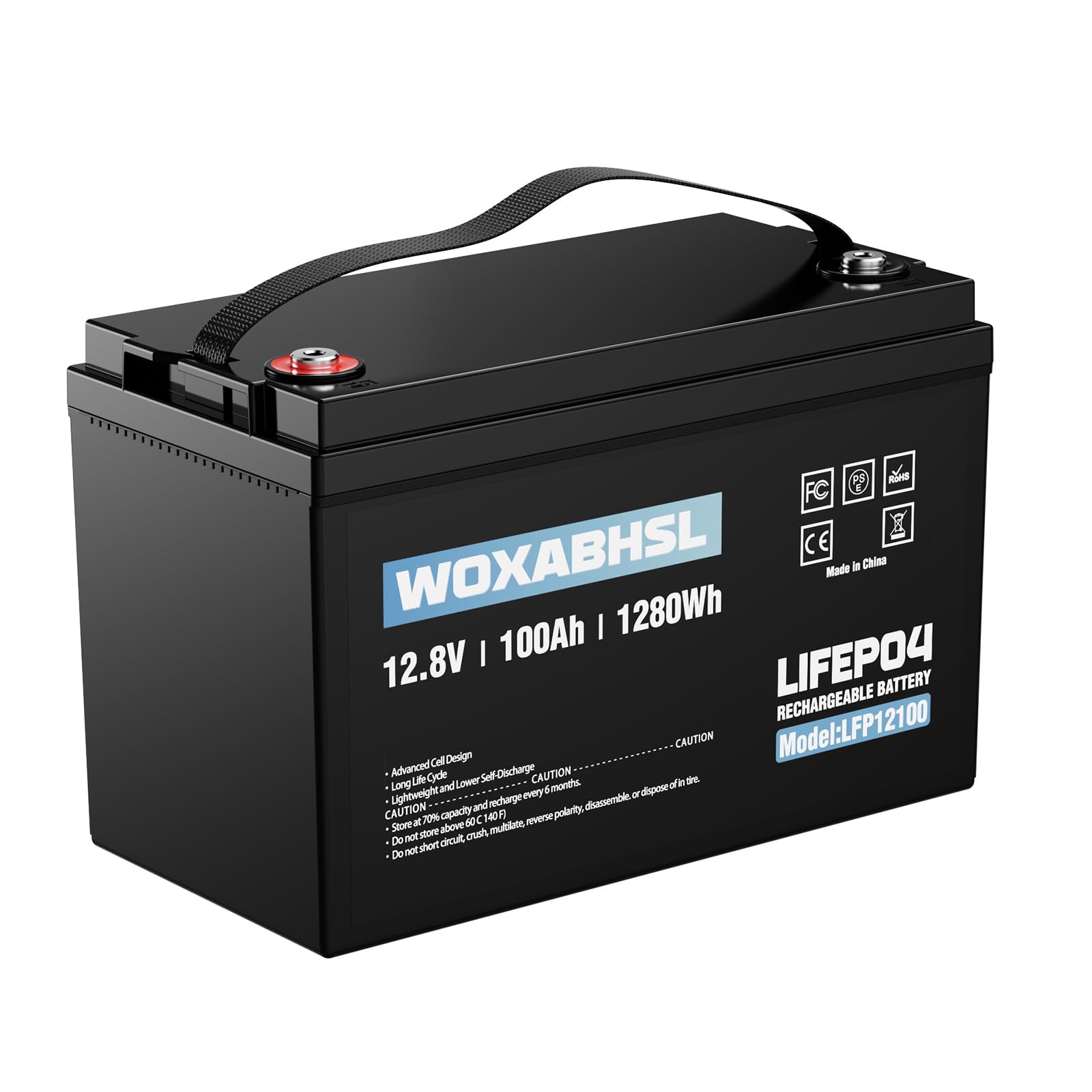
WOXABHSL offers a 12V 200Ah LiFePO4 battery that doubles the capacity of standard 100Ah units while maintaining a compact footprint suitable for larger battery trays. Weighing 22.05 pounds, it achieves roughly half the weight of a comparable lead-acid battery at the same capacity. The automotive-grade LiFePO4 cells carry a UL test certificate and support an extraordinary 4000 to 15000 deep cycles depending on discharge depth, with a 10-year design life under normal use.
The integrated 100A BMS provides protection against overcharge, over-discharge, short circuit, overload, and overheating. The battery delivers 95 percent depth-of-discharge efficiency with a stable voltage curve that stays above 12.8 volts throughout the discharge cycle, providing nearly double the usable runtime of a lead-acid battery of the same capacity. Owner feedback confirms that the battery works well for lower amp-draw applications such as Razor scooters and 24V systems, with one user noting that the BMS may cut power under full throttle in 36V high-power setups.
The battery arrived at approximately 70 percent state of charge in multiple owner reports, requiring 4 to 6 hours for full charge and cell balancing at 14.4 volts. The manufacturer backs the product with a 12-month replacement warranty and lifetime technical support. Some users recommend verifying the voltage after full charge to ensure the BMS properly balances all cells before putting the battery into heavy service. For applications requiring extended runtime in a single 12V unit, this 200Ah option provides substantial reserve.
What works
- High 200Ah capacity in a single 12V unit
- Only 22.05 lb for easy handling and installation
- 95% depth-of-discharge with stable 12.8V+ curve
- UL certified cells with up to 15000 cycles
What doesn’t
- BMS may trip under high-current 36V loads
- Requires initial 4-6 hour balancing charge
10. Mighty Max ML100-12 SLA AGM Battery

Mighty Max ML100-12 is a 12V 100Ah sealed lead-acid AGM battery that represents the traditional budget-friendly approach to golf cart power. It is UL certified and built as a maintenance-free, rechargeable SLA battery in a Group 30H form factor. Weighing significantly more than lithium alternatives, this battery provides a lower upfront cost for buyers who do not need the cycle life or weight savings of lithium chemistry.
Owner reports show that this battery works reliably in riding mowers, UPS systems, and gate openers when kept on a proper charger. One user upgraded their Ryobi mower from 75Ah to 100Ah and confirmed the battery fits the factory tray and delivers a full mowing session on less than one bar of the charge indicator. The AGM design is spill-proof and can be mounted in various orientations, though it should not be discharged below 50 percent state of charge to avoid permanent capacity loss.
The main concern from long-term users is lifespan — one owner reported that after two years, the battery delivered only 60 percent of rated capacity with significant voltage sag under load. The terminal bolts shipped with the battery have been reported as oversized by some buyers, requiring replacement for proper lug connection. The 1-year manufacturer warranty provides basic coverage, and the battery remains a workable option for low-usage scenarios or as a temporary replacement while saving for a lithium upgrade.
What works
- Budget-friendly upfront cost for entry-level buyers
- UL certified with sealed maintenance-free design
- Universal fit in many mower and UPS applications
- Spill-proof AGM construction for safe mounting
What doesn’t
- Short lifespan of approximately 2 years under regular use
- Heavy compared to lithium of same capacity
- Loses capacity quickly if discharged below 50%
11. Mighty Max ML100-12 GEL Battery

Mighty Max ML100-12 GEL uses GEL electrolyte technology instead of AGM, offering a thicker, non-spillable gel paste that handles vibration and shock better than standard flooded batteries. This 12V 100Ah battery weighs approximately 60 pounds and uses internal threaded terminals for secure cable connections. The GEL chemistry excels in extreme temperatures, maintaining consistent performance in both hot summer and cold winter conditions where other lead-acid types may struggle.
Owner feedback highlights the battery as a reliable backup power source for gate openers, with one unit keeping a gate operating for over two weeks during a power outage. The slower self-discharge rate compared to AGM means the battery retains its charge longer when sitting idle, making it suitable for seasonal equipment. The battery is UL certified and designed for deep cycle applications such as lawn mowers, floor machines, and mobility scooters.
Concerns from buyers include inconsistent quality control — one owner purchased four batteries for a 48V mower and found initial capacity ranged from 16 to 45 percent of the rated 75Ah, with all four failing after approximately 10 cycles. The 60-pound weight makes handling and installation more challenging than lithium alternatives, and the 1-year warranty provides limited recourse if premature failure occurs. The GEL battery fills a niche for buyers who need temperature resilience at a low entry price and are willing to accept shorter service life.
What works
- GEL electrolyte handles vibration and shock well
- Excellent performance in extreme temperature ranges
- Lower self-discharge rate than standard AGM
- UL certified for safety compliance
What doesn’t
- Heavy 60 lb weight complicates installation
- Quality control issues reported on multi-pack purchases
- Short lifespan compared to lithium alternatives
Hardware & Specs Guide
LiFePO4 Chemistry
Lithium iron phosphate cells provide 4000 to 15000 cycles versus 300 to 1000 cycles for lead-acid. They maintain a flat discharge curve above 12.8V for most of the cycle, delivering consistent power until the battery is nearly empty. LiFePO4 also handles partial state-of-charge operation without damage, unlike lead-acid which sulfates when left partially discharged.
BMS Protection Levels
A quality BMS monitors individual cell voltages and temperature, disconnecting the battery when any parameter exceeds safe limits. Look for a 100A continuous rating as a baseline for golf cart use, with 200A preferred for 48V systems. Low-temperature charging cutoff prevents permanent damage when charging below freezing, while cell balancing extends the overall pack life.
Capacity and Voltage Configurations
Most 36V golf carts use six 6V batteries producing 1.28kWh per 100Ah block. Converting to 12V lithium typically requires four 12V 100Ah batteries wired in series for 48V systems or three for 36V systems. Total bank capacity in kilowatt-hours is calculated as volts multiplied by amp-hours divided by 1000. Always leave a 20 percent reserve to avoid deep discharges that stress the BMS.
Weight and Installation Considerations
Lithium batteries weigh roughly one-third to one-half of equivalent lead-acid packs. A 300-pound lead-acid bank drops to approximately 100 pounds with lithium, improving acceleration and reducing suspension wear. Verify the battery compartment dimensions before purchase, and use M8 stainless steel bolts with lock washers for reliable connections. Most lithium kits include mounting straps or brackets for secure installation.
FAQ
Can I use 12V lithium batteries in my 48V golf cart?
How long do 12V golf cart batteries last on a single charge?
Do I need to upgrade my charger when switching to lithium?
What is the difference between AGM, GEL, and LiFePO4 for golf carts?
Can I mix old and new 12V batteries in my golf cart bank?
Final Thoughts: The Verdict
For most buyers, the 12 volt golf cart batteries winner is the GOLDENMATE 12V 100Ah LiFePO4 because it balances cycle life, weight, protection features, and price better than any other single unit on the market. If you want a complete drop-in kit with Bluetooth monitoring and a charger, grab the TEMGO 36V 100Ah Kit. And for a budget-friendly lead-acid replacement that still delivers solid performance in moderate use, the Mighty Max ML100-12 AGM gets the job done while you plan a future lithium upgrade.

Certification: BSc in Mechanical Engineering
Education: Mechanical engineer
Lives In: 539 W Commerce St, Dallas, TX 75208, USA
Md Amir is an auto mechanic student and writer with over half a decade of experience in the automotive field. He has worked with top automotive brands such as Lexus, Quantum, and also owns two automotive blogs autocarneed.com and taxiwiz.com.