A dead battery at the worst possible moment is a frustration every vehicle owner knows. A quality charger doesn’t just restore power — it extends battery life, prevents sulfation, and gives you confidence that your car, truck, motorcycle, or RV will start when you need it. The difference between a charger that merely works and one that truly protects your investment comes down to charging stages, build quality, and how well it matches your battery chemistry.
I’m Amir — the founder and writer behind Four Wheel Ask. My recommendations come from weeks of cross-referencing technical datasheets, analyzing owner-reported failures, and studying how different charging profiles affect long-term battery health across lead-acid, AGM, and LiFePO4 chemistries.
Whether you need a simple maintainer for winter storage or a high-current unit to revive deeply discharged batteries, the right choice saves money and hassle. After evaluating dozens of models against real-world use cases, I’ve compiled the options that define the best 12 volt battery charger category for every scenario.
How To Choose The Best 12 Volt Battery Charger
A battery charger is a straightforward device with a deceptively large impact on your battery’s service life. The wrong choice can overcharge, undercharge, or fail to address sulfation — the crystal buildup that silently kills lead-acid batteries. Here are the critical factors to weigh before buying.
Charging Stages and Smart Profiles
A basic charger dumps current until the battery is full and stops. A smart charger uses multiple stages — desulfation, bulk charge, absorption, analysis, and float maintenance — to maximize charge acceptance and prevent damage. For any battery you plan to keep longer than a year, a multi-stage smart charger is non-negotiable. Units with pulse repair capability can even recover mildly sulfated batteries, extending useful life by months or years.
Amp Rating: Matching Current to Capacity
The charging current, measured in amps, determines how fast the charger works. A 1.25-amp maintainer is fine for keeping a stored battery topped off, but reviving a deeply discharged 100Ah battery at that rate takes days. A 15-amp unit cuts that time dramatically. However, high current can damage smaller batteries — a motorcycle battery should not be charged at 20 amps. Match the charger’s output to your battery’s capacity: a good rule is 10–20% of the battery’s amp-hour rating for standard charging.
Chemistry Compatibility: Lead-Acid, AGM, Gel, and LiFePO4
Each battery chemistry requires a specific voltage and charging curve. Lead-acid and AGM chargers typically output 14.4–14.7V in bulk mode, while LiFePO4 needs 14.6V with a different absorption profile. Using the wrong profile can cause undercharging or trigger overvoltage protection. Look for a charger with dedicated modes or auto-detection for the battery type you own. If you have multiple chemistries, a unit that supports both lead-acid and LiFePO4 is essential.
Safety Protections and Build Quality
Reverse polarity protection, spark-proof clamps, over-temperature shutoff, and short-circuit prevention are not luxuries — they prevent damage to your vehicle’s electrical system and reduce fire risk. Temperature compensation adjusts voltage based on ambient conditions, preventing overcharge in hot weather and undercharge in the cold. A metal housing and a built-in cooling fan indicate a charger built for sustained use, while cheap plastic cases may struggle with heat dissipation during long charging cycles.
Quick Comparison
On smaller screens, swipe sideways to see the full table.
| Model | Category | Best For | Key Spec | Amazon |
|---|---|---|---|---|
| NOCO GENIUS5 | Premium Smart | Overall reliability and versatility | 5A, 6V/12V, lead-acid & LiFePO4, Force Mode | Amazon |
| BatteryMINDer 1510 | Desulfator | Extending battery life via desulfation | 1.5A, 12V, desulfation, temp compensation | Amazon |
| Battery Tender Plus | Maintainer | Long-term float maintenance | 1.25A, 12V, 4-step charging, 10-year warranty | Amazon |
| CRAFTSMAN 12A | Multi-Function | Charging, testing, and diagnostics | 12A, 6V/12V, tester, desulfation, LiFePO4 | Amazon |
| NEXPEAK 15A | High-Speed | Fast charging with pulse repair | 15A 12V / 8A 24V, LCD, 9-stage, LiFePO4 | Amazon |
| NOONE 2/8/15A | Metal Case | Durability and engine start function | 15A, 6V/12V, metal shell, 25A engine start, winter mode | Amazon |
| LiTime 20A | LiFePO4 Specialist | Fast charging large LiFePO4 banks | 20A, 14.6V, Anderson connector, 0V activation | Amazon |
| ECO-WORTHY 5A | Compact Smart | Small batteries and basic maintenance | 5A, 12V, LCD, lead-acid & LiFePO4 | Amazon |
| NEXPEAK 4-Pack | Multi-Unit | Maintaining several vehicles at once | 1.75A ea, 6V/12V, LCD, desulfation, 4-pack | Amazon |
| Power Queen 40A | High-Current LiFePO4 | Rapid charging of large lithium banks | 40A, 14.6V, LED display, 0V activation | Amazon |
| Schumacher SC1446 | Professional Wheeled | Engine starting and heavy-duty shop use | 200A start, 10A charge, 40A boost, timer, wheels | Amazon |
In‑Depth Reviews
1. NOCO GENIUS5

The NOCO GENIUS5 is the benchmark that other smart chargers are measured against. It delivers 5 amps of clean, microprocessor-controlled power to both 6V and 12V lead-acid (AGM, Gel, SLA, VRLA) and lithium-ion (LiFePO4) batteries. Compared to the older G3500, this unit is 34% smaller while producing over 65% more output — a testament to how far charging technology has advanced. The integrated thermal sensor adjusts voltage based on ambient temperature, which is critical for maintaining proper charge in freezing garages or hot summer sheds.
What sets the GENIUS5 apart is its ability to charge batteries from as low as 1 volt, and Force Mode allows manual charging of completely dead batteries down to zero volts. This is a genuine lifeline for deeply discharged or neglected batteries that other chargers refuse to recognize. The precision pulse charging automatically detects and reverses sulfation, restoring lost capacity over multiple cycles. Owner reports consistently highlight how it revived batteries that were written off by mechanics, and the included mounting bracket, eyelet terminals, and 72-inch AC cable make installation flexible for permanent mounting on RVs, boats, or classic cars.
Build quality is excellent — the casing feels dense, the alligator clips are aggressive, and the DC cable length (80 inches) provides good reach. The 3-year warranty and NOCO’s reputation for customer support add confidence, though some owners note the button interface has a slight delay. For anyone who wants a do-it-all smart charger that simply works across multiple battery chemistries and use cases, this is the one to beat.
What works
- Charges from 1V and Force Mode for zero-volt recovery
- Thermal sensor dynamically adjusts voltage for temperature
- Precision pulse desulfation extends battery life
- Compact and well-built with mounting accessories included
What doesn’t
- Button operation has a slight delay and can feel unintuitive at first
- 5A output is slower for large-capacity batteries than the 10A version
2. BatteryMINDer 1510

The BatteryMINDer 1510 is not just a charger — it’s a full-time desulfation device designed around a single purpose: extending battery life. Using a patented range of high frequencies, it actively reverses sulfation, which is the buildup of lead sulfate crystals that accounts for roughly 80% of premature battery failures. Unlike standard chargers that only desulfate during a specific stage, the 1510 continuously applies its restoration algorithm throughout the charging and maintenance cycle. Owners report bringing batteries back from what seemed like certain death, with some units lasting four times longer than untreated batteries.
The ambient temperature sensor is a standout feature — it precisely adjusts voltage based on real-time temperature readings, ensuring correct charging whether the battery sits in a freezing garage or a hot engine bay. The unit can maintain up to four batteries at once when connected in parallel using optional Y-connectors, making it ideal for winterizing a fleet of vehicles, boats, and lawn equipment. The 90–240V AC input allows worldwide use, and FCC certification confirms it meets strict energy efficiency standards. Owners who have used it for years on RVs, boats, and tractors report zero failures and significantly reduced battery replacement costs.
The 1.5 amp output is modest — this is a maintainer and desulfator, not a quick charger. Reviving a deeply discharged large battery can take days or weeks of continuous connection. The user interface is straightforward but the included chart can be confusing for first-time users. However, for anyone serious about maximizing battery lifespan, especially for seasonal vehicles, the BatteryMINDer 1510 is the most effective desulfation tool at this price point. The 5-year warranty reflects the manufacturer’s confidence in its long-term reliability.
What works
- Full-time desulfation extends battery life up to 4x
- Temperature compensation ensures proper voltage year-round
- Can maintain up to four batteries in parallel
- 5-year warranty and FCC certified
What doesn’t
- 1.5A output is slow for quick charging
- Setup chart can be confusing for new users
3. Battery Tender Plus
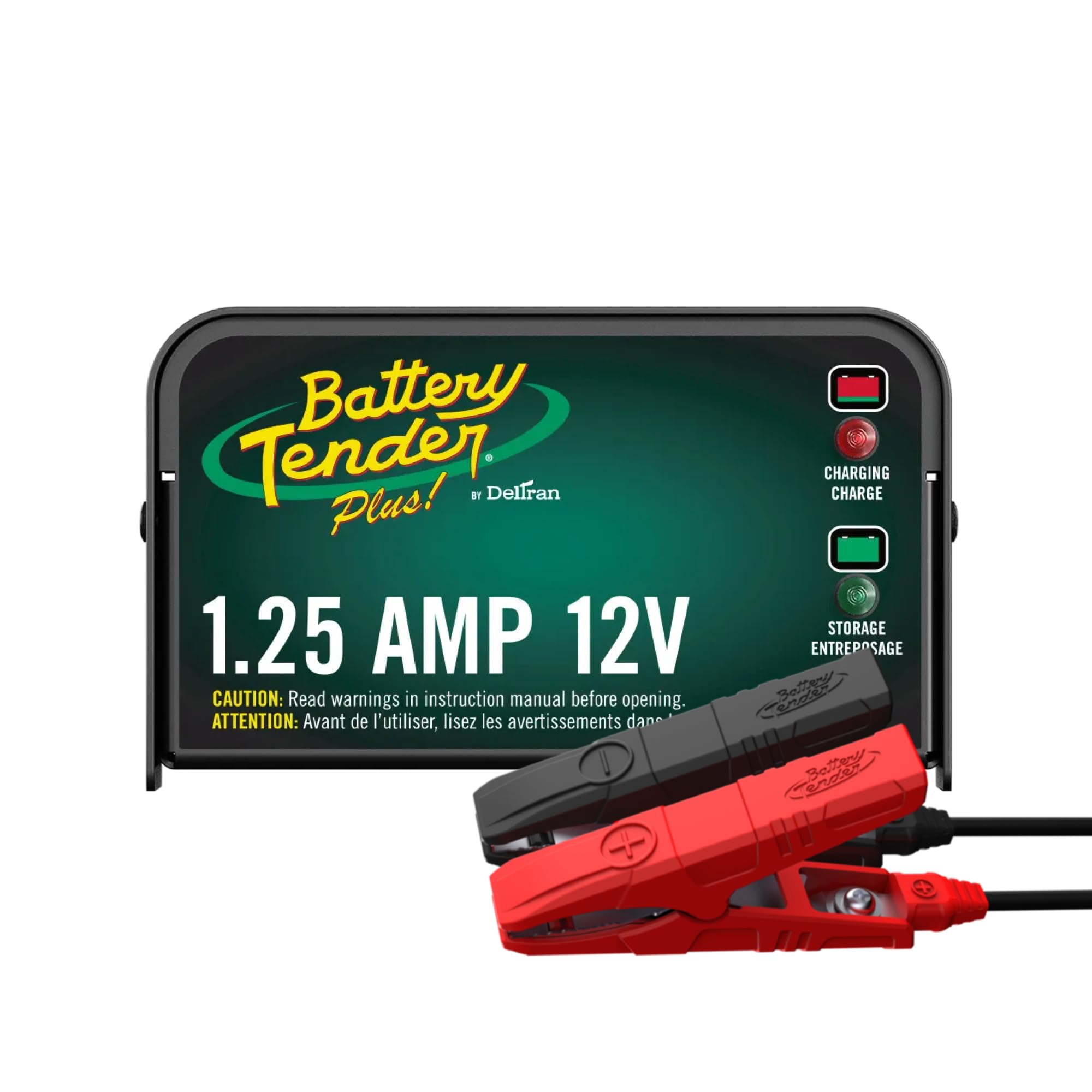
The Battery Tender Plus is the gold standard for long-term battery maintenance, and its reputation is built on decades of reliable service. This 1.25 amp, 4-step charger (bulk, absorption, storage, float) is designed specifically to keep 12V batteries at peak condition without overcharging. The two-color LED gives immediate visual feedback: red for charging, green for fully charged and maintaining. Unlike a basic trickle charger that continuously pushes current, the Battery Tender Plus intelligently drops to float mode and only resumes charging when voltage drops, making it safe to leave connected for months at a time.
The included quick-disconnect harness is a practical convenience — install the ring terminals on your battery once, and connecting and disconnecting takes seconds. The fused ring terminal cable and alligator clip accessory set covers most use cases out of the box. Owner feedback is overwhelmingly positive, with many reporting that it revived batteries that had been sitting dead for weeks. The 10-year manufacturer’s warranty is among the best in the industry and signals exceptional confidence in the product’s longevity. For classic car owners, motorcycle enthusiasts, and anyone who stores vehicles seasonally, this is the maintainer that generations of owners trust.
At 1.25 amps, the Plus is not designed for fast charging — charging a fully depleted car battery can take 12 hours or more. The AC cord is on the shorter side, which may require an extension cord when routing to a vehicle parked outdoors. Some owners have noted that physical vibration (from mounting on a vehicle or being knocked) can cause internal components to loosen over time, though this appears to be rare. For pure maintenance duty, however, the Battery Tender Plus remains the benchmark for simplicity and reliability.
What works
- Industry-leading 10-year warranty
- True 4-step smart charging prevents overcharging
- Quick-disconnect harness for convenient daily use
- Proven track record over decades of owner use
What doesn’t
- 1.25A output is slow for charging dead batteries
- Short AC cord may require an extension cord
4. CRAFTSMAN 12A

The CRAFTSMAN CMXCESM258 is a 4-in-1 device that charges, maintains, tests, and reconditions 6V and 12V batteries — a genuinely useful combination for the home mechanic. It delivers 12 amps for 12V charging, 3 amps for 12V maintenance, and 2 amps for 6V maintenance, covering standard flooded, AGM, lithium (LiFePO4), and deep-cycle batteries. The built-in battery tester provides quick diagnostics, allowing you to check state of charge and overall health without a separate tool. This makes it easier to decide whether a battery needs charging, reconditioning, or replacement.
The desulfation mode is a practical addition that helps reverse mild sulfation and extend battery life, and the smart trickle function ensures safe long-term connection without overcharging. Reverse polarity protection prevents damage if the clamps are accidentally reversed. Owner feedback highlights its effectiveness in maintaining infrequently driven cars and reviving neighbor’s dead batteries in cold climates — one owner reported successfully using it at -20°F. The unit is lightweight at 3.4 pounds, which some owners appreciate after decades of heavy metal chargers, but this also means the plastic housing feels less substantial than traditional units.
The 6-foot power cord and booster cables are adequate for most garage setups, and compatibility with both gas and diesel vehicles adds versatility. The lack of a dedicated repair mode (beyond desulfation) is a minor miss for a unit at this price point, and some owners wish for a more rugged clamp design. But for the hobbyist who wants one device that can charge fast, test health, and maintain long-term, the CRAFTSMAN 12A delivers excellent value in a compact package.
What works
- 4-in-1 functionality: charge, maintain, test, recondition
- 12A output provides decent charging speed for most car batteries
- Lightweight and easy to store
- Works with LiFePO4 in addition to lead-acid types
What doesn’t
- Plastic housing feels less durable than metal-case units
- No dedicated repair mode beyond basic desulfation
5. NEXPEAK 15A
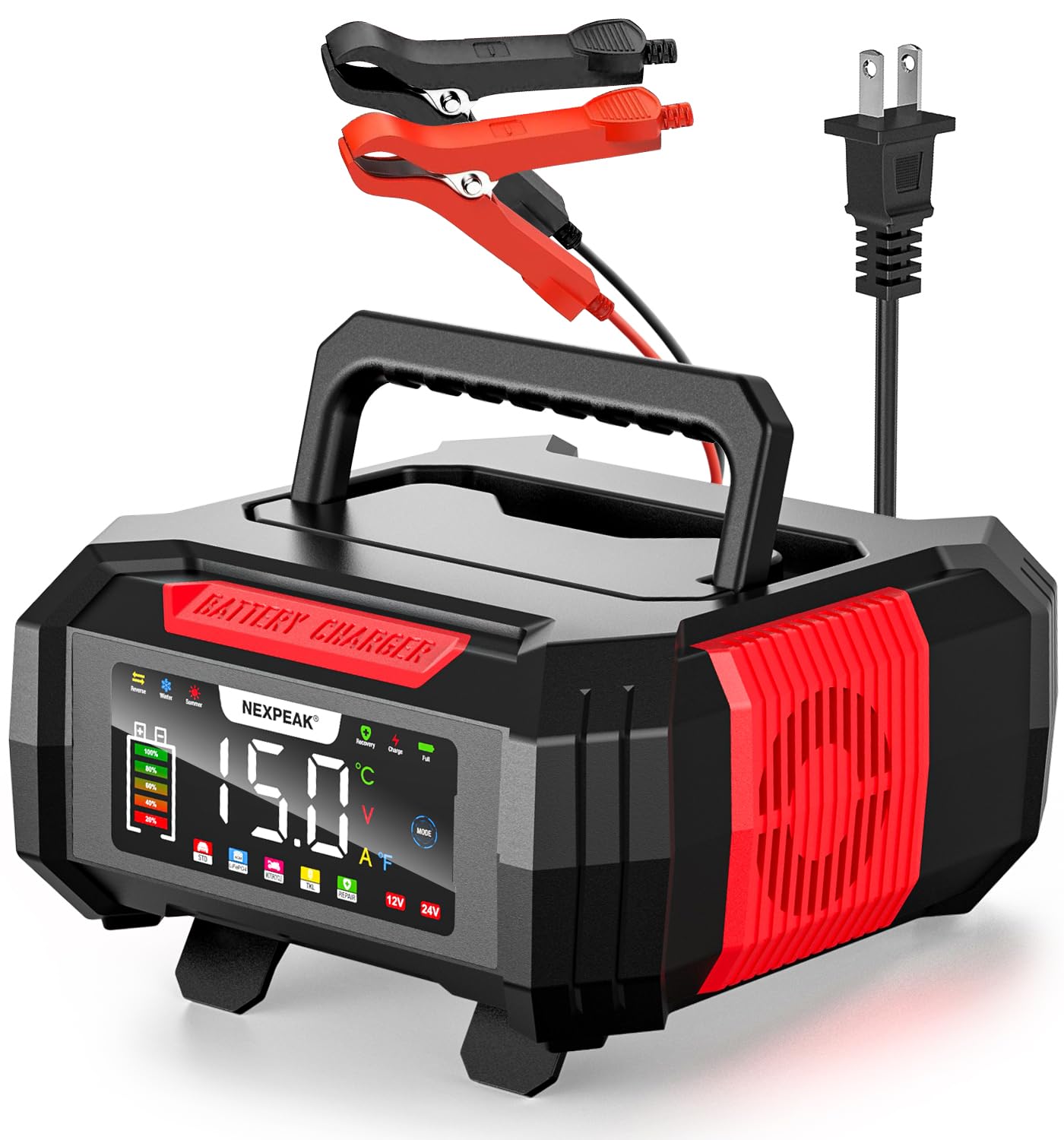
The NEXPEAK 15A charger brings impressive specs to a competitive price point. It outputs 15 amps for 12V charging and 8 amps for 24V, making it significantly faster than standard 10-amp units. The 9-stage smart charging process — including desulfation, bulk, absorption, analysis, repair, and float — rivals chargers costing twice as much. The extra-large color LCD screen displays voltage, current, internal temperature in Fahrenheit, charge percentage, and even seasonal modes (summer/winter), giving you full visibility into the charging process from across the garage.
A unique feature at this price is the 1.75-amp trickle charge mode that uses the full 9-stage process to safely maintain batteries over long periods. The pulse repair function automatically detects sulfation and applies high-frequency pulses to restore lost performance. The 8.9-foot charging cord (from clips to AC plug) provides excellent reach, making it easy to route to batteries in tight engine bays or mounted in boats. Owners consistently report that it works well on LiFePO4 batteries, tractor batteries, and deeply discharged car batteries, with the display making it easy to verify the charging status at a glance.
There are two important limitations: it cannot charge completely dead batteries below 0.3V, and some owners note that the actual charging current tops out around 11 amps even in 15-amp mode. The build quality is decent for the price, but the plastic housing and cooling fan are not as robust as premium competitors. For buyers who want fast, smart charging with full data visibility without spending premium money, the NEXPEAK 15A delivers exceptional capability per dollar spent.
What works
- 15A output charges significantly faster than 10A units
- Large color LCD shows comprehensive charging data
- 9-stage smart charging with pulse repair
- Long 8.9ft cord for flexible placement
What doesn’t
- Actual charging current may top out around 11A
- Cannot charge batteries below 0.3V
6. NOONE 2/8/15A

The NOONE charger stands out for its robust metal case and integrated engine start functionality — a rare combination at this price. It delivers 2, 8, or 15 amps of charging current for 6V and 12V batteries, plus a 25-amp engine start mode that can activate a dead battery in about 60 seconds. The metal housing with skeletonized carving design not only looks distinctive but also provides impact and drop resistance that plastic units cannot match. Inside, a high-speed cooling fan keeps temperatures in check during sustained charging sessions, and the ETL certification confirms it has passed rigorous safety testing.
The 7-stage smart charging program (desulfurization, soft start, bulk charge, absorption, analysis, repair, float) covers all the essential phases for optimal battery health. The winter mode increases charging voltage by 0.2V to improve battery activity in low temperatures — a genuinely useful feature for northern climates. The HD LCD screen clearly shows the charging stage, current, and voltage. The high-frequency chip claims up to 89.3% conversion efficiency, which translates to faster charging with less wasted energy compared to older transformer-based designs. Owner feedback is generally strong, with particular praise for the 6V mode that works reliably on vintage cars.
The engine start function is a nice emergency tool, but it’s not a substitute for a dedicated jump starter — it requires AC power, so it only helps when you have access to an outlet. There have been isolated reports of units failing after a few months, and the plastic components (fan, button) inside the metal case may not match the durability of the shell. At this price, the metal construction and ETL certification make it a compelling choice for anyone who values physical durability and wants the added security of an engine start mode.
What works
- Metal case provides superior impact and drop resistance
- 25A engine start mode for emergency starts
- Winter mode improves charging in cold temperatures
- ETL certified for safety
What doesn’t
- Isolated reports of units failing after a few months
- Engine start requires AC power — not a portable jump starter
7. LiTime 20A

The LiTime 20A charger is purpose-built for 12V (12.8V) LiFePO4 batteries, delivering 20 amps at 14.6V for fast, efficient charging. This is not a general-purpose charger — it is designed exclusively for lithium iron phosphate chemistry, making it ideal for RV house banks, off-grid solar systems, and deep-cycle marine batteries. The 3-stage charging profile (pre-charge, constant current, constant voltage) is precisely calibrated to the LiFePO4 voltage curve, ensuring the battery reaches full capacity safely without triggering BMS protection.
The 0V activation feature is critical for lithium batteries — it can wake up a deeply discharged battery whose BMS has shut down output, resetting the protection circuit and allowing normal charging to resume. The aluminum alloy housing with integrated cooling fan provides excellent thermal management; owners report the unit barely gets warm even after a full 5-hour charging cycle on a 100Ah battery. The Anderson 50A connector and M8 ring terminals offer secure, low-resistance connections suitable for high-current charging. FCC and CE certification confirm compliance with safety and emissions standards, and the 2-year warranty provides reasonable coverage for a specialized charger at this price point.
This charger is not compatible with lead-acid or AGM batteries — attempting to use it on those chemistries will likely damage both the charger and the battery. The 20A output requires appropriately sized cabling, and the Anderson connector, while excellent for durability, may require an adapter if your battery bank uses a different termination style. For serious lithium battery owners who need to recharge large banks quickly without babysitting the process, the LiTime 20A delivers precisely calibrated, worry-free performance that general-purpose chargers cannot match.
What works
- 20A output rapidly charges large LiFePO4 banks
- 0V activation wakes up BMS-protected batteries
- Aluminum housing with efficient cooling stays cool
- Precise 14.6V profile for LiFePO4 chemistry
What doesn’t
- Not compatible with lead-acid or AGM batteries
- Anderson connector may need adapters for some setups
8. ECO-WORTHY 5A

The ECO-WORTHY 5A is a compact, fully automatic smart charger designed for 12V lead-acid and LiFePO4 batteries. At 5 amps, it occupies a sweet spot between a slow maintainer and a fast charger — fast enough to charge a typical car battery overnight, yet gentle enough for long-term maintenance on smaller batteries. The LCD display shows voltage, current, and charge status, giving clear feedback without guesswork. The automatic bulk/absorption/float charging program ensures the battery receives the correct current at each stage without user intervention.
Versatility is a strong point: it comes with battery clips, O-ring terminal cables, and an SAE connector with a 10A fuse, making installation simple across different vehicles and access points. The intelligent detection system can identify low voltage, sulfation, or capacity loss and prompts the user to initiate repair charging. At just 0.45 kilograms (about 1 pound), it is easy to store in a glove box or tool bag. Owner reviews highlight its reliability for maintaining RV house batteries, motorcycle batteries, and lawn tractor batteries, with many noting that the LCD provides all the information needed to monitor charging progress at a glance.
The 5A output is not suitable for quickly reviving a deeply discharged large-capacity battery — a 100Ah battery would take roughly 20 hours from empty. Some owners noted that the unit runs warm during bulk charging, so ventilation is advisable. The plastic housing is functional but not as rugged as metal-case alternatives. For light-duty charging and maintenance of small to medium batteries, the ECO-WORTHY 5A offers an excellent balance of features and affordability in a compact footprint.
What works
- Compact and lightweight — easy to store
- LCD display provides clear charging status
- Includes three connection types (clips, ring, SAE)
- Works with both lead-acid and LiFePO4
What doesn’t
- 5A output is slow for large or deeply discharged batteries
- Runs warm during sustained bulk charging
9. NEXPEAK 4-Pack

The NEXPEAK 4-Pack delivers four 1.75-amp smart chargers in one box, making it the practical choice for households with multiple vehicles, boats, lawn tractors, or motorcycles that need seasonal maintenance. Each unit is a fully functional 4-in-1 device — charger, maintainer, trickle charger, and desulfator — for both 6V and 12V lead-acid batteries (flooded, gel, AGM, SLA, VRLA). The compact size (just over 2 inches wide) means each charger can be tucked away in tight spaces without blocking access to other equipment.
The 7-stage charging program includes desulfurization, trickle charging, constant current, constant voltage, battery current detection, compensation charging, and floating charging. The LCD screen on each unit displays charging percentage, voltage, and current. The STD mode cuts power when fully charged, while trickle mode maintains at 12.5V indefinitely — leaving them connected for months is safe. The 6.6-foot SAE cord with detachable alligator and ring connectors provides decent reach, and the memory function ensures the charger resumes the correct mode after a power outage. Owner feedback is consistently positive, with particular appreciation for the ability to keep multiple vehicles topped off without buying separate units.
The 1.75-amp output is suitable for maintenance and slow charging, but it cannot revive deeply discharged batteries quickly or handle batteries below 0.3V. Some owners report that the SAE connectors are stiff and difficult to separate, and the auto-voltage detection can occasionally misinterpret a 12V battery as 6V (though this can be overridden by holding the mode button). For fleet owners or families with multiple seasonal vehicles, the 4-pack format provides exceptional value per unit.
What works
- Four fully-featured chargers at a compelling per-unit value
- 7-stage smart charging with desulfation
- Compact size fits in tight spaces
- Memory function resumes correct mode after power loss
What doesn’t
- 1.75A output is slow for quick charging
- SAE connectors can be stiff to connect and disconnect
10. Power Queen 40A
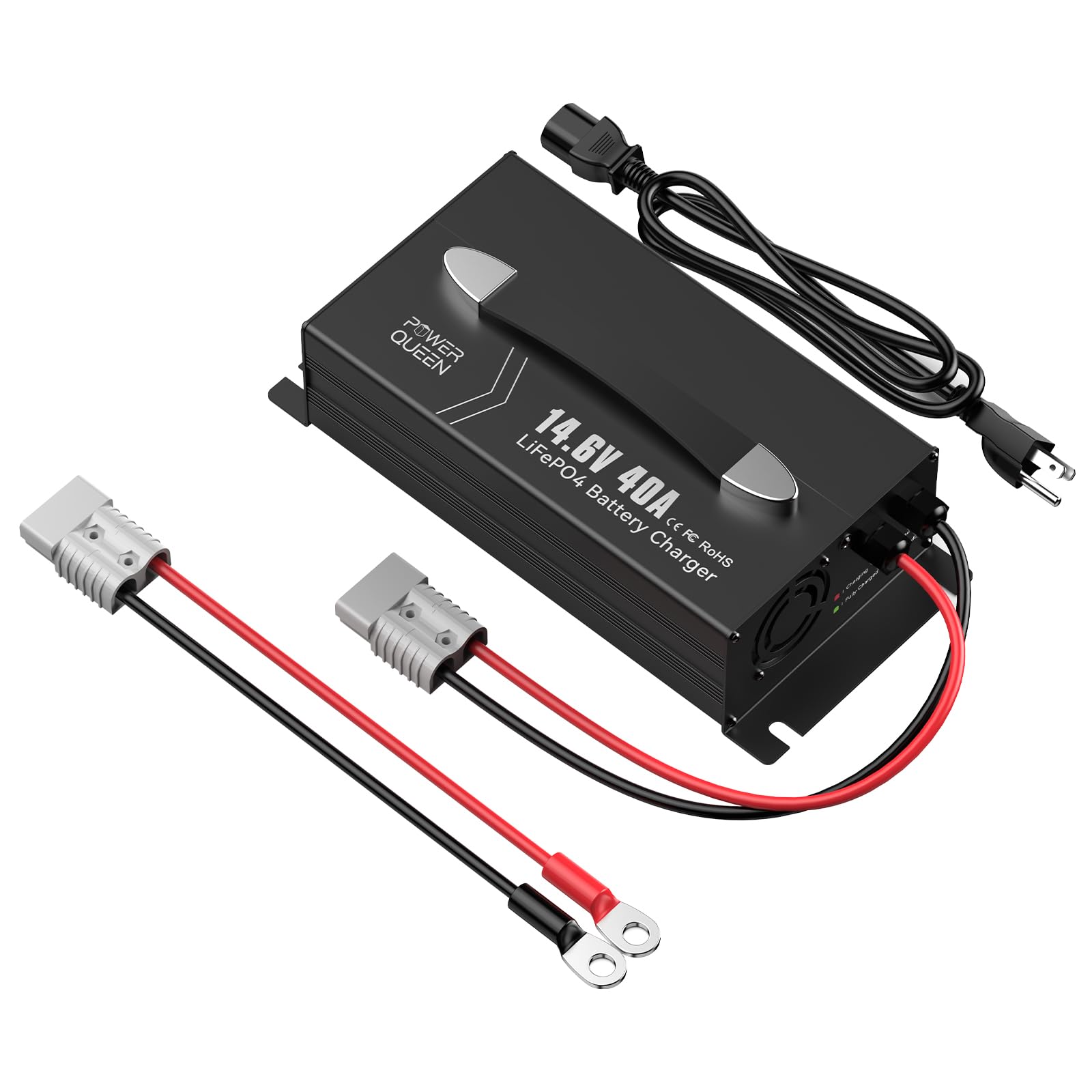
The Power Queen 40A charger is built for speed and precision with large-format LiFePO4 batteries. Delivering 40 amps at 14.6V, it can fully recharge a 200Ah lithium battery in roughly 5 hours — a task that would take a 5-amp charger over 40 hours. The 2-stage constant current/constant voltage (CC/CV) charging technology is specifically optimized for LiFePO4 chemistry, ensuring the battery receives maximum safe current during bulk phase and a precise voltage hold during absorption to reach true 100% state of charge.
The exclusive pre-charge mode (0V charging) can reset and wake up batteries whose BMS has entered protection shutdown due to deep discharge, a common issue with lithium batteries left in storage. The intuitive LED display shows real-time voltage, charging current, and output capacity, giving you full visibility into the charging process. Four protection functions — over-temperature, output short-circuit, output over-voltage, and reverse polarity — are built into the advanced circuit design, and the unit is manufactured under ISO 9001:2008 quality management standards. The metal casing and efficient thermal design ensure the charger stays cool even at maximum output.
This charger is specialized for LiFePO4 only and cannot be used on lead-acid, AGM, or gel batteries. The included detachable wire lugs with ring terminals are straightforward to install but may require adapters for batteries with alternative terminal configurations. Some owners wish it had a physical on/off toggle switch. For owners of large lithium battery banks in RVs, off-grid solar systems, or marine applications who need fast, reliable recharging, the Power Queen 40A delivers professional-grade performance at a competitive price relative to comparable high-current lithium chargers.
What works
- 40A output charges large LiFePO4 banks in hours, not days
- 0V pre-charge mode wakes up deeply discharged batteries
- Metal case with efficient cooling stays cool under load
- Clear LED display shows voltage, current, and capacity
What doesn’t
- LiFePO4 only — no lead-acid or AGM support
- No physical on/off switch
11. Schumacher SC1446

The Schumacher SC1446 is a heavy-duty, wheeled battery charger and engine starter built for professional shop use and serious home garages. It delivers 200 amps of 12V engine starting power, 40 amps of 12V boost charge, 20 amps of 6V/12V boost charge, and a 10-amp 12V charging rate. The analog ammeter lets you visually monitor charging current, and the 135-minute timer gives the operator precise manual control over every stage — this is a manual charger, not a fully automatic smart unit, and it requires attention and understanding to use correctly.
The steel case, heavy-duty clamps, retractable handle, and solid compact wheels make this a unit that can be rolled around a shop and will survive years of abuse. The 40-amp and 20-amp boost modes are genuinely useful for quickly adding charge to deeply discharged batteries before attempting an engine start. The unit works with 6V and 12V standard, AGM, gel, and deep-cycle batteries for both gas and diesel vehicles. UL certification confirms safety compliance, and the 5-year warranty on spare parts availability provides peace of mind for a long-term investment.
This is not a maintainer — there is no float mode or automatic shutoff, so it cannot be left connected indefinitely without risk of overcharging. The timer is functional but some owners report it is not precise, and the large clamps may be too wide for some battery terminals with side posts. At nearly 30 pounds, it is heavy, and the wheels are designed for shop floors, not rough surfaces. For fleet maintenance, farm use, or any environment where you need to start engines and charge batteries with robust, repairable equipment, the Schumacher SC1446 is the traditional workhorse that gets the job done.
What works
- 200A engine start capability for dead batteries
- Rugged steel case with wheels for easy shop mobility
- Multiple boost modes (40A and 20A) for deeply discharged batteries
- Analog ammeter provides real-time visual feedback
What doesn’t
- Manual operation — no automatic float mode for long-term maintenance
- Heavy at nearly 30 pounds; wheels are best on smooth surfaces
Hardware & Specs Guide
Charging Stages Explained
The number of charging stages directly affects battery health and lifespan. A basic charger may have only bulk and float stages. A 7-stage or 9-stage charger adds desulfurization (pulse recovery), soft start, absorption, analysis, and repair modes. Each additional stage provides more precise control over voltage and current, reducing stress on the battery and maximizing charge acceptance. For any battery you plan to keep long-term, a minimum of 4 stages is recommended; 7 or more stages offer optimal care, especially for AGM and LiFePO4 chemistries that require precise voltage regulation.
Amperage and Charging Speed
Higher amp ratings reduce charging time but can damage smaller batteries if not properly regulated. A 1.25-amp maintainer is ideal for 10–20Ah motorcycle or lawn tractor batteries but would take over 80 hours to charge a 100Ah deep-cycle battery from empty. A 15-amp charger handles that same 100Ah battery in roughly 7 hours. For standard car batteries (50–70Ah), a 5–10 amp charger offers a good balance of speed and safety. Always check your battery’s recommended charge rate — typically 10–20% of its amp-hour capacity.
Chemistry-Specific Charging Profiles
Lead-acid (flooded) batteries require a bulk voltage of approximately 14.4–14.8V, while AGM batteries typically charge at 14.5–14.9V but require a lower absorption current. LiFePO4 batteries need a strict 14.6V absorption voltage and can accept higher charge currents safely. Gel batteries require the lowest voltage (14.1–14.4V) and are most sensitive to overcharging. A multi-chemistry smart charger automatically selects the correct profile based on battery type selection, preventing damage from incorrect voltage application.
Temperature Compensation and Safety
Battery chemistry changes with temperature — cold batteries accept charge more slowly, while hot batteries risk thermal runaway if overcharged. Temperature compensation adjusts the charging voltage upward in cold conditions (to overcome increased internal resistance) and downward in heat (to prevent gassing and plate corrosion). This feature is essential for batteries exposed to seasonal temperature swings, such as those in unheated garages, boats, or RVs. Combined with reverse polarity protection, spark-proof clamps, and over-temperature shutoff, temperature compensation is a hallmark of a well-engineered charger.
FAQ
Can I leave a smart battery charger connected all winter?
What amp charger do I need for my car battery?
Can I charge a LiFePO4 battery with a lead-acid charger?
What does desulfation mean on a battery charger?
What is the difference between a battery maintainer and a battery charger?
Final Thoughts: The Verdict
For most buyers, the best 12 volt battery charger winner is the NOCO GENIUS5 because it combines smart multi-chemistry charging, Force Mode for dead batteries, pulse desulfation, and temperature compensation in a compact, well-built package that suits nearly every use case. If you want maximum battery life through continuous desulfation, grab the BatteryMINDer 1510. And for fast recharging of large LiFePO4 banks, nothing beats the LiTime 20A.

Certification: BSc in Mechanical Engineering
Education: Mechanical engineer
Lives In: 539 W Commerce St, Dallas, TX 75208, USA
Md Amir is an auto mechanic student and writer with over half a decade of experience in the automotive field. He has worked with top automotive brands such as Lexus, Quantum, and also owns two automotive blogs autocarneed.com and taxiwiz.com.