The temperature delta between a vehicle’s front vents and its rear seats can easily hit double digits on a hot afternoon. For anyone who regularly carries passengers, pets, or cargo in the back, that imbalance turns a simple drive into a test of endurance. A dedicated cabin air mover directly addresses that gap without requiring expensive HVAC modifications.
I’m Amir — the founder and writer behind Four Wheel Ask. Over thousands of hours spent analyzing owner reports, cross-referencing airflow specs, and evaluating build quality across dozens of models, I’ve developed a clear picture of what separates a genuine solution from a novelty gadget.
For anyone who has endured a sweltering backseat during a summer road trip, selecting the right best 12 volt automotive fan can transform cabin comfort and keep every passenger happy across all seasons.
How To Choose The Right 12 Volt Automotive Fan
Selecting a cabin fan involves more than picking the cheapest option with blades. Mounting style, airflow volume, noise output, and cord length all determine whether a fan becomes a permanent asset or a frustrating paperweight. Here is what to evaluate before buying.
Fan Size and Blade Design
Blade diameter directly correlates with the volume of air a fan can move. A 6-inch fan pushes significantly more cubic feet per minute (CFM) than a 4-inch unit at the same motor speed, but it also occupies more space in the cabin. Smaller dual-head models compensate by offering two separate airflow streams, which can cool multiple occupants simultaneously. For rear-seat use, dual 4-inch heads often strike the best balance between coverage and footprint. For a single driver needing maximum blast, a larger single fan is the better call.
Mounting Style and Build Quality
Clip-on fans attach to seat headrests, grab handles, or seat frames and require zero permanent installation. The clamp depth and padding matter — thin plastic clips can crack under vibration, while rubber-lined clamps stay secure on bumpy roads. Dashboard-mounted fans with adhesive pads offer more placement options but may leave residue if removed. Portable designs that sit on seats or center consoles are easy to move between vehicles but can slide during cornering. For daily use in a single vehicle, a robust clip-on design with metal-reinforced jaws provides the most secure hold.
Noise Level and Motor Quality
Noise is measured in decibels (dB), with most automotive fans ranging from 28 dB (barely audible) to 50 dB (noticeable hum). A fan that sounds reasonable in a parked car can become irritating on a four-hour highway trip. Sleeve bearings are common at lower price points and tend to wear faster, producing rattles after extended use. Higher-quality motors with sealed ball bearings or brushless designs run quieter over time and last through thousands of hours of operation. Reading owner feedback about long-term noise performance is often more revealing than the spec sheet.
Cord Length and Power Compatibility
Every 12V automotive fan plugs into a standard cigarette lighter socket, but cord length determines placement flexibility. An 8-foot cord lets you route the fan to rear seats from a front dash outlet, while a 28-inch cord limits you to positions near the socket. Some fans include a right-angle plug or a low-profile adapter that won’t block adjacent ports. For vehicles with USB-C or accessory ports that do not accept cigarette lighter plugs, a separate 12V-to-USB adapter may be required. Always verify that the fan’s total amperage draw does not exceed the vehicle socket’s fuse rating, typically 10 to 15 amps.
Quick Comparison
On smaller screens, swipe sideways to see the full table.
| Model | Category | Best For | Key Spec | Amazon |
|---|---|---|---|---|
| TN TONNY Dual Head Car Fan | Dual Head Clip Fan | Rear Passenger Comfort | Dual 4″ Heads, Stepless Speed | Amazon |
| Hynoo 12V Car Clip Fans | Dual Head Clip Fan | Cabin Versatility | 360° Rotation, 2.5m Cord | Amazon |
| XOOL 12V 6″ Car Fan | Single Clip Fan | High Airflow Output | 6″ Blade, Stepless Dial | Amazon |
| ZONETECH Dual Head Car Fan | Portable Dashboard Fan | Quick Setup & Removal | 8ft Cord, 3M Adhesive Base | Amazon |
| Wathai 120mm Computer Fan | Electronics Cooling Fan | DIY Projects & Small Enclosures | 66.7 CFM, 2000 RPM | Amazon |
In‑Depth Reviews
1. TN TONNY 12V Dual Head Car Fan

The TN TONNY Dual Head Car Fan delivers the most practical combination of airflow coverage, mounting security, and user control in this segment. Its two independently rotatable 4-inch heads allow each occupant to direct air precisely where needed, while the stepless speed dial eliminates the frustration of preset levels that are either too weak or too loud. The clamp mechanism uses a wide jaw with firm grip padding that stays locked on headrest posts and seat frames even over rough pavement.
Owner reports consistently highlight the near-silent operation at low speeds, making it viable for overnight use in campers and truck cabs without disturbing sleep. The dual-head design also means both the driver and rear passenger can benefit simultaneously, which is rare at this price tier. The 360-degree rotation on each head and the rotatable base give complete control over airflow direction without having to reposition the entire unit.
One caveat is that both heads share a single speed controller, so you cannot run one head on low and the other on high. The plastic housing feels solid for the weight class, though the clip could benefit from a slightly deeper jaw for very thick seat frames. For the vast majority of sedans, SUVs, and trucks, this fan installs in seconds and stays put through daily use.
What works
- Nearly silent operation at low speeds
- Two independently adjustable heads for multi-passenger coverage
- Stepless speed dial offers infinite adjustment range
- Secure clip holds firm on bumpy roads
What doesn’t
- Both heads share one speed control
- Clip depth may not suit thick off-road seat frames
2. Hynoo 12V Car Clip Fans

The Hynoo 12V Car Clip Fan stands out for its generous 2.5-meter power cord and full 360-degree rotation on both heads, giving it the widest placement flexibility of any dual-head model in this review. Each fan head rotates vertically a full 360 degrees and horizontally 180 degrees, meaning you can direct airflow forward toward the driver, backward into a cargo area, or angle both heads to cover a third-row seat. The clamp is reinforced with a sturdy jaw that handles vibration from rough roads without loosening.
Reviewers consistently praise the build quality relative to the price point, noting that the fan does not feel flimsy or cheap during assembly. The matte finish resists fingerprints and glare, which matters when the fan is mounted in direct sunlight. The low energy draw makes it safe for continuous use during long drives, and the noise level at medium speed is described as a gentle hum that does not interfere with conversation or music at normal volumes.
The primary trade-off is that the individual fan heads are 4 inches in diameter, so maximum airflow per head is lower than a single large fan. However, the dual-stream design compensates by cooling two seating positions simultaneously. Some owners have reported that the clip-on mechanism works best on headrest posts rather than flat seat-back panels, so verifying your vehicle’s seat geometry before purchase is wise.
What works
- Very long cord enables rear-seat placement from front outlet
- Full 360-degree rotation on both heads
- Sturdy build quality with good vibration resistance
- Low noise output at medium speeds
What doesn’t
- 4-inch heads limit maximum airflow per stream
- Clip optimized for headrest posts, not flat panels
3. XOOL 12V 6″ Car Fan

The XOOL 12V 6-Inch Car Fan is the strongest single-source airflow option in this lineup, thanks to its larger blade diameter and efficient motor. The stepless speed dial provides smooth adjustment from a gentle breeze to serious wind force — several owner reports note that high speed produces enough velocity to make phone calls difficult. This fan is ideal for the driver who wants maximum cooling directed at one zone without paying a premium.
The clip-on mount is generously sized and fits a wide range of surfaces from headrest posts to desk edges, making it equally useful in a vehicle, camper, or workshop. The powder-coated finish on the metal components resists corrosion, and the safety grid spacing is narrow enough to prevent finger contact. Owners who use this fan professionally in long-haul trucks report that it lasts roughly a year of 40-hour weeks before bearing wear becomes noticeable, which is reasonable for the price.
Noise output is higher than the dual-head models, particularly at maximum speed where it registers near 50 dB. The single-fan design also means you cannot cool two separate seating areas simultaneously unless you buy two units. For a solo driver or a passenger who needs serious airflow directed at one spot, this fan delivers unmatched volume per dollar.
What works
- Powerful airflow from large 6-inch blade
- Stepless dial gives true infinite adjustment
- Versatile clip fits many surfaces beyond car seats
- Corrosion-resistant powder-coated metal parts
What doesn’t
- Noticeable noise at highest speed settings
- Single head cannot cool multiple zones at once
4. ZONETECH Car Cooling Air Fan 12V Dual Head

The ZONETECH Dual Head Car Fan takes a different approach to mounting by offering both a portable design and a 3M adhesive base for semi-permanent dashboard or armrest installation. This flexibility makes it the best option for vehicles where seat-mounted clips are impractical, such as sports cars with fixed-back seats or vans with integrated seat structures. The 8-foot power cord is the longest in this comparison, allowing placement far from the cigarette lighter socket.
The dual-head design rotates a full 360 degrees, and each head can be tilted independently to direct air where it is needed most. Owners with rear-facing child seats or pets in cargo areas consistently report that this fan successfully pulls cool air from the front vents and circulates it to the back, reducing temperature complaints from young passengers. The protective circuit design prevents overheating during extended continuous use, which is a valuable safety feature for overnight trips.
Some early durability reports mention that one of the two fan motors can lose power after a few months of heavy daily use, though this pattern is not universal. The adhesive base, while convenient, may lose grip in very hot cabin temperatures over time. The fan is louder than premium competitors at equivalent speeds, making it better suited to daytime driving than overnight sleep environments.
What works
- 8-foot cord offers exceptional placement flexibility
- Dual heads with 360-degree rotation and independent tilt
- Adhesive base works where clips cannot attach
- Overheat protection circuit for extended use
What doesn’t
- Inconsistent long-term motor reliability reported
- Adhesive base may weaken in extreme cabin heat
- Audible noise at all speed settings
5. Wathai 120mm x 25mm 12V Computer Case Cooling Fan 2-Pack
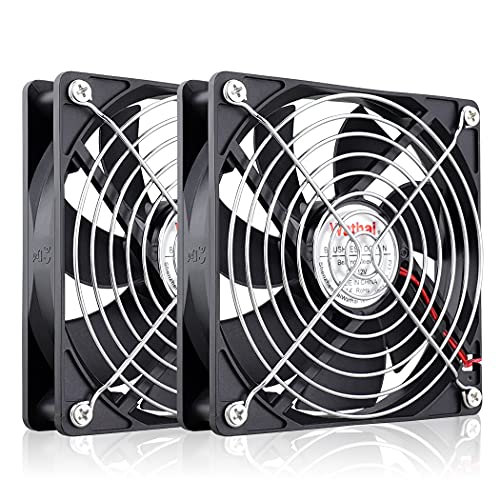
The Wathai 120mm Computer Fan occupies a different niche than the cabin-focused models above. Designed primarily for electronics cooling, this slim 120mm by 25mm fan delivers 66.7 CFM of airflow at a quiet 28 dB noise level — quieter than any automotive cabin fan tested. It comes as a two-pack with mounting screws, fan grills, and XH2.54-2Pin connectors, making it a solid option for DIY enthusiasts who want to build a custom ventilation solution for an RV electrical cabinet, a camper battery compartment, or a portable cooler setup.
Owner feedback shows this fan excelling in replacement roles for power supplies, amplifiers, and dehumidifiers where the original fan has failed. The sleeve bearing motor is rated for 35,000 hours, which translates to roughly four years of continuous operation. Several owners have successfully used these fans in camper van electrical bays to exhaust heat from inverter and battery banks, keeping sensitive electronics within their operating temperature range.
This is not a ready-to-deploy cabin fan — it lacks a cigarette lighter plug, clip mount, or any automotive-specific mounting hardware. To use it in a vehicle cabin, you would need to fabricate a bracket, wire a 12V plug, and install a switch. For the buyer who wants a plug-and-play solution for rear-seat passengers, one of the clip-on fans above is a far better choice. For the tinkerer who needs reliable, quiet airflow for an electronics enclosure, this kit delivers outstanding value.
What works
- Very quiet operation at just 28 dB
- Two fans included with all mounting hardware
- Compact size fits tight electronics enclosures
- Proven reliability in replacement and DIY applications
What doesn’t
- No cigarette lighter plug or automotive wiring
- No clip or mount for cabin use out of the box
- Requires fabrication skills for vehicle installation
Hardware & Specs Guide
Airflow Volume (CFM)
Cubic Feet per Minute measures how much air a fan moves at full speed. Higher CFM numbers mean stronger cooling but often come with more noise. For cabin fans, 60 to 80 CFM per head is sufficient for rear-seat comfort. Dual-head models with 40 CFM per head produce a combined output that effectively cools two passengers, while single 6-inch fans can exceed 80 CFM for concentrated airflow on one person.
Noise Level (dB)
Decibel ratings are logarithmic, meaning a 30 dB fan is twice as loud as 20 dB, and 50 dB is sixteen times louder than 20 dB. Fans rated under 30 dB are suitable for sleeping environments, those in the 30-40 dB range work well for daytime driving, and anything above 45 dB becomes intrusive during conversation or music listening. Always check owner reviews for real-world noise impressions since manufacturer dB ratings are measured in controlled conditions.
Mounting Mechanisms
Clip-on fans use spring-loaded jaws that clamp onto headrest posts, seat frames, or grab handles. Look for rubber or foam padding on the clamp interior to prevent scratching and improve grip. Adhesive-mounted fans use 3M VHB tape for dashboard or console attachment — these leave residue upon removal and lose adhesion in extreme heat. Portable fans rely on gravity and surface friction and should not be used in vehicles that corner aggressively.
Motor and Bearing Types
Sleeve bearings are common in budget fans and rely on oil-soaked porous metal. They wear faster in hot environments and can develop rattles after 6-12 months of daily use. Ball bearings use rolling elements and last significantly longer, typically 30,000 to 50,000 hours, but cost more. Brushless DC motors offer the best efficiency and lifespan but are rarely found in automotive cabin fans under mid-range pricing.
FAQ
What size 12 Volt Automotive Fan works best for rear passengers?
Can I install a 12 Volt Automotive Fan without permanent modifications?
How much power does a 12 Volt Automotive Fan draw from the car battery?
Are dual-head fans better than single-head fans for cabin cooling?
Final Thoughts: The Verdict
For most buyers, the best 12 volt automotive fan winner is the TN TONNY Dual Head Car Fan because it combines two independently adjustable heads, near-silent operation, and a secure clip-on mount at a reasonable investment. If you need maximum single-zone airflow, grab the XOOL 6-Inch Car Fan. And for the longest cord and most versatile rotation range, nothing beats the Hynoo 12V Car Clip Fan for cabin-wide coverage.

Certification: BSc in Mechanical Engineering
Education: Mechanical engineer
Lives In: 539 W Commerce St, Dallas, TX 75208, USA
Md Amir is an auto mechanic student and writer with over half a decade of experience in the automotive field. He has worked with top automotive brands such as Lexus, Quantum, and also owns two automotive blogs autocarneed.com and taxiwiz.com.