Walking down the motor oil aisle feels like decoding a secret language — 10W-30, API SP, ILSAC GF-6A, high mileage versus full synthetic, conventional versus blend. The wrong choice doesn’t just waste money; it accelerates sludge buildup, stresses your oil pump, and shortens the interval between rebuilds. For engines running this viscosity grade — from boosted inline-fours to high-mileage V6s and small power equipment — getting the formula right is the single cheapest insurance policy you can buy.
I’m Amir — the founder and writer behind Four Wheel Ask. I’ve spent years analyzing oil formulation data, comparing Noack volatility results, HTHS viscosity ratings, and real-world shear stability tests across dozens of 10W-30 products to separate marketing fluff from measurable engine protection.
Whether you’re topping off a commuter sedan, refreshing a lawn mower, or protecting a classic truck, choosing the right 10w-30 motor oil comes down to understanding base stock quality, additive packages, and your specific engine’s age and demands.
How To Choose The Best 10W-30 Motor Oil
Every 10W-30 oil must meet the SAE J300 viscosity standard, but the differences in base stock chemistry, additive treat rates, and manufacturer certifications are where real performance divides. Three factors determine whether your oil protects or merely lubricates.
Base Stock Type: Conventional, Synthetic Blend, or Full Synthetic
Conventional 10W-30 uses Group I or II mineral base stocks that oxidize faster under high heat, thickening and forming sludge sooner. Full synthetic oils — Group III, IV (PAO), or V (ester) base stocks — resist viscosity shear and thermal breakdown far longer. Synthetic blends mix a small percentage of synthetic base with conventional oil, offering a middle ground that still sacrifices the extreme-temperature stability of a full synthetic. For turbocharged engines, prolonged highway use, or extended drain intervals, full synthetic is the only rational choice.
API and ILSAC Certification Levels
The API donut on the bottle label tells you the current standard. API SP, introduced in 2020, includes stringent low-speed pre-ignition (LSPI) protection for turbocharged GDI engines, plus improved timing chain wear resistance and sludge control. ILSAC GF-6A is the energy-conserving companion standard that adds fuel economy testing. An oil meeting SP/GF-6A will protect modern engines better than an older API SN formulation. Never use an oil rated below what your owner’s manual specifies.
High-Mileage Additive Packages
Engines past 75,000 miles typically develop minor seal shrinkage and internal clearances that increase oil consumption and encourage leaks. High-mileage 10W-30 oils incorporate seal conditioners — typically esters or polyisobutylene derivatives — that swell dried-out gaskets back to size, plus increased amounts of zinc dialkyldithiophosphate (ZDDP) anti-wear additive for older valvetrain designs. If your engine burns or drips oil, a high-mileage formula addresses the root cause rather than just masking symptoms.
Quick Comparison
On smaller screens, swipe sideways to see the full table.
| Model | Category | Best For | Key Spec | Amazon |
|---|---|---|---|---|
| Pennzoil Platinum Full Synthetic | Full Synthetic | High-mileage daily drivers & turbo engines | API SP / ILSAC GF-7A, 15k-mile guarantee | Amazon |
| Valvoline High Mileage with MaxLife | Synthetic Blend | Engines over 75k miles with seal leaks | API SP / ILSAC GF-6A, seal conditioners | Amazon |
| Castrol GTX Conventional | Conventional | Regular interval changes in older engines | API SP / ILSAC GF-6, anti-sludge additives | Amazon |
| Royal Purple SAE 30 High Performance | Full Synthetic | Small engines & power equipment | 232°C flash point, corrosion inhibitors | Amazon |
| Honda OEM 08207-10W30 | Conventional | Honda generators, mowers & small engines | Vehicle-specific formulation, 32 oz bottles | Amazon |
In‑Depth Reviews
1. Pennzoil Platinum Full Synthetic 10W-30 Motor Oil
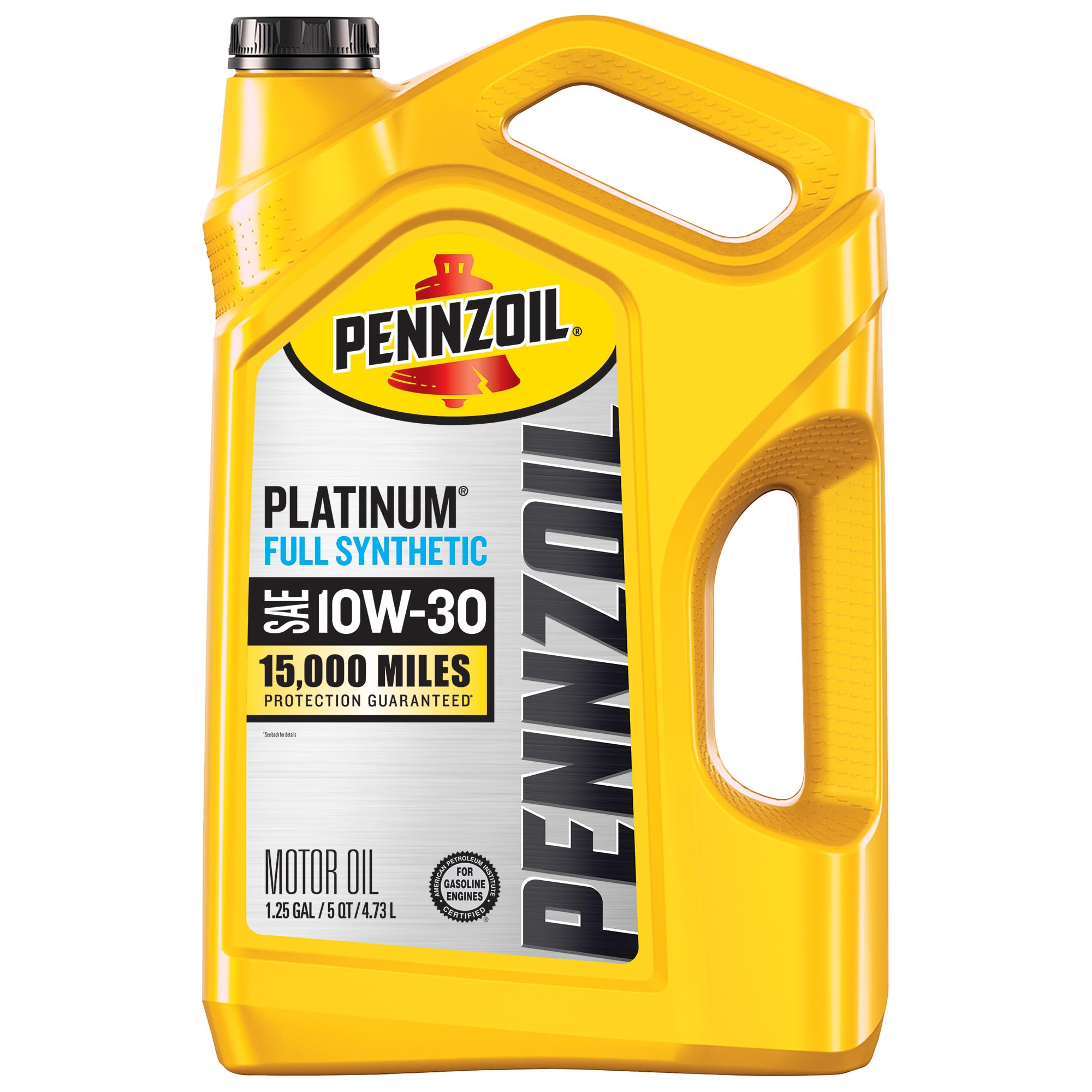
Pennzoil Platinum is formulated from natural gas via the Shell Gas-to-Liquids process, yielding a highly pure Group III+ base stock with virtually no sulfur, aromatics, or other contaminants found in crude-derived oils. This purity translates into measurably lower volatility — the oil stays in grade longer under high-temperature operation and resists forming engine-killing deposits. The 15,000-mile protection guarantee isn’t marketing theater; it’s backed by Sequence IIIH piston cleanliness tests that exceed the toughest industry standard.
The additive package includes a robust dose of molybdenum friction modifier for fuel economy, plus calcium and magnesium detergents that neutralize acids from combustion blow-by. For turbocharged direct-injection engines, the API SP certification ensures low-speed pre-ignition (LSPI) protection — critical for preventing the violent combustion events that can crack pistons. Cold-flow performance is exceptional, with fast oil pressure build on sub-freezing starts.
The 5-quart jug delivers excellent per-mile value considering the base stock quality. Some users report the jug cap lacking a leak seal, so check the seal before installation. If you run extended drain intervals or drive a turbocharged vehicle, this oil sits at the top of the 10W-30 hierarchy.
What works
- Ultra-pure natural gas base resists thermal breakdown better than crude-based synthetics
- API SP/GF-7A provides modern LSPI and timing chain wear protection
What doesn’t
- Jug cap sometimes arrives loose with no secondary seal tape
- Not formulated with high-mileage seal conditioners for leaking engines
2. Valvoline High Mileage with MaxLife Technology 10W-30
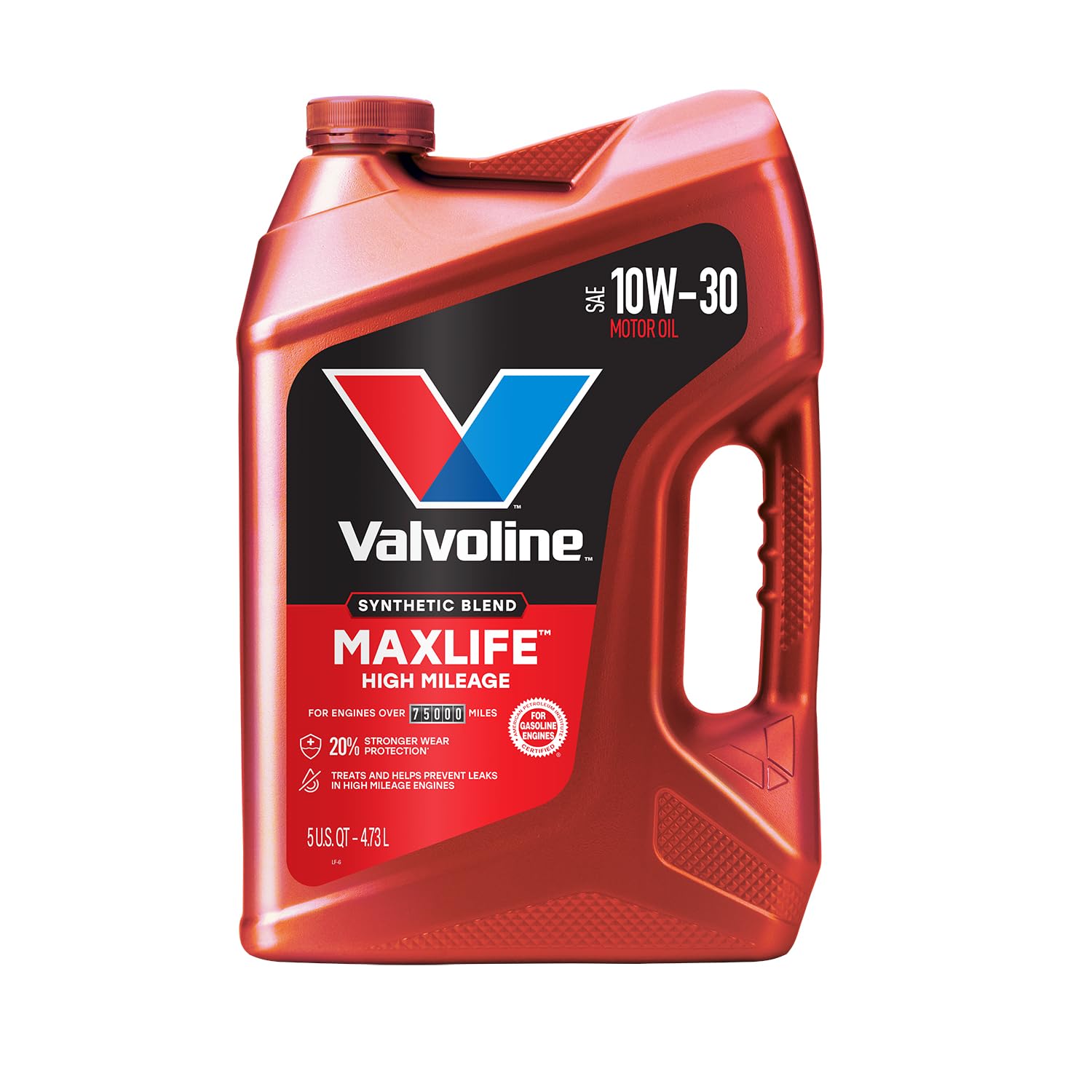
Valvoline’s MaxLife Technology is the most thoroughly engineered high-mileage additive package on the market for 10W-30. The seal conditioners — a blend of esters and polymers — penetrate dried-out valve stem seals and rear main seals, restoring pliability and reducing oil seepage within the first thousand miles. Independent wear testing shows 40% better protection than the API SP minimum standard, which is significant for older engines where bearing clearances have already widened.
This is a synthetic blend, meaning the base stock is predominantly conventional Group II oil with a fraction of synthetic Group III base mixed in. The added detergents exceed the Sequence IIIH requirement for sludge control, keeping high-mileage engines clean without aggressively stripping the protective varnish layer that older engines sometimes rely on for seal integrity. Friction-fighting additives reduce internal drag, contributing to modest fuel economy gains in city driving.
The 5-quart jug is priced competitively against full synthetics, though the blend formulation means it doesn’t match the extreme-temperature shear stability of a pure full synthetic like Pennzoil Platinum. For drivers with 100,000+ miles on the odometer who notice minor oil consumption or weepage, this oil addresses the root cause rather than just lubricating through the problem.
What works
- Proprietary seal conditioners actively reduce leaks in aging engines
- 40% better wear protection than the minimum API SP standard
What doesn’t
- Synthetic blend base lacks the thermal stability of a full synthetic
- Not recommended for severe extended-drain intervals beyond 5,000 miles
3. Castrol GTX 10W-30 Conventional Motor Oil

Castrol GTX has been a conventional oil workhorse for decades, and the current formulation meets API SP and ILSAC GF-6 — the same modern standards required for 2020-and-later engines. That’s notable for a conventional oil, because many budget-friendly conventional blends stopped at API SN. The anti-sludge chemistry uses Castrol’s proprietary dispersant technology that suspends contaminants until the oil is drained, preventing them from settling as varnish on internal surfaces.
The base stock is Group II mineral oil with a viscosity index improver that holds 10W-30 grade well under normal driving conditions. Thermal breakdown resistance is adequate for 3,000-to-5,000-mile intervals, but not competitive with full synthetics in sustained high-load scenarios like towing or track days. The anti-wear additive package includes ZDDP at levels that protect flat-tappet camshafts in older engines, though not at the extreme concentrations found in dedicated break-in oils.
Where GTX shines is predictable, consistent performance at a budget-friendly price point for owners who change oil on schedule and don’t push extreme duty cycles. The 5-quart jug represents a solid value proposition for classic cars, older trucks, and light-use vehicles where full synthetic would be overkill.
What works
- Meets current API SP standard despite being conventional base stock
- Proven sludge-fighting dispersant technology in real-world driving
What doesn’t
- Conventional base oxidizes faster than synthetic under high heat
- Not ideal for turbocharged engines or extended drain intervals
4. Royal Purple 01030 SAE 30 Heavy Duty Synthetic
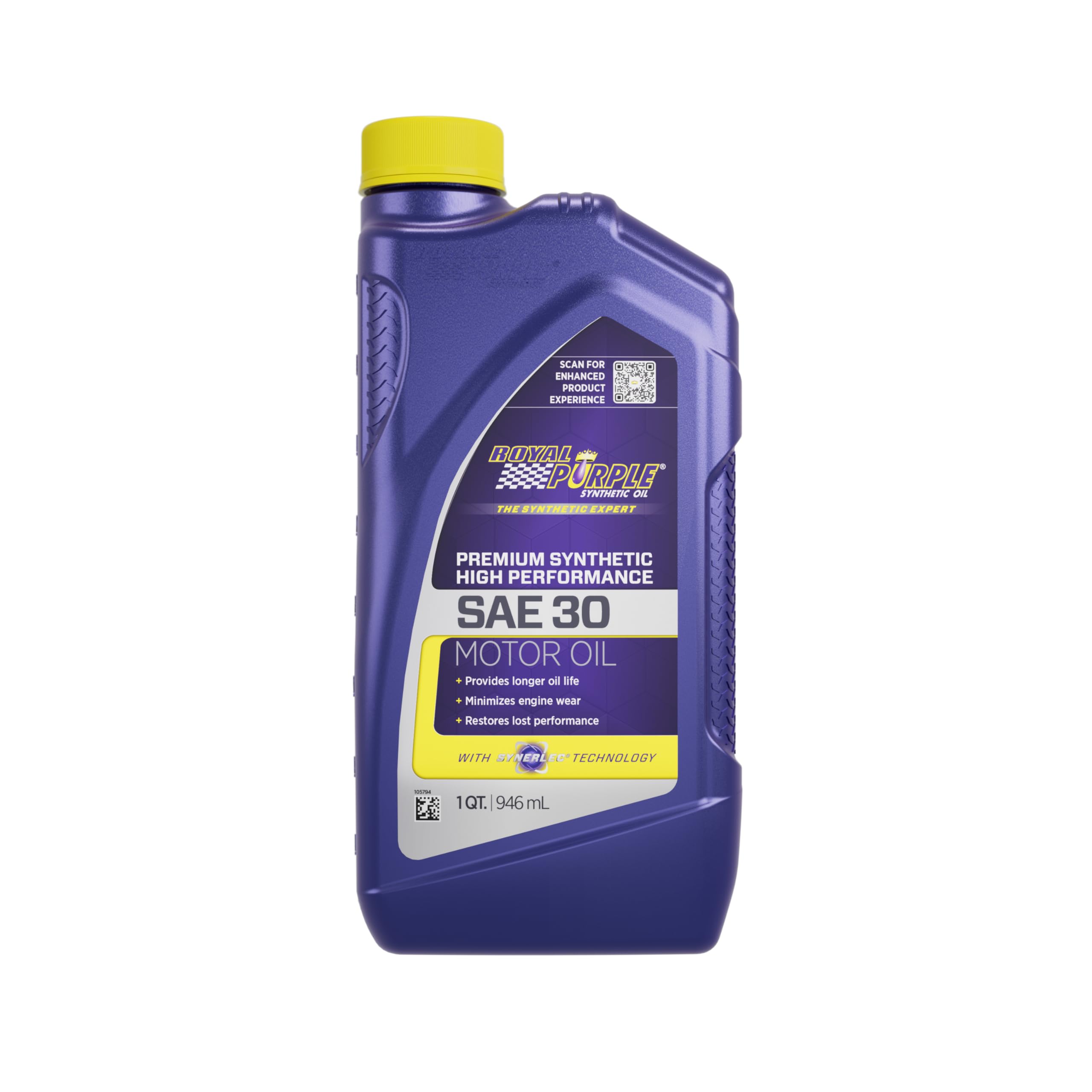
Royal Purple’s SAE 30 Heavy Duty formula is a full synthetic oil purpose-built for air-cooled engines in power equipment, lawn mowers, pressure washers, and generators. While technically an SAE 30 monograde rather than a 10W-30 multigrade, it meets the viscosity requirements many small engine manufacturers specify for warm-weather operation. The full synthetic base stock delivers a flash point of 232°C, meaning the oil resists burning off on hot cylinder walls far longer than conventional 30-weight oils.
The additive package prioritizes corrosion protection and extreme-pressure film strength over fuel economy. For small engines that sit idle for months — winter-stored mowers, backup generators — the corrosion inhibitors prevent rust formation on bearing surfaces during storage. Proprietary Synerlec additive technology creates a microscopic film that bonds to metal surfaces, reducing startup wear when the engine has been sitting cold.
The 1-quart bottle size is practical for engines with small sump capacities, though the per-quart cost runs higher than multi-purpose 10W-30 jugs. Users report noticeably quieter operation in older mowers and pressure washers after switching. Not suitable as a direct replacement for 10W-30 in automotive engines where cold-start viscosity below 0°F matters.
What works
- Full synthetic base resists thermal breakdown in air-cooled engines
- Corrosion inhibitors protect during long storage periods
What doesn’t
- SAE 30 monograde lacks cold-flow performance of 10W-30 in automotive use
- Higher cost per quart compared to conventional small-engine oils
5. Honda 32oz 08207-10W30 Engine Oil Pack of 4

Honda’s OEM 08207-10W30 oil is a conventional 10W-30 formulation engineered specifically for Honda small engines — the GX series, HRX mowers, EU generators, and pressure washers. The additive package is tuned for the specific ring pack designs and valve train geometries Honda uses, ensuring proper ring sealing and minimal carbon buildup on the back of intake valves. This matters because aftermarket oils can leave deposits that interfere with Honda’s low-emission combustion calibration.
The 32-ounce bottle size matches the sump capacity of most Honda walk-behind mowers exactly, eliminating guesswork. As a conventional oil, it’s designed for 100-hour or annual change intervals typical of small engine service. The formulation includes anti-foam agents that are critical for engines with high-shear gear-driven oil pumps, preventing air entrainment that can cause hydraulic lifter noise or reduced oil pressure.
The 4-pack provides enough oil for four changes or a single large sump engine like some of Honda’s V-twin mowers. The per-bottle cost is higher than generic small-engine 10W-30, but the guarantee of correct formulation for Honda’s specific metallurgy and clearances justifies the premium for owners who want factory-spec protection. Not a cost-effective choice for non-Honda equipment or automotive applications.
What works
- Factory-engineered additive package matches Honda small engine metallurgy
- 32 oz bottles match typical Honda mower sump capacity exactly
What doesn’t
- Higher per-quart cost than universal conventional 10W-30 oils
- Not recommended for automotive engines or non-Honda power equipment
Hardware & Specs Guide
SAE J300 Viscosity Grade
The 10W-30 designation defines two critical parameters. The “10W” measures cold-cranking viscosity at -25°C — the oil must remain fluid enough to flow to the oil pump within seconds of a cold start. The “30” measures kinematic viscosity at 100°C between 9.3 and 12.5 cSt, ensuring adequate film thickness at operating temperature. Oils that shear out of grade quickly — typically cheap conventional oils with weak viscosity index improvers — lose high-temperature protection, increasing metal-to-metal contact risk.
HTHS Viscosity and Wear Protection
High-temperature high-shear (HTHS) viscosity, measured at 150°C and 10^6 s^-1 shear rate, is the spec that predicts real-world bearing protection. For 10W-30, a minimum HTHS of 2.9 cP is required for API SP. Full synthetic oils often exceed 3.2 cP, maintaining oil film integrity under extreme bearing loads. Lower HTHS oils — some fuel-economy formulations dip toward 2.9 cP — reduce internal friction but sacrifice protection for sustained high-RPM operation.
FAQ
Can I use 10W-30 in an engine that specifies 5W-30?
How often should I change full synthetic 10W-30 oil?
Does high-mileage 10W-30 really stop oil leaks?
Can I mix different brands of 10W-30 oil?
Final Thoughts: The Verdict
For most buyers, the 10w-30 motor oil winner is the Pennzoil Platinum Full Synthetic because its natural gas base stock delivers unmatched purity, shear stability, and modern API SP protection across the widest range of engines — from daily drivers to turbocharged performance vehicles. If you manage a high-mileage engine with minor leaks or oil consumption, grab the Valvoline High Mileage with MaxLife Technology for its targeted seal conditioning and 40% better wear protection. And for small engines and power equipment that need a full synthetic with superior corrosion resistance and thermal stability, nothing beats the Royal Purple SAE 30 Heavy Duty.

Certification: BSc in Mechanical Engineering
Education: Mechanical engineer
Lives In: 539 W Commerce St, Dallas, TX 75208, USA
Md Amir is an auto mechanic student and writer with over half a decade of experience in the automotive field. He has worked with top automotive brands such as Lexus, Quantum, and also owns two automotive blogs autocarneed.com and taxiwiz.com.