Thin-gauge cables that stiffen in freezing weather or clamps that slip off side-post terminals turn a five-minute jump into a roadside frustration. The right set of 10-foot cables balances conductor thickness, clamp bite, and cold-weather flexibility, so you get a reliable connection the first time.
I’m Amir — the founder and writer behind Four Wheel Ask. I analyze automotive battery and charging accessories by cross-referencing detailed market data, published conductor specifications, and aggregated owner feedback to separate real performance from marketing claims.
Whether you drive a compact sedan, a full-size SUV, or a diesel truck, a solid set of 10 ft jumper cables needs the right gauge for your engine size, clamps that grip securely, and insulation that stays flexible in subzero conditions. This guide breaks down the key specs to look for and reviews the top contenders on the market.
How To Choose The Best 10 Ft Jumper Cables
Selecting the right set of jumper cables means matching the conductor gauge to your vehicle’s starting current requirements. A cable that works for a motorcycle will struggle with a diesel truck’s starter motor, creating dangerous heat buildup. The key specs are wire gauge, conductor material, clamp construction, and insulation cold rating.
Wire Gauge and Conductor Material
The American Wire Gauge (AWG) number gets smaller as the wire gets thicker. A lower gauge handles more amperage with less voltage drop. For passenger cars and SUPs with gasoline engines up to 6.0L, a 6 AWG cable is considered the minimum safe choice. For diesel trucks and heavy SUVs, 4 AWG or even 2 AWG provides the low-resistance path needed for reliable cranking. The conductor itself is typically either pure copper, which offers the best conductivity and flexibility, or copper-clad aluminum (CCA), which is lighter and cheaper but requires a thicker gauge to match copper’s current capacity. Pure copper cables resist internal breakage from repeated coiling at low temperatures.
Clamp Design and Grip Strength
A clamp with weak spring tension or narrow jaw opening will not stay attached to a side-post battery terminal. Look for fully insulated clamps that cover the entire metal surface to prevent accidental sparks against the chassis. Serrated teeth bite into lead terminals better than smooth jaws. Some premium clamps use a copper ribbon or bus bar on both sides of the jaw to conduct current through the entire clamp body, which reduces hot spots. The clamp opening should be wide enough to fit over top-post brass terminals and the recessed side posts found on many GM and some Ford vehicles.
Cable Length and Cold-Weather Flexibility
A 10-foot cable provides enough reach for nose-to-nose parking without requiring the cars to be perfectly aligned. The PVC or TPE (thermoplastic elastomer) jacket must stay pliable in freezing temperatures—some cables stiffen into a hard coil at -4°F (-20°C), making it difficult to route the cable to the battery. Check the manufacturer’s low-temperature rating: quality cables remain flexible down to -40°F/C. The jacket should also resist cracking when bent repeatedly at low temperatures.
Quick Comparison
On smaller screens, swipe sideways to see the full table.
| Model | Category | Best For | Key Spec | Amazon |
|---|---|---|---|---|
| Spartan Power 4 AWG 10Ft | Premium | Diesel trucks, heavy equipment | 4 AWG, pure copper, 5.76 lbs | Amazon |
| XINCOL A5 100% Copper 10FT | Premium | Large diesel & gas engines | 2 AWG, pure copper, 5.46 lbs | Amazon |
| CARTMAN 4 Gauge 16 Feet | Mid-Range | Full-size cars, cargo vans | 4 AWG, CCA, 4.38 lbs | Amazon |
| Nilight 6 Gauge 12 FT | Mid-Range | Compact cars, sedans, SUVs | 6 AWG, CCA, 3.65 lbs | Amazon |
| FUAUJUE Alligator Clip 10Ft | Budget | Small engines, testing | 10 AWG, 50 amps, 1.28 lbs | Amazon |
In‑Depth Reviews
1. Spartan Power 10 Foot 4 AWG Heavy Duty Jumper Cables

The Spartan Power set uses 4 AWG pure copper conductors with a UL-listed cable found in their inverter battery cable sets. At 5.76 pounds, the weight reflects the thick copper strands and heavy-duty insulation. The clamps feature a copper ribbon that connects both sides of the jaw, so voltage flows through the entire clamp body rather than just one contact point—a design that reduces resistive heating during extended cranking on diesel engines. The bright yellow storage bag includes a reflective safety stripe and can be worn as a backpack.
Owners of large diesel trucks and heavy fleet equipment report consistent starts even after multiple attempts on deeply discharged batteries. The lifetime crimp warranty from Spartan Power covers any factory crimp failure, which adds long-term confidence. The insulation stays flexible down to -40°F, making this set usable in extreme winter conditions where cheaper cables become rigid.
The main trade-off is the 10-foot length—adequate for nose-to-nose parking, but not long enough for awkward roadside angles where vehicles cannot align perfectly. Some users note the clamps, while sturdy, are bulky on compact car batteries with tight terminal access. The all-copper construction also makes these one of the heavier options for casual trunk storage.
What works
- Industrial-grade pure copper 4 AWG conductor handles high starting current without overheating
- Dual-sided copper ribbon clamps provide consistent power transfer through both jaws
- Reflective storage bag doubles as a backpack for convenient carry
What doesn’t
- 10-foot reach is limiting for vehicles that cannot park close together
- Bulky clamps may be difficult to attach on tight side-post terminals in small cars
2. XINCOL A5 100% Copper Jumper Cables 10FT
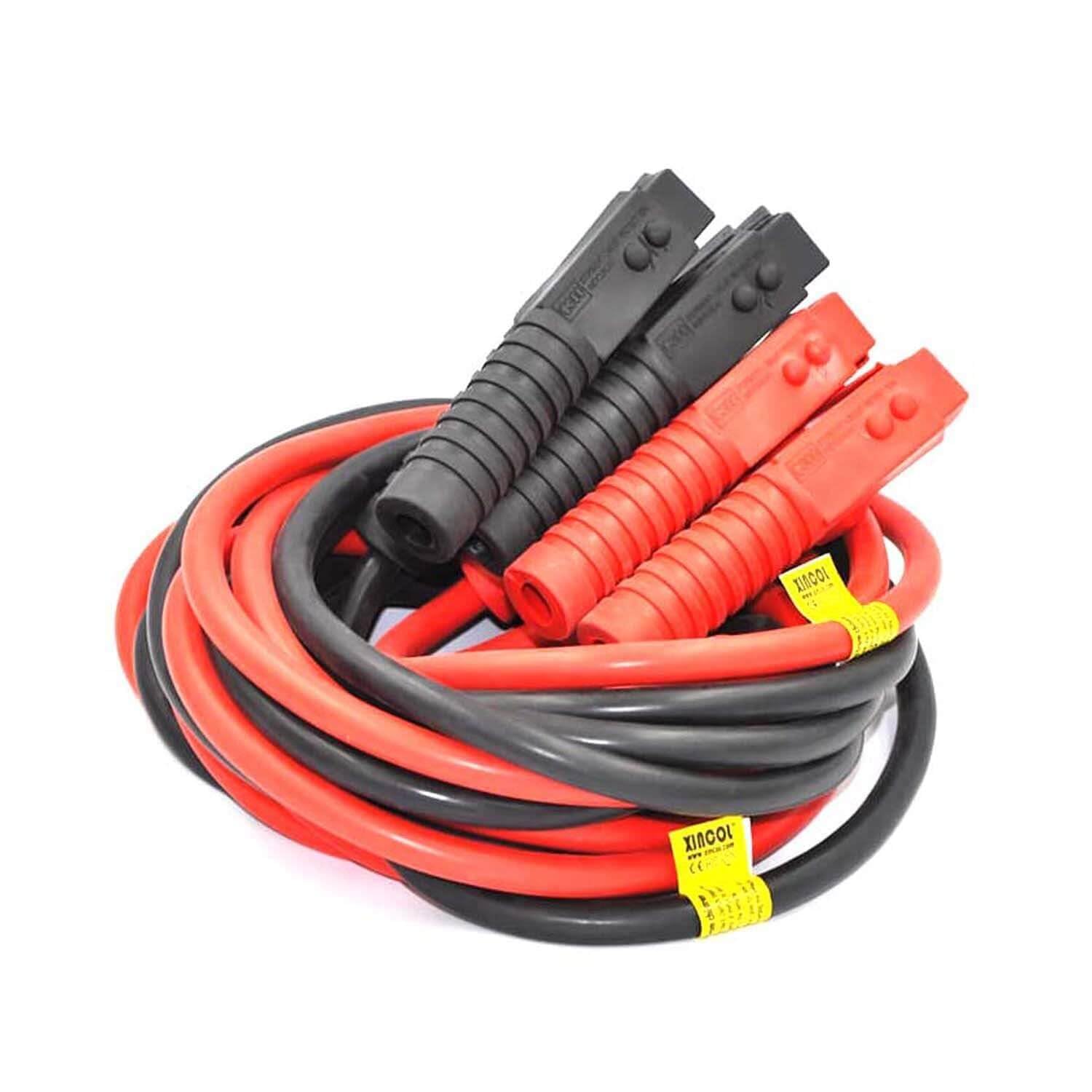
The XINCOL A5 set uses 2 AWG pure copper conductors, which is thicker than most consumer-grade jumper cables. At 5.46 pounds, the cable is dense and the 100% copper strands provide lower internal resistance than any CCA cable of the same gauge. The manufacturer claims it outperforms 1 AWG copper-clad aluminum cables in current delivery—a realistic advantage for large diesel engines up to 16L. The insulation is rated from -60°F to 160°F, making it one of the most cold-tolerant options available.
Users with 8.0L gas engines and 6.6L Duramax diesels report quick starts even after the battery has sat dead for days. The included cotton work gloves with yellow dotted grip are a practical addition for cold mornings. The portable drawstring bag keeps the cables organized, though the coil is large due to the 2 AWG thickness.
The 10-foot length is again the limiting factor—some users find that 20-foot versions reduce the need for precise vehicle positioning. A few reports mention that the clamp spring tension is not as strong as premium industrial clamps, and the metal-to-metal contact area could be larger. The higher price reflects the pure copper and 2 AWG size, making this set overkill for a compact sedan’s 4-cylinder engine.
What works
- 2 AWG pure copper conductor delivers maximum current for large diesel and gas engines
- Industrial PVC jacket stays flexible at -60°F for extreme winter reliability
- Includes high-visibility work gloves with grip dots for safe handling
What doesn’t
- Clamp spring tension could be stronger for a secure bite on side posts
- Over-specified and expensive for small 4-cylinder vehicles
3. CARTMAN 4 Gauge 16 Feet Jumper Cables 300AMP
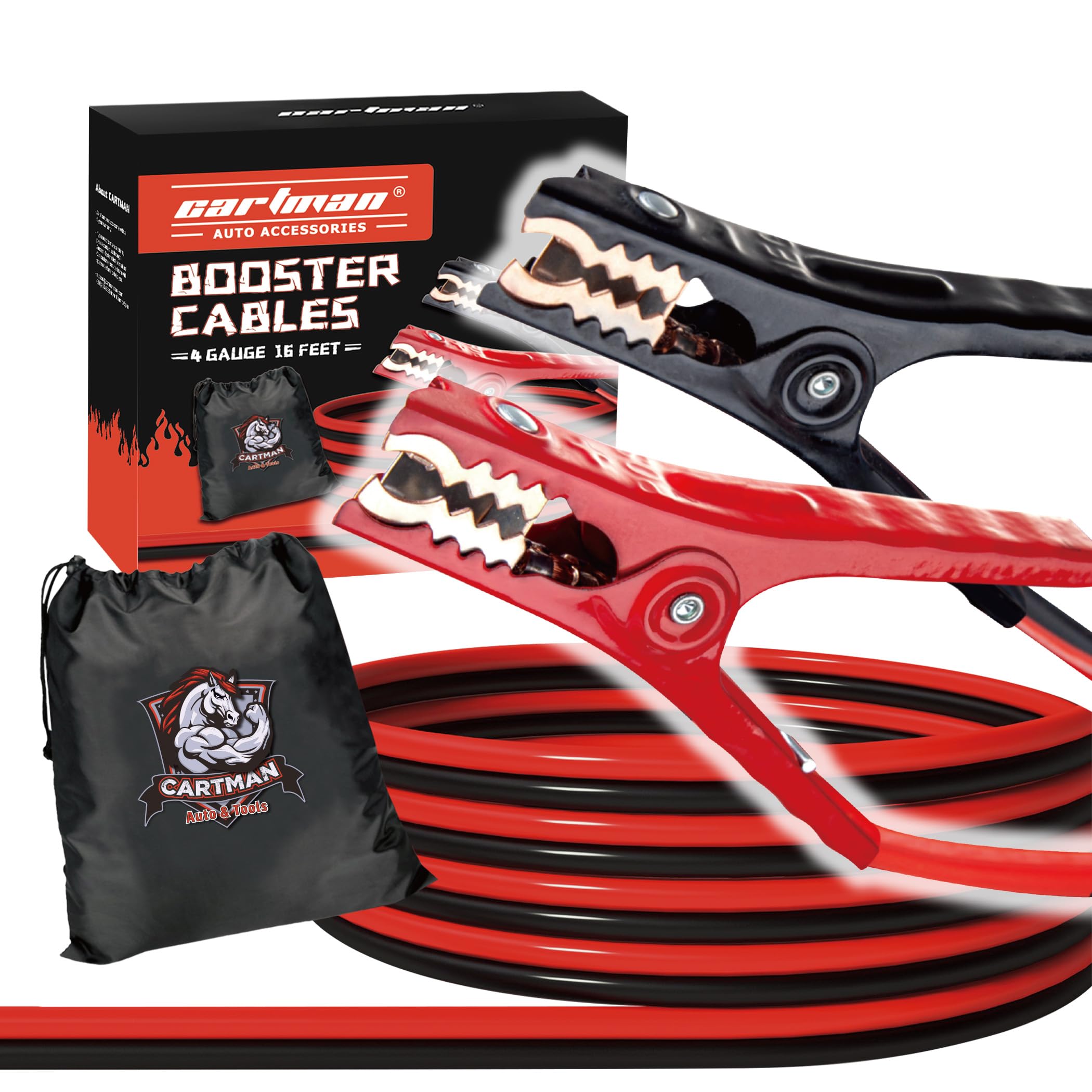
The CARTMAN cable uses a 4 AWG copper-clad aluminum (CCA) core inside a TPR jacket that is cold-resistant down to -13°F (-25°C). At 4.38 pounds, it is lighter than a comparable pure copper 4 AWG set, making it easier to store and handle. The patented anti-rust clamps are fully insulated with rubber and designed to fit both top-post and side-post battery terminals. The 16-foot length provides extra reach that helps when vehicles must park at awkward angles.
Owners of full-size cars, cargo vans, and mid-sized pickups report that the 300-amp instantaneous rating handles typical gasoline engines without issue. The included storage bag and gloves add convenience, though the bag is large enough to accommodate the 16-foot coil with careful winding. The CCA conductor performs adequately for standard automotive starting—the difference from pure copper shows mainly in reduced weight and slightly higher voltage drop under sustained high load.
The TPR jacket loses flexibility faster than premium PVC at extreme low temperatures (-20°F and below). Some users note that the clamps, while well insulated, do not have the same jaw-opening width as heavier-duty clamps on purely copper cables. For most gasoline passenger vehicles, this set offers a strong balance of conductor thickness and price.
What works
- 4 AWG CCA conductor provides ample current for gasoline engines at a lighter weight
- Insulated clamps fit both top-post and side-post battery terminals without shorting
- 16-foot length gives more flexibility for vehicle positioning
What doesn’t
- TPR jacket stiffens noticeably below -13°F compared to pure copper PVC options
- Clamp jaw opening may not fit the largest battery terminals on heavy-duty trucks
4. Nilight 6 Gauge 12 FT Jumper Cables

The Nilight set uses a 6 AWG copper-clad aluminum conductor rated for 450 amps of instantaneous current. At 3.65 pounds, this is a lightweight set well suited for a small to mid-size passenger car. The PVC insulation is rated from -40°F to +167°F, which covers most climate extremes without stiffening. The 12-foot length is slightly longer than the standard 10-foot, giving a bit more slack for bumper-to-bumper parking.
Users with compact cars, coupes, and small sedans report that the 6 AWG gauge starts their engines without noticeable voltage drop or heat buildup. The included storage bag and gloves are a nice touch at this price point. The clamp jaws are fully insulated with PVC and feature strong jagged teeth that bite into lead terminals effectively. The spring tension feels secure on top-post batteries.
The 6 AWG gauge is at the lower end of what is recommended for a full-size V8 engine or any diesel. Under repeated cranking on a severely drained battery, the CCA conductor can heat up faster than pure copper. The clamps are less suitable for side-post batteries, as the jaw depth is shallower than on specialty clamps. For a spare set in a compact car, this offers a solid safety net without adding trunk weight.
What works
- Lightweight 3.65 lb set is easy to store and handle in small vehicle trunks
- PVC insulation remains flexible from -40°F to +167°F for all-season reliability
- 450-amp rating is sufficient for most 4-cylinder and V6 gasoline engines
What doesn’t
- 6 AWG CCA conductor is undersized for V8 gasoline or any diesel engine
- Clamp jaws have shallow depth, making side-post connections difficult
5. FUAUJUE Alligator Clip 10 Ft Jumper Cables (10 AWG)
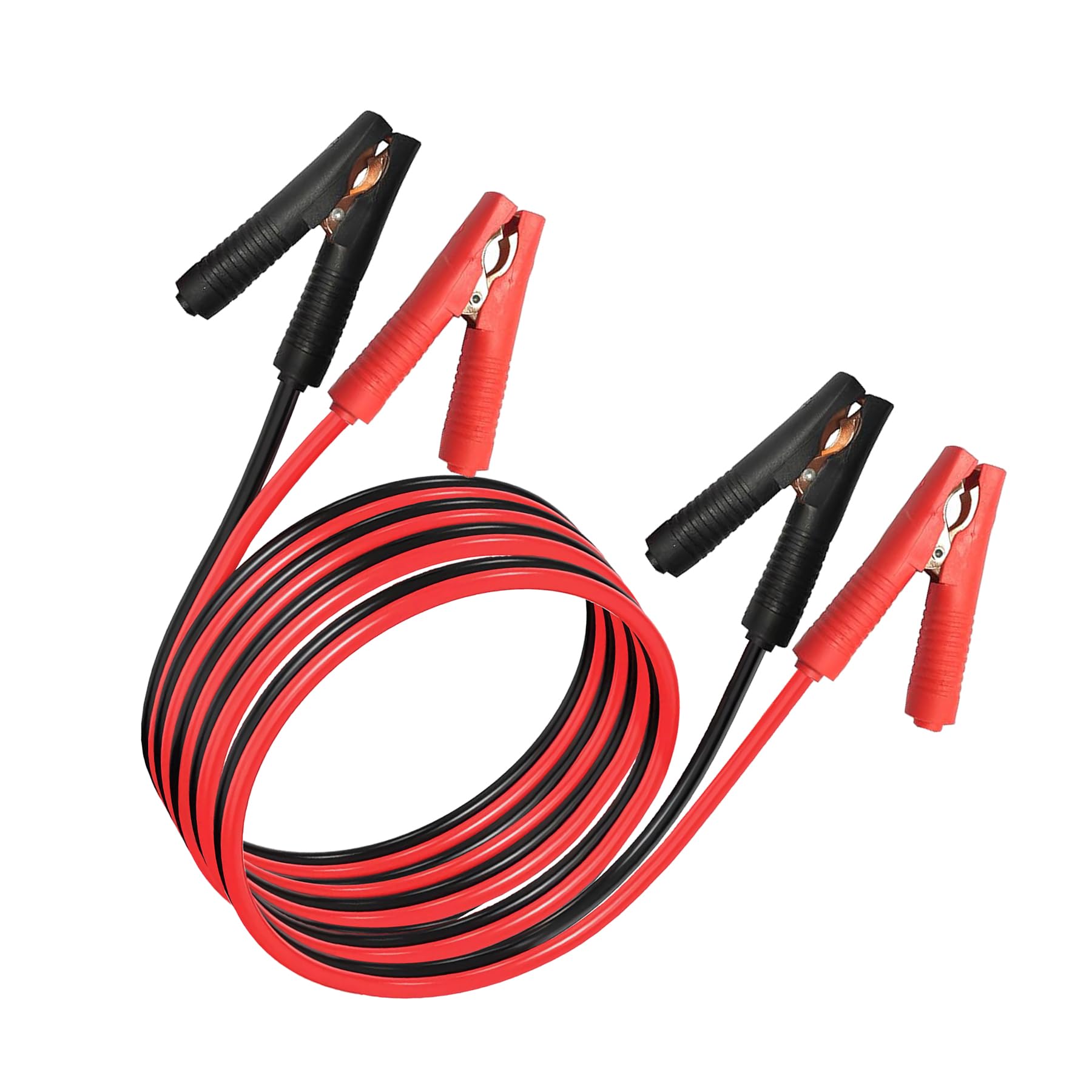
The FUAUJUE set uses 10 AWG solid copper wire inside a PVC jacket, with a total length of approximately 9.84 feet. The alligator clips open to 17mm (0.67 inches) and are fully insulated. The manufacturer specifically states a 50-amp current limitation, which is far below the 300-600 amp peak draw of a standard automotive starter motor during cranking. This set is explicitly described as suitable for test connections, not for continuous power use.
Some owners have used these on small 4-cylinder engines with partially charged batteries, reporting that the cables work but get hot quickly—within a few seconds of cranking. The lightweight construction (0.58 kg / 1.28 lbs) makes them easy to carry as an emergency backup. The PVC jacket is well attached to the clamps, avoiding the peeling issue seen on some ultra-budget cables.
The 50-amp rating is the critical limitation: a typical Honda Civic starter draws 150-300 amps during cranking, far exceeding what these cables are designed for. Attempting to start a fully dead battery on even a small engine risks overheating the wires and damaging the insulation. This set is best reserved for charging small batteries, powering accessories, or testing circuits—not as a primary jump-start solution for a passenger vehicle.
What works
- Extremely lightweight and compact for storage in a glove box or tool kit
- PVC jacket is securely bonded to the clamp, resisting peeling
- Useful for low-current testing, charging, and small engine applications
What doesn’t
- 10 AWG wire and 50-amp rating are severely undersized for automotive starting
- Wires heat up dangerously fast when used on any standard car battery
Hardware & Specs Guide
AWG (American Wire Gauge)
The gauge number decreases as the wire gets thicker. A 4 AWG cable has a conductor diameter of roughly 5.2mm and handles 300-500 amps, while a 10 AWG cable has a 2.6mm diameter and handles only about 30-50 amps. For gasoline vehicles up to 6.0L, 6 AWG is the minimum safe gauge. For diesel trucks or large V8s, 4 AWG or 2 AWG is recommended to minimize voltage drop and prevent overheating.
Pure Copper vs. CCA Conductors
Pure copper has about 60% higher conductivity than aluminum of the same cross-section. Copper-clad aluminum (CCA) uses an aluminum core with a thin copper coating—it is lighter and cheaper but requires one to two sizes thicker wire to match pure copper’s current capacity. Pure copper also resists internal strand breakage from repeated flexing at low temperatures better than aluminum cores.
Clamp Jaw Opening and Insulation
A clamp needs to open at least 0.75 inches (19mm) to fit over standard top-post terminals. Side-post batteries require a narrower clamp that can reach into recessed terminals. Fully insulated clamps cover all metal surfaces to prevent accidental arcing against the vehicle chassis. Dual-sided copper contact or copper ribbon in the clamp body reduces hot spots during extended cranking.
Cold Temperature Flexibility
PVC cable jackets can stiffen dramatically below -4°F (-20°C), making the cable hard to route to the battery terminals. Premium cables use TPE or cold-resistant PVC rated down to -40°F/C. The jacket should remain pliable at the lowest temperature you expect to encounter—a frozen cable that won’t uncoil is useless in an emergency.
FAQ
How do I know which gauge jumper cables I need for my vehicle?
Are copper-clad aluminum (CCA) jumper cables safe to use?
Why do my jumper cables get hot when I try to start the car?
Is a 10-foot jumper cable long enough for most situations?
Final Thoughts: The Verdict
For most buyers, the 10 ft jumper cables winner is the Spartan Power 4 AWG 10 Ft because its pure copper conductors, lifetime crimp warranty, and dual-sided clamps provide the reliability needed for gasoline and diesel engines alike. If you want a pure copper 2 AWG over-spec for large diesel trucks, grab the XINCOL A5. And for a budget-friendly mid-range option that still offers 4 AWG thickness and 16-foot reach, nothing beats the CARTMAN 4 Gauge 16 Feet.

Certification: BSc in Mechanical Engineering
Education: Mechanical engineer
Lives In: 539 W Commerce St, Dallas, TX 75208, USA
Md Amir is an auto mechanic student and writer with over half a decade of experience in the automotive field. He has worked with top automotive brands such as Lexus, Quantum, and also owns two automotive blogs autocarneed.com and taxiwiz.com.