A dead battery is more than an inconvenience—it’s a failure of preparation. Whether you’re dealing with sulfation from long-term storage or a deeply discharged power sports battery, a quality 10-amp charger is the difference between a quick restart and a costly replacement.
I’m Amir — the founder and writer behind Four Wheel Ask. I’ve spent countless hours comparing charging algorithms, evaluating build quality, and analyzing long-term owner feedback to separate genuine performance from marketing fluff.
Whether you need to maintain a classic car or revive a deeply discharged battery, finding the best 10 amp battery charger requires careful evaluation.
How To Choose The Best 10 Amp Battery Charger
Selecting the right charger isn’t just about grabbing the highest amperage. You need to consider battery chemistry, charging stages, safety features, and intended use case to avoid damaging your battery or wasting money.
Understanding Charge Rates and Multi-Stage Profiles
Not all 10-amp chargers deliver power the same way. A basic charger may simply dump current until the voltage rises, increasing the risk of overcharging. A multi-stage smart charger uses a bulk phase to deliver the full 10 amps, followed by an absorption phase that tapers the current, and finally a float or maintenance phase that keeps the battery topped off without cooking it. Look for units that advertise desulfation or reconditioning modes, as these use high-frequency pulses to break down lead-sulfate crystals and extend battery life.
Battery Chemistry Compatibility
Modern vehicles often use AGM, Gel, or Lithium Iron Phosphate (LiFePO4) batteries instead of standard flooded lead-acid. Each chemistry requires a distinct voltage profile. Charging a LiFePO4 battery with a standard lead-acid profile can trip the battery’s BMS or cause long-term damage. A versatile 10-amp charger will offer dedicated modes for standard, AGM, GEL, and Lithium batteries, allowing you to safely maintain everything from a lawn mower battery to a high-end sports car battery.
Safety Features and Build Quality
Reliability starts with genuine safety certifications. Spark-proof circuitry prevents ignition of flammable gasses, while reverse polarity protection saves you from costly mistakes. IP-rated enclosures add weather resistance for garage or shop use. Look for chargers with robust clamps, high-quality ring terminals, and adequate cable length—a flimsy cable set is often the first point of failure on budget units.
Smart Features vs. Manual Control
Smart chargers automatically adjust voltage and current based on battery condition and ambient temperature. Temperature compensation is a critical smart feature that prevents undercharging in cold climates and overcharging in heat. Wheeled professional chargers sometimes retain manual timers and amp meters for shops that demand precise control. Decide whether you want fully automatic operation or the ability to manually set charge parameters.
Quick Comparison
On smaller screens, swipe sideways to see the full table.
| Model | Category | Best For | Key Spec | Amazon |
|---|---|---|---|---|
| NOCO GENIUS10 | Smart Charger | Best Overall | 10A, 6V/12V, LiFePO4 | Amazon |
| Clore PL2310 | Smart Charger | Best Value | 2/6/10A, Temp Comp | Amazon |
| CRAFTSMAN CMXCESM258 | 4-in-1 Device | Best Features | 12A, Tester, Recond | Amazon |
| DeWalt DXAEC10 | 3-in-1 Charger | Brand Reliability | 10A, 6V/12V, LCD | Amazon |
| Schumacher SC1446 | Wheeled Starter | Heavy-Duty Use | 10A Charge, 200A Start | Amazon |
| Sailnovo 10A | Budget Charger | Budget Pick | 10A, IP65, Compact | Amazon |
| Makita DC10WA | Tool Charger | Makita Owners | 7.2V-12V, 2.4A | Amazon |
In‑Depth Reviews
1. NOCO GENIUS10

The NOCO GENIUS10 is the benchmark for intelligent charging. It delivers a full 10 amps to both 6V and 12V lead-acid (AGM, Gel, SLA, VRLA) and lithium-ion (LiFePO4) batteries. What sets it apart is its ability to charge deeply discharged batteries down to 1 volt, plus a Force Mode that manually allows charging from 0 volts—critical for recovering neglected batteries.
An integrated thermal sensor dynamically adjusts the charge rate based on ambient temperature, preventing overcharge in summer heat and undercharge in winter cold. The precision pulse charging mode automatically detects and reverses sulfation and acid stratification, restoring lost capacity and extending overall battery life. The build quality is excellent, with a compact, 17% smaller chassis than the previous generation and a 72-inch AC cable for flexible placement.
Safety is comprehensive, with spark-proof circuitry, reverse polarity protection, and an automatic maintainer mode that allows indefinite connection. The included mounting bracket and eyelet terminals make it easy to hardwire into a vehicle for permanent maintenance. For the vast majority of users, this is the single most reliable and technologically balanced 10-amp charger on the market.
What works
- Charges batteries from 1 volt; Force Mode handles 0 volts
- Integrated thermal sensor for temperature compensation
- Precision pulse desulfation extends battery life
- Compact design with included mounting bracket
What doesn’t
- Premium price point compared to basic chargers
- LCD interface is simple but lacks advanced diagnostics
2. Clore Automotive PL2310
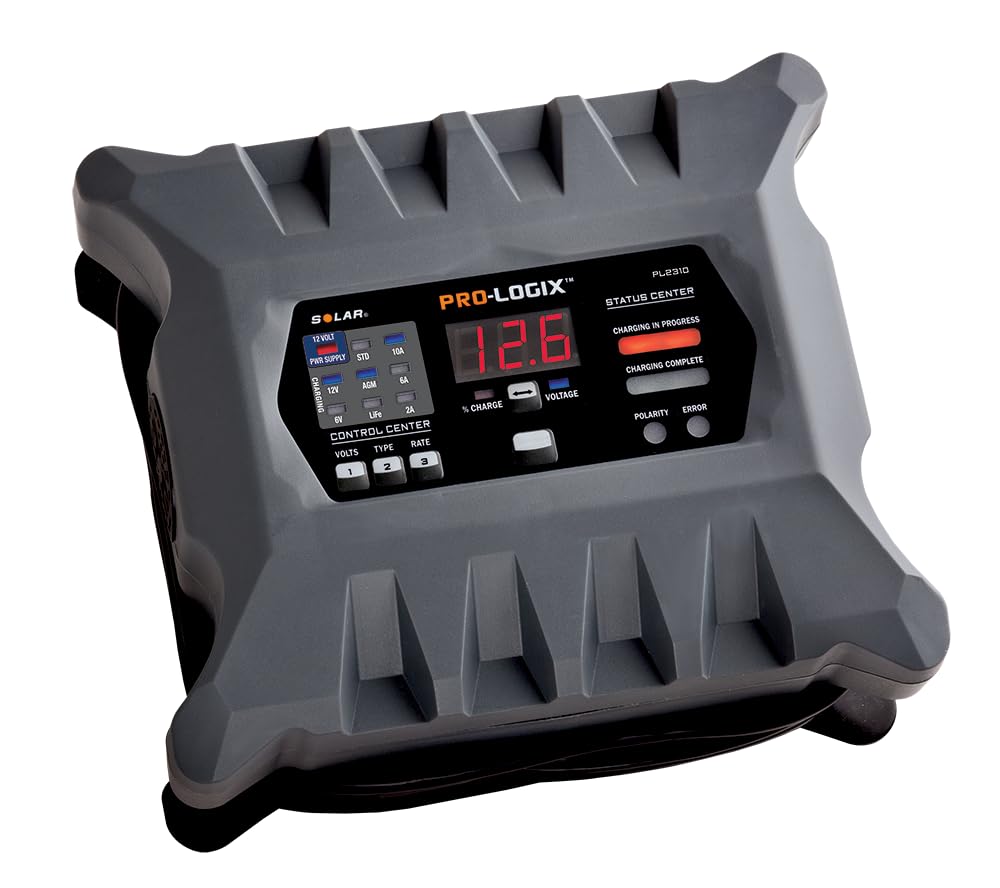
Clore Automotive brings decades of professional-grade battery service experience to the PL2310. This fully automatic smart charger offers three selectable charge rates—2, 6, and 10 amps—giving you precise control over how you charge everything from a small motorcycle battery to a large deep-cycle marine battery. It works with 6V and 12V lead-acid batteries, including AGM, Gel, and flooded types.
The advanced multi-phase charging process is where this unit truly shines. It incorporates temperature compensation to adjust the charge voltage based on ambient conditions, a feature typically reserved for much more expensive units. The PL2310 also includes a stable power supply mode, allowing you to maintain system voltage during diagnostics or memory retention without the ripple and noise of a basic charger.
Build quality is robust, with a durable case and heavy-duty battery clamps. It functions as a maintainer and desulfator, making it a versatile tool for seasonal vehicle storage. For the combination of adjustability, temperature compensation, and a stable power supply mode, this charger delivers exceptional value for the discerning owner.
What works
- Selectable 2/6/10 amp charge rates for versatility
- Integrated temperature compensation
- Stable power supply mode for diagnostics
- Desulfation mode extends battery life
What doesn’t
- Does not support lithium LiFePO4 batteries
- Larger footprint than modern compact chargers
3. CRAFTSMAN CMXCESM258

The CRAFTSMAN CMXCESM258 is a fully integrated battery management station. It combines a 12-amp charger, a 3-amp maintainer, a battery tester, and a reconditioning desulfator into one compact unit. This 4-in-1 approach eliminates the need for separate diagnostic tools, allowing you to check battery health, charge, and maintain from a single device.
It delivers 12 amps for rapid 12V charging, 3 amps for 12V maintenance, and 2 amps for 6V charging, making it compatible with standard, AGM, lithium (LiFePO4), and deep-cycle batteries. The smart trickle charge feature ensures safe long-term connection without overcharging. The built-in battery tester provides an immediate health assessment, which is invaluable for diagnosing whether a battery needs charging or replacing.
The reconditioning mode uses advanced desulfation pulses to break down lead-sulfate crystals, helping to restore lost capacity and improve performance. Safety features include reverse polarity protection and a 6-foot AC power cord. For the DIYer who wants a complete garage solution, this unit packs the most features per square inch.
What works
- 4-in-1 functionality (charger, maintainer, tester, reconditioner)
- 12 amp output for faster charging
- Built-in battery tester for health diagnostics
- Wide compatibility including LiFePO4
What doesn’t
- Interface can be confusing for first-time users
- Clamps feel less robust than professional-grade units
4. DeWalt DXAEC10

DeWalt’s DXAEC10 is a straightforward, reliable 3-in-1 battery charger, maintainer, and trickle charger designed for the user who trusts brand reputation and robust build quality. It delivers a full 10 amps to 6V and 12V AGM, GEL, WET, and LiFePO4 batteries, covering virtually all modern automotive and power sports battery types.
High-frequency charging technology restores lost battery performance for stronger engine starts, while the fully automatic operation prevents overcharging. The bright LCD screen provides clear, real-time feedback on charger operation and battery status, making it easy to monitor the charging process from a distance. The universal battery connector adds convenience for different terminal configurations.
Built-in circuit protection guards against overcharging, reverse polarity, and short circuits, providing peace of mind for overnight or long-term connection. The compact, rugged case is typical of DeWalt’s tool-grade design philosophy. It’s a no-nonsense charger that performs exactly as specified, backed by a well-known service network.
What works
- Bright, easy-to-read LCD screen for monitoring
- Broad compatibility including LiFePO4
- Fully automatic with solid circuit protection
- Trusted brand with strong customer support
What doesn’t
- No desulfation or reconditioning mode
- Fixed charge rate, no adjustable amperage
5. Sailnovo 10A
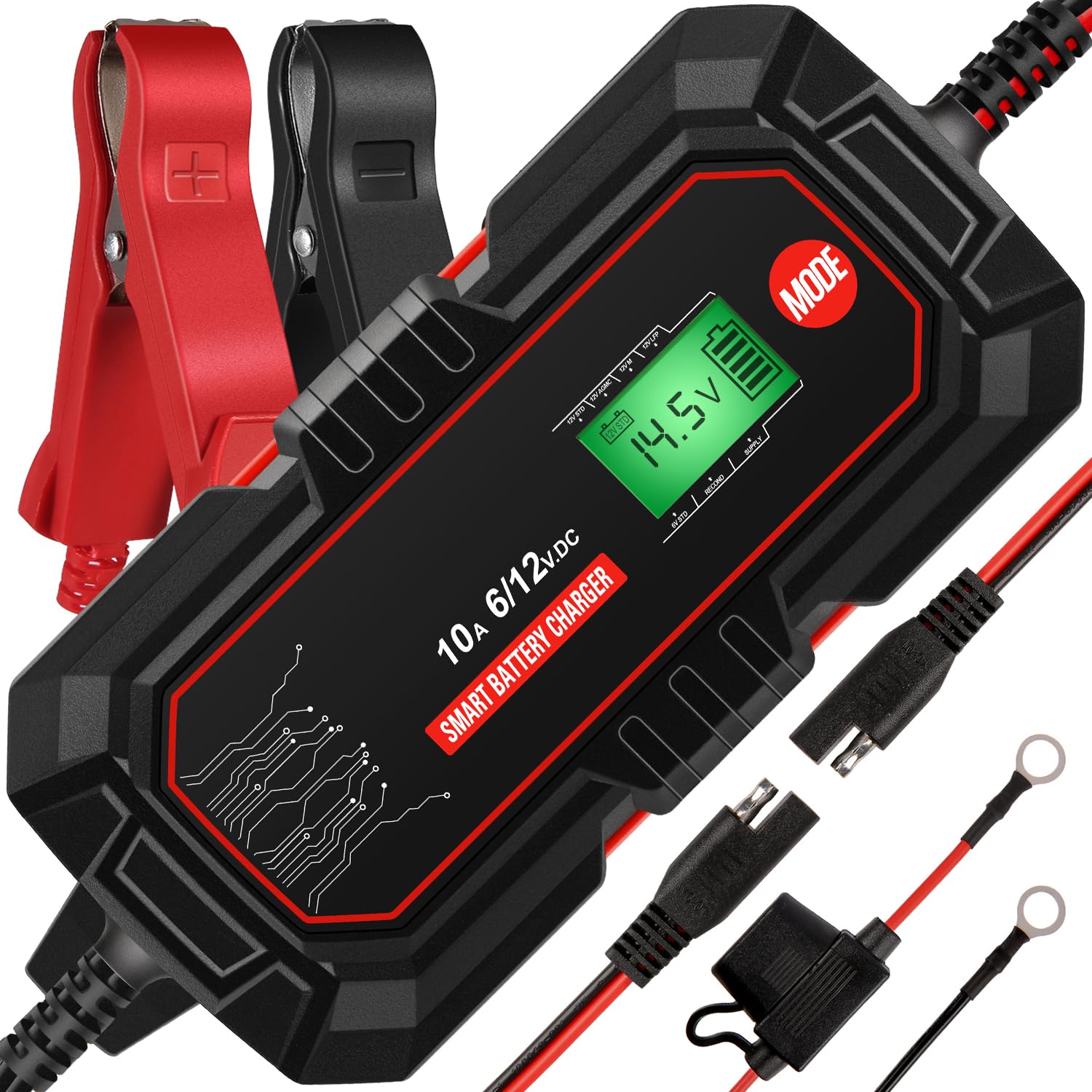
The Sailnovo 10A charger proves that essential smart features can be accessible without a premium budget. It offers a 10-stage charging profile for 6V and 12V lead-acid batteries (Flooded, AGM, Gel, SLA, VRLA) and 12V LiFePO4 batteries. The intelligent mode adjusts the charge output based on ambient temperature to prevent overcharging in hot climates and undercharging in cold conditions.
A standout feature at this entry-level price point is the IP65 weather-resistant enclosure, which adds significant durability for garage or outdoor use. The spark-proof circuitry and automatic reverse polarity detection provide essential safety layers. The LCD display gives clear feedback on charging status and mode changes, with a flashing “V” indicator to confirm when the unit has entered maintenance mode.
The 5-foot output cable includes both alligator clips and fused-ring terminal harnesses for hard-to-reach batteries. The compact, lightweight design (2.4 lbs) includes convenient hooks for wall mounting. For the budget-conscious buyer who still wants multi-stage charging, temperature adaptation, and modern safety features, the Sailnovo is a compelling entry-level choice.
What works
- IP65 weather resistance for garage/outdoor use
- Intelligent temperature adaptation
- 10-stage charging profile
- Includes both clamps and ring terminals
What doesn’t
- Brand lacks the long track record of established competitors
- Build quality of clamps feels less premium
6. Makita DC10WA
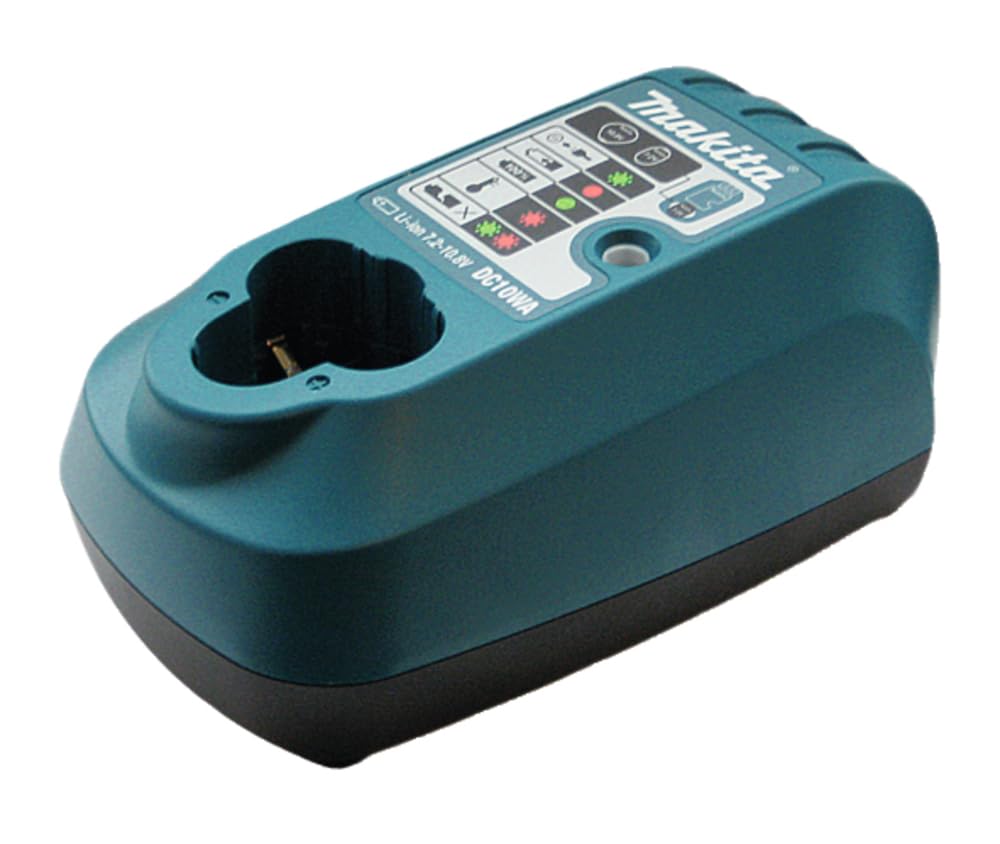
The Makita DC10WA serves a specific but essential role: charging Makita 7.2V through 12V Max Lithium-Ion batteries. This is not a universal automotive battery charger; it is a dedicated tool battery charger designed for Makita’s power tool ecosystem. For owners of Makita drills, impacts, and compact saws, this is the correct OEM charging solution.
It accepts all Makita 7.2V, 9.6V, and 12V Max slide-style lithium-ion batteries, using a smart charging algorithm to optimize charge time and battery life. The compact, lightweight design (1 lb) makes it easy to mount on a wall or store in a tool bag. The constant monitoring prevents overcharging, ensuring the battery is ready when you are.
While it only outputs a 2.4-amp current, it is precisely tuned for the voltage and chemistry of Makita tool packs. This is not a product for charging car batteries or third-party batteries. It is a purpose-built tool that does its specific job flawlessly. If you are invested in the Makita 12V Max platform, this charger is a necessary and reliable component of your system.
What works
- Official Makita OEM charger, guaranteed compatibility
- Optimized charging algorithm for Makita batteries
- Compact and lightweight for portability
- Prevents overcharging for long battery life
What doesn’t
- Only works with Makita 7.2V-12V Max batteries
- Not suitable for standard automotive or marine batteries
7. Schumacher SC1446

The Schumacher SC1446 is a professional-grade, wheeled 2-in-1 battery charger and engine starter built for heavy-duty use. It delivers a 10-amp charge rate for 12V batteries, but its primary strength is the 200-amp engine start capability and the 40-amp boost mode for deeply discharged batteries. This is a tool designed for the working shop or the serious farm/ranch environment.
Unlike fully automatic smart chargers, the SC1446 uses a precision manual control with a 135-minute timer, giving the operator complete control over the charging session. The analog ammeter provides visual feedback of the charging current, allowing experienced users to gauge battery acceptance and condition. It works with 6V and 12V standard, AGM, gel, and deep-cycle batteries.
Construction is heavy-duty, featuring a sturdy steel case, heavy-duty clamps, a retractable handle, and solid compact wheels for mobility. The 6-foot power cord and front-mounted booster cables make it easy to position next to the vehicle. This is not a set-and-forget maintainer; it’s a powerful, manual tool for reviving dead batteries and jump-starting vehicles in demanding conditions.
What works
- 200-amp engine start capability for dead batteries
- Durable steel case with wheels for portability
- Manual timer and analog amp meter for experienced users
- 40-amp boost mode for deeply discharged batteries
What doesn’t
- Manual operation requires supervision and experience
- Large and heavy (29.9 lbs) compared to compact chargers
Hardware & Specs Guide
Multi-Stage Charging Explained
Modern smart chargers use a multi-stage process to safely and efficiently recharge a battery. The Bulk stage delivers the full rated current (e.g., 10 amps) until the battery reaches about 80% charge. The Absorption stage then reduces the current while holding the voltage steady to fully saturate the battery without overheating it. Finally, the Float or Maintenance stage drops the voltage to a safe level to keep the battery topped off indefinitely without electrolyte loss or gassing. Some chargers also include a Desulfation stage that uses high-frequency pulses to break down lead sulfate crystals that form during prolonged discharge.
Battery Chemistry Compatibility
Different battery chemistries demand different charging algorithms. Standard Flooded Lead-Acid batteries require a higher absorption voltage (around 14.4V to 14.8V) and are tolerant of periodic equalization charges. AGM (Absorbent Glass Mat) batteries need a slightly lower voltage (14.1V to 14.4V) to prevent gas venting. Gel batteries are the most sensitive, requiring the lowest voltage (14.0V to 14.2V) and a strict current limit. Lithium Iron Phosphate (LiFePO4) batteries require a completely different profile, typically charging to 14.6V with a built-in Battery Management System (BMS) that handles cell balancing. Using the wrong profile can damage the battery or trigger the BMS safety disconnect.
FAQ
Can I leave a 10 amp battery charger connected indefinitely?
What is the difference between a battery charger and a maintainer?
Will a 10 amp charger work with my motorcycle or lawn mower battery?
Final Thoughts: The Verdict
For most buyers, the best 10 amp battery charger winner is the NOCO GENIUS10 because it combines advanced safety features, temperature compensation, and lithium compatibility in a compact, fully automatic package. If you want adjustable charge rates and a stable power supply mode at a great value, grab the Clore PL2310. And for heavy-duty shop use where you need engine starting power and manual control, nothing beats the Schumacher SC1446.

Certification: BSc in Mechanical Engineering
Education: Mechanical engineer
Lives In: 539 W Commerce St, Dallas, TX 75208, USA
Md Amir is an auto mechanic student and writer with over half a decade of experience in the automotive field. He has worked with top automotive brands such as Lexus, Quantum, and also owns two automotive blogs autocarneed.com and taxiwiz.com.