The wrong 0W-20 oil in your engine is not a minor misstep — it is a slow-rolling gamble with bearing life, timing chain tension, and long-term deposit control. Modern engines, especially turbocharged direct-injection platforms, demand a precise balance of cold-start flow and high-temperature film strength that only a properly formulated full synthetic can deliver. Choosing based on price alone or grabbing whatever is on sale ignores the real cost of internal wear.
I’m Amir — the founder and writer behind Four Wheel Ask. My work focuses on analyzing technical specifications, manufacturer approvals, and long-term owner feedback across dozens of oil formulations to identify what actually protects an engine over its service life.
Drawing on extensive analysis of specifications, approvals, and owner feedback, this guide isolates the best 0w-20 auto oil options for your specific engine.
How To Choose The Best 0W-20 Auto Oil
Selecting the right 0W-20 oil means looking past the bottle design and focusing on approvals, base oil quality, and additive technology. Modern engines place extreme demands on lubrication, and not all oils marked 0W-20 deliver the same level of protection.
API and ILSAC Certifications
The latest API SP and ILSAC GF-6 standards address low-speed pre-ignition (LSPI), timing chain wear, and deposit control. Oils carrying these certifications have passed rigorous bench and engine testing. Always verify the starburst or donut symbol on the container rather than relying on marketing claims alone.
Full Synthetic vs. Synthetic Blend
0W-20 viscosity requires a high-quality base stock to maintain film strength at operating temperature while remaining fluid enough for cold starts. Full synthetic formulations use Group III, IV, or V base oils that resist thermal breakdown far better than conventional or blended alternatives. For turbocharged or high-compression engines, full synthetic is the baseline, not an upgrade.
OEM Approvals and Backward Compatibility
Manufacturers such as BMW, Ford, GM, and Chrysler issue specific approvals (BMW Longlife-17 FE+, GM dexos1 Gen 2, Ford WSS-M2C947-B1) that dictate additive chemistry and performance thresholds. Using an oil that meets or exceeds the exact specification in your owner’s manual ensures the engine sees the protection it was designed around.
Quick Comparison
On smaller screens, swipe sideways to see the full table.
| Model | Category | Best For | Key Spec | Amazon |
|---|---|---|---|---|
| Castrol EDGE Extended Performance 0W-20 | Full Synthetic | Extended drain intervals | API SP, ILSAC GF-7, dexos1 Gen 3 | Amazon |
| Motul 8100 ECO-lite 0W-20 | Full Synthetic | European and domestic turbo engines | API SP, dexos1 Gen 2, Ford WSS-M2C947-B1 | Amazon |
| Liqui Moly Top Tec 6600 0W-20 | Full Synthetic | BMW Longlife-17 FE+ engines | BMW LL-17 FE+, API SP | Amazon |
| Valvoline Restore & Protect 0W-20 | Full Synthetic | Deposit removal and prevention | ILSAC GF-6A, API SP | Amazon |
| Havoline PRO-DS 0W-20 | Full Synthetic | Turbo direct-injection protection | API SP, ILSAC GF-6 | Amazon |
| K&N Premium Synthetic 0W-20 | Full Synthetic | All-weather daily driving | API SP, Synthamax Technology | Amazon |
| Toyota TGMO 0W-20 | Full Synthetic | Toyota and Scion factory fill | SN, 10,000-mile interval | Amazon |
| Royal Purple HMX 5W-20 | Full Synthetic | High-mileage engine restoration | Synerlec additive, LSPI protection | Amazon |
| Mobil 1 Extended Performance High Mileage 5W-20 | Full Synthetic | Engines over 75,000 miles | ILSAC GF-6, 20,000-mile interval | Amazon |
| Valvoline VR1 Racing 20W-50 | Full Synthetic | High-RPM racing engines | 20W-50, 2X zinc, anti-foam | Amazon |
| PENN GRADE 1 High Performance 20W-50 | Synthetic Blend | Street and racing performance | 20W-50, shock load protection | Amazon |
In‑Depth Reviews
1. Castrol EDGE Extended Performance 0W-20

Castrol EDGE Extended Performance 0W-20 carries approvals that span the latest industry standards: API SQ/SP/SN PLUS, ILSAC GF-7, ACEA C5, GM dexos1 Gen 3, and MB-Approval 229.71. This breadth of certification indicates a formulation tested across multiple engine architectures, including turbocharged direct-injection and hybrid powertrains. The 5-quart jug delivers enough volume for a standard oil change on most passenger vehicles.
Castrol claims 3X stronger viscosity retention versus leading full synthetics and 50X better high-temperature performance as measured in the Seq IIH test. For daily drivers running extended drain intervals up to 25,000 miles or one year, the film strength at elevated oil temperatures becomes a critical factor. The inclusion of Ford WSS-M2C947-B1 and WSS-M2C962-A approvals also makes this a direct fit for many Ford and Lincoln applications that specify those standards.
Owners report consistent oil pressure readings across severe driving conditions, though some note the 5-quart size falls just short for engines requiring a full 6-quart fill. The formulation uses a high-performance additive package that resists shear and volatility, which translates to fewer top-offs between changes. For most modern gasoline engines, this oil represents a well-documented, broadly approved baseline that does not force compromises.
What works
- Extensive manufacturer approvals covering GM, Ford, Mercedes, and Fiat
- Proven high-temperature viscosity retention for extended drain intervals
- Meets the latest ILSAC GF-7 standard for LSPI and timing chain wear protection
What doesn’t
- 5-quart volume may not fully cover some engines requiring 6 quarts
- Premium formulation comes at a higher per-quart cost than value synthetics
2. Motul 8100 ECO-lite 0W-20

Motul 8100 ECO-lite 0W-20 is engineered specifically for modern Ford, GM, Chrysler, and Fiat platforms requiring dexos1 Gen 2 approval. The 5-liter jug (approximately 5.28 quarts) provides a slight volume advantage over standard 5-quart containers, which matters for European vehicles that specify a 5-liter fill. The formulation uses low-friction technology aimed at reducing internal drag and improving fuel economy in naturally aspirated and turbocharged engines alike.
API SP certification ensures protection against low-speed pre-ignition, timing chain wear, and sludge formation — the three primary failure modes in modern direct-injection engines. Motul backs the oil with a flash point of 433 degrees Celsius, indicating strong resistance to volatilization at high operating temperatures. The 5W-20-like cold-flow properties of this 0W-20 grade allow rapid oil pressure buildup during winter starts.
Owner reports highlight consistent performance across severe service conditions, including towing and extended idling. The oil meets Ford WSS-M2C947-A and WSS-M2C947-B1, making it a direct replacement for factory fill in many EcoBoost engines. Some users note that the 5-liter format requires careful measuring for engines calibrated to a 6-quart sump, but the extra volume is welcome for those who prefer metric measurements.
What works
- dexos1 Gen 2 and Ford WSS-M2C947-B1 approvals for domestic and European engines
- 5-liter jug provides extra volume for metric-specified sumps
- High flash point indicates strong resistance to thermal breakdown
What doesn’t
- Vehicle-specific fit may not suit older engines without those approvals
- Not as widely stocked in retail stores as mass-market brands
3. Liqui Moly Top Tec 6600 0W-20

Liqui Moly Top Tec 6600 0W-20 carries the BMW Longlife-17 FE+ approval, a specification specifically designed to reduce the risk of low-speed pre-ignition in turbocharged gasoline engines. LSPI remains one of the most damaging abnormal combustion events in modern downsized engines, and this oil formulation targets that failure mode directly. The 5-liter bottle suits European vehicles that follow metric fill volumes.
The backward compatibility with older BMW Longlife standards means this oil can serve as a replacement in applications where a previous generation spec was required. Liqui Moly uses a fully synthetic base oil combined with a balanced additive package that supports extended drain intervals without sacrificing detergency. The oil meets API SP requirements, ensuring broad applicability beyond just BMW models.
Owner feedback emphasizes the oil’s ability to maintain stable oil pressure during extended high-speed cruising and track-day use. Some users note that the price point places it firmly in the premium segment, and the vehicle-specific fit means it is not the most versatile choice for a household with multiple brands. For BMW owners seeking the latest LL-17 FE+ protection, however, this oil is one of the few fully approved options.
What works
- BMW Longlife-17 FE+ approval directly addresses LSPI risk
- Backward compatible with older BMW oil standards
- Strong additive package supports extended drain intervals
What doesn’t
- Premium pricing limits accessibility for budget-focused buyers
- Vehicle-specific fit reduces cross-platform versatility
4. Valvoline Restore & Protect 0W-20

Valvoline Restore & Protect 0W-20 introduces a unique positioning in the category: it is the first motor oil marketed specifically to actively remove existing engine deposits while preventing future buildup. Valvoline’s Active Clean Technology claims to remove up to 100% of piston deposits with continuous use, based on Adapted Sequence IIIH testing. This makes the oil particularly relevant for engines that have accumulated varnish from previous lower-quality oil changes or extended intervals.
The formulation delivers 79% stronger anti-wear protection than the GF-6 minimum standard, as measured by industry wear tests. Liqui-Shield Technology works alongside the detergency package to prevent new deposits from forming after the cleaning phase. The oil meets ILSAC GF-6A and API SP, covering all modern gasoline engines including turbocharged and direct-injection variants.
Owner reports from high-mileage applications note visible improvements in engine cleanliness after several oil change cycles, with some users reporting smoother idle and reduced oil consumption. The oil is American-made and carries Valvoline’s 150-year heritage in lubricant formulation. Some users caution that the cleaning action may dislodge larger deposits in severely neglected engines, potentially clogging oil pickup screens — a risk inherent to any high-detergency oil.
What works
- Active deposit removal technology addresses existing engine sludge
- 79% stronger anti-wear protection versus GF-6 minimum standard
- Broad API SP and ILSAC GF-6A compatibility
What doesn’t
- Cleaning action may dislodge large deposits in neglected engines
- Results require multiple oil change cycles to become noticeable
5. Havoline PRO-DS 0W-20
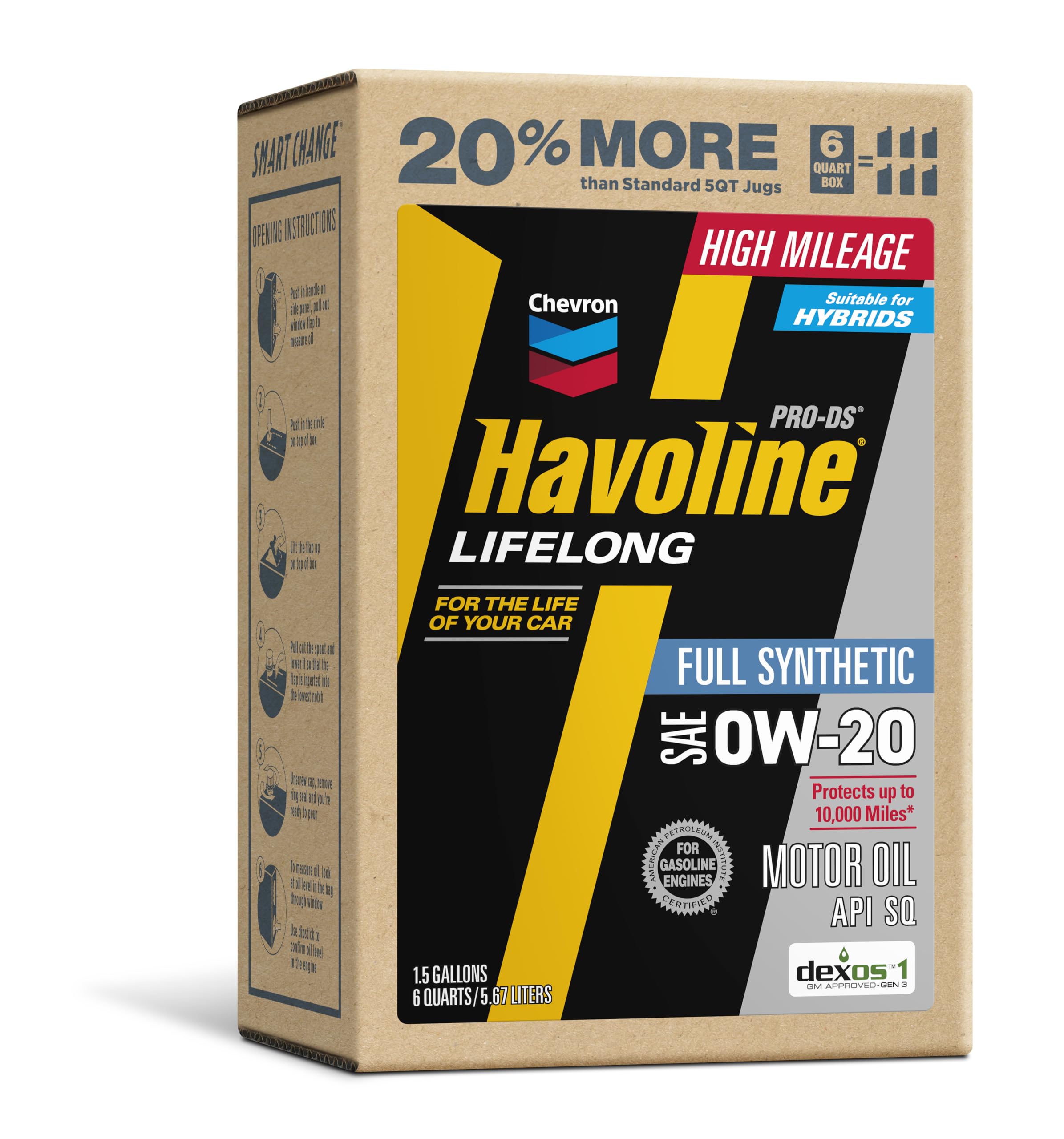
Havoline PRO-DS 0W-20 from Chevron targets modern turbocharged and direct-injection engines with an emphasis on LSPI mitigation and deposit control. The PRO-DS designation stands for “Deposit Shield,” reflecting a formulation built around keeping piston crowns, ring lands, and valve trains free of carbon buildup. The 6-quart pouch packaging offers a practical advantage for engines requiring a full 6-quart fill, eliminating the need to buy an extra quart separately.
Chevron’s proprietary additive technology provides unsurpassed protection against sludge, varnish, and deposit formation while delivering superior anti-wear protection for bearings and turbocharger components. The oil meets API SP and ILSAC GF-6 standards, covering a wide range of domestic and import vehicles including hybrids and light-duty trucks. The 0W-20 viscosity ensures reliable cold-start flow down to subzero temperatures.
Owners appreciate the 6-quart format for simplifying oil changes on vehicles with larger sump capacities, and the pouch design reduces waste compared to rigid plastic bottles. Some users note that the brand is less widely recognized than Mobil 1 or Castrol, which can create hesitation among buyers unfamiliar with Chevron’s lubricant division. The performance data, however, shows a formulation that competes directly with premium synthetics at a more accessible price point.
What works
- 6-quart pouch matches larger sump capacities without extra purchases
- Strong LSPI and deposit control for turbo direct-injection engines
- Competitive performance specs at a more accessible price point
What doesn’t
- Brand recognition lags behind legacy names like Mobil and Castrol
- Pouch packaging may be less familiar to DIY oil changers
6. K&N Premium Synthetic 0W-20

K&N Premium Synthetic 0W-20 leverages the brand’s engineering reputation from the filtration world to deliver a full synthetic oil built around Synthamax additive technology. The formulation prioritizes minimizing harmful contaminants and sludge buildup while maintaining stable viscosity across extreme temperature ranges. The 5-quart bottle serves standard passenger car applications with straightforward packaging.
The advanced full synthetic formula uses a balanced detergent and dispersant system to keep combustion byproducts suspended rather than depositing on internal surfaces. K&N positions this oil for all-weather protection, with cold-flow properties that reduce startup wear and high-temperature stability that resists thermal breakdown during sustained driving. The oil meets API SP requirements and is compatible with universal fit applications.
Owner feedback highlights consistent oil analysis results showing low wear metal levels after extended drain intervals. Some users note that the oil does not carry ILSAC GF-6 certification explicitly, which may matter for owners who follow manufacturer specifications strictly. The bottle design includes a measured window for easy pour monitoring, a small but appreciated detail for DIY users.
What works
- Synthamax additive technology targets sludge and contaminant control
- Strong low-temperature flow for reduced cold-start wear
- Measured bottle window aids accurate pouring
What doesn’t
- No explicit ILSAC GF-6 certification listed
- Brand is better known for filters than lubricants
7. Toyota TGMO 0W-20

Toyota TGMO (Toyota Genuine Motor Oil) 0W-20 is the factory-fill specification for Toyota and Scion vehicles, formulated in partnership with ExxonMobil. The 6-quart case provides exactly the volume needed for most Toyota applications, reducing waste and simplifying inventory for owners who perform their own maintenance. The oil carries Toyota’s engineering approval, which removes any ambiguity about compatibility for Toyota and Scion owners.
The formulation is designed around Toyota’s recommended 10,000-mile or 12-month oil change interval under normal operating conditions. The 0W-20 viscosity supports the fuel economy targets built into Toyota’s engine designs while providing the wear protection required for extended service life. The oil meets SN certification and includes additives that reduce the environmental burden of waste oil disposal.
Owner feedback from Toyota and Scion forums consistently recommends sticking with TGMO for vehicles under warranty to avoid any potential claim disputes. Some users note that the oil does not carry the latest API SP or ILSAC GF-6 certifications, which may be a consideration for owners of newer Toyota models that specify those standards. For older Toyota vehicles, however, this oil remains the recommended choice.
What works
- Exact factory-fill specification for Toyota and Scion vehicles
- 6-quart case matches Toyota sump capacities precisely
- Designed around 10,000-mile Toyota recommended intervals
What doesn’t
- Does not carry the latest API SP or ILSAC GF-6 certification
- Only suitable for Toyota and Scion applications
8. Royal Purple HMX 5W-20

Royal Purple HMX with Synerlec is formulated specifically for high-mileage engines where wear has widened clearances and reduced oil pressure. The 5W-20 viscosity grade (not 0W-20) targets engines that require a slightly thicker hot-film strength while maintaining good cold-flow properties. The oil is fortified with additional zinc and phosphorus anti-wear additives, which are known to protect flat-tappet camshafts and high-stress valvetrain components.
The proprietary Synerlec additive technology increases oil film strength, allowing the lubricant to maintain separation between metal surfaces under higher loads and temperatures. Royal Purple includes LSPI protection in the formulation, making it suitable for turbocharged high-mileage engines that may be prone to abnormal combustion events. The exceptional oxidation stability helps the oil resist thickening over extended drain intervals.
Owner reports from high-mileage applications note restored oil pressure and reduced valvetrain noise after switching to Royal Purple HMX. Some users caution that the 5W-20 viscosity may not be suitable for engines specifically calibrated for 0W-20, as the thicker oil can affect variable valve timing actuation and fuel economy. The boat vehicle service type listed in specifications reflects Royal Purple’s marine heritage, but the oil is widely used in automotive applications.
What works
- Fortified zinc/phosphorus additive package for flat-tappet and high-wear engines
- Synerlec technology increases film strength for restored oil pressure
- LSPI protection suitable for turbocharged high-mileage engines
What doesn’t
- 5W-20 viscosity differs from the 0W-20 standard discussed in this guide
- Thicker oil may affect VVT operation and fuel economy in engines designed for 0W-20
9. Mobil 1 Extended Performance High Mileage 5W-20

Mobil 1 Extended Performance High Mileage 5W-20 is engineered for engines with over 75,000 miles, combining Mobil 1’s Triple Action+ Formula with a high-mileage additive package. The 6-pack of 1-quart bottles provides flexibility for topping off or blending, and the 5W-20 viscosity (not 0W-20) targets engines that have accumulated enough wear to benefit from a slightly thicker oil film. Mobil 1 backs this formulation with a 20,000-mile or one-year drain interval capability.
The oil meets ILSAC GF-6 standards, providing LSPI protection and timing chain wear prevention while keeping the engine clean and supporting fuel economy. Thermal protection extends to 500 degrees Fahrenheit, with low-temperature protection down to minus 40 degrees Fahrenheit. The high-mileage additive package includes seal conditioners that help reduce leaks common in aging engines.
Owner feedback emphasizes the peace of mind that comes from Mobil 1’s reputation and the extended drain capability. Some users note that the 5W-20 viscosity may not be appropriate for engines that specifically require 0W-20, as the thicker cold-flow properties can delay oil pressure buildup in freezing conditions. For high-mileage engines originally specified for 5W-20, however, this oil represents a top-tier choice.
What works
- 20,000-mile drain interval capability reduces maintenance frequency
- Triple Action+ Formula combines performance, protection, and cleanliness
- Seal conditioners help mitigate leaks in high-mileage engines
What doesn’t
- 5W-20 viscosity is not a direct replacement for engines requiring 0W-20
- 6-pack of 1-quart bottles requires more handling than a single jug
10. Valvoline VR1 Racing 20W-50
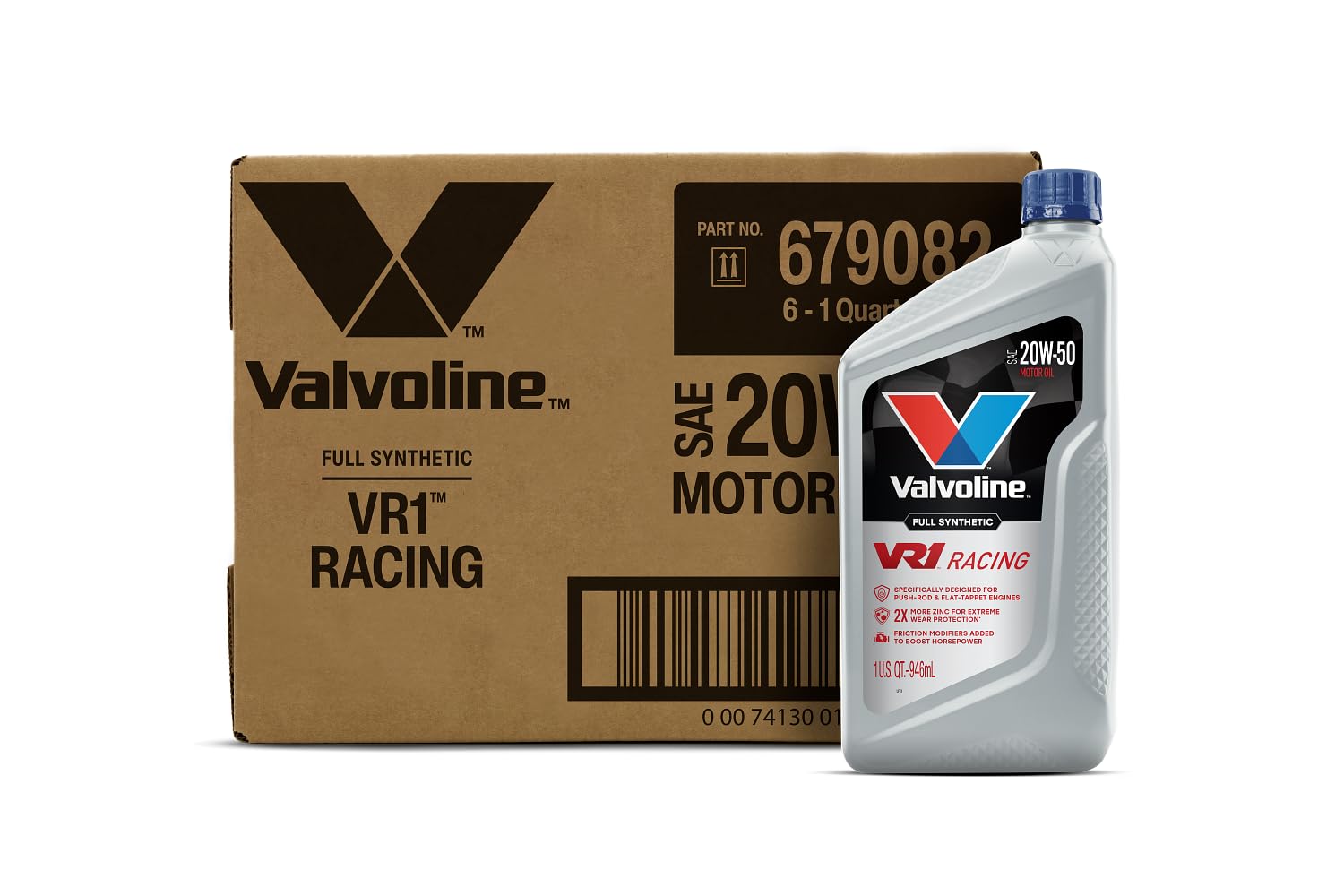
Valvoline VR1 Racing 20W-50 is a full synthetic racing oil engineered for high-performance gasoline engines operating at sustained high RPM and extreme temperatures. The 20W-50 viscosity (significantly thicker than 0W-20) is intended for engines with built clearances, high oil temperatures, and aggressive cam profiles that require a robust oil film. The 6-quart case provides enough volume for engines with large sump capacities or for those who prefer to have spare oil on hand.
The formulation delivers 2X the zinc content of standard passenger car oils, providing extreme anti-wear protection for flat-tappet cams, roller lifters, and heavily loaded bearings. Special friction modifiers help minimize heat generation at high RPM, while enhanced anti-foam agents safeguard the oil film under the aeration conditions common in racing applications. The oil is recommended for engines burning full or partial alcohol fuels, expanding its relevance to dedicated race vehicles.
Owner feedback from the racing community praises VR1 for maintaining consistent oil pressure during endurance events and track days. Some users note that the high zinc content can poison catalytic converters over time, making this oil unsuitable for street-driven vehicles with modern emissions equipment. The 20W-50 viscosity also requires warm-up before aggressive driving to ensure adequate flow to critical components.
What works
- 2X zinc content provides extreme anti-wear protection for racing valvetrains
- Enhanced anti-foam agents maintain film integrity at high RPM
- Suitable for alcohol-fueled engines and dedicated race applications
What doesn’t
- 20W-50 viscosity is incompatible with engines designed for 0W-20
- High zinc content can damage catalytic converters on street vehicles
11. PENN GRADE 1 High Performance 20W-50

PENN GRADE 1 High Performance 20W-50 is a synthetic blend formulated for highly stressed street and racing engines that operate under severe shock loads and high temperatures. The 20W-50 viscosity targets engines with generous bearing clearances, high oil temperatures, and performance camshafts that require a thick, robust oil film. The twelve-pack of 1-quart bottles provides ample volume for multiple oil changes or for engines with exceptionally large sump capacities.
The formulation uses high-quality PennGrade base stocks combined with select additive technologies to deliver excellent shock load and high-temperature protection. The oil reduces internal friction for increased horsepower output while maintaining strong lubricating film protection under demanding torque and extreme temperature conditions. Good anti-foaming and shear stability help the oil maintain its viscosity grade throughout its service life.
Owner feedback from vintage muscle car and race car builders highlights the oil’s ability to protect flat-tappet camshafts during break-in and sustained high-load operation. Some users note that the 20W-50 viscosity is not suitable for modern engines designed around 0W-20 or 5W-20 grades, and the lack of API SP certification means it should not be used in engines requiring the latest emissions-compatible formulations. For dedicated performance vehicles, however, this oil remains a respected choice.
What works
- Excellent shock load protection for high-stress racing and street performance engines
- Strong anti-foaming and shear stability at extreme temperatures
- Suitable for flat-tappet camshaft break-in and protection
What doesn’t
- 20W-50 viscosity is incompatible with engines requiring 0W-20
- Lacks API SP certification for modern emissions-compatible engines
Hardware & Specs Guide
Viscosity Grade Explained
The 0W-20 designation describes two critical behaviors. The “0W” rating indicates the oil remains fluid enough to pump through the engine at temperatures as low as minus 40 degrees Celsius, providing rapid protection during cold starts. The “20” rating defines the oil’s thickness at 100 degrees Celsius, measured in centistokes. A 0W-20 oil must maintain a kinematic viscosity between 6.9 and 9.3 cSt at operating temperature, which is significantly thinner than a 5W-30 or 10W-40. This low hot-viscosity reduces parasitic drag on rotating components, directly improving fuel economy and allowing tighter bearing clearances in modern engine designs.
API and ILSAC Certifications
The American Petroleum Institute (API) and International Lubricant Standardization and Approval Committee (ILSAC) set the benchmark performance standards for passenger car motor oils. API SP, introduced in 2020, includes tests for low-speed pre-ignition (LSPI) prevention, timing chain wear protection, and sludge control under high-temperature operation. ILSAC GF-6A aligns with API SP and adds fuel economy retention requirements. Oils carrying these certifications have passed standardized engine tests that simulate real-world driving conditions, making certification a more reliable indicator of performance than marketing claims alone.
Full Synthetic vs. Synthetic Blend vs. Conventional
Full synthetic 0W-20 oils use Group III, IV, or V base stocks that provide superior thermal stability, oxidation resistance, and low-temperature flow compared to conventional mineral oils. Synthetic blends mix conventional base oil with a percentage of synthetic base stock, offering a middle ground in both performance and cost. For modern engines that specify 0W-20, full synthetic is the appropriate choice because the viscosity grade requires the base oil to maintain film strength at operating temperature — a property that conventional base stocks struggle to deliver consistently across the full temperature range.
Additive Packages and LSPI Protection
Low-speed pre-ignition is an abnormal combustion event specific to turbocharged direct-injection engines, where the air-fuel mixture ignites before the spark plug fires, causing extreme cylinder pressure spikes that can crack pistons or bend connecting rods. Modern 0W-20 oils formulated to API SP include specific calcium and magnesium detergent ratios that reduce the likelihood of LSPI events. Additional additives such as zinc dialkyldithiophosphate (ZDDP) provide anti-wear protection, while phenolic and aminic antioxidants extend the oil’s service life by resisting thermal breakdown at operating temperatures above 100 degrees Celsius.
FAQ
What does the 0W-20 viscosity rating actually mean for my engine?
Can I use 5W-20 instead of 0W-20 if 0W-20 is not available?
How often should I change 0W-20 synthetic oil?
Is it safe to switch between different brands of 0W-20 synthetic oil?
What happens if I use 0W-20 oil in an engine that recommends 5W-30?
Final Thoughts: The Verdict
For most buyers, the best 0w-20 auto oil winner is the Castrol EDGE Extended Performance 0W-20 because it combines the broadest set of manufacturer approvals — GM dexos1 Gen 3, Ford WSS-M2C947-B1, MB-Approval 229.71 — with proven high-temperature viscosity retention at an accessible price point. If you need active deposit removal in a high-mileage or neglected engine, grab the Valvoline Restore & Protect 0W-20. And for BMW owners requiring the latest Longlife-17 FE+ standard to combat LSPI, nothing beats the Liqui Moly Top Tec 6600 0W-20.

Certification: BSc in Mechanical Engineering
Education: Mechanical engineer
Lives In: 539 W Commerce St, Dallas, TX 75208, USA
Md Amir is an auto mechanic student and writer with over half a decade of experience in the automotive field. He has worked with top automotive brands such as Lexus, Quantum, and also owns two automotive blogs autocarneed.com and taxiwiz.com.