Dialing in the perfect air-to-fuel mixture separates a motor that runs crisp from one that pings, stumbles, or runs dangerously lean. Whether you’re tuning a carbureted classic, sorting out a standalone ECU, or squeezing every pony from a forced-induction build, a wideband gauge is the only tool that tells you exactly where your AFR sits — no guesswork, no butt-dyno speculation.
I’m Amir — the founder and writer behind Four Wheel Ask. I’ve spent years analyzing wideband controller specs, LSU sensor compatibility, and real-world owner feedback across dozens of AFR gauge setups to separate the kits that deliver reliable lambda data from the ones that introduce more variables than they solve.
If you’re serious about engine tuning and want to avoid melted pistons or wasted fuel, you need a trusted fuel ratio gauge that captures every 0.1 AFR fluctuation with speed and repeatability.
How To Choose The Best Fuel Ratio Gauge
Not all AFR gauges produce trustworthy data. The difference between a gauge that saves your engine and one that misleads you lies in the sensor technology, controller logic, and display clarity. Focus on these three areas to make the right call.
Wideband vs. Narrowband — The Real Distinction
A narrowband sensor reads only around stoichiometric (14.7:1) and is useless for tuning under load. Wideband UEGO sensors measure across the full 10:1 to 20:1 AFR range, giving you the granular data needed for idle, cruise, and wide-open-throttle tuning. Every gauge on this list uses wideband technology, but controller quality — specifically the response time in milliseconds — determines how faithfully the gauge mirrors actual cylinder conditions.
Sensor Type — Why the 4.9 LSU Dominates
Nearly all modern wideband kits use the Bosch LSU 4.9 sensor. It heats up faster, responds in the 20-millisecond range, and resists contamination better than the older 4.2 generation. Some budget kits ship with generic sensors that may not hold calibration. Confirm that the included sensor is a genuine 4.9 LSU or a known equivalent before assuming accuracy.
Display Readability and Analog Output
If the gauge lives in your line of sight during pulls, a multi-color LED sweep or bold digital readout helps you read changes without focusing away from the road. Just as important is the 0-5V analog output — this lets you log AFR data into your ECU or standalone data logger. Without it, your gauge is just a pretty dashboard accessory with no tuning utility.
Quick Comparison
On smaller screens, swipe sideways to see the full table.
| Model | Category | Best For | Key Spec | Amazon |
|---|---|---|---|---|
| AEM X-Series 30-0334 | Premium Wideband | Pro tuning & OBD-II data | Fastest independent test, CAN output | Amazon |
| Innovate LC-2 DB Blue 3795 | Premium Kit | Complete kit with tuning cable | Dual 0-5V analog outputs, DirectDigital tech | Amazon |
| GlowShift 7 Color GS-C702W | Mid-Range Wideband | E85 flex-fuel & custom aesthetics | 7-color display, 10-20 AFR range | Amazon |
| AEM 30-4110NS | Mid-Range Controller | Replacement gauge without sensor | 52mm, 0-5V output, no free-air cal needed | Amazon |
| FHRHRY 30-4110 | Mid-Range Kit | Full kit with dual bezels & faceplates | 4.9 LSU sensor, 0-5V output | Amazon |
| Gledewen 30-0300 | Mid-Range Kit | Dual calibration modes & 24-color sweep | ±1% accuracy, 20ms response | Amazon |
| ZHSYMX AFR Kit | Budget Kit | Entry-level tuning on a budget | 52mm housing, 16V compatible | Amazon |
In‑Depth Reviews
1. AEM X-Series Wideband UEGO Gauge 30-0334

The AEM X-Series came out fastest in an independent 17-controller shootout, and its patented X-Digital technology delivers a response speed that genuinely matters when you’re tuning at the ragged edge. The 5.3-inch machined housing houses a controller that outputs both 0-5V analog and CAN-based OBD-II data, meaning you can stream AFR straight into a 2008-or-newer ECU without extra adapters. The included Bosch 4.9 LSU sensor is factory-calibrated with a trim resistor so no free-air calibration is ever needed, though the controller supports it as the sensor ages.
For tuners who datalog, the CAN output eliminates the need for separate analog-to-digital conversion — the gauge talks directly to your ECU or standalone logger. The digital display is crisp and updates fast enough to catch transient lean spikes that slower gauges smooth out. The OBD-II connectivity alone separates this from every other kit on the market for late-model builds.
It lands at a premium price point, but you’re paying for the fastest closed-loop response and the most versatile data integration available in a standalone gauge. If your build involves a modern ECU that speaks CAN, this is the only gauge that unlocks that data path without extra hardware.
What works
- Fastest controller response in independent testing.
- OBD-II CAN output for direct ECU integration.
- Factory-calibrated resistor for instant setup.
What doesn’t
- Premium price reflects the advanced connectivity.
- OBD-II feature only works on 2008+ vehicles.
2. Innovate Motorsports LC-2 DB Blue 3795

Innovate’s DirectDigital wideband technology processes sensor signals in the digital domain before conversion, which eliminates the drift and latency analog controllers introduce. The LC-2 controller paired with the Bosch 4.9 LSU sensor gives you two configurable 0-5V analog outputs, so you can send one stream to your ECU and another to a standalone data logger simultaneously — critical for dual-purpose tuning setups. The kit ships with a weld-in bung, programming cable, and sensor harness, making it a true out-of-box tuning package.
The blackout appearance when unpowered is a clean touch for builds where gauge visibility matters only when the ignition is on. The blue DB display is readable without being distracting. The included programming cable lets you adjust output scaling and lambda calibration curves through Innovate’s LogWorks software, giving you granular control that fixed-parameter gauges simply can’t match.
The only real consideration is that the LC-2 controller is slightly larger than some all-in-one gauge designs, requiring more space behind the dash for mounting. But for tuners who want independent analog channels and software-level calibration control, the LC-2 remains a reference-grade option at a mid-premium price.
What works
- Two independent configurable analog outputs.
- Digital-domain processing eliminates drift.
- Full kit with bung, harness, and tuning cable.
What doesn’t
- Controller box requires extra mounting space.
- Software calibration has a learning curve.
3. GlowShift 7 Color Digital Wideband GS-C702W-SM

GlowShift carved out a loyal following by offering color-customizable digital displays at a price point well below premium competitors. This 7 Color Series gauge reads gasoline AFR from 10.00 to 20.00 and switches to a 6.00 to 12.00 range for E85 — a feature set that matters if you run flex fuel and need a gauge that understands the different stoichiometry. The 4.9 LSU sensor is included along with a weld-in bung, control box, and full harness set, and the step-by-step instructions are genuinely helpful for first-time installers.
The seven solid color modes and two cycle modes let you match factory dashboard backlighting or build a custom aesthetic. A dimmer wire reduces brightness by 30% with headlights on, preventing glare during night tuning sessions. The data logging output wire is included, and the gauge updates fast enough to catch transient events during WOT pulls — though not quite at the sub-20ms speed of the AEM X-Series.
Some owners report sensor longevity issues after extended use, and the control box is a separate component that needs to be secured out of sight. For the money, you get a full E85-compatible wideband system with display flexibility that no other kit in this price band offers.
What works
- E85 tuning range from 6.00 to 12.00 AFR.
- Seven customizable LED colors plus cycle modes.
- Clear instructions for DIY installation.
What doesn’t
- Separate control box adds mounting complexity.
- Some reports of sensor longevity concerns.
4. AEM 30-4110NS Digital Wideband UEGO Gauge

The 30-4110NS is the same gauge and controller found in AEM’s full kit, but sold without the wideband sensor. This makes it an ideal drop-in replacement if your existing Bosch 4.9 LSU sensor is still healthy, or if you prefer to source your own sensor separately. The 52mm housing fits standard pods, and the 0-5V analog output covers the 10-20 AFR range — exactly what you need for gasoline tuning. No free-air calibration is required, ever.
The interchangeable black and white faceplates let you match the gauge to your interior without painting or modifying. The digital readout is large and responds quickly, and owners consistently report plug-and-play compatibility with existing sensor wiring. The build quality is consistent with AEM’s reputation — the plastic housing feels solid, and the LED display holds up well in daily-driver environments.
Because it does not include a sensor, you must have a compatible wideband O2 sensor on hand before install. If you already have a 4.9 LSU from a previous setup or want to use a specific sensor variant, this is the most cost-effective way to get AEM’s proven controller logic into your dash without paying for duplicate hardware.
What works
- Cost-effective if you already own a 4.9 LSU sensor.
- Interchangeable faceplates for interior matching.
- Plug-and-play compatibility with existing sensor wiring.
What doesn’t
- No sensor included — requires separate purchase.
- Limited to 10-20 AFR range via analog output.
5. FHRHRY Wideband UEGO AFR Gauge 30-4110

This FHRHRY kit takes the standard 52mm wideband formula and adds customization options that usually cost extra: black and silver bezels plus black and white faceplates are both included, so you can match the gauge to your dash aesthetic without buying separate trim rings. The 4.9 LSU sensor is bundled in, and the controller outputs a standard 0-5V analog signal across the 10-20 AFR range. The 24-month warranty is also longer than most competitors at this price tier.
The digital LED display with the sweeping “needle” bar changes color from lean to rich, giving you a quick visual reference without needing to read exact numbers during a hard pull. The controller handles up to 16V systems without issue, and the 18mm x 1.5 thread bung is standard for most exhaust applications. Owners report that the sensor response feels snappy during transient throttle changes, and the installation instructions are clear enough for a weekend garage job.
It is worth noting that FHRHRY is a lesser-known brand compared to AEM or Innovate, so long-term parts availability and technical support may not match established names. But for someone building a weekend toy who wants a full kit with style options and a strong warranty, this is a compelling mid-range choice.
What works
- Dual bezel and faceplate sets for customization.
- 24-month warranty — above average for the price.
- Color-changing LED sweep for quick AFR reference.
What doesn’t
- Less brand recognition for long-term support.
- Standard analog output only — no digital logging.
6. Gledewen Wideband UEGO AFR Gauge 30-0300

The Gledewen 30-0300 stands out because it offers two calibration modes — resistor trim (rCAL) and free air (ACAL) — giving the user control over how the sensor is zeroed. The factory-calibrated trim resistor in the sensor connector means most installs won’t need any action, but having the free-air option available as the sensor ages is a real advantage for tuners who keep a setup for years. The specified ±1% measurement accuracy and 20-millisecond response time put it on par with kits costing significantly more.
The 24-color-coded LED sweep combined with a four-digit central readout lets you switch between AFR, lambda, and oxygen percentage — three data views that help during different tuning phases. The gauge housing is 52mm and the kit includes the LSU 4.9 sensor, power/ground wiring, and mounting hardware. The reversible faceplate adds a layer of customization for angled dashboard installations.
Build quality is decent for the price, though the plastic gauge housing feels less substantial than the machined AEM units. If accurate lambda measurement with calibration flexibility is your priority and you want to keep spending in the mid-range zone, the Gledewen delivers the spec sheet of a premium kit at a budget-friendly tier.
What works
- Dual calibration modes — resistor trim and free air.
- ±1% accuracy with a 20ms response time.
- Displays AFR, lambda, and oxygen percentage.
What doesn’t
- Plastic gauge housing lacks premium feel.
- Brand not as established as AEM or Innovate.
7. ZHSYMX Universal Digital Wideband AFR Gauge
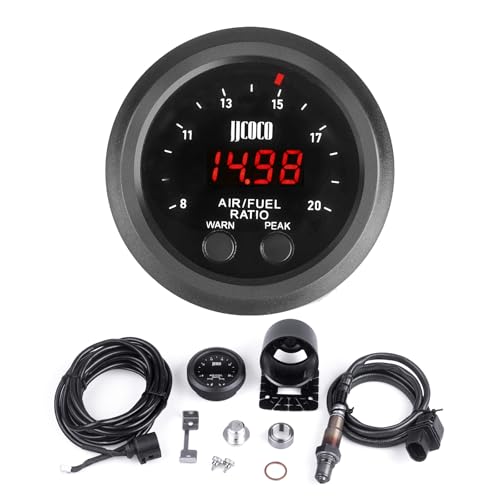
At the entry-level price point, the ZHSYMX kit provides the core wideband function — a 52mm gauge, included O2 sensor, and pre-wired harness — for a fraction of the cost of premium setups. Owners have successfully used it to dial in carbureted engines on classic cars and even a 300cc track bike, with real-world accuracy that held up well enough for basic tuning. The ABS housing is lightweight, and the kit requires no free-air calibration out of the box.
The included mounting pod feels cheap — multiple owners note the plastic construction — and the sensor quality has drawn mixed feedback. One verified review reported the sensor failing after three days, though others report multiple seasons of reliable use for intermittent tuning sessions rather than permanent installation. If you plan to use the gauge strictly for initial setup and occasional verification, the sensor may last fine. For constant real-time monitoring, a more robust unit is likely worth the investment.
This is the right choice if your budget is tight and you need a functional AFR reading to get a carbureted or basic EFI tune close to target. Just factor in the possibility of replacing the sensor sooner than you would with a premium kit, and consider the gauge a tuning tool rather than a permanent dashboard fixture.
What works
- Lowest entry price for a full wideband kit.
- Helps carbureted engine tuning significantly.
- No free-air calibration required for initial use.
What doesn’t
- Included pod mount feels cheaply made.
- Mixed sensor reliability reports.
Hardware & Specs Guide
Wideband UEGO Sensor — Why 4.9 LSU Matters
The Bosch LSU 4.9 is the current standard for automotive wideband sensing. It reaches operating temperature in under 5 seconds, provides a linear output from 0.65 to 1.20 lambda, and resists thermal shock and contamination better than earlier 4.2 sensors. Kits using genuine 4.9 sensors offer faster heater ramp-up and more stable readings during cold starts, which directly affects tuning accuracy in the first minutes of engine operation.
Response Time — The 20ms Benchmark
A controller’s response time dictates how faithfully it tracks real-time changes in exhaust oxygen content. Twenty milliseconds — typical of modern controllers like the AEM X-Series and Innovate LC-2 — is fast enough to catch individual cylinder events at moderate RPM. Slower controllers (50ms or more) smooth out transient spikes, which masks lean conditions that could damage pistons under sustained load. For forced-induction or high-compression builds, faster response is not a luxury; it is engine insurance.
FAQ
How do I know if my engine needs a wideband versus a narrowband AFR gauge?
Can I use a single wideband gauge to tune a V8 engine?
What does the 0-5V analog output actually do for my tuning setup?
Final Thoughts: The Verdict
For most buyers, the fuel ratio gauge winner is the AEM X-Series 30-0334 because nobody else bundles OBD-II CAN output, the fastest independent test response time, and a factory-calibrated 4.9 LSU sensor into one gauge package. If you need dual analog outputs for split ECU-logger setups, grab the Innovate LC-2 DB Blue 3795. And for the best value in a full E85-compatible kit with customizable aesthetics, nothing beats the GlowShift 7 Color GS-C702W-SM.

Certification: BSc in Mechanical Engineering
Education: Mechanical engineer
Lives In: 539 W Commerce St, Dallas, TX 75208, USA
Md Amir is an auto mechanic student and writer with over half a decade of experience in the automotive field. He has worked with top automotive brands such as Lexus, Quantum, and also owns two automotive blogs autocarneed.com and taxiwiz.com.