Adding an aftermarket amplifier or subwoofer to a factory car stereo can turn into a frustrating mess of humming, hissing, and signal dropouts when you don’t have the right interface. A proper RCA car audio adapter converts the high-level speaker signal from your stock or aftermarket head unit into a clean, low-level RCA signal that your amplifier actually wants to see, and the wrong one will introduce noise that no amount of gain adjustment can fix.
I’m Amir — the founder and writer behind Four Wheel Ask. I’ve spent years analyzing the build quality, transformer isolation, and channel configurations of line output converters, and I know exactly which models deliver noise-free signal transfer and which ones just add interference.
After evaluating dozens of adapters based on signal linearity, channel count, remote turn-on capability, and owner feedback, these are the picks that actually preserve audio fidelity. This guide breaks down the top-rated rca car audio adapter options so you can match the right converter to your specific factory amp setup.
How To Choose The Best RCA Car Audio Adapter
Selecting the right line output converter means matching the channel count, signal isolation method, and voltage handling to your specific head unit and amplifier setup. Ignoring these specs leads to audible noise or insufficient signal strength.
Channel Count: 2-Channel vs 4-Channel
A 2-channel converter suits a single subwoofer amplifier setup because you only need to carry the left and right signal for a mono bass channel. A 4-channel converter lets you drive a pair of full-range speakers plus a subwoofer by keeping the front and rear channels separate, which matters for systems that retain factory equalization curves.
Signal Isolation: Passive Resistors vs Audio Transformers
Budget converters use simple resistor networks to drop voltage — these are prone to engine whine because they don’t break the ground loop. Converters with internal audio transformers provide galvanic isolation, which physically separates the speaker-level and RCA grounds, killing alternator noise at the source. If your vehicle has a known alternator whine problem, go with a transformer-based unit.
Gain Adjustment Range
Adjustable input sensitivity lets you match the converter’s output voltage to your amplifier’s input stage. Too much voltage clips the amp; too little forces you to crank the gain and invites noise. Look for a model with a trim pot that provides at least a 10 dB adjustment range so you can dial in a clean signal regardless of your head unit’s pre-out level.
Quick Comparison
On smaller screens, swipe sideways to see the full table.
| Model | Category | Best For | Key Spec | Amazon |
|---|---|---|---|---|
| Scosche SLC4 | 4-Channel | Factory amp integration | 80W per channel handling | Amazon |
| Recoil LOC4 | 4-Channel | Noise-free signal | Audio transformer isolation | Amazon |
| Scosche LOC2SL | 2-Channel | Remote subwoofer control | Includes remote gain knob | Amazon |
| NuIth 2-Channel | 2-Channel | Budget single-sub setup | 50W nominal power rating | Amazon |
| Kxable Y-Adapter | Splitter Cable | Long cable runs | 50 ft / 22AWG copper | Amazon |
In‑Depth Reviews
1. Scosche SLC4 4-Channel Line Output Converter
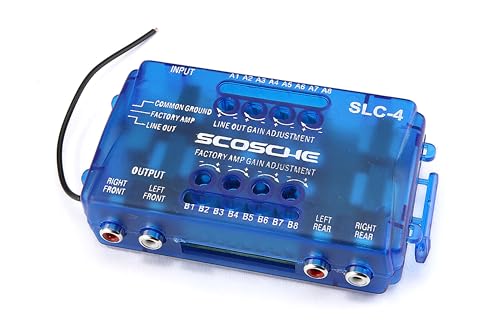
The Scosche SLC4 is a 4-channel line output converter that handles up to 80 watts per channel, making it one of the most robust passive converters on the market for factory amp integration. Owners report seamless compatibility with premium factory systems like Bose in Mazda Miatas and Nissan Armadas, as well as JBL setups in late-model Toyotas — the unit retains the factory amplifier’s equalization while providing clean RCA signal to an aftermarket head unit.
Build quality is a mixed bag: the plastic housing feels durable enough for a tucked-away install, but the screw-down speaker wire terminals are small and prone to stripping if over-torqued. Several users noted that the ground wire is short, which requires an extension for certain chassis grounding points. The gain adjustment pots are accessible and work well for dialing in the signal level without needing an oscilloscope.
Customer feedback consistently highlights that the SLC4 works perfectly out of the box when installing an aftermarket radio into a vehicle with a factory Bose or JBL amplifier — no additional configuration needed. The main compromise is the terminal quality, which demands careful installation technique to avoid loose connections that cause intermittent signal loss.
What works
- Works seamlessly with factory Bose, JBL, and premium amps
- 80W per channel handling covers most factory speaker outputs
- Gain adjustment range allows precise signal matching
What doesn’t
- Speaker wire terminals are small and strip easily
- Ground wire is too short for many installations
2. Recoil LOC4 Four Channel Line Output Converter
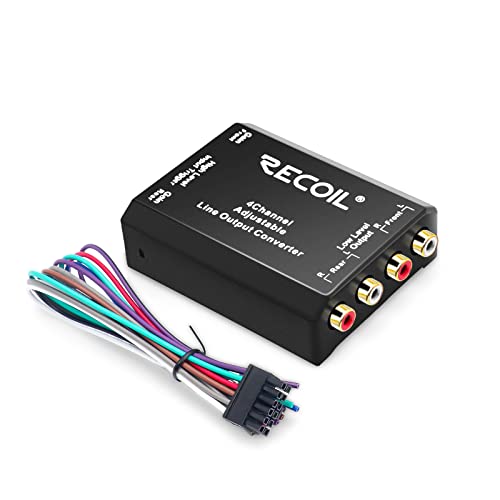
The Recoil LOC4 takes a different approach than passive resistor-based converters by using internal audio transformers for galvanic isolation between the speaker-level input and the RCA output. This transformer design physically breaks the ground loop that causes alternator whine, making it the top choice for vehicles with persistent noise issues that cheaper converters cannot fix. The unit also provides a remote turn-on output, which eliminates the need to run a separate trigger wire from the head unit to the amplifier.
Frequency response is rated at ±0.5 dB from 20 Hz to 20 kHz, which means the converter does not color the audio signal — what goes in is what comes out. The four-channel configuration allows independent front/rear signal routing, which is critical for systems that want to retain factory fade control while adding an aftermarket multi-channel amp. The adjustable gain pots on each pair of channels give you fine control over input sensitivity.
The trade-off for transformer isolation is a slightly larger footprint compared to basic passive converters, but the build quality is a clear step up with reinforced terminal blocks that accept larger-gauge speaker wire without feeling fragile. For anyone who has chased alternator whine through a system using a budget LOC, the Recoil LOC4 is a one-and-done solution.
What works
- Audio transformers eliminate ground loop and alternator noise
- Flat ±0.5 dB frequency response from 20-20,000 Hz
- Integrated remote turn-on output simplifies wiring
What doesn’t
- Slightly larger than passive converters
- No remote gain knob included
3. Scosche LOC2SL 2-Channel Line Output Converter with Remote Knob
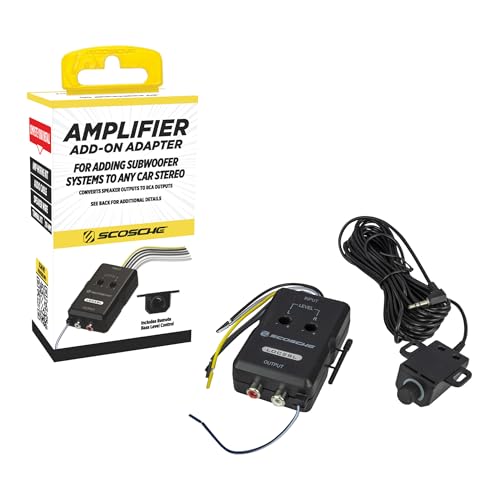
The Scosche LOC2SL is a 2-channel line output converter that includes a wired remote gain knob, which allows you to adjust subwoofer volume from the driver’s seat without reaching for the amplifier. This feature is a major convenience for anyone who wants to tune bass levels on the fly — simply mount the knob in the dash or center console and route the cable to the converter. The unit accepts speaker-level input and outputs clean RCA signal for a mono subwoofer amplifier.
The converter itself uses a passive resistor network rather than audio transformers, so it does not provide galvanic isolation. In vehicles with clean electrical systems this is not an issue, but in cars with known alternator whine you may still hear background noise. The build quality is typical Scosche — compact plastic housing with screw terminals that accept up to 18 AWG speaker wire, and a 12-volt maximum supply voltage rating that matches most factory systems.
For a dedicated subwoofer setup where you want driver-level bass control without investing in a bass knob that works with your specific amp, the LOC2SL is a clever integration. The remote knob itself feels sturdy with a smooth rotation and a reasonable cable length for routing through the firewall or under carpet.
What works
- Remote gain knob enables on-the-fly bass adjustment
- Compact form factor fits in tight dash spaces
- Simple plug-and-play installation for subwoofer setups
What doesn’t
- No transformer isolation — alternator whine may persist
- Screw terminals feel lightweight for repeated use
4. NuIth 2-Channel Line Output Converter

The NuIth 2-channel line output converter is an entry-level passive adapter designed for adding a single subwoofer amplifier to a factory or aftermarket stereo. Rated at 50 watts nominal power handling, it is sufficient for most stock speaker outputs that typically sit between 15 and 40 watts RMS. The converter includes level gain adjustment pots that let you trim the signal voltage to match your amplifier’s input sensitivity without forcing the amp to run at extreme gain settings.
Installation is straightforward — tap into the speaker wires behind the radio or at the speaker, connect the 12-volt power lead to an accessory source, and run the RCA cables to your amplifier. Customer feedback on the 2024 Chevy Equinox and 2007 Toyota Avalon confirms that the unit works well for basic subwoofer integration. The relay-based turn-on circuit senses signal from the speaker wires and sends a 12-volt trigger to the amp, eliminating the need for a dedicated remote wire.
The primary limitation is the passive resistor design, which offers no isolation from ground loop noise. Several users noted that correct speaker polarity is critical — reversing the polarity cancels bass output. The screw terminals accept speaker wire cleanly, but the overall build feels less substantial than the Scosche units, particularly in the plastic housing thickness and wire retention tension.
What works
- Signal-sensing remote turn-on saves wiring effort
- Gain adjustment pots allow precise level matching
- Works reliably for simple single-subwoofer installations
What doesn’t
- No transformer isolation — prone to alternator whine
- Plastic housing feels less durable than competing models
5. Kxable RCA Y-Adapter Splitter Cable 50 Feet
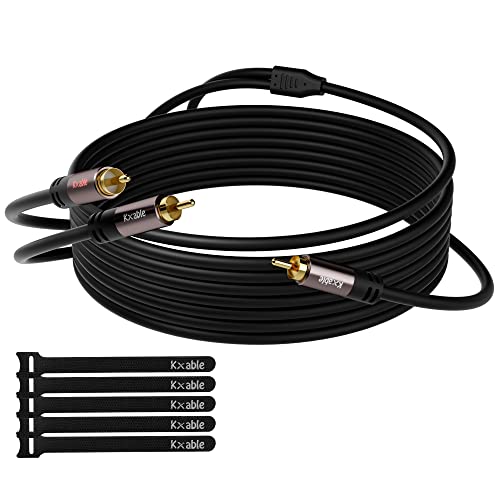
The Kxable RCA Y-Adapter is not a line output converter — it is a 50-foot RCA splitter cable that converts a single male RCA output into two female RCA jacks. This is useful when you need to run a long signal cable from the head unit to a rear-mounted amplifier without joining multiple short cables, or when you want to split a mono subwoofer output to feed both left and right inputs on a two-channel amp. The 22 AWG pure copper conductor is thicker than typical 24 or 26 AWG cables, which reduces resistance over long runs and preserves signal integrity.
The cable features multi-layer shielding including an aluminum foil wrap to reject EMI and RFI interference, which is important for automotive environments where alternators and ignition systems generate electrical noise. The 24K gold-plated RCA connectors resist corrosion and maintain a tight fit on both head unit and amplifier jacks. The Y-configuration is bidirectional, so you can also use it to combine two outputs into one input for bridging applications.
At 50 feet, this cable is overkill for most passenger car installations — 6 to 12 feet is typically enough for a trunk-mounted amplifier. However, for large vehicles like SUVs, vans, or RVs where the amplifier sits far from the head unit, the extra length and heavy-gauge construction make this a solid choice. The flexibility of the cable jacket is good, which helps when routing through tight panel gaps and door sills.
What works
- 22 AWG pure copper reduces signal loss over long distances
- Multi-layer shielding rejects automotive EMI/RFI noise
- Bidirectional design works for splitting or combining signals
What doesn’t
- 50-foot length is excessive for most passenger car installs
- Not a line output converter — requires existing RCA output
Hardware & Specs Guide
Passive Resistor vs Transformer Isolation
Passive resistor converters use a voltage divider network to drop speaker-level signal down to RCA level — they are simple and cheap, but they do not break the ground loop between the head unit and amplifier, so alternator whine frequently bleeds through. Transformer-based converters use a physical isolation transformer that magnetically couples the signal while keeping the grounds separate, completely eliminating ground-loop noise at the cost of slightly higher component cost and physical size.
Channel Count and System Architecture
A 2-channel converter is adequate for adding a subwoofer amplifier because the amplifier sums left and right into a mono signal internally. A 4-channel converter is required when you want to drive separate front and rear amplifiers while retaining factory fade control. Some 4-channel units allow you to bridge channels for a single subwoofer, but using a four-channel converter for a single sub gives you flexibility to expand later without replacing the converter.
FAQ
Will an RCA car audio adapter work with my factory Bose amplifier?
Why do I hear alternator whine after installing a line output converter?
Can I use a 2-channel converter for a 4-channel amplifier?
Final Thoughts: The Verdict
For most buyers, the best rca car audio adapter winner is the Scosche SLC4 because it handles 80 watts per channel, integrates seamlessly with factory premium amplifiers, and provides four channels for full system flexibility. If you are battling alternator whine and need clean signal isolation, grab the Recoil LOC4 for its transformer-based noise rejection. And for a simple subwoofer add-on where you want driver-level bass control from the dash, nothing beats the Scosche LOC2SL with its included remote gain knob.

Certification: BSc in Mechanical Engineering
Education: Mechanical engineer
Lives In: 539 W Commerce St, Dallas, TX 75208, USA
Md Amir is an auto mechanic student and writer with over half a decade of experience in the automotive field. He has worked with top automotive brands such as Lexus, Quantum, and also owns two automotive blogs autocarneed.com and taxiwiz.com.