An outdated factory radio with no navigation turns every unfamiliar route into a gamble. You rely on a phone mount that blocks the vent, a cable that tangles, and a screen that dims the moment the sun hits it. A proper head unit with built-in GPS ends that shuffle — delivering turn-by-turn directions, live traffic rerouting, and point-of-interest search directly on a dashboard display designed for driving visibility.
I’m Amir — the founder and writer behind Four Wheel Ask. I’ve spent years parsing specs like screen resolution, processor speed, map update policies, and audio DSP capabilities across dozens of aftermarket receivers to understand which models actually hold up in daily driving and which are just glossy specs on a box.
After digging into display brightness, GPS acquisition times, wireless CarPlay stability, and audio customization depth across the current market, I’ve narrowed the field to the best models worth your consideration. This guide covers the best car radio with navigation available today, broken down by performance tier and use case.
How To Choose The Best Car Radio With Navigation
Not every navigation receiver is built the same. Some rely entirely on your phone’s GPS chip, while others pack their own satellite receiver for offline route guidance. Matching the right unit to your driving habits — highway commutes, off-road exploration, or city errands — defines whether the upgrade feels seamless or frustrating.
Screen Quality and Sunlight Visibility
Navigation is useless if you can’t read the map in direct sunlight. Look for a display with at least 500 nits of brightness and an anti-glare coating. Capacitive touchscreens respond faster than resistive ones, and a resolution of at least 1024×600 keeps street labels sharp. A QLED or IPS panel with a wide viewing angle prevents the image from washing out when the driver or passenger glances over.
GPS Engine and Offline Navigation
Receivers that rely solely on smartphone mirroring lose navigation the moment your phone loses signal. A unit with a dedicated GPS antenna and pre-loaded mapping software — like Garmin or iGO — provides turn-by-turn directions without cellular dependency. Check whether map updates are free or require purchase, and verify that the satellite receiver supports multiple GPS, GLONASS, and Galileo signals for faster lock times.
Audio Processing for Voice Guidance Clarity
Navigation prompts compete with road noise, music, and passengers. A digital signal processor with time alignment and a multi-band equalizer lets you prioritize the front channels where navigation voice plays. Look for units with Speed Compensated Volume Control, which automatically raises the volume as wind and tire noise increase, keeping turn announcements audible without manual adjustment.
Quick Comparison
On smaller screens, swipe sideways to see the full table.
| Model | Category | Best For | Key Spec | Amazon |
|---|---|---|---|---|
| Kenwood DNX697S | Premium | Built-in Garmin Navigation | 6.8″ Capacitive Touchscreen, Garmin GPS | Amazon |
| Pioneer DMH-W4660NEX | Premium | Wireless Apple CarPlay Stability | 6.8″ Capacitive, Hi-Volt 4V Preouts | Amazon |
| Sony XAV-AX6000 | Premium | Bezel-Less Design & HDMI Input | 7″ Anti-Glare, 5V Preouts | Amazon |
| Sony XAV-AX4000 | Mid-Range | Compact Splash-Proof Build | 6.95″ Touchscreen, 1cm Time Alignment | Amazon |
| Pioneer AVH-3500NEX | Premium | Motorized Screen / Single-DIN Fit | 7″ Motorized, CD/DVD Playback | Amazon |
| Kenwood DMX500S | Mid-Range | Clean Sound & Dual Phone Pairing | 6.8″ 1024×600, 13-Band EQ | Amazon |
| ATOTO S8L | Mid-Range | Built-In 4G LTE & AI Assistant | 7″ QLED 550 Nits, 4GB+64GB | Amazon |
| ATOTO A6PF | Mid-Range | DSP Tuning & GPS Tracking | 7″ IPS 1024×600, 2G+32G | Amazon |
| SJoyBring QLED Upgrade | Budget | Value: Dash Cam + Backup Camera Included | 7″ QLED 1280×720, 240W Amp | Amazon |
In‑Depth Reviews
1. Kenwood DNX697S

The Kenwood DNX697S stands apart from the smartphone-mirroring crowd because it packs a dedicated Garmin navigation engine directly on board. You get turn-by-turn directions, lane guidance, and speed limit alerts without any phone connection, making it an ideal pick for areas with spotty cellular coverage. The 6.8-inch capacitive touchscreen responds reliably with gloves on, and the customizable multi-widget home screen lets you keep maps and music visible simultaneously.
Audio versatility runs deep here — the DNX697S supports FLAC playback for lossless music and includes a 13-band equalizer with digital time alignment. HD Radio comes built in, and the Bluetooth module handles dual phone pairing for shared vehicles. The rear USB port charges devices at a decent rate while reading media from flash drives, and the backup camera input supports adjustable parking guidelines that stay accurate even with aftermarket cameras.
Some users report screen glare in direct overhead sunlight, and the DVD/CD mechanism introduces a moving part that can fail if exposed to extreme cabin temperatures repeatedly. Map updates through Garmin require a separate purchase, which adds long-term cost. Still, for drivers who want independent navigation that doesn’t drain their phone battery or disappear into a loading spinner, this Kenwood delivers a mature, stable experience.
What works
- Dedicated Garmin GPS works without phone signal
- Multi-widget screen shows maps and audio side by side
- FLAC playback and 13-band EQ for sound quality
What doesn’t
- Screen glare can be problematic in bright sun
- Map updates require paid subscription
- DVD mechanism adds a potential failure point
2. Pioneer DMH-W4660NEX

Pioneer’s DMH-W4660NEX is engineered for drivers who live inside the Apple and Google ecosystems but refuse to tolerate laggy wireless connections. Its dual-band Wi-Fi module maintains a stable link to your phone for wireless CarPlay or Android Auto, and the 6.8-inch capacitive display renders maps with enough clarity to spot side streets at a glance. Amazon Alexa integration gives hands-free control over navigation, music, and smart home devices without reaching for the screen.
The audio side is equally serious — the unit delivers 4-volt high-voltage preamp outputs that feed external amplifiers without signal degradation, and the built-in 13-band equalizer allows precise tonal shaping. FLAC file playback is supported for audiophile-grade audio, and the HD Radio tuner pulls in cleaner digital signals than standard analog FM. The backup camera input processes a clear image, and the parking guide overlay is fully customizable to match the width of your vehicle.
Installation depth is more demanding than some competitors because the DMH-W4660NEX requires a double-DIN opening and a CANBUS adapter for certain vehicle models to retain steering wheel controls. The user interface, while feature-rich, follows Pioneer’s somewhat dense menu logic that takes time to memorize. Wireless connection drops have been reported in crowded urban Wi-Fi zones, though a firmware update usually stabilizes the link.
What works
- Reliable wireless CarPlay with dual-band Wi-Fi
- 4V high-voltage preouts for clean external amp signal
- Amazon Alexa integration for hands-free commands
What doesn’t
- Menu system feels dense and unintuitive at first
- Wireless connection can drop in crowded RF areas
- Requires adapter for steering wheel control in many cars
3. Sony XAV-AX6000

Sony’s XAV-AX6000 rethinks the dashboard aesthetic with a bezel-less 7-inch capacitive touchscreen that blends into the dash like a factory-installed display. The anti-glare coating is genuinely effective — maps remain readable even with the sun blazing through the windshield, a weak point in many competing units. The HDMI input allows video mirroring or connection of external media devices, making it a flexible hub for passengers on long trips.
Audio performance benefits from 5-volt gold-plated preamp outputs that preserve signal fidelity over long RCA runs to external amplifiers. The time alignment can be adjusted down to 1-centimeter increments for each of the five channels, allowing precise soundstage positioning that makes navigation voice prompts feel anchored to the center of the dash. The compact rear chassis simplifies installation in tight dashes where depth clearance is limited.
The XAV-AX6000 lacks a dedicated GPS antenna, so all navigation runs through smartphone mirroring. This means the unit is useless for maps if your phone’s battery dies or loses cellular signal. The resistive-style touch feedback on the capacitive screen feels slightly less direct than competitors, and there is no physical volume knob — a common complaint for drivers who prefer tactile control without glancing away from the road.
What works
- Bezel-less design looks like a factory OEM unit
- 5V preouts deliver clean signal for external amps
- 1cm time alignment for precise soundstage tuning
What doesn’t
- No built-in GPS — navigation requires phone mirroring
- No physical volume knob for tactile adjustment
- Capacitive touch can feel less direct than some rivals
4. Sony XAV-AX4000

The Sony XAV-AX4000 packs the same core navigation and audio processing DNA as the AX6000 but in a chassis that fits a single-DIN opening physically while presenting a 6.95-inch floating display. This makes it a strong candidate for older vehicles where a double-DIN slot doesn’t exist. The wireless CarPlay and Android Auto connection boots quickly — typically under 10 seconds from ignition — and maintains a stable link without the frequent re-pairing some lower-tier units exhibit.
Sony’s built-in DSP brings the same 1-centimeter time alignment and 14-band graphic equalizer found in the AX6000, so audio customization is identical. The interface is clean and responsive, with four preset wallpaper themes and two manual wallpaper slots for personalization. The included external microphone improves call clarity by isolating the driver’s voice from cabin noise, which also benefits navigation voice recognition accuracy.
The floating screen design protrudes from the dash, which can block lower air vents in some vehicles and might catch glare from certain angles despite the anti-glare coating. There is no CD/DVD drive, no HDMI input, and no SiriusXM tuner built in — Sony trimmed connectivity to keep the price accessible. Some early units have exhibited screen freezing after several months, though firmware updates have resolved the issue for most users.
What works
- Fits single-DIN openings without adapter plate needed
- Quick boot time under 10 seconds
- Same advanced DSP as AX6000 at lower price tier
What doesn’t
- Floating screen can block vents depending on vehicle
- No CD/DVD, HDMI, or SiriusXM native support
- Screen freeze issues reported on early firmware
5. Pioneer AVH-3500NEX

The Pioneer AVH-3500NEX solves a unique fitment problem: it delivers a full 7-inch touchscreen in a single-DIN chassis by using a motorized mechanism that slides and tilts the display into view. This is a lifesaver for vehicles with shallow dash cavities that can’t accommodate a standard double-DIN radio. Wired Apple CarPlay and Android Auto provide the navigation mirroring, while the built-in CD/DVD player offers physical media support for those who still keep a disc collection.
Audio customization runs deep with a 13-band graphic equalizer, high- and low-pass crossover filters, and Pioneer’s Auto EQ system that uses an included microphone to measure cabin acoustics and adjust settings automatically. The 4-volt preamp outputs drive external amplifiers cleanly, and HD Radio brings in digital broadcasts with improved fidelity. The backup camera input supports multiple camera angles and customizable parking guidelines that adapt to steering wheel inputs on compatible cameras.
The motorized mechanism introduces mechanical noise during extension and retraction, and the screen auto-darkens when parked as a security deterrent, which some owners find annoying if they want to use the display while stationary. Bluetooth call quality is average — the external microphone is included but picking up clear speech at highway speeds can be hit-or-miss. The unit lacks wireless smartphone mirroring, so a cable is required every time for CarPlay or Android Auto.
What works
- 7-inch screen fits single-DIN dash openings
- Auto EQ measures cabin for optimized sound
- CD/DVD playback for physical media support
What doesn’t
- Motorized screen makes mechanical noise during operation
- Wired connection required for CarPlay/Android Auto
- Bluetooth call quality is inconsistent at highway speed
6. Kenwood DMX500S
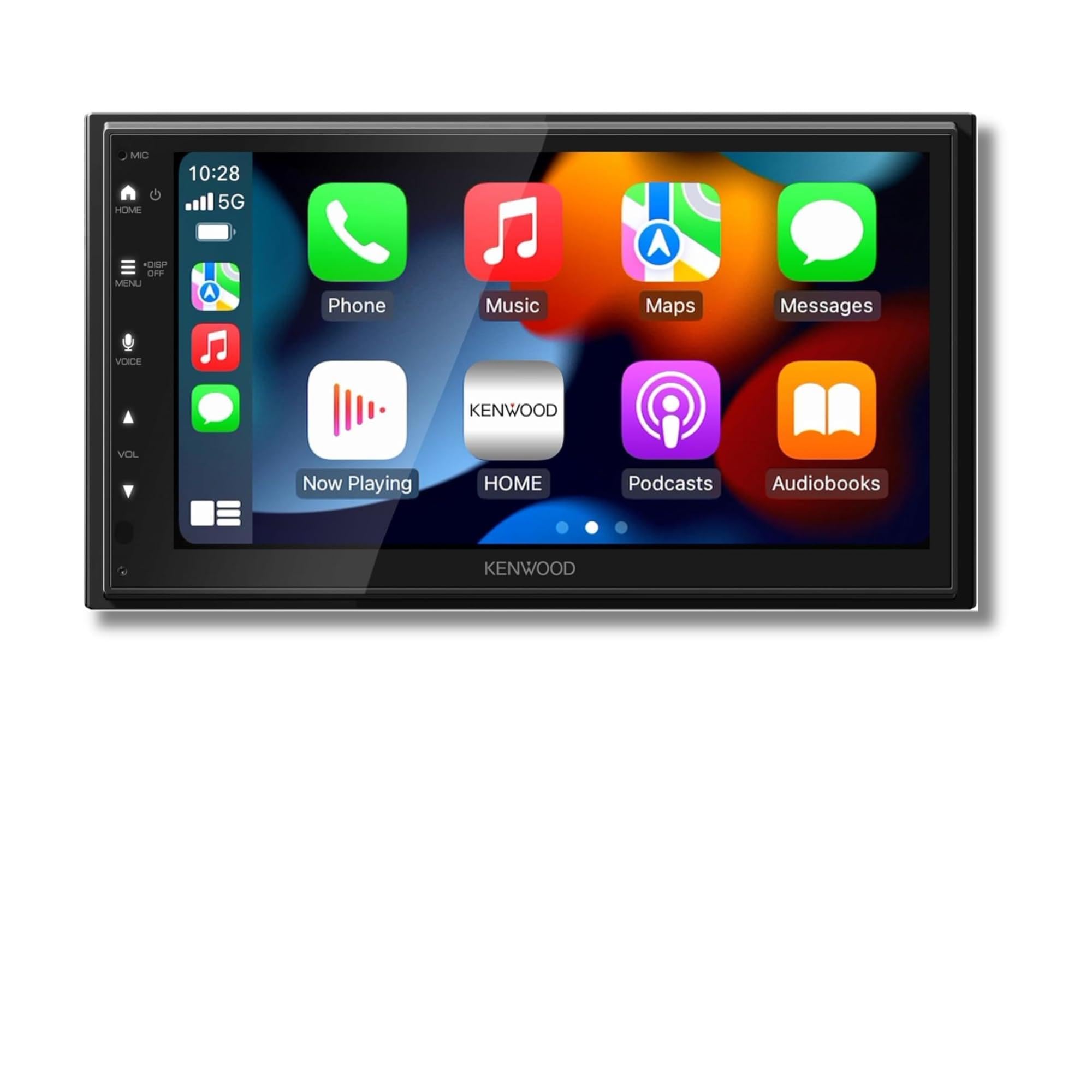
The Kenwood DMX500S hits a sweet spot for buyers who prioritize sound quality and daily driving reliability over flashy extras. The 6.8-inch high-resolution capacitive touchscreen processes maps and media smoothly, and the wireless CarPlay and Android Auto connection is one of the more stable implementations in the mid-range bracket. The dual phone pairing feature is genuinely useful for shared vehicles — both phones stay connected simultaneously for calls from either device without manual switching.
Audio output is where this Kenwood distinguishes itself from cheaper alternatives. The 50-watt x 4 built-in amplifier drives factory speakers with authority, and the 13-band graphic EQ paired with digital time alignment lets you dial in a soundstage that makes navigation prompts cut through music clearly. The rear video output allows connection to a backseat monitor, and the compact double-DIN chassis fits most standard openings without excessive adapters.
There is no built-in GPS module, so all navigation runs through your smartphone’s data connection. The physical button array is limited, relying heavily on the touchscreen for functions like volume adjustment, which some drivers dislike. The USB port only charges at 2.1 amps, which is adequate for maintaining battery level during navigation but won’t fast-charge modern phones rapidly.
What works
- Dual phone pairing for shared vehicles
- Stable wireless CarPlay/Android Auto connection
- 13-band EQ and time alignment for audio tuning
What doesn’t
- No built-in GPS — phone data required for maps
- Heavy reliance on touchscreen for volume control
- USB charging limited to 2.1 amps
7. ATOTO S8L
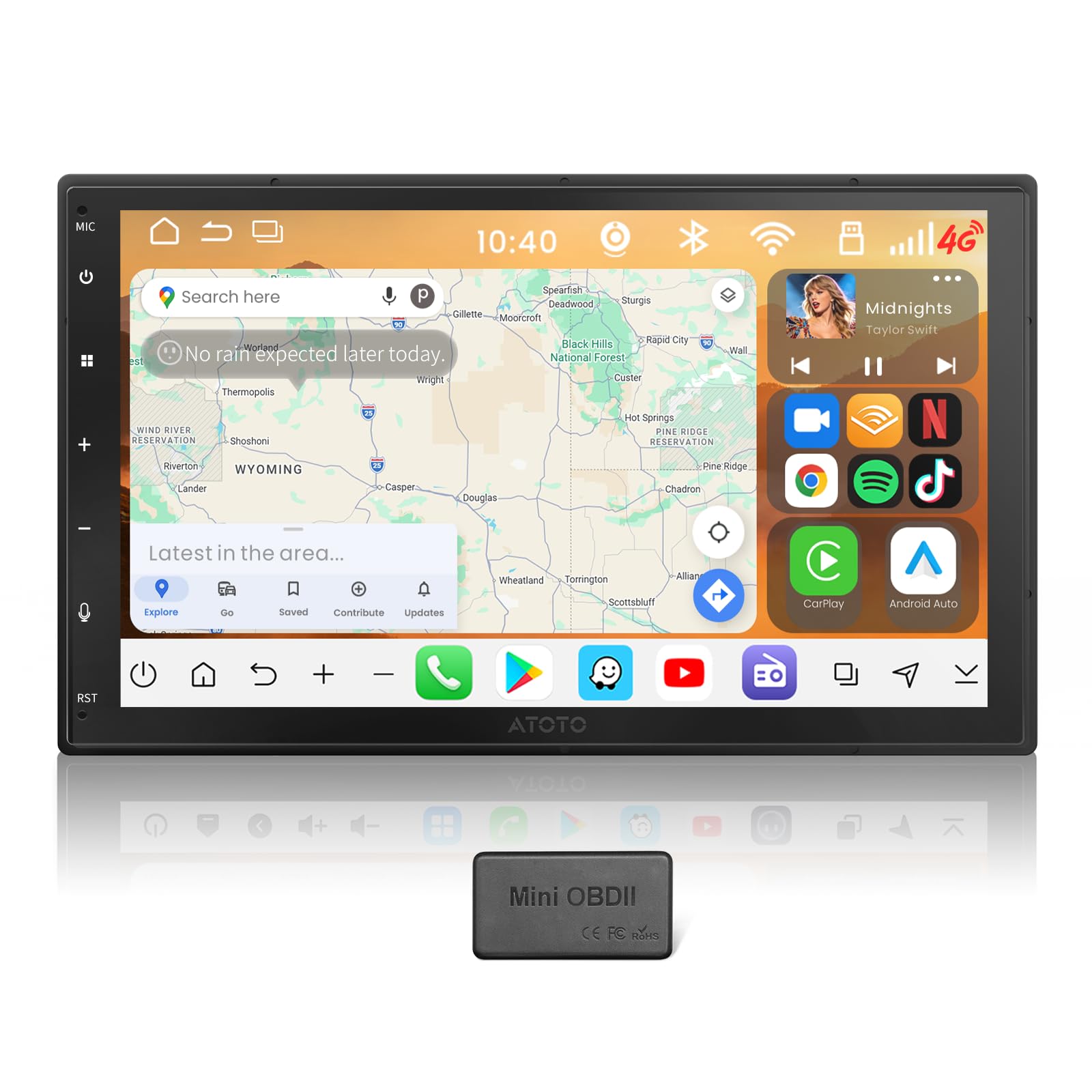
The ATOTO S8L is an Android-based receiver that breaks free from phone tethering entirely by accepting a 4G LTE SIM card. Insert a data plan, and the unit runs navigation, streaming, and app updates independently — your phone can stay in your pocket or even be left at home without losing map access. The 7-inch QLED display pushes 550 nits of brightness, making it one of the most sunlight-readable screens at this price point, and the 178-degree viewing angle keeps the passenger’s map visible without washout.
The S8L ships with Android 15 out of the box and packs 4GB of RAM and 64GB of storage, providing enough headroom for multiple navigation apps like Google Maps, Waze, or Sygic to run simultaneously. The built-in agentic AI assistant, powered by ChatGPT and Gemini, can answer route queries or provide local recommendations through voice commands without needing your phone. The included Bluetooth OBD-II scanner reads real-time vehicle data, which the S8L can display on screen alongside navigation directions.
Android-based receivers require a comfort level with app management and occasional updates that a traditional radio user might find unfamiliar. The S8L’s boot time is longer than purpose-built automotive OS units, and the fan-cooled chassis is necessary to prevent overheating but introduces a faint audible whir in a silent cabin. The SIM card implementation does not support voice calling natively — phone calls still require Bluetooth pairing with a smartphone.
What works
- 4G LTE SIM slot for phone-independent navigation
- 550-nit QLED display is bright in direct sunlight
- Included OBD-II scanner for real-time vehicle data
What doesn’t
- Longer boot time than dedicated OS units
- Cooling fan produces audible noise in quiet cabins
- SIM card does not enable native voice calling
8. ATOTO A6PF

ATOTO’s A6PF brings a level of audio DSP tuning rarely seen outside premium-tier receivers. The 36-band graphic equalizer allows surgical control over frequency response, while Speed Compensated Volume Control automatically adjusts loudness to counter increasing road and wind noise at higher speeds. The 7-inch IPS display delivers 1024×600 resolution with a 178-degree viewing angle, keeping navigation maps legible from the driver and passenger seats even in harsh side lighting.
The unit runs Android 10 on an ARM Cortex A55 octa-core processor with 2GB of RAM and 32GB of storage — adequate for running navigation apps like OsmAnd with offline maps downloaded directly to the unit. The Live Rear-View function processes a 720p HD camera feed even while driving forward, not just when reversing, which helps monitor trailers or blind spots behind the vehicle. ATOTO’s exclusive TrackHU app provides real-time vehicle tracking with 15-second location updates and geofence alerts.
The A6PF lacks wireless CarPlay and Android Auto — connection requires a USB cable, which feels dated when competing units at the same price offer wireless mirroring. The interface responsiveness can lag when multiple apps run simultaneously, particularly if navigation is streaming live traffic data while music plays. Bluetooth tethering for internet access is less stable than direct Wi-Fi, causing occasional map loading delays in areas with weak cellular signal.
What works
- 36-band EQ with time alignment for advanced DSP
- Speed Compensated Volume adjusts for cabin noise
- TrackHU GPS tracking with geofence alerts
What doesn’t
- Wired connection only for CarPlay and Android Auto
- Interface can lag with multiple apps running
- Bluetooth tethering less stable than Wi-Fi
9. SJoyBring QLED Upgrade

The SJoyBring QLED Upgrade is the entry-level option that bundles surprising hardware for the price, including a 7-inch QLED display at 1280×720 resolution, a front-facing dash cam, and a rear backup camera in the box. The QLED panel produces saturated colors and deep blacks that make navigation map contrast pop, though peak brightness is lower than the 550-nit displays found in premium units. Wireless Apple CarPlay and Android Auto work without a cable, automatically syncing as soon as you start the car.
The 240-watt 4.2-channel audio output feeds front and rear speakers plus a separate subwoofer channel, providing enough headroom to drive an external amplifier. The included dash cam records 1280×720 video at a 170-degree wide angle, and loop recording ensures continuous capture on a microSD card. The backup camera automatically activates when shifting into reverse, and the night vision capability works well in dim parking lots.
Build quality reflects the price point — the plastic chassis feels less rigid than Kenwood or Pioneer units, and the touchscreen registers presses with a slight delay. The dash cam’s 720p resolution is adequate for insurance documentation but lacks the detail needed to read license plates clearly from a distance. Installation may require a separate wire harness adapter and antenna adapter depending on your vehicle, and the user manual is sparse on wiring details.
What works
- Includes front dash cam and rear backup camera
- Wireless CarPlay and Android Auto out of the box
- 7-inch QLED display with vivid color saturation
What doesn’t
- Plastic chassis feels less durable than major brands
- Touchscreen has slight input lag
- Dash cam 720p resolution struggles with license plates
Hardware & Specs Guide
Display Type and Brightness
The screen is your primary interface for navigation. QLED panels offer deeper contrast and more saturated colors than standard IPS displays, making map elements pop more in moderate light. However, raw brightness measured in nits matters more for direct sunlight readability — anything above 500 nits with a confirmed anti-glare coating is ideal for a car radio with navigation. Capacitive touchscreens are standard on all modern receivers and support multi-touch pinch-to-zoom on maps, while resistive screens (rare in this tier) require firmer pressure and lack gesture support.
GPS Module and Satellite Reception
A receiver with a dedicated GPS antenna and internal navigation software can function entirely offline, which is critical for rural driving, mountain passes, or underground parking where cellular data disappears. Units relying solely on smartphone mirroring depend on the phone’s GPS and data connection — if the phone overheats on the dashboard or enters a low-signal zone, navigation stops. Multi-constellation support (GPS + GLONASS + Galileo) reduces satellite lock times from 60 seconds down to under 10 seconds on a cold start, a meaningful difference when you’re already in the car and ready to go.
FAQ
Can I use a car radio with navigation without a smartphone connected?
How often do navigation map updates need to be purchased?
Does a higher screen resolution make navigation easier to read?
Final Thoughts: The Verdict
For most buyers, the best car radio with navigation winner is the Kenwood DNX697S because it combines a dedicated Garmin GPS that works offline with a responsive touchscreen, deep audio customization, and reliable wireless mirroring. If you want a sleek anti-glare display and 5-volt preouts for audiophile-grade sound, grab the Sony XAV-AX6000. And for phone-independent navigation with a built-in 4G SIM slot and OBD-II diagnostics, nothing beats the ATOTO S8L.

Certification: BSc in Mechanical Engineering
Education: Mechanical engineer
Lives In: 539 W Commerce St, Dallas, TX 75208, USA
Md Amir is an auto mechanic student and writer with over half a decade of experience in the automotive field. He has worked with top automotive brands such as Lexus, Quantum, and also owns two automotive blogs autocarneed.com and taxiwiz.com.